Chindia Alert: You’ll be Living in their World Very Soon
aims to alert you to the threats and opportunities that China and India present. China and India require serious attention; case of ‘hidden dragon and crouching tiger’.
Without this attention, governments, businesses and, indeed, individuals may find themselves at a great disadvantage sooner rather than later.
The POSTs (front webpages) are mainly 'cuttings' from reliable sources, updated continuously.
The PAGEs (see Tabs, above) attempt to make the information more meaningful by putting some structure to the information we have researched and assembled since 2006.
BEIJING, March 18 (Xinhua) — China hopes the Democratic People’s Republic of Korea (DPRK) and the United States will cherish the hard-won momentum of dialogue and keep talking until a peaceful denuclearized Korean Peninsula is realized, a foreign ministry spokesperson said Monday.
Spokesperson Geng Shuang made the remarks at a daily press briefing in response to a question on DPRK Vice Foreign Minister Choe Son Hui’s comment on a briefing held in Pyongyang.
Choe Son Hui said on Friday that the recent summit between the top leader of the DPRK Kim Jong Un and U.S. President Donald Trump failed because the U.S. side lacked sincerity.
“After the Hanoi summit, the DPRK and the U.S. both expressed willingness to continue dialogues. We commend and encourage this,” Geng said.
China always believes that the Korean Peninsula issue can only be solved peacefully through political dialogues, he said.
He added that the key to keeping up and advancing dialogue is to accommodate all parties’ legitimate concerns in a balanced way, build up mutual trust and consensus, take phased and synchronized steps, and start with easier moves.
“As the nuclear issue has dragged on for decades and complicated factors are at play, one cannot expect it to be solved overnight. All parties need to have reasonable expectations. One shouldn’t set the bar too high at the outset or make unilateral, unrealistic demands,” Geng quoted Foreign Minister Wang Yi as saying.
He also said China hoped that the DPRK and the United States could cherish the hard-won momentum of dialogue, seize the opportunity, meet each other halfway, build up mutual trust and consensus, keep talking till something good comes out of the talks and a peaceful denuclearized Korean Peninsula is realized.
“The international community should encourage both sides to keep moving toward the goal of denuclearizing the Korean Peninsula and establishing a peace regime,” Geng said.
China will continue to play a constructive role along with other parties, the spokesperson stressed.
SAN FRANCISCO, March 16 (Xinhua) — A group of U.S. and Chinese scholars and experts met Saturday in Silicon Valley to discuss opportunities and challenges in smart energy application and building smart villages in the United States and China.
Representatives from Microsoft Corporation, the Global Energy Interconnection Research Institute (GEIRI) North America, and other professionals in energy industry shared their experience and expertise on developing smart energy at a seminar launched by the U.S.-China Green Energy Council in San Jose, California.
Chen Xi, Chief Information Officer of GEIRI North America, affiliated to the State Grid Corporation of China (SGCC), said the SGCC, the largest electricity utility company in China, boasts advanced electricity technology and abundant experience in construction of power networks in the country.
The United States has accumulated a lot of experience on power market, high efficiency and the ability of profit-making of utility companies, which can be learned by China in developing a better and more efficient power network in the future, Chen said.
The seminar held two panels for in-depth discussions on smart energy cooperation between the United States and China, present and future challenges, artificial intelligent (AI) technology in power development, business development and building smart villages.
Panel speakers included Scott Mauvais, director of Microsoft Cities, who talked on AI for sustainability, Zhiwei Wang, president of GEIRI North America, and Professor Tom Kosnik, a partner of FoundersX Ventures, an early stage venture capital firm dedicated to investment in AI and big data.
WASHINGTON (Reuters) – White House national security adviser John Bolton said on Monday Pakistan’s foreign minister has assured him Islamabad is committed to de-escalating tensions with India and dealing “firmly” with terrorists.
Bolton’s comments follow a Feb. 14 suicide bombing, claimed by Pakistan-based militants, which killed at least 40 Indian paramilitary police.
“Spoke with Pakistani FM (Shah Mehmood) Qureshi to encourage meaningful steps against JeM (Jaish-e-Mohammed) and other terrorist groups operating from Pakistan,” Bolton said on Twitter.
“The FM assured me that Pakistan would deal firmly with all terrorists and will continue steps to deescalate tensions with India,” Bolton added.
Pakistan, which denies Indian accusations of aiding militant groups, last week announced a crackdown against all proscribed outfits.
Pakistan’s foreign ministry late on Monday said Qureshi informed Bolton “about the de-escalatory measures taken by Pakistan” in the wake of the aerial bombing missions carried out by both countries in late February.
Qureshi told Bolton that Pakistan’s strike in Kashmir on Feb. 27 was in self-defence and retaliation to India’s raid on its territory a day earlier. New Delhi said it hit a JeM training camp in Pakistan, but Islamabad denies any such camp exists.
The two countries fought an aerial dogfight over Kashmir on Feb. 27, and a couple of days later Pakistan returned a downed Indian pilot in a gesture that appeared to de-escalate the crisis.
German Foreign Minister Heiko Maas, in a joint conference with Qureshi, commended Pakistan on Tuesday for returning the pilot and offering talks with India. But he also urged Islamabad to stamp out militant groups which attack neighbouring countries.
“We both agreed that cross-border terrorism has to be permanently stopped and there too there have been positive signs in the past few days that we welcome very much,” Maas said. “Ultimately it’s about fighting any kind of terrorism and extremism.”
WASHINGTON, March 8 (Xinhua) — The Chinese Embassy in Washington D.C. will hold a celebration marking the 40th anniversary of sister city relationships between Chinese and U.S. cities, it said in a statement Friday.
Officials of U.S. states, cities, and towns that have sister city ties with their Chinese counterparts are expected to join the celebration on Wednesday, which will be co-hosted by both the Chinese embassy and Sister Cities International (SCI), a non-profit organization that promotes local level ties between the United States and other countries.
The event would also celebrate the 40th anniversary of the China-U.S. diplomatic relations, the embassy’s statement said.
WASHINGTON (Reuters) – U.S. President Donald Trump said he had asked China to immediately remove all tariffs on U.S. agricultural products because trade talks were progressing well.
He also delayed plans to impose 25 percent tariffs on Chinese goods on Friday, as previously scheduled.
“I have asked China to immediately remove all Tariffs on our agricultural products (including beef, pork, etc.) based on the fact that we are moving along nicely with Trade discussions,” Trump said on Twitter, pointing out that he had not raised tariffs on Chinese goods to 25 percent from 10 percent on March 1 as planned.
“This is very important for our great farmers – and me!” Trump said.
Farmers are a key constituency for Trump’s Republican Party, and the U.S. president’s trade war with China has had a heavy impact on them. Beijing imposed tariffs last year on imports of soybeans, grain sorghum, pork and other items, slashing shipments of American farm products to China.
U.S. Agriculture Secretary Sonny Perdue said this week that U.S. trade negotiators had asked China to reduce tariffs on U.S. ethanol, but it was not immediately clear whether Beijing was willing to oblige.
Trump’s post on Twitter came several hours after the U.S. Trade Representative’s office said that it would delay the scheduled hike in tariffs on $200 billion worth of Chinese goods.
The notice, due to be published in the Federal Register next Tuesday, says it is “no longer appropriate” to raise the rates because of progress in negotiations since December 2018. The tariff would remain “at 10 percent until further notice.”
In a statement on Saturday, China said it welcomed the delay.
Speaking at a separate briefing in Beijing, a Chinese government official said both countries were working on the next steps, though he gave no details.
“China and the United States reaching a mutually-beneficial, win-win agreement as soon as possible is not only good for the two countries, but is also good news for the world economy,” said Guo Weimin, spokesman for the high profile but largely ceremonial advisory body to China’s parliament.
A tariff increase to 25 percent from 10 percent was initially scheduled for Jan. 1, but after productive conversations with Chinese President Xi Jinping, the Trump administration issued a 90-day extension of that deadline.
Trump had said on Sunday he would again delay the increase because of progress in the talks.
BEIJING, March 1 (Xinhua) — China appreciates the return of 361 Chinese relics and artifacts by the United States, said a Foreign Ministry spokesperson Friday.
The remarks came as Lu Kang, the spokesperson of the Foreign Ministry, responded to a query about the return of the Chinese relics and artifacts by the United States.
The United States announced the return of 361 Chinese relics and artifacts to China at a ceremony held Thursday in the Eiteljorg Museum in Indianapolis, the U.S. state of Indiana.
The repatriation will lead to the return of the largest batch of relics and artifacts to China from the United States since 2009, when the two nations signed a memorandum of understanding to enhance cooperation in this regard.
“Cooperation in preservation of relics is an important part of people-to-people, cultural exchanges between China and the United States,” Lu said. “We’re willing to make concerted efforts with the United States to enhance exchange and cooperation in preservation of relics, and to make greater contribution to advancing preservation efforts of cultural heritage in the world.”
Next month’s nautical spectacle will allow country to show off its most advanced warships to an international audience
More than a dozen foreign navies are expected to join in, including the United States
Chinese navy’s 70th birthday parade showcases rising sea power
1 Mar 2019
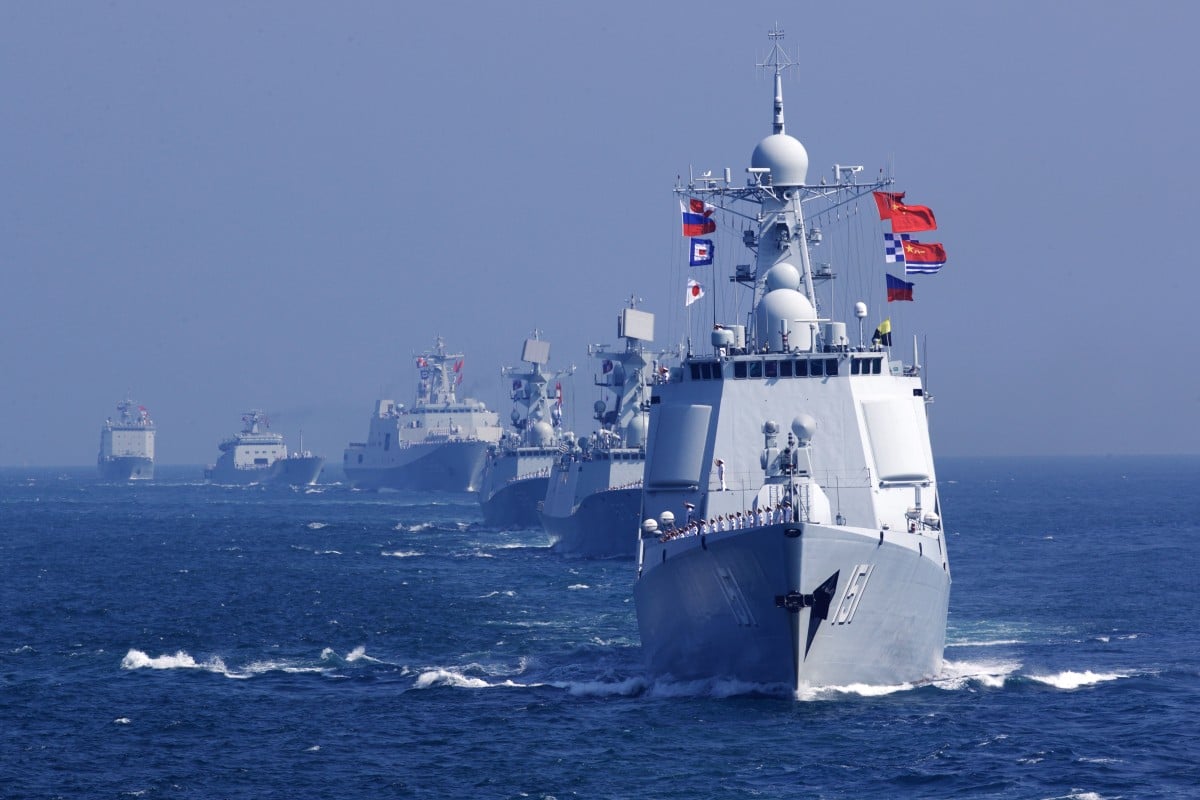
Chinese warships pictured at the end of joint exercise with the Russian navy in 2016. Photo: Xinhua
China will hold a naval parade next month to mark the 70th anniversary of the founding of the People’s Liberation Army Navy and will invite more than a dozen of foreign navies to participate.
The parade will take place on April 23 in the Yellow Sea off the coast of Qingdao in Shandong province, Ren Zhiqiang, a spokesman for the Ministry of National Defence, said on Thursday.
Ren did not provide further details of the parade but military analysts said the exercise would give the navy the opportunity to display its rapidly growing strength and show how that has increased in the past 12 months.
‘No-go zone’ in Yellow Sea for Chinese aircraft carrier sea trials
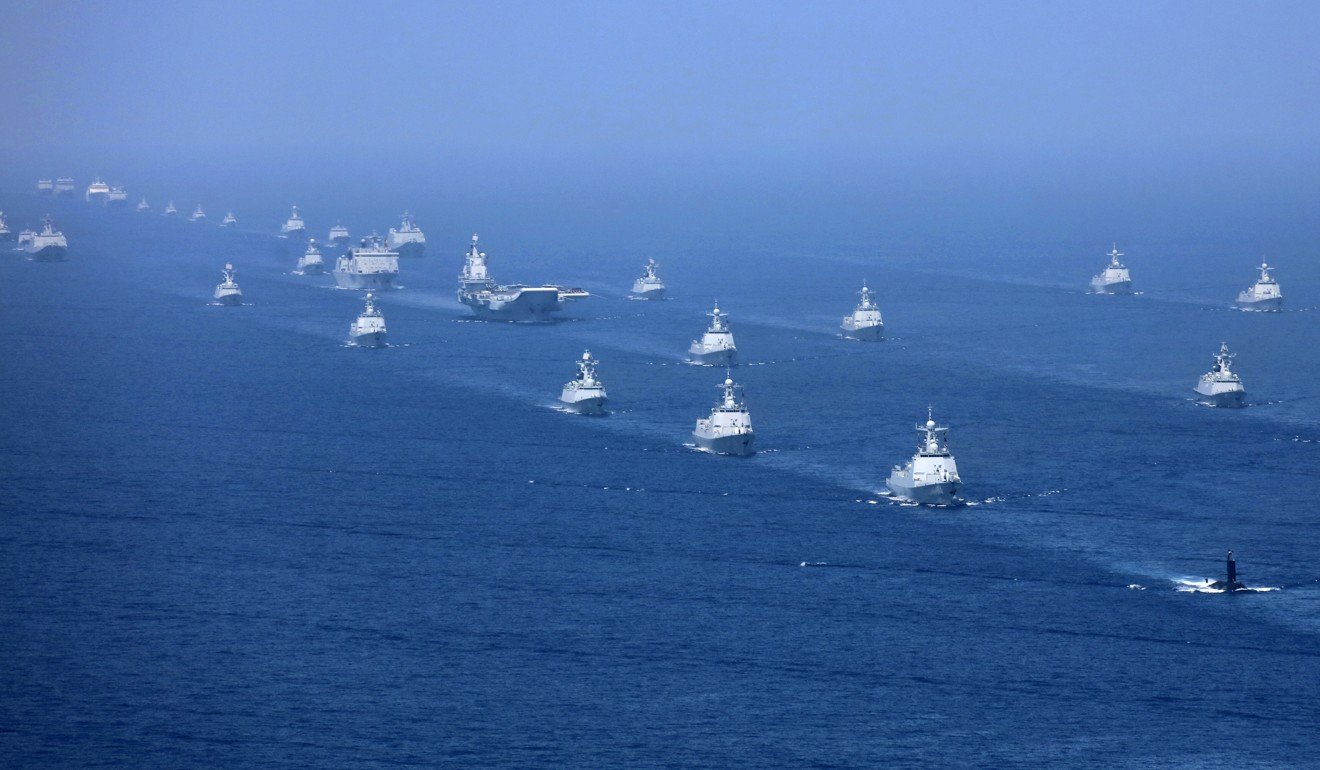
In April last year a naval review in the South China Sea featured a total of 48 vessels and 76 planes, including China’s first aircraft carrier, the Liaoning, its Type 094A and 095 nuclear submarines, 052D guided missile destroyers and J-15 fighter jets.
The experts expect that next month’s event will provide a showcase for several new and more powerful vessels including its home-grown aircraft carrier Type 001A, the Type 055 – Asia’s most powerful destroyer – and several nuclear submarines.
“The fact that China is holding the naval parade just one year after the South China Sea review shows the great importance [the leadership] attaches to the development of China’s maritime interests, the navy and its expansion,” navy expert Li Jie said.
Chinese President Xi Jinping joined the crew on the deck of the cruiser Changsha following last year’s naval review. Photo: Xinhua
Share:
China also held a major naval parade in 2009 to mark the navy’s 60th anniversary.
It was smaller in scale than the upcoming extravaganza with 25 PLA vessels and 31 fighter jets taking part.
Fourteen foreign navies sent ships to the 2009 parade, including the USS Fitzgerald from America and the guided-missile cruiser Varyag from Russia. France, Australia, South Korea, India and Pakistan also joined in the event.
More foreign countries are expected to join the party this year as the PLA has become more active internationally and China has sold more warships to foreign navies.
China’s new veterans’ law to be reviewed at National People’s Congress next week
“The parade is more like a birthday party for the PLA Navy and the participation of foreign navies is a matter of diplomatic courtesy with few military implications,” said Yue Gang, a former PLA colonel.
Yue said the US and its allies would attend despite the rising tensions between the two sides.
Since 2015 the US and Chinese navies have engaged in a series of confrontations in the South China Sea as China strengthens its military presence in the region and the US has sought to challenge Beijing’s claims to the waters by conducting what it describes as “freedom of navigation” operations.
“I don’t expect they will send any of the warships that have taken part in such operations [to the parade],” Yue said.
China has greatly expanded its naval capabilities in recent years. Photo: AP
Share:
It has been reported that the Japanese Maritime Self-Defence Force has expressed an interest in joining the parade and the Philippines – which has a rival claim to the South China Sea – is planning to send a vessel to the event for the first time.
Li said militaries such as the US and Japan would not want to miss the chance to observe the PLA Navy closely.
“In addition, greater transparency [through the parade] will also help reassure smaller regional partners such as the Philippines that China is a friendly power despite its growing military strength,” he said.
China held its first naval parade in 1957 and April’s display will be the sixth such event.
Sailors also took part in the parade through Tiananmen Square to mark the foundation of the People’s Republic on October 1 1949.
The founder of Huawei has said there is “no way the US can crush” the company, in an exclusive interview with the BBC.
Ren Zhengfei described the arrest of his daughter Meng Wanzhou, the company’s chief financial officer, as politically motivated.
The US is pursuing criminal charges against Huawei and Ms Meng, including money laundering, bank fraud and stealing trade secrets.
Huawei denies any wrongdoing.
Mr Ren spoke to the BBC’s Karishma Vaswani in his first international broadcast interview since Ms Meng was arrested – and dismissed the pressure from the US.
“There’s no way the US can crush us,” he said. “The world cannot leave us because we are more advanced. Even if they persuade more countries not to use us temporarily, we can always scale things down a bit.”
However, he acknowledged that the potential loss of custom could have a significant impact.
Last week, US Secretary of State Mike Pompeo warned the country’s allies against using Huawei technology, saying it would make it more difficult for Washington to “partner alongside them”.
Australia, New Zealand, and the US have already banned or blocked Huawei from supplying equipment for their future 5G mobile broadband networks, while Canada is reviewing whether the company’s products present a serious security threat.
Mr Ren warned that “the world cannot leave us because we are more advanced”.
“If the lights go out in the West, the East will still shine. And if the North goes dark, there is still the South. America doesn’t represent the world. America only represents a portion of the world.”
Many of the UK’s mobile companies, including Vodafone, EE and Three, are working with Huawei to develop their 5G networks.
They are awaiting a government review, due in March or April, that will decide whether they can use Huawei technology.
Commenting on the possibility of a UK ban, Mr Ren said Huawei “won’t withdraw our investment because of this. We will continue to invest in the UK.
“We still trust in the UK, and we hope that the UK will trust us even more.
“We will invest even more in the UK. Because if the US doesn’t trust us, then we will shift our investment from the US to the UK on an even bigger scale.”
Image copyrightGETTY IMAGESImage captionHuawei has denied that it poses any risk to the UK or any other country
What does Mr Ren think about his daughter’s arrest?
Mr Ren’s daughter Meng Wanzhou, Huawei’s chief financial officer, was arrested on 1 December in Vancouver at the request of the US, and is expected to be the subject of a formal extradition request.
The first covers claims Huawei hid business links to Iran – which is subject to US trade sanctions. The second includes the charge of attempted theft of trade secrets.
Mr Ren was clear in his opposition to the US accusations.
“Firstly, I object to what the US has done. This kind of politically motivated act is not acceptable.
“The US likes to sanction others, whenever there’s an issue, they’ll use such combative methods.
“We object to this. But now that we’ve gone down this path, we’ll let the courts settle it.”
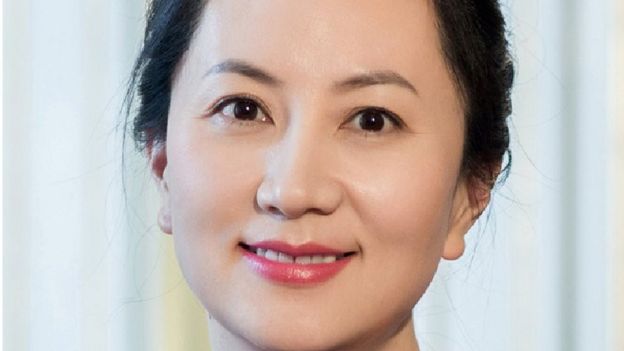
Image copyrightREUTERSImage captionMeng Wanzhou was arrested in Vancouver last December
What did Mr Ren say about Chinese government spying?
Huawei, which is China’s largest private company, has been under scrutiny for its links to the Chinese government – with the US and others expressing concern its technology could be used by China’s security services to spy.
Under Chinese law, firms are compelled to “support, co-operate with and collaborate in national intelligence work”.
But Mr Ren said that allowing spying was a risk he wouldn’t take.
“The Chinese government has already clearly said that it won’t install any backdoors. And we won’t install backdoors either.
“We’re not going to risk the disgust of our country and of our customers all over the world, because of something like this.
“Our company will never undertake any spying activities. If we have any such actions, then I’ll shut the company down.”
Is Huawei part of the Chinese state?
Analysis – Karishma Vaswani, BBC Asia business correspondent – Shenzhen
For a man known as reclusive and secretive, Ren Zhengfei seemed confident in the conviction that the business he’s built for the last 30 years can withstand the scrutiny from Western governments.
Mr Ren is right: the US makes up only a fraction of his overall business.
But where I saw his mood change was when I asked him about his links to the Chinese military and the government.
He refused to be drawn into a conversation, saying only that these were not facts, simply allegations.
Still, some signs of close links between Mr Ren and the government were revealed during the course of our interview.
He also confirmed that there is a Communist Party committee in Huawei, but he said this is what all companies – foreign or domestic – operating in China must have in order to abide by the law.
Pakistan Prime Minister Imran Khan on Tuesday said if there is any evidence of involvement of any Pakistani national in Pulwama terror attack, his government will act against the culprits. (AP)
Pakistan Prime Minister Imran Khan has denied his country’s role behind the Pulwama terror attack, the worst in Jammu and Kashmir in decades. He claimed that India does not have any evidence to prove Pakistan’s role in terror attacks in Kashmir.
“You (India) have blamed the Pakistan government without any evidence…If you have any evidence, we will act,” Imran Khan said.
He said, “It is in our interest that nobody from our soil spreads violence. I want to tell Indian government that we will take action if evidence is found against anyone from Pakistan.”
“What has Pakistan to gain from this? Why will Pakistan do this at a stage when it is moving towards stability,” said Imran Khan adding that “this is a Naya Pakistan with a new mindset.”
Calling for a dialogue with India, he said, “If you thinks you will attack us and we will not think of retaliating…We will retaliate. We all know starting a war is in the hands of humans, where it will lead us only God knows. This issue should be solved through dialogue.”
Imran Khan’s reaction comes days after at least 40 CRPF jawans were killed in a terror attack in Jammu and Kashmir. Pakistan-backed terror outfit Jaish-e-Mohammad claimed responsibility for the attack.
Earlier, Pakistan sought an urgent intervention of UN Secretary-General in defusing tensions with India and help facilitate dialogue between the two countries.
Following the terror attack, India launched a diplomatic offensive against Pakistan with the ministry of external affairs reaching out to more than two dozen countries including P5 – the US, the UK, France, Russia and China, which has repeatedly blocked India’s bid to get Jaish-e-Mohammad chief Masood Azhar declared as global terrorist by the United Nations.
China has used veto to shield Masood Azhar. Pakistan has also denied its support to the terror group. On Monday, in a joint statement Imran Khan and Saudi Arabia’s prince Mohammed bin Sultan “underlined the need for avoiding politicisation of UN listing regime.” This is being viewed as a snub to India’s renewed efforts to isolate Pakistan over its continued support to terror outfits and corner Masood Azhar’s JeM.
India withdrew the most favoured nation (MFN) status accorded to Pakistan in 1996. The MFN status had not been revoked even during the 1999 Kargil War and in the aftermath of 2008 Mumbai terror attack that killed more than 160 people.
Opinion piece in major state media outlets is seen to be part of Beijing’s efforts to reassure its citizens that the tariff war with the United States will soon be over
A Chinese delegation led by Vice-Premier Liu He is expected to leave on Tuesday for the American capital after last week’s trade talks in Beijing produced ‘progress’
China applauds ‘positive’ Donald Trump tweet ahead of Washington talks
18 Feb 2019
China and US make ‘progress’ but talks to head to Washington next week
16 Feb 2019
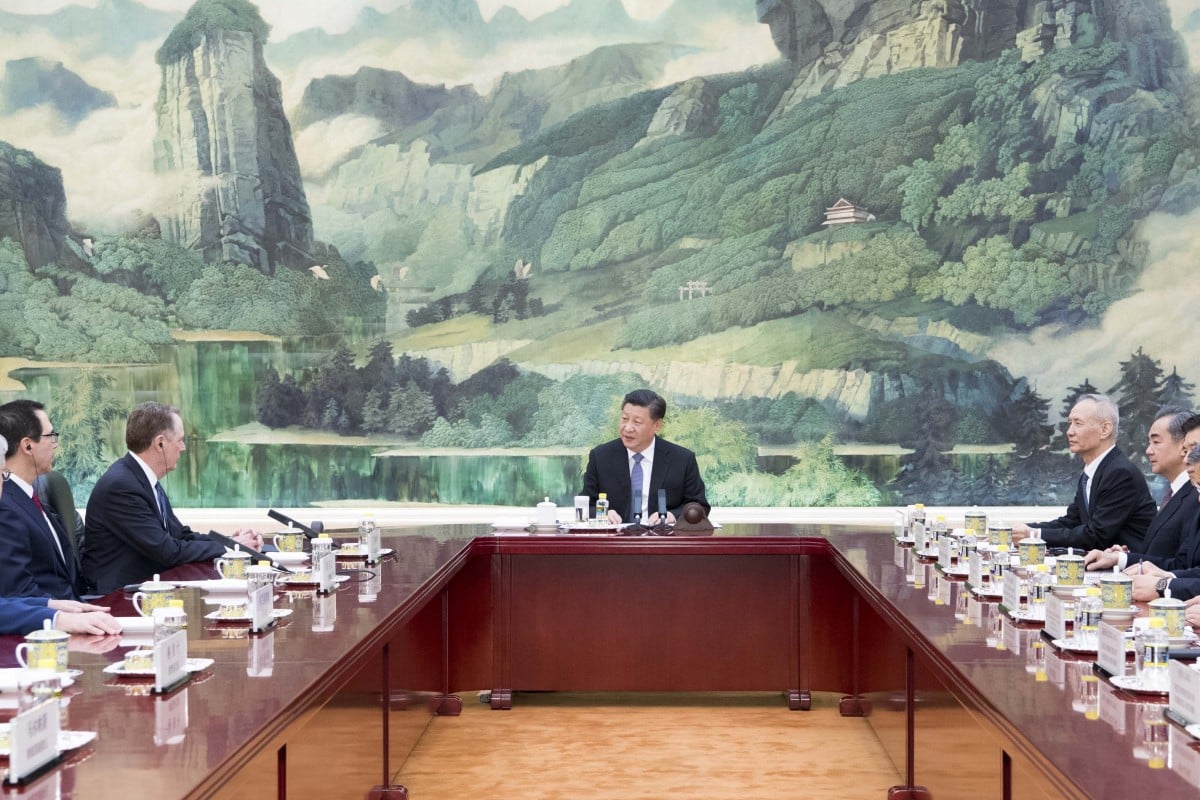
Chinese President Xi Jinping urged for a “mutually beneficial” trade deal in this week’s talks when he met US trade representative Robert Lighthizer and US Treasury Secretary Steven Mnuchin in Beijing on Friday, according to Xinhua. Photo: Xinhua
A tweet by US President Donald Trump on the ongoing trade war is a “positive” signal, brightening prospects of a deal from this week’s talks in Washington, according to an opinion piece published by China’s major state media outlets on Monday.
Monday’s opinion piece was published the day before a Chinese delegation led by Vice-Premier Liu He is expected to leave for talks in Washington.
In the tweet on Sunday, Trump said: “Important meetings and calls on China trade deal, and more, today with my staff. Big progress being made on soooo many different fronts! Our country has such fantastic potential for future growth and greatness on an even higher level!”
The opinion piece, which was published by the official Xinhua news agency, the People’s Daily and the Global Times under the pseudonym Niu Tanqin, is seen to be part of Beijing’s efforts to reassure its citizens that the trade war with the United States will soon be over.
It did contrast previous columns on Trump by the same author, who in March last year argued that China dislikes the American president for his “insatiable demands, greediness and lack of trust worthiness”.
Last week’s trade talks in Beijing produced “progress” ahead of the March 1 deadline, which could see tariffs on US$200 billion worth of Chinese products increased from 10 per cent to 25 per cent if the world’s two largest economies fail to reach a deal.
The outcome of the talks in Washington, which are likely to be the last before March 1, will largely decide whether China and the United States can reach a pact, likely in the form of a memorandum of understanding, to suspend the tariff battle that has been roiling global markets and clouding growth prospects since last year.
According to the opinion piece, Trump’s use of “soooo” instead of “so” indicated that the US president was excited when he heard reports from his trade envoys following the talks in Beijing, which Chinese President Xi Jinping attend on Friday.
Donald J. Trump
✔@realDonaldTrump
Important meetings and calls on China Trade Deal, and more, today with my staff. Big progress being made on soooo many different fronts! Our Country has such fantastic potential for future growth and greatness on an even higher level!
“The US side is attaching great importance [to the trade talks]. Although Trump is on vacation, he listened to relevant reports and he definitely will make specific instructions,” it added.
Trump has been upbeat about the prospects of reaching a trade deal with China, and said on Friday at the White House: “It’s going extremely well.”
Chinese President Xi urged for a “mutually beneficial” trade deal in this week’s talks when he met US trade representative Robert Lighthizer and US Treasury Secretary Steven Mnuchin in Beijing on Friday, according to Xinhua.
Stocks in China and Hong Kong surged on Monday, partly bolstered by the increased likelihood of a trade deal between China and the United States.
Monday’s opinion piece fits into the latest official line that an agreement is very likely to end the tariff war after the Global Times said over the weekend that the bilateral trade talks are “sprinting” towards a positive end.
Donald Trump’s demands ‘good for China’, says economist Jin Keyu
Meanwhile, reports in China suggest differences between Beijing and Washington still remain over forced technology transfer, intellectual property rights, cyber theft as well as a verification system to ensure China keeps its promises.
Xi told the US trade envoys that China is willing to “cooperate” but “cooperation has principals”, a statement showing that Beijing will not entertain US demands if it finds such demands violate China’s principals.
A White House statement on Friday said that “much work remains”, showing gaps still exist.








 CHINDIA ALERT: You'll be living in their world, very soon