Archive for ‘US’

31/01/2019

Fresh round of China-U.S. trade talks start in Washington

WASHINGTON, Jan. 30 (Xinhua) — China and the United States kicked off here on Wednesday morning a new round of high-level talks to address their differences on outstanding economic and trade issues.

The talks, scheduled for two days, mark a significant step in the implementation of the important consensus reached by Chinese President Xi Jinping and U.S. President Donald Trump during a working dinner in Buenos Aires, Argentina, on Dec. 1.

The two heads of state agreed back then that the two sides should try to reach a mutually beneficial and win-win agreement within 90 days to bring an early end to their months-long trade friction featuring massive tariffs on imports from each other.

The latest talks began shortly after 9 a.m. local time (1400 GMT) at the Eisenhower Executive Office Building, part of the White House complex, following a brief session open to the media.

All the discussions and negotiations, which are expected to last until Thursday afternoon, will be held behind closed doors.

The Chinese delegation, headed by Vice Premier Liu He, includes senior officials from major economic sectors of the Chinese government, while the U.S. team is led by Trade Representative Robert Lighthizer and includes Treasury Secretary Steven Mnuchin, among others.

The White House has said that the U.S. side welcomes the Chinese delegation, which arrived in Washington on Monday, and that Trump is scheduled to meet with Liu on Thursday.

The world is watching these talks closely, with many hoping for some substantial, positive progress to be made.

Analysts have warned that the lasting trade tension between the world’s two largest economies would not only impact their own businesses, workers and consumers, but also stoke global market fears of uncertainty and disruption, and erode confidence in the long-term global economic growth.

While acknowledging that the talks will not be easy given the complexity and difficulty of certain issues in dispute, China maintains that there will be no insoluble problems between the two countries as long as they both keep the great benefits of cooperation in mind and show sincerity and mutual respect at the negotiating table.

Source: Xinhua

29/01/2019

China says U.S. should bear consequences of Venezuela sanctions

BEIJING (Reuters) – The United States should bear responsibility for the consequences of its sanctions on Venezuela, China said on Tuesday, after Washington imposed sweeping restrictions on Venezuelan state-owned oil firm PDVSA.

The latest U.S. sanctions announced on Monday appear to be aimed at pressuring President Nicolas Maduro to step down and to build on the momentum that has mounted in recent weeks against him at home and abroad.

Juan Guaido, the Venezuelan opposition leader who proclaimed himself interim president last week with U.S. backing, and who is supported by most Western countries, says Maduro stole his re-election and must resign to allow new, fair polls.

China has said it opposes unilateral sanctions.

Foreign Ministry spokesman Geng Shuang said historical experience showed foreign interference “only makes situations more complicated”.

“The relevant country’s sanctions on Venezuela will lead to the deterioration of conditions of people’s lives,” Geng told a regular news briefing in Beijing, referring to the United States.

“They should bear responsibility for the serious consequences from this,” he said.

China has lent more than $50 billion to Venezuela through oil-for-loan agreements over the past decade, securing energy supplies for its fast-growing economy.

But the financing dried up as the South American country’s economy began spiralling downward in 2015, pressured by plummeting oil prices.

The Trump administration had long held off targeting Venezuela’s oil sector for fear that it would hurt U.S. refiners and raise oil prices for Americans. White House officials had also expressed concern about inflicting further hardship on the Venezuelan people.

Source: Reuters

27/01/2019

Overseas Chinese in San Francisco Bay area hailed for building strong China-U.S. relations

U.S.-SAN FRANCISCO-CHINESE NEW YEAR-RECEPTION

Zhang Jianxin, Deputy Consul General of the Chinese Consulate General in San Francisco, addresses a reception celebrating the upcoming Chinese Lunar New Year in San Francisco, the United States, Jan. 25, 2019. The Chinese Consulate General in San Francisco on Friday held a reception to celebrate upcoming Chinese Lunar New Year and honor the contribution of overseas Chinese in forging a close and strong relationship between China and the United States. (Xinhua/Dong Xudong)

SAN FRANCISCO, Jan. 25 (Xinhua) — The Chinese Consulate General in San Francisco on Friday held a reception to celebrate upcoming Chinese Lunar New Year and honor the contribution of overseas Chinese to forging a close and strong relationship between China and the United States.

In an address read by Deputy Consul General Zhang Jianxin to hundreds of participants at the event, Chinese Consul General Wang Donghua said the vast majority of overseas Chinese have participated in one way or another in the process of building a wealthier and stronger China over the past 40 years since China introduced the policy of reform and opening-up in 1978.

Wang said he hopes overseas Chinese will seize historical opportunities to render firm support for China’s further reform and opening-up and work harder to boost the China-U.S. friendship.

Speaking at the event marking Chinese Lunar New Year, which falls on Feb. 5, Peter Chi, a veteran leader of the Chinese community in San Francisco and the San Francisco Committee to Promote Reunification of China, said overseas Chinese are keen on cementing a more stable China-U.S. relationship.

“The year 2019 will witness several wonderful events for China, including the 40th anniversary of the establishment of diplomatic relations between China and the United States, the 70th anniversary of the founding of New China … and 40th anniversary of the Message to Compatriots in Taiwan issued by the Standing Committee of the Fifth National People’s Congress of China on Jan. 1, 1979,” he said.

Many overseas Chinese, particularly those living in the United States, are proud of the tremendous achievements that China has made in the past 40 years, Chi said.

“As a member of the San Francisco Committee to Promote Reunification of China, I earnestly hope Taiwan will eventually be reunited with the motherland,” he added.

On the other hand, overseas Chinese also would like to see the U.S.-China relations further develop and grow in a stable, healthy and smooth way, and they all will have a role to play during this process, Chi said.

Florence Fong, a prominent leader of the Chinese community in northern California, said 2019 is the Year of Pig, and in the 12-year-cycle Chinese zodiac, the sign of Pig represents wealth, fortune and happiness.

“Over the past years, the Chinese people have emigrated to various places in the world and they have brought the brilliant Chinese culture and heritage to every corner of the globe,” Fong said.

“Today, Chinese Lunar New Year has been observed in 133 countries, making it the most celebrated festival in the world,” she said.

Fong said she hopes China, as the country of her origin, will continue to grow into a more prosperous country in the future.

California State Assemblyman Scott Weiner presented a certificate of recognition to Deputy Consul General Zhang to honor the “strong relationship” between San Francisco and China.

Source: Xinhua

25/01/2019

Exclusive: Hindu group RSS urges India’s Modi to resist U.S. push to ease e-commerce curbs

NEW DELHI (Reuters) – A Hindu nationalist group close to Prime Minister Narendra Modi’s party has urged him to resist pressure from the United States and not defer new regulations for the e-commerce sector, according to a letter seen by Reuters.

The economic wing of the group, Rashtriya Swayamsevak Sangh (RSS), which is the fountainhead of the ruling party, has written to Modi saying that changing the policy implementation date, under pressure from Washington, will hurt 130 million small Indian entrepreneurs.

“There is no need to buckle under these pressures. India must continue to chart the way best for itself and the entrepreneurs,” the Swadeshi Jagran Manch said in its letter, which was reviewed by Reuters.

The new rules, to be implemented from Feb. 1, will deal a blow to Walmart Inc and Amazon.com’s ambitions in the country. They mandate that e-commerce companies will not be allowed to sell products from firms in which they have an equity interest.

Reuters reported on Thursday the United States government had told Indian officials the new rules will hinder the investment plans of the two companies.

The rules, which will force the companies to change their business structures and raise operational costs, have sparked an extensive lobbying effort from both Amazon and Walmart, which last year invested $16 billion in Indian e-commerce company Flipkart.

Both Amazon and Walmart have sought an extension of the Feb. 1 deadline, but government sources have said that was unlikely to happen as Modi needs millions of traders by his side in an upcoming national election due by May.

On Friday, the Confederation of All India Traders, which has supported tougher scrutiny of large e-commerce players, said “the entire trading community will vote against the government if they extend the deadline”.

The e-commerce spat is the latest in a number of disputes over trade and investment relations between India and the United States.

Walmart spokesman Greg Hitt told Reuters this week the company had “engaged the (United States) administration on this issue”.

The RSS has long advocated self-reliance and opposed the opening up of the Indian economy to foreign players.

Small Indian retailers have alleged that e-commerce companies use their control over inventory from their affiliates to create an unfair marketplace that allows them to sell some products at lower prices, which hurts the businesses of brick-and-mortar retailers. Such arrangements would be barred under the new policy.

In front-page advertisements in newspapers last week, Walmart-owned Flipkart highlighted how the platform had helped transform local struggling businesses selling badminton racquets and sarees, a traditional dress.

Source: Reuters

25/01/2019

Alibaba slams U.S. treatment of Huawei, efforts to curb China’s rise

HONG KONG (Reuters) – A senior Alibaba executive slammed the United States’ treatment of China’s Huawei Technologies [HWT.UL] as “extremely unfair”, saying measures by the country to curb the firm’s access to their markets was “very politically motivated”.

Joe Tsai, the e-commerce giant’s executive vice-chairman, also sharply criticised what he called an attempt by the U.S. government to curb China’s rise via a trade war.

He struck an optimistic note about China’s economy, saying it remained fundamentally strong despite a slowdown, and added that stimulus such as tax cuts needed to be imposed to prop it up even as it battles U.S. efforts to dent its businesses.

U.S. President Donald Trump’s administration has not only slapped crippling tariffs on Chinese imports, it has also stepped up scrutiny of Chinese investments in the country and torpedoed many deals citing national security concerns.

Huawei, the world’s biggest network equipment maker, has been caught up in the crosshairs, with the United States alleging its products could be used by Beijing for espionage.

SPONSORED

Huawei has repeatedly denied the allegation.

“I think what the American government and together with the Five Eyes Alliance – what they’re trying to do with Huawei – is a bit unfair, there’s definitely a political agenda behind it,” Tsai said at a Reuters BreakingViews event in Hong Kong.

The United States and its allies, Australia and New Zealand, have restricted Huawei’s access to their markers, while Canada and the United Kingdom are reviewing whether to curb access.

Last month, Meng Wanzhou, Huawei’s finance chief, was arrested in Canada, sparking a diplomatic row between Canada and China. She faces extradition to the United States.

Tsai, a Canadian passport holder, said he hoped the relationship between Canada and China would improve.

“I love Canadians, they’re great,” Tsai joked when asked about Meng’s arrest, calling it a politically charged question.

“ANTI-CHINA PROBLEM”

Relations between Washington and Beijing have deteriorated rapidly amid a tit-for-tat escalation in tariffs that has roiled financial markets and raised fears over the impact on global supply chains and investment plans.

“President Trump may have started it focussing on the trade deficit itself … but over the course of the last nine months it was blown into a bigger anti-China problem,” Tsai said, adding the trade war has spurred anti-China sentiment.

“It worries everybody.”

Alibaba has been previously critical of the trade war as well, with founder Jack Ma calling the spat the “most stupid thing in the world.”

The company, which promised in 2017 to create a million U.S. jobs, backed out last year, blaming the trade war.

Tsai said U.S. regulators had made it very difficult for Alibaba to make investments in the country, adding that the company would look at other parts of the world for investment.

Just last year, a U.S. government panel rejected a bid by Ant Financial, which Ma owns together with Alibaba executives, to buy U.S. money transfer company MoneyGram International Inc on national security concerns.

Among the most high-profile Chinese deals to be scuttled under the Trump administration, the $1.2 billion deal’s failure was a major blow for Ma, who was looking to expand Ant’s footprint amid fierce competition back home from rival Tencent Holdings Ltd’s WeChat.

CHINA OPTIMISM

Brushing aside the pains of the trade war, Tsai said people were over worried about China’s economy. Chinese consumers are still fundamentally very strong and consumption in China is going to grow over the next 5-10 years, he said.

Comments from Tsai come at a time when China’s economic growth has slowed to its weakest pace in nearly three decades amid faltering domestic demand and bruising U.S. tariffs.

Growth is expected to ease further this year.

Tsai said Alibaba will continue to invest aggressively despite the uncertain business environment.

Asia’s second most valuable public company has been investing heavily in offline retail and rural e-commerce to win new customers as China’s urban market shows signs of saturation.

24/01/2019

Panda teeth are self-regenerating, Chinese and US scientists find – and it could benefit human dentures

  • The animals’ tooth enamel is able to recover its structure after damage, research reveals
  • Potential uses for human dentures and ceramics are being explored
PUBLISHED : Thursday, 24 January, 2019, 6:01pm
UPDATED : Thursday, 24 January, 2019, 6:01pm

Chinese and American scientists have discovered that pandas have self-regenerating teeth and are studying its potential uses for human dentures and ceramics.Giant panda tooth enamel can recover its structure at a microscopic and nanoscopic level to counter wear and tear, the Chinese Academy of Sciences’ Institute of Metal Research has said.

This regeneration helps the animals to munch up to 38kg of tough bamboo stems every day. The fibrous plant makes up 99 per cent of a panda’s typical diet.

However, the study found that the enamel was not resistant to large-scale cracks.

The discovery was made by a research team led by Liu Zengqian, a scientist at the institute’s fracture mechanics laboratory.

The team also included members from the University of California, Berkeley, the University of Science and Technology of China and the Lanzhou University of Technology.

The scientists have been studying the properties of giant panda tooth enamel since 2016.

Panda tooth enamel is made of the mineral hydroxyapatite, whose fibres are arranged in a special structure that reduces the growth of small cracks, Liu was quoted as saying in the Chinese Academy of Sciences press release. Water molecules help the process along, it said.

The research team is using these findings to develop high-performance material for use in bionic human dentures and durable ceramics.

In 2015, researchers at the Chengdu Research Base of Giant Panda Breeding in southwest China found that pandas’ digestive systems had not evolved to adapt to their all-bamboo diet.

Despite spending up to 14 hours a day eating bamboo, giant pandas were able to digest only about 17 per cent of the bamboo they consumed, the researchers found.

Wild giant panda survival rates are threatened by the loss of their bamboo rainforest habitat, but the population has recovered after a high-profile captivity breeding programme backed by the Chinese government.

The animals are no longer classified as endangered. According to the latest census taken in 2014, more than 1,800 pandas are alive in the wild.

Source: SCMP

24/01/2019

China blasts U.S. “technology bullying” with Huawei CFO extradition

BEIJING, Jan. 23 (Xinhua) — China on Wednesday said the U.S. plan to extradite Meng Wanzhou, Huawei chief financial officer, from Canada did not comply with international law or have legitimacy.

The remarks came as Foreign Ministry spokesperson Hua Chunying reiterated China’s position on the Meng Wanzhou case at a press briefing.

Hua said the U.S. request for Meng’s extradition was essentially related to U.S. sanctions against Iran.

“Huawei has stated for many times that it has complied with all laws and regulations of the country in which it operates,” Hua said.

She stressed that China had consistently opposed the U.S. unilateral sanctions against Iran and unilateral sanctions against Iran outside the framework of the UN Security Council, which are not in line with international law and are opposed by the world, including U.S. allies.

“Canada is also opposed to this issue,” Hua said. “The U.S. act is highly political which is essentially technology bullying, and its purpose is to do everything in its power to suppress Chinese high-tech enterprises and contain China’s legitimate development rights.”

She said people of insight and a sense of justice in the international community should resolutely oppose it.

Source: Xinhua

22/01/2019

U.S. to formally seek extradition of Huawei executive Meng Wanzhou – Globe and Mail

(Reuters) – The United States will proceed with the formal extradition from Canada of Huawei executive Meng Wanzhou, Canada’s ambassador to the United States told the Globe and Mail, as Beijing vowed to respond to Washington’s actions.

The deadline for filing is Jan. 30, or 60 days after Meng was arrested on Dec. 1 in Vancouver.

Meng, the daughter of Huawei Technologies Co Ltd founder Ren Zhengfei, was arrested at the request of the United States over alleged violations of U.S. sanctions on Iran. She was released on bail last month and is due in court in Vancouver on Feb. 6.

Relations between China and Canada turned frosty after the arrest, with China detaining two Canadian citizens and sentencing to death a Canadian man previously found guilty of drug smuggling.

Beijing has not tied any of the three Canadians’ cases to Meng’s arrest, but has warned of severe consequences if she was not immediately released. Western and former Canadian diplomats have said they have no doubt the cases are linked.

Huawei, the world’s biggest maker of telecommunications equipment, said it had no comment on ongoing legal proceedings when contacted by Reuters on Tuesday. A U.S. Justice Department spokesman said: “We will comment through our filings.”

The Canadian Justice Department did not immediately respond to a request for comment outside regular business hours.

China’s Foreign Ministry on Tuesday reiterated calls for Meng’s immediate release and said her case clearly was “not a regular judicial case”.

Anyone with fair judgment would determine that Canada made a “serious mistake” in this matter, ministry spokeswoman Hua Chunying told a regular news briefing.

“Canada and the United States arbitrarily abused their bilateral extradition treaty to seriously infringe upon a Chinese citizen’s security and legal rights,” Hua said.

China “strongly urges” the United States to correct its “mistake”, cancel the arrest order for Meng, and not make a formal extradition request, she added.

Asked if China would retaliate against the United States if Meng is extradited, Hua said, “China will, of course, respond to U.S. actions.” She did not elaborate.

“PAYING THE PRICE”

Canada is one of over 100 countries with which the United States has extradition treaties.

Once a formal request is received, a Canadian court must determine within 30 days if there is sufficient evidence to support extradition, and Canada’s Minister of Justice must give a formal order.

In an article published on Monday, a former Canadian spy chief said Canada should ban Huawei from supplying equipment for next-generation telecoms networks, while Canada’s government is studying any security implications.

Some of Canada’s allies such as the United States and Australia have already imposed restrictions on using Huawei equipment, citing the risk of it being used for espionage.

Huawei has repeatedly said such concerns are unfounded, while China’s ambassador to Canada last week said there would be repercussions if Ottawa blocked Huawei.

In Monday’s interview, MacNaughton said he had complained to the United States that Canada was suffering from Chinese revenge for an arrest made at the U.S.’s request.

“We don’t like that it is our citizens who are being punished,” the Globe and Mail cited MacNaughton as saying. “(The Americans) are the ones seeking to have the full force of American law brought against (Ms. Meng) and yet we are the ones who are paying the price. Our citizens are.”

Canadian Prime Minister Justin Trudeau previously said China was arbitrarily using the death penalty and called on world leaders to raise concerns about the detained Canadians.

Source: Reuters

13/01/2019

Bank of China to enable payment in yuan on U.S. e-commerce platforms: Xinhua

BEIJING (Reuters) – Bank of China’s New York branch will enable Chinese firms to receive payment in yuan rather than dollars from their sales on U.S. e-commerce platforms this year, the official Xinhua news agency reported on Sunday.

Pledging to introduce more services for small and medium-sized enterprises engaged in cross-border trade between the United States and China, executives from the branch said payment in yuan would be possible by tapping new functions of e-MPay, a cross-border payment system launched by the branch in 2016.

The branch is developing a system using an existing platform to “facilitate trade finance for e-commerce players,” said Xu Chen, president and chief executive officer of Bank of China USA, Xinhua reported, without providing further details.

The system will adhere to U.S. anti-money laundering rules through artificial intelligence and cyber security technologies, Xu added.

A unit of fellow state-owned bank Industrial and Commercial Bank of China (ICBC) last year settled money laundering charges in the United States.

07/01/2019

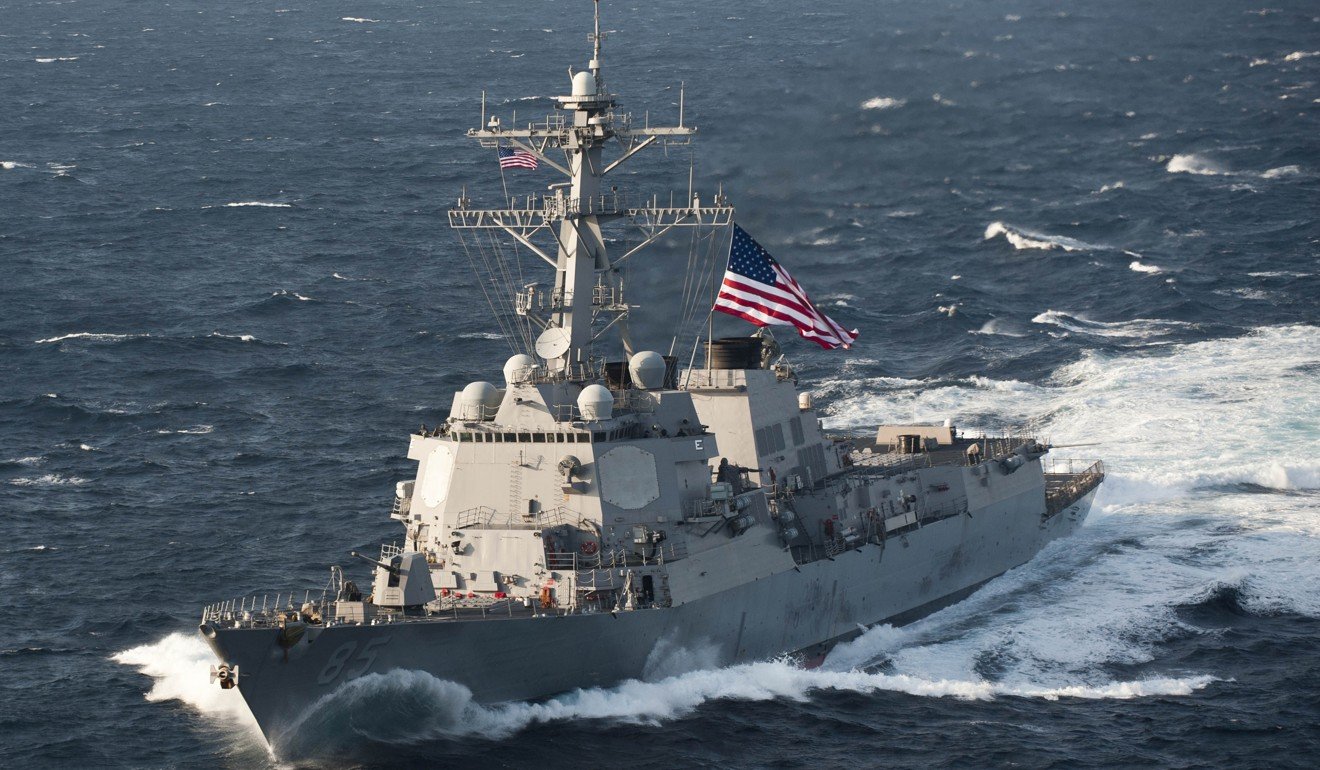
US warship sails near disputed Paracels in South China Sea as trade talks under way in Beijing

  • USS McCampbell sailed within 12 nautical miles of the island chain ‘to challenge excessive maritime claims’
  • But Pacific Fleet say ‘freedom of navigation’ operation was not about any one country or to make political statement
PUBLISHED : Monday, 07 January, 2019, 3:58pm
UPDATED : Monday, 07 January, 2019, 4:17pm
Reuters

A US guided-missile destroyer sailed near the disputed Paracel Islands in the South China Sea claimed by China as US officials join talks in Beijing during a truce in a bitter trade war.

The USS McCampbell carried out a “freedom of navigation” operation, sailing within 12 nautical miles of the Paracel Island chain, “to challenge excessive maritime claims”, Pacific Fleet spokeswoman Rachel McMarr said in a statement.

The operation was not about any one country or to make a political statement, McMarr said.

China lodged “stern representations” with the United States over the action, its foreign ministry said on Monday.

Ministry spokesman Lu Kang told a regular briefing that the US operation in the region violated China’s law and urged the United States to stop such actions.

It comes as trade talks between China and the United States are under way in Beijing, the first round of face-to-face discussions since both sides agreed to a 90-day truce in a trade war that has roiled international markets.

China claims almost all of the strategic waters, and frequently lambasts the United States and its allies for freedom of navigation naval operations near Chinese-occupied islands.

Vietnam, the Philippines, Brunei, Malaysia, Indonesia and Taiwan have competing claims in the region.

US President Donald Trump and Chinese President Xi Jinping in December agreed to put on hold a spiralling trade dispute of tit-for-tat import tariffs on hundreds of billions worth of goods.

Trump has imposed tariffs to pressure Beijing to change its practices on issues ranging from corporate espionage to market access and industrial subsidies. China has retaliated with tariffs of its own.

Fears have grown in recent months that the dispute is just one vector in a bilateral relationship that is fast cooling across the board, with top administration officials sharply criticising Beijing for everything from human rights abuses and its influence operations in the United States.

The two countries are also at odds over regional security issues, including Washington’s overtures to the self-ruled island of Taiwan, which Beijing claims as its own.

China and the United States have in the past repeatedly traded barbs over what Washington says is Beijing’s militarisation of the South China Sea by building military installations on artificial islands and reefs.

China defends its construction as necessary for self-defence and says that it is rather Washington that is responsible for ratcheting up tensions in the region by sending warships and military plans close to islands Beijing claims.

Law of Unintended Consequences

continuously updated blog about China & India

ChiaHou's Book Reviews

continuously updated blog about China & India

What's wrong with the world; and its economy

continuously updated blog about China & India