13/09/2019
- Operations aimed to caution Beijing that US forces can carry out amphibious campaigns far from home
- Washington has power to intervene directly in territorial disputes between its allies and China
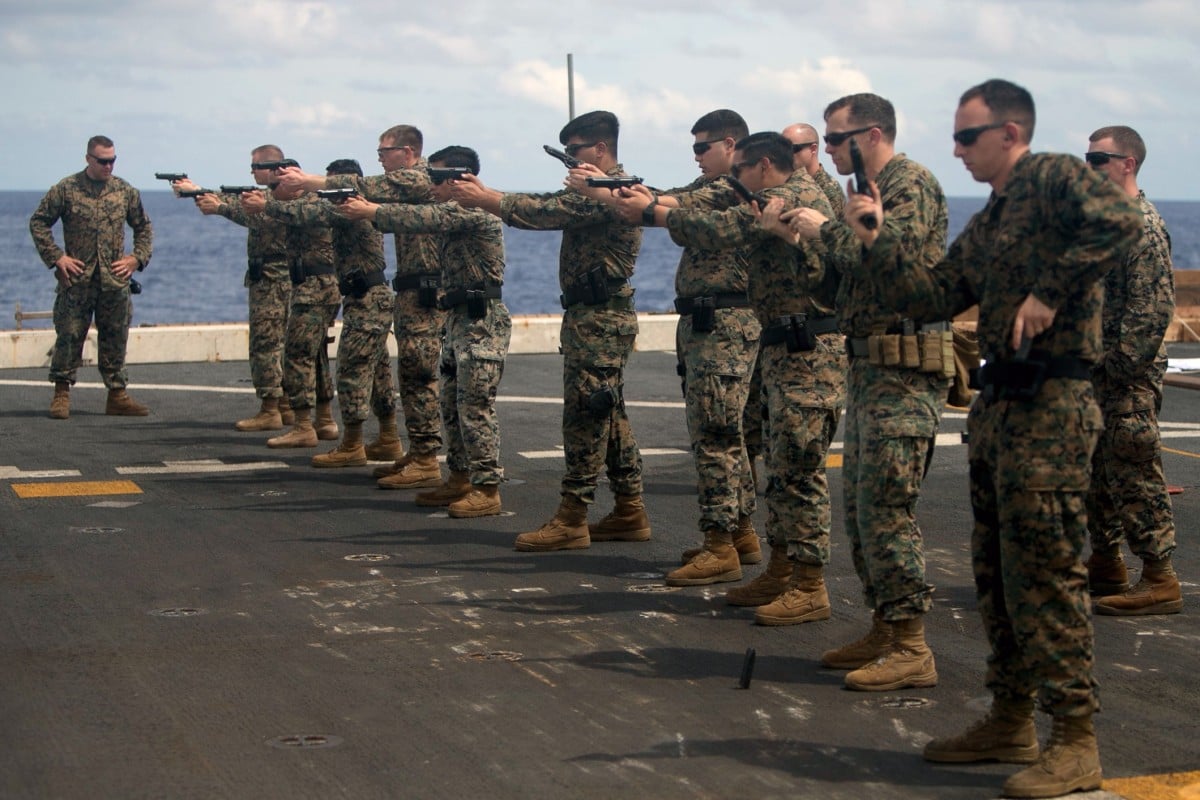
US Marines practise speed reloads on August 9 aboard the USS Green Bay, part of the Wasp Amphibious Ready Group, in the Indo-Pacific region. Photo: Handout
US Marines have conducted airfield- and island-seizure drills in the East and South China seas in what observers say is meant to remind Beijing of US military supremacy in the Asia-Pacific.
The 11-day naval drills were conducted near the Philippines and around the Japanese island of Okinawa by Okinawa-based US marine expeditionary units, the 31st Marine Expeditionary Unit said.
Observers said the operations were meant as a warning to Beijing that the US military could carry out amphibious campaigns far from home if Washington needed to intervene in territorial disputes between China and America’s allies in the region.
The 31st Marine Expeditionary Unit and Amphibious Squadron 11 conducted joint weapons drills from their Wasp Amphibious Ready Group ships from August 9-19, the Okinawa-based marine unit said in a statement.
The activity took place in the Philippine and East China seas and around an American naval base in Japan, it said.
The unit’s Amphibious Reconnaissance Platoon also performed a reconnaissance and surveillance mission through a high-altitude, low-opening parachute jump onto Okinawa.
A tilt-rotor aircraft, which hovers like a helicopter but flies like an aeroplane, afterward sent a landing team from a Wasp ship more than 400km (250 miles) away to establish the arming and refuelling point. The team achieved its objective in just over one hour, the statement said.
“The speed with which the Marines were able to establish the forward arming and refuelling point demonstrates a capability that is critical to conducting expeditionary operations in a contested environment,” the statement quoted Lieutenant Guirong Cai, a FARP officer-in-charge from the Marine Air Traffic Control Mobile Team, as saying.
“Their proficiency in swiftly setting up a refuelling point with 5,500 pounds (2.5 tonnes) of fuel demonstrates the 31st MEU’s ability to rapidly refuel and redeploy our air assets as the mission requires.”
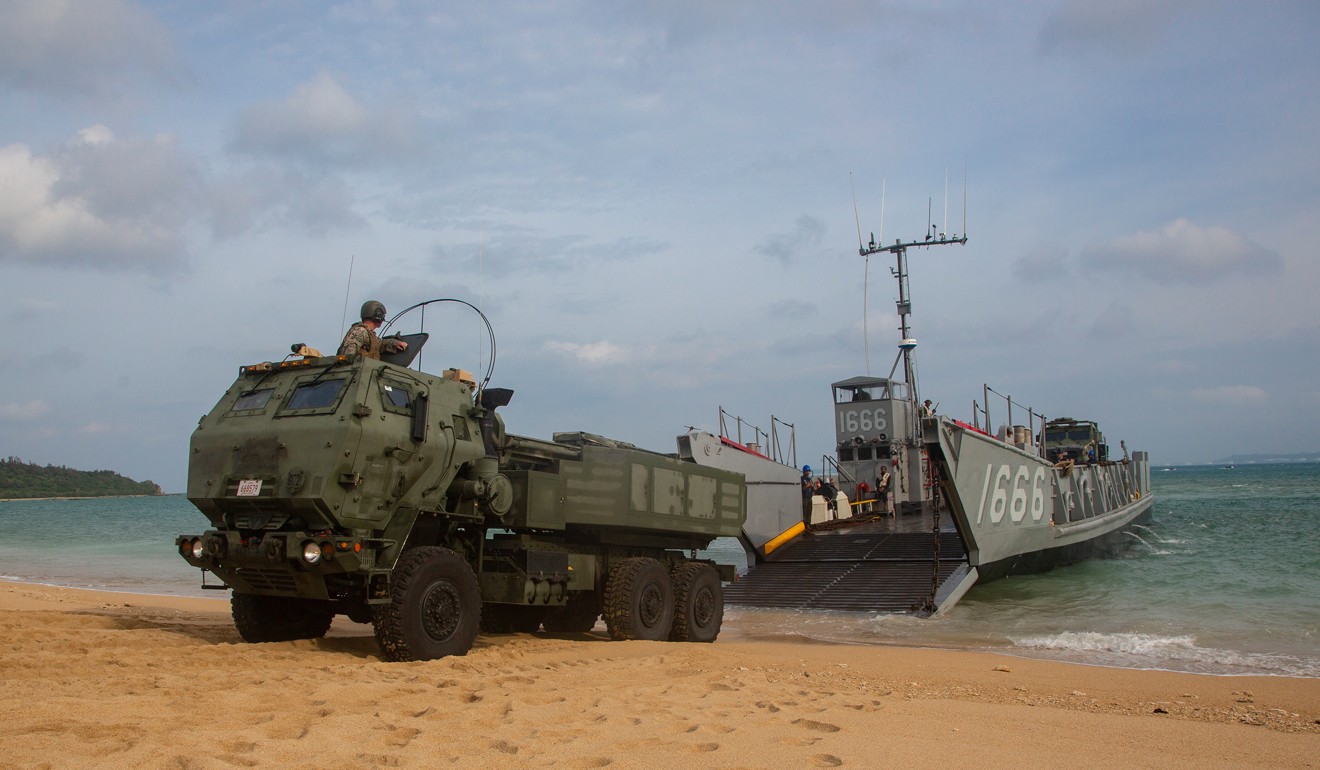
A US landing craft lowers its ramp to unload a high mobility artillery rocket system as part of a simulated amphibious raid at Kin Blue on Okinawa on August 14. Photo: Handout
China has a territory dispute with Japan over Diaoyu Islands, known as the Senkakus in Japan, in the East China Sea, while both Beijing and Manila have put in claims on the Scarborough Shoal – also known in China as Huangyan Dao – in the South China Sea.
Adam Ni, a China specialist at Sydney’s Macquarie University, said the drills near the Philippines and Okinawa showed that such a campaign would encompass a wide area, including the South and East China seas, where the US has joined other countries in the region to conduct freedom of navigation operations since 2015.
Maritime drills between US, Asean coincide with rising tensions
“It is a clear reminder to China of US military supremacy despite the narrowing of gaps in military capability in recent years,” Ni said. “The message is that the US military can still take China-controlled South China Sea features in high-intensity conflict.”
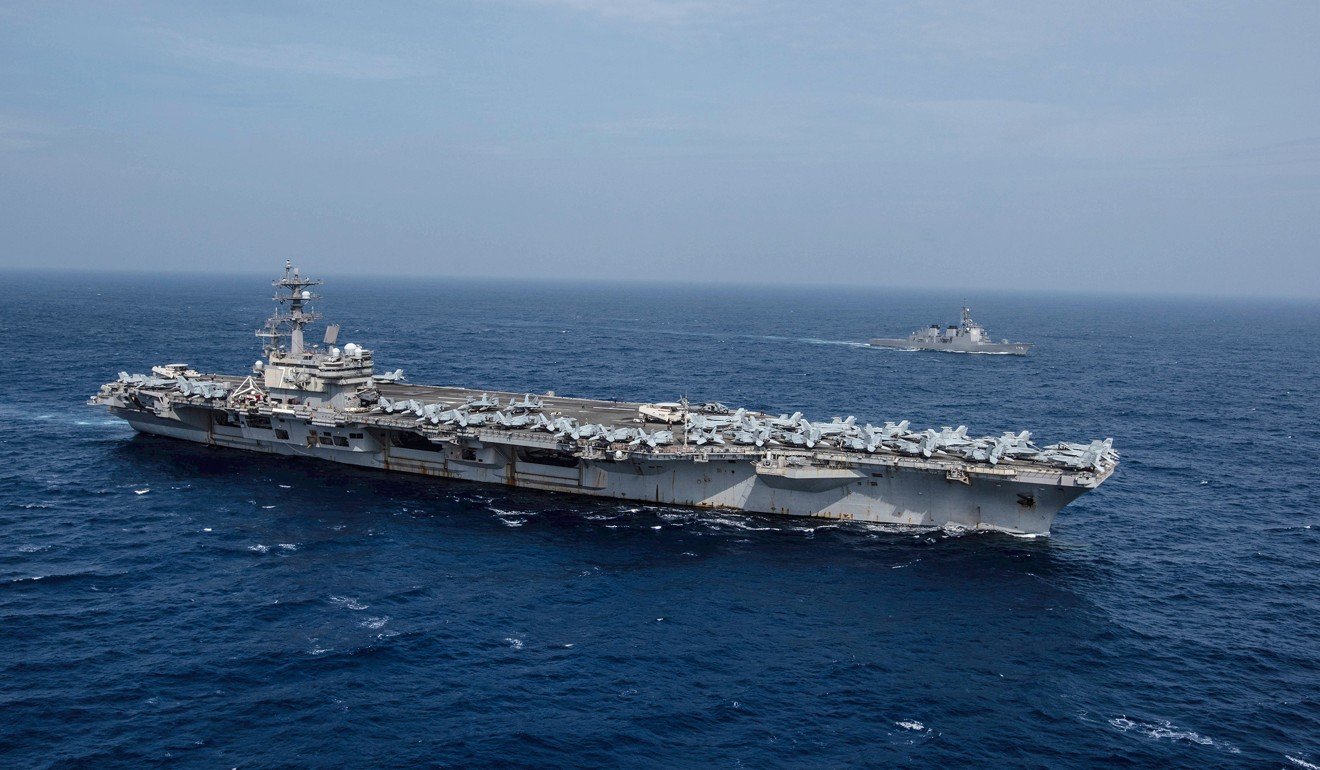
The USS Ronald Reagan aircraft carrier sails alongside a Japan Maritime Self-Defence Force guided-missile destroyer during drills. Photo: Handout
The statement did not say whether the Philippine navy and Japanese maritime self-defence force took part in the drills. But Hong Kong-based military commentator Song Zhongping said the US government would call on its two allies to observe the exercises.
“Whether Washington will intervene in territorial disputes between China and the Philippines as well as China and Japan, the American [military] has used [these drills] to strengthen its island-capture and airfield seizure capabilities in unfamiliar waters and areas,” Song said.
“To show its close relationship with and commitments to Manila and Tokyo, the Americans would invite the two allies to watch the drills. That could also be a good time to sell their amphibious warships and new model aircraft to Japan.”
During the drills, 10 simulated casualties were treated by three medical technicians from the US Air Force’s special operations group and given blood transfusions before being loaded onto a KC-130 transport aircraft for in-flight medical treatment en route to Marine Corps Air Station Futenma on Okinawa, the US Marines said.
Source: SCMP
Posted in 31st Marine Expeditionary Unit, Aircraft carrier, airfield- and island-seizure drills, America’s military edge, American naval base, amphibious campaigns, amphibious raid, Amphibious Reconnaissance Platoon, ASEAN, Asia-Pacific, Asia-Pacific drills, Beijing, China alert, Diaoyu Islands dispute, East China Sea, East China seas, guided missile destroyer, high mobility artillery rocket system, high-altitude, Huangyan Dao, Indo-Pacific region, Japan, Japan Maritime Self-Defence Force, Japanese island, Kin Blue, low-opening parachute jump, Macquarie University, Manila, Marine Air Traffic Control Mobile Team, Marine Corps Air Station Futenma, Marines, Maritime drills, Okinawa, Philippine Navy, Philippines, reconnaissance, remind, Scarborough Shoal, Senkakus, South China Sea, surveillance mission, Sydney, Uncategorized, US, US landing craft, US Marines, US military supremacy, USS Green Bay, USS Ronald Reagan, Washington, Wasp Amphibious Ready Group |
Leave a Comment »
28/08/2019
- It follows Beijing’s decision earlier this month to turn down an application for two US Navy ships to visit Hong Kong
- The countries have traded barbs about the handling of anti-government protests in the city
The US has had port visits denied by Chinese authorities twice this month. Photo: Alamy
A US Navy warship was denied a port visit to the eastern Chinese city of Qingdao on Sunday, the US Indo-Pacific Command said on Wednesday.
The request denial comes at a time of heightened tensions between China and the United States, with the countries engaged in a prolonged trade dispute and a war of words over anti-government protests in Hong Kong.
“The PRC [People’s Republic of China] denied the US Navy’s request to visit the Qingdao Port,” Commander Reann Mommsen, public affairs officer for the US Seventh Fleet, said in a statement on Wednesday.
Mommsen declined to name the warship denied entry or when the request was refused, referring questions about the reasons to Beijing.
The blocked visit was first reported by Reuters, which cited an anonymous US defence official as saying that China had denied the request for the destroyer before the intended visit on Sunday.
It is the second time in a month that China has prevented US Navy vessels making a port call.
On August 13, the United States Pacific Fleet said China had denied requests for two US Navy ships to
visit Hong Kong.
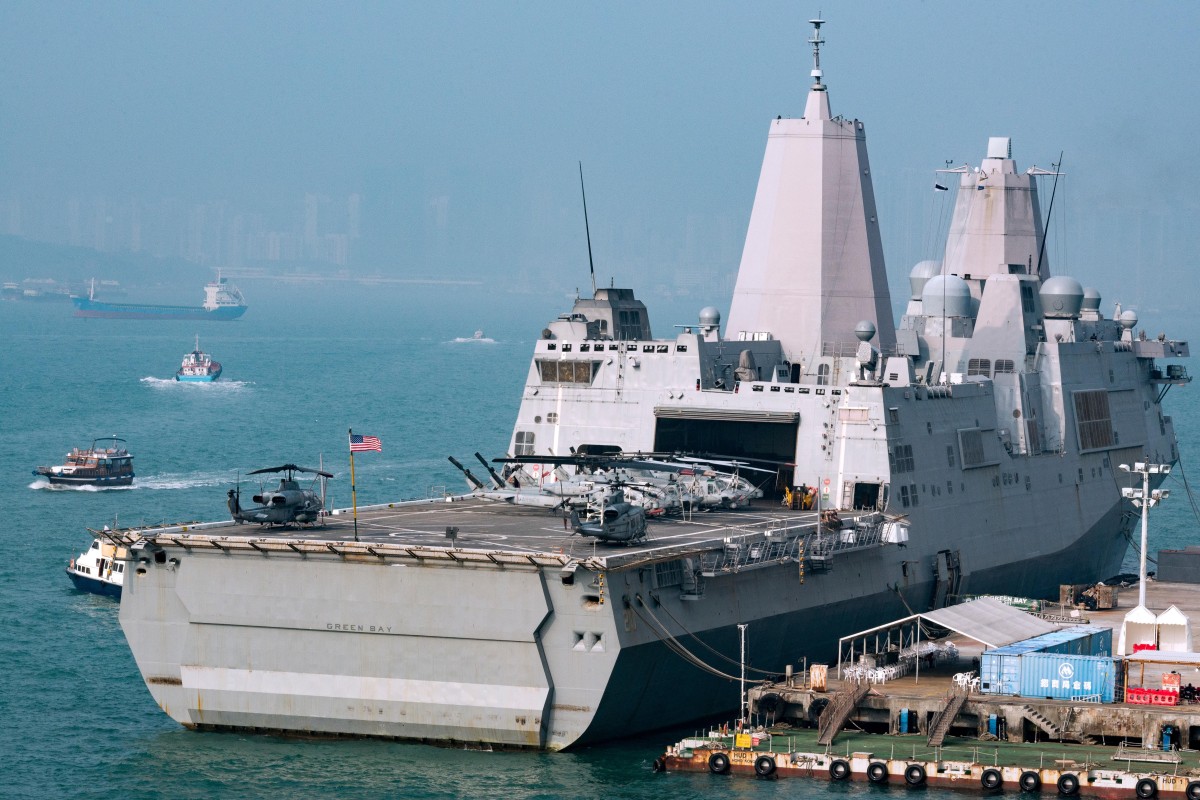
The USS Green Bay, an amphibious dock landing ship, had been due to make a port call in Hong Kong on August 17, and the guided missile cruiser USS Lake Erie was scheduled to visit next month, according to Nate Christensen, deputy spokesman for the Pacific Fleet.
A source close to the Chinese navy confirmed the Qingdao rejection, saying it was “normal practice” based on the current China-US relationship.
“Hasn’t the [US’] application to visit Hong Kong just been rejected?” the source asked.
Hong Kong has seen 12 weeks of anti-government protests, triggered by a now-shelved
that would have allowed criminal suspects to be transferred to mainland China.
Zhou Chenming, a Beijing-based military expert, said the refusal was a natural result of the worsening bilateral ties between China and the US.
“Many bilateral exchanges are bound to deteriorate when countries’ ties worsen, such as during the China-US trade war. And now coupled with the Hong Kong unrest, many exchanges [between China and the US] have been downgraded,” Zhou said.
Liu Weidong, from the Chinese Academy of Social Sciences, echoed Zhou’s view and said a visit from the US warship would be meaningless at present.
“Now the US is very provocative … so China doesn’t want to welcome its warship,” Liu said.
Doubt has been cast on whether trade talks between the two countries are set to resume, with Beijing’s foreign ministry contradicting US President Donald Trump’s claim that China had sought a return to the negotiating table.
The countries had been due to speak on Tuesday, according to a previous statement from China’s Ministry of Commerce after their last telephone call on August 13. But there has been no announcement so far from either side on whether such a conversation took place.
Last week, China said it would levy retaliatory tariffs of 5 to 10 per cent on US$75 billion worth of US goods. The Trump administration responded by announcing a tariff increase from 25 to 30 per cent on US$250 billion of Chinese goods, and from 10 to 15 per cent on US$300 billion worth of Chinese products.
The US also designated Beijing as a currency manipulator, raising fears of an economic cold war between the two countries.
Posted in amphibious dock landing ship, Beijing, blocks, China alert, China-US trade war, China’s Foreign Ministry, China’s Ministry of Commerce, Chinese Academy of Social Sciences, Chinese Academy of Social Sciences (CASS), claim, contradicting, currency manipulator, decision, denied, destroyer, guided missile cruiser, heightened tensions, Hong Kong, levy, People’s Republic of China, port visit, Qingdao, Qingdao Port, request, retaliatory tariffs, Reuters, Uncategorized, United States, United States Pacific Fleet, US Indo-Pacific Command, US Navy, US President Donald Trump, US Seventh Fleet, USS Green Bay, USS Lake Erie |
Leave a Comment »



 CHINDIA ALERT: You'll be living in their world, very soon