Archive for ‘Vatican’

06/04/2020

Mormon church to open first temple in mainland China

(Reuters) – The Utah-based Church of Jesus Christ of Latter-day Saints, also known as the Mormon church, plans to open its first temple in mainland China at a time when Beijing has been clamping down steadily on religious freedoms.

The temple in the eastern Chinese city of Shanghai will help fill a gap left by renovation work since last July at the church’s temple in Hong Kong, Russell M. Nelson, president of the church, announced on Sunday.

He also said seven other temples would open, including one in Dubai, its first in the Middle East.

“In Shanghai, a modest, multipurpose meeting place will provide a way for Chinese members to continue to participate in ordinances of the temple,” Nelson said.

“Because we respect the laws and regulations of the People’s Republic of China, the Church does not send proselytizing missionaries there; nor will we do so now,” he said.

A former cardiac surgeon, Nelson has spent time in China, studied Mandarin and was granted an honorary professorship by China’s Shandong University School of Medicine.

In January, the church sent two planeloads of protective medical equipment to the Children’s Medical Center in Shanghai to help manage the coronavirus outbreak.

No official figure is available for the number of Mormons in China.

China’s constitution guarantees religious freedom but under President Xi Jinping Beijing has tightened restrictions on religions seen as a challenge to the authority of the ruling Communist Party.

The government has cracked down on underground churches, both Protestant and Catholic, and has rolled out legislation to increase oversight of religious education and practices.

Chinese law requires that places of worship register and submit to government oversight, but some have declined to register and are known as “house” or “underground” churches.

The Chinese government formally recognizes five religions: Buddhism, Taoism, Islam, Catholicism and Protestantism.

“Expatriate and Chinese congregations will continue to meet separately. The Church’s legal status there remains unchanged,” Nelson said.

“In an initial phase of facility use, entry will be by appointment only. The Shanghai Temple will not be a temple for tourists from other countries,” he said.

In 2018, the Vatican and China signed an agreement on the appointment of Roman Catholic bishops, a breakthrough on an issue that for decades fuelled tensions between the Holy See and Beijing and thwarted efforts toward diplomatic relations.

Source: Reuters
28/08/2019

Chinese Catholic bishop ordained with Pope’s approval

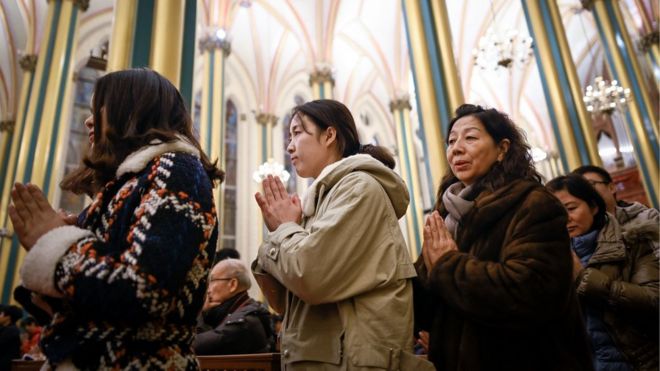
Chinese worshippers attend a mass during the Christmas Eve at a Catholic church in Beijing on December 24, 2018.Image copyright GETTY IMAGES
Image caption Christmas in Beijing: Catholics attend mass on 24 December 2018

A bishop has been ordained with the blessing of both the Pope and the Chinese state for the first time under a new deal.

Religious organisations in China must be approved by the state, leading to a decades-long row with the Vatican.

But a deal was agreed last September, giving the Vatican a say in the bishops appointed by the state church.

Yao Shun received the papal mandate for his ordination as bishop in China’s Inner Mongolia region.

The country is home to about 12 million Catholics – split between the Chinese Patriotic Catholic Association and an underground church loyal to the Vatican.

For decades, members of the underground church have only recognised the authority of the pope, while members of the state church have refused it. The relationship between the Holy See and Beijing has been strained by the disagreement since the 1950s.

In practice, the Vatican has recognised many Chinese bishops over the years on an individual, informal basis, including several last year as part of the deal.

Media caption Father Dong Guanhua has been kicked out of the Chinese Catholic church for calling himself a bishop

The Vatican confirmed the new bishop’s ordination – referring to him as Antonio Yao Shun – as “the first to take place in the framework of the Provisional Agreement between the Holy See and the People’s Republic of China”.

But the deal between the two remains controversial among some Catholics.

Cardinal Joseph Zen from Hong Kong – where Chinese rules on state churches do not apply – accused the Vatican of “selling out” when details of the deal became clear in January 2018.

He said that the decision to reconcile with Beijing meant that retiring bishops of the underground church, faithful to Rome, would now be replaced by state-approved appointees.

Catholic news outlet Crux, meanwhile, reported that Bishop Shun had been chosen by the Vatican some time ago, before the agreement came into effect – and so his ordination is not a true test of the new mechanism.

But Bishop Shun’s ordination may be a notable moment in the reconciliation between the two countries.

In the past, Chinese state bishops were excommunicated from the Catholic Church for their role in ordaining new bishops outside of the papal mandate.

Vatican News, a media outlet owned by the Holy See, reports that “at present, all the Catholic bishops in China are in full communion with the Pope”.

The relationship between China and the Vatican is further complicated by the Vatican’s diplomatic relations with Taiwan, which China considers to be a breakaway province destined for reunification at some future date.

Source: The BBC

17/03/2019

As Xi heads to Italy, Vatican says China should not fear Church

VATICAN CITY (Reuters) – A top Vatican official says China’s government should not fear “distrust or hostility” from the Roman Catholic Church, writing amid speculation over whether President Xi Jinping will meet Pope Francis this week.

Senior Vatican sources have said Francis is willing to meet Xi and that intermediaries had made overtures to the Vatican, but the Chinese side had not yet formally asked for a meeting. Any encounter would be the first between a Chinese leader and a pope.

Xi’s visit, starting Thursday, is his first to Italy following a historic agreement in September between the Vatican and the Chinese government on the appointment of bishops in China.

Beijing cut diplomatic ties with the Vatican in 1951 and has remained concerned that an independent Church in China could threaten its authority.

“The Holy See (nurtures) no distrust or hostility towards any country,” Vatican Secretary of State Cardinal Pietro Parolin writes in the introduction of a new book on China to be published on Tuesday. An advance copy of Parolin’s comments in the book, “The Church in China – A Future Yet to be Written” – were made available to Reuters.

Parolin, second only to the pope in the Vatican hierarchy, said the Catholic Church’s work in China “cannot be separated from a stance of respect, esteem, and trust towards the Chinese people and their legitimate state authorities.”


This appeared to be another attempt by the Vatican to allay Beijing’s concerns.

While the historic September agreement initiated an unprecedented direct dialogue between the Vatican and China, Beijing and the Holy See have not resumed diplomatic, relations.

Parolin wrote that the previously “inextricable knots” in relations between China and the Vatican could be untied through a new, unified approach involving a mix of “theology, law, pastoral work, and even diplomacy.”

It is routine for heads of state and government visiting Italy to also meet the pope. A Vatican source said it could be inserted into Xi’s schedule “at the last minute”. A Vatican spokesman said it is not on the pope’s schedule.

The September deal, in the making for more than 10 years, gives the Vatican a long-sought say in the choice of bishops in China. Critics, particularly conservative Catholics, have labelled it a sellout to the Communist government.

China’s approximately 12 million Catholics have been split between an underground Church swearing loyalty to the Vatican and the state-supervised Catholic Patriotic Association. Now both sides recognise the pope.

Many believe the September deal is a precursor to resumption of diplomatic ties with Beijing.

That would mean severing relations with Taiwan, which Beijing regards as a renegade province. The Vatican is the self-ruled island’s last remaining diplomatic ally in Europe.

Source: Reuters

Law of Unintended Consequences

continuously updated blog about China & India

ChiaHou's Book Reviews

continuously updated blog about China & India

What's wrong with the world; and its economy

continuously updated blog about China & India