Archive for ‘Vice-President Mike Pence’

03/11/2019

China, SE Asian states push trade pact despite India doubts

BANGKOK (Reuters) – Leaders from China and Southeast Asia states called for swift agreement on what could become the world’s largest trade bloc at a regional summit on Sunday, but new demands from India left officials scrambling to salvage progress.

Hopes of finalising the Asia-wide Regional Comprehensive Economic Partnership (RCEP), which is backed by China, have been thrown into doubt at the summit of the Association of Southeast Asian Nations (ASEAN) in Bangkok, Thailand.

Summit host Thailand said late on Sunday that the deal could be signed by February 2020. Thailand had previously said it aimed to conclude negotiations by the end of the year.

New impetus to reach agreement has come from the U.S.-China trade war, which has helped knock regional economic growth to its lowest in five years.

“The early conclusion of RCEP negotiations will lay the foundation for East Asia’s economic integration,” said a statement from China’s foreign ministry after Premier Li Keqiang met Southeast Asian leaders.

But Indian Prime Minister Narendra Modi did not even mention the RCEP deal in opening remarks at a meeting with Southeast Asian leaders and instead spoke only of reviewing the existing trade agreement between ASEAN and India.

Nor did Modi mention the trade bloc, whose 16 countries would account for a third of global gross domestic product and nearly half the world’s population, in Twitter posts after meeting Thai and Indonesian leaders.

An Indian foreign ministry official later told a media briefing “Let’s take all the RCEP questions tomorrow.”

Southeast Asian countries had hoped at least a provisional agreement could be announced on Monday.

But India has been worried about a potential flood of Chinese imports. A person with knowledge of New Delhi’s negotiations said new demands were made last week “which are difficult to meet.”

TRADE WAR IMPACT

Negotiators were meeting into the evening on Sunday to try to come to an agreement, Thai government spokeswoman Narumon Pinyosinwat told reporters on Sunday.

“We don’t have a conclusion yet. Once there is one, it would be announced,” she said. “Commerce ministers are still discussing outstanding issues. The signing is expected around February next year.”

Thai Prime Minister Prayuth Chan-ocha told the formal opening of the ASEAN summit on Sunday that the 16 nations in the potential trade bloc ought to come to agreement this year to stimulate economic growth, trade and investment.

Some countries have raised the possibility of moving ahead without India on forming a bloc that also included Japan, South Korea, Australia and New Zealand.

But Thai commerce minister Jurin Laksanawisit told Reuters on Sunday that India had not pulled out.

Another advantage for Southeast Asian countries from having relative heavyweight India in the trade pact would be less domination by China.

Longstanding rivals China and India, which fought a border war in 1962, clashed verbally in recent days over India’s decision to formally revoke the constitutional autonomy of the disputed Muslim majority state of Kashmir.

The U.S. decision to send a lower level delegation to the summits this year has raised regional concerns that it can no longer be relied on as a counterweight to China’s increasing regional might.

Instead of President Donald Trump or Vice President Mike Pence, the United States will be represented by Commerce Secretary Wilbur Ross and White House national security adviser Robert O’Brien.

At the summit, China’s Premier Li said China was ready to work with countries in the region for long term peace and stability in the South China Sea, where neighbours reject Beijing’s sweeping maritime claims.

Source: Reuters
15/10/2019

China calls on Turkey to halt military incursion in Syria and ‘return to right track’

  • Beijing joins global condemnation of attack launched by Ankara on Kurdish fighters after US President Donald Trump decided to pull out troops
  • Foreign ministry spokesman says issue should be resolved with ‘political solutions’ and the operation may result in a revival of Islamic State
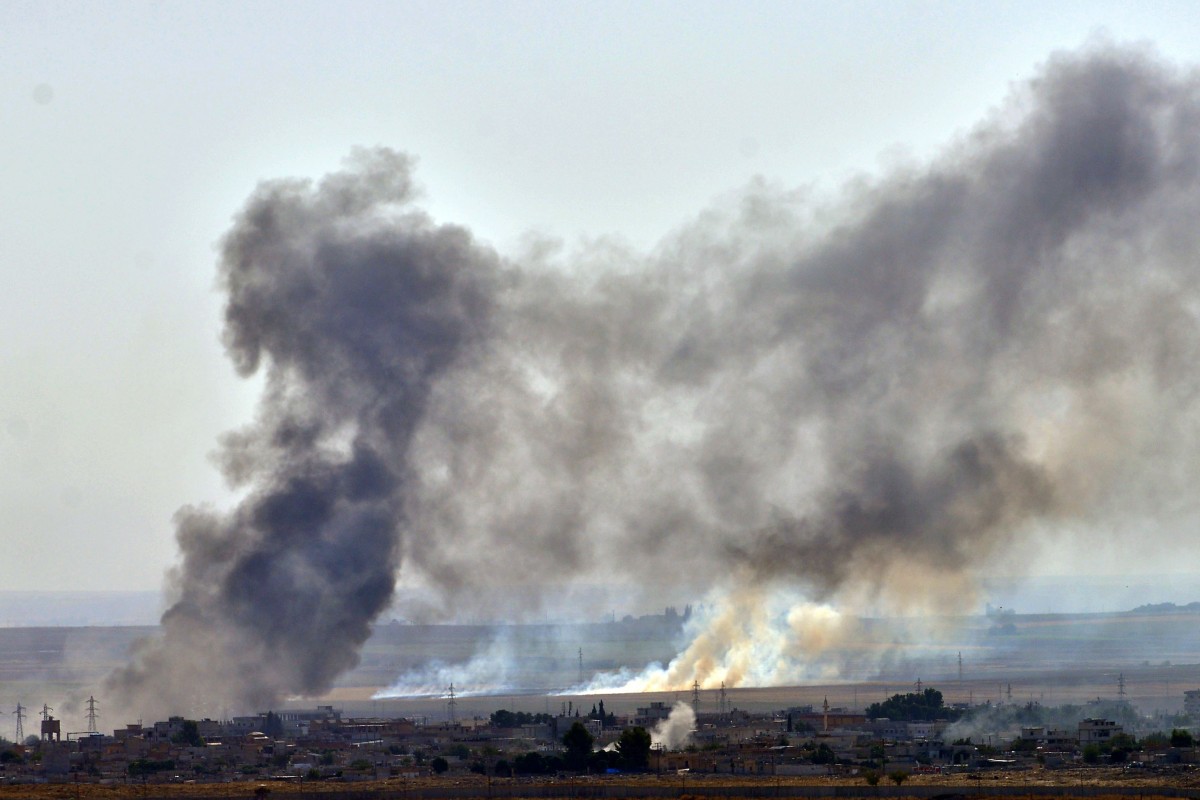
Turkey launched the attack on Kurdish fighters in northeastern Syria last week. Photo: Xinhua

China has urged Turkey to stop the military offensive it began in northeastern Syria last week and “return to the right track”.

Beijing is the latest to join global condemnation of the cross-border attack launched by Ankara on Kurdish fighters last Wednesday following US President Donald Trump’s decision to withdraw US troops from the region.

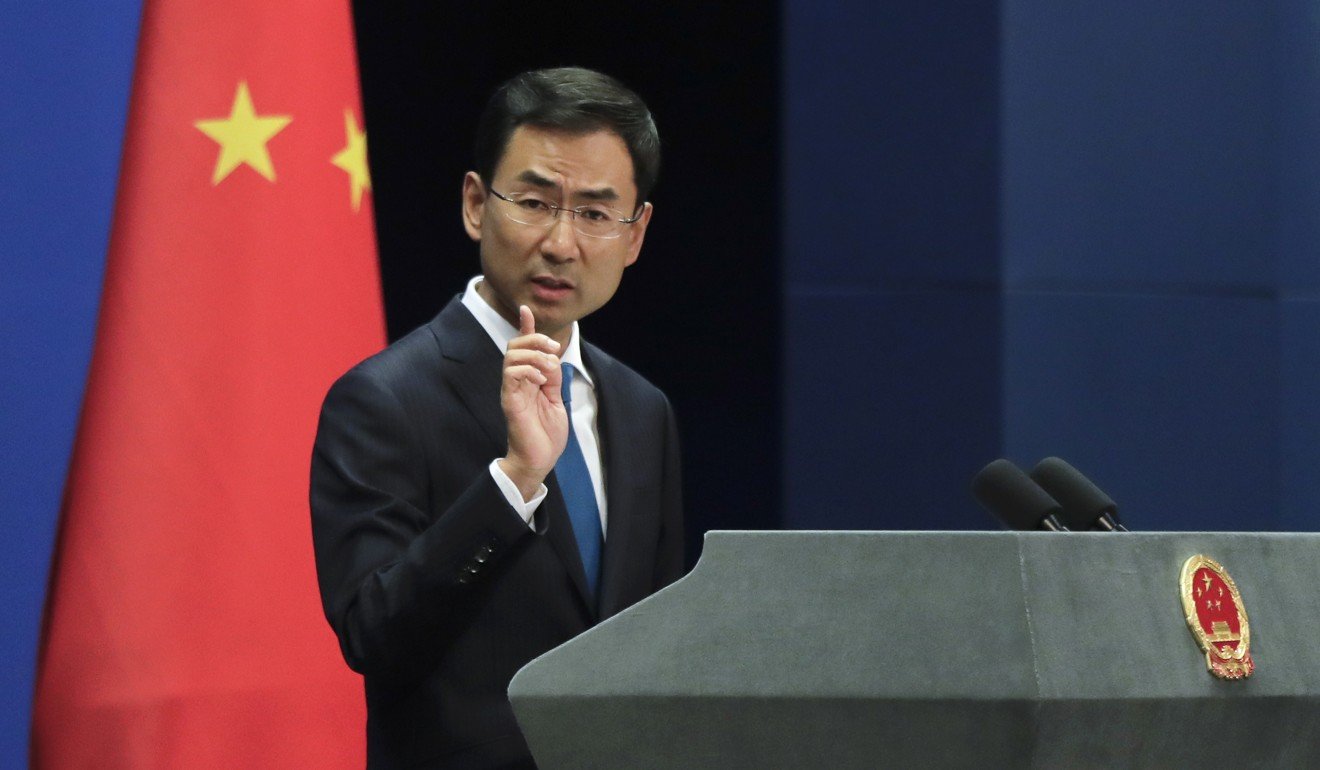
Foreign ministry spokesman Geng Shuang on Tuesday called for a ceasefire.

“The Chinese side has always opposed the use of force in international relations and has advocated for adherence to the Charter of the United Nations, and to resolve problems through political and diplomatic channels,” Geng said during a regular press briefing, when asked about Beijing’s position on the situation.

“Sovereignty, independence, unification and territorial integrity should be respected and protected,” he said. “We urge Turkey to halt military action and to return to the right track, resolving the issue with political solutions.”

Chinese foreign ministry spokesman Geng Shuang called on Turkey to “work with the international community in fighting against terrorism”. Photo: AP

Geng also said the “anti-terrorism situation in Syria is still severe”, and the military operation could result in a comeback by Islamic State.

“We urge Turkey to take responsibility and work with the international community in fighting against terrorism,” he said.

Explained: why are Syria’s Kurds accusing the US of betrayal?
Trump’s move has drawn sharp criticism from around the world. Critics say he has abandoned the allies that helped fight against Isis, and that withdrawing troops could pave the way for a resurgence of the jihadist group whose violent takeover of Syrian and Iraqi land five years ago was the reason US forces went in.

The US president said about 1,000 US troops who had been partnering with local Kurdish fighters to battle Islamic State in northern Syria were leaving the country. He said they would remain in the Middle East to “monitor the situation” and to prevent a revival of Isis – a goal that even Trump’s allies say has become much more difficult as a result of the US pull-out.

Turkey says the offensive aims to remove the Kurdish-led Syrian Democratic Forces from the border area and create what it calls a “safe zone” to relocate 1 million Syrian refugees.

Facing mounting criticism, Trump on Monday announced sanctions would be imposed

 on Turkey, halted bilateral trade negotiations and called for an immediate ceasefire.
Vice-President Mike Pence also said Trump was sending him to the Middle East because the president was concerned about instability in the region.
Beijing has long worried that conflict in the region could spill over to Chinese soil after thousands of Uygurs – the Turkic-speaking Muslim minority from far western China – travelled to Syria to train and fight as jihadists.
Source: SCMP
16/06/2019

Beijing sees ‘broad consensus’ with UN on Xinjiang as human rights groups blast envoy’s visit

  • UN counterterrorism chief Vladimir Voronkov not expected to make statement after visiting region last week
  • Trip prompts calls for independent observation in Muslim-majority area where an estimated 1 million people are held in detention facilities
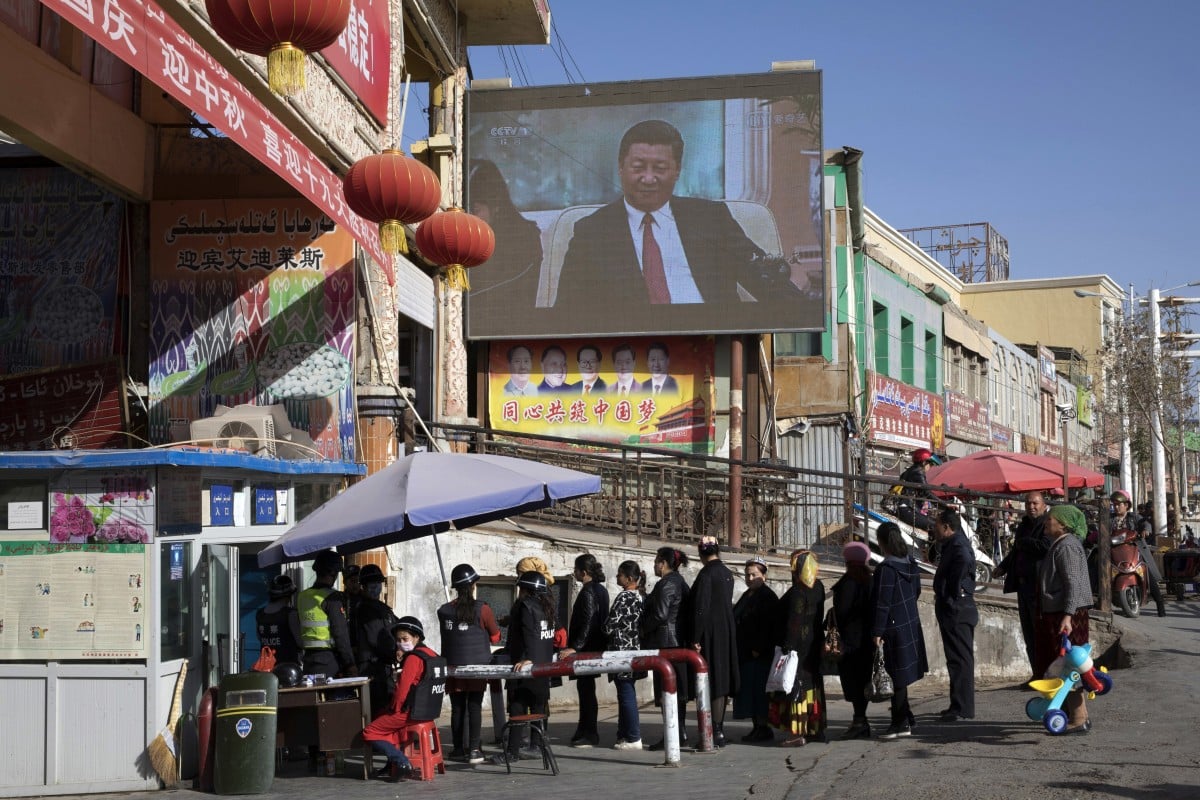
Residents go through a security checkpoint at the entrance to a bazaar in Hotan, Xinjiang. The UN’s counterterrorism chief visited the far western region last week. Photo: AP
Human rights group Amnesty International has joined growing criticism of a top UN official’s visit to China’s 
Xinjiang region

, echoing calls for more independent investigations of detention facilities for ethnic Uygurs.

The invitation to the United Nations envoy to visit was Beijing’s latest attempt to show it has nothing to hide in what it calls “re-education facilities” that hold an estimated 1 million people in the Muslim-majority area in western China.
But critics have warned that state-led media tours and diplomatic visits lack the unfettered access needed to make a proper assessment of alleged rights abuses in the region.
UN counterterrorism chief Vladimir Voronkov 
visited Beijing and Xinjiang

from Thursday to Saturday and met Le Yucheng, the vice foreign minister, according to a statement from the foreign ministry on Sunday. The statement said the two sides had reached a “broad consensus”.

UN human rights chief ‘is welcome to visit Xinjiang’

Voronkov’s visit follows months of pressure to allow the UN to investigate alleged human rights abuses in Xinjiang. China has so far only allowed guided tours of the region for foreign journalists and diplomatic envoys.

Reuters reported on Saturday that Voronkov’s itinerary was planned by China and that his UN office did not expect to make any public statement about the trip, according to an email from Voronkov’s office seen by the news agency.

The United Nations said in August last year it had credible reports that detention facilities in Xinjiang held 1 million Uygurs and other Muslims. Beijing says the facilities are for “vocational training” and tied to deradicalisation and anti-terrorism efforts.

Patrick Poon, a Hong Kong-based researcher with Amnesty International, said he was “very much concerned” about how the UN envoy’s visit had been arranged.

“From what we saw in the previous visits orchestrated by the Chinese government for diplomats, it’s very difficult for anyone to believe how this visit will be able to show any authentic situation on the ground,” Poon said.

“If the Chinese government is sincere, let independent UN experts, such as the special rapporteurs, have independent observation of what’s happening in Xinjiang.”

Xinjiang’s vanishing mosques highlight pressure on China’s Muslims
His remarks followed criticism of the trip from Human Rights Watch on Friday.
“The UN allowing its counterterrorism chief to go to Xinjiang risks confirming China’s false narrative that this is a counterterrorism issue, not a question of massive human rights abuses,” Human Rights Watch UN director Louis Charbonneau told Agence France-Presse.
Also on Friday, US Deputy Secretary of State John Sullivan called UN Secretary General Antonio Guterres to express “deep concerns” about Voronkov’s visit, according to the State Department website. Sullivan called for “unmonitored and unhindered access to all camps and detainees in Xinjiang by UN human rights officials”.
The United States has been increasingly vocal about China’s human rights abuses. Vice-President Mike Pence is due to give a speech on China’s “control and oppression” of citizens on June 24, but according to Bloomberg it could be postponed to avoid inflaming tensions with Beijing ahead of a possible meeting between US President Donald Trump and his Chinese counterpart Xi Jinping at the Group of 20 leaders summit in Japan on June 28-29. The speech was originally scheduled for June 4 but was delayed by Trump, Bloomberg reported, citing sources familiar with the matter.
Source: SCMP
Law of Unintended Consequences

continuously updated blog about China & India

ChiaHou's Book Reviews

continuously updated blog about China & India

What's wrong with the world; and its economy

continuously updated blog about China & India