04/05/2020
BEIJING (Reuters) – Tang Yue, a 27-year-old teacher from the city of Guilin in southwest China, steam-presses a blue dress and takes dozens of photographs before picking one to clinch her 200th online sale.
For a growing number of Chinese like Tang, hit by job losses, furloughs and salary cuts, the consumer economy has begun to spin in reverse. They are no longer buying – they are selling.
Instead of emerging from the coronavirus epidemic and returning to the shopping habits that helped drive the world’s second-largest economy, many young people are offloading possessions and embracing a new-found ethic for hard times: less is more.
With Tang’s monthly salary of about 7,000 yuan ($988), the self-described shopaholic said she has bought everything from Chanel lipsticks to Apple’s (AAPL.O) latest iPad in the past three years.
But the adrenaline rush that comes with binge-shopping is gone, said Tang, whose wages have been slashed with the suspension of all the classes on tourism management she usually teaches.
“The coronavirus outbreak was a wake-up call,” she said. “When I saw the collapse of so many industries, I realised I had no financial buffer should something unfortunate happen to me.”
There is no guarantee that the nascent minimalist trend will continue once the coronavirus crisis is fully over, but if it does, it could seriously damage China’s consumer sector and hurt thousands of businesses from big retailers to street-corner restaurants, gyms and beauty salons.
To be sure, there are signs that pent-up demand will drive a rush of spending as authorities reopen malls, leisure venues and tourist spots. In South Korea, the first major economy outside of China to be hit by the virus, people thronged malls this weekend to go “revenge shopping” to make up for time lost in lockdown.,
There are some signs that a similar trend will take hold in China, where some upscale malls are starting to get busy, although luxury firm Kering SA (PRTP.PA) – which owns Gucci, Balenciaga and other fashion brands – has said it is hard to predict how or when sales in China might come back.
A recent McKinsey & Co survey showed that between 20% and 30% of respondents in China said they would continue to be cautious, either consuming slightly less or, in a few cases, a lot less.
“The lockdown provided consumers with a lot of time and reasons to reflect and consider what is important to them,” said Mark Tanner, managing director at Shanghai-based research and marketing consultancy China Skinny.
“With much more of their days spent in their homes, consumers also have more time and reasons to sort through things they don’t feel they need – so they’re not living around clutter that is common in many apartments.”
#DITCHYOURSTUFF
Tang made a spreadsheet to keep track of her nearly 200 cosmetic products and hundreds of pieces of clothing. She then marked a few essentials in red that she wanted to keep. In the past two months, she has sold items worth nearly 5,000 yuan on second-hand marketplaces online.
Bargain-hunting online has become a new habit for some Chinese as the stigma that once hung over second-hand goods has begun to fade.
Idle Fish, China’s biggest online site for used goods, hit a record daily transaction volume in March, its parent company Alibaba (BABA.N) told Reuters.
Government researchers predict that transactions for used goods in China may top 1 trillion yuan ($141 billion) this year.
Posts with the hashtag #ditchyourstuff have trended on Chinese social media in recent weeks, garnering more than 140 million views.
Jiang Zhuoyue, 31, who works as an accountant at a traditional Chinese medicine company in Beijing – one of the few industries that may benefit from the health crisis – has also decided to turn to a simpler life.
“I used to shop too much and could be easily lured by discounts,” said Jiang. “One time Sephora offered 20% off for all goods, I then bought a lot of cosmetics because I feel I’m losing money if I don’t.”
Jiang, the mother of a 9-month-old baby, said she recently sold nearly 50 pieces of used clothing as the lockdown gave her the opportunity to clear things out. “It also offered me a chance to rethink what’s essential to me, and the importance of doing financial planning,” she said.
Eleven Li, a 23-year-old flight attendant, said she used to spend her money on all manner of celebrity-endorsed facial masks, snacks, concert tickets and social media activity, but now has no way to fund her spending.
“I just found a new job late last year, then COVID-19 came along, and I haven’t been able to fly once since I joined, and I’ve gotten no salary at all,” said Li, who said she was trying to sell her Kindle.
Some are even selling their pets, as they consider leaving big cities like Beijing and Shanghai where the high cost of living is finally catching up with them.
NO RETURN TO OLD WAYS?
As the coronavirus comes under control in China, the government is gradually releasing cities from lockdown, easing transport restrictions and encouraging consumers to venture back into malls and restaurants by giving out billions-worth of cash vouchers, worth between 10 yuan and 100 yuan.
But many people say they are still worried about job security and potential wage cuts because of the struggling economy. Nationwide retail sales have plunged every month so far this year.
Xu Chi, a Shanghai-based senior strategic analyst with Zhongtai Securities, said some Chinese consumers may prove the ‘21 Day Habit Theory,’ a popular scientific proposition that it only takes that long to establish new habits.
“We believe people’s spending patterns follow the well-known theory, which means most people in China, having been cooped-up at home for more than a month and not having binge-shopped, may break the habit and not return to their old ways,” Xu said.
Jiang said she was determined not to return to her free-spending ways and planned to cook more at home.
“I’ll turn to cheaper goods for some luxury brands,” she said. “I’ll choose Huawei’s smartphone, because (Apple’s) iPhone has too much brand premium.”
Tang, who has recently used 100 yuan of shopping coupons to stock up on food, is going to hold the purse strings even tighter.
“I’ve set my monthly budget at 1,000 yuan,” she said. “Including one – and just one – bottle of bubble tea.”
Source: Reuters
Posted in #ditchyourstuff, 1,000 yuan, 200th, accountant, adrenaline, Alibaba (BABA.N), apartments, Apple’s, Apple’s (AAPL.O), authorities, ‘21 Day Habit Theory,’, “revenge shopping”, Balenciaga, Bargain-hunting, beauty salons, Beijing, big cities, big retailers, biggest online site, binge-shopping, blue dress, bottle, bought, brand premium, bubble tea, businesses, buying, cash vouchers, cautious, celebrity-endorsed, Chanel, China, China Skinny, China's, China’s, Chinese, Chinese social media, City, classes, collapse, Company, concert tickets, Consumer economy, consumer sector, coronavirus crisis, coronavirus epidemic, coronavirus outbreak, cosmetic products, cost of living, COVID-19, daily, damage, Dozens, drive, economy, embracing, emerging, essentials, establish, ethic, every month, everything, facial masks, fashion brands, financial buffe, Flight attendant, Food, furloughs, garnering, Government, growing, guarantee, Guilin, gyms, hard times, hashtag, health crisis, helped, high, hit by, how or when, Huawei's, hurt, Idle Fish, industries, iPad, IPhone, job losses, Job security, Kering SA (PRTP.PA), Kindle, leisure venues, less is more, lipsticks, lockdown, luxury firm, Major, make up, malls, March, McKinsey & Co, minimalist, monthly budget, monthly salary, nascent, nationwide, new-found, number, offloading, online sale, outside, owns, parent company, pent-up demand, People, pets, photographs, picking, pieces of clothing, plunged, popular, possessions, posts, predict, proposition, prove, purse strings, realised, recent, record, red, reopen, research and marketing consultancy, researchers, respondents, restaurants, retail sales, returning, Reuters, reverse, rush, salary cuts, scientific, second-hand goods, second-hand marketplaces, self-described, selling, senior, Shanghai, Shanghai-based, shopaholic, shopping coupons, shopping habits, slashed, smartphone, snacks, so far, social media activity, South Korea, Southwest China, spenders, spending, spreadsheet, sputters, steam-presses, stigma, strategic analyst, street-corner, survey, suspension, teacher, teaches, this year, Thousands, thronged, time lost, to clinch, to spin, tourism management, tourist spots, Traditional Chinese medicine, transaction, trend, trended, trillion yuan, Uncategorized, unfortunate, used goods, views, Virus, volume, wage cuts, wages, weekend, weeks, world’s second-largest economy, young, yuan |
Leave a Comment »
09/09/2019
- Merkel makes the case on sensitive issues in Beijing without being offensive, observer says
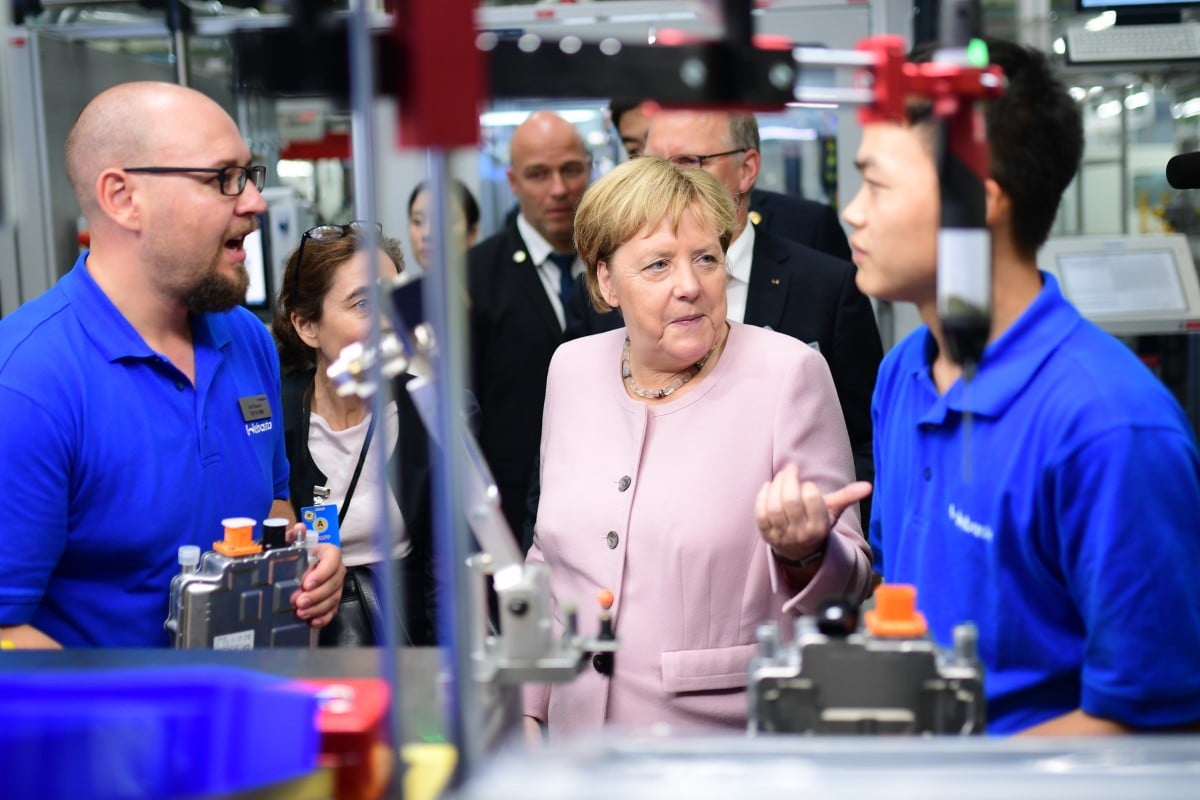
German Chancellor Angela Merkel (centre) talks to staff at manufacturer Webasto during a visit in Wuhan on Saturday. Photo: EPA-EFE
German Chancellor Angela Merkel may be slowly declining in influence in European politics but she remains the EU’s strongest voice in dealing with China, analysts said after her latest trip to China last week.
During the two-day visit, Merkel and Chinese President Xi Jinping discussed the sensitive topic of Hong Kong and the social credit system in China.
German diplomats also averted a plan by Chinese officials to scrap a joint press conference by Merkel and Chinese Premier Li Keqiang out of concerns that it could be dominated by questions about the escalating protests in Hong Kong.
Two sources told the South China Morning Post that the Chinese side initially suggested not letting journalists ask questions during the press conference. German diplomats persisted, saying that Merkel would hold her own press conference to take media questions, the sources said.
Germany’s Angela Merkel renews call for peaceful resolution to Hong Kong protests
After talks with the Chinese president and premier, Merkel said Beijing had listened to her views about resolving the Hong Kong conflict without violence, adding: “This is important.”
She said she also pressed the European Union’s position that the Sino-British Joint Declaration on Hong Kong remained effective, countering Beijing’s assertion that the 1984 document has ceased to be valid.
“Merkel navigated the narrow line to raise these sensitive issues without being overly offensive,” said Jan Weidenfeld, of the Berlin-based Mercator Institute for China Studies.
Joerg Wuttke, president of the EU Chamber of Commerce in China, said Merkel’s biggest achievement was to raise the issue about the social credit system in China, a policy that aims to rank every individual and corporate entity based on their compliance with state-stipulated social norms.
“It is important to us that she makes the Chinese leadership aware that the German business community would like to get better briefed and prepared for this major change in company compliance by the Chinese authorities,” Wuttke said. “Merkel was the first foreign leader to do so.”
Despite Merkel’s tough approach, China’s foreign ministry was full of praise for the German leader’s visit, saying both sides were “satisfied” with the outcomes.
“This is Chancellor Merkel’s 12th China visit, so she should be one of the Western leaders who visited China the most times and knows China the best,” ministry spokeswoman Hua Chunying said on Monday.
Hong Kong is a matter for China, Premier Li Keqiang tells Angela Merkel
Back home, however, German media and businesses remained sceptical about the future.
Bild, the country’s biggest-circulation newspaper, has been following closely the arrest of Hong Kong pro-democracy activist Joshua Wong Chi-fung, who was detained at Hong Kong airport on his way to Berlin at the newspaper’s invitation. Wong was later cleared to travel abroad.
Several newspapers have put pressure on Merkel to speak out for Hong Kong, with one calling on her to replace a stop in mainland China with one in the former British colony, which she refused.
On the business side, German businesses also urged Merkel to caution Beijing against sending troops to Hong Kong out of concerns that the lucrative Chinese market would become subject to international sanctions.
Another concern is the slow pace of structural reforms that would open up Chinese markets to foreign businesses.
Source: SCMP
Posted in Angela Merkel, averted, Beijing, Berlin, Bild, China alert, Chinese leadership, Chinese premier Li Keqiang, Chinese President Xi Jinping, Europe, European Union, former British colony, German business community, German Chancellor, German diplomats, Hong Kong, Hong Kong airport, Joshua Wong Chi-fung, Mainland China, Mercator Institute for China Studies, Sino-British Joint Declaration on Hong Kong, social credit system, south china morning post, strong voice, Uncategorized, views, Webasto, Wuhan |
Leave a Comment »



 CHINDIA ALERT: You'll be living in their world, very soon