Chindia Alert: You’ll be Living in their World Very Soon
aims to alert you to the threats and opportunities that China and India present. China and India require serious attention; case of ‘hidden dragon and crouching tiger’.
Without this attention, governments, businesses and, indeed, individuals may find themselves at a great disadvantage sooner rather than later.
The POSTs (front webpages) are mainly 'cuttings' from reliable sources, updated continuously.
The PAGEs (see Tabs, above) attempt to make the information more meaningful by putting some structure to the information we have researched and assembled since 2006.
Image copyright GETTY IMAGESImage caption The Chinese city of Wuhan recently lifted its strict quarantine measures
The Chinese city of Wuhan, where the coronavirus originated last year, has raised its official Covid-19 death toll by 50%, adding 1,290 fatalities.
Wuhan officials attributed the new figure to updated reporting and deaths outside hospitals. China has insisted there was no cover-up.
It has been accused of downplaying the severity of its virus outbreak.
Wuhan’s 11 million residents spent months in strict lockdown conditions, which have only recently been eased.
The latest official figures bring the death toll in the city in China’s central Hubei province to 3,869, increasing the national total to more than 4,600.
China has confirmed nearly 84,000 coronavirus infections, the seventh-highest globally, according to Johns Hopkins University data.
What’s China’s explanation for the rise in deaths?
In a statement released on Friday, officials in Wuhan said the revised figures were the result of new data received from multiple sources, including records kept by funeral homes and prisons.
Deaths linked to the virus outside hospitals, such as people who died at home, had not previously been recorded.
Media caption Learn how Wuhan dealt with the lockdown
The “statistical verification” followed efforts by authorities to “ensure that information on the city’s Covid-19 epidemic is open, transparent and the data [is] accurate”, the statement said.
It added that health systems were initially overwhelmed and cases were “mistakenly reported” – in some instances counted more than once and in others missed entirely.
A shortage of testing capacity in the early stages meant that many infected patients were not accounted for, it said.
A spokesman for China’s National Health Commission, Mi Feng, said the new death count came from a “comprehensive review” of epidemic data.
In its daily news conference, the foreign ministry said accusations of a cover-up, which have been made most stridently on the world stage by US President Donald Trump, were unsubstantiated. “We’ll never allow any concealment,” a spokesman said.
Why are there concerns over China’s figures?
Friday’s revised figures come amid growing international concern that deaths in China have been under-reported. Questions have also been raised about Beijing’s handling of the epidemic, particularly in its early stages.
In December 2019, Chinese authorities launched an investigation into a mysterious viral pneumonia after cases began circulating in Wuhan.
China reported the cases to the World Health Organization (WHO), the UN’s global health agency, on 31 December.
But WHO experts were only allowed to visit China and investigate the outbreak on 10 February, by which time the country had more than 40,000 cases.
The mayor of Wuhan has previously admitted there was a lack of action between the start of January – when about 100 cases had been confirmed – and 23 January, when city-wide restrictions were enacted.
Around that time, a doctor who tried to warn his colleagues about an outbreak of a Sars-like virus was silenced by the authorities. Dr Li Wenliang later died from Covid-19.
Wuhan’s death toll increase of almost exactly 50% has left some analysts wondering if this is all a bit too neat.
For months questions have been asked about the veracity of China’s official coronavirus statistics.
The inference has been that some Chinese officials may have deliberately under-reported deaths and infections to give the impression that cities and towns were successfully managing the emergency.
If that was the case, Chinese officials were not to know just how bad this crisis would get in other countries, making its own figures now seem implausibly small.
The authorities in Wuhan, where the first cluster of this disease was reported, said there had been no deliberate misrepresentation of data, rather that a stabilisation in the emergency had allowed them time to revisit the reported cases and to add any previously missed.
That the new death toll was released at the same time as a press conference announcing a total collapse in China’s economic growth figures has led some to wonder whether this was a deliberate attempt to bury one or other of these stories.
Then again, it could also be a complete coincidence.
China has been pushing back against US suggestions that the coronavirus came from a laboratory studying infectious diseases in Wuhan, the BBC’s Barbara Plett Usher in Washington DC reports.
US President Donald Trump and some of his officials have been flirting with the outlier theory in the midst of a propaganda war with China over the origin and handling of the pandemic, our correspondent says.
Mr Trump this week halted funding for the World Health Organization (WHO), accusing it of making deadly mistakes and overly trusting China.
“Do you really believe those numbers in this vast country called China, and that they have a certain number of cases and a certain number of deaths; does anybody really believe that?” Mr Trump said at the White House on Wednesday.
On Thursday, UK Foreign Secretary Dominic Raab said: “We’ll have to ask the hard questions about how [coronavirus] came about and how it couldn’t have been stopped earlier.”
But China has also been praised for its handling of the crisis and the unprecedented restrictions that it instituted to slow the spread of the virus.
SHANGHAI (Reuters) – China ordered on Saturday that anyone in Wuhan working in certain service-related jobs must take a coronavirus test if they want to leave the city.
The order comes after the central city, where the coronavirus emerged late last year, lifted a 70-day lockdown that all but ended the epidemic there.
People in Wuhan work in nursing, education, security and other sectors with high exposure to the public must take a nucleic acid test before leaving, the National Health Commission said in an order.
The government of Hubei province, of which Wuhan is capital, will pay for the tests, the commission said.
Since the city relaxed its lockdown restrictions people who arrived in there before Chinese New Year, when the virus was peaking in China, are allowed to go back to their homes.
People working in other sectors aiming to leave Wuhan are encouraged to take voluntary tests before going.
Within seven days of arrival at their destinations, people who can present test results showing they do not carry the virus, as well as a clean bill of health on a health app, can go back to work.
Everyone else will have to spend 14 days in quarantine before returning to work.
Authorities have worked with the China’s tech giants to devise a colour-based health code system, retrieved via mobile app, that uses geolocation data and self-reported information to indicate one’s health status.
Wuhan will speed up its efforts to investigate asymptomatic coronavirus cases and confirm the presence of antibodies in people, which might suggest immunity, the commission said.
Wuhan, which accounts for 60% of infections in China and 84% of the death toll as of Saturday, has been testing inhabitants aggressively throughout the virus’ breakout and many companies had already been asking workers from the city to undergo tests before resuming work.
Wuhan revised up its death toll from the coronavirus by 1,290 on Friday, taking the city’s toll to 3,869, because of incorrect reporting, delays and omissions, especially in the chaotic early stages of the outbreak, authorities said.
China national death toll is 4,632 from 82,719 cases.
Image copyright GETTY IMAGESImage caption The Chinese city of Wuhan recently lifted its strict quarantine measures
The Chinese city of Wuhan, where the coronavirus originated last year, has raised its official Covid-19 death toll by 50%, adding 1,290 fatalities.
Wuhan officials attributed the new figure to updated reporting and deaths outside hospitals. China has insisted there was no cover-up.
It has been accused of downplaying the severity of its virus outbreak.
Wuhan’s 11 million residents spent months in strict lockdown conditions, which have only recently been eased.
The latest official figures bring the death toll in the city in China’s central Hubei province to 3,869, increasing the national total to more than 4,600.
China has confirmed nearly 84,000 coronavirus infections, the seventh-highest globally, according to Johns Hopkins University data.
What’s China’s explanation for the rise in deaths?
In a statement released on Friday, officials in Wuhan said the revised figures were the result of new data received from multiple sources, including records kept by funeral homes and prisons.
Deaths linked to the virus outside hospitals, such as people who died at home, had not previously been recorded.
Media caption Learn how Wuhan dealt with the lockdown
The “statistical verification” followed efforts by authorities to “ensure that information on the city’s Covid-19 epidemic is open, transparent and the data [is] accurate”, the statement said.
It added that health systems were initially overwhelmed and cases were “mistakenly reported” – in some instances counted more than once and in others missed entirely.
A shortage of testing capacity in the early stages meant that many infected patients were not accounted for, it said.
A spokesman for China’s National Health Commission, Mi Feng, said the new death count came from a “comprehensive review” of epidemic data.
In its daily news conference, the foreign ministry said accusations of a cover-up, which have been made most stridently on the world stage by US President Donald Trump, were unsubstantiated. “We’ll never allow any concealment,” a spokesman said.
Why are there concerns over China’s figures?
Friday’s revised figures come amid growing international concern that deaths in China have been under-reported. Questions have also been raised about Beijing’s handling of the epidemic, particularly in its early stages.
In December 2019, Chinese authorities launched an investigation into a mysterious viral pneumonia after cases began circulating in Wuhan.
China reported the cases to the World Health Organization (WHO), the UN’s global health agency, on 31 December.
But WHO experts were only allowed to visit China and investigate the outbreak on 10 February, by which time the country had more than 40,000 cases.
The mayor of Wuhan has previously admitted there was a lack of action between the start of January – when about 100 cases had been confirmed – and 23 January, when city-wide restrictions were enacted.
Around that time, a doctor who tried to warn his colleagues about an outbreak of a Sars-like virus was silenced by the authorities. Dr Li Wenliang later died from Covid-19.
Wuhan’s death toll increase of almost exactly 50% has left some analysts wondering if this is all a bit too neat.
For months questions have been asked about the veracity of China’s official coronavirus statistics.
The inference has been that some Chinese officials may have deliberately under-reported deaths and infections to give the impression that cities and towns were successfully managing the emergency.
If that was the case, Chinese officials were not to know just how bad this crisis would get in other countries, making its own figures now seem implausibly small.
The authorities in Wuhan, where the first cluster of this disease was reported, said there had been no deliberate misrepresentation of data, rather that a stabilisation in the emergency had allowed them time to revisit the reported cases and to add any previously missed.
That the new death toll was released at the same time as a press conference announcing a total collapse in China’s economic growth figures has led some to wonder whether this was a deliberate attempt to bury one or other of these stories.
Then again, it could also be a complete coincidence.
But China has also been praised for its handling of the crisis and the unprecedented restrictions that it instituted to slow the spread of the virus. WHO Director General Dr Tedros Adhanom Ghebreyesus has hailed China for the “speed with which [it] detected the outbreak” and its “commitment to transparency”.
US President Donald Trump this week halted funding for the WHO, accusing it of making deadly mistakes and overly trusting China.
“Do you really believe those numbers in this vast country called China, and that they have a certain number of cases and a certain number of deaths; does anybody really believe that?” Mr Trump said at the White House on Wednesday.
On Thursday, UK Foreign Secretary Dominic Raab said: “We’ll have to ask the hard questions about how [coronavirus] came about and how it couldn’t have been stopped earlier.”
China’s economy shrank for the first time in decades in the first quarter of the year, as the virus forced factories and businesses to close.
The world’s second biggest economy contracted 6.8% according to official data released on Friday.
The financial toll the coronavirus is having on the Chinese economy will be a huge concern to other countries.
China is an economic powerhouse as a major consumer and producer of goods and services.
This is the first time China has seen its economy shrink in the first three months of the year since it started recording quarterly figures in 1992.
“The GDP contraction in January-March will translate into permanent income losses, reflected in bankruptcies across small companies and job losses,” said Yue Su at the Economist Intelligence Unit.
Last year, China saw healthy economic growth of 6.4% in the first quarter, a period when it was locked in a trade war with the US.
In the last two decades, China has seen average economic growth of around 9% a year, although experts have regularly questioned the accuracy of its economic data.
Its economy had ground to a halt during the first three months of the year as it introduced large-scale shutdowns and quarantines to prevent the virus spread in late January.
As a result, economists had expected bleak figures, but the official data comes in slightly worse than expected.
Among other key figures released in Friday’s report:
Factory output was down 1.1% for March as China slowly starts manufacturing again.
Retail sales plummeted 15.8% last month as many of shoppers stayed at home.
Unemployment hit 5.9% in March, slightly better than February’s all-time high of 6.2%.
Analysis: A 6% expansion wiped out
Robin Brant, BBC News, Shanghai
The huge decline shows the profound impact that the virus outbreak, and the government’s draconian reaction to it, had on the world’s second largest economy. It wipes out the 6% expansion in China’s economy recorded in the last set of figures at the end of last year.
Beijing has signalled a significant economic stimulus is on the way as it tries to stabilise its economy and recover. Earlier this week the official mouthpiece of the ruling Communist Party, the People’s Daily, reported it would “expand domestic demand”.
But the slowdown in the rest of the global economy presents a significant problem as exports still play a major role in China’s economy. If it comes this will not be a quick recovery.
On Thursday the International Monetary Fund forecast China’s economy would avoid a recession but grow by just 1.2% this year. Job figures released recently showed the official government unemployment figure had risen sharply, with the number working in companies linked to export trade falling the most.
China has unveiled a range of financial support measures to cushion the impact of the slowdown, but not on the same scale as other major economies.
“We don’t expect large stimulus, given that that remains unpopular in Beijing. Instead, we think policymakers will accept low growth this year, given the prospects for a better 2021,” said Louis Kuijs, an analyst with Oxford Economics.
Since March, China has slowly started letting factories resume production and letting businesses reopen, but this is a gradual process to return to pre-lockdown levels.
Media caption Why does China’s economy matter to you?
China relies heavily on its factories and manufacturing plants for economic growth, and has been dubbed “the world’s factory”.
Stock markets in the region showed mixed reaction to the Chinese economic data, with China’s benchmark Shanghai Composite index up 0.9%.
WASHINGTON (Reuters) – U.S. President Donald Trump said on Wednesday his government is trying to determine whether the coronavirus emanated from a lab in Wuhan, China, and Secretary of State Mike Pompeo said Beijing “needs to come clean” on what they know.
The source of the virus remains a mystery. General Mark Milley, chairman of the Joint Chiefs of Staff, said on Tuesday that U.S. intelligence indicates that the coronavirus likely occurred naturally, as opposed to being created in a laboratory in China, but there is no certainty either way.
Fox News reported on Wednesday that the virus originated in a Wuhan laboratory not as a bioweapon, but as part of China’s effort to demonstrate that its efforts to identify and combat viruses are equal to or greater than the capabilities of the United States.
This report and others have suggested the Wuhan lab where virology experiments take place and lax safety standards there led to someone getting infected and appearing at a nearby “wet” market, where the virus began to spread.
At a White House news conference Trump was asked about the reports of the virus escaping from the Wuhan lab, and he said he was aware of them.
“We are doing a very thorough examination of this horrible situation that happened,” he said.
Asked if he had raised the subject in his conversations with Chinese President Xi Jinping, Trump said: “I don’t want to discuss what I talked to him about the laboratory, I just don’t want to discuss, it’s inappropriate right now.”
Trump has sought to stress strong U.S. ties with China during the pandemic as the United States has relied on China for personal protection equipment desperately needed by American medical workers.
As far back as February, the Chinese state-backed Wuhan Institute of Virology dismissed rumors that the virus may have been artificially synthesized at one of its laboratories or perhaps escaped from such a facility.
Pompeo, in a Fox News Channel interview after Trump’s news conference, said “we know this virus originated in Wuhan, China,” and that the Institute of Virology is only a handful of miles away from the wet market.
“We really need the Chinese government to open up” and help explain “exactly how this virus spread,” said Pompeo.
“The Chinese government needs to come clean,” he said.
The broad scientific consensus holds that SARS-CoV-2, the virus’ official name, originated in bats.
Trump and other officials have expressed deep skepticism of China’s officially declared death toll from the virus of around 3,000 people, when the United States has a death toll of more than 20,000 and rising.
He returned to the subject on Wednesday, saying the United States has more cases “because we do more reporting.”
“Do you really believe those numbers in this vast country called China, and that they have a certain number of cases and a certain number of deaths; does anybody really believe that?” he said.
SUIFENHE, China (Reuters) – China’s northeastern border with Russia has become a frontline in the fight against a resurgence of the coronavirus epidemic as new daily cases rose to the highest in nearly six weeks – with more than 90% involving people coming from abroad.
Having largely stamped out domestic transmission of the disease, China has been slowly easing curbs on movement as it tries to get its economy back on track, but there are fears that a rise in imported cases could spark a second wave of COVID-19.
A total of 108 new coronavirus cases were reported in mainland China on Sunday, up from 99 a day earlier, marking the highest daily tally since March 5.
Imported cases accounted for a record 98. Half involved Chinese nationals returning from Russia’s Far Eastern Federal District, home to the city of Vladivostok, who re-entered China through border crossings in Heilongjiang province.
RELATED COVERAGE
Number of people crossing China borders cut 90% as part of virus efforts: official
“Our little town here, we thought it was the safest place,” said a resident of the border city of Suifenhe, who only gave his surname as Zhu.
“Some Chinese citizens – they want to come back, but it’s not very sensible, what are you doing coming here for?”
The border is closed, except to Chinese nationals, and the land route through the city had become one of few options available for people trying to return home after Russia stopped flights to China except for those evacuating people.
Streets in Suifenhe were virtually empty on Sunday evening due to restrictions of movement and gatherings announced last week, when authorities took preventative measures similar to those imposed in Wuhan, the central Chinese city where the pandemic ripping round the world first emerged late last year.
The total number of confirmed cases in mainland China now stands at 82,160 as of Sunday, and at the peak of the first wave of the epidemic on Feb 12 there were over 15,000 new cases.
Though the number of daily infections across China has dropped sharply from that peak, China has seen the daily toll creep higher after hitting a trough on March 12 because of the rise in imported cases.
Chinese cities near the Russian frontier are tightening border controls and imposing stricter quarantines in response.
Suifenhe and Harbin, the capital of Heilongjiang, are now mandating 28 days of quarantine as well as nucleic acid and antibody tests for all arrivals from abroad.
In Shanghai, authorities found that 60 people who arrived on Aeroflot flight SU208 from Moscow on April 10 have the coronavirus, Zheng Jin, a spokeswoman for the Shanghai Municipal Health Commission, told a press conference on Monday.
Residents in Suifenhe said a lot of people had left the city fearing contagion, but others put their trust in authorities’ containment measures.
“I don’t need to worry,” Zhao Wei, another Suifenhe resident, told Reuters. “If there’s a local transmission, I would, but there’s not a single one. They’re all from the border, but they’ve all been sent to quarantine.”
JOHANNESBURG (Reuters) – African ambassadors in China have written to the country’s foreign minister over what they call discrimination against Africans as the country seeks to prevent a resurgence of the coronavirus.
Several African countries have separately also demanded that China address their concerns that Africans, in particular in the southern city of Guangzhou, are being mistreated and harassed.
Having brought under control the original outbreak centred on the city of Wuhan, China is now concerned about imported cases and is stepping up scrutiny of foreigners coming into the country and tightening border controls. It has denied any discrimination.
In recent days Africans in Guangzhou have reported being ejected from their apartments by their landlords, being tested for coronavirus several times without being given results and being shunned and discriminated against in public. Such complaints have been made in local media, and on social media.
The ambassadors’ note said such “stigmatisation and discrimination” created the false impression that the virus was being spread by Africans.
“The Group of African Ambassadors in Beijing immediately demands the cessation of forceful testing, quarantine and other inhuman treatments meted out to Africans,” it said.
The note was sent to China’s top diplomat, Wang Yi, copying the chair of the African Union, South African President Cyril Ramaphosa and all African foreign ministers.
The Chinese foreign ministry’s International Press Centre did not immediately respond to a request for comment on the note, sent outside of business hours.
The Chinese embassy in South Africa also did not respond.
Foreign affairs official Liu Baochun told a news conference on Sunday that Guangzhou is enforcing anti-virus measures on anyone who enters the city from across the national border, regardless of nationality, race or gender.
The Chinese embassy in Zimbabwe on Saturday dismissed the accusation that Africans were being deliberately targeted.
“It is harmful to sensationalize isolated incidents,” it said in a tweeted statement. “China treats all individuals in the country, Chinese and foreign alike, as equals.”
DISAPPOINTMENT
The ambassadors’ note highlighted a number of reported incidents, including that Africans were being ejected from hotels in the middle of the night, the seizure of passports, and threats of visa revocation, arrest or deportation.
On Saturday, Ghana’s foreign minister of affairs Shirley Ayorkor Botchwey said she had summoned the Chinese ambassador to express her disappointment and demand action.
Kenya’s foreign ministry has also “officially expressed concern”, adding the government is working with Chinese authorities to address the matter.
On Friday, Nigerian legislator Akinola Alabi tweeted a video of a meeting between the leader of Nigeria’s lower house of parliament, Femi Gbajabiamila, and Chinese Ambassador Zhou Pingjian. In it, Gbajabiamila demanded an explanation from the diplomat after showing Zhou a video of a Nigerian complaining about mistreatment in China.
The ambassador said in response to the questions from the house leader that he took the complaints “very seriously” and promised to convey them to the authorities back home.
BEIJING (Reuters) – China reported on Saturday a rise in new coronavirus cases, as authorities try to head off a second wave of infections, particularly from imported and asymptomatic cases, as curbs on cities and travel are lifted.
The National Health Commission said 46 new cases were reported on Friday, including 42 involving travellers from abroad, up from 42 cases a day earlier.
In its statement the commission added that 34 new asymptomatic cases were reported, down from 47 the previous day.
Mainland China’s tally of infections now stands at 81,953. The death toll rose by three to 3,339.
Tough curbs imposed since January helped rein in infections sharply from the height of the pandemic in February. But policymakers fear a second wave triggered by arrivals from overseas or asymptomatic patients.
Northeastern Heilongjiang recently reported a spike in new cases because of Chinese nationals entering the province from Russia, which has seen a surge of cases.
Provincial health officials said it had 22 new imported cases on Friday, all Chinese nationals coming from Russia, and one new local case, in its capital of Harbin.
Inner Mongolia had a daily tally of 27 new imported cases by Saturday morning, all from Russia, the region’s health authority said.
The central province of Hubei, where the virus emerged late last year, reported no new cases for a seventh successive day.
A rise in virus infections has prompted authorities in Guangzhou to step up scrutiny of foreigners, ordering bars and restaurants not to serve clients who appear to be of African origin, the U.S. consulate in the southern city said.
Anyone with “African contacts” faces mandatory virus tests followed by quarantine, regardless of recent travel history or previous isolation, it said in a statement.
It advised African-Americans or those who feel they might be suspected of contact with nationals of African origin to avoid the city.
Since the epidemic broke out in the provincial capital of Wuhan, it has spread around the world, infecting 1.6 million people and killing more than 100,000.
BEIJING (Reuters) – China will promote the sales of export products in domestic markets, as foreign trade faces unprecedented challenges due to the coronavirus pandemic, an assistant commerce minister said on Friday.
As the coronavirus spreads to almost all of China’s trading partners, the world’s second-largest economy is set to reach a grim milestone for full year growth, with the pace of expansion likely to be the slowest since the Cultural Revolution ended in 1976. And, the export sector is facing millions of job losses and factory shutdowns.
“Due to the rapid spread of the epidemic in the world, foreign demand has slumped and the biggest difficulty facing foreign trade companies is the plunge in orders,” said Ren Hongbin, the assistant minister at the Ministry of Commerce.
He said firms across the board have had their orders cancelled or delayed, and new orders are “very hard to sign”.
“The uncertainty about the pandemic has become the biggest uncertainty for foreign trade development.”
Forecasters expect China’s 2020 growth could be nearer the 2.0% mark – the slowest in over 40 years – due to the sweeping impact of the pandemic both at home and overseas. The economy grew 6.1% last year.
China’s overseas shipments fell 17.2% in January-February from the same period a year earlier, marking the steepest fall since February 2019. Imports sank 4% from a year earlier.
Among the government measures to support the sector, China is accelerating efforts to build online trade fairs and guiding exporters to work with e-commerce retailers for sales in domestic markets and coordinating with its trading partners to stabilise supply chains, said Ren.
The Canton Fair, China’s oldest and biggest trade fair due to take place online, will feature live-streaming services for participants, Li Xingqian, another commerce ministry official, told the same briefing. The fair was originally scheduled to begin on April 15, but was postponed due to the coronavirus outbreak.
China is willing to boost trade relations with other countries, including the United States, under the new circumstances, said Ren, adding that Beijing hopes to work together with Washington to promote bilateral trade.
Both countries have been engaged in a near two-year long trade war with tit-for-tat tariffs on each other’s goods, before negotiators called a truce with an interim trade deal in January.
MUNICH (Reuters) – One January lunchtime in a car parts company, a worker turned to a colleague and asked to borrow the salt.
As well as the saltshaker, in that instant, they shared the new coronavirus, scientists have since concluded.
That their exchange was documented at all is the result of intense scrutiny, part of a rare success story in the global fight against the virus.
The co-workers were early links in what was to be the first documented chain of multiple human-to-human transmissions outside Asia of COVID-19, the disease caused by the coronavirus.
They are based in Stockdorf, a German town of 4,000 near Munich in Bavaria, and they work at car parts supplier Webasto Group. The company was thrust under a global microscope after it disclosed that one of its employees, a Chinese woman, caught the virus and brought it to Webasto headquarters. There, it was passed to colleagues – including, scientists would learn, a person lunching in the canteen with whom the Chinese patient had no contact.
The Jan. 22 canteen scene was one of dozens of mundane incidents that scientists have logged in a medical manhunt to trace, test and isolate infected workers so that the regional government of Bavaria could stop the virus from spreading.
That hunt has helped Germany win crucial time to build its COVID-19 defences.
The time Germany bought may have saved lives, scientists say. Its first outbreak of locally transmitted COVID-19 began earlier than Italy’s, but Germany has had many fewer deaths. Italy’s first detected local transmission was on Feb. 21. By then Germany had kicked off a health ministry information campaign and a government strategy to tackle the virus which would hinge on widespread testing. In Germany so far, more than 2,100 people have died of COVID-19. In Italy, with a smaller population, the total exceeds 17,600.
“We learned that we must meticulously trace chains of infection in order to interrupt them,” Clemens Wendtner, the doctor who treated the Munich patients, told Reuters.
Wendtner teamed up with some of Germany’s top scientists to tackle what became known as the ‘Munich cluster,’ and they advised the Bavarian government on how to respond. Bavaria led the way with the lockdowns, which went nationwide on March 22.
Scientists including England’s Chief Medical Officer Chris Whitty have credited Germany’s early, widespread testing with slowing the spread of the virus. “‘We all know Germany got ahead in terms of its ability to do testing for the virus and there’s a lot to learn from that,’” he said on TV earlier this week.
Christian Drosten, the top virologist at Berlin’s Charite hospital, said Germany was helped by having a clear early cluster. “Because we had this Munich cohort right at the start … it became clear that with a big push we could inhibit this spreading further,” he said in a daily podcast for NDR radio on the coronavirus.
Drosten, who declined to be interviewed for this story, was one of more than 40 scientists involved in scrutiny of the cluster. Their work was documented in preliminary form in a working paper at the end of last month, intended for The Lancet. The paper, not yet peer-reviewed, was shared on the NDR site.
ELECTRONIC DIARIES
It was on Monday, Jan. 27, that Holger Engelmann, Webasto’s CEO, told the authorities that one of his employees had tested positive for the new coronavirus. The woman, who was based in Shanghai, had facilitated several days of workshops and attended meetings at Webasto’s HQ.
The woman’s parents, from Wuhan, had visited her before she travelled on Jan. 19 to Stockdorf, the paper said. While in Germany, she felt unusual chest and back aches and was tired for her whole stay. But she put the symptoms down to jet lag.
She became feverish on the return flight to China, tested positive after landing and was hospitalised. Her parents also later tested positive. She told her managers of the result and they emailed the CEO.
In Germany, Engelmann said he immediately set up a crisis team that alerted the medical authorities and started trying to trace staff members who had been in contact with their Chinese colleague.
The CEO himself was among them. “Just four or five days before I received the news, I had shaken hands with her,” he said.
Now known as Germany’s “Case #0,” the Shanghai patient is a “long-standing, proven employee from project management” who Engelmann knows personally, he told Reuters. The company has not revealed her identity or that of others involved, saying anonymity has encouraged staff to co-operate in Germany’s effort to contain the virus.
The task of finding who had contact with her was made easier by Webasto workers’ electronic calendars – for the most part, all the doctors needed was to look at staff appointments.
“It was a stroke of luck,” said Wendtner, the doctor who treated the Munich patients. “We got all the information we needed from the staff to reconstruct the chains of infection.”
For example, case #1 – the first person in Germany to be infected by the Chinese woman – sat next to her in a meeting in a small room on Jan. 20, the scientists wrote.
Where calendar data was incomplete, the scientists said, they were often able to use whole genome sequencing, which analyses differences in the genetic code of the virus from different patients, to map its spread.
By following all these links, they discovered that case #4 had been in contact several times with the Shanghai patient. Then case #4 sat back-to-back with a colleague in the canteen.
When that colleague turned to borrow the salt, the scientists deduced, the virus passed between them. The colleague became case #5.
Webasto said on Jan. 28 it was temporarily closing its Stockdorf site. Between Jan. 27 and Feb. 11, a total of 16 COVID-19 cases were identified in the Munich cluster. All but one were to develop symptoms.
All those who tested positive were sent to hospital so they could be observed and doctors could learn from the disease.
Bavaria closed down public life in mid-March. Germany has since closed schools, shops, restaurants, playgrounds and sports facilities, and many companies have shut to aid the cause.
HAMMER AND DANCE
This is not to say Germany has defeated COVID-19.
Its coronavirus death rate of 1.9%, based on data collated by Reuters, is the lowest among the countries most affected and compares with 12.6% in Italy. But experts say more deaths in Germany are inevitable.
“The death rate will rise,” said Lothar Wieler, president of Germany’s Robert Koch Institute for infectious diseases.
The difference between Germany and Italy is partly statistical: Germany’s rate seems so much lower because it has tested widely. Germany has carried out more than 1.3 million tests, according to the Robert Koch Institute. It is now carrying out up to 500,000 tests a week, Drosten said. Italy has conducted more than 807,000 tests since Feb. 21, according to its Civil Protection Agency. With a few local exceptions, Italy only tests people taken to hospital with clear and severe symptoms.
Germany’s government is using the weeks gained by the Munich experience to double the number of intensive care beds from about 28,000. The country already has Europe’s highest number of critical care beds per head of the population, according to a 2012 study.
Even that may not be enough, however. An Interior Ministry paper sent to other government departments on March 22 included a worst-case scenario with more than 1 million deaths.
Another scenario saw 12,000 deaths – with more testing after partial relaxation of restrictions. That scenario was dubbed “hammer and dance,” a term coined by blogger Tomas Pueyo. It refers to the ‘hammer’ of quick aggressive measures for some weeks, including heavy social distancing, followed by the ‘dance’ of calibrating such measures depending on the transmission rate.
The German government paper argued that in the ‘hammer and dance’ scenario, the use of big data and location tracking is inevitable. Such monitoring is already proving controversial in Germany, where memories of the East German Stasi secret police and its informants are still fresh in the minds of many.
A subsequent draft action plan compiled by the government proposes the rapid tracing of infection chains, mandatory mask-wearing in public and limits on gatherings to help enable a phased return to normal life after Germany’s lockdown. The government is backing the development of a smartphone app to help trace infections.
Germany has said it will re-evaluate the lockdown after the Easter holiday; for the car parts maker at the heart of its first outbreak, the immediate crisis is over. Webasto’s office has reopened.
All 16 people who caught COVID-19 there have recovered.


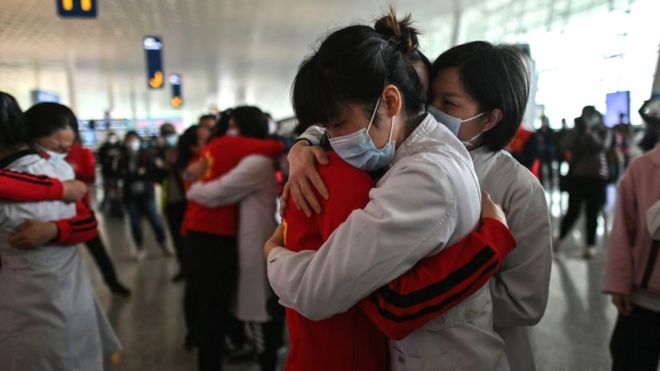 Image copyright GETTY IMAGES





 CHINDIA ALERT: You'll be living in their world, very soon