Chindia Alert: You’ll be Living in their World Very Soon
aims to alert you to the threats and opportunities that China and India present. China and India require serious attention; case of ‘hidden dragon and crouching tiger’.
Without this attention, governments, businesses and, indeed, individuals may find themselves at a great disadvantage sooner rather than later.
The POSTs (front webpages) are mainly 'cuttings' from reliable sources, updated continuously.
The PAGEs (see Tabs, above) attempt to make the information more meaningful by putting some structure to the information we have researched and assembled since 2006.
Warship joined by at least five escort vessels and analysts say the drills were ‘very significant’ to show the strike group wasn’t hit by coronavirus
Latest exercises also seen as putting pressure on Taiwan’s pro-independence forces, with strike group sailing through the strait
The Liaoning is seen as having a big role in the Chinese military’s plan to unify Taiwan by force. Photo: AFP
China’s first aircraft carrier, the Liaoning, returned to its home port of Qingdao on Thursday after nearly a month of training on the high seas, the People’s Liberation Army said.
According to military analysts, the warship was joined by at least five escort vessels, and the drills showed its crew had not been affected by the coronavirus pandemic and that it remained combat-ready.
The annual cross-region drills included intensive and complicated air and sea operations, the official PLA Daily said in a post on social media on Friday.
“The drills have further improved the real combat training level of the Liaoning carrier strike group, putting its systematic combat capability to the test,” the statement on WeChat said, without giving other details.
It was the longest training session by China’s navy since the PLA resumed all large-scale drills in March, after they were suspended because of disruptions to transport and military resources across the country as the deadly new virus rapidly spread.
Beijing-based naval expert Li Jie said it was important for the carrier to get back to training activities.
“The recent training by the Liaoning carrier strike group is very significant because it’s evidence that none of the 2,000 sailors and commanders on the ship have been hit by Covid-19, and neither have any of the other soldiers and personnel on the other warships and support units,” Li said.
The coronavirus situation has eased in China, where the first cases were reported late last year, but it continues to spread across the globe and has infected more than 3.2 million people worldwide and killed over 233,000.
Sailors on warships like USS Theodore Roosevelt vulnerable as coronavirus spreads
29 Mar 2020
The virus has also hit crew members on at least 40 US Navy warships, and Li said that left China with the only operational aircraft carrier in the region.
“Since the four American aircraft carriers in the Indo-Pacific region have all been struck by the pandemic, China is the only country that can operate an aircraft carrier in the area,” he said.
US warship captain seeks to isolate crew members as coronavirus spreads
Taiwan’s defence ministry reported earlier that the Liaoning flotilla had sailed through the Taiwan Strait twice last month as it headed towards the western Pacific, prompting the self-ruled island to scramble aircraft and send warships to monitor its movements.
Japan’s Ministry of Defence said the Liaoning was escorted by two destroyers, two frigates and a supply ship, and they had passed through the Bashi Channel, a waterway to the south of Taiwan, and headed towards waters east of Taiwan.
As tensions continue to simmer between Taipei and Beijing, the PLA has stepped up activities around the island, which the mainland sees as part of its territory awaiting reunification.
Hong Kong-based military commentator Song Zhongping said the latest naval drills were also aimed at heaping more pressure on Taiwan’s pro-independence forces as well as foreign countries seeking to intervene in cross-strait issues.
Coronavirus: US ‘supports Taiwan joining WHO events’ in ministerial phone call
28 Apr 2020
“Taiwan’s pro-independence forces have become more active and are attempting to take advantage amid the pandemic,” said Song, a military commentator with Phoenix Television.
“The Liaoning would play a major role in the PLA’s plan to unify Taiwan by force, so it’s necessary for the aircraft carrier strike group to get back to operations, step up training and send a warning to Taipei,” he added.
Lu Li-Shih, a former instructor at the naval academy in Taiwan, noted that the PLA Navy had regularly held drills in the waters east of Taiwan in recent years to avoid surveillance by US satellites.
LUCKNOW (Reuters) – U.S. and European defence firms backed Indian Prime Minister Narendra Modi’s military modernisation drive at a defence exhibition on Friday, despite a lengthy procurement process running into years and limited funds.
Airbus SE (AIR.PA) and U.S.-based Lockheed Martin Corp (LMT.N) and Boeing Co. (BA.N) are eying multi-billion dollar deals under Modi’s aim to upgrade an ageing fleet of aircraft and enhance local arms manufacturing to cut imports.
“I feel encouraged overall,” Anand Stanley, President and managing director of Airbus India and South Asia, told Reuters.
“Every year the government is doing capital allocation. They are spending,” he said.
The military is also looking to buy submarines, warships and battlefield communication systems. But these have made little headway.
Airbus is offering to set up an assembly line in India in partnership with the Tata Group to produce the C295W military transport aircraft as a replacement for Indian Air Force’s Avro fleet.
The 120 billion rupee Avro replacement programme has been in the pipeline for almost a decade.
Airbus on Thursday signed a memorandum of understanding (MoU) with India’s Adani Aerospace and Defence, part of the diversified Adani Group, for aircraft services in India and South Asia.
Boeing, which has pitched its F/A-18 Block III Super Hornet fighter for the India air force and navy and is competing with Lockheed Martin’s F-21, said it plans to push India’s armed forces’ drive for modernisation through a suite of five products – the Super Hornet, KC-46 tanker, P-8I aircraft, AH-64E Apache and CH-47(I) Chinook helicopters.
The company said it wants to build a global defence and aerospace ecosystem “that creates jobs and industrial capacity with Make in India,” said Salil Gupte, president, Boeing India in a statement during the exhibition.
Boeing and Lockheed will be competing with Sweden’s Saab AB (SAABb.ST) with its Gripen fighter and France’s Dassault Aviation SA (AVMD.PA) Rafale and Russian fighter aircraft.
Lockheed Martin, as part of its fighter jet F-21 proposal for the Indian Air Force, signed an MoU with Bharat Electronics Ltd (BAJE.NS) on Friday to explore industrial opportunities around the F-21 fleet, which is essentially building up a spare and supply ecosystem.
The three aerospace giants, with huge displays at the Defence Expo 2020 held in the northern city of Lucknow, displayed miniaturised versions of the latest aircraft and helicopters that they have pitched to India.
Another French defence firm, Dassault (DAST.PA), which recently delivered its first Rafale aircraft to the government in October under a contract to supply 36 units, said it is developing its facility in central India to make the Rafale jets in the subcontinent.
has further bolstered its defence links with the United States with plans to build an F-16 fighter jet maintenance centre, as the Taipei government continues to resist Beijing’s objective of unification.
The self-ruled island’s Aerospace Industrial Development Corporation (AIDC) and US defence contractor Lockheed Martin signed a strategic partnership agreement on Tuesday that aimed to promote the establishment of an F-16 fighter jet maintenance centre in Taiwan, to be completed by 2023.
It is the latest of several significant agreements with the US during Donald Trump’s presidency. Trump approved a US$2.2 billion arms sale on July 8 that included 108 American-made M1A2T Abrams tanks and 250 Stinger missiles.
He was quicker to approve F-16 sales than his predecessors, agreeing in August to sell the island 66 F-16V jets, which will mean Taiwan owns the most F-16s in the Asia-Pacific region.
Trump also approved, in September last year, a US$330 million deal to provide spare parts and other logistics for several types of the island’s military aircraft – less than a year after the US agreed to sell US$1.4 billion of missiles, torpedoes and an early warning system to Taiwan.
Beijing views Taiwan as a breakaway province to be reunited with the mainland by force if necessary.
‘Fighter jets trump battle tanks’ in Taiwan’s US arms priorities
Collin Koh, a research fellow at the S. Rajaratnam School of International Studies with Nanyang Technological University in Singapore, said the planned maintenance centre underlined how Taiwan-US military ties had become stronger under the more enthusiastic US administration of Trump and the Taiwanese presidency of
“The [F-16 fighter jet maintenance] centre, by improving the availability and readiness of the F-16 fleet, allows Taiwan to sustain its combat aviation, not only for daily operation but also for training,” Koh said.
“This does represent a step up. Taiwan is no longer just an end-user operating the American hardware, but will also be empowered to service it. It is designed to help Taiwan achieve better defence self-sufficiency, one of the key pledges by the Tsai administration.”
Tang Shaocheng, a senior researcher in international relations at Taiwan’s National Cheng-chi University, said the increasingly close relations between Taipei and Washington made dealing with the island more tricky for Beijing.
Beijing ‘interferes daily’ in Taiwan’s election, says Tsai Ing-wen
“The Tsai administration cares about what the US thinks but not what Beijing thinks, paving the way for ever-closer ties,” Tang said. “That definitely leaves less room for Beijing to get Taipei into its orbit, by using various economic measures.”
Beijing has suspended exchanges with Taipei and staged a series of war games around Taiwan to intimidate the island since Tsai, of the independence-leaning Democratic Progressive Party, became president in 2016 and refused to accept its one-China policy.
Beijing has also tried to isolate Taiwan internationally by poaching its diplomatic allies
since Tsai took office, has repeatedly warned Washington against seeking closer military ties with Taipei, and has protested against every arms deal the two have made.
The US acknowledges the Chinese claim that it has sovereignty over Taiwan, which split from the mainland in 1949 and is self-governing. However, the US regards the status of Taiwan as unsettled and supports the island with arms sales and other measures, such as by sending warships through the Taiwan Strait that separates the island from China.
BEIJING, Nov. 28 (Xinhua) — A spokesperson for China’s Ministry of National Defense on Thursday slammed U.S. warships and military aircraft’s willful and repeated trespassing into the adjacent waters and airspace of China’s islands and reefs in the South China Sea.
The trespassing hurts regional peace and stability, harms China’s sovereignty and security, and endangers the lives of frontline officers and soldiers of both sides, spokesman Ren Guoqiang said at a press conference, calling it “a highly dangerous provocation.”
“We demand that the United States immediately stop such infringement upon China’s interests,” Ren said, adding that the Chinese military is always on high alert and will take all necessary measures to resolutely safeguard national sovereignty, security and development interests.
After nearly 10 years of planning, the country’s two shipbuilders will be reunited with a combined revenue of US$141.5 billion
China’s two shipbuilding giants have built hundreds of military vessels over the past few years as the country’s navy seeks to modernise rapidly. Photo: Xinhua
China on Friday announced the merger of the country’s two largest state-owned shipbuilding giants, a step Beijing has been preparing for nearly a decade to strengthen the competitiveness of its shipbuilding industry.
The intention to merge the Shanghai-based China State Shipbuilding Corp (CSSC) and the China Shipbuilding Industry Co (CSIC), based in Dalian, Northern Liaoning province, was announced in a statement on the website of the state-owned Assets Supervision and Administration Commission of the State Council, China’s cabinet.
The merger would enable China to establish a shipbuilding giant with a combined revenue up to 1 trillion yuan (US$141.5 billion), capable of building vessels ranging from warships, like aircraft carriers, to civilian ships such as container ships and oil tankers, said a source familiar with the merger plan.
“This merger has been in the making since Hu Wenming, a former party leader of the state-owned aviation industry, was assigned to CSSC as party secretary in 2010,” the source said, requesting anonymity because of the sensitivity of the issue.
“The merger plan was put on the drawing board at a time when the world shipping industry had entered a golden period in 2009, and the business of CSSC and CSIC was at its peak, but [China’s] analysis indicated a decline was on the horizon, as has actually happened in recent years.”
Chinese shipbuilder touts warships in push to expand arms sales in region
CSIC and CSSC were part of the same group until 1999 when they were split into two separate entities. Since then, China has overtaken South Korea and Japan to become the world’s largest builder of merchant ships, a rise spurred by the boom in world trade and the country’s accession to the World Trade Organisation in 2001.
CSSC manages shipbuilding business in the east and south of China, while CSIC oversees activities in the northern and western parts of the country. Both are also primary contractors for PLA naval ships.
Commercial shipbuilding was the major source of revenue for both enterprises, given they were generally less technologically challenging and of lower cost to build, the source said.
“Developing and building warships for the PLA needs more manpower and more advanced technologies because naval ships, which are built for sea battles, take longer to build and require cutting-edge technologies, hence the higher costs,” the source said.
China tests new warships in live-fire drills near Vietnam
CSSC and CSIC have built hundreds of military vessels over the past few years as the Chinese navy seeks to modernise rapidly. These have included aircraft carriers, Type 055 destroyers, Type 075 amphibious assault ships and Type 094A nuclear submarines.
But, the source said, the two giants’ naval warship building mission would be cut back next year, as Beijing expected greater financial pressure as a result of slower economic growth. The merger would allow the two companies to pool their resources and enhance their competitiveness, especially in the development of mega vessels.
But the source said the two giants’ naval warships building missions would be cut back beginning next year as Beijing foresees greater financial pressure as a result of slower economic growth. The merger will allow the two companies to pool their resources and enhance their competitiveness, especially in areas of mega vessels.
“The merger is also part of China’s long-term maritime energy development plan to meet President Xi Jinping’s sustainable and clean energy goal, because China needs more giant vessels to help ship oil and gas from other countries,” the source said.
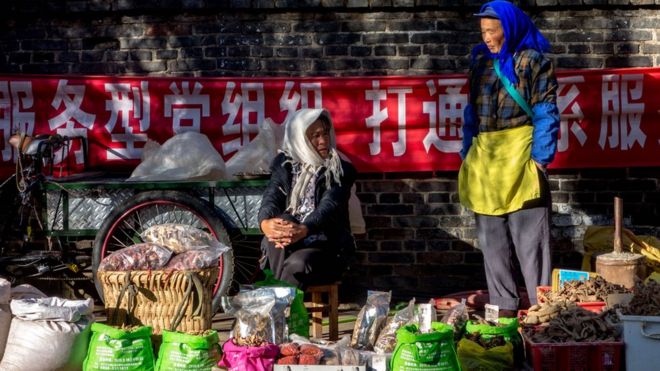
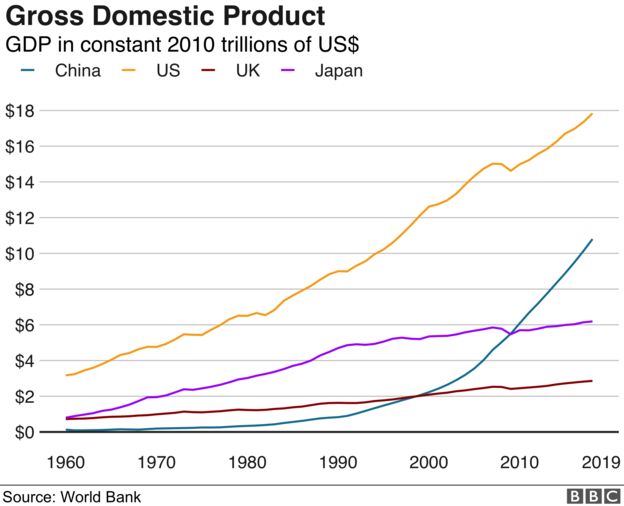
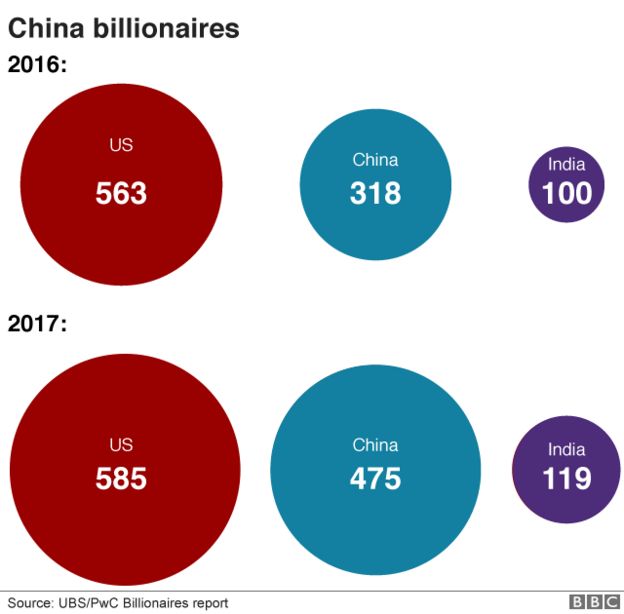
It took China less than 70 years to emerge from isolation and become one of the world’s greatest economic powers.
As the country celebrates the anniversary of the founding of the People’s Republic of China, we look back on how its transformation spread unprecedented wealth – and deepened inequality – across the Asian giant.
“When the Communist Party came into control of China it was very, very poor,” says DBS chief China economist Chris Leung.
“There were no trading partners, no diplomatic relationships, they were relying on self-sufficiency.”
Over the past 40 years, China has introduced a series of landmark market reforms to open up trade routes and investment flows, ultimately pulling hundreds of millions of people out of poverty.
The 1950s had seen one of the biggest human disasters of the 20th Century. The Great Leap Forward was Mao Zedong’s attempt to rapidly industrialise China’s peasant economy, but it failed and 10-40 million people died between 1959-1961 – the most costly famine in human history.
This was followed by the economic disruption of the Cultural Revolution in the 1960s, a campaign which Mao launched to rid the Communist party of his rivals, but which ended up destroying much of the country’s social fabric.
‘Workshop of the world’
Yet after Mao’s death in 1976, reforms spearheaded by Deng Xiaoping began to reshape the economy. Peasants were granted rights to farm their own plots, improving living standards and easing food shortages.
The door was opened to foreign investment as the US and China re-established diplomatic ties in 1979. Eager to take advantage of cheap labour and low rent costs, money poured in.
“From the end of the 1970s onwards we’ve seen what is easily the most impressive economic miracle of any economy in history,” says David Mann, global chief economist at Standard Chartered Bank.
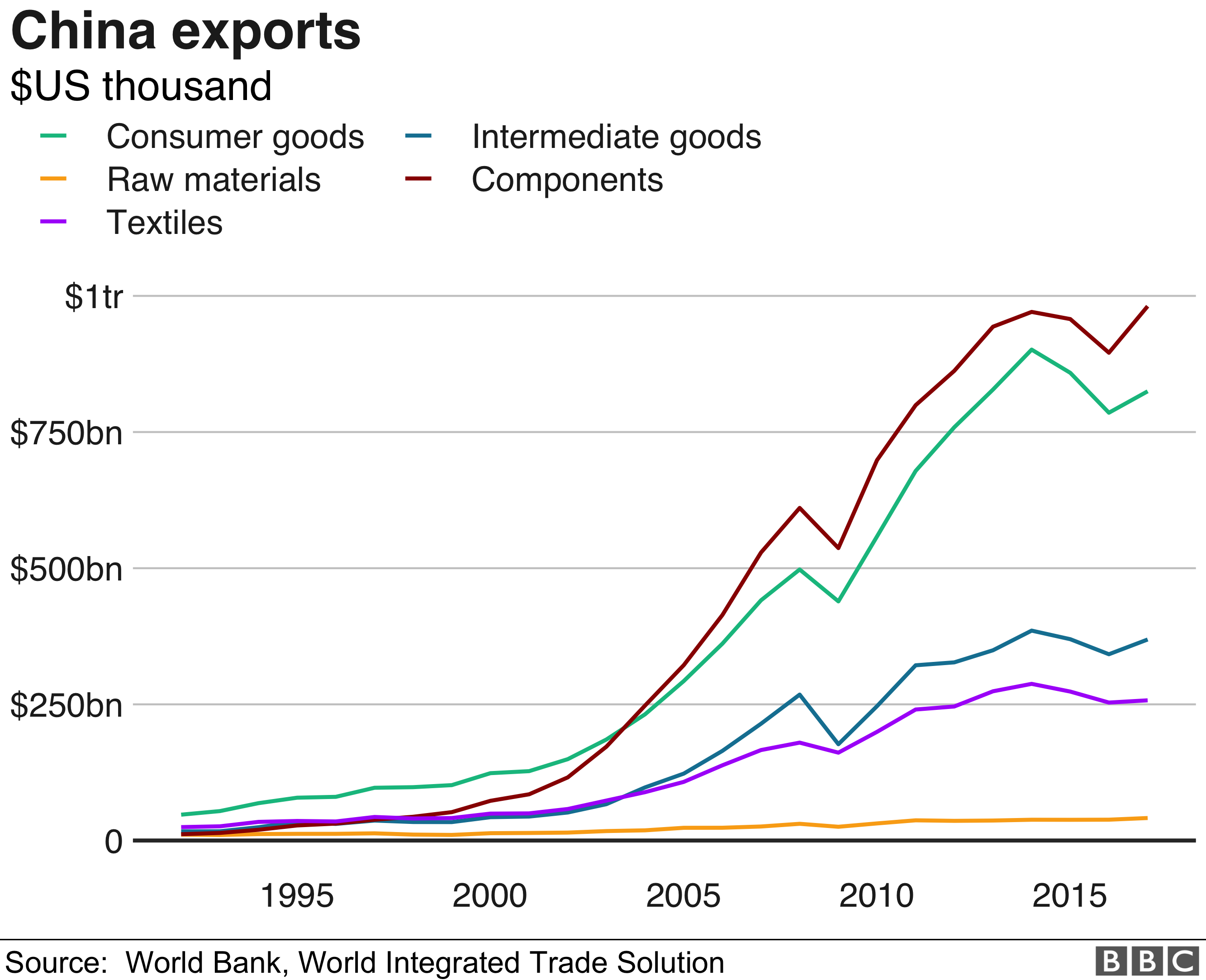
Through the 1990s, China began to clock rapid growth rates and joining the World Trade Organization in 2001 gave it another jolt. Trade barriers and tariffs with other countries were lowered and soon Chinese goods were everywhere.
“It became the workshop of the world,” Mr Mann says.
Take these figures from the London School of Economics: in 1978, exports were $10bn (£8.1bn), less than 1% of world trade.
By 1985, they hit $25bn and a little under two decades later exports valued $4.3trn, making China the world’s largest trading nation in goods.
Poverty rates tumble
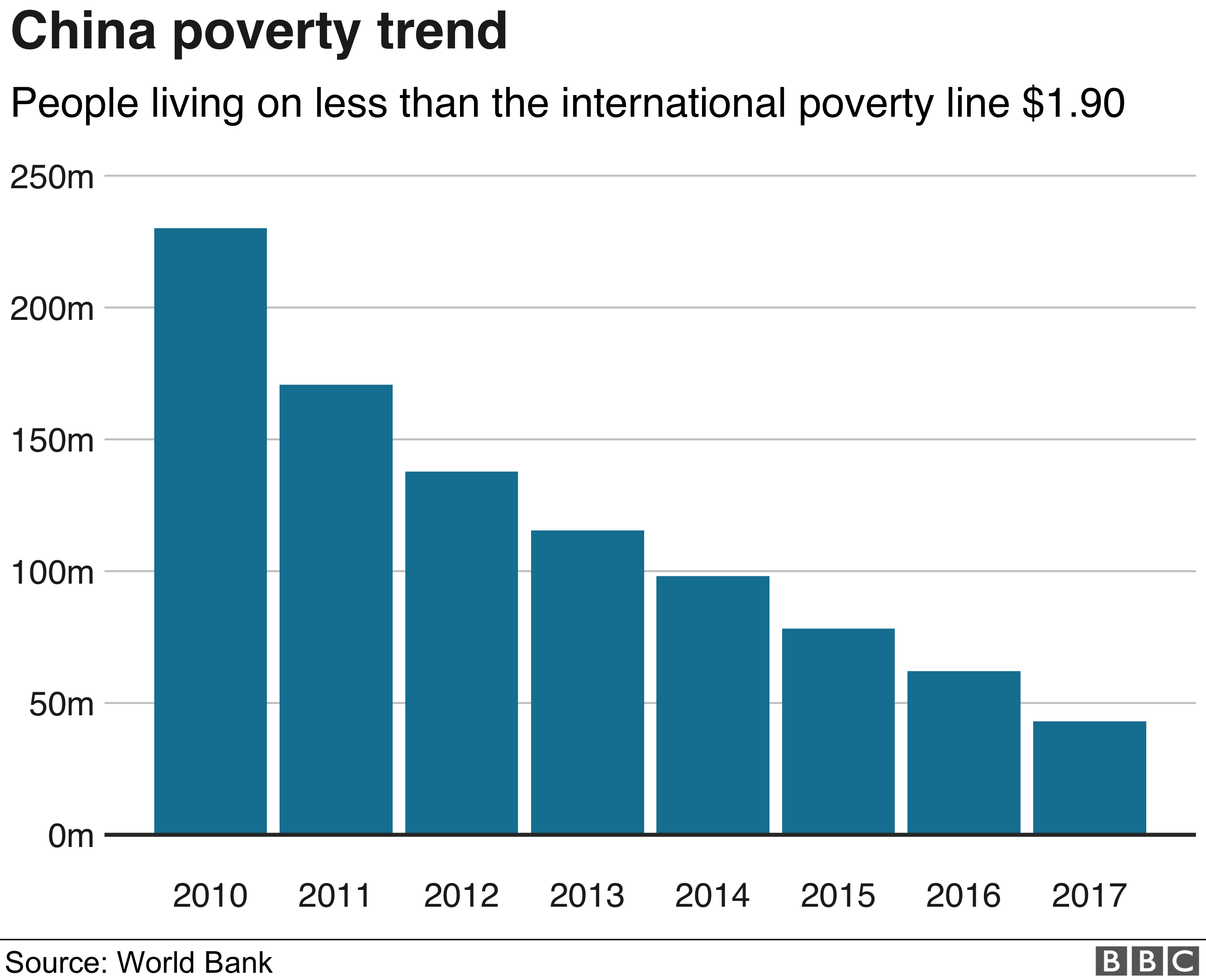
The economic reforms improved the fortunes of hundreds of millions of Chinese people.
The World Bank says more than 850 million people been lifted out of poverty, and the country is on track to eliminate absolute poverty by 2020.
At the same time, education rates have surged. Standard Chartered projects that by 2030, around 27% of China’s workforce will have a university education – that’s about the same as Germany today.
Rising inequality
Still, the fruits of economic success haven’t spread evenly across China’s population of 1.3 billion people.
Examples of extreme wealth and a rising middle class exist alongside poor rural communities, and a low skilled, ageing workforce. Inequality has deepened, largely along rural and urban divides.
“The entire economy is not advanced, there’s huge divergences between the different parts,” Mr Mann says.
The World Bank says China’s income per person is still that of a developing country, and less than one quarter of the average of advanced economies.
China’s average annual income is nearly $10,000, according to DBS, compared to around $62,000 in the US.
Slower growth
Now, China is shifting to an era of slower growth.
For years it has pushed to wean its dependence off exports and toward consumption-led growth. New challenges have emerged including softer global demand for its goods and a long-running trade war with the US. The pressures of demographic shifts and an ageing population also cloud the country’s economic outlook.
Still, even if the rate of growth in China eases to between 5% and 6%, the country will still be the most powerful engine of world economic growth.
“At that pace China will still be 35% of global growth, which is the biggest single contributor of any country, three times more important to global growth than the US,” Mr Mann says.
The next economic frontier
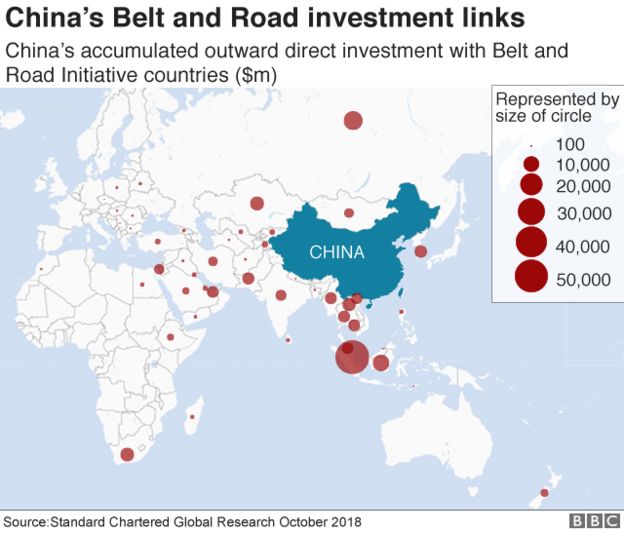
China is also carving out a new front in global economic development. The country’s next chapter in nation-building is unfolding through a wave of funding in the massive global infrastructure project, the Belt and Road Initiative.
The so-called new Silk Road aims to connect almost half the world’s populations and one-fifth of global GDP, setting up trade and investment links that stretch across the world.
Military experts say PLA modernisation brought about during Xi Jinping’s presidency will be the main focus of October 1 celebration in Beijing
It’s necessary for China to ‘show some of its muscle’ amid the trade dispute with the US, observer says
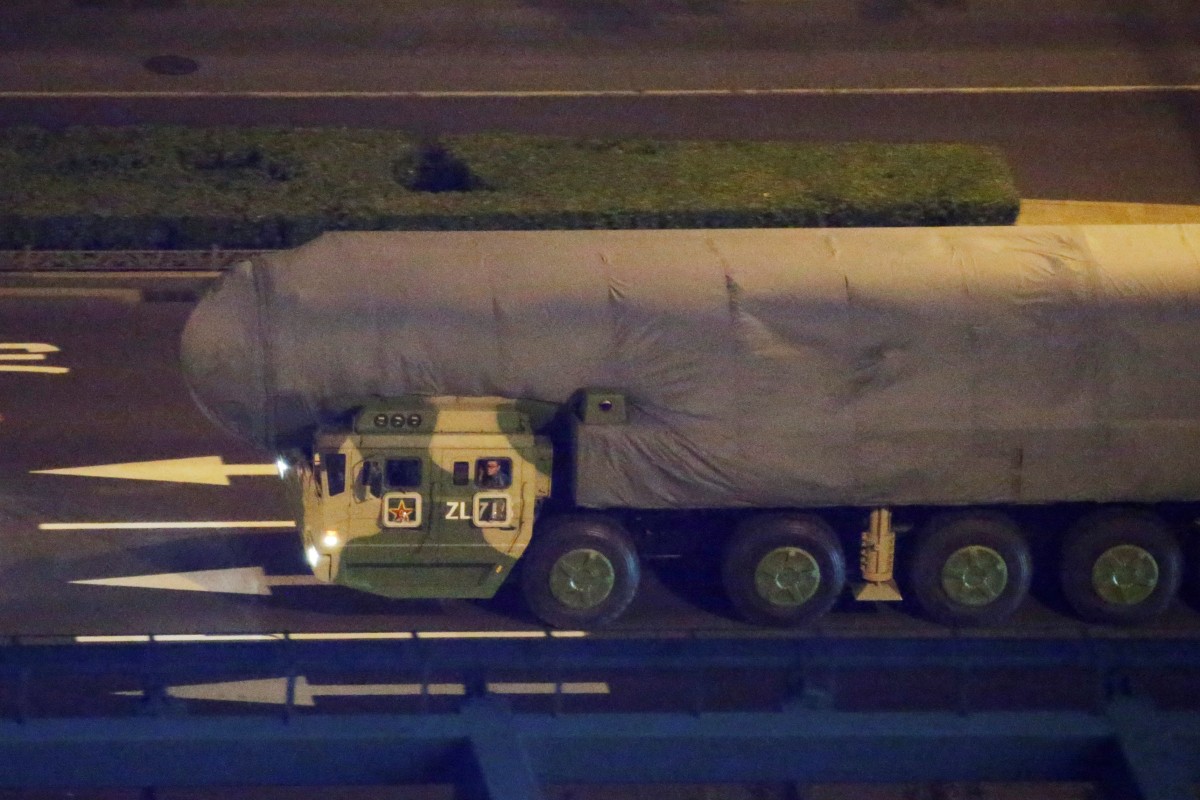
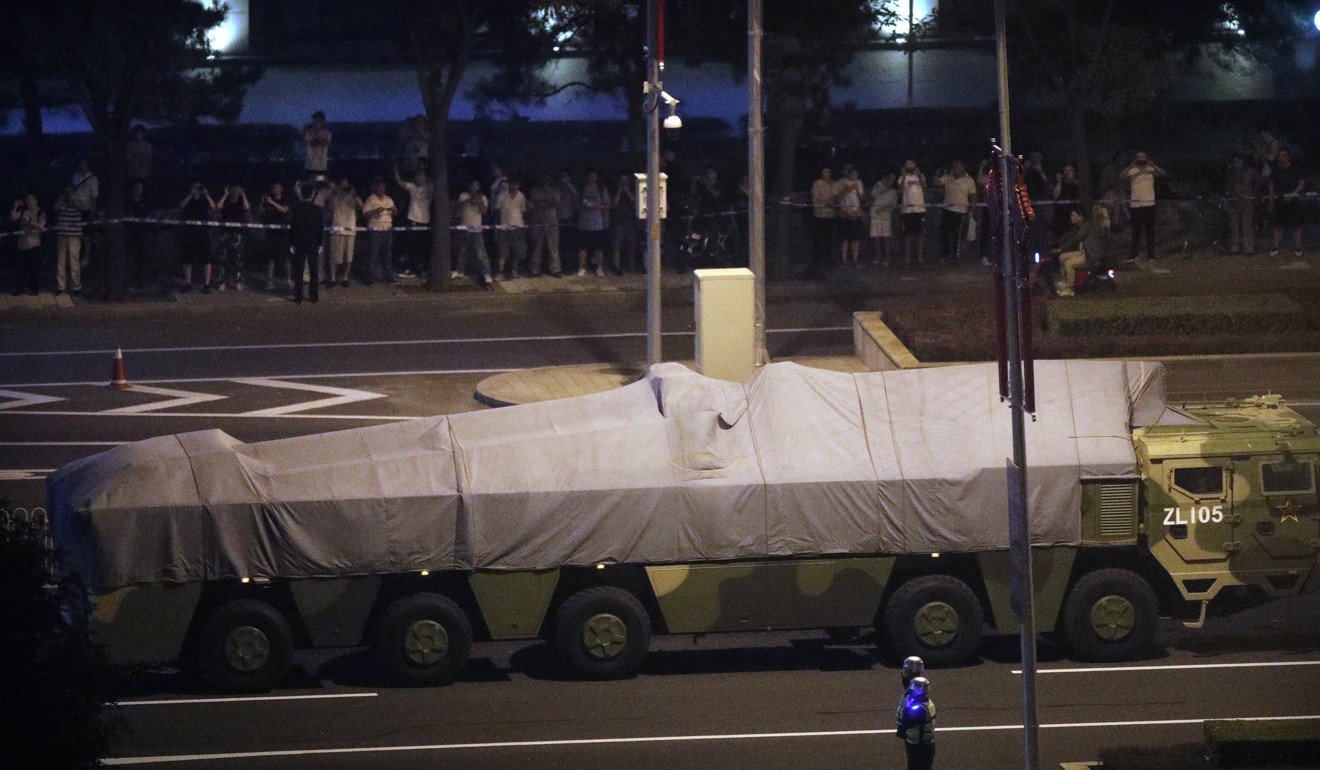
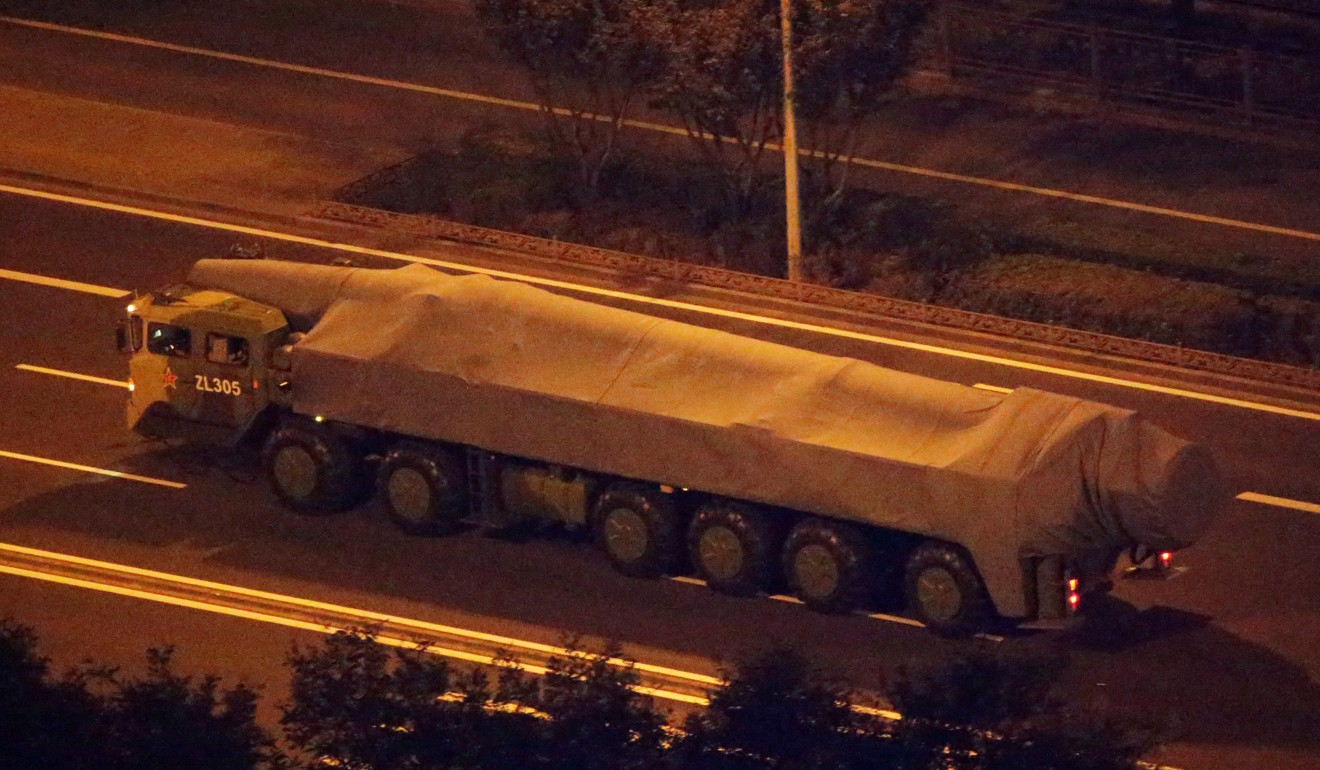
China’s land-based DF-41 intercontinental ballistic missile will be among the military hardware on show on October 1. Photo: Reuters
China plans to show off its most advanced active weapon systems at the upcoming National Day parade, which will be the biggest of the 14 such events it has held over the past seven decades.
The parade, to be held on October 1 to mark the 70th anniversary of the founding of the People’s Republic, will highlight the military modernisation – particularly in nuclear deterrence – that has taken place since President Xi Jinping came to power in late 2012, according to military experts.
The People’s Liberation Army (PLA) offered a glimpse of those weapons during rehearsals for the parade in downtown Beijing from September 14.
As part of the celebrations, Xi, who also chairs the Central Military Commission, will inspect 48 squads on the ground and more than a dozen airborne squadrons, according to a military insider involved in support services for the parade.
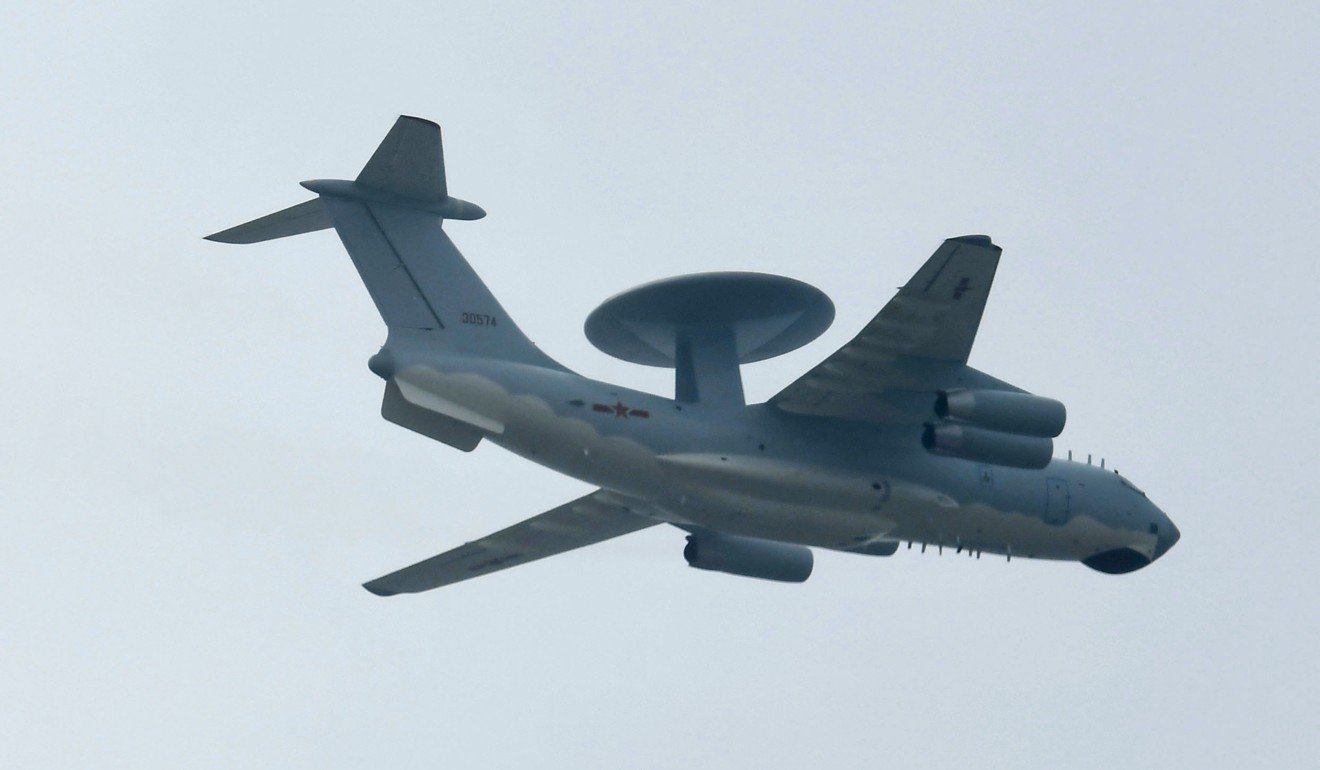
More than a dozen airborne squadrons will take part in the National Day parade. Photo: Kyodo
The squadrons will include the air force’s first stealth fighter, the J-20; the main active warplanes such as the J-10 and J-11B; and armed helicopters like the Z-20. However, the J-8 fighter jet would not appear this year, the source said, confirming that the first interceptor built in China has been formally retired.
“The ground march will be led by several hero forces from the five theatre commands, which is different from previous squads selected from the ground forces, air force and navy,” said the insider, who requested anonymity because of the sensitivity of the matter.
“The main goal of this year’s parade is to promote the military modernisation of the PLA under President Xi’s leadership over the past seven years, with the military overhaul being one of the key achievements.”
Thirty-three of the 48 squads would be “weapon squads”, while the 13 others would be made up of infantry troops from the five theatre commands, the source said.
National Day fireworks in Hong Kong cancelled over safety fears
As part of the PLA’s sweeping military reforms, the army’s previous seven military commands were reshaped into five theatre commands, while the four former general headquarters were dissolved and replaced by 15 small functional departments.
In September 2015, Xi announced the PLA would shed 300,000 troops, cutting its size to 2 million, a move aimed at turning the PLA into a more nimble and combat-ready fighting force on a par with international standards.
Xi also split the former Second Artillery Corps into the Rocket Force and the Strategic Support Force, with the latter backing up the military’s electronic warfare units in cyberspace and outer space.
Among the 33 weapon squads, the highlights are expected to be the PLA’s strategic nuclear missiles such as the Rocket Force’s land-based DF-41 intercontinental ballistic missile (ICBM), the DF-21D anti-ship ballistic missile, the DF-17 hypersonic missile and the sea-launched JL-2, or Big Wave-2.
Adam Ni, a researcher at Macquarie University in Australia, said that showing off different types of missiles on land and sea indicated that the PLA was improving its nuclear deterrence capabilities by perfecting a three-pronged military force structure, or the so-called nuclear triad.
The DF-17 hypersonic ballistic missile will be one of the highlights of the parade. Photo: AP
The DF-41 is capable of carrying multiple warheads and many decoys, making it harder to detect than silo-based systems and better able to survive a first strike.
Ni said the DF-41 was China’s next-generation cutting-edge weapon.
“It’s actually an advanced ICBM and has a range to hit practically anywhere in the world, including the continental United States,” Ni said.
“The DF-41 is the ultimate symbol of the destructive potential of Chinese armed forces, just as nuclear weapons are similar symbols of the US and Russia.”
The JL-2 – which has a shorter range of 7,000km (4,350 miles) and can be launched by the PLA Navy’s Type 094 submarines – is unable to hit anywhere on the American continent when launched from submarines in the South China Sea and coastal areas of China.
China tests new warships in live-fire drills near Vietnam
However, China is developing the JL-3, which has a range of about 9,000km; the upgraded version of the JL-2, with a flight test conducted in June, though it is still less than the 12,000km range of the American Trident II.
“China is stepping up its military modernisation, which includes a number of aspects; the land-based aspect is introducing more mobile and survivable missile systems,” Ni said.
“The game change will happen when China is able to hit the whole US continent with its missile submarines in Chinese coastal waters.”
In military terms, survivable refers to the ability to remain mission capable after a single engagement.
The DF-17 is a land-to-land short-range strategic missile capable of delivering both nuclear and conventional payloads. The US intelligence community has estimated that it will reach initial operational capability by 2020. But if the missile is displayed in the parade, that means it is active already.
China conducted two tests of the DF-17 in November 2017, with the first launched from the Jiuquan Space Launch Centre in Inner Mongolia.
An insider said the main goal of this year’s parade is to promote the military modernisation of the PLA. Photo: Reuters
Hong Kong-based military commentator Song Zhongping said the nuclear weapons that would go on show in the parade would all be strategic missiles designed to improve China’s deterrent capabilities.
The show comes after the PLA delivered a national defence white paper in July stressing its goal to “maintain national strategic security by deterring other countries from using or threatening to use nuclear weapons against China”.
Unlike in the past, this year’s report stated that the US and China were now competing superpowers, and that the PLA’s growing forces were developing to the point that they could challenge the US.
Zhou Chenming, a Beijing-based military observer, said it was also necessary for the PLA to “show some of its muscle” amid the ongoing trade dispute between Beijing and Washington.
“To prevent misunderstanding, most of the weapons are just strategic equipment, not tactical arms, because Beijing still doesn’t want to irritate Washington,” he said.
About 280,000 people were involved in the rehearsals for the parade and related support services, according to Xinhua.
WASHINGTON (Reuters) – A French warship passed through the strategic Taiwan Strait this month, U.S. officials told Reuters, a rare voyage by a vessel of a European country that is likely to be welcomed by Washington but increase tension with Beijing.
The passage, which was confirmed by China, is a sign that U.S. allies are increasingly asserting freedom of navigation in international waterways near China. It could open the door for other allies, such as Japan and Australia, to consider similar operations.
The French operation comes amid increasing tensions between the United States and China. Taiwan is one of a growing number of flashpoints in the U.S.-China relationship, which also include a trade war, U.S. sanctions and China’s increasingly muscular military posture in the South China Sea, where the United States also conducts freedom of navigation patrols.
Two officials, speaking on condition of anonymity, said a French military vessel carried out the transit in the narrow waterway between China and Taiwan on April 6.
One of the officials identified the warship as the French frigate Vendemiaire and said it was shadowed by the Chinese military. The official was not aware of any previous French military passage through the Taiwan Strait.
The officials said that as a result of the passage, China notified France it was no longer invited to a naval parade to mark the 70 years since the founding of China’s Navy. Warships from India, Australia and several other nations participated.
China said on Thursday it had lodged “stern representations” with France for what it called an “illegal” passage.
“China’s military sent navy ships in accordance with the law and the rules to identify the French ship and warn it to leave,” defence ministry spokesman Ren Guoqiang told a regularly scheduled media briefing, while declining to say if the sailing had led to the withdrawal of France’s invitation to the parade of ships this week.
“China’s military will stay alert to firmly safeguard China’s sovereignty and security,” he said.
Colonel Patrik Steiger, the spokesman for France’s military chief of staff, declined to comment on an operational mission.
The U.S. officials did not speculate on the purpose of the passage or whether it was designed to assert freedom of navigation.
MOUNTING TENSIONS
The French strait passage comes against the backdrop of increasingly regular passages by U.S. warships through the strategic waterway. Last month, the United States sent Navy and Coast Guard ships through the Taiwan Strait.
The passages upset China, which claims self-ruled Taiwan as part of its territory. Beijing has been ramping up pressure to assert its sovereignty over the island.
Chen Chung-chi, spokesman for Taiwan’s defence ministry, told Reuters by phone the strait is part of busy international waters and it is “a necessity” for vessels from all countries to transit through it. He said Taiwan’s defence ministry will continue to monitor movement of foreign vessels in the region.
“This is an important development both because of the transit itself but also because it reflects a more geopolitical approach by France towards China and the broader Asia-Pacific,” said Abraham Denmark, a former U.S. deputy assistant secretary of defence for East Asia.
The transit is a sign that countries like France are not only looking at China through the lens of trade but from a military standpoint as well, Denmark said.
Last month, France and China signed deals worth billions of euros during a visit to Paris by Chinese President Xi Jinping. French President Emmanuel Macron wants to forge a united European front to confront Chinese advances in trade and technology.
QINGDAO, China (Reuters) – Warships from India, Australia and several other nations arrived in the eastern Chinese port city of Qingdao on Sunday to attend a naval parade, part of a goodwill visit as China extends the hand of friendship despite regional tensions and suspicions.
China on Tuesday will mark 70 years since the founding of the People’s Liberation Army Navy, where it will show off new warships including nuclear submarines and destroyers at a major review in the waters off Qingdao.
China says warships from about a dozen nations are also taking part – one diplomatic source with direct knowledge said it was 13 countries in total – and the PLA is putting its best foot forward to welcome them.
India, which has been at odds with China over their disputed land border and Beijing’s support for India’s regional rival Pakistan, has sent stealth guided-missile destroyer the “INS Kolkata” to take part, along with a supply ship.
“We bring to you one of the best ships that we have made. It is the pride of the nation and the navy, and we are very happy to be here,” Captain Aditya Hara told reporters on the dockside after disembarking from the ship in Qingdao.
A source familiar with the situation told Reuters the “Kolkata” had sailed through the Taiwan Strait to get to Qingdao, a sensitive waterway that separates China from self-ruled Taiwan, claimed by Beijing as sacred Chinese territory.
“We headed on a direct route and we are very happy that we were facilitated by the PLA Navy and they ensured that we had a safe passage to Qingdao,” Hara said, when asked if they had sailed via the Taiwan Strait.
Australia, a close U.S. ally, has sent the “HMAS Melbourne” guided-missile frigate to Qingdao, though officials declined to make the captain available for interview.
China and Australia have sparred over Australian suspicions of Chinese interference in the country’s politics and Australia’s banning of China’s Huawei Technologies Co Ltd from supplying equipment for its planned 5G broadband network.
Japan has also sent a destroyer to Qingdao, in the first visit of a Japanese navy ship to China since 2011, according to Japanese media.
Ties between China and Japan, the world’s second and third-largest economies, have been plagued by a long-running territorial dispute over a cluster of East China Sea islets and suspicion in China about Japanese Prime Minister Shinzo Abe’s efforts to amend Japan’s pacifist constitution.
But they have sought to improve relations more recently, with Abe visiting Beijing in October, when both countries pledged to forge closer ties and signed a broad range of agreements including a $30 billion currency swap pact.
The other countries taking part include China’s close friend Russia, and three countries which have sparred with China over competing claims in the disputed South China Sea: Vietnam, Malaysia and the Philippines.
Pakistan, a very close Chinese ally, is not on the list of countries officials have provided which are sending ships to the parade.
Next month’s nautical spectacle will allow country to show off its most advanced warships to an international audience
More than a dozen foreign navies are expected to join in, including the United States
Chinese navy’s 70th birthday parade showcases rising sea power
1 Mar 2019
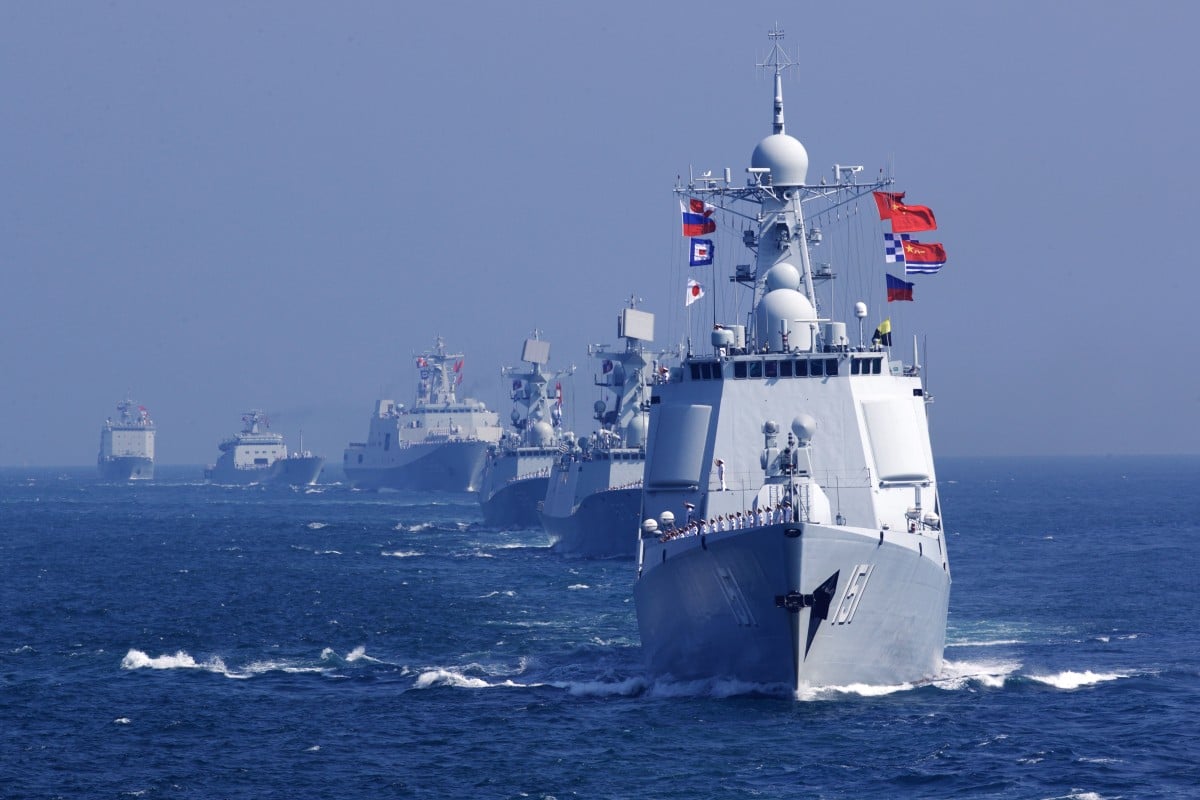
Chinese warships pictured at the end of joint exercise with the Russian navy in 2016. Photo: Xinhua
China will hold a naval parade next month to mark the 70th anniversary of the founding of the People’s Liberation Army Navy and will invite more than a dozen of foreign navies to participate.
The parade will take place on April 23 in the Yellow Sea off the coast of Qingdao in Shandong province, Ren Zhiqiang, a spokesman for the Ministry of National Defence, said on Thursday.
Ren did not provide further details of the parade but military analysts said the exercise would give the navy the opportunity to display its rapidly growing strength and show how that has increased in the past 12 months.
‘No-go zone’ in Yellow Sea for Chinese aircraft carrier sea trials
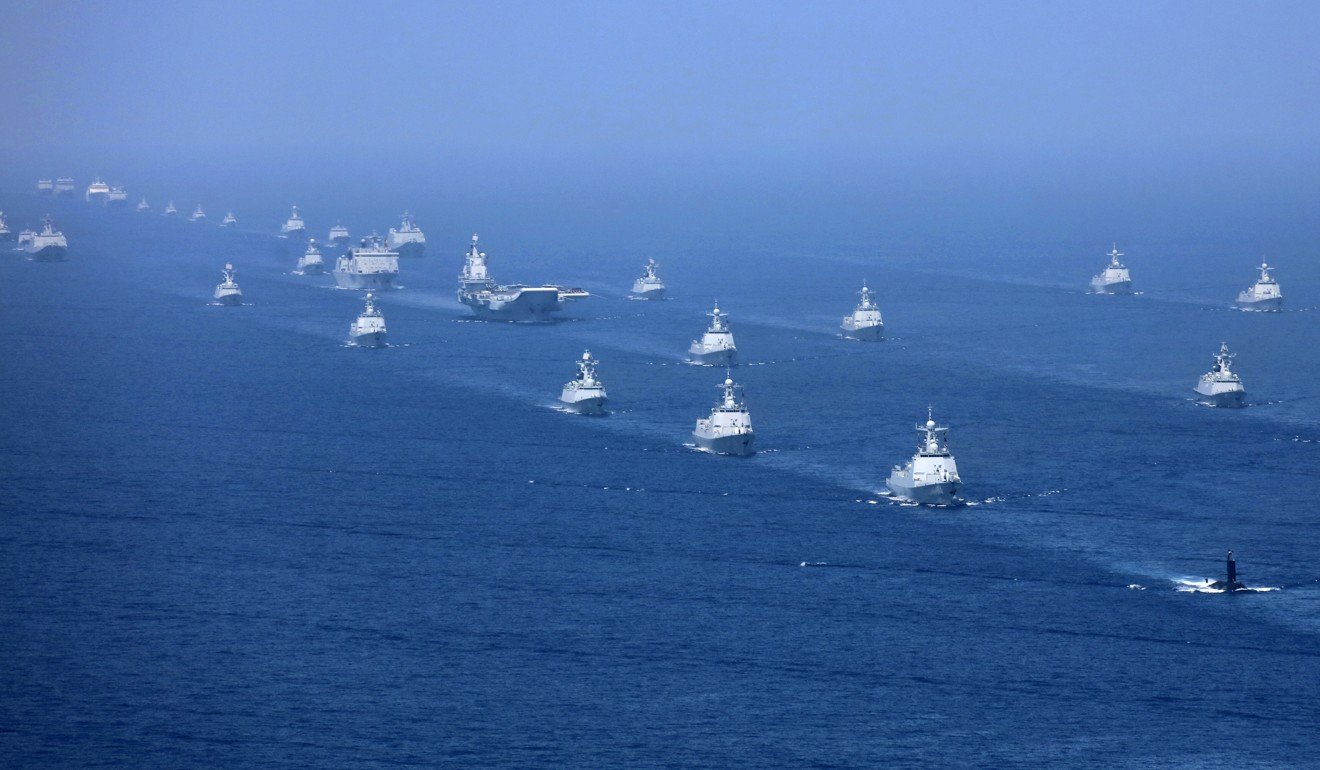
In April last year a naval review in the South China Sea featured a total of 48 vessels and 76 planes, including China’s first aircraft carrier, the Liaoning, its Type 094A and 095 nuclear submarines, 052D guided missile destroyers and J-15 fighter jets.
The experts expect that next month’s event will provide a showcase for several new and more powerful vessels including its home-grown aircraft carrier Type 001A, the Type 055 – Asia’s most powerful destroyer – and several nuclear submarines.
“The fact that China is holding the naval parade just one year after the South China Sea review shows the great importance [the leadership] attaches to the development of China’s maritime interests, the navy and its expansion,” navy expert Li Jie said.
Chinese President Xi Jinping joined the crew on the deck of the cruiser Changsha following last year’s naval review. Photo: Xinhua
Share:
China also held a major naval parade in 2009 to mark the navy’s 60th anniversary.
It was smaller in scale than the upcoming extravaganza with 25 PLA vessels and 31 fighter jets taking part.
Fourteen foreign navies sent ships to the 2009 parade, including the USS Fitzgerald from America and the guided-missile cruiser Varyag from Russia. France, Australia, South Korea, India and Pakistan also joined in the event.
More foreign countries are expected to join the party this year as the PLA has become more active internationally and China has sold more warships to foreign navies.
China’s new veterans’ law to be reviewed at National People’s Congress next week
“The parade is more like a birthday party for the PLA Navy and the participation of foreign navies is a matter of diplomatic courtesy with few military implications,” said Yue Gang, a former PLA colonel.
Yue said the US and its allies would attend despite the rising tensions between the two sides.
Since 2015 the US and Chinese navies have engaged in a series of confrontations in the South China Sea as China strengthens its military presence in the region and the US has sought to challenge Beijing’s claims to the waters by conducting what it describes as “freedom of navigation” operations.
“I don’t expect they will send any of the warships that have taken part in such operations [to the parade],” Yue said.
China has greatly expanded its naval capabilities in recent years. Photo: AP
Share:
It has been reported that the Japanese Maritime Self-Defence Force has expressed an interest in joining the parade and the Philippines – which has a rival claim to the South China Sea – is planning to send a vessel to the event for the first time.
Li said militaries such as the US and Japan would not want to miss the chance to observe the PLA Navy closely.
“In addition, greater transparency [through the parade] will also help reassure smaller regional partners such as the Philippines that China is a friendly power despite its growing military strength,” he said.
China held its first naval parade in 1957 and April’s display will be the sixth such event.
Sailors also took part in the parade through Tiananmen Square to mark the foundation of the People’s Republic on October 1 1949.




 CHINDIA ALERT: You'll be living in their world, very soon
China’s Liaoning aircraft carrier returns home from a month of training
China’s first aircraft carrier, the Liaoning, returned to its home port of Qingdao on Thursday after nearly a month of training on the high seas, the People’s Liberation Army said.
According to military analysts, the warship was joined by at least five escort vessels, and the drills showed its crew had not been affected by the coronavirus pandemic and that it remained combat-ready.
The annual cross-region drills included intensive and complicated air and sea operations, the official PLA Daily said in a post on social media on Friday.
“The drills have further improved the real combat training level of the Liaoning carrier strike group, putting its systematic combat capability to the test,” the statement on WeChat said, without giving other details.
Beijing-based naval expert Li Jie said it was important for the carrier to get back to training activities.
“The recent training by the Liaoning carrier strike group is very significant because it’s evidence that none of the 2,000 sailors and commanders on the ship have been hit by Covid-19, and neither have any of the other soldiers and personnel on the other warships and support units,” Li said.
The coronavirus situation has eased in China, where the first cases were reported late last year, but it continues to spread across the globe and has infected more than 3.2 million people worldwide and killed over 233,000.
Sailors on warships like USS Theodore Roosevelt vulnerable as coronavirus spreads
The virus has also hit crew members on at least 40 US Navy warships, and Li said that left China with the only operational aircraft carrier in the region.
“Since the four American aircraft carriers in the Indo-Pacific region have all been struck by the pandemic, China is the only country that can operate an aircraft carrier in the area,” he said.
Japan’s Ministry of Defence said the Liaoning was escorted by two destroyers, two frigates and a supply ship, and they had passed through the Bashi Channel, a waterway to the south of Taiwan, and headed towards waters east of Taiwan.
As tensions continue to simmer between Taipei and Beijing, the PLA has stepped up activities around the island, which the mainland sees as part of its territory awaiting reunification.
Hong Kong-based military commentator Song Zhongping said the latest naval drills were also aimed at heaping more pressure on Taiwan’s pro-independence forces as well as foreign countries seeking to intervene in cross-strait issues.
Coronavirus: US ‘supports Taiwan joining WHO events’ in ministerial phone call
“Taiwan’s pro-independence forces have become more active and are attempting to take advantage amid the pandemic,” said Song, a military commentator with Phoenix Television.
“The Liaoning would play a major role in the PLA’s plan to unify Taiwan by force, so it’s necessary for the aircraft carrier strike group to get back to operations, step up training and send a warning to Taipei,” he added.
Lu Li-Shih, a former instructor at the naval academy in Taiwan, noted that the PLA Navy had regularly held drills in the waters east of Taiwan in recent years to avoid surveillance by US satellites.
Source: SCMP
Posted in air and sea operations, Aircraft, Aircraft carrier, annual, Beijing, by force, China’s, combat-ready, complicated, coronavirus, Coronavirus pandemic, cross-region drills, destroyers, escort vessels, Friday, frigates, from, high seas, home port, intensive, Japan’s Ministry of Defence, Liaoning, military commentator, military’s plan, month, naval academy, People’s Liberation Army, pla navy, pro-independence forces, Qingdao, returns home, sailing through, sailors, scramble, self-ruled island, social media, strait, strike group, supply ship, Surveillance, Taipei, Taiwan, Taiwan Strait, Taiwan’s, Taiwan’s defence ministry, to unify, training, Uncategorized, US Navy, US satellites, USS Theodore Roosevelt, vulnerable, warship, warships, WeChat, western Pacific, WHO | Leave a Comment »