This story is part of an ongoing series on US-China relations produced jointly by theSouth China Morning Post and POLITICO, with reporting from Asia and the United States.
THIS WEEK IN ASIA
Get updates direct to your inbox
Rising tensions over Beijing’s accelerating military build-up in the South China Sea are stoking fears of a major-power clash between China and the United States – fuelling urgent calls for new security talks before the two nations stumble into a shooting war.
But the worries come amid a dearth of official dialogue between two of the world’s largest militaries, and as US leaders espouse an increasingly harder line against China’s actions.
The US and its allies have stepped up naval and air patrols over the sea and cancelled joint exercises with Beijing, while China is considering requiring all aircraft flying over the area to first identify themselves – a step that many nations would consider threatening.
Military experts say the showdown could easily spin out of control.
“Chinese colleagues have said to me explicitly that if the US continues to sail through and overfly what they see as their waters, China will eventually shoot down the offending aircraft,” said Matthew Kroenig, a former CIA analyst and Pentagon strategist.
“Maybe that’s just a bluff, but if China shot down a US plane, that would be a scenario ripe for escalation. It’s hard to see President Trump or any other US leader backing down from that.”
US military leaders insist they’re determined to avoid that. Navy Admiral Phil Davidson, the US commander of the Indo-Pacific Command, told POLITICO he’s eager to open a new dialogue with his Chinese counterparts, contending that “a military-to-military relationship is quite important.”
“I have yet to meet the [chief of defence] or the minister of defence in China,” he said. “I hope to visit early next year.”
Marine General Joseph Dunford, the chairman of the US Joint Chiefs of Staff, says establishing more channels for the militaries to avoid conflict is one of his top priorities as Washington and Beijing also tussle over issues such as trade and North Korea’s nuclear program. “Competition does not necessarily lead to conflict,” he said at a recent security forum in Canada.
On the other hand, the US is trying to send Chinese leaders a pointed message by sending an increased number of military patrols through the disputed waters, Dunford said in an interview with POLITICO.
“What we are doing is preserving the principle of open access to the global commons,” Dunford said. And he said nations “violating international norms, standards and the law” should know they are “going to pay a cost that is higher than whatever they hope to gain.”
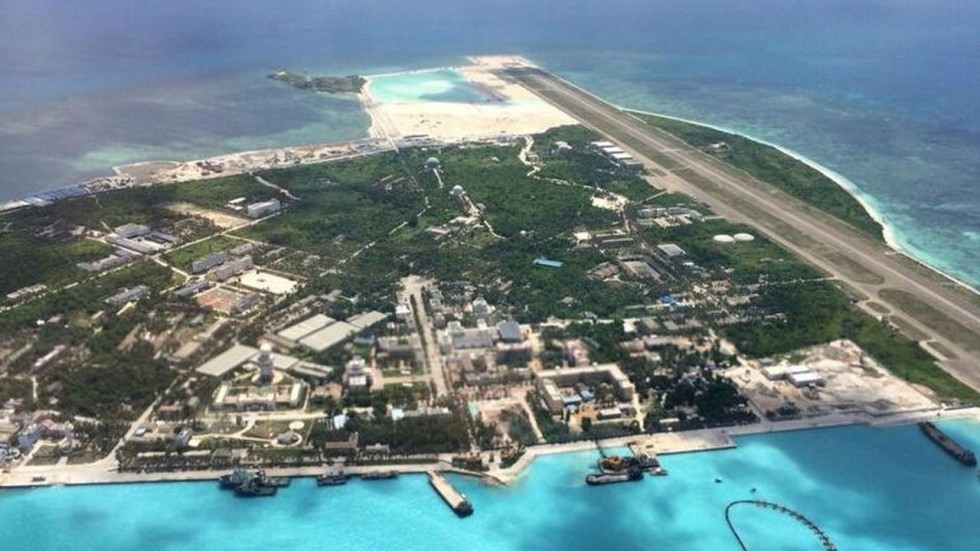
Similarly, Beijing’s leaders are not backing down from their military expansion in the vast South China Sea, which stretches more than 1.3 million square miles with trillions of dollars worth of trade transiting annually. Those waters near the Spratly Islands chain where China seized reefs and began building artificial islands during the second term of the Obama administration.
Despite public assurances from President Xi Jinping that the features would not be militarised, China recently deployed surface-to-air missiles and other weapons and equipment. Earlier this year, satellite images showed that Beijing has built at least four airstrips suitable for military aircraft on Woody Island, as well as the reefs in the archipelago known as Fiery Cross, Mischief and Subi.
China has telegraphed steps to further solidify its claims in the waters. In June, Chinese Lieutenant General He Lei acknowledged during the Shangri-La defence summit in Singapore that China is deploying troops and weapons on both natural and man-made islands in the Paracel and Spratly archipelagos.
Chinese military sources from a state-owned firm specialising in radar systems to detect stealth aircraft for the PLA said the People’s Liberation Army’s Air Force and Strategic Support Force have also placed sophisticated radar systems in the South China Sea.
“Since the US has kept sending spy aircraft to do the close-in reconnaissance activities near China’s territory waters in the South China Sea, it’s necessary to deploy a sophisticated radar system to the artificial islands to detect the US aircraft,” one of the sources from the firm said.
Lieutenant General He Lei, who led the Chinese military delegation to the Shanghai-La Dialogue, said that “deploying troops and weapons on islands in the South China Sea is within China’s sovereign right to do and allowed by international law.”
The US and other countries have condemned the expansion as a violation of international law. And, in recent months, top American military officials have dropped some of their usual diplomatic language.
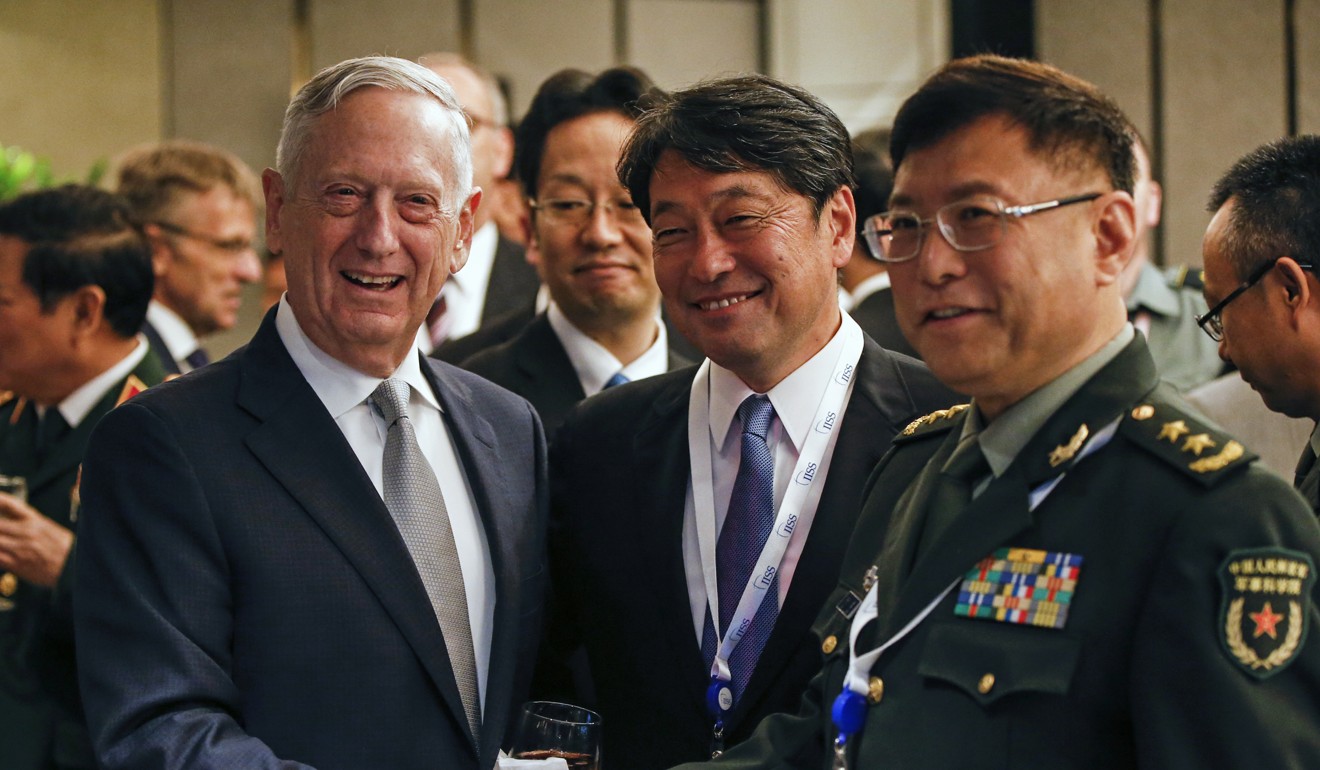
US Defence Secretary James Mattis revoked China’s invitation to participate in an annual military exercise this fall, then cancelled a trip to Beijing planned for October.
“If you’d asked me two months ago, I’d have said we are still attempting to maintain a cooperative stance,” the retired four-star general said at the Shangri-La summit. “But then you look at what President Xi said in the Rose Garden of the White House in 2015, that they would not militarise the Spratlys, and then we watched what happened four weeks ago, it was time to say there’s a consequence to this.”
During his trip to Vietnam in October, Mattis said Washington was highly concerned about China’s “predatory” behaviour and militarisation of the South China Sea.
“We remain highly concerned with the continued militarisation of features in the South China Sea,” he said, saying that this continued to happen despite a pledge by President Xi Jinping not to do so.
Davidson, the top American commander in the Asia-Pacific, expressed alarm recently at China’s “secretly deployed anti-ship missiles, electronic jammers and surface-to-air missiles.”
“So what was a great wall of sand just three years ago,” Davidson added, “is now a great wall of SAMs in the South China Sea, giving [the People’s Republic of China] the potential to exert national control over international waters in the South China Sea.”
The US and its allies have also launched “freedom of navigation” operations in the region. In September, two pairs of US Air Force B-52 bombers flew over the disputed area – one pair over the South China Sea and one over the East China Sea. A week later, the destroyer USS Decatur came within 12 nautical miles of two of the disputed reefs, prompting manoeuvres by a Chinese destroyer that the Pentagon called “unsafe” and “unprofessional.”
Australia, Japan, France, Canada and New Zealand are among the allies taking part in the patrols.
But the growing prominence of those other military forces has caused China to “push back more, and that heightens the risk that you could have an inadvertent crisis,” said Lindsey Ford of the Asia Society, who is also a former senior adviser to the US assistant secretary of Defence for Asian and Pacific security affairs.
China’s interest is not simply to exert political or economic influence in the region, said Kroenig, the former CIA analyst. Its activities are also defensive in nature, he believes.
China, like the Soviet Union during the cold war, is not confident that its nuclear ballistic missile submarines could survive in the open ocean during a conflict with the United States, he said – because waters closer to Chinese territory are too shallow. So it hopes to use the South China Sea as an operating area for its subs.
“That’s a strategic military purpose on top of the political purpose,” said Kroenig. “I’ve had a Chinese colleague say to me: ‘You guys don’t really care about these territorial claims in the South China Sea. You’re trying to deny our nuclear deterrent.’”
Now, Chinese military experts say, Beijing is considering establishing an “air defence identification zone”, which would require all aircraft over the area to declare their identity and destination.
The rationale is ostensibly peaceful in nature: Chinese officials maintain it would help prevent disasters such as the 2014 disappearance of Malaysia Airlines flight MH370.
But a zone Beijing established in the East China Sea in 2013 drew a joint rebuke from Japan and the Association of Southeast Asian Nations, which considered it threatening.
The resistance from other nations “implied that such a move constituted a security challenge”, said Collin Koh Swee Lean, an analyst at the S. Rajaratnam School of International Studies in Singapore.
Koh warned that the air traffic proposal could derail regional talks about establishing a code of conduct to avoid confrontations in the area. He also predicted that the US might feel compelled to ramp up its military presence in response – a view echoed by Zhou Chenming, a military expert based in Beijing.
Further fuelling tensions in the South China Sea is the growing role of China’s so-called Maritime Militia, a naval paramilitary force that operates disguised as fishing or other civilian vessels. Vice-President Mike Pence recently criticised the forces as extra-legal, and the rules for approaching them are ill-defined.
“Should we treat them as military vessels and expect them to behave that way?” asked the Asia Society’s Ford. “China is exploiting a loophole. Pence’s recent remarks calling out the Maritime Militia explicitly suggest the US is refining its thinking about how to approach that loophole.”
For now, senior American military leaders are expressing confidence that US forces can continue to aggressively promote their freedom of navigation mission without sparking a violent confrontation.
“I think one of the unfortunate things is the focus on two destroyers passing in the daylight,” Davidson told POLITICO. “That is not what the issue is about in the South China Sea. It is about trade, commerce, financial markets moving their information around the globe – every airline that flies over the top.”
Others worry that the longer the United States and China up the ante the more likely things could spin out of control.


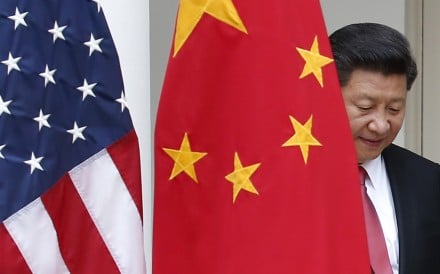
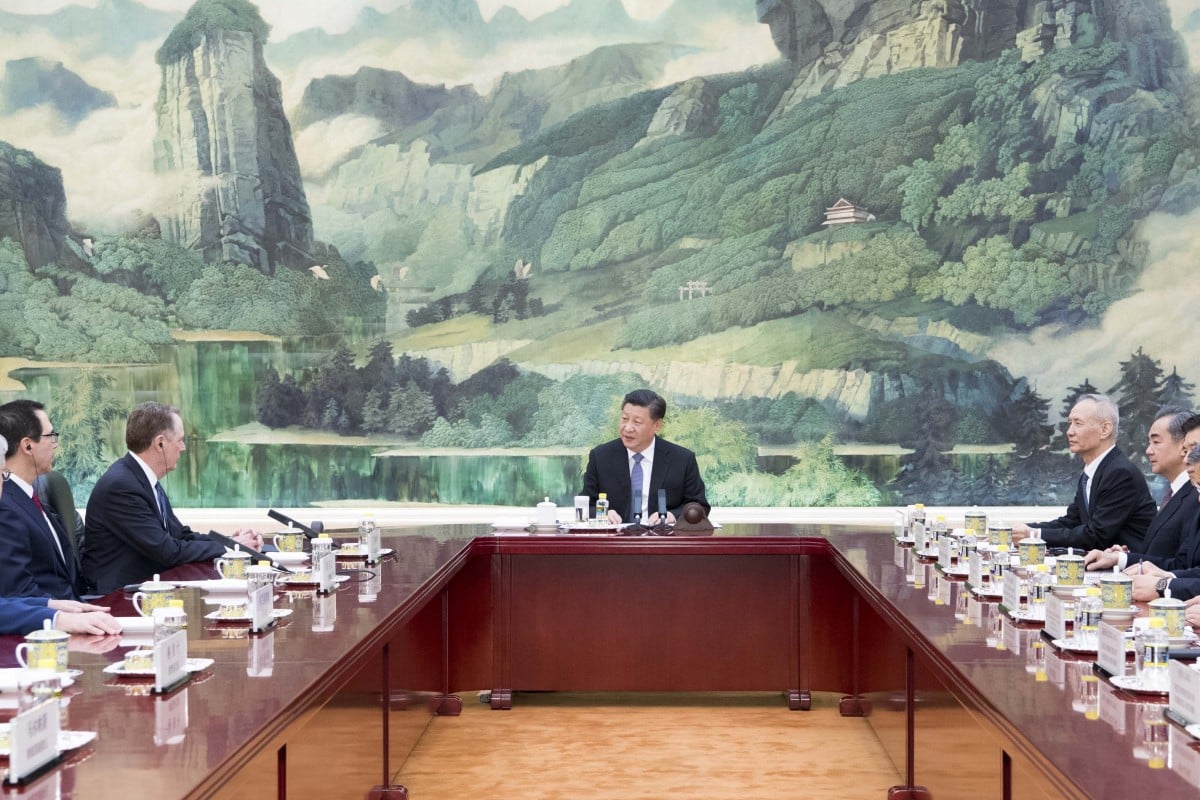 Chinese President Xi Jinping urged for a “mutually beneficial” trade deal in this week’s talks when he met US trade representative Robert Lighthizer and US Treasury Secretary Steven Mnuchin in Beijing on Friday, according to Xinhua. Photo: Xinhua
 Donald J. Trump



 CHINDIA ALERT: You'll be living in their world, very soon


4