Chindia Alert: You’ll be Living in their World Very Soon
aims to alert you to the threats and opportunities that China and India present. China and India require serious attention; case of ‘hidden dragon and crouching tiger’.
Without this attention, governments, businesses and, indeed, individuals may find themselves at a great disadvantage sooner rather than later.
The POSTs (front webpages) are mainly 'cuttings' from reliable sources, updated continuously.
The PAGEs (see Tabs, above) attempt to make the information more meaningful by putting some structure to the information we have researched and assembled since 2006.
BEIJING (Reuters) – China announced on Sunday two new confirmed cases of coronavirus and four new asymptomatic cases, including one person without symptoms of COVID-19 on a chartered flight from Germany.
The two confirmed cases in Shandong province on Saturday compared with four cases the day before, data from the country’s health authority showed.
The National Health Commission (NHC) confirmed three new asymptomatic cases on Saturday.
On Sunday, the Chinese city of Tianjin confirmed one asymptomatic person, a passenger arriving from Frankfurt on a chartered Lufthansa flight, LH342, to Tianjin. This case was discovered between midnight and 6 a.m. local time on Sunday, the city’s daily statements show.
These charter flights are part of an accelerated entry procedure offered by Beijing as China and Germany seek to reignite their economies after months of lockdown. The flight to Tianjin carried about 200 passengers, mostly German business executives.
Lufthansa has another charter flight scheduled for Shanghai on Wednesday.
A 34-year-old German engineer tested positive for the coronavirus after arriving in Tianjin but he does not have any symptoms, the Tianjin government said on its official social media platform Weibo.
The asymptomatic patient has been transferred to a local hospital to be placed under medical observation, the Tianjin government said, adding that the whole process was a “closed loop”, meaning posing no great risk to the Chinese public.
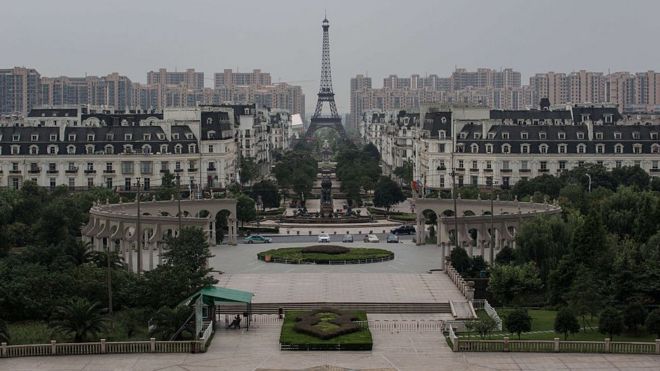
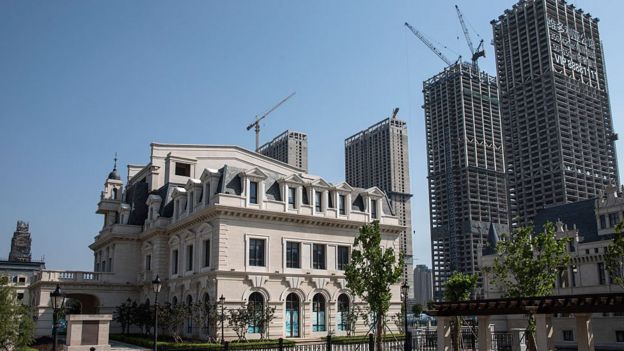
The statement, issued on 27 April but only reported this week, singles out stadiums, exhibition centres, museums and theatres as public facilities where it’s especially important to ban plagiarism.
“City constructions are the combination of a city’s external image and internal spirit, revealing a city’s culture,” the government statement says.
It calls for a “new era” of architecture to “strengthen cultural confidence, show the city’s features, exhibit the contemporary spirit, and display the Chinese characteristics”.
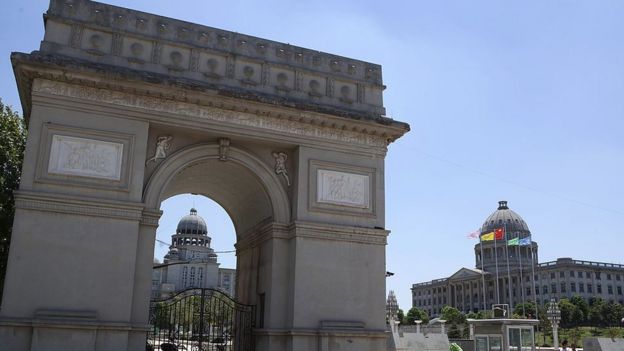
Image copyright STR / AFP / GETTYImage caption – Not the Arc de Triomphe, but a college gate in Wuhan
The guidelines on “foreign” architecture were mostly welcomed on Chinese social media.
“The ban is great,” wrote a Weibo user, according to state media the Global Times. “It’s much better to protect our historical architectures than build fake copycat ones.”
Another recalled seeing an imitation White House in Jiangsu province. “It burned my eyes,” she said.
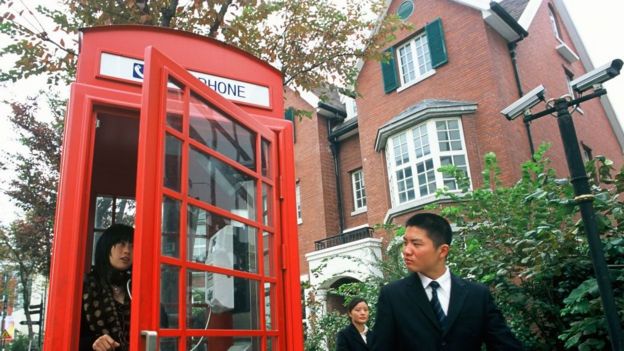
Image copyright OLIVIER CHOUCHANA / GETTYImage caption Thames Town, an English-themed town near Shanghai, pictured in 2008
In 2013, the BBC visited “Thames Town”, an imitation English town in Songjiang in Shanghai.
The town features cobbled streets, a medieval meeting hall – even a statue of Winston Churchill – and was a popular spot for wedding photos.
“Usually if you want to see foreign buildings, you have to go abroad,” said one person. “But if we import them to China, people can save money while experiencing foreign-style architecture.”
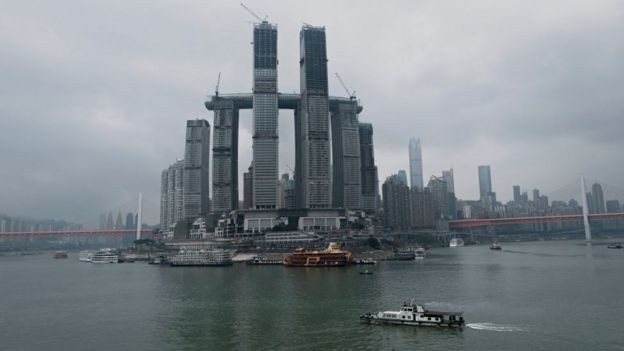
Image copyright WANG ZHAO / GETTYImage caption – Raffles City, Chongqing, in 2019 – mimicking the Marina Bay Sands hotel in Singapore
China, of course, is not the only country to borrow – or copy – other countries’ designs.
Las Vegas in the US revels in its imitations of iconic foreign architecture including the Eiffel Tower and Venetian canals.
Thailand also has developments that mimic the Italian countryside and charming English villages, mainly aimed at domestic tourists.
This marks the latest mobile network upgrade on Mount Everest, where Chinese carriers had previously installed 2G, 3G and 4G equipment
China Mobile plans to deploy Huawei 5G gear at an altitude of 6,500 metres, providing network coverage to the mountain’s summit
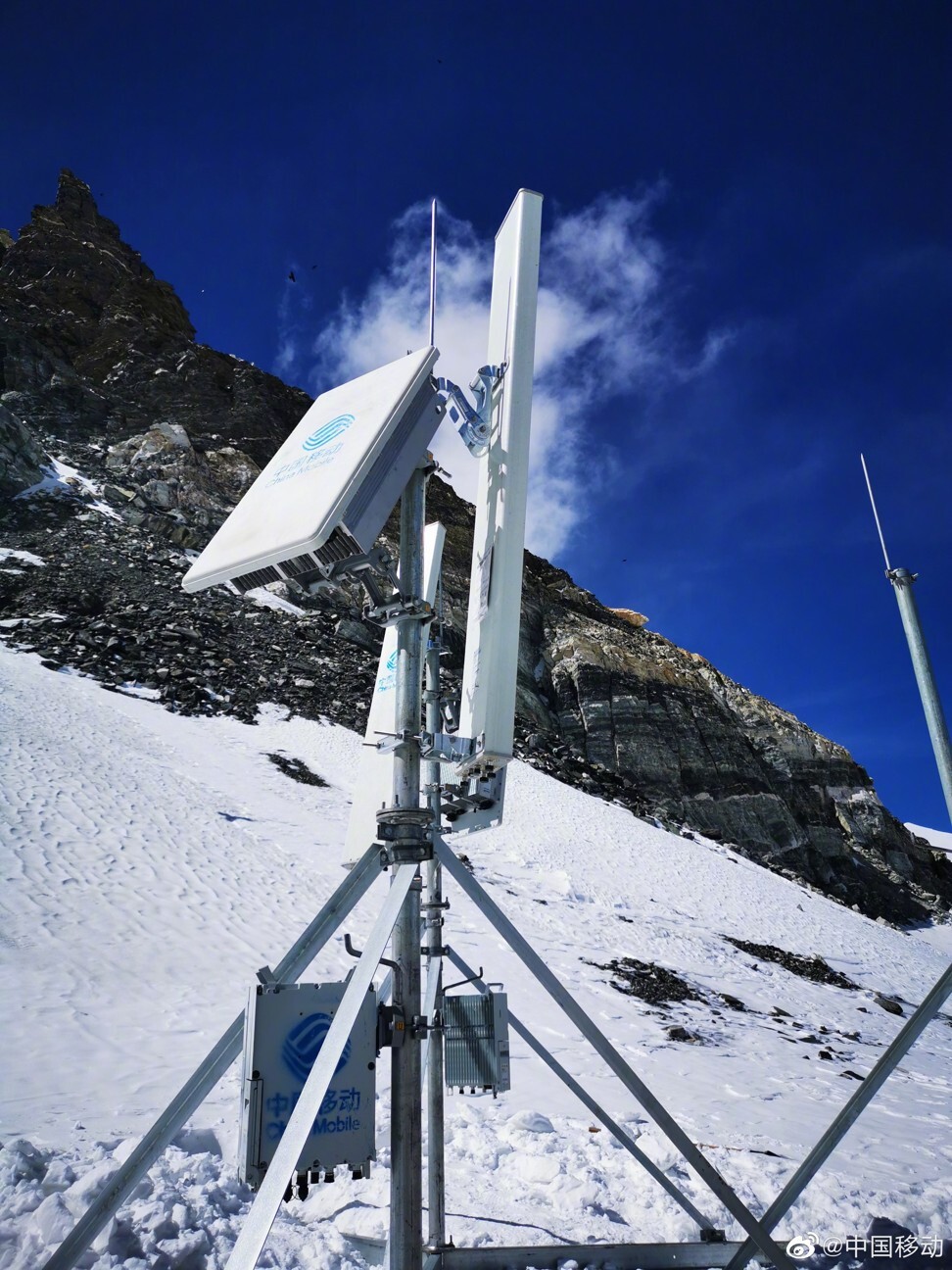
A team from China Mobile shows off the initial 5G base stations, supplied by Huawei Technologies, that the telecoms carrier deployed on Mount Everest this April. Photo: Weibo
Huawei Technologies has teamed up with wireless network operators China Mobile, China Unicom and China Telecom to roll out advanced 5G infrastructure on
The deployment of 5G base stations on the famous Himalayan mountain, with an elevation of 8,848 metres, has extended the reach of the next-generation mobile technology, which has been held up as “the connective tissue” for the Internet of Things, autonomous cars, smart cities and other new applications – providing the backbone for the industrial internet. The new 5G infrastructure roll-outs were announced by Huawei in a post on Chinese microblogging site Weibo on Monday and confirmed by its spokeswoman on Tuesday.
China Mobile, the world’s largest wireless network operator, said its 5G project on Mount Everest marked “not only another extreme challenge in a human life exclusion zone, but also laid a solid foundation for the later development of 5G smart tourism and 5G communications for scientific research”, according to the company’s post on Weibo on Monday.
The Hong Kong and New York-listed carrier set up three 5G base stations – radio access gear that connects mobile devices to the broader telecommunications network – on April 19 in two camps at altitudes of 5,300 metres and 5,800 metres, which provide online download speed of about 1 gigabit per second.
China Mobile plans to install two more 5G base stations, supplied by telecommunications gear maker Huawei Technologies, on Mount Everest before April 25. Photo: Weibo
Installation of two more base stations are expected to be completed by China Mobile before April 25 in another camp at an altitude of 6,500 metres, providing 5G network coverage to the summit of Mount Everest. The international border between China and Nepal is 1,414 kilometres in length and runs across that summit.
More than 150 China Mobile employees are taking part on the construction and maintenance of the new 5G base stations as well as upgrading existing infrastructure on the surrounding areas, according to the company. It said 25 kms of new optical cables have also been laid out to support this project.
China Telecom confirmed its Mount Everest project on Tuesday in a statement, which said its 5G base stations were installed on April 13 at an altitude of 5,145 metres. It partnered with state-run China Central Television to broadcast a 24-hour live-streamed programme on April 14 from Mount Everest, which had an audience of more than six million people.
China Mobile did not immediately respond to a request for comment. China Unicom did not immediately reply to a separate request for comment.
Mobile network operators in China launched initial commercial 5G services last year. The country has already deployed more than 160,000 5G base stations, covering more than 50 cities, according to a report published last month by the GSMA, the trade body which represents mobile operators worldwide.
While initial commercial 5G mobile services were launched in countries like South Korea, the US, and Australia, the scale of China’s market is likely to dwarf the combined size of those economies, negating any first-mover advantage.
The steady annual deployment of new 5G base stations is critical to meet future demand in the world’s second largest economy and biggest smartphone market. China is expected to have 600 million 5G mobile users by 2025, which would make up 40 per cent of total global 5G subscribers, according to the GSMA.
Documentary puts China’s literary hero into context: there is Dante, there’s Shakespeare, and there’s Du Fu
Theatrical legend Sir Ian McKellen brings glamour to beloved verses in British documentary
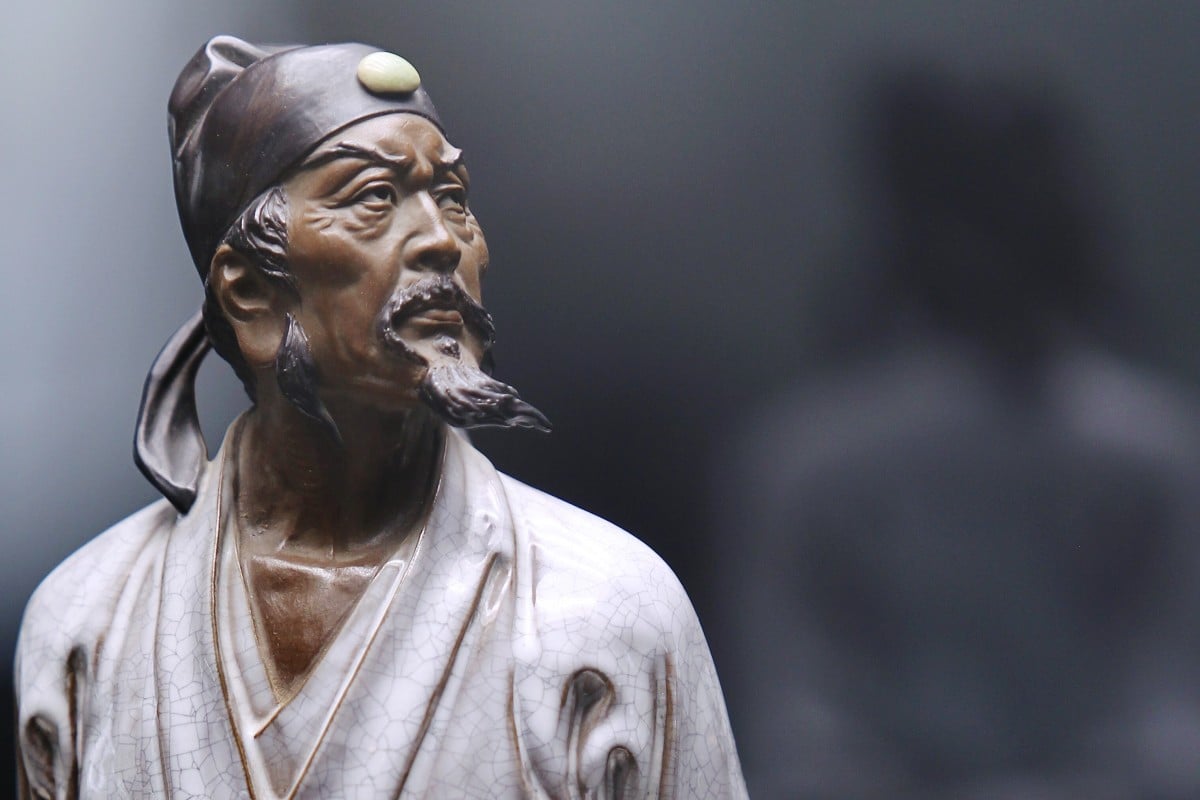
A ceramic figurine of Du Fu, a prominent Chinese poet of the Tang dynasty. Du is the subject of a new BBC documentary, thrilling devotees of his poetry. Photo: Simon Song
The resonant words of an ancient Chinese poet spoken by esteemed British actor Sir Ian McKellen have reignited in China discussion about its literary history and inspired hope that Beijing can tap into cultural riches to help mend its image in the wake of the coronavirus pandemic.
The BBC documentary Du Fu: China’s Greatest Poet has provoked passion among Chinese literature lovers about the poetic master who lived 1,300 years ago.
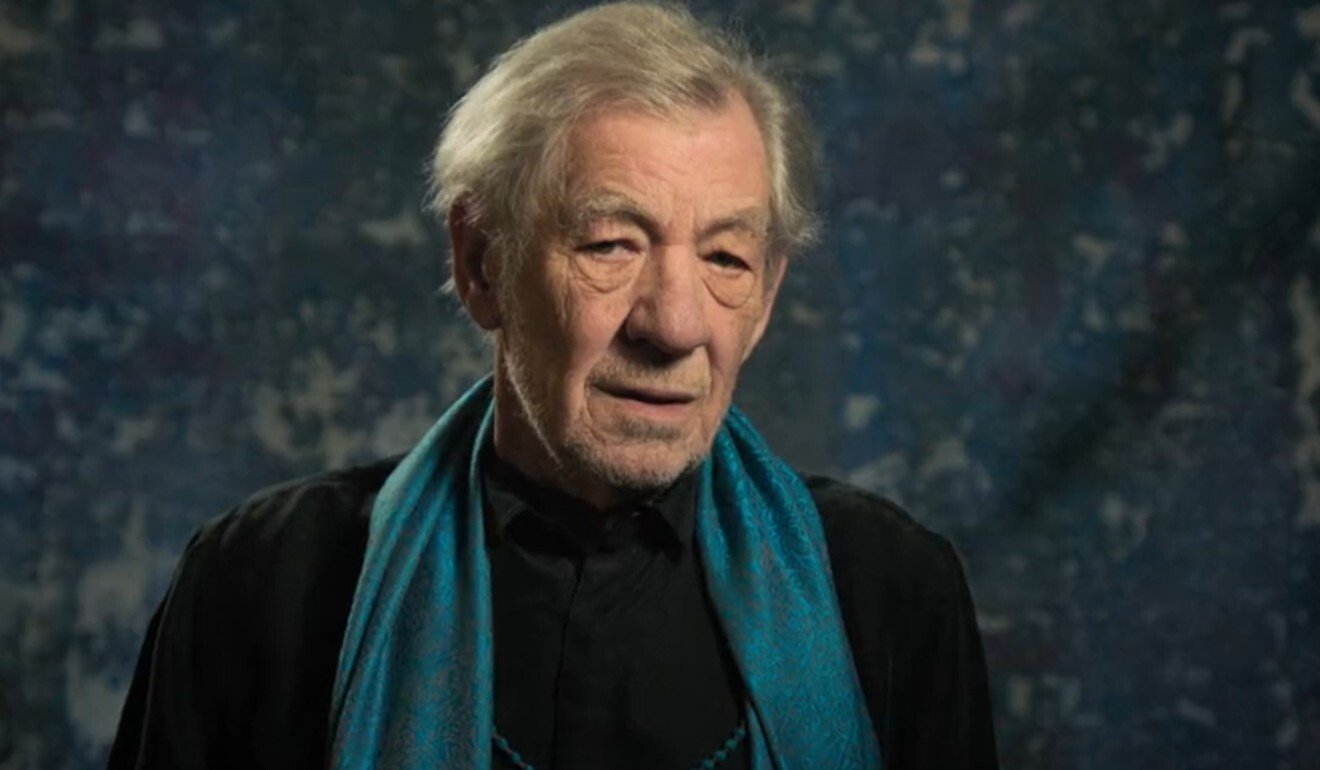
Sir Ian Mckellen read works of ancient Chinese poet Du Fu in Du Fu: China’s Greatest Poet. Photo: BBC Four / MayaVision International
The one-hour documentary by television historian Michael Wood was broadcast on television and aired online for British viewers this month but enthusiasm among Chinese audiences mean the trailer and programme have been widely circulated on video sharing websites inside mainland China, with some enthusiasts dubbing Chinese subtitles.
The documentary has drawn such attention in Du’s homeland that even the Communist Party’s top anti-graft agency has discussed it in its current affairs commentary column. Notably, Wood’s depiction of Du’s life from AD712 to 770 barely mentioned corruption in the Tang dynasty (618-907) government.
“I couldn’t believe it!!” Wood said in an email. “I’m very pleased of course … most of all as a foreigner making a film about such a loved figure in another culture, you hope that the Chinese viewers will think it was worth doing.”
Often referred to as ancient China’s “Sage of Poetry” and the “Poet Historian”, Du Fu witnessed the Tang dynasty’s unparalleled height of prosperity and its fall into rebellion, famine and poverty.
Writer, historian and presenter Michael Wood followed the footsteps of the ancient Chinese poet Du Fu in Yangtze River gorges. Photo: BBC Four / MayaVision International
Wood traced Du’s footsteps to various parts of the country. He interviewed Chinese experts and Western sinologists, offering historical and personal contexts to introduce some of Du’s more than 1,400 poems and verses chronicling the ups and downs of his life and China.
The programme used many Western reference points to put Du and his works into context. The time Du lived in was described as around the as the Old English poem Beowulf was composed and the former Chinese capital, Changan, where Xian is now, was described as being in the league of world cities of the time, along with Constantinople and Baghdad.
Harvard University sinologist Stephen Owen described the poet’s standing as such: “There is Dante, there’s Shakespeare, and there’s Du Fu.”
The performance of Du’s works by Sir Ian, who enjoyed prominence in China with his role as Gandalf in the Lord of the Rings movie series, attracted popular discussion from both media critics and general audiences in China, and sparked fresh discussion about the poet.
“To a Chinese audience, the biggest surprise could be ‘Gandalf’ reading out the poems! … He recited [Du’s poems] with his deep, stage performance tones in a British accent. No wonder internet users praised it as ‘reciting Du Fu in the form of performing a Shakespeare play,” wrote Su Zhicheng, an editor with National Business Daily.
A stone sculpture at Du Fu Thatched Cottage in Chengdu city, China. Photo: Handout
On China’s popular Weibo microblog, a viewer called Indifferent Onlooker commented on Sir Ian’s recital of Du’s poem My Brave Adventures: “Despite the language barrier, he conveyed the feeling [of the poet]. It’s charming.”
Some viewers, however, disagreed. At popular video-sharing website Bilibili.com, where uploads of the documentary could be found, a viewer commented: “I could not appreciate the English translation, just as I could not grasp Shakespeare through his Chinese translated works in school textbooks.”
Watching the documentary amid the coronavirus pandemic, some internet users drew comparisons of Du to Fang Fang, a modern-day award-winning poet and novelist who chronicled her life in Wuhan during the Covid-19 lockdown.
Shanghai pictured in April. Devastation wrought by the coronavirus pandemic has brought about a new suspicion of China. Photo: Bloomberg
The pandemic has infected more than 2.5 million people and killed more than 170,000. It has put the global economy in jeopardy, fuelling calls for accountability. British Foreign Secretary Dominic Raab last week called for a “deep dive” review and the asking of “hard questions” about how the coronavirus emerged and how it was not stopped earlier.
Steve Tsang, director of the SOAS China Institute at University of London, said the British establishment and wider public had changed its perception of Beijing as questions arose about outbreak misinformation and the political leverage of personal protective gear supply.
“The aggressive propaganda of the Chinese government is getting people in the UK to look more closely at China and see that it is a Leninist party-state, rather than the modernising and rapidly changing society that they want to see in China,” Tsang said.
On Sunday, a writer on the website of the National Supervisory Commission, China’s top anti-corruption agency, claimed – without citing sources – that the Du Fu documentary had moved “anxious” British audience who were still staying home under social distancing measures.
“If anyone wants to put the fear of the coronavirus behind them by understanding the rich Chinese civilisation, please watch this documentary on Du Fu,” it wrote, adding that promoting Du’s poems overseas could help “healing and uniting our shattered world”.
English-language state media such as CGTN and the Global Times reported on the documentary last week and some Beijing-based foreign relations publications have posted comments about the film on Twitter.
Wood said he had received feedback from both Chinese and British viewers that talked about “the need, especially now, of mutual understanding between cultures”.
“It is a global pandemic … we need to understand each other better, to talk to each other, show empathy: and that will help foster cooperation. So even in a small way, any effort to explain ourselves to each other must be a help,” Wood said.
He said the idea for producing a documentary about Du Fu started in 2017, after his team had finished the Story of China series for BBC and PBS.
Du Fu: China’s Greatest Poet first aired in Britain on April 7 on BBC Four, the cultural and documentary channel of the public broadcaster. It is a co-production between the BBC and China Central Television.
Wood said a slightly shorter 50-minute version would be aired later this month on CCTV9, Chinese state television’s documentary channel.
The film was shot in China in September, he said.
“I came back from China [at the] end of September, so we weren’t affected by the Covid-19 outbreak, though of course it has affected us in the editing period. We have had to recut the CCTV version in lockdown here in London and recorded two small word changes on my iPhone!” Wood said.
WUHAN, China (Reuters) – China reported a drop in new coronavirus infections for a fourth day as drastic curbs on international travellers reined in the number of imported cases, while policymakers turned their efforts to healing the world’s second-largest economy.
The city of Wuhan, at the centre of the outbreak, reported no new cases for a sixth day, as businesses reopened and residents set about reclaiming a more normal life after a lockdown for almost two months.
Smartly turned out staff waited in masks and gloves to greet customers at entrances to the newly-reopened Wuhan International Plaza, home to boutiques of luxury brands such as Cartier and Louis Vuitton.
“The Wuhan International Plaza is very representative (of the city),” said Zhang Yu, 29. “So its reopening really makes me feel this city is coming back to life.”
Sunday’s figure of 31 new cases, including one locally transmitted infection, was down from 45 the previous day, the National Health Commission said.
As infections fall, policymakers are scrambling to revitalise an economy nearly paralysed by months-long curbs to control the spread of the flu-like disease.
On Monday, the central bank unexpectedly cut the interest rate on reverse repurchase agreements by 20 basis points, the largest in nearly five years.
The government is pushing businesses and factories to reopen, as it rolls out fiscal and monetary stimulus to spur recovery from what is feared to be an outright economic contraction in the quarter to March.
China’s exports and imports could worsen as the pandemic spreads, depressing demand both at home and abroad, Xin Guobin, the vice minister of industry and information technology, said on Monday.
The country has extended loans of 200 billion yuan (22.75 billion pounds) to 5,000 businesses, from 300 billion allocated to help companies as they resume work, Xin said.
Authorities in Ningbo said they would encourage national banks to offer preferential credit of up to 100 billion yuan to the eastern port city’s larger export firms. The city government will subsidize such loans, it said in a notice.
VIRUS CONCERNS
While new infections have fallen sharply from February’s peak, authorities worry about a second wave triggered by returning Chinese, many of them students.
China cut international flights massively from Sunday for an indefinite period, after it began denying entry to almost all foreigners a day earlier.
Average daily arrivals at airports this week are expected to be about 4,000, down from 25,000 last week, an official of the Civil Aviation Administration of China told a news conference in Beijing on Monday.
The return to work has also prompted concern about potential domestic infections, especially over carriers who exhibit no, or very mild, symptoms of the highly contagious virus.
Northwestern Gansu province reported a new case of a traveller from the central province of Hubei, who drove back with a virus-free health code, national health authorities said.
Hubei authorities say 4.6 million people in the province returned to work by Saturday, with 2.8 million of them heading for other parts of China.
Most of the departing migrant workers went to the southern provinces of Guangdong and Fujian, the eastern provinces of Zhejiang and Jiangsu, and northeast China.
In Hubei’s capital of Wuhan, more retail complexes and shopping streets reopened.
Electric carmaker Tesla Inc has also reopened a showroom in Wuhan, a company executive said on Weibo.
Shoppers queued 1-1/2 metres (5 ft) apart for temperature checks at Wuhan International Plaza, while flashing “green” mobile telephone codes attesting to a clean bill of health.
To be cleared to resume work, Wuhan residents have been asked to take nucleic acid tests twice.
“Being able to be healthy and leave the house, and meet other colleagues who are also healthy is a very happy thing,” said Wang Xueman, a cosmetics sales representative.
BEIJING (Reuters) – China on Sunday reported 46 new cases of coronavirus, the fourth straight day with an increase, with all but one of those imported from overseas, and further stepped up measures to intercept cases from abroad as the outbreak worsens globally.
While China says it has drastically reduced the number of domestically transmitted cases – the one reported on Sunday was the first in four days – it is seeing a steady rise in imported cases, mostly from Chinese people returning from overseas.
In a sign of how seriously China is taking the threat of imported cases, all international flights due to arrive in Beijing starting Monday will first land at another airport, where passengers will undergo virus screening, government agencies said on Sunday, in an expansion of existing measures.
International flights that were scheduled to arrive in the capital will land instead at one of 12 airports. Passengers who clear screening will then be permitted to reboard the plane, which will then fly to Beijing, the regulator said.
Separately, Shanghai and Guangzhou both announced that all arriving international passengers will undergo an RNA test to screen for coronavirus, expanding a program that previously only applied to those coming from heavily-hit countries.
RELATED COVERAGE
Emirates airline adds Beijing and Seattle to flight suspensions
Among the new cases from abroad reported on Sunday, a record 14 were in the financial hub of Shanghai and 13 were in Beijing, a decline from 21 the previous day.
The new locally transmitted case was in the southern metropolis of Guangzhou and was also the first known case where the infection of a local person was linked to the arrival of someone from overseas, according to Guangdong province.
Hu Xijin, the editor-in-chief of the Global Times newspaper, called for all cities in China to implement 14-day quarantines for people arriving from abroad.
He also called for quarantine policies to apply to people from Hong Kong and Macau as well, he said on his Weibo account on Sunday.
“I am worried that there are similar cases to the Guangzhou one existing in other parts of the country. There were reports previously that people coming back from abroad returned to their homes in Shanghai without any obstacles,” Hu said.
“It matters to the overall situation of China’s next prevention and control efforts if we can plug the leaks.”
The Global Times is a tabloid published by the Ruling Communist Party’s People’s Daily.
The latest figures from China’s National Health Commission bring total reported coronavirus cases in the country to 81,054, with 3,261 deaths, including six on Saturday. On Saturday, China reported 41 new coronavirus cases for the previous day, all of them imported.
Of all 97 imported cases as of end-Saturday, 92 of them are Chinese nationals and 51 are Chinese students returning from studying abroad, said Gao Xiaojun, spokesman for the Beijing Municipal Health Commission during a press conference on Sunday.
The Beijing health commission announced separately on its website it had two more imported cases on Sunday, bringing the city’s total number of imported cases to 99 as of Sunday noon.
BACK TO A KIND OF NORMAL
China is trying to revive an economy that is widely expected to contract deeply in the current quarter, with life slowly returning to normal in cities such as Beijing and Shanghai, albeit with everyone wearing masks in public.
Still, numerous shops and restaurants remain shut – many have gone out of business – and factories and other workplaces are still not operating at full capacity.
On Sunday, a central bank official called for stepped-up global policy coordination to manage the economic impact of the pandemic. He said China’s recent policy measures were gaining traction, and it has capacity for further action.
Chen Yulu, a deputy governor at the People’s Bank of China (PBOC), also said he expects significant improvement in the Chinese economy in the second quarter.
And while the virus will continue putting upward pressure on near-term consumer prices, there is no basis for long-term inflation or deflation, he told a news briefing.
Globally, roughly 275,000 people have been infected with the virus, and more than 11,000 have died, according to a Reuters tally, with the number of deaths in Italy recently surpassing those in China.
“Now I think the epidemic has been controlled. But this definitely doesn’t mean that it’s over,” said a 25-year-old woman surnamed He who works in the internet sector and was visiting the vast Summer Palace complex in Beijing on Saturday.
“I’m willing to come out today but of course I am still afraid,” she told Reuters.
The central province of Hubei, where the outbreak first emerged late last year in its capital Wuhan, reported its fourth straight day of no new cases.
China has used draconian measures to contain the spread of the virus, including locking down Hubei province.
Woman becomes angry over long delay on tarmac waiting for health assessments
Customs official says that Shanghai is stepping up medical checks as precaution against imported infection but that travellers need only wait one or two hours
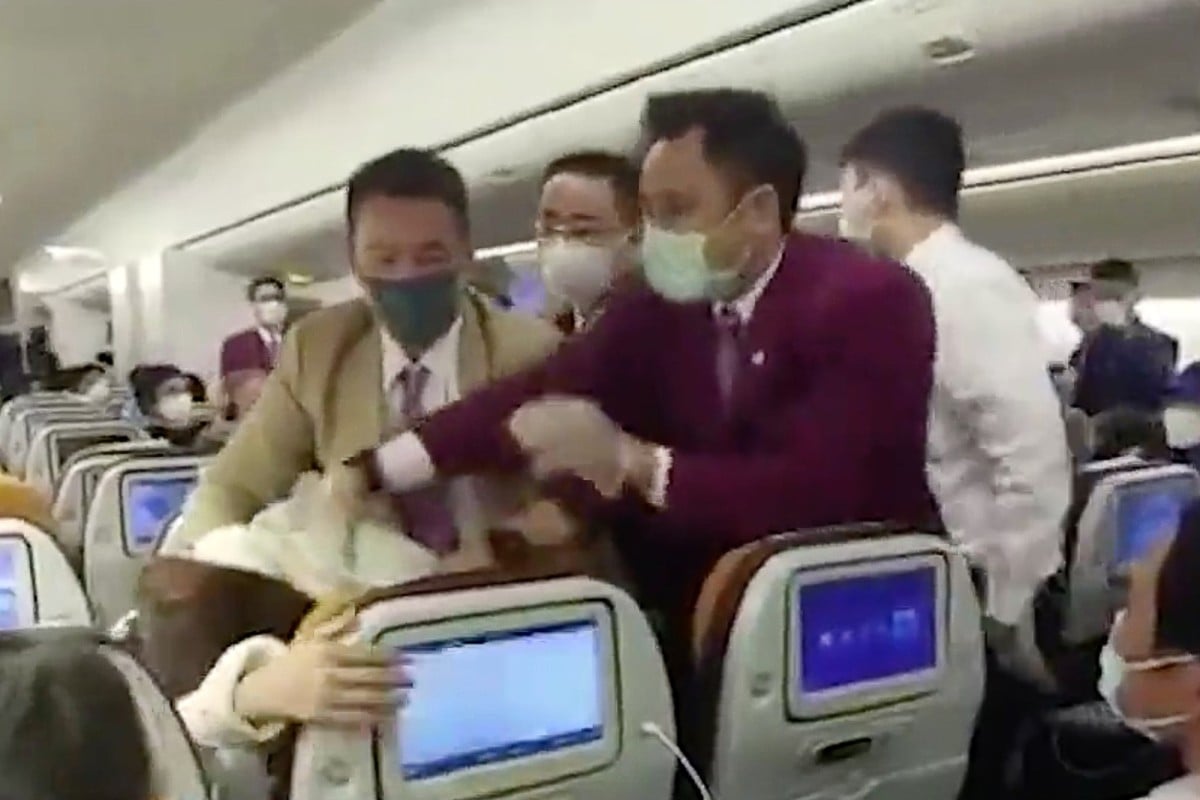
Video taken on board a Thai Airways flight at Shanghai on Friday purports to show flight attendants trying to control a passenger who coughed on one of their colleagues. Photo: Handout
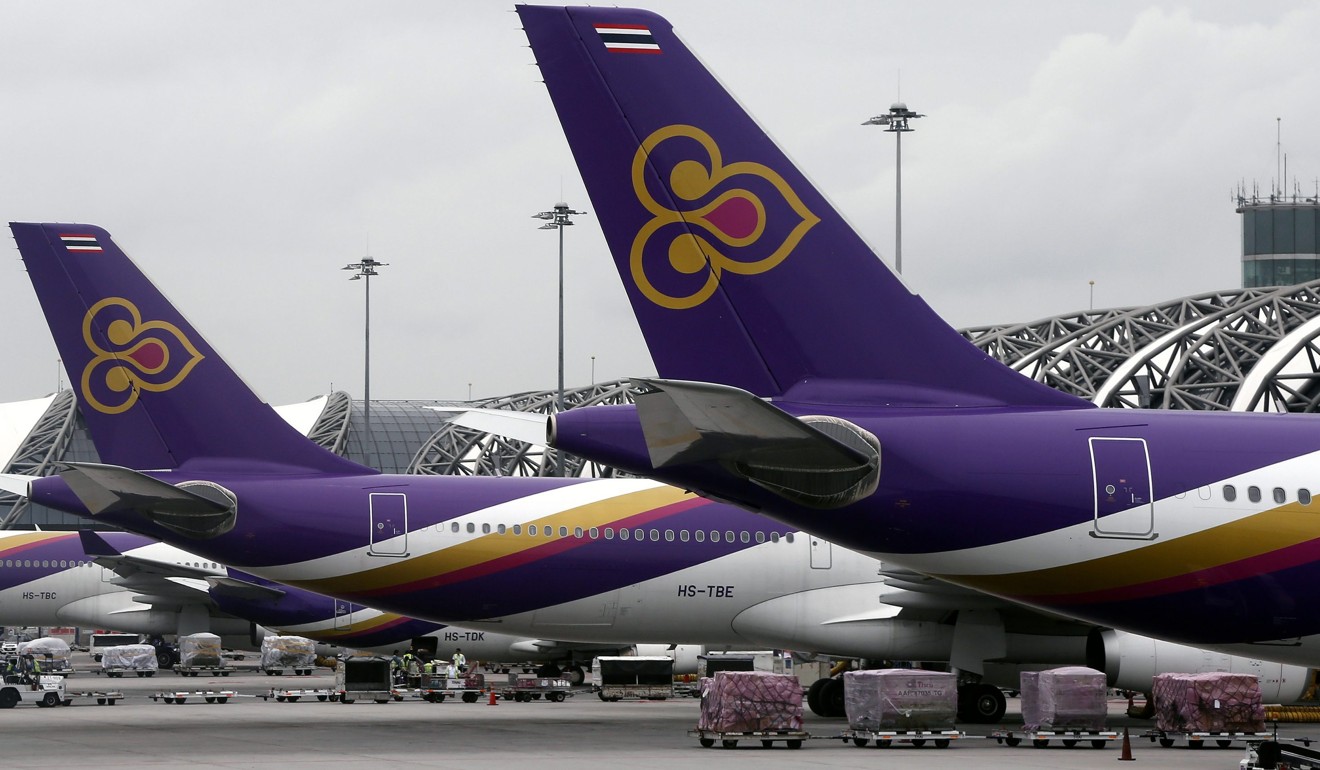
Thai Airways staff had to restrain a Chinese woman after she coughed at a flight attendant while passengers waited for hours to get acoronavirus check upon landing in Shanghai from Bangkok.
The carrier said the woman coughed deliberately at the attendant because she was angered about the long wait for a check on Friday. It said the passengers had to wait seven hours to be screened at Shanghai Pudong International Airport Thai Airways said that after the passenger coughed at the woman attendant, some of her colleagues approached the passenger to stop her “inappropriate” behaviour. They then explained the situation to her and asked her to cooperate and calm down, the airline said.
The woman had to be subdued and no further action was taken, the airline said in a statement.
In footage posted online, the woman is subdued by at least one male attendant, who presses her into her seat by her neck as two more male attendants stand nearby, saying “sit down” to her in English.
The woman then yells “What have I done?” in Chinese.
Thai Airways said that every passenger arriving in Shanghai or flying through the airport from countries with a high incidence of coronavirus cases such as Italy, South Korea, Japan and Iran must be examined by medical staff on the aircraft. Planes that were not checked were not permitted to open their doors to let passengers off.
The airline said the length of wait depended upon the number of passengers coming from those “key areas”.
An official from Shanghai Customs said that passengers on the flight had to be checked because some had transferred from Iran, where more than 7,000 cases and 230 fatalities have been reported.
The Thai Airways flight was on the ground at Shanghai for seven hours pending medical checks on passengers and crew. Photo: EPA
The woman’s behaviour divided opinion on social media.
“Shame on her!” a user of Weibo, China’s Twitter-like service, wrote. “It’s so shameful for her to act like that in front of foreigners.”
“I think the flight attendants were fairly gentlemanly,” another user wrote. “She should have been taken away.”
Coronavirus update: Xi Jinping makes first visit to Wuhan since outbreak began
10 Mar 2020
A Weibo user who claimed to be on the plane at that time said it was not right for “three men” to subdue the woman.
“I don’t want to see my compatriot be bullied,” she wrote. “The attendants only stopped their action after two Chinese passengers stood up to intervene.”
Shanghai’s two airports have tightened medical checks on travellers from overseas, leading to complaints about long waiting times.
Health workers check passengers’ temperatures, screen their health disclaimer cards and check their travel histories.
Music video about Covid-19 safety released by rail operator in Thai capital Bangkok
Each passenger arriving from “key areas”, where there are a lot of infections, have to have their temperature checked twice after they get off the plane. Some may have to undergo simple physical checks.
Passengers who travelled to those key areas in the past 14 days, no matter their nationality, would be sent to designated places for 14 days of medical observation, authorities said.
The Shanghai Customs official said passengers were disembarked in batches to avoid crowding, making the examination process longer.
Egypt reports first coronavirus death; Iran toll jumps by nearly 50
9 Mar 2020
She said that after the authorities allocated more than 300 customs staff to support monitoring at border ports at the end of last week, the examination process now took one to two hours.
“Many people blamed us for low speed and low efficiency, but didn’t ask why,” she said, adding that people’s messy handwriting on their health disclaimer cards and poor memory of where they had been in the past 14 days also complicated the clearance process.
“As a citizen, shouldn’t they cooperate in this critical moment?” she said.
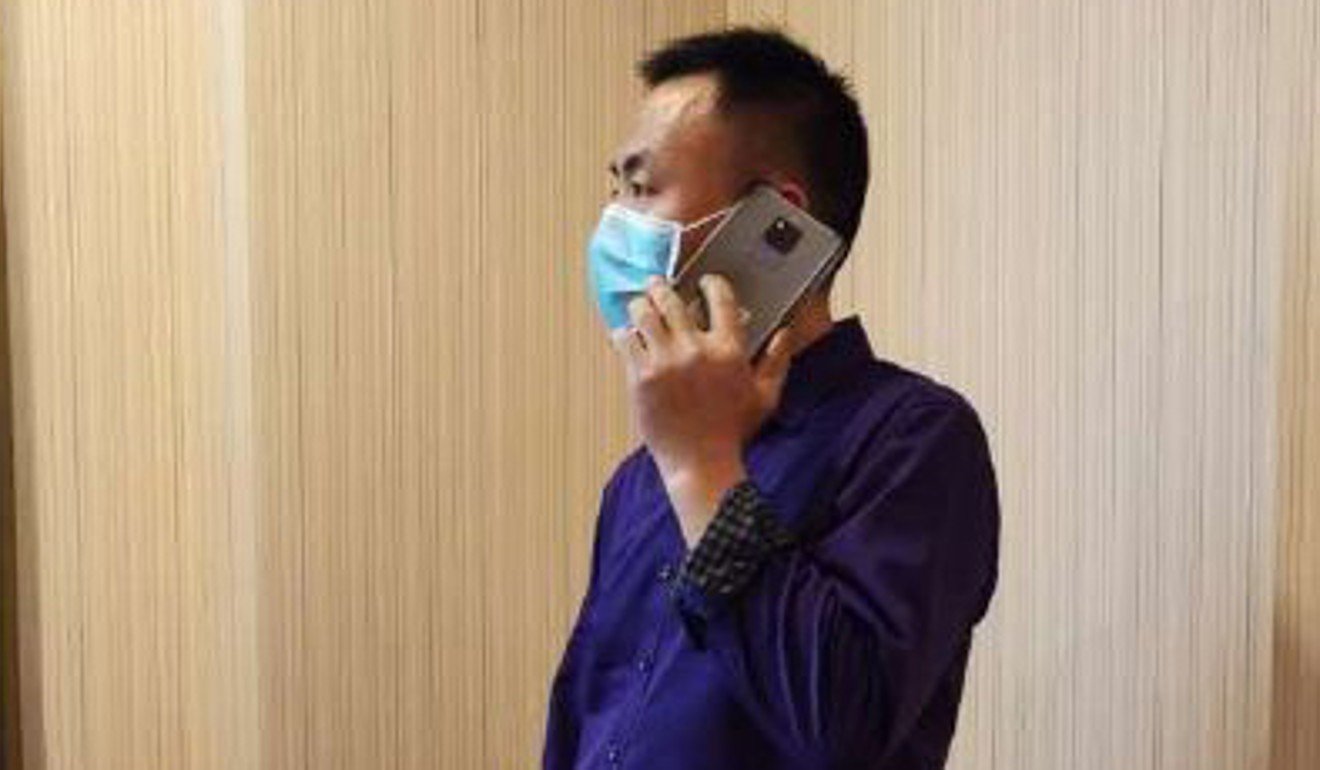
Shen Cong, taken from the family home in Guangzhou 15 years ago, was found in a nearby city last week
He was one of nine children abducted by a gang, but police say there is no evidence of a woman alleged to be the go-between
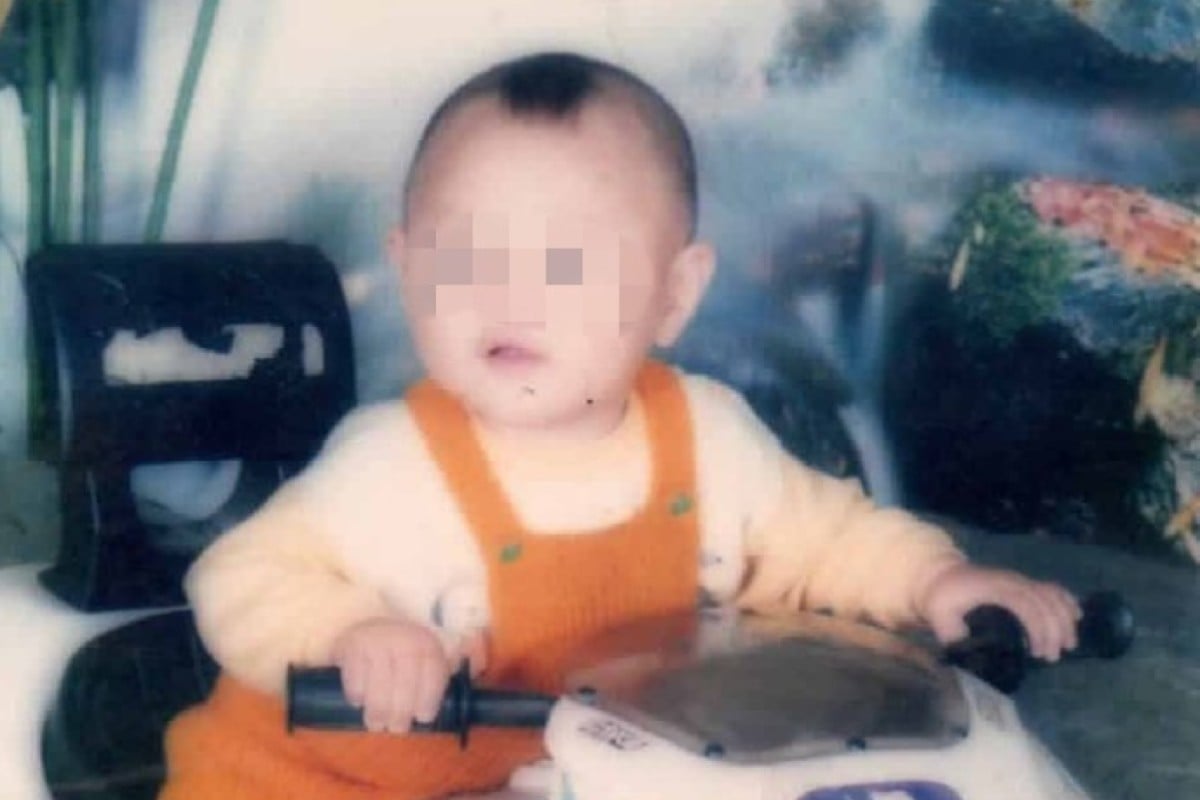
Shen Cong’s parents had been searching for him since he was abducted in 2005. Photo: Handout
A teenage boy was reunited with his parents in the southern Chinese city of Guangzhou on Saturday after being kidnapped from their home as an infant, ending a 15-year search by his family.
The boy was taken in 2005 – one of nine children abducted by a gang in Guangdong province around that time. In recent years the case has drawn attention on Chinese social media, particularly the alleged involvement of a shadowy go-between known as “Aunt Mei”, but Guangzhou police stressed there was no evidence such a person existed.
Police said 16-year-old Shen Cong had been found on Wednesday in Meizhou, a city about 400km (250 miles) away. DNA testing confirmed he was the missing child and police arranged the reunion with his parents, Shen Junliang and his wife, who was identified as Yu in the statement.
Police did not say what had led to the discovery of the boy, but they said his foster parents had been taken in for questioning.
His biological father Shen Junliang on Sunday said they were overjoyed to have their son back home, adding that he was healthy and a tall boy who loved sports.
“Before I met my son I’d been imagining what it would be like to talk to him. I didn’t think he would be this mature – he seems more mature than his peers and he has good manners,” the father wrote on Weibo, China’s Twitter. “We’ve spent the entire time together, from Saturday night until now. We’re getting along and he’s happy too.”
Shen Junliang said they were overjoyed to have their son back home at last. Photo: Handout
The parents are now getting to know their son, having not seen him since he was abducted from their rented flat in Zengcheng district on January 4, 2005.
That day, the child had been at home with his mother while his father was at work. Shen Junliang has alleged that two of their neighbours led two strangers into the flat at about 10.40am, and the two strangers drugged and tied up Yu before kidnapping the one-year-old boy.
His mum revealed she was abandoned as a kid. A film was born
21 Dec 2019
Shen Junliang had been searching for his boy ever since. He gave up his job and has travelled all over Guangdong province looking for him. He had more than 1 million posters printed with photos and a description of his son, offering a reward of 100,000 yuan (US$14,400) for any information on the case.
One of them read: “Shen Cong has birthmarks on the toe of his left foot, his right buttock and his right thigh. Anyone who has any leads … please contact me or Guangzhou police.”
Kidnapped: the Chinese parents desperately searching for missing children
He started posting about the case on Weibo in 2016, sharing every piece of news related to the kidnap and appealing for anyone with information to come forward.
In March that year, there was a development, with police arresting five suspects in the case.
Police said the lead suspect, Zhang Weiping, had confessed to selling Shen Cong to a couple in Heyuan, another city in Guangdong, for 13,000 yuan on January 6, 2005.
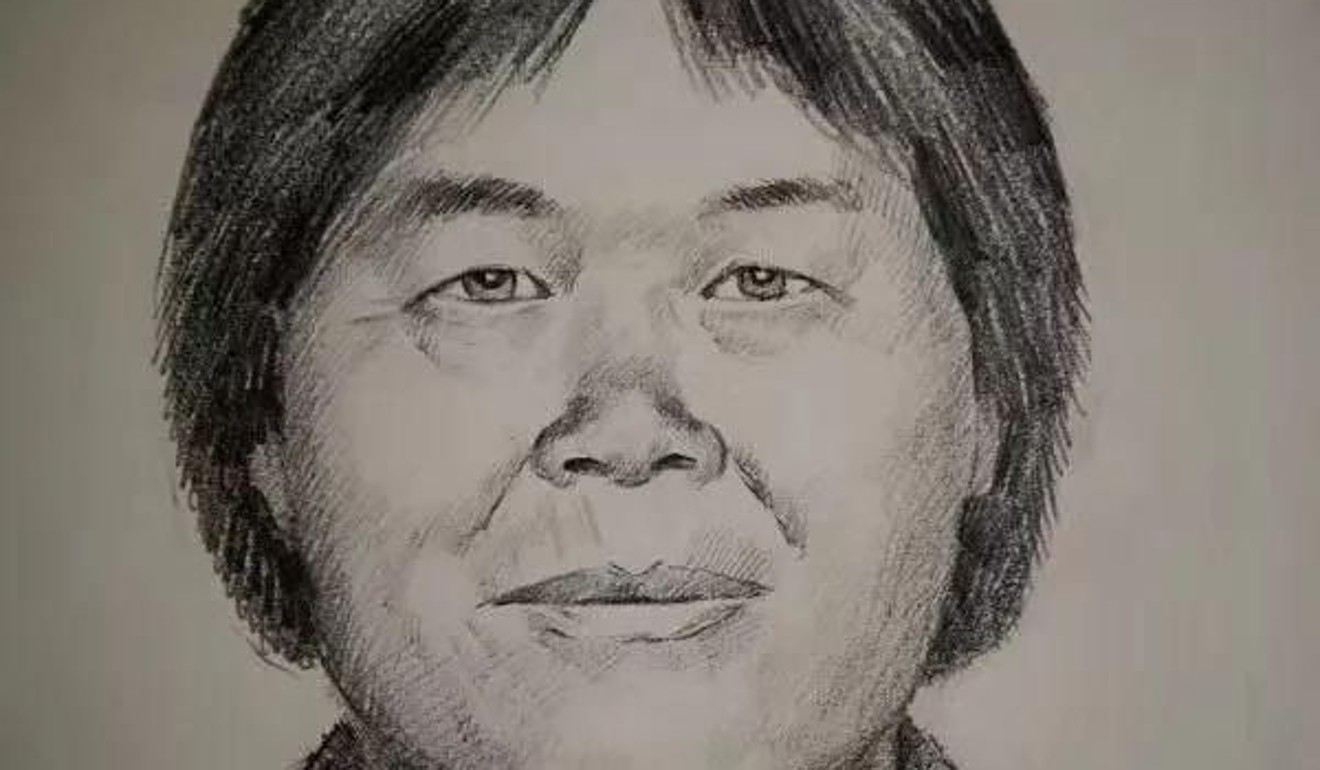
Zhang told police that an intermediary nicknamed Aunt Mei had been involved in that deal and the sale of eight other boys in the province from 2003 to 2005.
Zhang Weiping, who was sentenced to death for kidnapping children, alleged an intermediary known as Aunt Mei was involved in the case. Photo: Handout
Zhang and another gang member were sentenced to death for kidnapping children in 2018, two others were jailed for life, and a fifth person was jailed for 10 years.
Two of the other boys who had been abducted were found by police last year.
But Guangzhou police said they had not found any information leading them to the mysterious woman – apparently in her 60s and a Cantonese and Hakka speaker – Zhang alleged was the go-between.
“Police have checked all the details, all the people and places related to Zhang’s confession,” the statement said. “We’ve also received reports from people all over China since 2017 about Aunt Mei, but so far none of these tips have proved to be true.”
A first batch of 72 bookstores are launching on food delivery platform Meituan “as soon as next week”
Booksellers in China’s capital city have been struggling to stay afloat due to reduced footfall during the epidemic
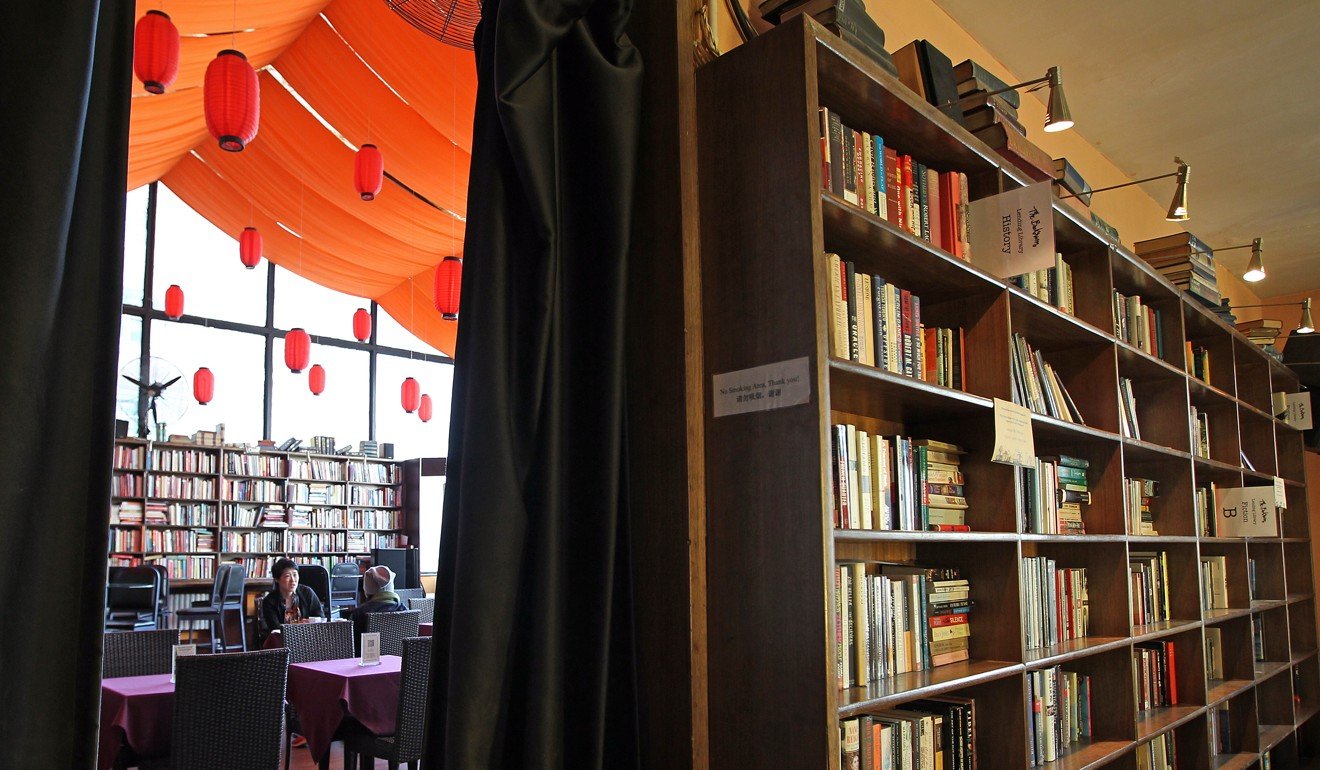
For illustration: coffee and cake in front of a shelf of books at a bookstore. Photo: SCMP / Dickson Lee
Bookstores in Beijing, struggling to survive amid the coronavirus epidemic, are teaming up with a popular food delivery app to help get books into the hands of readers.
The initiative, co-launched by food delivery company Meituan Dianping and the municipal government of Beijing, will feature a first batch of 72 bookstores.
“Due to the epidemic, 80 per cent of physical bookstores are closed,” the publicity department of the Communist Party of China’s Beijing Municipal Committee told local media. “Although many of them try to launch online programmes to keep customers, it doesn’t make a substantial income for stores … companies want the government to coordinate more resources and platforms to help them.”
The bookstores will not have to pay a fee to join the programme, according to the Beijing publicity department.
Users will be able to purchase books on Meituan “as soon as next week”, the food delivery company said in a statement. “After the launch, we will support bookstores by charging them lower service fees, providing subsidies and launching reward plans to help them get on board quickly,” the company added.
China’s smartphone brands adapt to life under coronavirus restrictions
17 Feb 2020
Bookstores in China’s capital city have been hit hard by the coronavirus outbreak. About 60 per cent of 248 stores in Beijing said they expected their revenues to drop more than 50 per cent year-on-year, while only 48 per cent said their cash flows were sufficient to support operations for another one to three months, according to a report by the Beijing Institute of Culture Innovation and Communication.
With fewer customers patronising physical stores and pressure from rent and employee salaries, more bookstores are looking toward online channels to increase sales. Among those interviewed by the Beijing Institute of Culture Innovation and Communication, 21.8 per cent said they were now selling books only via online channels, 48 per cent had tried advertising on social media platforms like WeChat and Weibo, while 16.9 per cent are promoting books on video-sharing platforms like Douyin and Kuaishou.
An interior view of a bookstore, Bookworm, at Sanlitun, Beijing. File photo: SCMP
Last week, Beijing-based bookstore chain OWSpace, which has 15 year history selling books and drinks, posted an appeal on its WeChat account for loyal customers to pay a 50 yuan to 8,000 yuan membership fee to help with its cash flow.
Among their four physical stores in China, only one in Beijing remains open and traffic is a tenth of what it was before the outbreak, it said.
“The store can only sell 15 books a day on average, and more than half are bought by our own staff. We expect our revenue in February to drop 80 per cent compared to other years,” OWSpace said in the post.
Wu Yanping, the general manager of OWSpace’s offline stores, said one of the chain’s stores in Beijing is joining Meituan’s book delivery platform. The store remains physically closed because it is located in an office park that prohibits anyone who travelled out of Beijing from entering before they complete the mandatory 14-day quarantine period.
“Our Dongfeng store is closed for now but even if it opens later, it will not have much traffic [because of the travel restrictions]. So we hope to sell books along with our coffee and drinks on the delivery platform even with the store closed,” Wu said.
Beijing has initiated a range of measures to help keep bookstores afloat, including subsidising their rent, rewarding stores that stay open during the epidemic and encouraging bookstores to expand their sales channels online.
Wu said that since OWSpace posted its appeal letter, it managed to reopen another store in Hangzhou, in the eastern province of Zhejiang, and traffic to both stores has been “gradually recovering to just under 50 per cent of a normal day [before the outbreak]”.
OWSpace also conducts live streams on Taobao three times a week to introduce books, encourage viewers to appreciate literature and sell the store’s peripheral products.
“Readers are quite enthusiastic about it. There were almost 10,000 people watching our last live stream” Wu said.
Taobao is an e-commerce platform operated by Alibaba Group Holding, which is the parent company of the Post.
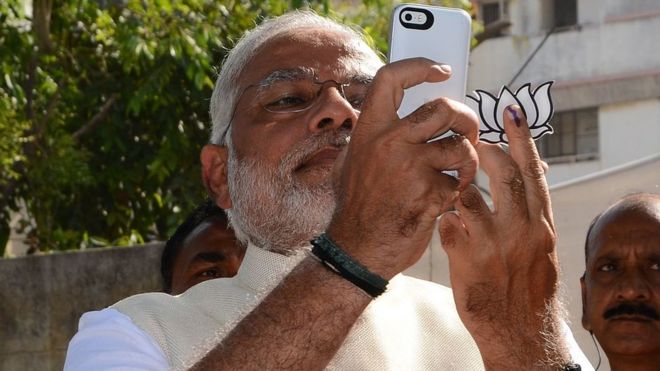
Image copyright STRDELImage caption Prime Minister Modi is the third most followed leader on Twitter after Donald Trump
The world’s second most popular leader – when it comes to social media, at least – sent shockwaves through the internet on Monday, after announcing he was considering leaving the platforms.
After all, Indian Prime Minister Narendra Modi is the only politician to even come close to challenging US President Donald Trump’s online dominance.
And so it was somewhat unsurprising that the hashtag #ModiQuitsSocialMedia began trending in India, with users quick to share a heady cocktail of conspiracy theories, memes and desperate pleas.
However, Mr Modi, who has 54 million followers on Twitter, 35.2 million followers on picture sharing platform Instagram and 44 million followers on Facebook, soon revealed the true reason behind his abandonment of social media.
On Tuesday, he said that he would “give away my social media accounts to women whose life & work inspire us”.
But the “big reveal” came only after his first tweet generated an absolute social media storm.
Some theories suggested he was quitting social media platforms as they were being controlled by his opponents. Others speculated that he would launch an indigenous social platform, to match Twitter and Facebook, something similar to social media platforms like WeChat and Weibo in China.
“Expect SM companies stock to crash,” wrote one confident user.
Apart from the theories, there were desperate pleas from his fans. One wrote: “Please Sir, You can’t leave social media now for the sake of your fans!” Another added: “Modi Ji if you leave social media , they will use it against you and nation interest.”
“For me he is not only PM of India but also emotion. You’re king of social media. Don’t go sir.”
Some users suggested that his account had been hacked.
Soon, #Iwillalsoleavetwitter started trending.
Arun Yadav, the head of Haryana state IT and social media for BJP, tweeted asking the PM to not quit the platform as it was one way Indians could communicate with him.
But there were also jokes.
“Spare a thought for Twitter, Facebook & their stocks. PM Modi is all set to demonetise social media,” wrote one user, referring to the overnight decision to ban high value currency notes in November.
One user suggested that the prime minister was quitting all other platforms in order to make his TikTok debut.
“Modi ji is a typical Indian boyfriend after breakup,” quipped one Twitter user.
“Modiji should be awarded Nobel Peace Prize for bringing peace in the digital world,” said another.
Image caption #NoModiNoTwitter was a India trend on Twitter after PM Modi’s tweet yesterday
There were political reactions too.
In a cheeky response, Rahul Gandhi, former president of the main opposition Congress party, tweeted: “Give up hatred, not social media accounts.”
Congress leader and MP Shashi Tharoor followed suit, writing: “The PM’s abrupt announcement has led many to worry whether it’s a prelude to banning these services throughout the country too.”
Mr Modi’s eventual tweet which clarified matters was seen by some as an anti-climax.
But for the millions who were pleading with him to reconsider, this is surely a big relief.












 CHINDIA ALERT: You'll be living in their world, very soon