Chindia Alert: You’ll be Living in their World Very Soon
aims to alert you to the threats and opportunities that China and India present. China and India require serious attention; case of ‘hidden dragon and crouching tiger’.
Without this attention, governments, businesses and, indeed, individuals may find themselves at a great disadvantage sooner rather than later.
The POSTs (front webpages) are mainly 'cuttings' from reliable sources, updated continuously.
The PAGEs (see Tabs, above) attempt to make the information more meaningful by putting some structure to the information we have researched and assembled since 2006.
Chinese President Xi Jinping attends the opening ceremony of the FIBA Basketball World Cup 2019 at the National Aquatics Center, also known as the Water Cube, in Beijing, capital of China, Aug. 30, 2019. (Xinhua/Huang Jingwen)
BEIJING, Aug. 30 (Xinhua) — Chinese President Xi Jinping attended the opening ceremony of the FIBA Basketball World Cup 2019 Friday at the National Aquatics Center (Water Cube) in Beijing.
When Xi stepped into the Olympic Hall of the Water Cube with FIBA President Horacio Muratore, FIBA Secretary General Andreas Zagklis and visiting Philippine President Rodrigo Duterte, the audience gave a warm welcome with a standing applause.
After the national flag of the People’s Republic of China was raised and the national anthem being performed and sung, Muratore delivered a speech.
He said the 2019 edition will be the largest and most-watched Basketball World Cup in history, and will feature the greatest ever number of host cities.
He highly commended the preparation China has made for the competition and said he believed that this Basketball World Cup would be a tremendous success.
At Muratore’s invitation, Xi declared the opening of the FIBA Basketball World Cup 2019.
Artistic performances unveiled after the rising of the flags of the FIBA and the FIBA Basketball World Cup 2019.
Yao Ming, chairman of the China Basketball Association, escorted the trophy of the Basketball World Cup into the center.
The FIBA Basketball World Cup is the top national-level basketball competition held by FIBA every four years. This year’s competition will be held from Aug. 31 to Sept. 15.
NEW DELHI (Reuters) – Indian cricketers wore army camouflage-style caps in a match with Australia on Friday in solidarity with Indian paramilitary police killed in a militant attack by a Pakistan-based group and in an unusually strong display of patriotic fervour in sport.
The suicide bombing last month killed 40 in Indian-controlled Kashmir, a region also claimed by Pakistan. The attack prompted India to launch an air strike inside Pakistan, which responded with an aerial attack the next day.
The Board of Control for Cricket in India (BCCI) has in recent days tried unsuccessfully to isolate Pakistan in the cricketing world. The International Cricket Council rejected India’s calls to boycott games against Pakistan, whose prime minister is former cricketing hero Imran Khan.
But there are still calls within India for the national team to pull out of a World Cup match against Pakistan in June in England.
The idea to sport the olive-and-black caps bearing the BCCI’s logo came from former Indian cricket captain and current player Mahendra Singh Dhoni, one of the game’s biggest stars and an honorary lieutenant colonel with the Indian army.
“It’s a special cap,” Indian captain Virat Kohli said before the third in a five-match one-day series with Australia. “This is to pay respect to the martyrs … and their families.”
He said all the players would donate their fees from the match to a national defence fund to help out the families of defence personnel who die on duty. Kohli also urged all Indians to contribute to the fund.
The BCCI posted a clip on Twitter of commentators for the match also wearing the caps, signing off the tweet with “#JaiHind”, or “Hail India”.
The board has scrapped the opening ceremony for the Indian Premier League Twenty20 tournament, which begins on March 23, and will donate the money saved to the families of those who died in the bomb attack.
Cricket historian Boria Majumdar said he could not remember seeing any Indian cricket team in the past making such a gesture, which he called a “peaceful political stand”.
“(Indian cricket) teams have expressed solidarity in the past but not this kind of public display of that solidarity,” Majumdar told Reuters.
“Sport has always been meshed with politics and people have often used it to make very strong points. This is yet another one. This is a peaceful way of expressing solidarity in a manner which I don’t see problematic at all.”
But Pakistani lawyer Abdullah Nizamani said on Twitter the BCCI and international cricket board should keep “sports away from petty politics”. Some Pakistanis even asked on social media if Indian cricketers would turn up for the World Cup match with Pakistan in military fatigues.
Nuclear-armed neighbours India and Pakistan have fought two of their three wars since independence over Kashmir, which both sides claim in full but rule in part.
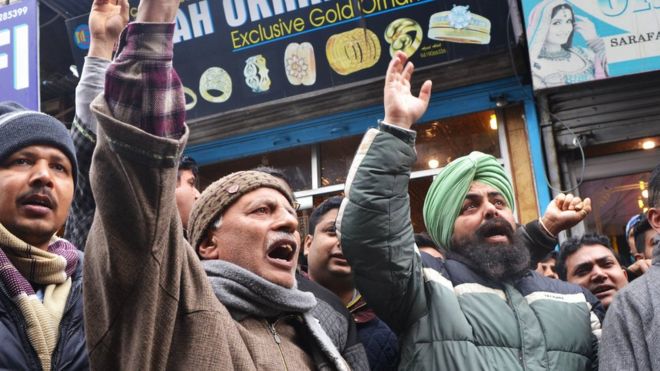
Image copyrightGETTY IMAGESImage captionProtests have been held in Indian-administered Kashmir over attacks on Kashmiris in other parts of India
India’s top court has ordered the government to protect Kashmiri people from attacks in apparent retaliation for last week’s deadly bombing in Indian-administered Kashmir.
There have been several reports of Kashmiri students and businessmen being harassed or beaten up in recent days.
The Supreme Court has also sought a response from the states where these alleged incidents happened.
The attack has sparked anger and anti-Pakistan protests across India.
The suicide bombing of an Indian security convoy in Pulwama on 14 February was claimed by a Pakistan-based militant group and has led to a war of words between nuclear-armed India and Pakistan.
But in some cases the anger has been directed against Kashmiri people living in other parts of India. The attack, which killed more than 40 Indian paramilitary police, was the deadliest against Indian forces in Kashmir in decades.
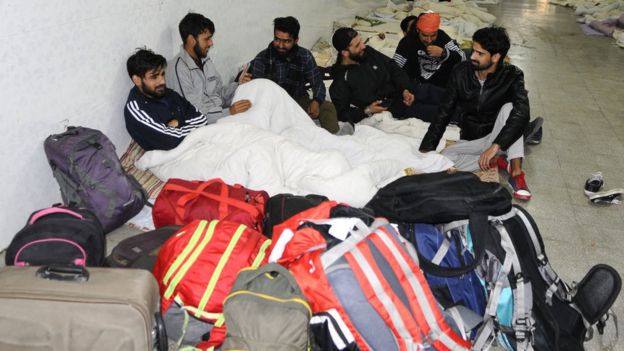
Hundreds of Kashmiri students, traders and businessmen have returned to Kashmir from various Indian cities out of fear that they could face harassment or attack.
India has long had a volatile relationship with Muslim-majority Kashmir, where there has been an armed insurgency against Indian rule since the late 1980s.
The region has been a flashpoint between India and Pakistan since independence. Both countries claim all of Kashmir but control only parts of it. They have fought two wars and a limited conflict over the territory.
Image copyrightGETTY IMAGESImage captionKashmiri students living in Dehradun and other cities have returned home since the attack
What did the court say?
The court’s decision singled out the federal government as well as governments in 10 states which are home to a sizeable Kashmiri population.
It asked authorities to widely publicise the details of officials who Kashmiris can contact if they face threats or violence.
The order was in response to a petition seeking protection for Kashmiris living across India. Tehseen Poonawala, one of the petitioners, told the BBC that he was moved to act because he was “disturbed” after reading reports of Kashmiris being attacked.
“It’s not about Kashmiris. It’s about human beings. We cannot be a country that responds with mob violence,” he said.
What happened to Kashmiri students?
In the days following the attack, isolated incidents of students from Kashmir being beaten up or evicted from their accommodation in northern Indian states were reported in local media. Kashmiri Muslims were warned to stay vigilant and India’s Central Reserve Police Force (CRPF) offered help to those in need, but also warned of false reports.
“We did so to provide protection to the [Kashmiri] students,” the college principal, Aslam Siddidqu, told the BBC, adding that he had faced pressure from right-wing groups.
Federal education minister Prakash Javadekar has denied that “incidents” have taken place involving Kashmiri students.
But a police official in Dehradun told the BBC that 22 students had been arrested for protesting and demanding that Kashmiri students be expelled from colleges in the city.
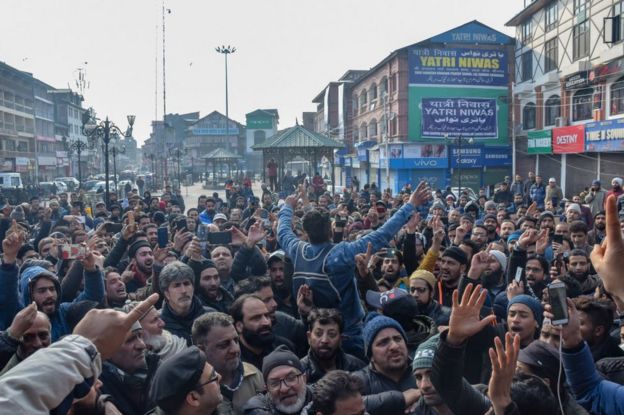
Image copyrightGETTY IMAGESImage captionMarkets and businesses were closed to protest against violence
What’s the bigger picture?
The attack has raised tensions between India and Pakistan, which have fought two wars and a limited conflict in the region and are both nuclear powers.
India has accused Pakistani intelligence services of having a hand in the attack, which was claimed by militant group Jaish-e-Mohammad.
Pakistan denies this and has warned that it will retaliate if India takes military action. In his first comments addressing the attack, Prime Minister Imran Khan said India should “stop blaming Pakistan without any proof or evidence” and urged Indian authorities to share any “actionable intelligence”.
India has moved to impose trade restrictions on Pakistan. It has also said it will build dams to reduce the flow of water to Pakistan from three rivers in India. Similar plans were announced in 2016, after a deadly militant attack on an Indian base in Kashmir.



 CHINDIA ALERT: You'll be living in their world, very soon