Archive for ‘world economy.’

17/05/2020

Lufthansa Cargo adds more flights to mainland China, ferrying urgent supplies to Europe

  • There has been strong demand for air freight services since April, when Chinese factories got back to work
  • Cargo flights have become critical in moving protective health equipment across the globe
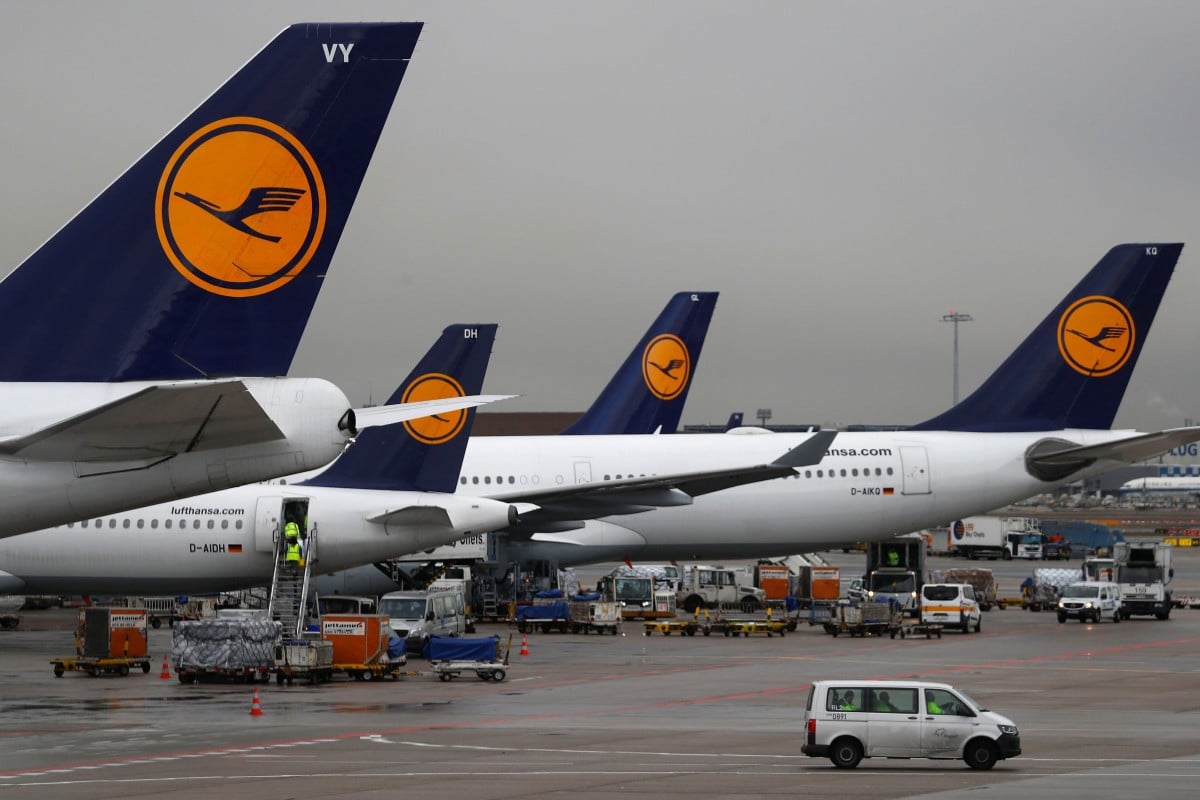
Planes of German air carrier Lufthansa at the country’s largest airport in Frankfurt. Photo: Reuters

German freight carrier Lufthansa Cargo is expanding in China, surpassing 100 weekly flights for the first time, and adding new flights to Shenzhen.

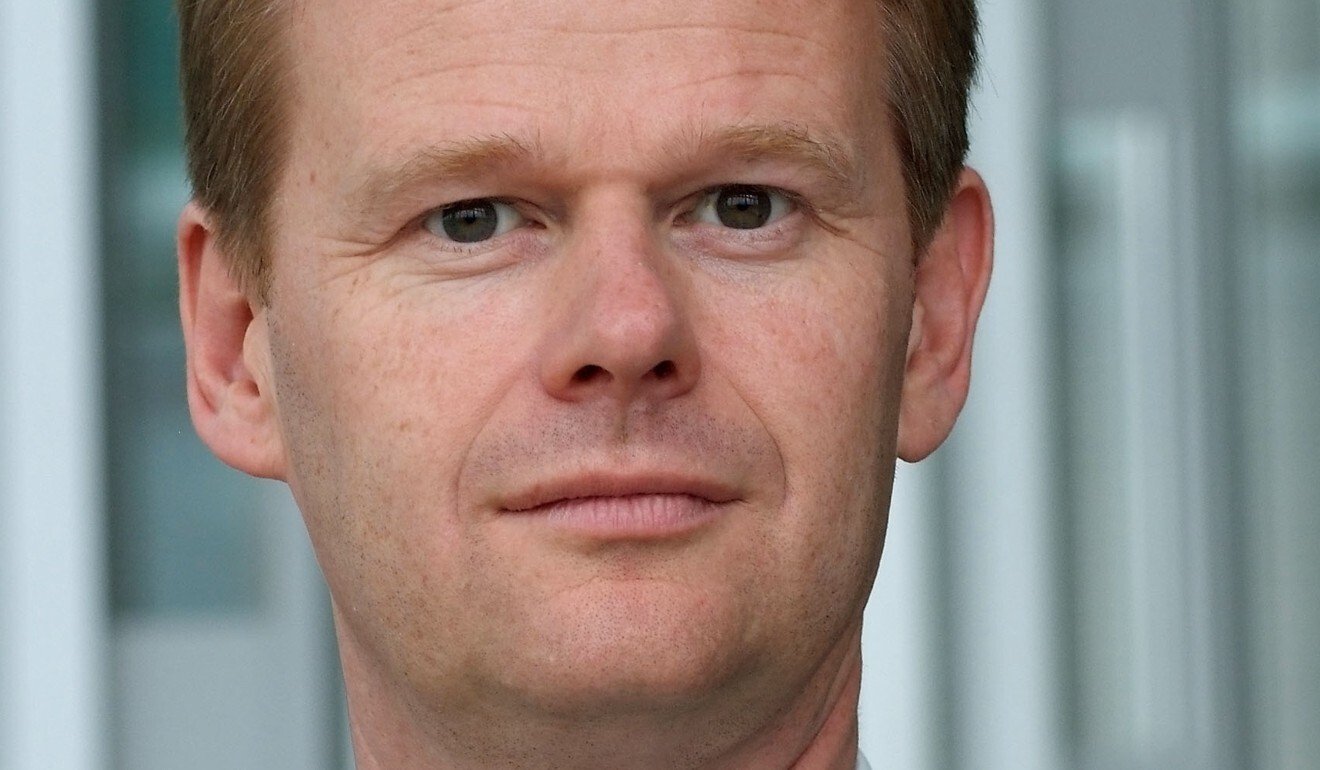
Peter Gerber, CEO of Europe’s largest cargo airline, said there had been heavy demand for its services, though this might cool by the peak of summer.

“At the moment, cargo demand is very, very strong,” he told the Post. “It started to get strong in April, when Chinese industries got back to work, and after that we have seen a constant, heavy demand, a real peak.”

Cathay Pacific and Cathay Dragon report combined HK$4.5 billion loss for start of 2020

15 May 2020
Global air freight capacity has been squeezed as two-thirds of the world’s aircraft have been grounded by the Covid-19 pandemic.
The collapse of air travel has practically put a stop to passenger flights, which typically carry half of all air cargo.

Since the pandemic, cargo flights have been critical in moving protective health equipment across the globe. From sending masks and other supplies to China in February, the German carrier is now taking urgent supplies from the mainland back to Europe.

Peter Gerber says Lufthansa Cargo has a high responsibility in maintaining supply chains, for both global health and world trade. Photo: Handout
“We have a high responsibility in maintaining supply chains in these unprecedented times for both global health and world trade,” Gerber said.

With the addition of Shenzhen, Lufthansa Cargo will fly to five destinations in China. It serves more than 300 destinations in 100 countries.

The cargo carrier is part of the Lufthansa Group and coordinates all the freight that goes into the passenger planes of its sibling brands, including Lufthansa, Swiss and Austrian.

Coronavirus: South Africa asks Hong Kong to remove its citizens from government quarantine list

16 May 2020

By next week, Lufthansa Cargo will be running more freight flights to China than the 72 passenger flights the group flew weekly before the pandemic to Beijing, Shanghai, Shenyang, Nanjing and Qingdao.

Lufthansa Cargo has a fleet of seven Boeing 777 Freighters (777Fs), with two new 777Fs arriving this year as part of its strategy to operate a fleet with a single aircraft type.

It also has six McDonnell Douglas-11Fs that Gerber said would still be retired as planned at the end of 2020, despite the extra demand for cargo capacity.

Its additional flights to China will make use of “preighters” – passenger aircraft flying cargo only. Gerber felt the trend of using empty passenger planes as “preighters” had peaked, pointing out that they cost the same to operate as freighters but carry only a fraction of the cargo.

Although he did not rule out future expansion, he said: “Demand will gradually come down in the next two or three months because a lot of equipment would have been shipped by then and some shipments will go on rail or ocean shipping.”

Coronavirus: Cathay Pacific could get cash injection from shareholder Qatar Airways

13 May 2020

He said some uncertainty remained over continued demand for airfreighted cargo, given the battered state of the world economy. Airlines would have to consider longer-term demand before deciding to invest more in cargo aircraft. “It depends how it looks beyond the next year,” he said.

Gerber said no decision had been taken yet on whether to convert some of the group’s orders for Boeing’s newest widebody 777X passenger aircraft into cargo planes.

He added that future plane orders would be balanced against the wider needs and spending decisions at Lufthansa Group, which is currently negotiating a government pandemic bailout package in the region of 9 billion (US$9.7 billion).

Source:SCMP

09/05/2020

Xinhua Headlines: World’s factory turns to domestic market amid global coronavirus recession

— As the continued global spread of COVID-19 is weighing on the world economy, China’s foreign trade is under considerable downward pressure.

— Many export-oriented companies in China are turning to the domestic market for a lifeline while grappling with dropping overseas orders as major markets remain in the grip of the pandemic.

by Xinhua writers Zhang Yizhi, Li Huiying, Hu Guanghe, Xu Ruiqing

FUZHOU, May 9 (Xinhua) — Walking back and forth between shelves of neatly stacked shoes, some 20 live streamers dashed at the instructions of their followers on the phone, grabbing a shoe now and then from the shelves for a close-up in front of the camera.

At around eight o’clock every night, the supply chain platform 0594 in the city of Putian, east China’s Fujian Province, springs to life as live streamers flock to the exhibition area to sell shoes produced by the local manufacturers, many of which are troubled by the cancellations or delays of overseas orders amid the global coronavirus pandemic.

“To get rid of the excess inventory, many manufacturers in Putian are turning to live streaming to explore the domestic market,” said Chen Xing, general manager of 0594. “We are now cooperating with over 40 manufacturers and there will be more of them joining us in the future.”

The platform is also building an internet celebrity incubator and has so far organized seven rounds of influencer training courses enrolling more than 200 attendees.

Huang Huafang, 39, signed up for the two-day crash course in late March and soon after started her first live streaming session. She works from around 2 p.m. to 10 p.m., attracting over 500 followers and selling more than 20 pairs of shoes every day.

Though she is not a well-known live streamer, she is optimistic about the future. “There is a long way to go, but I believe live streaming is a trend. It is an essential skill for anyone who wants to market online,” said Huang.

A staff sells shoes through live streaming at an e-commerce warehouse in Putian, southeast China’s Fujian Province, May 7, 2020. (Xinhua/Lin Shanchuan)

According to Chen, the platform 0594 sold almost 130,000 pairs of shoes in April alone. As the domestic economic outlook continues to pick up, the sales target of May has been set at 200,000 pairs.

Like manufacturers in Putian, a city with a large number of export-oriented enterprises, many Chinese factories are turning to the domestic market for a lifeline, while grappling with dropping overseas orders as major markets remain in the grip of the pandemic.

ADAPT OR DIE

With decades of experience in manufacturing and developing products for overseas clients, some export-oriented companies in China are rolling out products catering to the domestic market.

After months of gloomy business, Wu Songlin, general manager of Putian-based Hsieh Shun Footwear Co., Ltd., heaved a sigh of relief as trucks loaded with therapeutic shoes tailored to the home market left his factory.

It was the first shipment for the domestic market since Wu and his partners started the company in 2010. In the past, his company only had two clients, one from Europe and the other from Japan. Business used to run smoothly and life was good.

But his factory was on the brink of a shutdown in March when the coronavirus pandemic started to ravage the global economy. No new orders came in and shipments of existing orders were requested to be delayed until June.

People work in a footwear workshop in Putian, southeast China’s Fujian Province, April 27, 2020. (Xinhua/Lin Shanchuan)

“Orders were canceled after completion of production, and our capital flow is stuck in our inventory. The pressure is mounting to keep the factory running,” Wu said. “By the end of June, workers would be left with no work to do as soon as we complete the existing orders.”

After losing almost all their orders from overseas clients, the desperate shoemaker turned to the domestic market. He called one of his old business partners and secured an order for massage footwear, which is selling like hot cakes in the domestic market as health tops the agenda in the time of the novel coronavirus.

The factory produced 10,000 pairs of massage shoes in April, and the number is expected to reach 30,000 in May, enough to keep the production lines running.

Thanks to the company’s quick adaptation, about 200 workers kept their jobs in the factory, while 20 percent were furloughed and the remaining workers were arranged to work in other companies as part of the city’s employee sharing program.

“If domestic orders keep coming in, our operation will hopefully get back to normal by September when the monthly output of massage shoes will reach 90,000,” Wu said. “By then the company will live and thrive without any orders from overseas customers.”

A woman works in a workshop of Hsieh Shun Footwear Co., Ltd. in Putian, southeast China’s Fujian Province, May 7, 2020. (Xinhua/Lin Shanchuan)

But switching to another market is not easy, explained Wu. In the past, export-oriented factories were only in charge of manufacturing, while brands would take care of sales, promotion as well as customer support.

“If you are selling to the domestic market, you need to have your own brand and marketing capacity,” he said. “Working with e-commerce platforms could be one way out, but it’s more important to understand domestic consumers and meet their needs.”

CUSTOMIZE THE FUTURE

For years, many export-focused manufactures have been trying to climb up the value chain and tap the uncharted waters of the domestic market. As the pandemic continues to spread, there is a strong push for them to embrace customized manufacturing.

In an experience store located in downtown Putian, customers line up waiting to have their feet measured on a smart device. After a few seconds, they get their readings on the phone, and a few swipes and clicks later, they place their orders with unique features, colors, and shapes.

Adjacent to the experience store, there is a flexible manufacturing workshop, which gives quick responses to orders and produces shoes following the customized demands of individual buyers.

SEMS, a longstanding sports footwear manufacturer that has established a partnership with several international brands, started to adopt flexible manufacturing years ago in an effort to adapt to the evolving domestic market.

A customer has her feet measured on a smart device in sports footwear manufacturer SEMS in Putian, southeast China’s Fujian Province, May 8, 2020. (Xinhua/Lin Shanchuan)

Customization gives consumers the benefit of products that fit their needs, and at the same time allows factories to utilize improved workflows and technology to maintain high output and omit the process of inventory and distribution, said Zhu Yizhen, the executive vice president of the company.

“Currently we only sell over 100 pairs of customized shoes a day, but we are at the dawn of a new era,” Zhu said. “We hope more companies awaken to the developing trend and join in the practice of mass customization.”

Customer to manufacturer, or C2M, which allows consumers to place orders directly to factories for customized products, has become a buzzword among export-oriented manufacturers hoping to reach domestic consumers amid the pandemic.

Li Junjie, who runs a ceramic flowerpot plant in Fujian’s Dehua County, one of the manufacturing centers of ceramics in China, did not sell a single pot to his overseas customers since the coronavirus outbreak in late January.

The factory used to export 30 percent of its flowerpots to the United States and Spain, but Li managed to make up for the lost deals by selling on domestic e-commerce platforms. Instead of bulk orders placed by foreign clients, domestic consumers tend to purchase customized products in small amounts.

Photo shows the automatic production line of a customized workshop in sports footwear manufacturer SEMS in Putian, southeast China’s Fujian Province, May 8, 2020. (Xinhua/Lin Shanchuan)

With the big data provided by e-commerce platforms, Li can tell which items will be a hit so as to increase their production and develop new products based on a thorough analysis of different consumer groups.

“Our online sales almost doubled over the past year, and we have sold over 100,000 customized pots this year, thanks to the C2M business model,” Li said.

Li’s company is one of many Chinese small and medium-sized enterprises (SMEs) that have benefited from the e-commerce giant Alibaba’s Spring Thunder Initiative, which is aimed at helping export-focused SMEs expand into new markets.

The initiative will also help some SMEs to transform and develop their business in the Chinese market through measures such as resource support, fee reductions, and fast-track processing.

Source: Xinhua

17/04/2020

China commends Saudi Arabia on proposing G20 agriculture ministers meeting

BEIJING, April 17 (Xinhua) — China highly commends Saudi Arabia on proposing to convene a special meeting of the G20 agriculture ministers and hopes the meeting will send a positive signal in safeguarding global food security amid COVID-19 fight, a Foreign Ministry spokesperson said Friday.

Spokesperson Zhao Lijian said the G20 Extraordinary Virtual Leaders’ Summit on COVID-19 on March 26 reached an important consensus on fighting the pandemic through solidarity and stabilizing the world economy.

As the pandemic develops, Saudi Arabia has proposed to convene a special meeting of the G20 agriculture ministers on April 21 to cope with the food and agricultural security issues under the current situation, said Zhao, adding that China highly commends this proposal.

Chinese Minister of Agriculture and Rural Affairs Han Changfu will attend the G20 meeting, Zhao said.

China has always attached great importance to the issue of food security and hopes the meeting will send a positive signal in fighting the pandemic with solidarity and maintaining the security and stability of the global food supply, he added.

Source: Xinhua

13/04/2020

Coronavirus: China’s export showroom Yiwu grinds to a near halt as global pandemic restrictions bite

  • China’s famed Yiwu International Trade Market, a barometer for the health of the nation’s exports, has been hammered by the economic fallout from Covid-19
  • Export orders have dried up amid sweeping containment measures in the US and Europe and restrictions on foreigners entering China have shut out international buyers
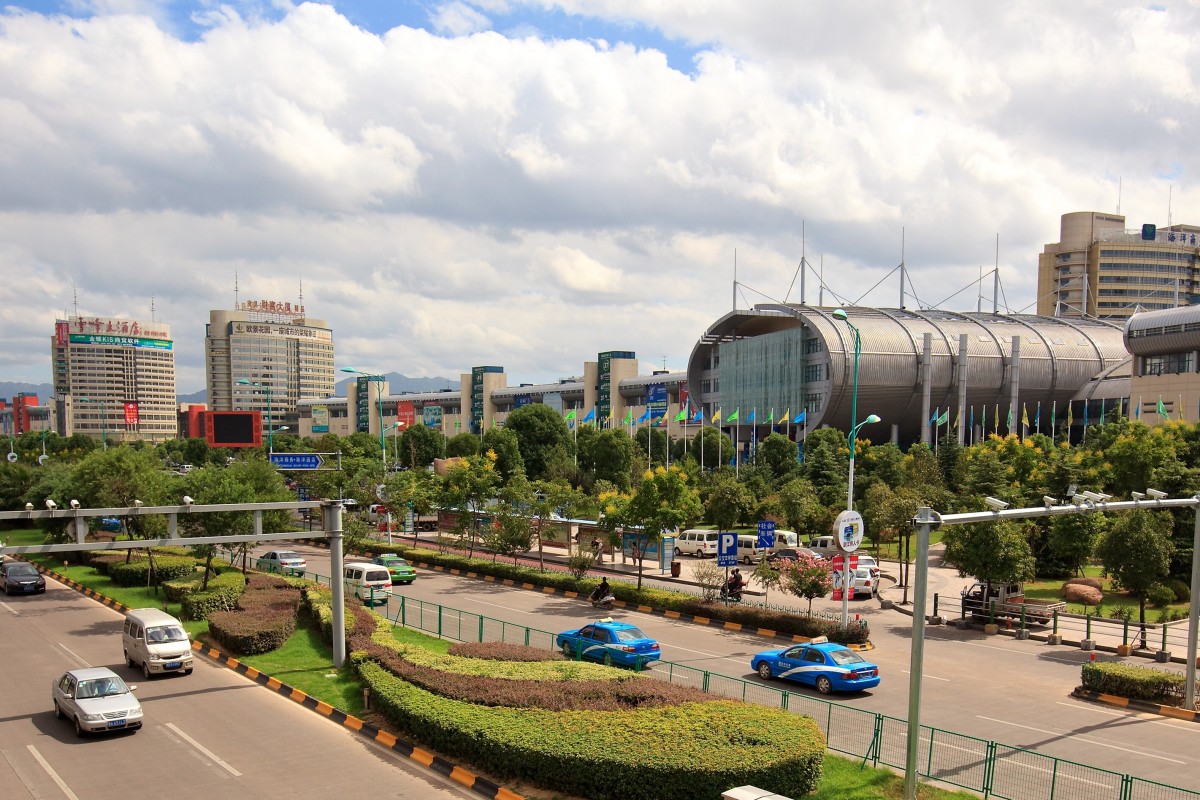
The coronavirus pandemic has severely dented wholesale trade at the Yiwu International Trade Market in China. Photo: SCMP

The Yiwu International Trade Market has always been renowned as a window into the vitality of Chinese manufacturing, crammed with stalls showcasing everything from flashlights to machine parts.

But today, as the coronavirus pandemic rips through the global economy, it offers a strikingly different picture – the dismal effect Covid-19 is having on the nation’s exports.

The usually bustling wholesale market, home to some 70,000 vendors supplying 1,700 different types of manufactured goods, is a shadow of its former self.

Only a handful of foreign buyers traipse through aisles of the sprawling 4-million-square-metre (43 million square feet) complex, while store owners – with no customers to tend to – sit hunched over their phones or talking in small groups.

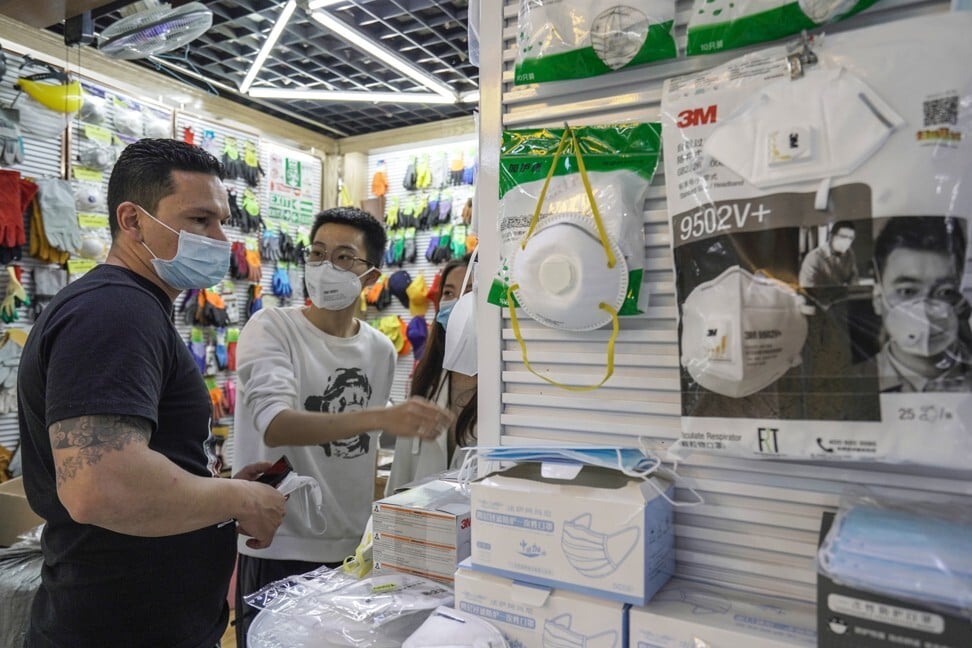
A foreign buyer visits a stall selling face masks. Photo: Ren Wei
“We try to convince ourselves that the deep slump will not last long,” said the owner of Wetell Razor, Tong Ciying, at her empty store. “We cannot let complacency creep in, although the coronavirus has sharply hampered exports of Chinese products.”
Chinese exports plunged by 17.2 per cent in January and February combined compared to the same period a year earlier, according to the General Administration of Customs. The figure was a sharp drop from 7.9 per cent growth in December.
After riding out a supply shock that shut down most of its factories, China is now facing a second wave demand shock, as overseas export orders vanish amid sweeping containment measures to contain the outbreak around the globe.

Nowhere is that clearer to see than in Yiwu. The city of 1.2 million, which lies in the prosperous coastal province of Zhejiang, was catapulted into the international limelight as a showroom for Chinese manufacturing when the country joined the World Trade Organisation in 2001.

Coronavirus: Is the gig economy dead, and should the self-employed worry?
Before the pandemic, thousands of foreign buyers would flock to the mammoth trade market each day to source all manner of products before sending them home.

But the outbreak, which has claimed the lives of more than 113,000 people and infected more than 1.9 million around the world, is proving a major test for the market and the health of the trade dependent city.

Imports and exports via Yiwu last year were valued at 296.7 billion yuan (US$42.2 billion) – nearly double the city’s economic output.

Businesses, however, are facing a very different picture in 2020. Most traders at the market say they have lost at least half their business amid the pandemic, which was first detected in the central Chinese city of Wuhan last year.

Just take a look at the situation in Yiwu and you will understand the extent of the virus’ effect on China’s trade with foreign countries – Tianqing

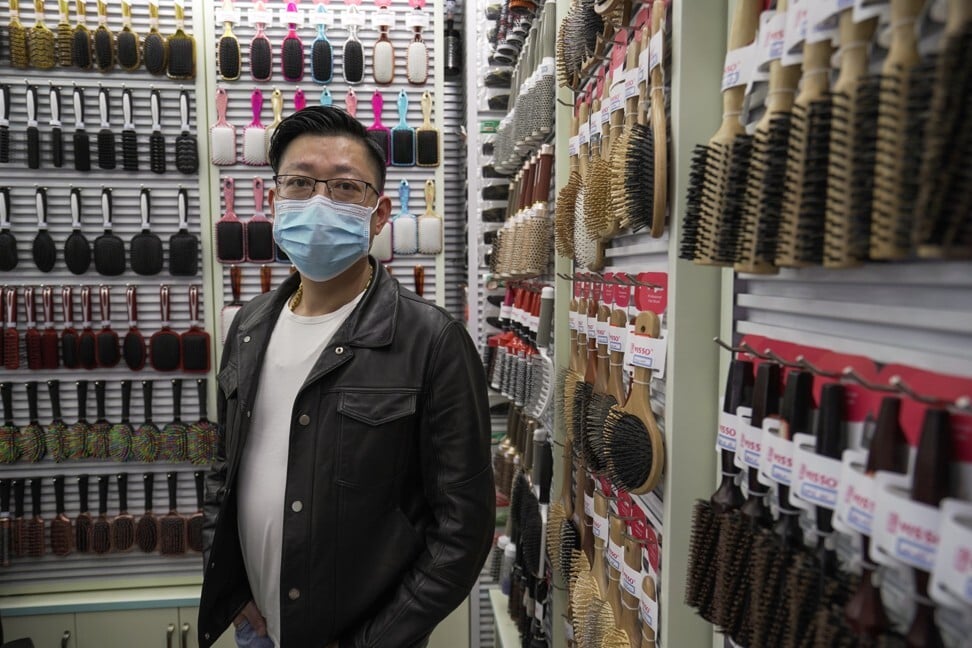
“Yiwu is the barometer for China’s exports,” said Jiang Tianqing, the owner of Beauty Shine Industry, a manufacturer of hair brushes. “Just take a look at the situation in Yiwu and you will understand the extent of the virus’ effect on China’s trade with foreign countries.”

Jiang said his business was only just hanging on thanks to a handful of loyal customers placing orders via WeChat.

“I assume it will be a drawn-out battle against the coronavirus,” he said. “We are aware of the fact that developed economies like the US and Europe have been severely affected.”

The Yiwu market reopened on February 18 after a one-month long hiatus following the Lunar New Year holiday and the government’s order to halt commercial activities to contain the spread of the outbreak.

Jiang Tianqing, owner of hair brush company Beauty Shine Industry. Photo: Ren Wei
But facing the threat of a spike in imported cases, Beijing banned foreigners from entering the country in late March – shutting out potential overseas buyers.
Despite the lack of business, local authorities have urged stall owners to keep their spaces open to display Yiwu’s pro-business attitude, owners said.
“For those bosses who just set up their shops here, it would be a do-or-die moment now since their revenue over the next few months will probably be zero,” said Tong. “I am lucky that my old customers are still making orders for my razors.”
The impact of the coronavirus is just the latest challenge for local merchants, who normally pay 200,000 yuan (US$28,000) per year for a 10-square-metre (108 square feet) stall at the market.
Traders were hard hit by the trade war between China and the United States when the Trump administration imposed a 25 per cent tariff on US$200 billion of Chinese imports last year.
At the time, some Chinese companies agreed to slash their prices to help American buyers digest the additional costs.
“But it is different this time,” said Jiang. “Pricing does not matter. Both buyers and sellers are eager to seal deals, but we are not able to overcome the barriers [to demand caused by the virus].”
Even when businesses can secure orders, it is a struggle to deliver them
.

Ma Jun, a manager with a LED light bulb trading company, said the only export destination for her company’s products was war-torn Yemen because it was the only country with ports still open.

It is a public health crisis that ravages not just our businesses, but the whole world economy – Dong Xin

Dong Xin, an entrepreneur selling stationery products, said he could not ship the few orders he had because “ocean carriers have stopped operations”.
“It is a public health crisis that ravages not just our businesses, but the whole world economy,” he said. “The only thing can do is to pray for an early end to the pandemic.”

Most wholesale traders in the Yiwu market run manufacturing businesses based outside the city, so a sharp fall in sales has a ripple effect on their factories, potentially resulting in massive job cuts.

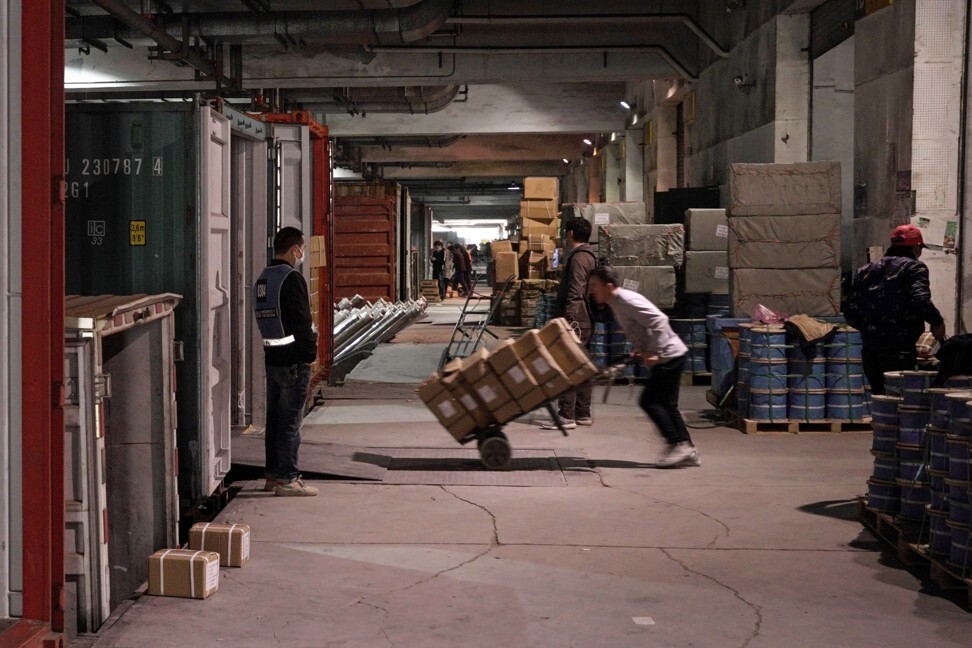
Workers pack containers at Yiwu Port, an inland port home to dozens of warehouses. Photo: Ren Wei
At Yiwu Port, an inland logistics hub full of warehouses where goods from the factories are unpacked and repacked for shipping abroad, container truck drivers joke about their job prospects.
“We used to commute between Shaoxing and here five times a week, and now it is down to twice a week,” said a driver surnamed Wang, describing the trip from his home to the shipping port, just over 100km away.
“At the end of the day, we may not be infected with the coronavirus, but our jobs will still be part of the cost of the fight against it.”
Source: SCMP
10/04/2020

Chinese vice premier talks with British finance minister on bilateral cooperation

BEIJING, April 9 (Xinhua) — Chinese Vice Premier Hu Chunhua held a phone conversation on Thursday with British Chancellor of the Exchequer Rishi Sunak on advancing bilateral cooperation on epidemic prevention and economic development.

Hu, who leads the Chinese delegation to the China-UK Economic and Financial Dialogue (EFD), noted that Chinese President Xi Jinping and British Prime Minister Boris Johnson recently held two phone conversations and reached important consensus on jointly dealing with the pandemic and developing China-UK relations.

The Chinese side stands ready to work with the British side to implement the consensus reached by the two leaders, deepen practical cooperation in such fields as epidemic prevention and finance, and provide Britain with support and assistance within its capabilities in medical supplies and other fields, Hu said.

The vice premier expressed hope that the two sides will further strengthen cooperation under the framework of the United Nations and the Group of 20, promote macroeconomic policy coordination, cut tariff, remove barriers, and facilitate the flow of trade, so as to maintain the stability of the global industrial supply chain and promote sustainable growth of the world economy.

For his part, Sunak thanked China for its support and assistance, adding that Britain stands ready to strengthen bilateral cooperation in epidemic prevention, economy and finance through channels like the China-UK EFD, so as to continuously advance bilateral relations.

Source: Xinhua

Law of Unintended Consequences

continuously updated blog about China & India

ChiaHou's Book Reviews

continuously updated blog about China & India

What's wrong with the world; and its economy

continuously updated blog about China & India