Archive for ‘world peace’

15/05/2020

Trump says doesn’t want to talk to Xi, could even cut China ties

WASHINGTON (Reuters) – U.S. President Donald Trump signaled a further deterioration of his relationship with China over the coronavirus outbreak, saying he has no interest in speaking to President Xi Jinping right now and going so far as to suggest he could even cut ties with the world’s second largest economy.

In an interview with Fox Business Network broadcast on Thursday, Trump said he was very disappointed with China’s failure to contain the disease and that the pandemic had cast a pall over his January trade deal with Beijing, which he has previously hailed as a major achievement.

“They should have never let this happen,” Trump said. “So I make a great trade deal and now I say this doesn’t feel the same to me. The ink was barely dry and the plague came over. And it doesn’t feel the same to me.”

Trump’s pique extended to Xi, with whom the U.S. president has said repeatedly he has a good relationship.

“But I just – right now I don’t want to speak to him,” Trump said in the interview, which was taped on Wednesday.

Trump was asked about a Republican senator’s suggestion that U.S. visas be denied to Chinese students applying to study in fields related to national security, such as quantum computing and artificial intelligence.

“There are many things we could do. We could do things. We could cut off the whole relationship,” he replied.

“Now, if you did, what would happen? You’d save $500 billion,” Trump said, referring to estimated U.S. annual imports from China, which he often refers to as lost money.

Chinese foreign ministry spokesman Zhao Lijian told reporters in Beijing on Friday that maintaining a steady bilateral relationship served the interests of both peoples and would be beneficial for world peace and stability.

“Both China and the U.S. should now be cooperating more on fighting the virus together, to cure patients and resume economic production, but this requires the U.S. to want to work with us on this,” Zhao said.

Trump’s remarks drew ridicule from Hu Xijin, editor in chief of China’s influential Global Times tabloid, who referred to the president’s much-criticized comments last month about how COVID-19, the disease caused by the coronavirus, might be treated.

“This president once suggested COVID-19 patients inject disinfectants,” Hu said on Twitter. “Remember this and you won’t be surprised when he said he could cut off the whole relationship with China.”

CONCERNED, REVIEWING OPTIONS

U.S. Treasury Secretary Steven Mnuchin told Fox Business Network China needed to provide a lot more information about the coronavirus and Trump was reviewing his options.

“The president is concerned. He’s reviewing all his options. Obviously, we’re very concerned about the impact of this virus on the economy, on American jobs, the health of the American public and the president is going to do everything to protect the economy and protect American workers,” Mnuchin said.

“It’s a difficult and complex matter and the president has made very clear, he wants more information. They didn’t let us in, they didn’t let us understand what was going on.”

Trump and his Republican backers have accused Beijing of failing to alert the world to the severity and scope of the coronavirus outbreak and of withholding data about the earliest cases. The pandemic has sparked a sharp global recession and threatened Trump’s November re-election chances.

The United States has been hardest hit by the pandemic, according to official data.

China insists it has been transparent, and, amid increasingly bitter exchanges, both sides have questioned the future of the trade deal.

Opponents of Trump have said that while China has much to answer for over the outbreak, he appears to be seeking to deflect attention from criticism over his response to the crisis.

Scott Kennedy of Washington’s Center for Strategic and International Studies think tank called Trump’s remarks “dangerous bravado.”

“Avoiding communication is not an effective strategy for solving a crisis that requires global cooperation. And cutting off the economic relationship would badly damage the American economy,” he said.

Michael Pillsbury, a China analyst who has worked as an outside adviser to Trump, told Reuters he believed the president was concerned that China not only wanted to re-negotiate the Phase 1 deal, but also had not been meeting goals in purchasing from United States.

He said that according to figures cited by the China Daily, China’s purchases of U.S. products in the first four months of this year were 3% less than during the same period last year.

“It’s not good news for reducing the trade deficit or helping our economy recover from the coronavirus crisis,” he said.

China took some additional steps towards the Phase 1 goals on Thursday, buying U.S. soybean oil for the first time in nearly two years and issued customs notices allowing imports of U.S. barley and blueberries.

An executive from Chinese state agriculture trading house COFCO said China was set to speed up purchases of U.S. farm goods to implement the Phase 1 deal.

While U.S. intelligence agencies have said the coronavirus does not appear manmade or genetically modified, Trump said in his interview that China should have stopped it at its source.

“Whether it came from the lab or came from the bats, it all came from China, and they should have stopped it,” he said.

“It got out of control.”

Source: Reuters
01/10/2019

Military advances and Xi Jinping’s supreme status among the themes as Beijing celebrates National Day

  • 70th anniversary of the founding of the People’s Republic of China marked by its biggest ever military parade and huge civilian parade
  • Xi says no force can stop China ‘marching forward’ and vows to protect the long-term stability of Hong Kong
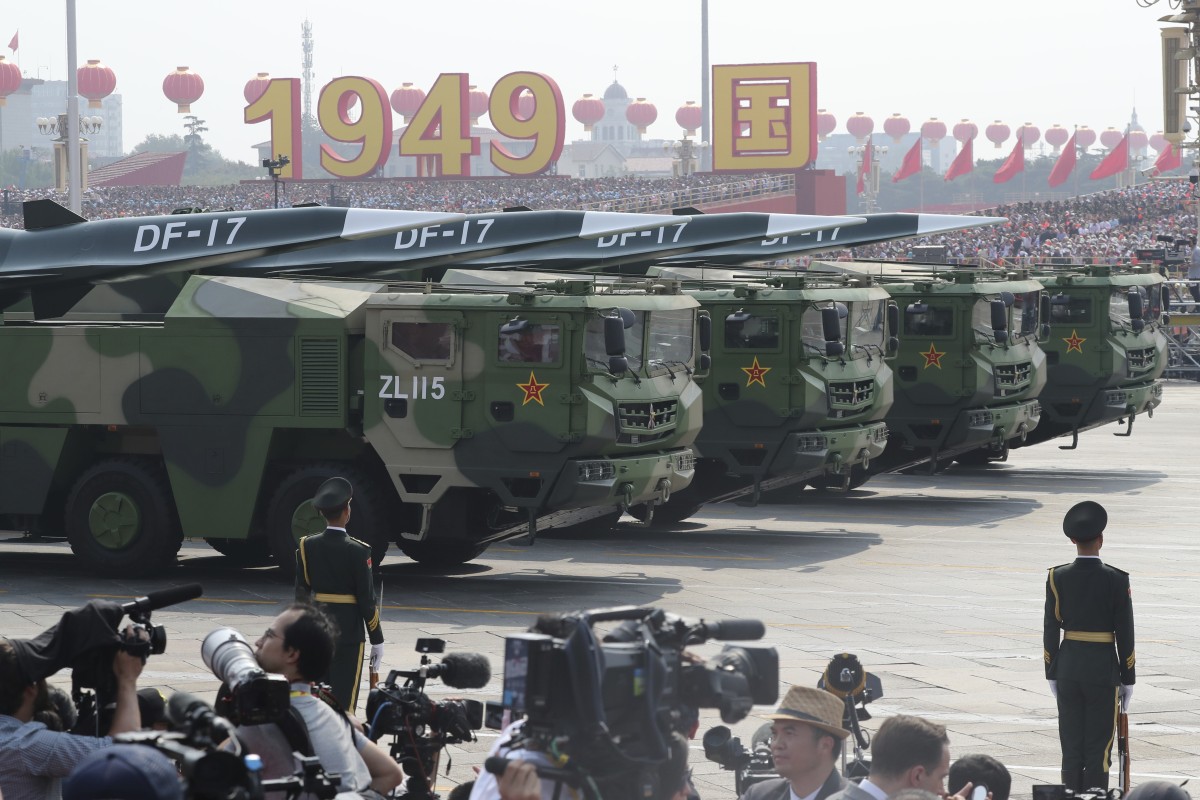
Military vehicles carry DF-17 missiles capable of reaching the US mainland during the parade to mark 70 years of the People’s Republic. Photo: AP
China staged a massive military parade in Beijing on Tuesday to mark the 70th anniversary of the founding of the People’s Republic, with much of the smog-shrouded capital city under a security lockdown.
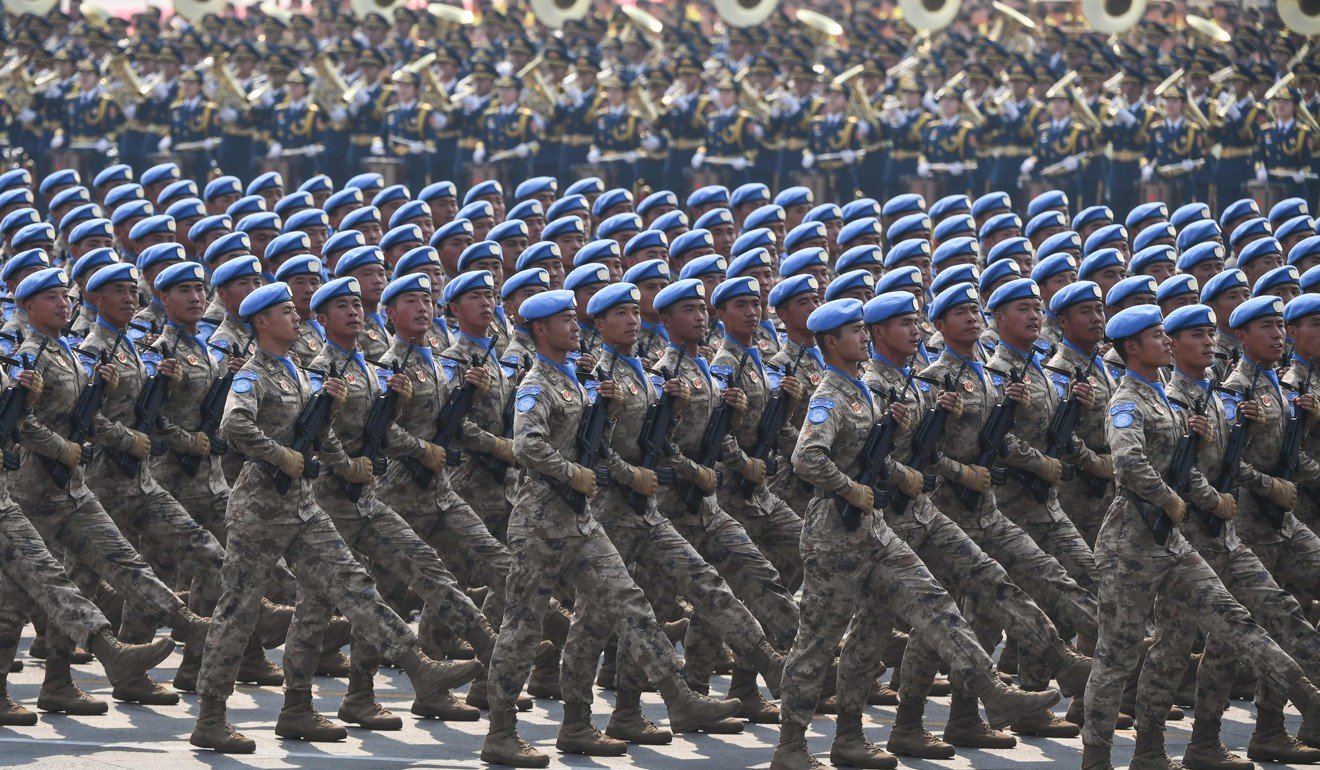
President Xi Jinping inspected over 15,000 troops, more than 160 aircraft and 580 weapon systems in a show of the country’s growing military might and his drive to modernise the People’s Liberation Army.
He also delivered a bullish eight-minute speech hailing the accomplishments of seven decades of Communist rule and pledging to achieve his vision of a “Chinese dream” of national rejuvenation and global prominence.

Here are some of the key takeaways from a day of celebration in Beijing:

A show of unity

Xi presided over the ceremony in Tiananmen Square flanked by his predecessors Jiang Zemin and Hu Jintao, along with other retired and present party elders.

The rare appearance of Jiang and Hu – on the rostrum of the Gate of Heavenly Peace, where the country’s founding father Mao Zedong declared Communist rule on October 1, 1949 – was clearly aimed at projecting unity and solidarity in the face of daunting domestic and international challenges.

China’s National Day parade, as it happened
Hu had been absent from the funeral of former premier Li Peng in late July, although the ailing Jiang attended.

Former vice-president Zeng Qinghong and Song Ping, the oldest party elder in attendance, also appeared on the rostrum.

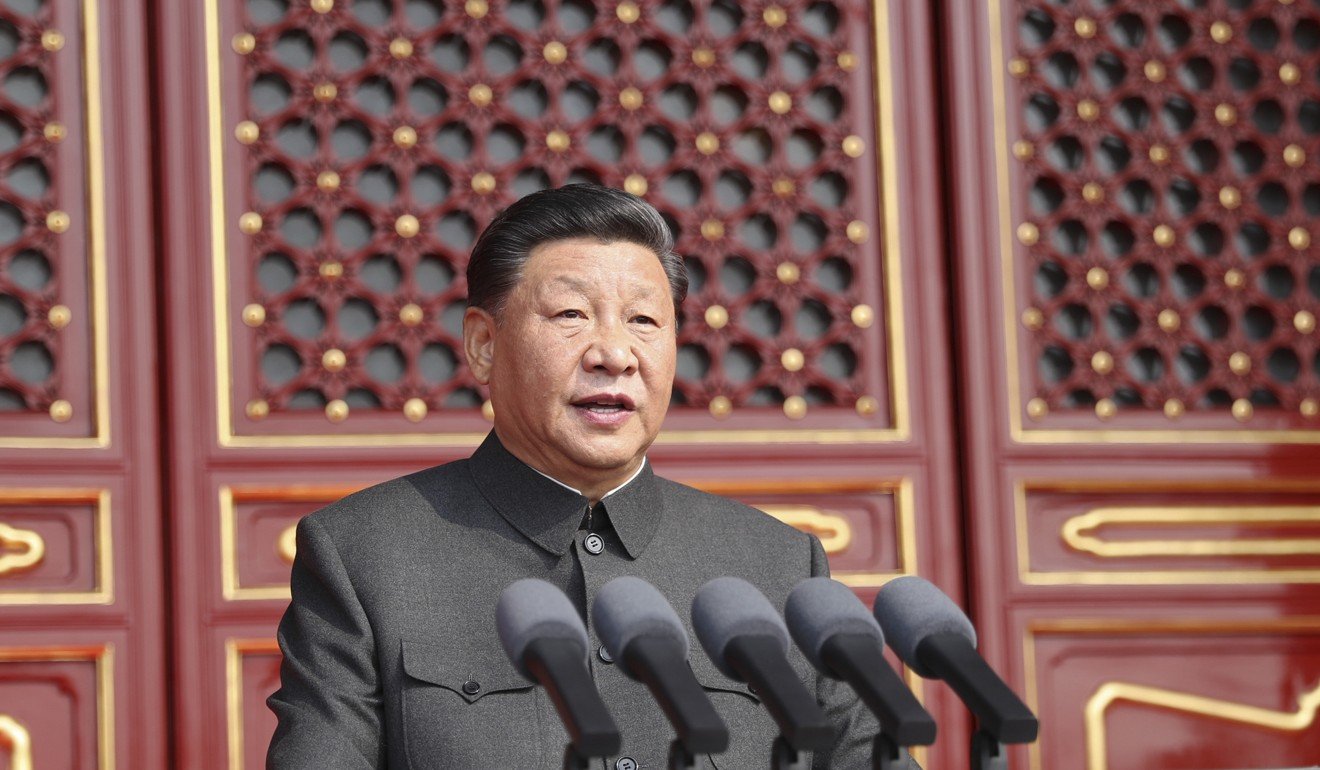
President Xi Jinping speaks in Tiananmen Square during Tuesday’s celebrations. Photo: Xinhua

But notably, while former premier Wen Jiabao was present, his predecessor Zhu Rongji was not.

‘No force can shake China’

Dressed in a Mao suit, Xi’s nationally televised speech invoked China’s “century of humiliation” and praised the achievements of its people, saying there was no force that could stop it forging ahead.

“No force can shake the status of our great motherland, and no force can stop the Chinese people and the Chinese nation from marching forward,” he said.

Chinese troops take part in the Republic’s largest ever military parade. Photo: AFP
“The People’s Liberation Army [PLA] will serve its purpose in safeguarding the sovereignty, security and development interests of the country, and world peace,” he said, at a time when Beijing has expanded its military footprint globally, including with its first overseas military base in Djibouti.
Xi called on the Communist Party and the country to unite and continue to fight for the realisation of what he called the “Chinese dream” – the nation’s rejuvenation.
One country, two systems
Amid escalating unrest in Hong Kong, which has plunged the city into a deepening crisis and threatened to overshadow the National Day celebrations, Xi vowed that the central government would uphold “one country, two systems”.
He said the central government would protect the long-term stability of Hong Kong and Macau, and stressed the goal of “peaceful reunification” with the self-ruling Taiwan, repeating a message frequently used by his predecessors, including Deng Xiaoping, Jiang and Hu.

The theme of one country, two systems later appeared in a National Day parade for the first time, with placards forming the words: “Hong Kong’s tomorrow will be better.”

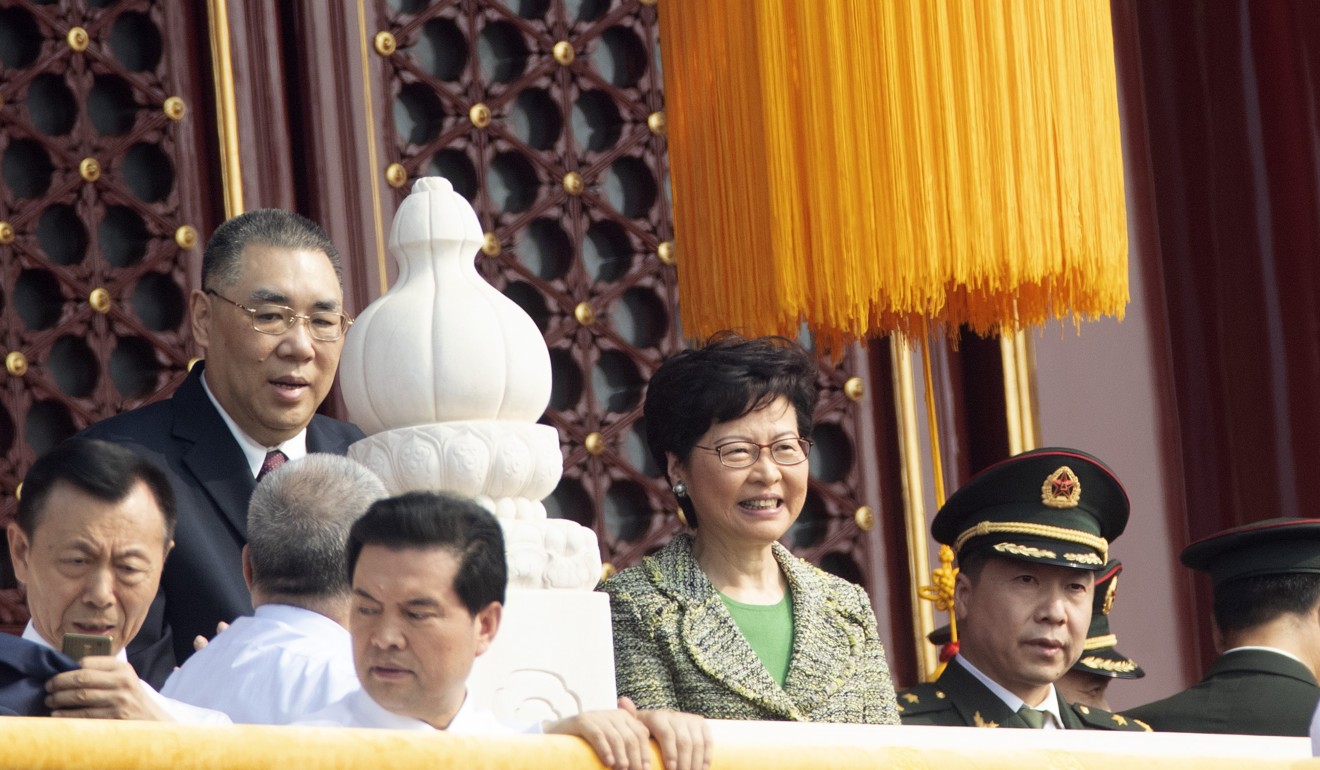
Hong Kong Chief Executive Cheng Yuet-ngor attended the ceremony, as did 10 Hong Kong police officers involved in suppressing anti-government protests in the city.
Showing off new weapons
China’s advancement in military weaponry was on full display, with almost half of the items featured being shown to the public for the first time.
Hong Kong leader Carrie Lam was among the guests in Beijing on Tuesday. Photo: AP

The morning’s celebrations included an 80-minute military parade – the biggest since the founding of the People’s Republic – in an apparent effort to showcase the prowess of the PLA, the world’s biggest military with 2 million personnel.

Among the weapons shown were DF series missiles, including the DF-17, a nuclear-capable glider that has the capacity to strike the US mainland, and the DF-41, which has a range of up to 15,000km, making it the world’s longest-range military missile.

Signalling Xi’s status

A 100,000-strong civilian parade featuring huge portraits of Xi and predecessors including Mao, Deng, Jiang and Hu wrapped up the morning celebration.

The procession was divided into three parts, representing three eras of the People’s Republic: the Mao era, Deng’s reform and opening up, and Xi’s era, which seeks global prominence on a par with that of the United States.

Xi appeared keen to project his supreme status in the party, reinforced since he abolished the constitutional term limit a year ago, allowing him potentially to remain leader for life.

He waved at his own portrait, unveiled alongside a sign reading “Carry out Xi Jinping Thought on Socialism with Chinese Characteristics for a New Era”.

Source: SCMP

06/03/2019

China Focus: China to lower defense budget growth to 7.5 percent

BEIJING, March 5 (Xinhua) — China will lower its defense budget growth rate to 7.5 percent in 2019, from last year’s 8.1 percent, according to a draft budget report submitted to the annual session of the National People’s Congress (NPC) Tuesday.

The 2019 defense budget will be 1.19 trillion yuan (about 177.61 billion U.S. dollars), figures from the report show.

The rate marks the fourth straight year for the budgeted growth rate remaining single digit, following five consecutive years of double-digit increases.

China’s budgeted defense spending growth rate stood at 8.1 percent in 2018, 7 percent in 2017, and 7.6 percent in 2016.

“The Chinese government has always paid attention to controlling the scale of defense expenditure,” said He Lei, former deputy head of the Academy of Military Sciences.

Describing China’s defense budget increase as reasonable and appropriate, Zhang Yesui, spokesperson for the legislative session, said the rise aimed to “meet the country’s demand in safeguarding national security and military reform with Chinese characteristics.”

“China’s limited defense spending, which is for safeguarding its national sovereignty, security and territorial integrity, poses no threat to any other country,” Zhang said at a press conference Monday.

The expenditure has been mainly used for advancing defense and military reforms, supporting military training and diverse tasks, modernizing weapons and equipment, and improving welfare of service personnel, according to He, who is also a deputy to the NPC.

“The defense budget increase is appropriate against the backdrop of profound changes in the country’s overall strength, its security environment, and the global strategic situation,” He said.

China’s defense budget takes up a fairly small share of its GDP and national fiscal expenditure compared with other major countries, said He, noting that its military spending per capita and per soldier was also very low.

While the national defense spending in a number of major developed countries accounts for more than 2 percent of their GDP, the ratio was only about 1.3 percent for China in 2018.

The United States has increased its national defense expenditure for the fiscal year 2019 to 716 billion dollars, about four times the budget of China, the world’s second largest economy.

China’s military spending per capita is only about one-nineteenth of that of the United States.

“When it comes to whether a country poses a threat to other countries, the key is not that country’s national strength and armed forces, but the policies it adopts,” said Chen Zhou, research fellow with the Academy of Military Sciences.

“China has always been following the path of peaceful development and firmly adheres to a defense policy that is defensive in nature,” Chen said, noting that China’s development would not pose a threat to any other country.

He Lei highlighted China’s role in providing public security goods for the international community, saying the Chinese military had actively participated in UN peacekeeping missions, maintained security of marine passages, and engaged in international rescue and security cooperation.

“The growth in China’s defense spending is the growth of forces for world peace,” he noted.

Source: Xinhua

Law of Unintended Consequences

continuously updated blog about China & India

ChiaHou's Book Reviews

continuously updated blog about China & India

What's wrong with the world; and its economy

continuously updated blog about China & India