Archive for ‘World Trade Organization (WTO)’

27/03/2020

Xi Focus: China underscores unity to save world economy from recession

BEIJING, March 27 (Xinhua) — As the novel coronavirus disease (COVID-19) makes social distancing and working from home the new normal, leaders of the Group of 20, home to almost two-thirds of the world’s population and about 86 percent of the gross world product, convened Thursday for a virtual summit that sent a clear message: We are in the same boat.

The G20 Extraordinary Virtual Leaders’ Summit on COVID-19 was the first of its kind in the history of G20, and also the first major multilateral event attended by President Xi Jinping since the outbreak of the COVID-19.

Speaking to his colleagues via video link from Beijing, Xi put forward four proposals to cope with a situation that is “disturbing and unsettling,” calling for an all-out global war against the COVID-19 outbreak and enhancing international macro-economic policy coordination to prevent a recession.

“At such a moment, it is imperative for the international community to strengthen confidence, act with unity and work together in a collective response,” Xi said. “We must comprehensively step up international cooperation and foster greater synergy so that humanity as one could win the battle against such a major infectious disease.”

In a demonstration of the need for greater global coordination and solidarity, the G20 members were joined by leaders from invited countries including hard-hit Spain as well as multiple international organizations including the United Nations (UN), the World Health Organization (WHO), the World Trade Organization (WTO), and the International Monetary Fund (IMF).

While previous G20 summits often discussed high-stake topics like economic recession and boosting development policy, Thursday’s emergency meeting came at a time when the world is grappling with a dicey pandemic and concerns are mounting over the “black swan” event that could derail the global economy.

As China’s epidemic prevention and control are continuously improving, and the trend of an accelerated restoration of normal production and life is being consolidated and expanded, his remarks at the G20 summit are timely and of critical importance for countries now fighting at the front lines of a battle to stem the pandemic and forestalling a recession.

UNITED WE STAND

The number of COVID-19 cases worldwide topped 462,684, with 20,834 deaths as of 10 a.m. Central European Time, Thursday, according to the data kept by the WHO. The economic toll is also climbing as more businesses and trade come to a grinding halt amid massive lockdowns.

“The COVID-19 pandemic is endangering countries rich and poor, large and small, strong and weak alike,” said Wei Jianguo, vice chairman of the China Center for International Economic Exchanges and former vice minister of Commerce. “We are now at a critical juncture of fighting the pandemic and stabilizing the global economy, and the international community expects the G20 to play a leading role.”

The significance and urgency of Thursday’s meeting hark back to scenarios in the depth of the global financial crisis in 2008 when meetings of G20 finance ministers and central bank governors were raised to the level of heads of state and government for better crisis coordination. What’s different is that grave challenges facing the world today have led to warnings of a downturn even worse than in 2008.

“This pandemic will inevitably have an enormous impact on the economy,” WTO Director-General Roberto Azevedo said in a video clip posted on the website of the organization. “Recent projections predict an economic downturn and job losses that are worse than the global financial crisis a dozen years ago.”

To prevent the world economy from falling into recession, Xi said countries need to leverage and coordinate their macro policies to counteract the negative impact as the outbreak has disrupted production and demand across the globe.

“We need to implement strong and effective fiscal and monetary policies to keep our exchange rates basically stable. We need to better coordinate financial regulation to keep global financial markets stable. We need to jointly keep the global industrial and supply chains stable,” he told the summit in a speech titled “Working Together to Defeat the COVID-19 Outbreak.”

Xi’s remarks on fighting as one echoed. IMF Managing Director Kristalina Georgieva said: “We project a contraction of global output in 2020, and recovery in 2021. How deep the contraction and how fast the recovery depends on the speed of containment of the pandemic and on how strong and coordinated our monetary and fiscal policy actions are.”

“We will get through this crisis together. Together we will lay the ground for a faster and stronger recovery,” she said in a statement released after the conference call.

The important lesson in international solidarity is often forgotten when things are going fine, William Jones, Washington bureau chief of the U.S. publication Executive Intelligence Review, told Xinhua in a recent interview.

“The experience with the COVID-19 will hopefully lead to more collaborative efforts between countries and strengthen the notion of a community with a shared destiny,” he said.

As China is a key driver of global economic growth, its economic performance bears great significance on the outlook of global recovery. In a strong morale and practical boost, Xi reaffirmed China would actively contribute to the global war against COVID-19 and a stable world economy.

“Guided by the vision of building a community with a shared future for mankind, China will be more than ready to share its good practices, conduct joint research and development of drugs and vaccines, and provide assistance where it can to countries hit by the growing outbreak,” Xi said.

Xi said China will contribute to a stable world economy by continuing to advance reform and opening-up, widen market access, improve the business environment and expand imports and outbound investment, and called on all G20 members to take collective actions — cutting tariffs, removing barriers, and facilitating the unfettered flow of trade.

The country is beefing up wider opening-up to foreign investment. Revision of the negative list on foreign investment is underway as part of the plan to improve business environment and expand the catalog of industries where foreign investment is encouraged.

New editions of the list will probably be released in May, expanding market access of the tertiary sector, such as health care, aged service, finance, transportation, logistics, tourism, education and training and value-added services of telecommunications, said Zhang Fei with the Chinese Academy of International Trade and Economic Cooperation.

Noting that a global solution is needed to address the global challenge brought about by the pandemic, Azevedo said cross-border trade and investment flows have a role to play in efforts to combat the COVID-19 pandemic and will be vital for fostering a stronger recovery once the medical emergency subsides.

“No country is self-sufficient, no matter how powerful or advanced it may be. Trade is what allows for the efficient production and supply of basic goods and services, medical supplies and equipment, food and energy that we all need,” he said.

Source: Xinhua

22/11/2019

Chinese premier meets int’l institutions leaders on world economy

CHINA-BEIJING-LI KEQIANG-INT'L INSTITUTIONS LEADERS-ROUNDTABLE MEETING (CN)

Chinese Premier Li Keqiang and leaders of six major international economic and financial institutions meet the media after their fourth roundtable meeting in Beijing, capital of China, Nov. 21, 2019. The six leaders are World Bank Group President David Malpass, International Monetary Fund Managing Director Kristalina Georgieva, World Trade Organization Deputy Director-General Alan Wolff, International Labor Organization Director-General Guy Ryder, Organization for Economic Cooperation and Development Secretary-General Angel Gurria and Financial Stability Board Chairman Randal Quarles. (Xinhua/Yue Yuewei)

BEIJING, Nov. 21 (Xinhua) — Chinese Premier Li Keqiang held a roundtable meeting with leaders of six major international economic and financial institutions in Beijing on Thursday.

The six leaders are World Bank Group President David Malpass, International Monetary Fund Managing Director Kristalina Georgieva, World Trade Organization Deputy Director-General Alan Wolff, International Labor Organization Director-General Guy Ryder, Organization for Economic Cooperation and Development Secretary-General Angel Gurria and Financial Stability Board Chairman Randal Quarles.

Li expressed hope to build consensus, boost confidence and deepen cooperation through the meeting, so as to promote the sustained, healthy and stable development of world economy.

It is the fourth roundtable meeting for Li and leaders of the six institutions. This year’s meeting features the theme of “promoting openness, stability and high-quality development of the world economy.”

Source: Xinhua

01/10/2019

China anniversary: How the country became the world’s ‘economic miracle’

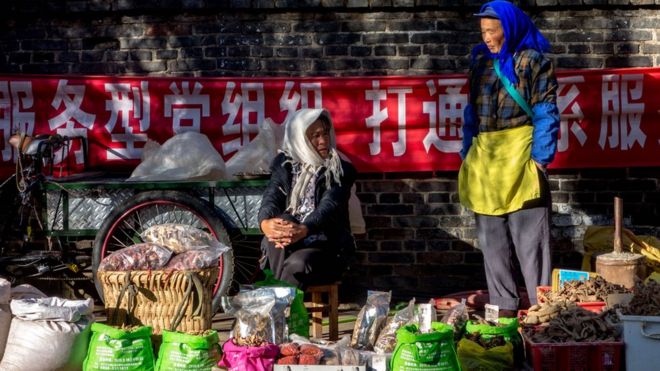
Local women sell produce in the market. Zhongyi market, located at the southern gate of Dayan ancient city, in Lijian, Yunnan Province in ChinaImage copyrightGETTY IMAGES

It took China less than 70 years to emerge from isolation and become one of the world’s greatest economic powers.

As the country celebrates the anniversary of the founding of the People’s Republic of China, we look back on how its transformation spread unprecedented wealth – and deepened inequality – across the Asian giant.

“When the Communist Party came into control of China it was very, very poor,” says DBS chief China economist Chris Leung.

“There were no trading partners, no diplomatic relationships, they were relying on self-sufficiency.”

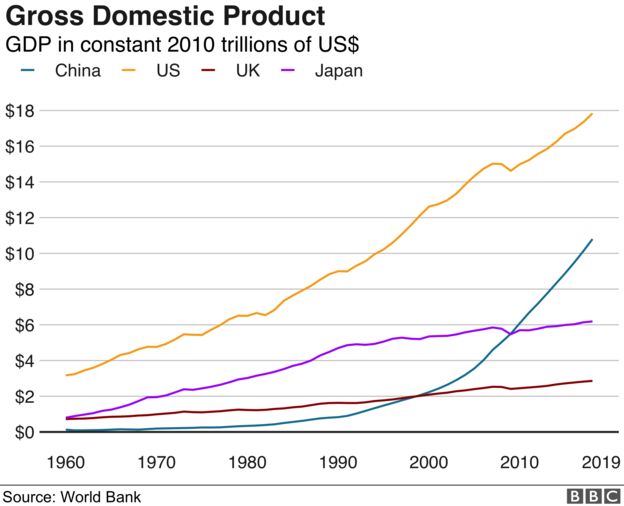
Over the past 40 years, China has introduced a series of landmark market reforms to open up trade routes and investment flows, ultimately pulling hundreds of millions of people out of poverty.

Chart showing gross domestic product of US, China, Japan and the UK

The 1950s had seen one of the biggest human disasters of the 20th Century. The Great Leap Forward was Mao Zedong’s attempt to rapidly industrialise China’s peasant economy, but it failed and 10-40 million people died between 1959-1961 – the most costly famine in human history.

This was followed by the economic disruption of the Cultural Revolution in the 1960s, a campaign which Mao launched to rid the Communist party of his rivals, but which ended up destroying much of the country’s social fabric.

‘Workshop of the world’

Yet after Mao’s death in 1976, reforms spearheaded by Deng Xiaoping began to reshape the economy. Peasants were granted rights to farm their own plots, improving living standards and easing food shortages.

The door was opened to foreign investment as the US and China re-established diplomatic ties in 1979. Eager to take advantage of cheap labour and low rent costs, money poured in.

“From the end of the 1970s onwards we’ve seen what is easily the most impressive economic miracle of any economy in history,” says David Mann, global chief economist at Standard Chartered Bank.

Through the 1990s, China began to clock rapid growth rates and joining the World Trade Organization in 2001 gave it another jolt. Trade barriers and tariffs with other countries were lowered and soon Chinese goods were everywhere.

“It became the workshop of the world,” Mr Mann says.

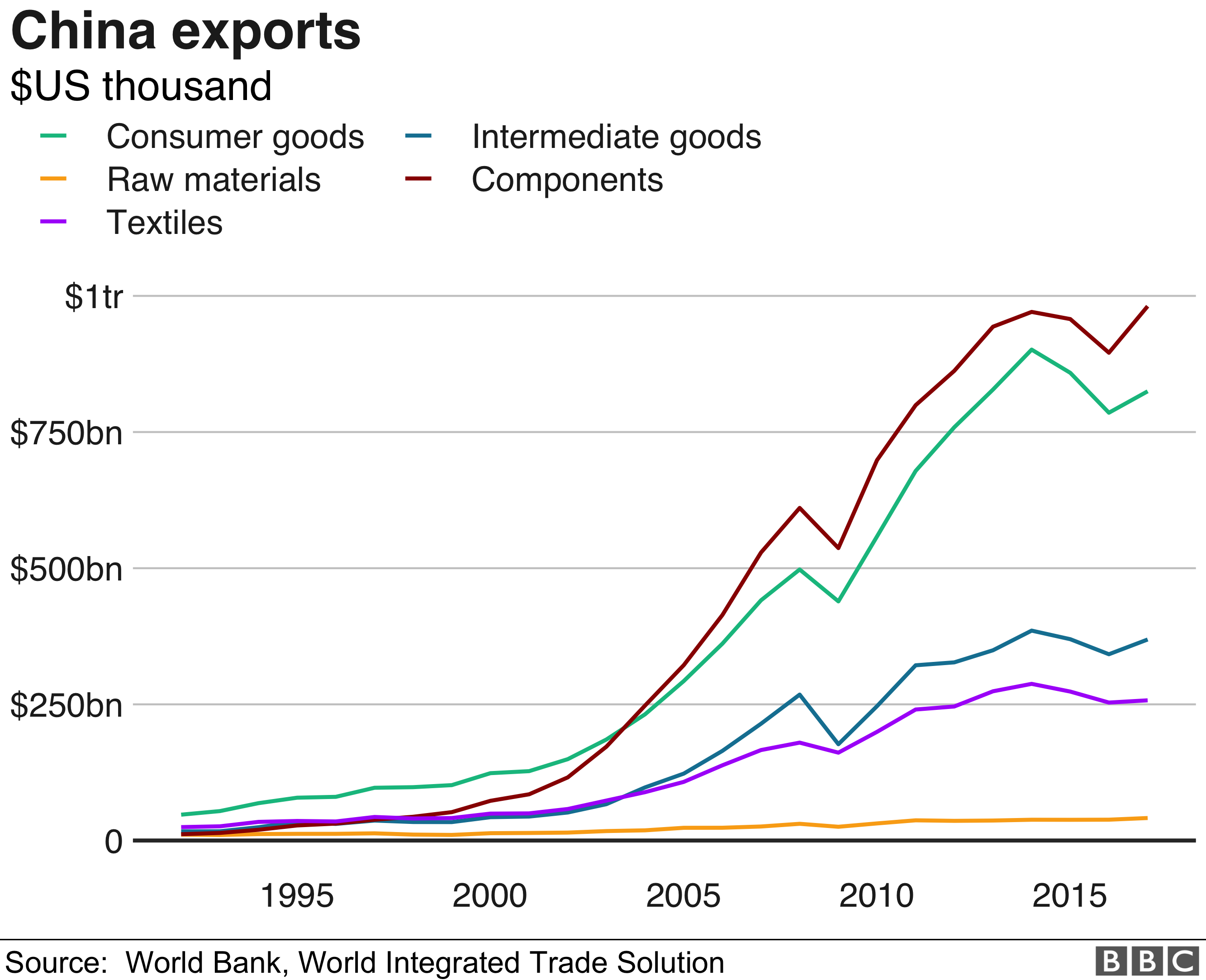
Chart showing China exports

Take these figures from the London School of Economics: in 1978, exports were $10bn (£8.1bn), less than 1% of world trade.

By 1985, they hit $25bn and a little under two decades later exports valued $4.3trn, making China the world’s largest trading nation in goods.

Poverty rates tumble

The economic reforms improved the fortunes of hundreds of millions of Chinese people.

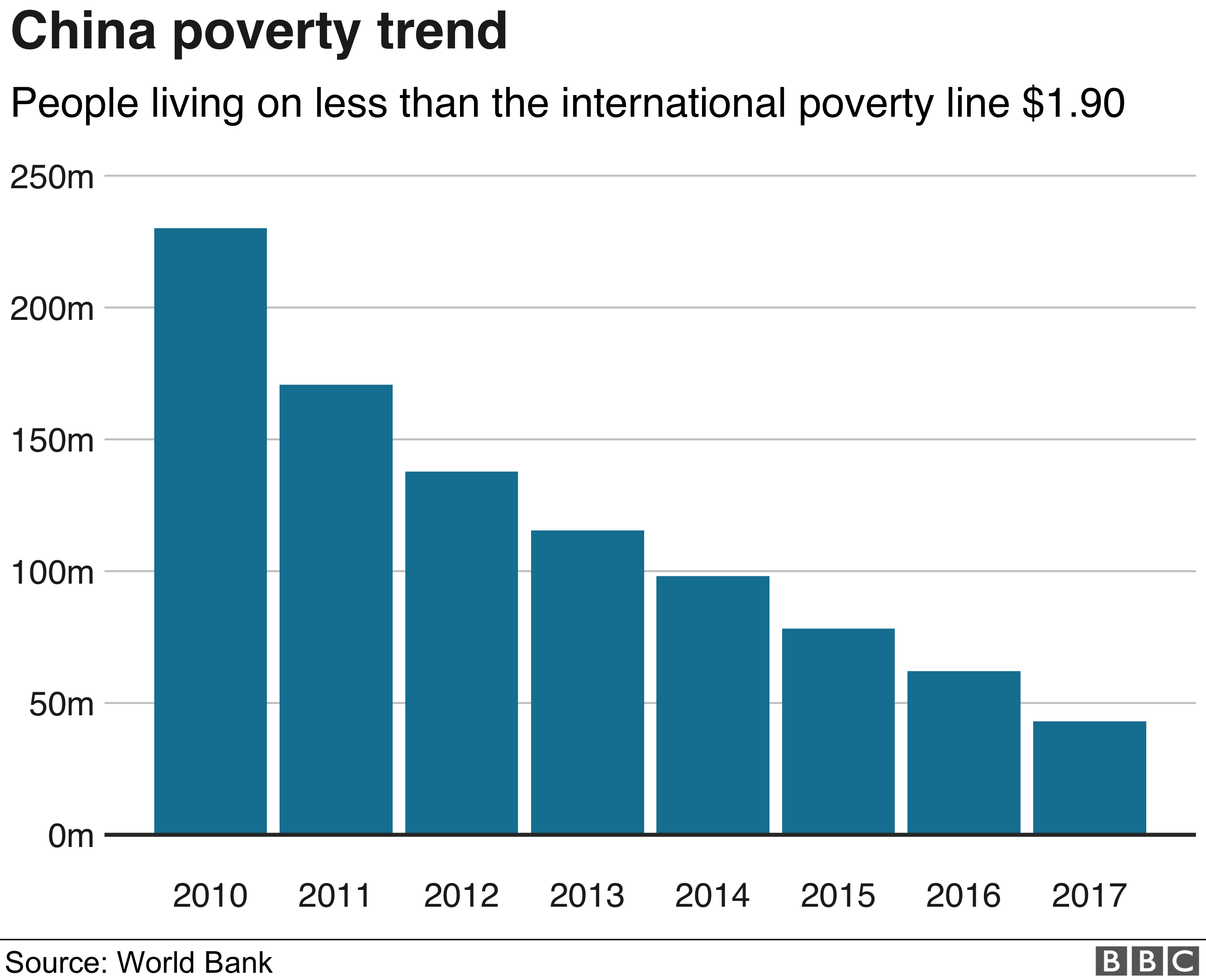
The World Bank says more than 850 million people been lifted out of poverty, and the country is on track to eliminate absolute poverty by 2020.

At the same time, education rates have surged. Standard Chartered projects that by 2030, around 27% of China’s workforce will have a university education – that’s about the same as Germany today.

China poverty rates

Rising inequality

Still, the fruits of economic success haven’t spread evenly across China’s population of 1.3 billion people.

Examples of extreme wealth and a rising middle class exist alongside poor rural communities, and a low skilled, ageing workforce. Inequality has deepened, largely along rural and urban divides.

“The entire economy is not advanced, there’s huge divergences between the different parts,” Mr Mann says.

The World Bank says China’s income per person is still that of a developing country, and less than one quarter of the average of advanced economies.

China’s average annual income is nearly $10,000, according to DBS, compared to around $62,000 in the US.

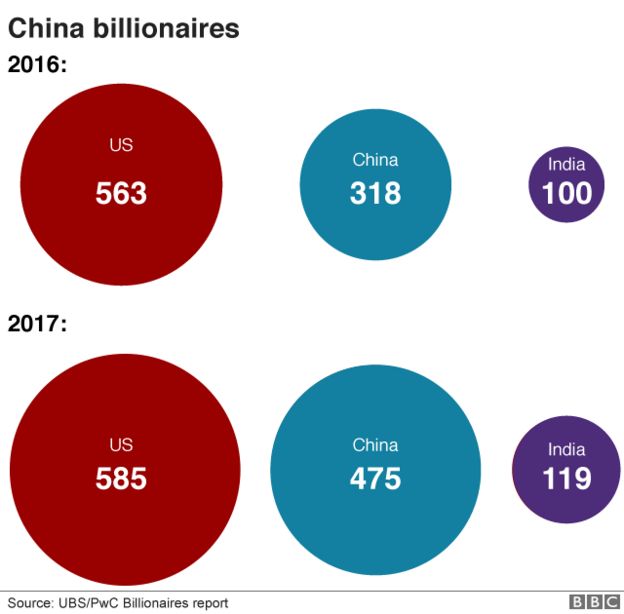
Billionaires in China, the US and India

Slower growth

Now, China is shifting to an era of slower growth.

For years it has pushed to wean its dependence off exports and toward consumption-led growth. New challenges have emerged including softer global demand for its goods and a long-running trade war with the US. The pressures of demographic shifts and an ageing population also cloud the country’s economic outlook.

Still, even if the rate of growth in China eases to between 5% and 6%, the country will still be the most powerful engine of world economic growth.

“At that pace China will still be 35% of global growth, which is the biggest single contributor of any country, three times more important to global growth than the US,” Mr Mann says.

The next economic frontier

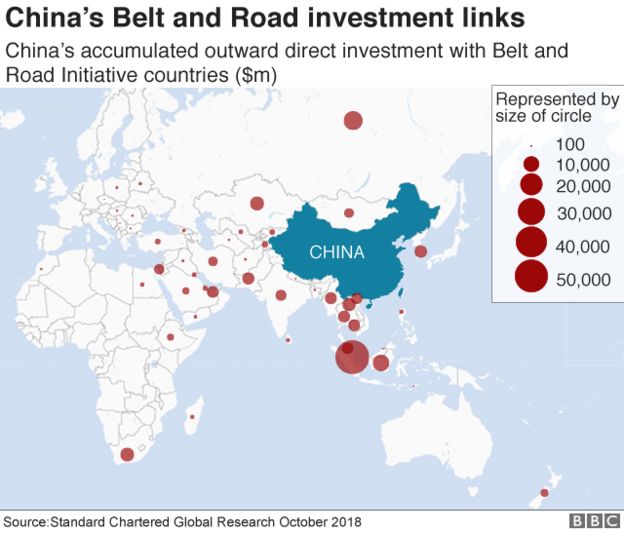
China is also carving out a new front in global economic development. The country’s next chapter in nation-building is unfolding through a wave of funding in the massive global infrastructure project, the Belt and Road Initiative.

Map showing Chinese investment as part of the Belt and Road initiative

The so-called new Silk Road aims to connect almost half the world’s populations and one-fifth of global GDP, setting up trade and investment links that stretch across the world.

Source: The BBC

19/09/2019

Chinese premier meets Putin on bilateral ties

RUSSIA-MOSCOW-CHINA-LI KEQIANG-PUTIN-MEETING

Chinese Premier Li Keqiang meets with Russian President Vladimir Putin at the Kremlin in Moscow, Russia, Sept. 18, 2019. (Xinhua/Liu Bin)

MOSCOW, Sept. 18 (Xinhua) — Chinese Premier Li Keqiang on Wednesday met with Russian President Vladimir Putin at the Kremlin to discuss bilateral relations.

Li arrived at Moscow after holding talks and co-chairing the 24th regular meeting between Chinese and Russian heads of government with his Russian counterpart, Dmitry Medvedev, in St. Petersburg.

The Chinese premier firstly extended Chinese President Xi Jinping’s sincere greetings to Putin.

Recalling his meeting with Medvedev, Li said this visit helped draw a comprehensive plan for exchanges and cooperation between China and Russia in various fields, and achieved a lot of new results.

The three-day visit came as the two countries are celebrating the 70th anniversary of their diplomatic ties. During Xi’s visit to Russia in June this year, China-Russia relationship was elevated to a comprehensive strategic partnership of coordination for a new era.

China and Russia are each other’s biggest neighbor, said Li, adding that a healthy and stable development of bilateral relations is not only beneficial to both sides, but also conducive to the region and the world.

China is willing to continue to consolidate friendship, deepen cooperation and strengthen exchanges with Russia, as well as jointly safeguard an international system with the United Nations at its core and a multilateral trading system based on the World Trade Organization’s rules, which is of great significance for promoting development, prosperity, peace and stability of the world, said the premier.

Noting that China and Russia have broad prospects for cooperation, Li said that China stands ready to better synergize the Belt and Road Initiative (BRI) with the Eurasian Economic Union, to promote the simultaneous increase in both the scale and the quality of the two-way trade.

“China is further expanding opening up and the huge market potential will bring more opportunities to enterprises from all over the world including Russia,” Li said, expressing hopes that the two countries can continue to open up to each other, broaden investment and market access and create more cooperation opportunities for enterprises from the two countries.

With joint efforts, China-Russia practical cooperation will achieve more fruitful results and deliver greater benefits to the two peoples in the new era, Li said.

Congratulating on the 70th anniversary of the founding of the People’s Republic of China, Putin said relations with China are a priority of Russian diplomacy.

Bilateral cooperation has recorded remarkable achievements since the two countries established diplomatic ties 70 years ago, he said, noting that their relations have been upgraded to a comprehensive strategic partnership of coordination for a new era.

Russia-China relations are an important stabilizing factor in international relations, Putin said.

Noting the meeting between Li and Medvedev has effectively promoted bilateral practical cooperation with its many new results, he pledged Russia’s willingness to better align its development strategy with the BRI, constantly expand the two countries’ trade and promote common development.

Also on Wednesday, Li laid a wreath at the Tomb of the Unknown Soldier in Moscow.

Source: Xinhua

12/09/2019

China welcomes more Japanese investments: Premier Li

BEIJING, Sept. 11 (Xinhua) — Premier Li Keqiang on Wednesday expressed his expectation for the Japanese economic community to seize the opportunities of China’s opening up, increase investment in China and expand bilateral cooperation areas to promote more achievements in trade and the economy.

Li made the remarks in a meeting with a delegation from Japan’s business community, led by president of the Japan-China Association on Economy and Trade Shoji Muneoka, chair of the Japan Chamber of Commerce and Industry Akio Mimura, and Nobuyuki Koga, chairman of the Board of Councilors of the Japan Business Federation.

China-Japan relations have returned to the right track since last year thanks to the joint efforts of the two sides, and the trade and economic cooperation between the two countries has been steadily advanced and the prospects for bilateral cooperation are broad, said Li.

When China-Japan relations encountered difficulties, the Japanese economic community made important efforts and contributions to maintain their healthy and steady development as well as accelerate pragmatic cooperation between the two countries, the Chinese premier said.

According to Li, China and Japan are two of the world’s major economies, and should give full play to their complementary advantages and work together to deepen cooperation, which will not only benefit the two countries, but also conducive to regional and global economy, as well as the prosperity and stability of the world.

Noting that economic globalization is irreversible, and economic and trade exchanges should not be blocked by national borders, Li pointed out that promoting the healthy development of globalization is the way of progress.

“China has always firmly upheld the multilateral trading system with the World Trade Organization at its core and promotes the liberalization and facilitation of trade and investment,” Li said, stressing China will unswervingly promote all-round opening up, and strive to optimize the business environment.

China welcomes the Japanese economic community to seize the opportunity brought forth by China’s opening up and increase investments in China, expand cooperation areas, and promote more cooperation achievements in trade and economic areas between the two countries, he said.

While expressing congratulations on the 70th anniversary of the founding of the People’s Republic of China, the Japanese economic delegation said that Japan and China have witnessed progress in bilateral ties since last year, and close high-level exchanges have facilitated the two countries’ economic and trade cooperation.

The Japanese economic community firmly supports free trade and hopes China and the United States will resolutely resolve their trade disputes through negotiation, they said.

Speaking highly of China’s efforts in promoting trade and investment liberalization, expanding market access and improving the business environment, they said that the Japanese economic community is willing to boost cooperation with the Chinese side in science and technology innovation, climate change, health care and third-party markets.

They also expressed their expectation of concluding the negotiations for the Regional Comprehensive Economic Partnership (RCEP), a proposed free trade agreement between the 10 ASEAN (the Association of Southeast Asian Nations) members and Australia, China, India, Japan, South Korea and New Zealand, by the end of the year.

Source: Xinhua

10/08/2019

Xi Focus: China’s head-of-state diplomacy breaks new ground

BEIJING, Aug. 10 (Xinhua) — Chinese President Xi Jinping has led new advances in the development of major country diplomacy with Chinese characteristics.

Xi had a packed diplomatic schedule in the first half of 2019. In April-May, he chaired or attended three events China hosted in a row in just more than half a month. In June, he made four overseas visits and attended four important international meetings in a month.

Amid immense changes in the international situation, the head-of-state diplomacy has led the way forward.

FORGING GLOBAL PARTNERSHIP NETWORK

Xi made his first overseas visit this year in March to three European countries: Italy, Monaco and France, injecting strong impetus into the China-EU comprehensive strategic partnership.

Major-country relations continued to grow. In June, Xi paid a state visit to Russia where he and Russian President Vladimir Putin elevated the China-Russia ties to a comprehensive strategic partnership of coordination for a new era. It was Xi’s eighth visit to Russia and his 31st meeting with Putin since he took office as the Chinese president in 2013.

Friendly exchanges with neighboring countries were deepened. In June, he paid a state visit to the Democratic People’s Republic of Korea (DPRK), opening a new chapter for China-DPRK friendship. Also in June, Xi visited Kyrgyzstan and Tajikistan and met with Japanese Prime Minister Shinzo Abe in the Japanese city of Osaka. All in all, Xi met or held talks with more than 30 leaders of neighboring countries in the first half of the year.

Common progress with the vast majority of developing countries was advanced. Xi congratulated the inauguration of the China-Africa Institute, the opening of the Coordinators’ Meeting on the Implementation of the Follow-up Actions of the Beijing Summit of the Forum on the China-Africa Cooperation, and the first China-Africa Economic and Trade Expo.

Xi also chaired a China-Africa leaders’ meeting on the sidelines of the G20 summit in Osaka, at which leaders reached a broad consensus on a range of issues.

LEADING GLOBAL OPENNESS, COOPERATION

Xi has said a few anti-globalization movements that have emerged in the world cannot stop the tide of globalization.

Thinking in big-picture terms, a Chinese poem says, helps one dispel the clouds to see the sun.

At the G20 summit in Osaka, Xi announced China’s further opening-up measures which have since strengthened the confidence of the global economy.

On the sidelines of the G20 summit, Xi met with U.S. President Donald Trump. They agreed to advance a China-U.S. relationship featuring coordination, cooperation and stability.

China is playing a more positive role in the multilateral trading system, taking globalization toward the direction of more inclusiveness and benefit for all, said World Trade Organization Director General Roberto Azevedo.

Meanwhile, the China-proposed principle of extensive consultation, joint contribution and shared benefits is gaining worldwide recognition.

In April, the Second Belt and Road Forum for International Cooperation was attended by about 6,000 participants from 150 countries and 92 international organizations.

A study published by the World Bank found that fully implementing deeper policy reforms of the Belt and Road Initiative would lift 32 million people out of moderate poverty, increase global trade by up to 6.2 percent and increase global income by as much as 2.9 percent.

WORKING TOGETHER FOR BETTER FUTURE

The Chinese president has called on countries around the world to make concerted efforts and jointly shape the future of humanity.

In various occasions ranging from the global governance forum co-hosted by China and France to the Conference on Dialogue of Asian Civilizations, Xi put forward China’s approaches on global governance and encouraged all parties to build consensus on upholding multilateralism.

China has been committed to firmly upholding the international system with the United Nations at its core and international law as its foundation, and standing on the side of justice as China plays an active role in endeavors such as advancing the political settlement of the Korean Peninsula issue and supporting maintaining the Iran nuclear deal.

China has become a strong pillar of international cooperation and multilateralism, according to UN Secretary-General Antonio Guterres.

At the three events China hosted in the first half of the year, Xi expounded on the concept of building a community with a shared future for humanity from different perspectives: help developing countries break growth bottlenecks, tackle environmental challenges and look to culture and civilization to play their role.

All won broad recognition.

Under Xi’s leadership, the major country diplomacy with Chinese characteristics is sailing towards a brighter future.

Source: Xinhua

02/08/2019

U.S. pressure on WTO reform discords with facts, WTO principles: MOC

CHINA-BEIJING-MINISTRY OF COMMERCE-PRESS CONFERENCE (CN)

Gao Feng, spokesperson of China’s Ministry of Commerce, gestures at the ministry’s press conference in Beijing, capital of China, Aug. 1, 2019. (Xinhua/Zhang Yuwei)

BEIJING, Aug. 1 (Xinhua) — U.S. denial of “developing country status” of some members including China in the World Trade Organization (WTO) is neither in line with the facts nor with the principles and spirit of the organization, said the Ministry of Commerce Thursday.

Development issues are at the heart of the WTO work, Gao Feng, spokesperson for the ministry, remarked at a news conference when answering questions related to the United States applying pressure on the WTO.

Although some members in the WTO have developed rapidly in recent years, the overall gap between the developing and developed countries still exists and even tends to enlarge, Gao said.

He pointed out that the developing nations still need policy space to promote all-round development, and their endowed rights of “special and differential treatment” should be effectively protected.

“China is the largest developing country in the world, and it would take a long time for the country to catch up with developed countries in many aspects,” Gao said.

Citing a recent report issued by the United Nations Conference on Trade and Development, Gao pointed out that China’s human development index ranked 86th in the world, which was just slightly above the world average level.

He also said that the gap of absolute per capita income between China and the United States has widened from 43,000 U.S. dollars to 46,000 U.S. dollars between 2000 and 2016.

As a responsible developing country, China will continue to shoulder its international responsibilities commensurate with its economic development, Gao said.

He stressed that China, together with other developing countries in the WTO, will firmly uphold its lawful rights and interests and will play a constructive role in the WTO reform.

“We hope that the U.S. side could abandon erroneous practices of unilateralism and bullying and work with other WTO members to push forward the WTO reform in a positive direction,” Gao said.

Source: Xinhua

01/07/2019

First China-Africa Economic, Trade Expo closes in central China

CHANGSHA, June 30 (Xinhua) — The first China-Africa Economic and Trade Expo closed Saturday in Changsha, the capital city of central China’s Hunan Province.

A total of 84 deals worth 20.8 billion U.S. dollars were reached in trade, agriculture, tourism and other fields during the three-day event, which saw 14 activities, including the opening ceremony, seminars, conferences and forums, as well as an exhibition.

Experts, businessmen and officials from China and African countries discussed the new methods of the cooperation between the two sides during the event.

International organizations including the United Nations Industrial Development Organization, the World Food Programme and the World Trade Organization have sent representatives to the expo.

The expo, with an exhibition area of more than 40,000 square meters, attracted over 100,000 guests and traders, including those from 53 African countries, according to the organizing committee.

Source: Xinhua

01/07/2019

Spotlight: Xi’s trip to Osaka drives multilateralism, G20 cooperation, global economy

JAPAN-OSAKA-XI JINPING-G20 SUMMIT

Chinese President Xi Jinping attends the 14th G20 summit held in Osaka, Japan, June 28, 2019. Xi called on G20 to join hands in forging high-quality global economy while addressing the 14th G20 summit held in the Japanese city of Osaka. (Xinhua/Xie Huanchi)

BEIJING, June 29 (xinhua) — Attending the summit of the Group of 20 (G20) major economies and holding meetings with his counterparts, Chinese President Xi Jinping paid a three-day visit to Osaka, Japan, which has proved a success with expanding consensus on the promotion of multilateralism and providing direction for both the G20 cooperation and global growth.

Chinese State Councilor and Foreign Minister Wang Yi made the remarks while noting that the 14th summit happened at a historic moment when chaos and uncertainties have brought the world to a critical crossroads, and that Xi’s tight diplomatic agenda marked China’s continuous efforts as a reliable and responsible major country to help with broad visions and workable solutions.

Envisioning a new type of international relations and a community with a shared future for mankind, Xi’s efforts were focused on promoting multilateralism, partnerships, mutually beneficial cooperation and joint development, which helped expand consensus, push forward cooperation, and increase confidence in global peace and development.

According to Wang, Xi’s speech at the G20 summit struck an extensive chord and China’s ideas received widespread support. In addition, the world is happy to see that Xi’s meetings with other leaders will help shape healthier major-country relations, that new opportunities will come with the new measures Xi announced for China’s further opening-up, and that Xi and U.S. President Donald Trump agreed that the two countries will restart trade talks.

WIDE CONSENSUS

During his trip to Osaka, by upholding multilateralism, the Chinese president guided the dialogue and discussions towards the direction of cooperation and inclusiveness in order to achieve win-win results.

Xi made four overseas trips since the beginning of June, setting a record for the history of the diplomacy of The People’s Republic of China, Wang said.

Xi put forward a four-point proposal in his speech at the summit, including exploring driving force for growth, improving global governance, removing development bottlenecks, and properly addressing differences.

Those proposals have outlined the direction to tackle the challenges facing the world economy, which is conducive to creating greater space for the global development and a better environment for international cooperation, Wang said.

With joint efforts, the G20 summit in Osaka has voiced support for multilateralism. It has been proven that upholding and practicing multilateralism is not just China’s choice, but a consensus and wish of the majority of countries in the world, Wang said.

Besides, on the sidelines of the G20 summit, Xi also attended a meeting of BRICS nations, China-Africa leaders’ meeting, China-Russia-India leaders’ meeting, and held a series of bilateral meetings.

During the meetings, Xi urged more efforts to promote global governance based on the principle of extensive consultation, joint contribution and shared benefits, safeguard the international system with the UN at the core and the international law as the foundation, preserve the multilateral trade regime with the World Trade Organization at the core and the rules as the foundation, promote multilateralism and free trade, push forward the democratization of international relations, and build an open world economy, Wang said.

Meanwhile, Xi met with Japanese Prime Minister Shinzo Abe with the two sides reaching a 10-point consensus to promote the development of bilateral relations.

When meeting with UN Secretary-General Antonio Guterres, Xi said the more complex and severe the situation is, the more necessary it is to highlight the UN’s authority and role.

Xi also exchanged views and reached new consensus with South Korean President Moon Jae-in on bilateral relations and the Korean Peninsula situation. Xi’s meetings with his French counterpart, Emmanuel Macron, and German Chancellor Angela Merkel will promote the in-depth development of China-Europe relations, Wang said.

Xi also met with Trump, South African President Cyril Ramaphosa, Indonesian President Joko Widodo during his visit.

COOPERATION, NOT CONFRONTATION

As China’s legitimate and lawful rights have been undermined by a series of unilateral and protectionist measures by the United States, China has to adopt necessary counter-measures, Wang said.

During the summit, Xi, at the invitation of his U.S. counterpart, met with President Trump, stating China’s stance on fundamental issues concerning the development of bilateral relations, and conducting candid communication over major challenges facing the two sides, Wang added.

Summing up the experience and illumination in the past the four decades since China and the United States established diplomatic ties, Xi said the two sides both benefit from cooperation and lose in confrontation, and that cooperation and dialogue are better than friction and confrontation.

China and the United States have highly integrated interests and extensive cooperation areas, and they should not fall into so-called traps of conflict and confrontation, Xi said.

On issues involving China’s sovereignty and dignity, China must safeguard its core interests, Xi stressed.

For his part, Trump said he values the good relationship with Xi and that it is of great significance for the two heads of state to maintain close contacts.

The U.S. side attaches importance to its relations with China, and harbors no hostility towards China, Trump said, adding that his country is willing to cooperate with China and that he hopes for better relations between the two countries.

During the meeting, Xi also reiterated the position of the Chinese government on the Taiwan issue, urging the United States to stick to the one-China principle and the three China-U.S. joint communiques.

The U.S. stance has not changed and it continues to pursue the one-China policy, Trump said.

When talking about the China-U.S. trade frictions, Xi emphasized that the essence of the China-U.S. economic and trade cooperation is mutual benefit and win-win, and that the two sides will eventually have to find a mutually acceptable solution to their differences through equal dialogue and consultation. Trump agreed with Xi in this regard.

Trump said the differences in such fields as economy and trade between the two sides should be properly settled, and that the United States will not add new tariffs on imports from China.

The most important consensus reached between the two heads of state is that China and the United States agree to continue to advance a China-U.S. relationship featuring coordination, cooperation and stability, Wang said.

They announced the restart of economic and trade consultations between their countries on the basis of equality and mutual respect. These significant consensuses send positive signals to the international community and global markets, Wang said.

As long as the two sides follow the principles and consensus established by the two heads of state, firmly grasp the correct direction of bilateral ties, expand cooperation based on mutual benefit, manage differences on the basis of mutual respect, and properly settle all problems that exist or will likely happen in bilateral relations, there is hope of a long-term and steady growth of the China-U.S. ties, and of more benefit to the two peoples and the people from other parts of the world, Wang said.

BRIGHT FUTURE OF CHINA

During the G20 summit and meetings with other world leaders, Xi explained China’s development philosophy and cooperation proposals.

According to Wang, Xi stressed that China is confident in pursuing its path, handling its own affairs well, achieving peaceful co-existence and win-win cooperation with all other countries, which has enhanced their understanding and support for China.

Stressing that the Chinese economy is registering a stable performance with good momentum for growth, Xi introduced a clear attitude and the latest measures on opening up the Chinese market, expanding imports, improving business environment as well as advancing free trade arrangements and regional economic integration, Wang said.

The Chinese president said China is breaking new ground in opening-up and pressing ahead with high-quality development.

Meanwhile, during the summit, Xi invited all interested parties to join the Belt and Road Initiative, amplifying the positive effects of the second Belt and Road Forum for International Cooperation.

Xi also advocated international cooperation in innovation so as to benefit more countries and people, Wang said.

According to Wang, all sides are optimistic about China’s development prospects, and believe that the new round of reform and opening-up measures announced by Xi are sincere and substantial, and the high-quality cooperation on building the Belt and Road corresponds with the trend of the times and the aspirations of people in the world.

It has been once again proven that China is a driving force for world economic growth, promoting openness in the world and providing a major market for other countries to explore business opportunities, Wang said.

Source: Xinhua

08/06/2019

Factbox: China, Africa to embrace closer economic, trade ties

BEIJING, June 8 (Xinhua) — China and African countries will see more intimate economic and trade ties as the first China-Africa Economic and Trade Expo will open on June 27 in Changsha, the capital city of Hunan Province.

A total of 53 African countries have confirmed to attend the expo, and international organizations including the United Nations Industrial Development Organization, the World Food Programme and the World Trade Organization will also send representatives to attend the event.

Here are some facts and figures revealing the growing vitality of trade between China and Africa as well as broader economic exchanges.

— China has been the largest trading partner of Africa for 10 consecutive years.

— In 2018, trade volume between China and Africa amounted to 204.2 billion U.S. dollars, up 20 percent year on year.

— China’s imports of non-resource products from Africa have increased significantly. In 2018, China’s imports from Africa went up 32 percent year on year, with the imports of agricultural products up 22 percent.

— China’s exports of mechanical, electrical and high-tech products accounted for 56 percent of its total exports to African countries.

— China has finished the negotiations of a free trade agreement with Mauritius.

— More than 3,700 Chinese enterprises have been set up in Africa by the end of 2018, with combined direct investment over 46 billion dollars.

— China’s financial institutions have established more than 10 branches in Africa.

— South Africa and seven other countries have included the Chinese currency renminbi (RMB), or the yuan, in their foreign exchange reserves.

— China has formed RMB clearing arrangements with Zambia and signed currency swap agreements with four African countries including Morocco.

Source: Xinhua

Law of Unintended Consequences

continuously updated blog about China & India

ChiaHou's Book Reviews

continuously updated blog about China & India

What's wrong with the world; and its economy

continuously updated blog about China & India