Chindia Alert: You’ll be Living in their World Very Soon
aims to alert you to the threats and opportunities that China and India present. China and India require serious attention; case of ‘hidden dragon and crouching tiger’.
Without this attention, governments, businesses and, indeed, individuals may find themselves at a great disadvantage sooner rather than later.
The POSTs (front webpages) are mainly 'cuttings' from reliable sources, updated continuously.
The PAGEs (see Tabs, above) attempt to make the information more meaningful by putting some structure to the information we have researched and assembled since 2006.
Luo Zhaohui, who was credited with helping to resolve 2017 Doklam stand-off peacefully, joins group set up to tackle global warming
Luo Zhaohui previously served as China’s ambassador to India. Photo: Handout
China’s former ambassador to India Luo Zhaohui has joined a national team in charge of fighting climate change, the Chinese government website has announced.
The team, led by Premier Li Keqiang, will be responsible for coming up with proposals to tackle the problem, develop proposals for energy conservation and analyse the impact of climate change on socio-economic development.
China is currently the world’s largest polluter, accounting for a quarter of the world’s total emissions, making it crucial in the effort to curb global warming.
The US withdrawal from the Paris Climate Agreement in 2017 also makes China the largest single economy committed to the efforts to limit emissions.
In this post, Luo is in charge of Beijing’s relations with its Asian neighbours, replacing Kong Xuanyou, who was named China’s new ambassador to Japan.
Luo was credited by diplomatic observers as having helped bring relations with India back on track after the 2017 Doklam stand-off, one of the worst border disputes in decades between the two sides.
In July 2017, Luo told media in New Delhi that the Chinese people were deeply angry over the “occupation” by Indian troops of its sovereign territory but helped to resolve the situation through diplomatic means, paving the way for an informal summit between President Xi Jinping and Prime Minister Narendra Modi in Wuhan last year.
Luo, 57, has also served in diplomatic missions in Singapore and the US and was head of the foreign ministry’s department for Asian affairs.
He previously served as ambassador to Pakistan and Canada before being posted to the embassy in New Delhi in India in 2016.
BEIJING, Oct. 9 (Xinhua) — Chinese President Xi Jinping’s upcoming trip to India and Nepal is expected to inject new impetus into China’s relations with the two countries, an official said here Wednesday.
The Chinese Foreign Ministry announced earlier in the day that at the invitation of Indian Prime Minister Narendra Modi and Nepali President Bidhya Devi Bandari, President Xi will attend the second informal meeting with Modi and pay a state visit to Nepal from Oct. 11 to 13.
This will be Xi’s first overseas trip after the grand celebration of the 70th anniversary of the founding of the People’s Republic of China, Vice Foreign Minister Luo Zhaohui told a press briefing.
Xi’s trip will inject new impetus into China-India and China-Nepal relations, even China’s relations with South Asia, Luo said, adding that Xi’s trip will also open up new space for strengthening regional connectivity and economic and trade cooperation, set up new platforms for enhancing mutual trust and friendship among regional people, and make new contributions to world peace and prosperity.
China and India, both as developing countries and emerging economies, are the only two major countries in the world with a population of more than 1 billion, Luo said, stressing that China-India cooperation will not only benefit the development of the two countries, but also help promote world multipolarization and economic globalization, and safeguard the common interests of developing countries.
Since the first informal meeting between Xi and Modi in Wuhan last year, China-India relations have entered a new stage of steady growth, with cooperation and exchanges being carried out in various fields and differences being properly managed, Luo said.
In Chennai, Xi will have an in-depth communication with Modi on issues that have overall, long-term and strategic significance on bilateral relations, set the tune and guide the direction for future development of the ties, and speak to the world in unanimous voice, so as to inject positive energy into the world full of uncertainties.
Regarding Xi’s visit to Nepal, Luo said that Xi will be the first Chinese president to visit the South Asian country after an interval of 23 years.
Nepal, as a friendly neighbor, also serves as an important partner of China in terms of carrying out the Belt and Road cooperation, Luo said.
Since the establishment of diplomatic ties, the two countries have treated each other on an equal footing with mutual respect and support, said Luo, adding that China and Nepal have become a model of mutually beneficial cooperation between countries that are different in social system and size.
“This historic visit will definitely exert historic influence,” Luo said.
He said that Xi will attend the welcome ceremony and banquet hosted by President Bandari, meet with Bandari, hold talks with Prime Minister K.P. Sharma Oli and jointly witness the signing of cooperation documents with him.
Xi will also meet with co-chairman of the Nepal Communist Party Pushpa Kamal Dahal, also known as Prachanda, and leaders of the country’s Federal Parliament and other political party leaders, Luo added.
Leaders of the two countries will make new plans for the development of bilateral relations, ushering in a new era of fast development for China-Nepal relations, Luo said.
This will also consolidate political mutual trust and foundation of public opinions for friendship between the two countries, push forward high quality construction of the Belt and Road, speed up building an interconnectivity network across the Himalayas, and inject new impetus into pragmatic cooperation in various areas between the two countries, Luo said.
NEW DELHI (Reuters) – India’s Prime Minister Narendra Modi will welcome Chinese President Xi Jinping at an informal summit this week, the Indian foreign ministry said on Wednesday, their talks coming at a time of strained ties over the disputed region of Kashmir.
The meeting in the southern Indian city of Chennai on Oct. 11-12 is aimed at enhancing the rapport the leaders built when they met in the Chinese city of Wuhan last year to help stabilise ties after a standoff in another contested section of their long border, far removed from Kashmir.
But India’s decision in August to withdraw special status for Kashmir drew sharp condemnation from Pakistan and its old ally, China, which took the matter to the U.N. Security Council.
During a meeting with Pakistan Prime Minister Imran Khan in Beijing on Wednesday, Xi said that he was watching the situation in Kashmir closely, the official Xinhua News Agency reported.
Xi said that the right and wrong of the situation was clear and India and Pakistan should resolve the dispute via peaceful dialogue, according to Xinhua.
India says its revocation of the special status of Muslim-majority Kashmir, which was accompanied by a crackdown on dissent by the security forces, is an internal matter aimed at developing the Himalayan territory, which is also claimed by Pakistan, more quickly.
India will make clear that any change to its Jammu and Kashmir state is an internal affair if the Chinese side were to raise the matter in the forthcoming talks, a government source said.
China’s close security ties with Pakistan have long been a matter of concern in New Delhi and in recent years India has drawn closer to the United States to help balance China’s rising weight across the region.
“The forthcoming Chennai Informal Summit will provide an opportunity for the two leaders to continue their discussions on overarching issues of bilateral, regional and global importance and to exchange views on deepening India-China Closer Development Partnership,” the Indian ministry said in a statement.
“OMINOUS SIGNALS
China, which has been criticised by the United States for its treatment of members of Muslim ethnic minorities, said it believed India and Pakistan must refrain from taking unilateral action in Kashmir and has expressed concern over human rights violations there. India has dismissed those concerns.
Srikanth Kondapalli, professor of Chinese studies at New Delhi’s Jawaharlal Nehru University, said it was important for the nuclear-armed neighbours to stabilise relations as both dealt with domestic and regional issues.
“The second informal meeting as such is significant given these ominous signals at bilateral, regional and global levels,” he said.
Xi will also make a state visit to Nepal at the end of his India visit, the first by a Chinese president in 22 years, the Nepali foreign ministry said.
China has deepened ties with India’s neighbours, building ports and power stations in an arc stretching from Bangladesh to Sri Lanka and Pakistan as part of its grand Belt and Road energy and infrastructure plan.
Ahead of Xi’s trip to India, China invited Pakistan’s Prime Khan for talks and said it supports Pakistan in safeguarding its independent sovereignty and territorial integrity.
The Himalayan region of Kashmir is divided between India, Pakistan and China. India rules the populous Kashmir Valley and the Hindu-dominated region around Jammu city, while Pakistan controls a wedge of territory in the west, and China holds a thinly populated high-altitude area in the north.
During Xi’s visit, Modi is expected to raise economic issues, including India’s $53 billion trade deficit with China in 2018/19, and the smaller presence of Indian companies in China compared with that of other major economies.
Aerial photo taken on Sept. 25, 2019 shows the Yangsigang Yangtze River bridge in Wuhan, capital of central China’s Hubei Province. The double-deck suspension bridge with the longest span in the world opened to traffic in Wuhan on Oct. 8. The double-deck road bridge over the Yangtze River, with a 1,700-meter-long main span, stretches 4.13 km in total length. The top deck of the 10th Yangtze River bridge has six lanes with a designed speed of 80 kph while the bottom deck also has six lanes but with a designed speed of 60 kph. (Xinhua/Xiong Qi)
WUHAN, Oct. 8 (Xinhua) — A double-deck suspension bridge with the longest span in the world opened to traffic in Wuhan, capital of central China’s Hubei Province, on Tuesday.
The first double-deck road bridge over the Yangtze River, with a 1,700-meter-long main span, stretches 4.13 km in total length.
The top deck of the 10th Yangtze River bridge has six lanes with a designed speed of 80 kph while the bottom deck also has six lanes but with a designed speed of 60 kph.
On the top deck there are also two sightseeing sidewalks and on the bottom deck there are two cycleways together with two sidewalks.
“The Yangsigang Yangtze River bridge is the world’s longest-spanning double-deck suspension bridge,” said Xu Gongyi, chief designer of the structure.
The new bridge will help ease traffic congestion and promote more balanced city development, said Lin Chi, vice president of Wuhan Urban Construction Investment and Development Group Co., Ltd.
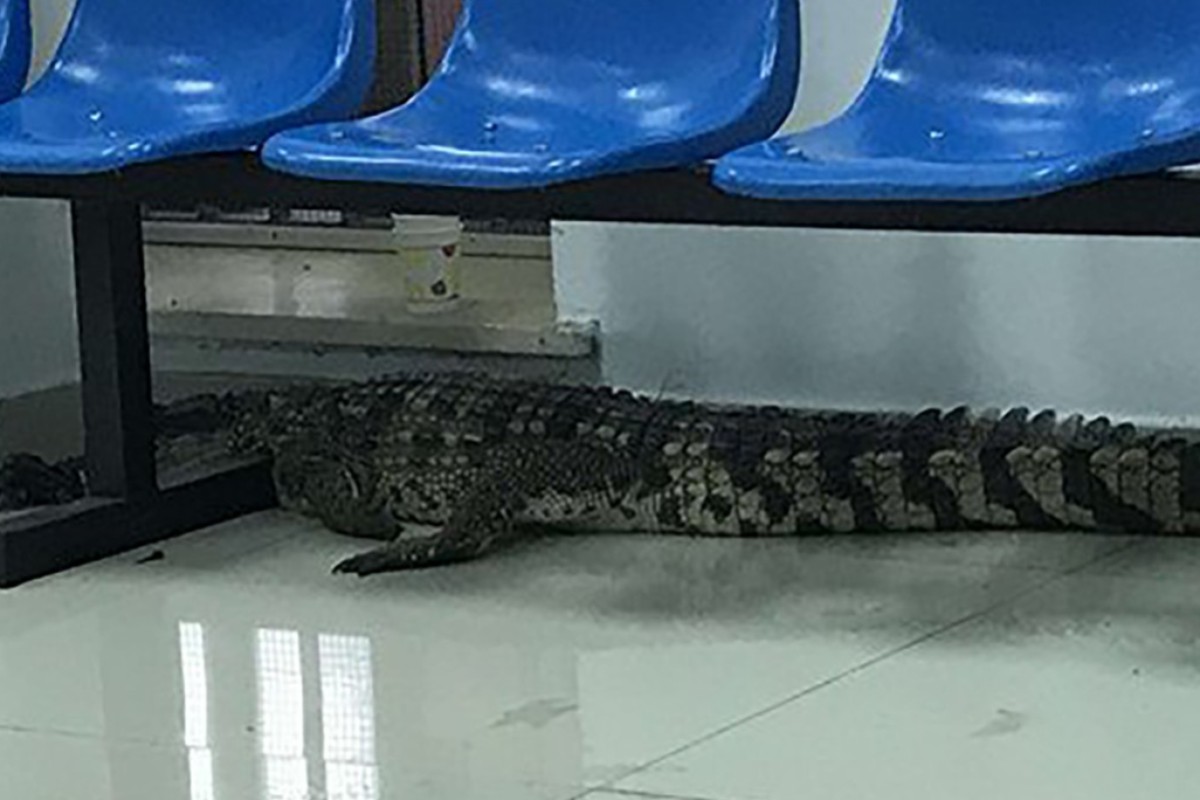
Police investigation reveals animal had escaped from a nearby restaurant
The escaped crocodile was captured by police officers and taken to the local station. Photo: Handout
A security guard at a beauty spot in eastern China was shocked to discover a 2-metre (6ft 6in) crocodile while on his rounds in the early hours of Monday morning.
The animal was lying motionless on a road at Xinlonghu Park in Changzhou, Jiangsu province, with its jaws tied by a strip of cloth, when it was spotted by the security guard, who immediately called the police, according to the Modern Express newspaper.
It took a number of officers to capture the crocodile and take it to the local police station, where an investigation revealed the animal had escaped from a nearby restaurant. The animal was returned and the restaurant owner was “criticised” by police, who urged that a close eye be kept on the animal, the report said.
“They bought it from a farm somewhere as a food material to attract customers. It has been killed for crocodile meat dishes,” an officer told the South China Morning Post on Wednesday.
Crocodiles were once vegetarians – but it was just a phase
Police said it was fortunate that the crocodile had been caught before it had entered the park’s lake or caused any danger to people.
It is unclear what species the crocodile belonged to but China permits the commercial breeding and use of the critically endangered Siamese crocodile, as well as saltwater and Nile crocodiles, which are listed as least concern species.
A staff member of the restaurant, called No. 1 Lakeside, told the Post stewed crocodile meat was on the menu for 168 yuan (US$23.60) a serving, while stewed crocodile claw was also available at 258 yuan.
Crocodile appears in ancient Chinese medicine books as a treatment for respiratory illnesses and the meat has long been regarded as a delicacy, especially in southern China, such as Guangdong province. Crocodile skin also remains a popular material for luxury handbags and other leather goods.
In June, another crocodile, measuring about 1.5 metres, was found in a road puddle during a heavy rain in Wuhan, in the central province of Hubei, where many restaurants have crocodile meat on their menus, the Chutian Metropolis Daily reported.
In that incident it took three officers to capture the animal which was sent to a wildlife centre where a physical check-up showed it had been bred in captivity, most likely for food.
Police investigation reveals animal had escaped from a nearby restaurant
The escaped crocodile was captured by police officers and taken to the local station. Photo: Handout
A security guard at a beauty spot in eastern China was shocked to discover a 2-metre (6ft 6in) crocodile while on his rounds in the early hours of Monday morning.
The animal was lying motionless on a road at Xinlonghu Park in Changzhou, Jiangsu province, with its jaws tied by a strip of cloth, when it was spotted by the security guard, who immediately called the police, according to the Modern Express newspaper.
It took a number of officers to capture the crocodile and take it to the local police station, where an investigation revealed the animal had escaped from a nearby restaurant. The animal was returned and the restaurant owner was “criticised” by police, who urged that a close eye be kept on the animal, the report said.
“They bought it from a farm somewhere as a food material to attract customers. It has been killed for crocodile meat dishes,” an officer told the South China Morning Post on Wednesday.
Crocodiles were once vegetarians – but it was just a phase
Police said it was fortunate that the crocodile had been caught before it had entered the park’s lake or caused any danger to people.
It is unclear what species the crocodile belonged to but China permits the commercial breeding and use of the critically endangered Siamese crocodile, as well as saltwater and Nile crocodiles, which are listed as least concern species.
A staff member of the restaurant, called No. 1 Lakeside, told the Post stewed crocodile meat was on the menu for 168 yuan (US$23.60) a serving, while stewed crocodile claw was also available at 258 yuan.
Crocodile appears in ancient Chinese medicine books as a treatment for respiratory illnesses and the meat has long been regarded as a delicacy, especially in southern China, such as Guangdong province. Crocodile skin also remains a popular material for luxury handbags and other leather goods.
In June, another crocodile, measuring about 1.5 metres, was found in a road puddle during a heavy rain in Wuhan, in the central province of Hubei, where many restaurants have crocodile meat on their menus, the Chutian Metropolis Daily reported.
In that incident it took three officers to capture the animal which was sent to a wildlife centre where a physical check-up showed it had been bred in captivity, most likely for food.
Merkel makes the case on sensitive issues in Beijing without being offensive, observer says
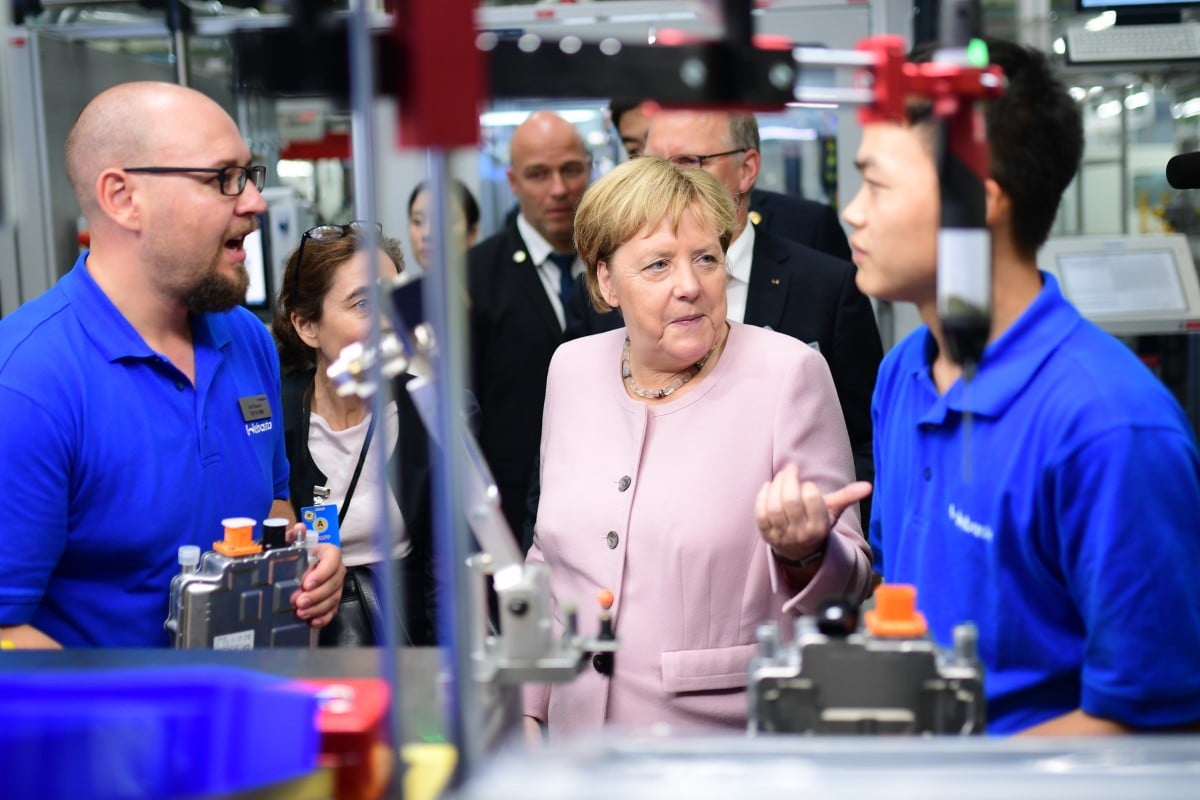
German Chancellor Angela Merkel (centre) talks to staff at manufacturer Webasto during a visit in Wuhan on Saturday. Photo: EPA-EFE
German Chancellor Angela Merkel may be slowly declining in influence in European politics but she remains the EU’s strongest voice in dealing with China, analysts said after her latest trip to China last week.
During the two-day visit, Merkel and Chinese President Xi Jinping discussed the sensitive topic of Hong Kong and the social credit system in China.
German diplomats also averted a plan by Chinese officials to scrap a joint press conference by Merkel and Chinese Premier Li Keqiang out of concerns that it could be dominated by questions about the escalating protests in Hong Kong.
Two sources told the South China Morning Post that the Chinese side initially suggested not letting journalists ask questions during the press conference. German diplomats persisted, saying that Merkel would hold her own press conference to take media questions, the sources said.
Germany’s Angela Merkel renews call for peaceful resolution to Hong Kong protests
After talks with the Chinese president and premier, Merkel said Beijing had listened to her views about resolving the Hong Kong conflict without violence, adding: “This is important.”
She said she also pressed the European Union’s position that the Sino-British Joint Declaration on Hong Kong remained effective, countering Beijing’s assertion that the 1984 document has ceased to be valid.
“Merkel navigated the narrow line to raise these sensitive issues without being overly offensive,” said Jan Weidenfeld, of the Berlin-based Mercator Institute for China Studies.
Joerg Wuttke, president of the EU Chamber of Commerce in China, said Merkel’s biggest achievement was to raise the issue about the social credit system in China, a policy that aims to rank every individual and corporate entity based on their compliance with state-stipulated social norms.
“It is important to us that she makes the Chinese leadership aware that the German business community would like to get better briefed and prepared for this major change in company compliance by the Chinese authorities,” Wuttke said. “Merkel was the first foreign leader to do so.”
Despite Merkel’s tough approach, China’s foreign ministry was full of praise for the German leader’s visit, saying both sides were “satisfied” with the outcomes.
“This is Chancellor Merkel’s 12th China visit, so she should be one of the Western leaders who visited China the most times and knows China the best,” ministry spokeswoman Hua Chunying said on Monday.
Hong Kong is a matter for China, Premier Li Keqiang tells Angela Merkel
Back home, however, German media and businesses remained sceptical about the future.
Bild, the country’s biggest-circulation newspaper, has been following closely the arrest of Hong Kong pro-democracy activist Joshua Wong Chi-fung, who was detained at Hong Kong airport on his way to Berlin at the newspaper’s invitation. Wong was later cleared to travel abroad.
Several newspapers have put pressure on Merkel to speak out for Hong Kong, with one calling on her to replace a stop in mainland China with one in the former British colony, which she refused.
On the business side, German businesses also urged Merkel to caution Beijing against sending troops to Hong Kong out of concerns that the lucrative Chinese market would become subject to international sanctions.
Another concern is the slow pace of structural reforms that would open up Chinese markets to foreign businesses.
German Chancellor Angela Merkel visits Wuhan Yangtze River Bridge in Wuhan, capital city of central China’s Hubei Province, Sept. 7, 2019. German Chancellor Angela Merkel visited Wuhan on Saturday. (Xinhua/Xiao Yijiu)
WUHAN, Sept. 7 (Xinhua) — Angela Merkel Saturday visited central China’s Wuhan during her 12th trip to the country as German Chancellor since 2005.
Before Wuhan, capital city of Hubei province, Merkel had visited a number of cities besides Beijing during her China trips in the past.
When talking with students of Huazhong University of Science and Technology, Merkel highlighted the importance of international cooperation in the era of globalization, and called on the students to be participants.
Saying that a nation’s prosperity is part of the prosperity of the whole world, she voiced her hope that students should shoulder common responsibilities to combat global challenges.
In the speech, Merkel reviewed her past trips to China. In Shenyang, she witnessed economic upgrading. In Chengdu she learned about development of western China. In Shenzhen she saw remarkable progress brought by the reform and opening-up.
She said quite a few noted German companies including Siemens, and small and medium-sized innovation enterprises are operating business in Wuhan. Wuhan and Duisburg became the first pair of sister cities between China and Germany in 1982.
Merkel exchanged views with students on internet, artificial intelligence, intelligent manufacturing, and environmental protection.
Before wrapping up her trip, Merkel also visited a local hospital and a factory of the German company Webasto.
WUHAN, China (Reuters) – German Chancellor Angela Merkelrenewed calls for a peaceful solution to unrest in Hong Kong on Saturday during her trip to China.
The Hong Kong protests have overshadowed a three-day visit Merkel had planned to use to press for greater access to Chinese markets for German businesses suffering a slowdown at home.
“I have advocated that conflicts be resolved without violence and that anything else would be a catastrophe from my point of view,” Merkel said.
After talks with President Xi Jinping and Premier Li Keqiang, Merkel said Beijing had listened to her views.
“This is important,” she added.
Hong Kong leader Carrie Lam announced concessions this week to try to end the protests, including formally scrapping a hugely unpopular extradition bill, but many said these were too little, too late.
Joshua Wong, a leader of pro-democracy protests in 2014 that were the precursor to the current unrest, thanked Merkel for addressing the topic with Beijing but said her comments fell short.
“Germany’s business interest should not override the universal values in which we believe,” Wong said in an interview with Germany’s mass-circulation Bild am Sonntag newspaper.
“If the Chancellor wants to do something, she must help to urge President Xi to respond to the demand for free elections.”
Image caption Local people say having an incinerator near their homes will be dangerous
While the world’s attention has been focused on the protests in Hong Kong, another Chinese city has been witnessing unrest on a scale rarely seen on the mainland.
Thousands of citizens in Wuhan, the capital city of central Hubei province, took to the streets last week for several days.
They were angry about a planned waste incineration plant they say will bring dangerous levels of pollution to their town.
But as the protests steadily grew over the week, a censorship and public security operation kicked in to try to keep a lid on the unrest.
Why are they so angry?
Wuhan desperately needs to find ways to handle the waste generated by its 10 million residents. So it has drawn up plans for a huge incinerator, to be based in the Yangluo zone of Xinzhou district, where about 300,000 people live.
According to a city government document published in February, the incinerator would possess a daily capacity of 2,000 tonnes of rubbish.
Xinzhou district also already hosts a waste landfill, the strong smells of which, according to some locals, can be caught even when one passes the area on a bus.
But there has been public concern that badly-made incinerators can emit dioxins that are highly toxic and can damage the immune system, interfere with hormones and cause cancer. In 2013, five such plants in Wuhan city were found to be sub-standard and emitting dangerous pollutants, according to China’s state broadcaster CCTV.
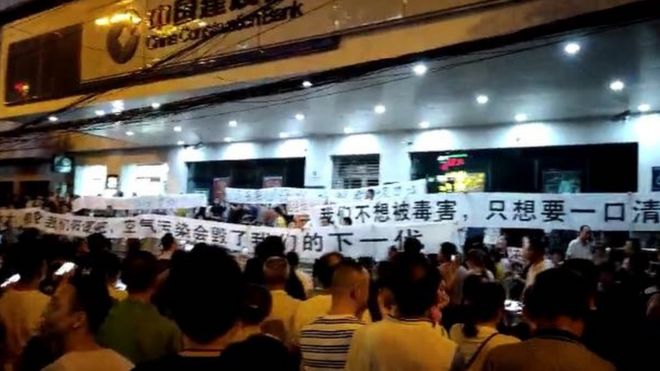
Image copyright OTHERImage caption Grainy social media footage showed huge numbers of police moving into the town
In late June, rumours began spreading that work had already started on the new plant, on a patch of land in Yangluo designated as an industrial park, close to residences and two schools.
Local people took to the streets for several days, demanding that the location be re-thought. They held banners with slogans like “air pollution will damage the next generation” and “we don’t want to be poisoned, we just need a breath of fresh air”. They weren’t demanding it be scrapped completely, just that it be moved further away.
The protests grew over several days and, according to some locals, the night with the biggest crowds saw up to 10,000 people taking part.
How has the government responded?
At first the Xinzhou district government attempted to calm the unrest. It issued a statement last Wednesday denying that work had started on the incinerator. It said the project hadn’t even been registered, nor had it gone through any environmental assessment.
They said the local government would attach “great importance to the voices of the people” in its decision-making, but warned that public security authorities would crack down on any “illegal criminal acts such as malicious incitement and provocation”.
Several locals said people were detained but the exact number couldn’t be confirmed.
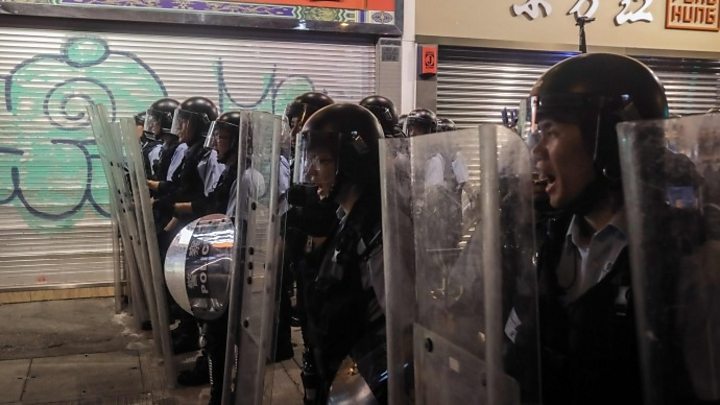
Over the weekend, the authorities appear to have successfully quashed the protests. Some locals said riot police were on the streets and shops around the protest sites had been ordered to shut by 6pm.
Meanwhile, China’s censors have been at work. Local voices on social media have been vanishing fast. Videos and photos of the crowded streets and clashes between the protesters and the police can be censored within hours. While there were a few reports in domestic media about the incinerator, none of them covered the protests.
Local people have said they’re not satisfied with the district government’s reassurances, because it’s the municipal authorities who have the final say.
But the municipality has kept quiet so far.
How unusual is this for China?
China often sees public protests like this, but mostly on a much smaller scale.
While the Chinese public have largely avoided protests about political reforms since the Tiananmen movement was crushed in 1989, “not in my back yard” protests related to environmental problems have become more common.
Civil movements against high-polluting projects date back to at least 2007 when a significant protest broke out in Xiamen city of Fujian province against an industrial chemical plant.
The incident became well-known at a time of lighter censorship, and the local government ended up moving the location of the project out of the city.
Media caption Hong Kong police and protesters clash
In 2015 there were protests in both Shanghai and northern Tianjin over planned manufacturing plants which locals felt put them in danger.
And in 2017, Qingyuan city in Guangdong province also saw protests over an incinerator.
During the Qingyuan protests nearly 10,000 locals took to the streets and police reportedly fired tear gas at the height of the unrest. Three days later the government cancelled the planned incinerator.
Might the Wuhan authorities learn from Qingyuan?
So far there’s no sign of that.
Even after a week of protests the city government seems deaf to public opinion.





 CHINDIA ALERT: You'll be living in their world, very soon