Chindia Alert: You’ll be Living in their World Very Soon
aims to alert you to the threats and opportunities that China and India present. China and India require serious attention; case of ‘hidden dragon and crouching tiger’.
Without this attention, governments, businesses and, indeed, individuals may find themselves at a great disadvantage sooner rather than later.
The POSTs (front webpages) are mainly 'cuttings' from reliable sources, updated continuously.
The PAGEs (see Tabs, above) attempt to make the information more meaningful by putting some structure to the information we have researched and assembled since 2006.
MACAO, Dec. 6 (Xinhua) — The “one country, two systems” principle has proved to be feasible, achievable and popular in the Macao Special Administrative Region (SAR) since Macao returned to the motherland in 1999, said Fu Ziying, director of the Liaison Office of the Central People’s Government in the Macao SAR.
Fu told Xinhua in a recent interview that the Macao SAR government, along with all walks of life, has comprehensively and precisely understood and implemented the “one country, two systems” principle and strictly abided by China’s Constitution and the Basic Law of the Macao SAR since Macao’s return to the motherland.
The Macao SAR government has ensured the steady and practical implementation of the “one country, two systems” principle by devoting to developing economy, improving people’s wellbeing, upholding inclusiveness and mutual support and promoting the unity of the compatriots in Macao under the banner of loving both the motherland and the region, thus opening a new horizon in practicing the “one country, two systems” with Macao characteristics.
Fu eulogized Macao’s success in implementing the “one country, two systems” principle in three aspects.
Firstly, for the past 20 years, the authority of China’s Constitution and the Basic Law has been firmly safeguarded in Macao and the executive-led system has been running smoothly.
The Macao SAR government and all walks of life have always firmly safeguarded the authority of China’s Constitution and the Basic Law by holistically combining upholding the principle of “one country” with respecting the differences of the “two systems,” and maintaining the power of the central government with ensuring the high degree of autonomy of the Macao SAR, ushering in a new era of good political situation in Macao.
The national sovereignty, security and interests are well safeguarded and the capability and level of law-based governance has been significantly promoted in Macao, Fu said.
Secondly, Macao has witnessed rapid economic development and continued improvement of people’s livelihood, with people feeling more satisfied and happier, Fu said.
Macao, by making good use of the advantages of the “one country, two systems” principle, has achieved a leaping development in economy, Fu said.
Over the past 20 years, Macao has witnessed the fastest development in its history, with outstanding performance in various macroeconomic sectors, Fu said.
With the full efforts from the SAR government in building long-term efficient mechanisms in social security, housing, education, health, human resources and disaster prevention and reduction, the social welfare and people’s livelihood have been greatly improved since Macao’s return to the motherland, said Fu,
Thirdly, Macao’s success could be seen in its harmony and inclusiveness in society, where both loving the motherland and the region has become the mainstream value, according to Fu.
He said education on the country’s Constitution and the Basic Law is deep-rooted in the society, as the “one country, two systems,” “Macao people governing Macao” and the high degree of autonomy are well-accepted by residents in Macao.
Fu said Macao has attached great importance to cultivating patriotism among the youth, with patriotic education legalized in Macao in 2006.
The development of the socialism with Chinese characteristics had entered a new era, so is the cause of the “one country, two systems,” said Fu.
Under the leadership of Chinese President Xi Jinping, the practice of “one country, two systems” is included in the Chinese Dream.
In the future, Macao should further exploit the advantages of “one country, two systems” principle, seize the opportunities brought about by the Belt and Road Initiative and the construction of the Guangdong-Hong Kong-Macao Greater Bay Area.
“We will always comprehensively and precisely understand and implement the principle of ‘one country, two systems’,” said Fu.
Fu called on Macao to participate in the country’s reform and opening-up cause more actively so as to help boost the country’s people-to-people exchanges with other countries.
He highlighted the importance of the construction of the Greater Bay Area, hoping that Macao would, by participating in the development, further expand its industries and promote people’s livelihood so as to maintain the economic and social stability.
“Remain true to the original aspiration of the principle of ‘one country, two systems,’ Macao, the land of lotus, will for ever glisten,” Fu added.
BEIJING (Reuters) – China will launch test flights for the next two space rockets in its Smart Dragon series meant for commercial use in 2020 and 2021, the official Xinhua news agency reported on Sunday, as an expected boom in satellite deployment gathers pace.
The release of the flight schedule by China Rocket Co, a unit of state-owned China Aerospace Science and Technology Corp, comes two months after the firm’s first reusable rocket, the 23-tonne Smart Dragon-1, delivered three satellites into orbit.
China envisions constellations of commercial satellites that can offer services ranging from high-speed internet for aircraft to tracking coal shipments. Reusable designs will enable frequent rocket launches and help keep costs down.
The solid-propellant Smart Dragon-2, weighing about 60 tonnes and with a total length of 21 metres, will be capable of sending 500 kg payloads into orbit at an altitude of 500 km (310 miles), Xinhua said. It is expected to conduct a flight test next year.
At about 116 tonnes and with a length of 31 metres, the Smart Dragon-3, set for a test flight in 2021, will be capable of sending 1.5 tonne payloads into orbit, Xinhua added.
In July, Beijing-based iSpace became the first private Chinese firm to deliver a satellite into orbit on its rocket. Since late last year, two other startups have attempted to launch satellites but failed.
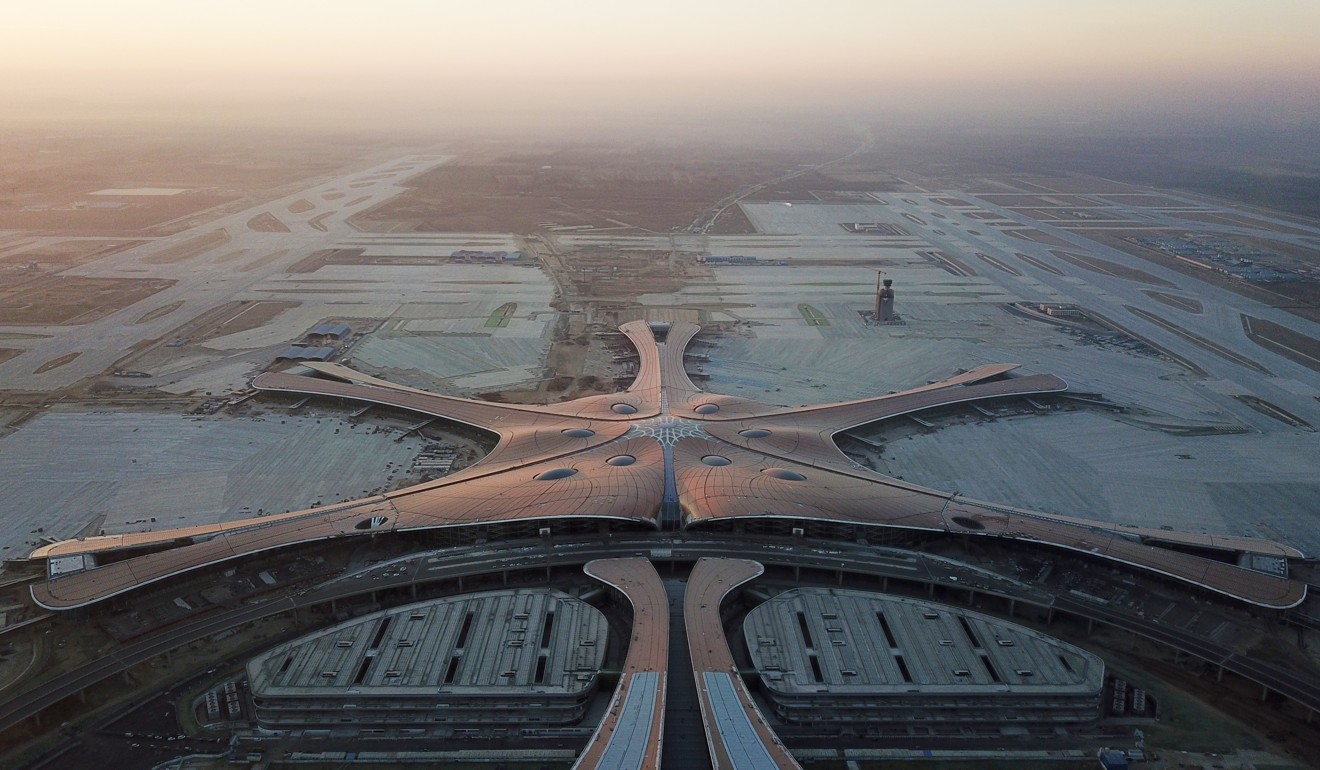
Visually spectacular and with the latest technology, the Chinese capital’s second international airport is open for business
The terminal building at Beijing Daxing International Airport, which has officially opened. Photo: Xinhua
At 4.23pm on Wednesday a China Southern Airlines A380 left Beijing for Guangzhou – on the first commercial flight out of the world’s latest and largest airport terminal at Daxing, five years after construction began on the ambitious project.
The 80 billion yuan (US$11 billion) Beijing Daxing International Airport was officially opened by Chinese President Xi Jinping on Wednesday morning.
China Southern Airlines, the mainland’s largest carrier, has 40 per cent of the flight slots at the new airport. It is one of 16 airlines which will be operating out of Beijing Daxing International Airport, the visually spectacular new facility at the southern end of the Chinese capital.
Six other flights, including China Eastern Airlines for Shanghai and Air China for Chengdu, took off before 5pm in the afternoon. These domestic airlines will have part of their operations moving to Daxing for the upcoming winter-spring season, according to the mainland’s aviation authority. No Hong Kong airlines were listed.
British Airways has announced its whole operation will be moved to Daxing, while some foreign airlines, such as Ethiopian Airlines, Polish Airlines, Malaysia Airlines, Royal Air Maroc and Finnair, will operate at both airports.
Spanning 47 sq km (18 square miles) – almost 50 per cent larger than the city of Macau – Daxing, with its 700,000 square metre (7.5 million sq ft) terminal is a spectacular sight. Its futuristic shape, resembling a giant hexagonal starfish or – as some internet users have dubbed it – an alien base, not only handles more aircraft, it also keeps passengers’ walks
From the centre of the security check to the furthest end gate in each wing is about 600 metres (1,970 feet), or less than an eight-minute walk.
Beijing’s new 7-runway, star-shaped Daxing airport opened by Xi Jinping
According to Xinhua, more than 70 restaurants, tea shops and coffee houses will operate in the airport, along with 36 international brands, including Louis Vuitton, Gucci and Bottega Veneta.
Daxing is designed to take pressure off the overcrowded Beijing Capital International Airport (BCIA) and, by 2021, is expected to handle 45 million passengers a year, rising to 72 million by 2025.
Located at the south of the capital, 46km (28.5 miles) from the central Tiananmen Square, the airport was once frowned upon for its less than optimal location, with its southern end at the border with Hebei province. But it may not be as time-consuming for travellers as originally thought.
The design of the airport means passengers will walk a much shorter distance to the check-in and security check.Hu Haiqing, China Southern Airlines
Hu Haiqing, deputy general manager of China Southern Airlines’ operation control centre, told Global Times that “although Daxing is further away from downtown Beijing than the Capital airport, there are still some advantages, especially for our airline”.
With most of its bases in the south of the country, China Southern Airlines flights to Daxing will be 10 to 15 minutes shorter than to the Capital airport. A further 15 to 20 minutes taxiing time will also be saved, thanks to its position in the new airport.
“The design of the airport also means passengers, once they leave their car or train, will walk a much shorter distance to the check-in and security check,” Hu said.
According to Xinhua, Daxing’s design also makes transit much quicker, with transfers between international and domestic flights up to 90 minutes shorter than from the Capital airport.
The futuristic shape of Daxing airport not only handles more aircraft, it also keeps passengers’ walks to a minimum. Photo: Xinhua
Public transport will be the quickest way to reach the new airport from downtown Beijing – 20 minutes from West Beijing railway station once the Beijing-Xiongan high-speed rail officially opens. The airport express service will also take passengers from Caoqiao station to the airport in 19 minutes.
There is no underground rail service or airport express connecting the Capital airport in the north with Daxing, but passengers can change trains at Caoqiao for downtown Beijing or other stations which connect with BCIA’s airport express service.
Waiting times at the new airport will be greatly reduced by the use of facial recognition technology for self-service check-in and smart security checks, according to Wang Hui, manager of Daxing’s terminal management department.
The technology does away with the need for a paper boarding pass and passengers can check-in, with or without luggage, and go through the security check by themselves.
Beijing is the window for China to go global … Daxing airport makes it possible to open more global routes.China Eastern Airlines pilot
“The airport has more than 400 self-service check-in kiosks, which means more than 80 per cent of check-ins will be self-service. That shortens each passenger’s queuing time to no more than 10 minutes,” Wang told Global Times.
“The smart security check channels are able to handle 260 passengers per hour, 40 per cent faster than using traditional means,” he said.
The opening of Daxing Airport could be a great boost for the mainland – and even the global – aviation industry by easing pressure on the Capital airport and making new routes possible, said a veteran China Eastern Airlines pilot who declined to be named.
5 things we know about Beijing’s new Daxing International Airport
Opening new flight routes from BCIA was almost impossible, he pointed out, because the centre of Beijing was a no-fly zone for security reasons. Daxing airport’s location at the southern end of the city, however, avoided the problem of planes having to bypass the restricted space, leaving room to open more routes for domestic and international flights.
“Beijing is the window for China to go global but the Capital airport’s schedule is saturated and unable to open new routes. Daxing airport makes it possible to open more global routes,” the pilot said.
He said the runway design at Daxing also meant fewer delays, because the four runways of phase one – more than any other airport in China – included one which was perpendicular to the other three, allowing flights to land and take off regardless of wind direction.
Military experts say PLA modernisation brought about during Xi Jinping’s presidency will be the main focus of October 1 celebration in Beijing
It’s necessary for China to ‘show some of its muscle’ amid the trade dispute with the US, observer says
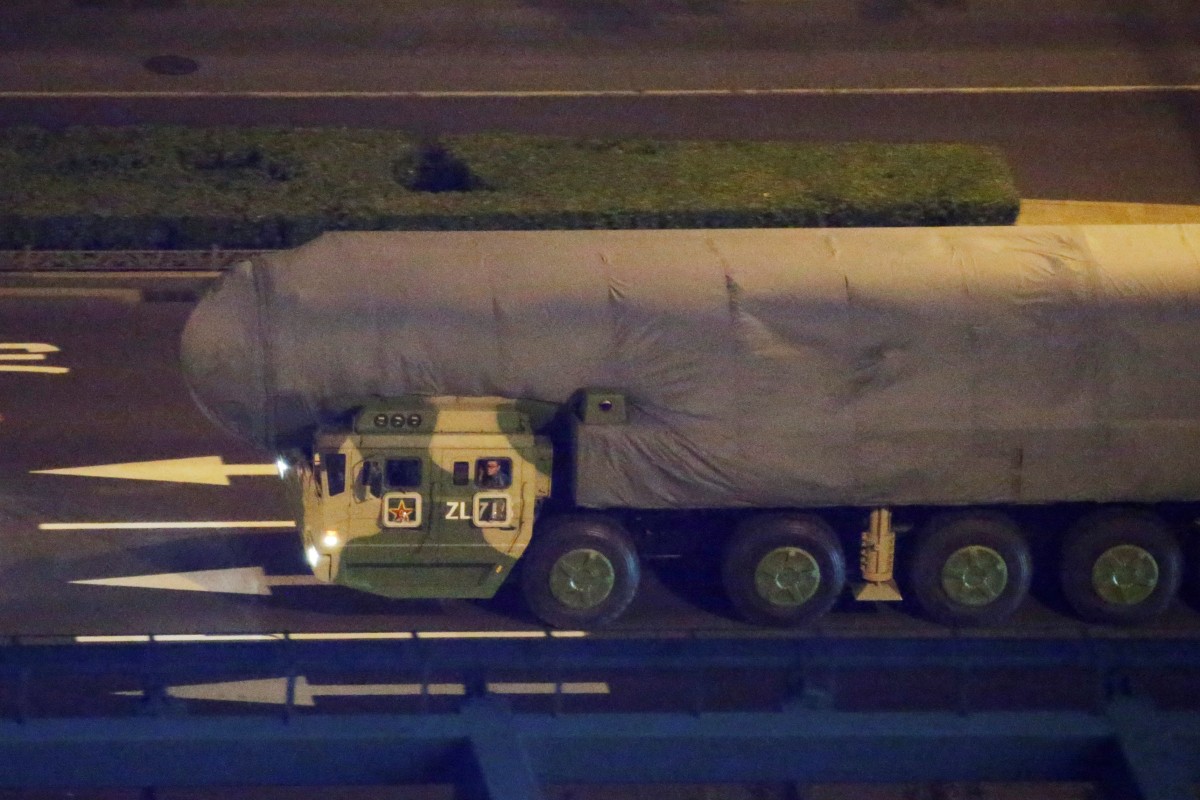
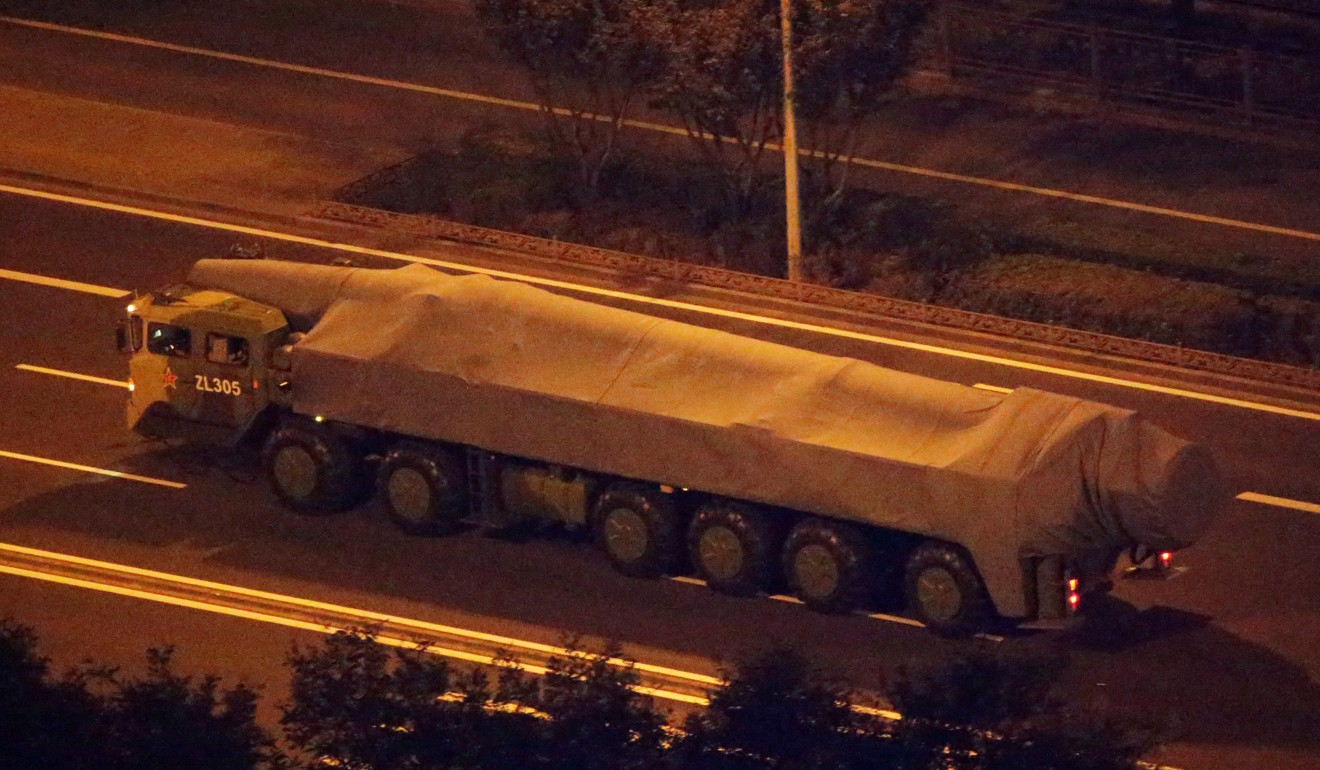
China’s land-based DF-41 intercontinental ballistic missile will be among the military hardware on show on October 1. Photo: Reuters
China plans to show off its most advanced active weapon systems at the upcoming National Day parade, which will be the biggest of the 14 such events it has held over the past seven decades.
The parade, to be held on October 1 to mark the 70th anniversary of the founding of the People’s Republic, will highlight the military modernisation – particularly in nuclear deterrence – that has taken place since President Xi Jinping came to power in late 2012, according to military experts.
The People’s Liberation Army (PLA) offered a glimpse of those weapons during rehearsals for the parade in downtown Beijing from September 14.
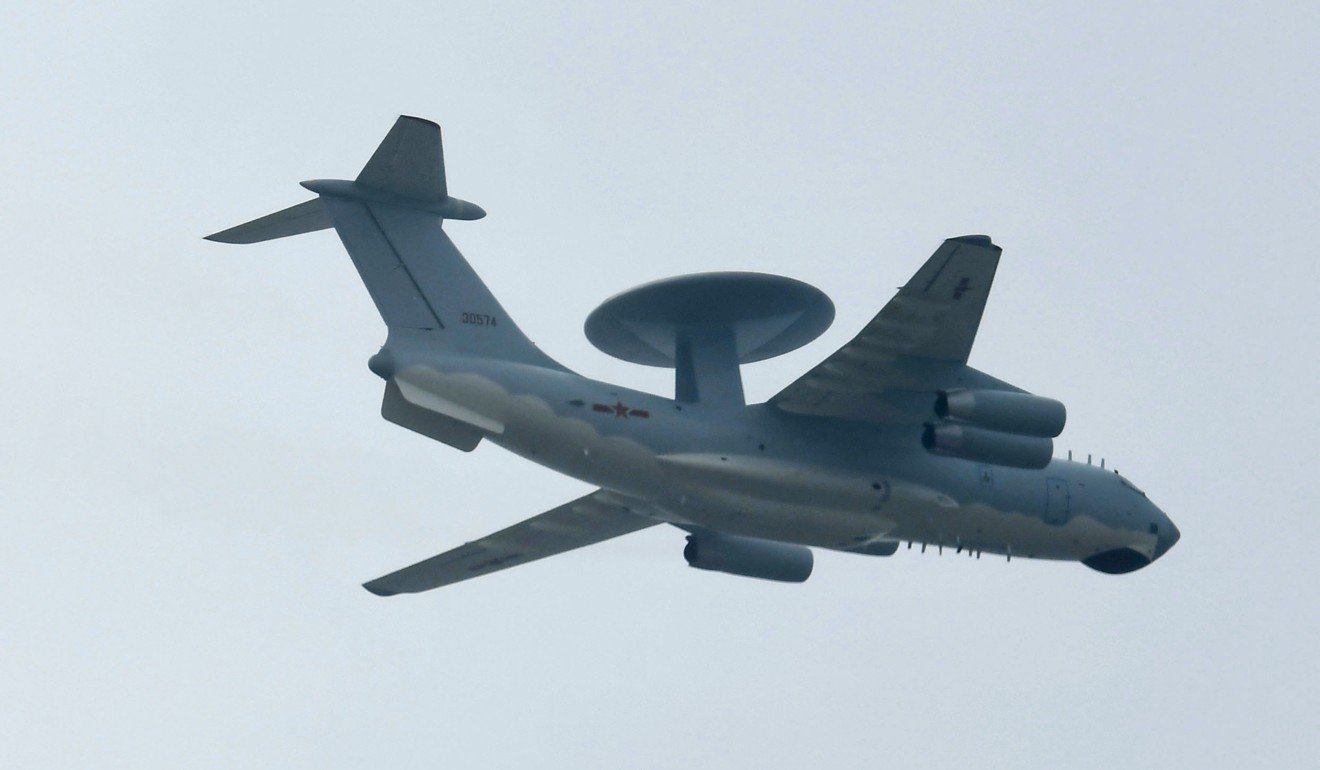
As part of the celebrations, Xi, who also chairs the Central Military Commission, will inspect 48 squads on the ground and more than a dozen airborne squadrons, according to a military insider involved in support services for the parade.
More than a dozen airborne squadrons will take part in the National Day parade. Photo: Kyodo
The squadrons will include the air force’s first stealth fighter, the J-20; the main active warplanes such as the J-10 and J-11B; and armed helicopters like the Z-20. However, the J-8 fighter jet would not appear this year, the source said, confirming that the first interceptor built in China has been formally retired.
“The ground march will be led by several hero forces from the five theatre commands, which is different from previous squads selected from the ground forces, air force and navy,” said the insider, who requested anonymity because of the sensitivity of the matter.
“The main goal of this year’s parade is to promote the military modernisation of the PLA under President Xi’s leadership over the past seven years, with the military overhaul being one of the key achievements.”
Thirty-three of the 48 squads would be “weapon squads”, while the 13 others would be made up of infantry troops from the five theatre commands, the source said.
National Day fireworks in Hong Kong cancelled over safety fears
As part of the PLA’s sweeping military reforms, the army’s previous seven military commands were reshaped into five theatre commands, while the four former general headquarters were dissolved and replaced by 15 small functional departments.
In September 2015, Xi announced the PLA would shed 300,000 troops, cutting its size to 2 million, a move aimed at turning the PLA into a more nimble and combat-ready fighting force on a par with international standards.
Xi also split the former Second Artillery Corps into the Rocket Force and the Strategic Support Force, with the latter backing up the military’s electronic warfare units in cyberspace and outer space.
Among the 33 weapon squads, the highlights are expected to be the PLA’s strategic nuclear missiles such as the Rocket Force’s land-based DF-41 intercontinental ballistic missile (ICBM), the DF-21D anti-ship ballistic missile, the DF-17 hypersonic missile and the sea-launched JL-2, or Big Wave-2.
Adam Ni, a researcher at Macquarie University in Australia, said that showing off different types of missiles on land and sea indicated that the PLA was improving its nuclear deterrence capabilities by perfecting a three-pronged military force structure, or the so-called nuclear triad.
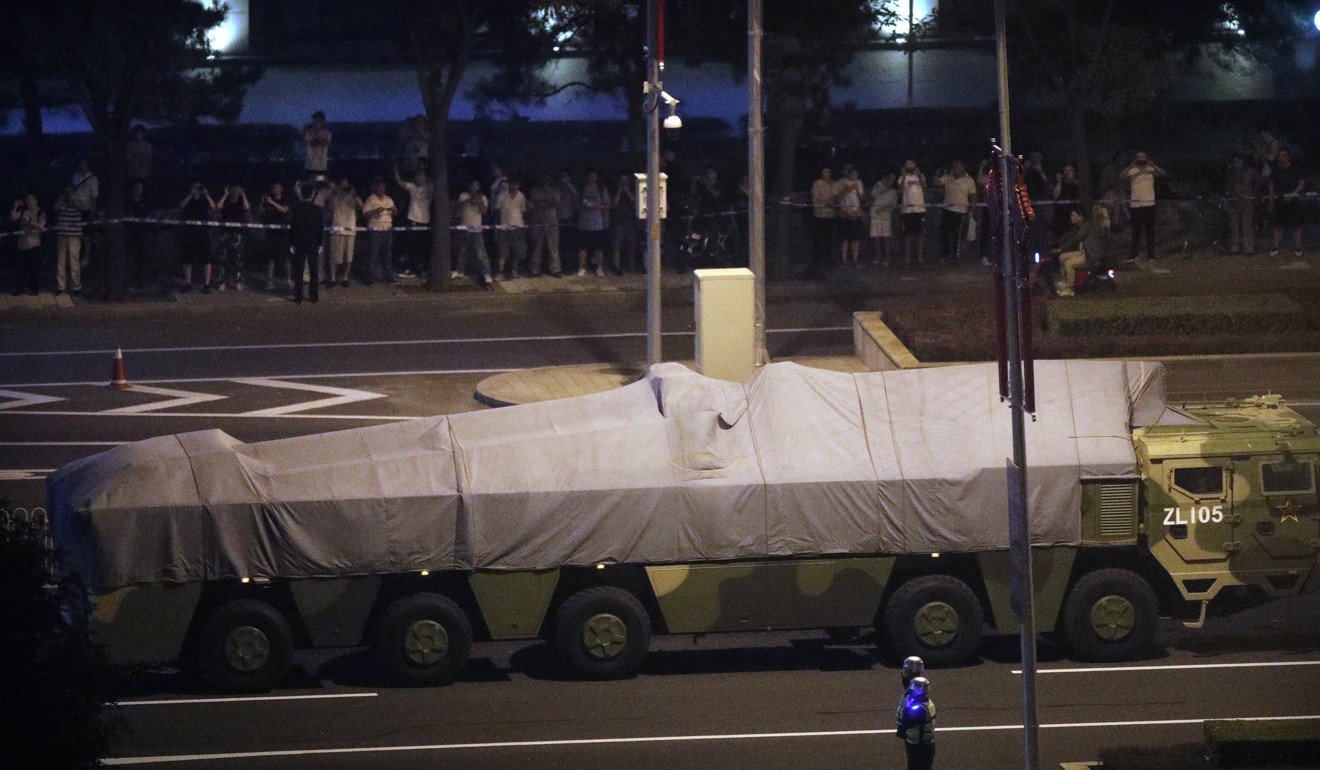
The DF-17 hypersonic ballistic missile will be one of the highlights of the parade. Photo: AP
The DF-41 is capable of carrying multiple warheads and many decoys, making it harder to detect than silo-based systems and better able to survive a first strike.
Ni said the DF-41 was China’s next-generation cutting-edge weapon.
“It’s actually an advanced ICBM and has a range to hit practically anywhere in the world, including the continental United States,” Ni said.
“The DF-41 is the ultimate symbol of the destructive potential of Chinese armed forces, just as nuclear weapons are similar symbols of the US and Russia.”
The JL-2 – which has a shorter range of 7,000km (4,350 miles) and can be launched by the PLA Navy’s Type 094 submarines – is unable to hit anywhere on the American continent when launched from submarines in the South China Sea and coastal areas of China.
China tests new warships in live-fire drills near Vietnam
However, China is developing the JL-3, which has a range of about 9,000km; the upgraded version of the JL-2, with a flight test conducted in June, though it is still less than the 12,000km range of the American Trident II.
“China is stepping up its military modernisation, which includes a number of aspects; the land-based aspect is introducing more mobile and survivable missile systems,” Ni said.
“The game change will happen when China is able to hit the whole US continent with its missile submarines in Chinese coastal waters.”
In military terms, survivable refers to the ability to remain mission capable after a single engagement.
The DF-17 is a land-to-land short-range strategic missile capable of delivering both nuclear and conventional payloads. The US intelligence community has estimated that it will reach initial operational capability by 2020. But if the missile is displayed in the parade, that means it is active already.
China conducted two tests of the DF-17 in November 2017, with the first launched from the Jiuquan Space Launch Centre in Inner Mongolia.
An insider said the main goal of this year’s parade is to promote the military modernisation of the PLA. Photo: Reuters
Hong Kong-based military commentator Song Zhongping said the nuclear weapons that would go on show in the parade would all be strategic missiles designed to improve China’s deterrent capabilities.
The show comes after the PLA delivered a national defence white paper in July stressing its goal to “maintain national strategic security by deterring other countries from using or threatening to use nuclear weapons against China”.
Unlike in the past, this year’s report stated that the US and China were now competing superpowers, and that the PLA’s growing forces were developing to the point that they could challenge the US.
Zhou Chenming, a Beijing-based military observer, said it was also necessary for the PLA to “show some of its muscle” amid the ongoing trade dispute between Beijing and Washington.
“To prevent misunderstanding, most of the weapons are just strategic equipment, not tactical arms, because Beijing still doesn’t want to irritate Washington,” he said.
About 280,000 people were involved in the rehearsals for the parade and related support services, according to Xinhua.
BAKU, Sept. 21 (Xinhua) — China and Azerbaijan enjoy promising prospects in co-building the Belt and Road, Chinese Ambassador to Azerbaijan Guo Min said in a recent exclusive interview with Xinhua.
With a sound and steady development of bilateral relations, Guo praised the advantages of the China-proposed Belt and Road Initiative (BRI) for both sides, emphasizing Azerbaijan’s full support for and involvement in the construction of the Belt and Road.
She said Azerbaijan sees the development of relationship with China as a diplomatic priority. “China and Azerbaijan have exchanged frequent high-level visits since the beginning of this year, with mutual political trust deepening even further.”
Azerbaijani President Ilham Aliyev attended the second Belt and Road Forum for International Cooperation held in Beijing in April, said Guo, adding “the leaders of the two countries reached important consensus to further develop bilateral relations and practical cooperation in various fields.”
“Cooperation in trade, energy, transportation, humanities and other fields has yielded fruits,” she said, noting bilateral trade reached 1.5 billion U.S. dollars from January to August, an increase of 104 percent from the same period last year.
“In recent years, the two nations have been promoting cooperation in a number of areas, including education, culture, health, sports and tourism on a continuous basis,” said the ambassador.
The two countries “have exchanged the visits of culture and art figures and held a wide range of film festivals, art exhibitions and other activities to actively promote unity, mutual understanding and friendly exchanges between the people,” according to Guo.
“At the next stage, the two nations should capitalize on the existing potential and focus on more points of interest,” the ambassador said.
She described the deep traditional friendship, high-level mutual political trust and the highly complementary practical cooperation as key foundations and effective guarantees for the stability and improvement of bilateral relations.
“China is willing to work together with Azerbaijan to push Sino-Azerbaijani friendship and cooperation to a new level and benefit the two countries and their peoples,” the ambassador added.
The manufacturing purchasing managers’ index, released by the National Bureau of Statistics on Saturday, was 49.5 in August
Figure adds to a month of woe for policymakers in Beijing, even ahead of planned US tariff increases on September 1, October 1, and December 15
China’s manufacturing purchasing managers’ index fell by 0.2 points in August as the trade war continued to bite. Photo: Xinhua
As the trade war with the United States continues to gather pace, manufacturers in China remain gloomy about their prospects, with the sector activity contracting for the fourth successive month in August.
The manufacturing purchasing managers’ index (PMI), released by the National Bureau of Statistics (NBS) on Saturday, stood at 49.5 in August, down from a reading of
, and below analysts’ expectations. The median result of a survey of analysts by Bloomberg expected a reading of 49.6.
The PMI is a gauge of sentiment among factory operators, with 50 being the demarcation line between expansion and contraction in sector activity. In the survey, manufacturers are asked to give a view on business issues such as export orders, purchasing, production and logistics.
That the index has remained in contractionary territory for six of eight months this year shows that the effects of US tariffs are resonating through the Chinese economy. The manufacturing PMI only showed expansion in March and April of this year.
New and higher US tariffs scheduled to enter force on September 1, October 1 and December 15 could provide some very temporary boost to Chinese exports and therefore manufacturers, should they inspire American buyers to make early purchases to pay lower tariff rates. However the long term trajectory is negative, with many manufacturers scoping out or already relocating to production sites outside the world’s second largest economy.
Also released on Saturday was the official non-manufacturing PMI, a survey of the construction and services sectors. This stood at 53.8, up from 53.7 in July, showing that these sectors have remained more robust in the face of a general slowdown in China’s economy. The Bloomberg survey of analysts had expected non-manufacturing PMI in August to remain unchanged.
Composite PMI, a combined reading of both manufacturing and non-manufacturing, was 53, down from 53.1 in July.
The August PMI decline “indicates downward pressure on the economy,” said Zhang Liqun, an analyst with the China Federation of Logistics and Purchasing, which produces the index with the NBS.
“Corporations’ forecasts of the market outlook were quite poor while being cautious on their production operations,” Zhang said. The PMI indicated a drop in new orders, which also reflected a lack of domestic demand. Given that the US is escalating tensions with China, downward pressure on external demand is also apparent, Zhang said.
August was a month to forget for policymakers in Beijing, with a series of negative data highlighting the serious economic challenges facing the nation. With the trade war threatening to tip the global economy into a recession, China remains heavily exposed.
The trade war is having a significant impact on Chinese manufacturing. Photo: Xinhua
While exports grew by 3.3 per cent in July, a sign of front-loading, imports fell by 5.6 per cent, emphasising the issues with consumption in China. This problem was also clear in retail sales figure, which came in at a disappointing 7.6 per cent for July, down from 9.8 per cent growth in June.
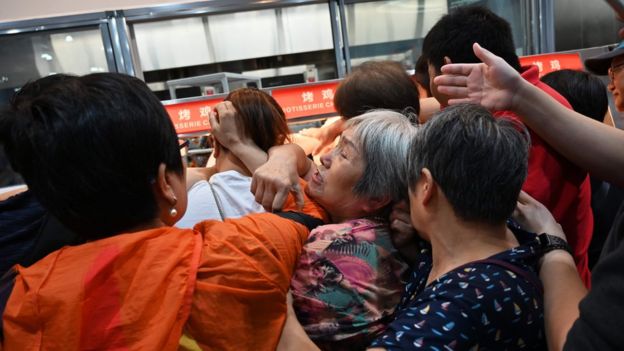
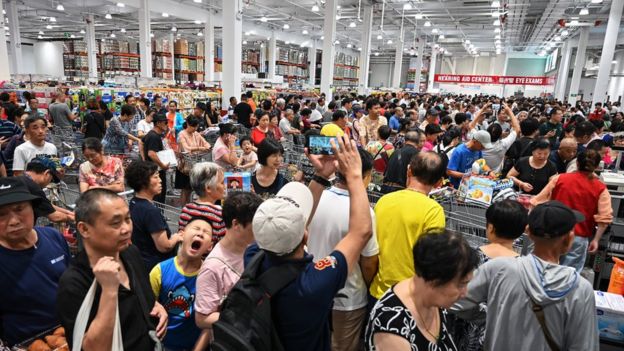
US retailer Costco was forced to close early on its opening day in China, after the store was swamped with shoppers.
Buyers battled long queues and traffic chaos, before the Shanghai store was shut hours early due to “overcrowding”.
Costco’s push into China comes as other foreign retailers have struggled to compete with local rivals.
It also comes at a time of rising tensions between the US and China over trade.
Costco is a discount warehouse store that sells a range of goods, from fresh foods to household electronics.
Some customers spent two hours lining up to pay for their purchases, while some had to wait three hours for parking, state news agency Xinhua reported.
Image copyright AFPImage caption Images from the store show customers caught up in heavy crowds
One video showed people pushing through heavy crowds to get their hands on roast chickens.
“Due to overcrowding in the market, and in order to provide you with a better shopping experience, Costco will temporarily close on the afternoon of August 27. Please avoid coming,” the retailer in a notice on its official app, according to AFP.
Image copyright GETTY IMAGESImage caption Some customers reportedly spent two hours lining up to pay for their goods
Costco has had an online presence in China since 2014, through a partnership with e-commerce giant Alibaba.
The firm’s first store in the country comes as other international retailers battle tough competition in China.
Earlier this year, Amazon said it was downsizing its operations in China and France’s Carrefour agreed to sell 80% of its China business to local retailer Suning.com after a series of losses.
The world’s two largest economies have been fighting a trade war for the past year, and tensions have escalated with the threat of more tariffs from both sides.
Tower falls on car outside the Chengdu worksite, killing motorist
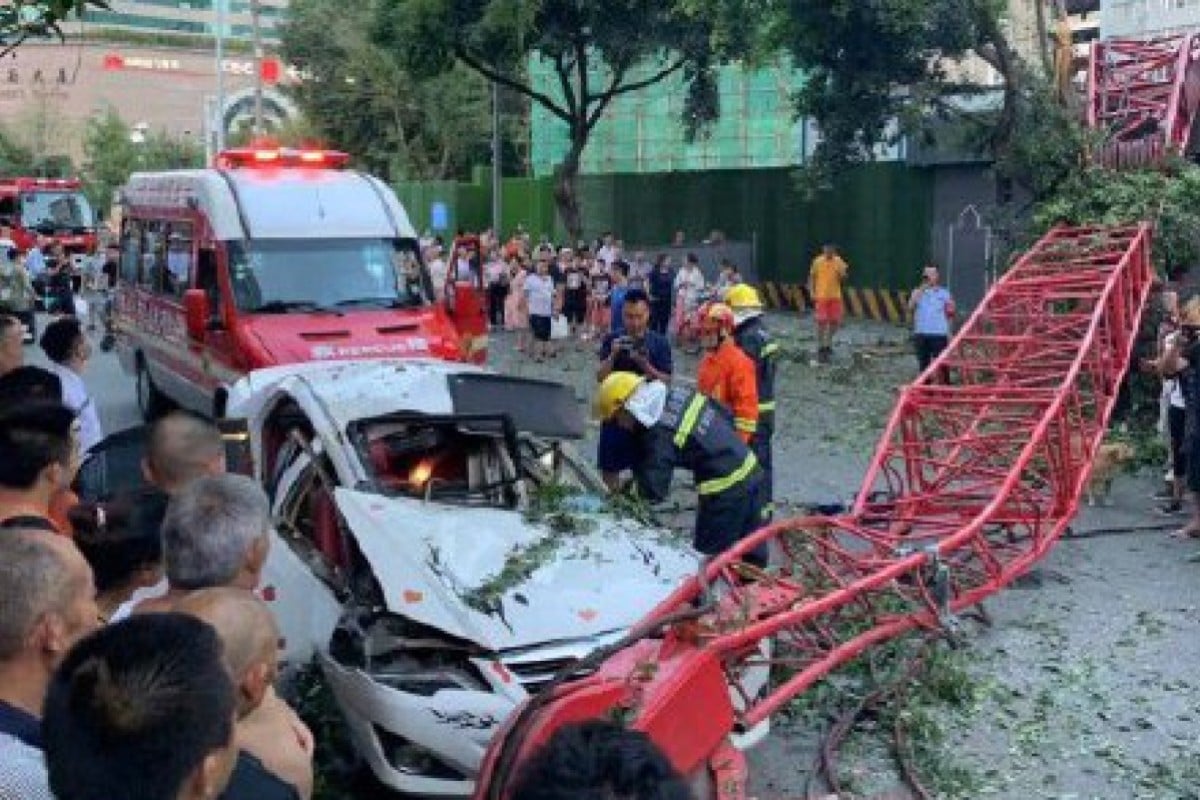
A motorist was killed when a construction crane collapsed in Chengdu on Wednesday. Photo: Weibo
Authorities in southwest China are investigating a crane collapse at a construction site that killed one person and injured another.
The crane collapsed in Chengdu, Sichuan province, at around 7pm on Wednesday, falling onto a car parked near the site and killing the driver, the city’s urban renewal authority said in an online statement. A pedestrian also suffered minor injuries, it said.
Police were investigating the cause of the incident.
A crane accident at a construction site in Southwest China killed one person and injured another on Wednesday. Photo: Weibo
Photos and footage posted online showed emergency workers and others trying to move the crane off of a white car.
Shanghai-based news outlet ThePaper.cn quoted a witness as saying that the crane fell through the construction site wall and a number of trees.
By 10pm, the car had been towed away and the road reopened for use, according to reports.
In January, four people were killed and one was injured when a crane collapsed in Changsha, Hunan province, state news agency Xinhua reported.
Stalled denuclearisation talks also expected to be on the agenda when Chinese president meets Kim Jong-un this week
Analysts say Korean peninsula has become intense diplomatic battleground between Beijing and Washington
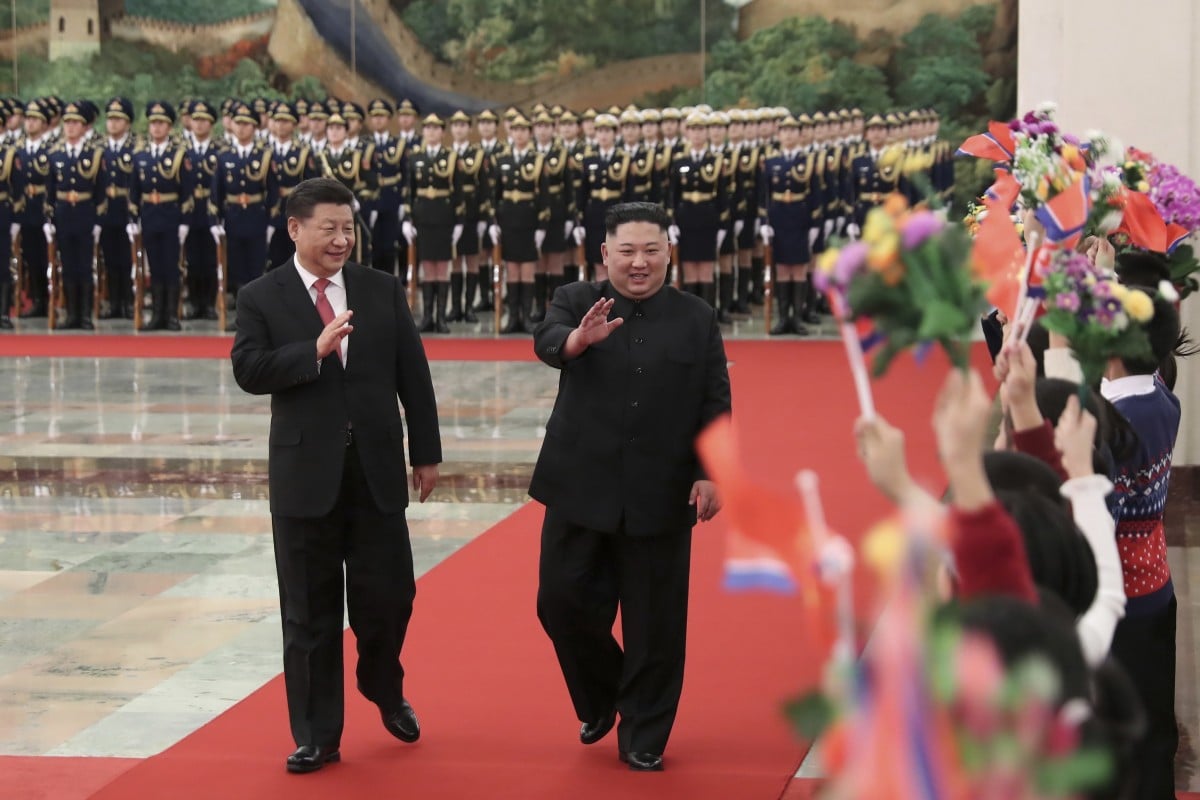
North Korean leader Kim Jong-un (right) attends a welcome ceremony in Beijing with Chinese President Xi Jinping in January. Xi will begin a visit to Pyongyang on Thursday. Photo: AP
will be a state visit – a higher status than the last trip to the hermit kingdom by a Chinese president, highlighting the close bilateral ties between Beijing and Pyongyang.
, is the first by a Chinese president to North Korea in 14 years and comes just a week before he is due to meet US President Donald Trump for talks on the sidelines of the Group of 20 summit in Japan.
“Leaders of the two countries will review the development of the bilateral relationship and carry out an in-depth exchange of opinions on the development of Sino-North Korean relations in the new era, and chart the future course of development,” state news agency Xinhua reported on Tuesday.
Xi’s predecessor, Hu Jintao, went to North Korea in October 2005 on a three-day trip described as an “official goodwill” visit.
Speaking at a regular press briefing in Beijing on Tuesday, foreign ministry spokesman Lu Kang said Xi’s visit aimed to “inject new impetus” into relations in the year the two countries marked the 70th anniversary of establishing diplomatic ties, and to give stalled denuclearisation talks a much needed push.
“Regarding the progress on denuclearisation, as I said, the result of the Hanoi leaders’ meeting in February was indeed a little unexpected. But after that, everyone actually looks forward to the resumption of dialogue in a good direction,” Lu said, referring to the failed talks between Trump and North Korean leader Kim Jong-un in the Vietnamese capital four months ago.
Trump hinted at the possibility of another meeting with Kim after receiving what he called “a beautiful letter” from the North Korean leader last week. On Tuesday, South Korea’s chief nuclear negotiator, Lee Do-hoon, said the US had been in contact with the North.
Life in North Korea the ‘admiration and envy’ of others, state media says
Washington will also send US Special Representative for North Korea Stephen Biegun to South Korea next week, days after Xi’s visit to Pyongyang, to fully align its position on North Korea with its ally.
Meanwhile, Trump confirmed he would meet Xi for talks in Osaka next week, saying in a tweet on Tuesday they had “a very good telephone conversation” and would hold “an extended meeting” at the G20 summit, where they are
Had a very good telephone conversation with President Xi of China. We will be having an extended meeting next week at the G-20 in Japan. Our respective teams will begin talks prior to our meeting.
Analysts said the Korean peninsula had become an intense diplomatic battleground between Beijing and Washington.
Cha Du-hyeogn, a visiting research fellow at the Asan Institute for Policy Studies in Seoul, said China and the US were competing for influence over the peninsula.
“The US and China are seeking a greater sphere of influence in the region. After the Singapore summit between Trump and Kim last year, the US and North Korea are the only key players on peninsula matters. China may want to restore its influence and become a major player,” Cha said.
“But China is less likely to have a so-called strategic competition with the US – that is to say, it won’t challenge the US-led sanctions regime and its goal in achieving North Korea’s denuclearisation. In fact, it is likely to persuade Kim to come to the negotiating table for complete denuclearisation.”
Chinese tourists flood North Korea as Beijing remains Pyongyang’s key ally
Pyongyang has demanded the lifting of sanctions imposed on the regime following its nuclear and missile tests, while Beijing has said the livelihoods of North Koreans should not be affected. But Washington insists full sanctions should remain in place.
The US has also voiced scepticism about Chinese compliance with the sanctions. At a security summit in Singapore earlier this month, US acting Pentagon chief Patrick Shanahan – who on Wednesday stepped down from his role
– presented his Chinese counterpart Wei Fenghe with photographs and satellite images of North Korean ships transferring oil near China’s coast.
Analysts said Xi would seek to use the visit to boost China’s diplomatic leverage on the North Korean nuclear front, strengthening its hand in dealing with the US.
Exports from North Korea to China, which account for the bulk of its trade, plunged 87 per cent last year from 2017, and the country has faced other economic problems at a time when Kim has vowed to deliver on the economy.
A diplomatic source said China was expected to offer a large amount of humanitarian assistance, such as food and fertiliser, to North Korea, which could weaken the impact of sanctions.
China’s goal of denuclearisation on the Korean peninsula is unwavering and will not changeLu Chao, North Korean affairs expert at Liaoning Academy of Social Sciences
Communist Party mouthpiece People’s Daily on Tuesday said via its social media account that Xi would discuss economic and trade cooperation with Kim during the visit.
Quoting Zheng Jiyong, director of the Centre for Korean Studies at Fudan University in Shanghai, the newspaper said Pyongyang had taken steps to reform its economy and introduced China’s industrial manufacturing blueprint.
In September, Beijing proposed building a rail link from the city of Dandong, in China’s northeastern Liaoning province, to Pyongyang and then on to Seoul and Busan in the South, as well as a new road between Dandong and Pyongyang through Sinuiju.
Lu Chao, a North Korean affairs expert at the Liaoning Academy of Social Sciences, said large-scale economic cooperation between China and North Korea was unlikely because of the sanctions, but smaller moves were possible.
Chinese tourists flood North Korea as Beijing remains Pyongyang’s key ally
“For example, China may export daily necessities to North Korea. And if it’s needed, China is very likely to provide [food] assistance to North Korea,” Lu said. “I believe the UN sanctions on North Korea should change, because it has shown a more substantive approach to [achieving] denuclearisation.”
But analysts said Beijing remained firm on the need for Pyongyang to honour its pledges so that denuclearisation could be achieved.
“China’s goal of denuclearisation on the Korean peninsula is unwavering and will not change … China supports [North Korea] and the US continuing to hold talks,” Lu said.
Beijing also had an important part to play in the peace process, according to Boo Seung-chan, an adjunct professor at the Yonsei Institute for North Korean Studies in Seoul.
“China can have a positive role as a mediator to facilitate the peace process on the Korean peninsula,” Boo said.
SARAJEVO, May 10 (Xinhua) — An agreement has been signed in Beijing on recording a remake of the 1969 movie “The Bridge” by the Sarajevo Film Center (SFC), Shanghai Huahua Culture Media Co. Ltd and Dandelion Productions Inc. of Serbia, SFC Director Jasmin Durakovic told Xinhua on Friday.
Directed by Hajrudin “Siba” Krvavac, “The Bridge” tells the story of partisans during World War II who send an elite team of explosive experts to blow up a strategically important bridge.
Durakovic emphasized that all movies directed by Krvavac are precious cultural assets in the Bosnia and Herzegovina’s (BiH) film archives.
He hopes that the remake of “The Bridge” — and possibly also of “Walter Defends Sarajevo” — will present the culture of BiH and the region through the global language of the film to today’s audiences.
Durakovic said he was highly confident that the remake will attract audiences in the countries of the former Yugoslavia, in other European countries and even in the United States.
In a telephone interview with Xinhua, Huahua Chief Executive Officer Kefei Wang, said his company will use cutting-edge film technology to present this period of history and its heroes “so as to revitalize the classics and live up to the profound expectations of the people of China, Serbia, and Bosnia and Herzegovina for movies.”
Production on the remake will begin in early 2020.





 CHINDIA ALERT: You'll be living in their world, very soon