Archive for ‘Yangtze River basin’

11/09/2019

China aims to become self-sufficient in pork production despite African swine fever

  • Agriculture ministry says long-term goal is achievable despite the loss of a third of domestic livestock owing to impact of disease
  • Observers believe foreign producers will never be able to produce enough to satisfy the world’s largest market for the meat
A pork vendor sleeps at a stall at a Beijing wholesale market. Photo: Simon Song

China will continue to strive for self-sufficiency in pork production although its farming industry has suffered a devastating blow after African swine fever wiped out about one-third of its hog herds, officials said on Wednesday.

Yu Kangzhen, a vice-minister for agriculture, said it was unrealistic for China to pin its hope on imports in meeting the country’s demand for pork.

Last year, China consumed about half of the world’s pork but more than 95 per cent was sourced from domestic supplies, which have taken a serious hit this year due to swine fever.

The disease is deadly for pigs, although not for humans, and there is currently no cure or vaccine.

“Even at its highest level, imports accounted for about 2 per cent of China’s domestic production,” said Yu at a press conference in Beijing.

“So from the statistics alone, we can see that we must adhere to the principle of self-sufficiency if we are to meet our demand for meat, and this also explains why we have put forward a 95 per cent self-sufficiency target.”

According to Yu, the total global trade in pork last year was 8 million tonnes – less than 15 per cent of China’s total production of 54 mi

Peng Shaozong, an official from the pricing department of the National Development and Reform Commission (NDRC), expressed confidence that foreign suppliers would be interested in filling any gaps in the Chinese market.

“Imports are guided by the market. If there is money to be made [in selling to China], they will definitely come,” said Peng on the sidelines of the press conference.

Pan Chenjun, from agribusiness bank Rabobank, said China’s pork production was expected to continue to fall in the coming year, putting pressure on the country’s US$140 billion pork industry.

In July, China’s pig population had fallen by 32.2 per cent from a year earlier, and was down 9.4 per cent compared with the previous month, according to latest government figures.

However, Pan said the government’s 95 per cent self-sufficiency target was in line with market realities.
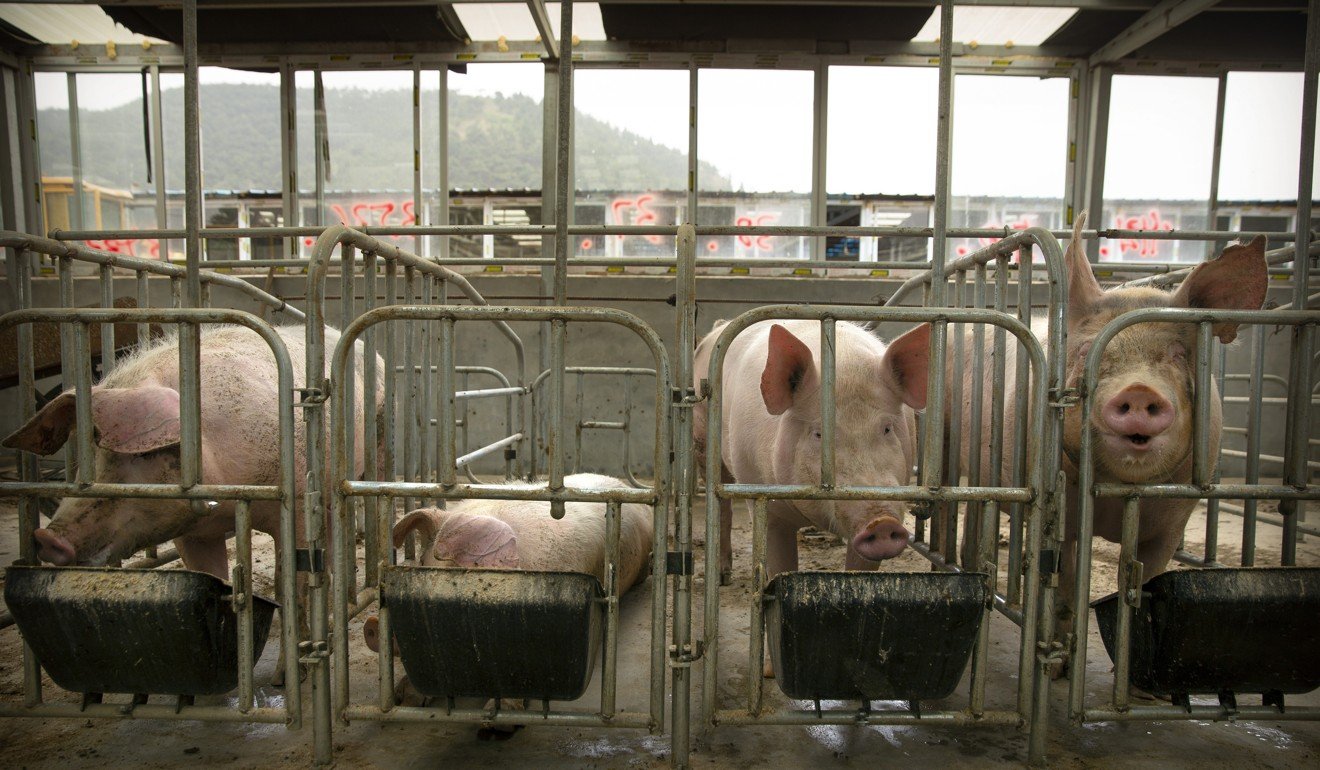
China’s domestic pig stocks have fallen by a third. Photo: AP

“In any case, the 95 per cent [self-sufficiency] goal is reasonable, as China’s pork market size is too big, and imports, despite rising this year, still represent just a small part,” Pan said.

Although China’s domestic shortfall may offer a windfall to foreign suppliers, they must obtain government approval before they could sell to China.

On Monday, Beijing approved imports from 25 Brazilian meat factories, bringing the country’s total number to 89.

On Wednesday, Danish officials completed a three-day trip to China, saying they expected to increase pork exports to China.

Danish food minister Mogens Jensen attended the opening of a new meat processing facility near Shanghai operated by Danish Crown.

China imported 230,000 tonnes of pork from Denmark in 2018, according to the country’s foreign ministry.

On Tuesday, the Chinese State Council issued a new set of guidelines to support the industry, outlining measures such as increased subsidies to boost domestic production in the face of worsening pork shortages that have sent prices to record highs.

The consumer price index released on Tuesday reinforced the bleak picture of a tight market supply as the data showed that pork prices rose by 46.7 per cent in August compared with a year earlier, almost double the 27 per cent rise witnessed in July.

Prices of pork are one of the major indicators used by Chinese citizens to gauge their well-being and, at the moment, that well-being is being eroded rapidly.

According to NDRC, China has already spent a total of 3.23 billion yuan (US$454 million) in subsidies so far this year to tackle the pork shortage crisis.

“As much as 1.1 billion yuan has been newly added under the budget of the central government, with the focus on supporting western provinces in the Yangtze River basin to carry out farm improvement works to control pollution and reduce livestock and poultry waste,” Peng from the NDRC said.

However, a report published by research firm Gavekal Dragonomics on Wednesday cautioned that the government’s plans to soften the blow on the industry might not be effective.

“As the overhaul of pig-raising practices to eliminate the disease would take years even if the government was moving more aggressively, high prices and pork shortages are going to persist,” the report said.

Source: SCMP

06/07/2019

China claims 55 of UNESCO world heritages with elected new sit

AZERBAIJAN-BAKU-CHINA-LIANGZHU-WORLD HERITAGE

The Chinese delegation celebrate during the 43rd session of the UNESCO World Heritage Committee in Baku, Azerbaijan, July 6, 2019. The United Nations Educational, Scientific and Cultural Organization (UNESCO) World Heritage Committee inscribed China’s Archaeological Ruins of Liangzhu City on the World Heritage List as a cultural site here on Saturday, bringing the total number of World Heritage Sites in China to 55, the highest in the world. (Xinhua/Tofik Babayev)

BAKU, July 6 (Xinhua) — China’s Archaeological Ruins of Liangzhu City was on Saturday inscribed to the UNESCO World Heritage List as a cultural site, bringing the total number of the Asian country’s sites on the list to 55.

The decision to add the Chinese cultural site, located in the eastern Chinese city of Hangzhou, to the United Nations Educational, Scientific and Cultural Organization’s (UNESCO) World Heritage List was approved by the World Heritage Committee at its ongoing 43rd session in the Azerbaijani capital of Baku.

“It is considered to be a supreme achievement of prehistoric rice-cultivating civilization of China and East Asia over 5,000 years ago and an outstanding example of early urban civilization,” said a report by the International Council on Monuments and Sites (ICOMOS), the committee’s official advisory body.

Sitting on a plain crossed by river networks in the Yangtze River Basin, the nominated property of Archaeological Ruins of Liangzhu City includes the archaeological remains of Liangzhu City (3300 BC-2300 BC), which was once the center of power and belief of an early regional state in the lower reaches of the Yangtze River during the Late Neolithic China period.

The property testifies to the existence of a regional state with a unified belief system and supported by a rice-cultivating agriculture in late Neolithic China. It also represents an early urban civilization with complex functions and structures.

“Archaeological Ruins of Liangzhu City is a major archaeological discovery of China in the 20th century and an important cultural site that witnessed the 5,000-year civilization of the country,” said Liu Yuzhu, head of China’s National Cultural Heritage Administration, at the committee session.

“We are proud that after 25 years of preparation, our efforts have finally led to the successful inscription of this exceptionally important property, which is the most concrete testimony of 5,000 years of Chinese civilization,” said Shen Yang, ambassador and permanent delegate of China to the UNESCO, following the announcement of the decision.

“We are keenly aware that the inscription also entails an enormous responsibility for conserving this heritage of humanity,” he added.

Zhou Jiangyong, Hangzhou’s municipal committee secretary of the Communist Party of China, said the Chinese city will spare no effort to “protect and make proper use of the enormous cultural heritage before passing it on to the the future generations.”

The Chinese side also pledged continued efforts and strengthened international cooperation in the protection and management of the world heritages in China.

The 43rd convention of the World Heritage Committee, held from June 30 to July 10, started on Friday to examine world heritage nominations. According to its agenda, it will also review the state of conservation of 166 sites on the World Heritage List, 54 of which are also on the List of World Heritage in Danger.

On Friday, China’s Migratory Bird Sanctuaries along the Coast of the Yellow Sea-Bohai Gulf (Phase I) was inscribed to the World Heritage List as a natural site.

At present, China has 55 world heritage sites, including 37 cultural sites, 14 natural sites, and 4 cultural and natural heritages.

Source: Xinhua

12/03/2019

China makes sound progress in protecting Yangtze environment: minister

(TWO SESSIONS)CHINA-BEIJING-NPC-PRESS CONFERENCE (CN)

Ecology and Environment Minister Li Ganjie attends a press conference on “fighting resolutely to prevent and control pollution” for the second session of the 13th National People’s Congress (NPC) in Beijing, capital of China, March 11, 2019. (Xinhua/Shen Bohan)

BEIJING, March 11 (Xinhua) — China has made sound progress in addressing the prominent problems over environmental protection along the Yangtze River Economic Belt, the country’s Ecology and Environment Minister Li Ganjie said Monday.

After two years of work, 99.9 percent of the 1,474 drinking water sources in cities above the county-level along the Yangtze River Economic Belt, stringing up 11 provinces and municipalities from west to east, have had their problems resolved, Li told a news conference on the sidelines of the annual legislative session.

Meanwhile, over 90 percent of the 12 “black and malodorous water bodies” in the provincial capital cities have been cleaned up, while prefecture-level cities are catching up on this front, Li said.

A special campaign targeting illegal disposal of solid and hazardous waste along the Yangtze, China’s longest river, has also been successful, the minister said, adding that the country has made notable progress in enhancing protection of the nature reserves in the Yangtze River basin.

The country will continue to improve the supervision system for Yangtze protection, Li said.

China has made the “defense of lucid waters” a primary task in the battle against pollution for 2019. Research will be conducted for the drafting of laws on bio-security and Yangtze River conservation this year, according to the work report of the Standing Committee of the 13th National People’s Congress.

Source: Xinhua

Law of Unintended Consequences

continuously updated blog about China & India

ChiaHou's Book Reviews

continuously updated blog about China & India

What's wrong with the world; and its economy

continuously updated blog about China & India