Archive for ‘yellow alert’

18/05/2020

Cyclone Amphan: India’s east coast braces for severe storm

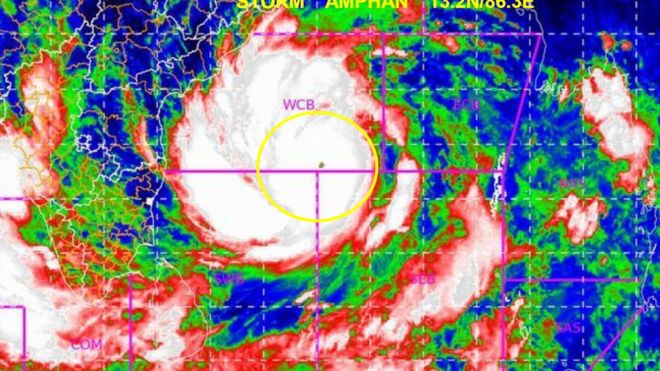
Cyclone AmphanImage copyright INDIA MET DEPARTMENT
Image caption The storm has worsened over the last 12 hours

Indian officials are on alert after Cyclone Amphan – due to make landfall on the east coast – looks likely to intensify into a “very severe” storm.

The storm is expected to make landfall on Wednesday afternoon and hit West Bengal and Odisha states. Twenty relief teams have been dispatched there.

Prime Minister Narendra Modi is due to chair a high-level meeting to further discuss preparations for the storm.

The cyclone comes amid huge levels of migration from the cities to villages.

Tens of thousands of people are fleeing cities in the wake of a lockdown to curb the spread of coronavirus. Both Odisha and West Bengal are seeing a large number of people return.

There are fears about the impact of the storm on them – many are on foot.

India’s meteorological department has issued a “yellow alert” for the region, advising fishermen not to “venture into the south Bay of Bengal during the next 24 hours, and north Bay of Bengal from 18-20 May”.

A ‘”yellow alert” or “cyclone alert” is issued “of the expected commencement of adverse weather over the coastal areas”.

Presentational white space

In a bulletin, the weather department said the storm is likely to move across the north-west Bay of Bengal, and cross West Bengal and Bangladesh coasts from noon local time on 20 May as a “very severe cyclonic storm”.

It also warned of rough seas, with storm surges that could inundate coastal areas.

The head of India’s National Disaster Relief Force (NDRF), SN Pradhan, said they were watching the situation closely and were in touch with state governments.

Last June a powerful cyclone that was expected to make landfall on India’s western coast changed its course, and moved further into the Arabian sea.

Hundreds of thousands of people had already been evacuated as the region braced for Cyclone Vayu, which was classified as “very severe”.

And in May last year India evacuated more than a million people to safety to avoid Cyclone Fani, in which 16 people were killed in Odisha.

In the Bay of Bengal, the cyclone season typically runs from April to December.

Source: The BBC

15/07/2019

China Focus: 17 dead or missing as rainstorms sweep central, east, south China

CHINA-GUANGXI-RONGAN-FLOODS-RECONSTRUCTION (CN)

Villagers clean a house damaged by floods at Jiangbei Village of Banlan Township, Rongan County, south China’s Guangxi Zhuang Autonomous Region,July 14, 2019. A series of reconstructing and rescuing works have been done since Rong’an was hit by heavy rains recently. (Xinhua/Huang Xiaobang)

BEIJING, July 14 (Xinhua) — At least 17 people were killed or missing and thousands evacuated as torrential downpours unleashed floods and toppled houses in central, eastern and southern China.

The National Meteorological Center on Sunday renewed a blue alert for rainstorms, predicting heavy rain in Zhejiang, Fujian, Jiangxi, Hunan, Guangdong, Yunnan, Sichuan provinces, as well as Guangxi Zhuang Autonomous Region and Tibet Autonomous Region.

Some of those regions will see up to 120 mm of torrential rainfall, it said.

China has a color-coded weather warning system, with red representing the most severe, followed by orange, yellow and blue.

As of 8 a.m. Sunday, at least 17 people died or were reported missing following rain-triggered floods in central Hunan Province, which also forced more than 470,000 people to be relocated and 179,000 were in urgent need of aid.

Four hydrometric stations along the Yangtze River in Xianning city, central Hubei Province, have reported the river water reaching or surpassing a level that can activate local anti-flood work.

In eastern Anhui Province, rain-triggered floods have affected more than 51,000 people and damaged over 2,700 hectares of crops.

The floods have forced the evacuation of 926 people, and caused a direct economic loss of more than 59.6 million yuan (8.66 million U.S. dollars) in the province.

As of Saturday noon, 330,000 people in 18 counties of Jiangxi Province have been affected by rainstorm-triggered floods, with over 10,500 residents relocated.

Poyang Lake, China’s largest freshwater lake in the lower reaches of the Yangtze, is swelling above the alarming level, according to the hydrographic department in Jiangxi.

The water level of the lake reached 20.08 meters as of 8 a.m. Saturday, 1.08 m above the warning level, as recorded by Xingzi Hydrometric Station on the lake.

In south China’s Guangxi Zhuang Autonomous Region, rainstorm has affected more than 360,000 people as of 5 p.m. Sunday, damaging over 35,000 hectares of crops, according to the region’s emergency management department.

The disastrous weather in Guangxi has prompted the region to activate a level-II emergency response and send special work teams and relief materials to the ravaged areas.

In some of the disaster-hit towns, flood water from subterranean rivers has inundated roads.

“After torrential downpours, waters on mountains and underground rivers converge into low-lying lands, which may lead to waterlogging. In affected villages, the water depth in some people’s houses can exceed two meters,” said Liao Bin, an official with Jiuwei Town, Hechi City.

Local authorities have dispatched boats and wooden rafts to transfer the stranded people, set up temporary relocation sites, and deliver living supplies to blocked villages.

Since June, the southwestern province of Guizhou has allocated a total of 16.5 million yuan for its hardest-hit 16 counties.

Source: Xinhua

08/07/2019

Ministry dispatches work teams to assist with local flood control

BEIJING, July 7 (Xinhua) — Four work teams have been dispatched to four provincial-level regions in southern China, including Jiangxi, Hunan, Guangxi and Guizhou, to assist with local flood control efforts, according to the Ministry of Water Resources Sunday.

The National Meteorological Center earlier issued a yellow alert for heavy rains in the country’s southern regions. Characterized by wide coverage and long duration, the rainstorm would hit the regions with precipitation up to 180 mm in some areas.

Water levels of major rivers in southern China would be above the warning line, according to the weather forecast.

The ministry stresses that local governments should take targeted measures to prevent mountain torrents, ensure dam safety during floods and strengthen patrols on the levee system.

The ministry also asks local water resources departments to pay close attention to the weather conditions and raining and flood situation, issue alerts timely and move the people out of the dangerous areas in time.

China has a four-tier color-coded weather warning system, with red representing the most severe, followed by orange, yellow and blue.

The China Meteorological Administration on Sunday also issued a grade-IV response for the upcoming rains. The grade-IV response, the lowest in China’s emergency response system, means a 24-hour alert, daily damage reports, and the allocation of money and relief materials within 48 hours.

Source: Xinhua

Law of Unintended Consequences

continuously updated blog about China & India

ChiaHou's Book Reviews

continuously updated blog about China & India

What's wrong with the world; and its economy

continuously updated blog about China & India