Archive for ‘Yellow River’

07/05/2020

Xinhua Headlines: Archaeological findings provide key proof of Chinese civilization origin

— Chinese archaeologists announced significant achievements at the Shuanghuaishu site in central China’s Henan Province, providing key proof of the origin of the over 5,000-year-long Chinese civilization.

— With an area of 1.17 million square meters, the Shuanghuaishu site, dating back to around 5,300 years, is located on the south bank of the Yellow River in the township of Heluo, Gongyi City, and was proposed to be named “Heluo kingdom.”

— A large number of relics of the Yangshao Culture dating back 5,000 to 7,000 years have been discovered at the site.

by Xinhua writers Xu Ruiqing, Wang Ding, Gui Juan, Shuang Rui

ZHENGZHOU, May 7 (Xinhua) — Chinese archaeologists announced Thursday significant achievements at the Shuanghuaishu site in central China’s Henan Province, providing key proof of the origin of the over 5,000-year-long Chinese civilization.

With an area of 1.17 million square meters, the Shuanghuaishu site is located on the south bank of the Yellow River in the township of Heluo, Gongyi City.

The ancient city relic dating back to around 5,300 years ago was proposed by Chinese archaeologists to be named “Heluo kingdom” after its location in the center of the Heluo area, where the Yellow River (known as He in ancient China) and the Luohe River meet.

“The Shuanghuaishu site is the highest-standard cluster with the nature of a capital city discovered so far in the Yellow River basin in the middle and late stage of Yangshao Culture, the early stage of the formation of Chinese civilization,” said Li Boqian, a professor at Peking University, at a press conference on major archaeological discoveries at Shuanghuaishu site held Thursday in Zhengzhou, the provincial capital.
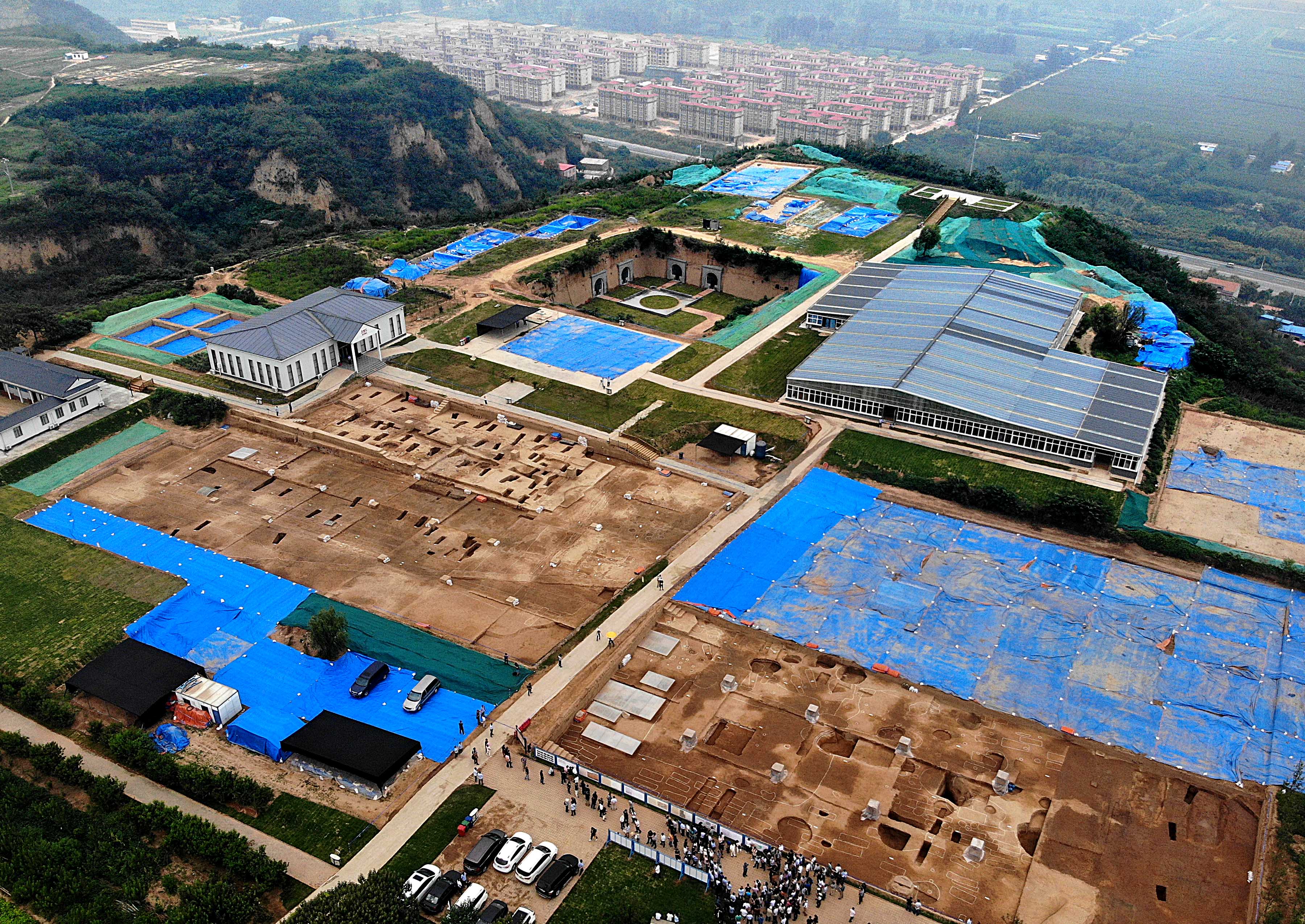
Aerial photo taken on Aug. 27, 2019 shows the Shuanghuaishu site in central China’s Henan Province. (Xinhua/Li An)

A large number of relics of the Yangshao Culture dating back 5,000 to 7,000 years have been discovered at the site, said Gu Wanfa, director of the Zhengzhou Municipal Research Institute of Cultural Relics and Archaeology, at the press conference.

“The important archaeological findings provide key proof of the origin of Chinese civilization, and also prove the representativeness and influence of the Heluo area in the golden stage of the origin of Chinese civilization around 5,300 years ago,” said Wang Wei, a member of the Chinese Academy of Social Sciences.

Since 2013, the Zhengzhou Municipal Research Institute of Cultural Relics and Archaeology and the Institute of Archaeology of the Chinese Academy of Social Sciences have conducted continuous archaeological excavations on the site.

According to archaeologists, the Shuanghuaishu site was about 1,500 meters long from east to west and 780 meters wide from north to south. It was surrounded by three ring trenches with each found to have external access, forming a strict defense system.

Aerial photo taken on Aug. 27, 2019 shows the Shuanghuaishu site in central China’s Henan Province. (Xinhua/Li An)

The central residential area with four rows of houses was found in the northern part of the inner ring moat. Meanwhile, three public cemeteries with more than 1,700 tombs, three sacrificial remains, an astronomical relic, a pottery workshop area, a water storage area, a road system, and other facilities were also discovered at the city ruins.

“The Shuanghuaishu site was a well-selected and scientifically planned settlement site,” said Wang.

“Based on the geographical location and scale, it’s also the only large-scale city settlement discovered so far in the Yellow River basin from the middle and late stage of Yangshao Culture,” Wang added.

Archaeologists believe that the Heluo kingdom was the source of many typical characteristics of Chinese civilization.

Silk originated in China and later became one of the country’s major trade items. “The mulberry-growing and silkworm-raising culture was an important component of Chinese civilization,” said Li.

Among the unearthed relics at Shuanghuaishu, a boar tusk carving of a silkworm, 6.4 cm long, nearly 1 cm wide and 0.1 cm thick, was believed to be China’s earliest carving depicting silkworms.

Undated photo shows a boar tusk carving of a silkworm unearthed at the Shuanghuaishu site in central China’s Henan Province. (Xinhua)

Experts say that the carving depicts a spinning silkworm which is quite similar to modern silkworms in appearance. “The spinning shape of the carving suggests that ancient Chinese people were familiar with the habits of silkworms,” said Gu.

Along with silk fabrics unearthed at the surrounding Wanggou site and Qingtai site, archaeologists said they are solid evidence to prove that the ancient Chinese in the Yellow River basin began raising silkworms and silk production around 5,300 years ago.

“Except Shuanghuaishu and its surrounding settlement sites, there were no definite discoveries from around 5,300 years ago related to the silk textile industry in other parts of the country,” said Li. “In that sense, they are the earliest representatives in the development history of Chinese mulberry cultivation and silkworm-rearing culture.”

Meanwhile, at the astronomical relic at Shuanghuaishu, nine pottery pots were arranged in the pattern of the nine stars of the Big Dipper, which shows that the ancestors of Heluo had relatively mature astronomical knowledge.

Photo taken on April 28, 2020 shows one of nine pottery pots arranged in the pattern of the nine stars of the Big Dipper, at an astronomical relic at the Shuanghuaishu site in central China’s Henan Province. (Xinhua/Li An)

“The relic also indicates the worship of the celestial body may have formed a grand sacrificial ceremony for observing the solar terms and praying for a good harvest,” said Gu.

Experts also believe the astronomical relic and the surrounding sacrificial remains constitute a whole, which is consistent with the records of winter solstice sacrifices in ancient Chinese documents. “It is of great significance to the study of early Chinese astronomy and the origin of Chinese civilization,” added Gu.

Source: Xinhua
29/12/2019

Discover China: Green shoots of prosperity as asparagus takes root in rural China

YINCHUAN, Dec. 28 (Xinhua) — In the remote Xiamaguan Township of northwest China’s Ningxia Hui Autonomous Region, swathes of green asparagus sway in the endless loess field.

Farmer Dong Yi started growing asparagus in 2017 when local officials encouraged villagers to cultivate the green plant to get out of poverty.

“We had never seen asparagus before, and everybody doubted if the plant could survive the harsh environment here,” said Dong, 56. “But I decided to try it anyway, because I was struggling to make money.”

Xiamaguan Township is located deep in the mountains, and the dry weather there leaves it in dire need of water. The township is among Ningxia’s poorest, where many people are still struggling to make ends meet.

Despite years of prosperity in the coastal regions, pockets of residents still lag behind in China’s underdeveloped rural areas, which poses a challenge for the country’s battle to wipe out absolute poverty by 2020.

In 2012, China had 98.99 million rural people living under the national poverty line of 2,300 yuan (329 U.S. dollars) in annual income. By the end of 2018, the number had dropped by 82.4 million, with 16.6 million still left in poverty. Ningxia is home to one of the largest poor populations in China.

However, the asparagus has brought fortunes to Xiamaguan Township, with more than 100 families having been lifted out of poverty since the industry took root there, according to the latest government figures. Currently, more than 130 hectares of asparagus thrive in the fields.

In the past, asparagus was something unheard of among impoverished farmers such as Dong Yi in Xiamaguan. Dong’s family has about three hectares of land. For generations, the family depended on grain plantation to make a living, though they barely made enough money to live a decent life.

A few years ago, a series of irrigation projects pumped water from the Yellow River into the dry, sandy lands in Ningxia. The Yellow River is China’s second-longest river. With more water, local residents decided to grow more crops, said local Party official Dong Zhanping.

“The farmers tried a variety of plants at first, including traditional Chinese herbs, and corn, but the yields were less than satisfactory,” the official said.

In 2017, township officials decided to introduce asparagus to the area after multiple field surveys. They invited a company that had success growing asparagus in a nearby county.

“We persuaded farmers to lease their land to us and we managed the land collectively,” Dong Zhanping said, adding that they gave 3,000 yuan to the farmers for each hectare of land they leased. Experts then cultivated asparagus seedlings in greenhouses, before planting them in the fields, depending on dripping irrigation technology.

“Different from the bamboo in southern China, asparagus can adapt to a very dry environment, which is why the land in Xiamaguan is perfect for its cultivation,” said company manager He Jiang. “Besides, the air here is fresh, and the soil is very clean, so the asparagus grown here is very good quality.”

In 2017, Dong Yi, the local farmer, went to learn about asparagus cultivation with the company’s technical staff in east China’s Shandong Province. He learned about weeding and fertilizing there, and returned home to train other villagers. By commanding new techniques and with hard work, farmers like Dong saw the potential of the industry after reaping a good harvest.

“This year we will have another bumper harvest,” he said. “Currently, more than 200 villagers are toiling in the fields.”

The success of Xiamaguan Township has permeated to other villages, according to local officials. In the past, many farmers left home for big cities for decent-paying jobs, but now they stay in their hometown and attend to the asparagus.

Dong Yi said the asparagus is in high demand, with orders from buyers in the provinces of Shandong and Guangdong. Many of the buyers purchased the crop online.

“When the harvest season comes in January, we will rake in more than 150,000 yuan per hectare,” he said.

The asparagus industry has also brought environmental benefits, including less sandy areas and more moist air, in addition to the economic boost.

“We hope to bring more farmers into the industry,” said Party official Dong Zhanping. “The plant has truly changed lives here.”

Source: Xinhua

05/12/2019

4,000-year-old granaries discovered in central China’s Neolithic ruins

ZHENGZHOU, Dec. 5 (Xinhua) — Archaeologists have unearthed a number of circular foundations at a Neolithic site of Longshan Culture dating back about 4,000 years in Huaiyang, central China’s Henan Province, and believe they are one of China’s earliest granaries.

The Shizhuang Site was discovered when workers built a factory. According to an archaeological survey, the site covers 30,000 square meters with the main living area of 5,000 square meters surrounded with rammed earth walls. The ground bases of the granaries are located inside the ancient settlement.

The Henan Provincial Institute of Cultural Relics and Archaeology began excavation of the site in July.

Cao Yanpeng, an associate researcher at the institute, said the Longshan Culture represents a gradual transition from a primitive society to a civilized era. The cultural sites were discovered in places in the middle and lower reaches of the Yellow River, including the current provinces of Shanxi, Shaanxi, Henan and Shandong.

The main artifacts from the culture are characterized by black pottery.

“Granaries from that period, especially circular ones, were rarely found in previous discoveries,” said Lei Xingshan, secretary of the Party Committee of Peking University’s School of Archaeology and Literature.

The site also contains cultural remains from the Spring and Autumn period (770 B.C.- 476 B.C.), and Han (202 B.C.-220) and Tang (618-907) dynasties.

Source: Xinhua

19/11/2019

China needs to divert more water to north to fight risk of drought, says premier

  • Li Keqiang tells senior officials to step up efforts to channel water from Yangtze River to arid regions
  • Impact of pollution and rising population has prompted increased efforts to improve efficiency and supply
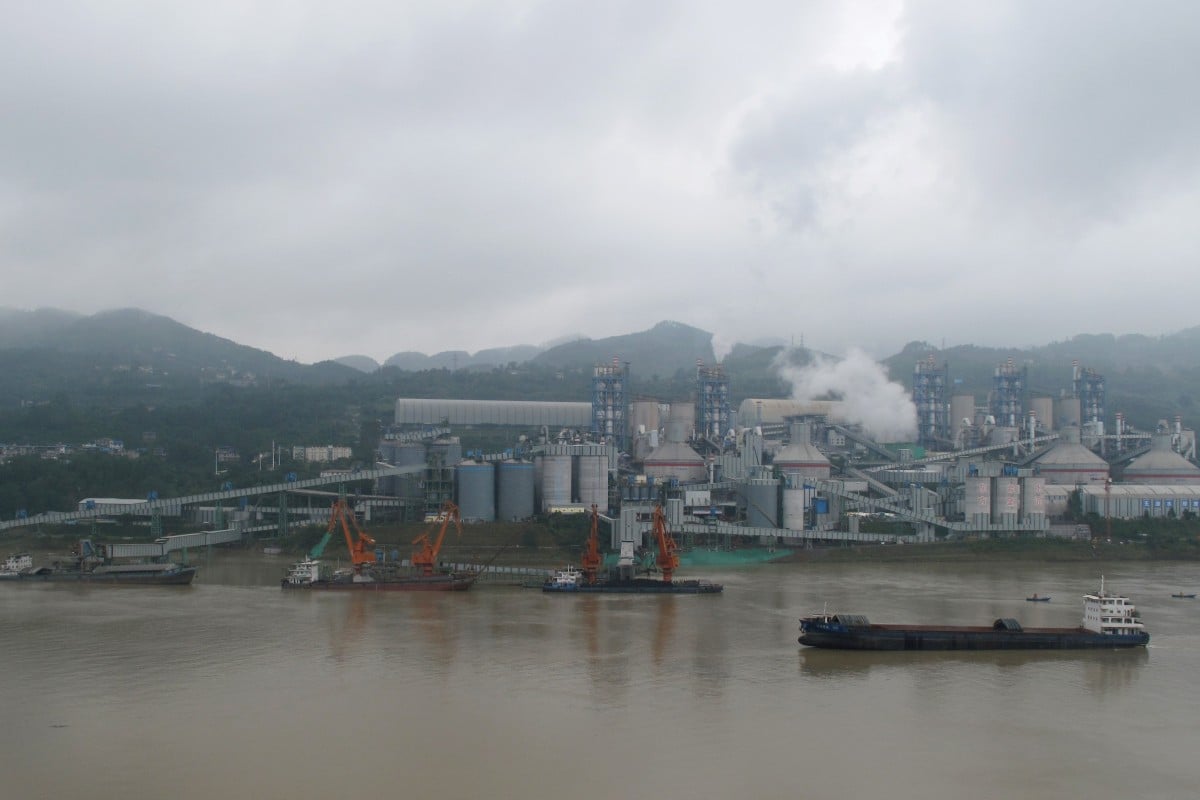
A cement plant on the banks of the Yangtze in Chongqing. The authorities are now trying to stop further development along the river. Photo: Reuters

China needs to divert more water to its arid northern regions and invest more in water infrastructure as shortages get worse because of pollution, overexploitation and rising population levels, Premier Li Keqiang has said.

China’s per capita water supplies are around a quarter of the global average. With demand still rising, the government has sought to make more of scarce supplies by rehabilitating contaminated sources and improving efficiency.

Water remained one of China’s major growth bottlenecks, and persistent droughts this year underlined the need to build new infrastructure, Li told a meeting of senior Communist Party officials on Monday. An account of the meeting was published by China’s official government website.

Local government bonds should be “tilted” in the direction of water infrastructure, he said, and innovative financing tools were also needed.

He also called for research into new pricing policies to encourage conservation.

Li said China’s water supply problems had been improved considerably as a result of the South-North Water Diversion Project, a plan to divert billions of cubic metres of water to the north by building channels connecting the Yangtze and Yellow rivers.

World ‘woefully unprepared’ for climate change’s effects on drinking water supplies drawn from mountains

He said opening up more channels to deliver water to regions north of the Yangtze River Delta would support economic and social development and optimise China’s national development strategy, according to a summary of the meeting on the government website.

China is in the middle of a wide-reaching programme to clean up the Yangtze River, its biggest waterway, and put an end to major development along its banks.

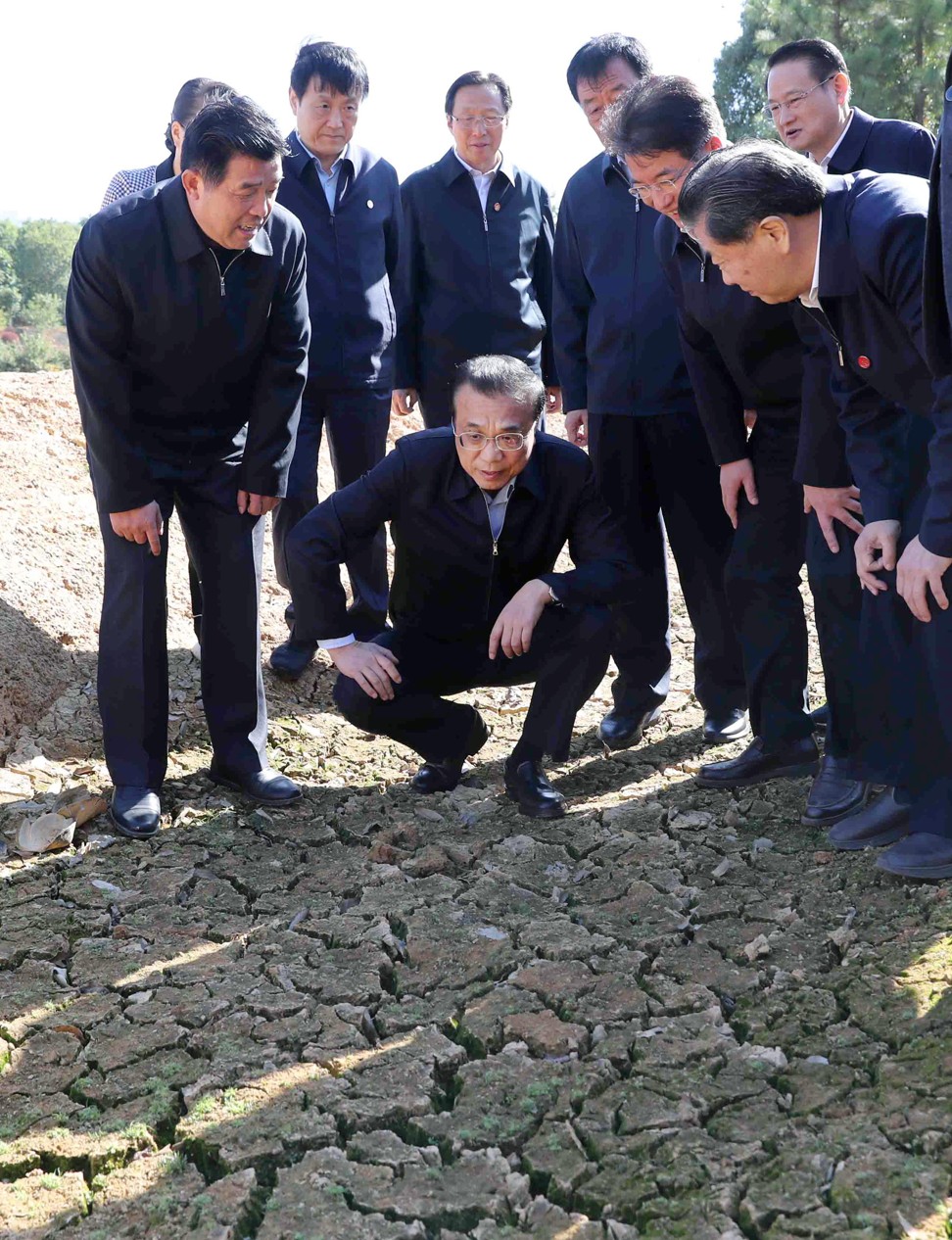
Chinese Premier Li Keqiang inspects an empty reservoir during a visit to Jiangxi province last week. Photo: Xinhua

Local governments have been under pressure to dismantle dams, relocate factories and even ban fishing and farming in ecologically fragile regions.

But experts say the ongoing campaign to divert the course of the Yangtze to other regions is still causing long-term damage to the river’s environmental health.

Many cities that had polluted their own water sources had drawn replacement supplies from the Yangtze, exceeding the river’s environmental capacity, said Ma Jun, founder of the Institute of Public and Environmental Affairs, which monitors water pollution.

Beijing already relied on diversion channels from the Yangtze to supply 70 per cent of its water, but had done little to improve conservation or reduce per capita consumption, which was higher than many Western countries, he said.

“[Diversion] has caused so much suffering and needs so many dams to keep up supply, and that has impacted biodiversity,” he said.

Source: SCMP

20/09/2019

Xi Focus: Xi stresses ecological protection and high-quality development of Yellow River

CHINA-HENAN-XI JINPING-SYMPOSIUM-YELLOW RIVER PROTECTION AND DEVELOPMENT (CN)

Chinese President Xi Jinping, also general secretary of the Communist Party of China Central Committee and chairman of the Central Military Commission, chairs and addresses a symposium on the ecological protection and high-quality development of the Yellow River in Zhengzhou, capital of central China’s Henan Province, Sept. 18, 2019. (Xinhua/Ju Peng)

ZHENGZHOU, Sept. 19 (Xinhua) — Chinese President Xi Jinping called for concerted efforts to promote ecological protection and high-quality development of the Yellow River.

Xi, also general secretary of the Communist Party of China Central Committee and chairman of the Central Military Commission, made the remarks while chairing a symposium Wednesday during his inspection tour to Henan Province.

NATIONAL STRATEGY

“The protection of the Yellow River is critical to the great rejuvenation and sustainable development of the Chinese nation,” said Xi, adding that it is a major national strategy.

Noting that the peace of the Yellow River is significant to the stability of China, Xi said Chinese people have struggled against the floods and droughts of the Yellow River since ancient times, and the Party and the state have attached great importance to the harnessing and development of the Yellow River after the founding of New China in 1949.

Originating in Qinghai Province, the Yellow River, known as China’s “Mother River” and the cradle of the Chinese civilization, runs through nine provinces and autonomous regions including Shaanxi and Henan before emptying into the Bohai Sea in east China’s Shandong Province.

The river got its name Huanghe in Chinese because of its yellow, muddy water, which appears as it runs through the Loess Plateau in northwest China.

The 5,464-km-long waterway feeds about 12 percent of China’s population, irrigates about 15 percent of arable land, supports 14 percent of national GDP, and supplies water to more than 60 cities.

Xi also pointed out difficulties and problems in protecting the Yellow River, including fragile ecological environment, severe condition of the water resources preservation and development quality that needs to be improved.

SOUL OF CHINESE NATION

Calling for strengthened protection of the ecological environment of the Yellow River basin, Xi said that differences between the upper, middle and lower reaches of the river should be fully considered, given that the Yellow River ecosystem is an organic whole.

Further efforts should be made to ensure the long-term stability of the Yellow River, Xi said, stressing that although the river has not seen major dangers for many years, we should not relax vigilance.

Over the past 2,500 years, the Yellow River has broken its dikes 1,600 times and has made 26 major changes in its course in the lower reaches.

Xi also stressed better use of water resources, with rational planning of the population, urban and industrial development to resolutely curb unreasonable water demand.

When pursuing high-quality development in the region, authorities should actively explore new ways with regional characteristics and participate in the construction of the Belt and Road to promote higher level of opening-up, Xi noted.

Meanwhile, Xi called for preserving, inheriting and carrying forward the Yellow River culture.

“The Yellow River culture, as an important part of the Chinese civilization, is the root and soul of the Chinese nation,” Xi said, calling for telling well the “Yellow River story” to pool spiritual strength for the realization of the Chinese dream of the great rejuvenation of the Chinese nation.

For over 3,000 years, some major dynasties in Chinese history built their capitals in the river basin, making the region the centers of politics, economy and culture in the country.

The Yellow River witnessed the birth of the four era-defining inventions in ancient China — printing techniques, papermaking, gunpowder and the compass, which all emerged in the drainage basin.

At Wednesday’s meeting, Vice Premier Han Zheng, also a member of the Standing Committee of the Political Bureau of the Communist Party of China Central Committee called for efforts to earnestly study and implement the spirit of Xi’s speech and strive to make new progress in the ecological protection and high-quality development of the Yellow River basin.

Source: Xinhua

19/09/2019

Xi stresses confidence, hard work in central China inspection

CHINA-HENAN-XI JINPING-INSPECTION TOUR (CN)

Chinese President Xi Jinping, also general secretary of the Communist Party of China Central Committee and chairman of the Central Military Commission, visits a revolutionary memorial hall in Xinxian County, central China’s Henan Province, Sept. 16, 2019. Xi went on an inspection tour in Henan Monday. (Xinhua/Xie Huanchi)

ZHENGZHOU, Sept. 18 (Xinhua) — Chinese President Xi Jinping called for unshakable confidence and hard work with great determination to write a magnificent chapter of the central region in the new era during his inspection tour to Henan Province from Monday to Wednesday.

Xi, also general secretary of the Communist Party of China (CPC) Central Committee and chairman of the Central Military Commission, called for efforts to promote the continuous and healthy development of the economy as well as social harmony and stability to give people a stronger sense of fulfillment, happiness and security.

On Wednesday afternoon, Xi listened to the work reports of the CPC Henan Provincial Committee and the provincial government.

Xi said that China’s development is in good shape, but the international situation is still complicated. China is faced with new risks and challenges and must manage its own affairs well.

Calling on Henan to promote high-quality economic development and seize the opportunities provided by the strategy for the rise of central China, he urged the province to focus on the high-quality development of the manufacturing industry and give priority to innovation in the overall development.

Xi also stressed efforts to actively push forward the supply-side reform in agriculture.

Xi noted that priority should be given to the protection of ecosystems and addressing environmental issues at the source.

On improving people’s living standards, Xi called for particular attention to ensuring employment for key groups such as college graduates, veterans, laid-off and rural migrant workers, as well as those returning to rural areas.He also called for efforts to help culture flourish, and promote the preservation, innovation and development of fine traditional Chinese culture.

Xi stressed that the first stage of the education campaign themed “staying true to our founding mission” had been concluded while the second stage had just begun, and called for efforts focused on dealing with the most urgent problems facing the people.

Education on red traditions should make Party members and officials remain true to the original aspiration and undertake their mission, and strive to advance the great cause that the martyrs fought and sacrificed themselves for, Xi said.

During the three-day inspection, Xi visited a martyrs cemetery and a museum in an old revolutionary base, handicraft shops and a homestay in a township, as well as an oil-seed camellia plantation, a village which had escaped poverty and a coal mining machinery company.

He also inspected the ecological protection of the Yellow River at a museum and a national geopark and met with senior military officers stationed in Henan.

Source: Xinhua

18/09/2019

Xi inspects manufacturing enterprise, Yellow River ecological protection in central China

CHINA-HENAN-ZHENGZHOU-XI JINPING-INSPECTION (CN)

Chinese President Xi Jinping, also general secretary of the Communist Party of China Central Committee and chairman of the Central Military Commission, communicates with workers while inspecting Zhengzhou Coal Mining Machinery Group Co., Ltd. during his tour in Zhengzhou, central China’s Henan Province, Sept. 17, 2019. (Xinhua/Ju Peng)

ZHENGZHOU, Sept. 17 (Xinhua) — Xi Jinping, general secretary of the Communist Party of China Central Committee, inspected a manufacturing enterprise and ecological protection of the Yellow River during his tour in Zhengzhou, central China’s Henan Province on Tuesday afternoon.

Source: Xinhua

22/08/2019

Xi makes inspection tour in Lanzhou, Gansu

CHINA-GANSU-LANZHOU-XI JINPING-INSPECTION (CN)

Chinese President Xi Jinping, also general secretary of the Communist Party of China Central Committee and chairman of the Central Military Commission, visits a Yellow River management point to learn about the management, protection and flood control project construction of the Yellow River in Lanzhou, northwest China’s Gansu Province, Aug. 21, 2019. (Xinhua/Wang Ye)

Source: Xinhua

09/08/2019

China on red alert as Typhoon Lekima bears down on east coast

A woman shields herself with an umbrella as she walks in New Taipei City in rain brought by Typhoon Lekima as it passes northeastern Taiwan on August 9, 2019Image copyright AFP
Image caption Lekima has brought heavy rain to Taiwan

Chinese authorities have declared a red alert as a powerful typhoon heads towards the eastern coast.

Typhoon Lekima is currently battering Taiwan with winds of more than 190km/h (120mph) and is due to make landfall in China’s Zhejiang province on Saturday.

Emergency teams have been deployed to the region to guide relief work, China’s emergency ministry said.

Thousands of people further up the coast in Shanghai have been warned to prepare to evacuate.

Lekima, which is the ninth typhoon so far this year, strengthened into a super typhoon late on Wednesday, but Taiwanese authorities have since downgraded it to a regular typhoon.

Flood warnings have been issued for eastern sections of China’s Yangtze River and the Yellow River until Wednesday. The provinces of Jiangsu and Shandong are also on alert.

Cruise liners have been told to delay their arrival in Shanghai and some train services have been suspended over the weekend.

Beijing has also cancelled some trains heading to and from the Yangtze delta region.

Lekima is one of two typhoons in the western Pacific at the moment. Further east, Typhoon Krosa is spreading heavy rain across the Northern Mariana Islands and Guam. It is moving north-west and could strike Japan some time next week, forecasters said.

Media caption BBC Weather’s Sarah Keith-Lucas on typhoons Lekima and Krosa

Lekima was passing the north of Taiwan on Friday, causing flight cancellations and the closures of schools and offices.

Power was cut to more than 40,000 homes and the island’s high speed rail service was suspended north of the city of Taichung, local media reported.

The huge storm came a day after eastern Taiwan was rattled by a 6.0 magnitude earthquake. Experts said the risks of landslides triggered by the tremor were made more likely by the typhoon dumping up to 900mm (35 inches) of rain on Taiwan’s northern mountains.

Media caption The 6.0 earthquake in Taiwan was caught on cat cam

Lekima also brought heavy rain and high winds to south-west Japan on Friday, cutting power to about 14,000 homes, broadcaster NHK reported.

China’s weather bureau said Lekima was expected to have weakened further by the time it made landfall. The country has a four-stage colour-coded warning system, with red representing the most severe weather.

Source: The BBC

25/06/2019

China Focus: China’s plateau province sets new record of surviving solely on clean energy

XINING, June 24 (Xinhua) — Northwest China’s Qinghai Province completed a 15-day all clean energy power supply trial, setting a new record following a successful nine-day trial last year, the State Grid Qinghai Electric Power Company announced on Monday.

Nearly 6 million people in the province, which borders Tibet Autonomous Region, only used electricity generated from wind, solar and hydro power stations, from June 6 to 23.

During the 15 days, Qinghai achieved zero carbon emission in power use.

This is the third province-wide clean energy trial in Qinghai. It relied solely on renewable energy for nine and seven consecutive days in 2018 and 2017.

Qinghai is the source of China’s three major rivers, the Yellow, Yangtze and Lancang, and has strong hydro and solar-power facilities.

During the trial, the whole province consumed a total 2.84 billion kwh, with the maximum load hitting 8.47 million kw, said Fang Baoming from the company.

The province’s cumulative capacity during the period reached nearly 4 billion kwh, with new energy taking a large share of 34.7 percent.

Power generated by thermal power plants only accounted for 1.8 percent of the gross generation in Qinghai during the period, and was all transmitted out of the province on demand of the market.

“The 15-day all clean energy power supply reduced coal burning of up to 1.29 million tonnes, and carbon dioxide emission of 2.32 million tonnes,” Fang said.

Qi Taiyuan, general manager of the company, said Qinghai’s electric grid has been expanded this year, with an installed capacity of 2.4 million kilowatts, up 50 percent from last year’s trial.

Qinghai’s installed capacity of new energy has reached 13.9 million kw, accounting for 46.7 percent, surpassing hydropower as the province’s largest power source.

According to the provincial 13th five-year plan, Qinghai will expand its solar and wind capacity to 35 million kilowatts by 2020 and supply 110 billion kilowatt hours of clean electricity every year to central and eastern parts of China, preventing the burning of 50 million tonnes of coal.

China’s enthusiasm for clean energy is pushing the world to transition toward a low-carbon future, with plans to invest 2.5 trillion yuan (370 billion U.S. dollars) in renewable energy by 2020, creating more than 13 million jobs, according to the National Energy Administration.

Source: Xinhua

Law of Unintended Consequences

continuously updated blog about China & India

ChiaHou's Book Reviews

continuously updated blog about China & India

What's wrong with the world; and its economy

continuously updated blog about China & India