Chindia Alert: You’ll be Living in their World Very Soon
aims to alert you to the threats and opportunities that China and India present. China and India require serious attention; case of ‘hidden dragon and crouching tiger’.
Without this attention, governments, businesses and, indeed, individuals may find themselves at a great disadvantage sooner rather than later.
The POSTs (front webpages) are mainly 'cuttings' from reliable sources, updated continuously.
The PAGEs (see Tabs, above) attempt to make the information more meaningful by putting some structure to the information we have researched and assembled since 2006.
A visitor views an exhibit at the Erlitou Relic Museum in Luoyang, central China’s Henan Province, Oct. 19, 2019. The Erlitou Relic Museum, which exhibits the history of ancient China’s first recorded dynasty of Xia (2070-1600 B.C.), opened Saturday in Luoyang. It exhibits over 2,000 items, including bronze wares, pottery wares and jade wares. Covering an area of 32,000 square meters, the museum exhibits the history of the Xia Dynasty, the first dynasty recorded in ancient China. Construction of the museum cost 630 million yuan (about 89 million U.S. dollars). The Erlitou Relics date back to 3,500 to 3,800 years ago in ancient China’s late Xia or early Shang (1600-1046 B.C.) dynasties. (Xinhua/Li An)
ZHENGZHOU, Oct. 19 (Xinhua) — The Erlitou Relic Museum opened Saturday in Luoyang city in central China’s Henan Province, unveiling the history and culture of ancient China’s first recorded dynasty of Xia (2070-1600 B.C.).
Covering an area of 32,000 square meters, the museum exhibits over 2,000 items, including bronze wares, pottery wares and jade wares.
Construction of the museum cost 630 million yuan (about 89 million U.S. dollars).
The Erlitou Relics date back to 3,500 to 3,800 years ago in ancient China’s late Xia or early Shang (1600-1046 B.C.) dynasties.
Discovered in 1959 in Luoyang by historian Xu Xusheng, Erlitou was identified by Chinese archaeologists as the relics of the capital city of the middle and late Xia Dynasty.
Over the past 60 years, archaeologists have excavated over 10,000 items out of a total area of 40,000 square meters from the site.
Zhao Haitao from the Chinese Academy of Social Sciences (CASS) Erlitou archaeological team, said that China’s earliest palace complex, bronze ware workshop and urban road network were all found at the site.
The museum has three display areas where visitors can experience and better understand the archaeological achievements of the Xia Dynasty, and probe into the history and culture of the Xia Dynasty via various kinds of projects, such as virtual reality, embossment and sand tables.
Li Boqian, a professor with the School of Archaeology and Museology of Peking University, said the Erlitou Relic Museum presents daily utensils, manufacturing tools and decorations for visitors to understand the social development, history and culture of the Xia Dynasty.
The museum will help people around the world learn about ancient Chinese history and culture, said Liu Yuzhu, director of China’s National Cultural Heritage Administration, at the opening ceremony.
In addition, the museum will become a demonstration site for the protection, preservation and exhibition of China’s major cultural heritage sites and a research center for the origin of Chinese civilization.
BEIJING (Reuters) – China will launch test flights for the next two space rockets in its Smart Dragon series meant for commercial use in 2020 and 2021, the official Xinhua news agency reported on Sunday, as an expected boom in satellite deployment gathers pace.
The release of the flight schedule by China Rocket Co, a unit of state-owned China Aerospace Science and Technology Corp, comes two months after the firm’s first reusable rocket, the 23-tonne Smart Dragon-1, delivered three satellites into orbit.
China envisions constellations of commercial satellites that can offer services ranging from high-speed internet for aircraft to tracking coal shipments. Reusable designs will enable frequent rocket launches and help keep costs down.
The solid-propellant Smart Dragon-2, weighing about 60 tonnes and with a total length of 21 metres, will be capable of sending 500 kg payloads into orbit at an altitude of 500 km (310 miles), Xinhua said. It is expected to conduct a flight test next year.
At about 116 tonnes and with a length of 31 metres, the Smart Dragon-3, set for a test flight in 2021, will be capable of sending 1.5 tonne payloads into orbit, Xinhua added.
In July, Beijing-based iSpace became the first private Chinese firm to deliver a satellite into orbit on its rocket. Since late last year, two other startups have attempted to launch satellites but failed.
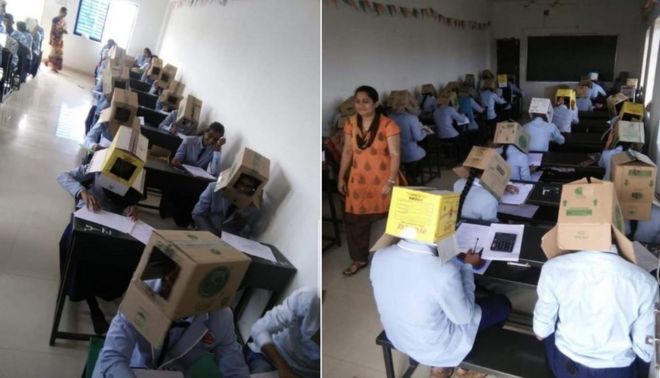
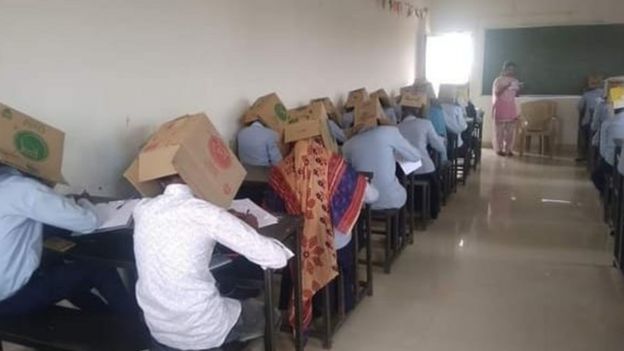
Image copyright ANIImage caption The photographs drew mockery and scorn on social media
An Indian school official has apologised after a bizarre set of images went viral showing students wearing cardboard boxes on their heads.
The images were taken during a chemistry exam at Bhagat Pre-University College in Haveri, Karnataka state.
They showed students wearing boxes, cut open on one side, to prevent them from being able to copy other people’s work.
A junior college administrator has spoken publicly and apologised to district officials for the incident.
MB Satish told BBC Hindi he was sorry for trying to use the unusual anti-cheating technique.
He said the school has only implemented the measure on an “experimental basis” after hearing of its use elsewhere.
Image copyright ANIImage caption The school official said he had heard of the technique being used in Mumbai
He also insisted it had been done with the students’ consent – in fact they had brought in their own boxes.
“There was no compulsion of any kind. You can see in the photograph that some students were not wearing it,” he said. “Some who wore it removed it after 15 minutes, some after 20 minutes and we ourselves asked them to remove it after one hour.”
Regional officials reportedly rushed to the school to complain as soon as they were made aware of the images.
SC Peerjade, deputy director of the local pre-University Education Board, described the practice as “inhumane”.
“When I got a message on this, I immediately went to the college and ordered the management to stop the practice,” he was quoted by the Times of India as saying. “I also issued a notice to the college management and am contemplating disciplinary action against them for implementing this idea.”
School officials have said they have ceased the practice and are co-operating with the school board’s directive.
SRINAGAR, India (Reuters) – India and Pakistan blamed one another for cross-border shelling in the disputed Kashmir region which killed and injured soldiers and civilians on both sides and made it one of the deadliest days since New Delhi revoked Kashmir’s special status in August.
India said there was heavy shelling by Pakistan across the border in northern Kashmir’s Tangdhar region late on Saturday night, killing two Indian soldiers and one civilian. Islamabad said one of its soldiers and three civilians died after India violated the ceasefire, according to the spokesman for the Pakistani Armed Forces.
Kashmir has been a disputed subject between the two nuclear-armed neighbours since they both got independence in 1947, and they have fought two of their three wars over the region.
Tensions between the two countries have flared and there has been intermittent cross-border firing since Aug. 5 when New Delhi flooded Indian Kashmir with troops to quell unrest after it revoked the region’s special autonomous status.
Islamabad has warned that changing Kashmir’s status would escalate tensions but India says the withdrawal of special status is an internal affair and is aimed at faster economic development of the territory.
Reuters was unable to independently verify the claims made by both sides on the shelling, which marks an escalation from the small arms fire usually exchanged by the two armies.
There was an unprovoked ceasefire violation by Pakistan, said Indian defence spokesman Colonel Rajesh Kalia.
“Our troops retaliated strongly causing heavy damage and casualties to the enemy,” Kalia said.
An Indian army source said the shelling was cover to assist militants enter India because of which a “calibrated escalation of area weapons was undertaken”. The Indian army “retains the right to respond at a time and place of it’s choosing” if the Pakistani army continues to do this, he said.
Pakistan, meanwhile, also claimed that India’s attack was unprovoked and deliberately targeted at civilians.
Major General Asif Ghafoor, a spokesman for the Pakistan Armed Forces, said Pakistan responded “effectively,” killing 9 Indian soldiers, injuring several others and destroying 2 bunkers.
“The Indian army shall always get a befitting response,” he said.
Indian forces in Kashmir have gone “berserk”, Raja Farooq Haider, prime minister of Pakistan’s Azad Kashmir region, said, adding that six civilians died and 8 were injured.
“This is the height of savagery. The world must not stay silent over it. #KashmirNeedsAttention,” he said in a tweet.
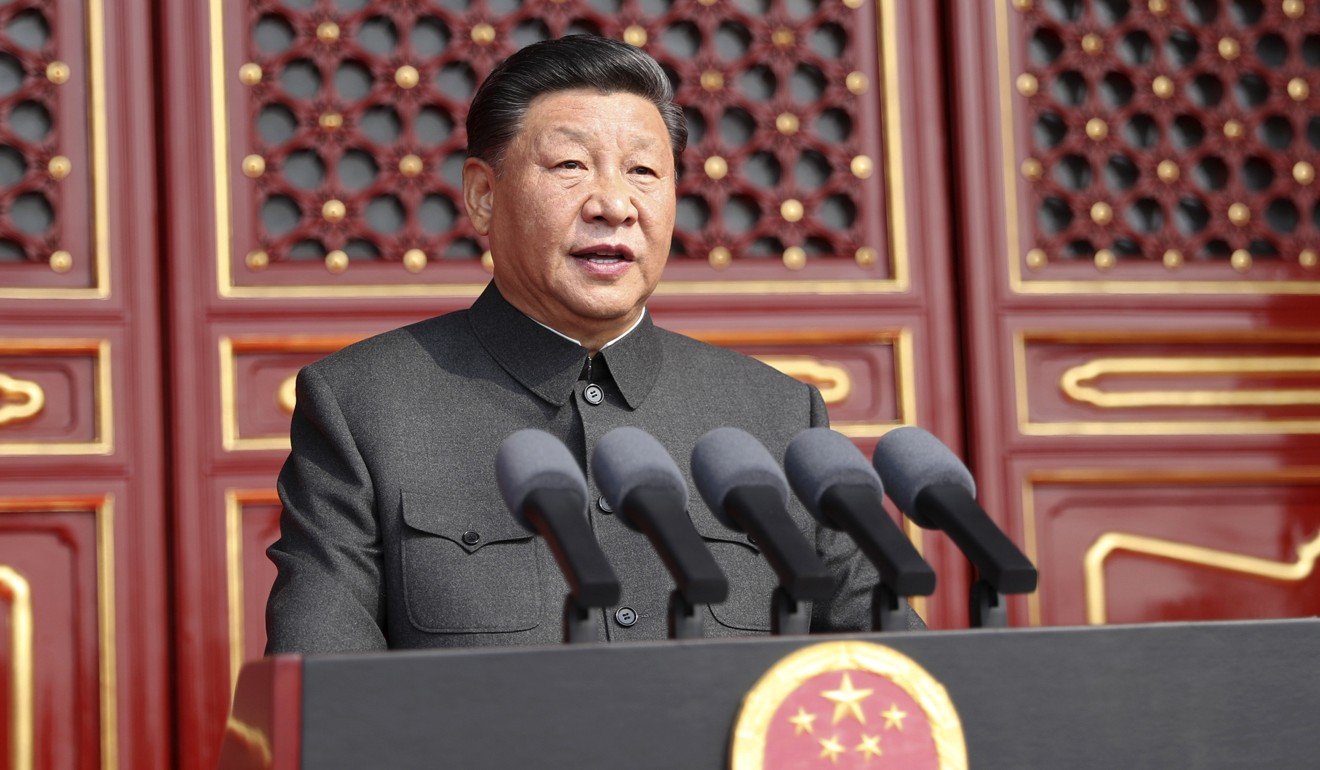
on Saturday reiterated his promise to keep opening up the nation’s markets to companies and investors from around the world.
“The door of China’s opening up will only open wider and wider, the business environment will only get better and better, and the opportunities for global multinational companies will only be more and more,” he said in a congratulatory letter read out by Vice-Premier Han Zheng at the inaugural Qingdao Multinationals Summit in the east China city.
The two-day event, which ends on Sunday, was organised by China’s commerce ministry and the provincial government of Shandong with the aim, according to its website, of giving multinational companies “the opportunity to articulate their business values and vision” and “promote cooperation with host countries”.
In his letter, Xi praised multinational companies for the role they had played in China’s opening up and reform over the past four decades, describing them as “important participants, witnesses and beneficiaries”.
China was willing to continue opening up to benefit not only itself but the world as a whole, he said.
“Only when the world is good, China is good. Only when China is good, can the world get better.”
Despite its upbeat tone, Xi’s message comes as Beijing is facing intense scrutiny from the international business community over its state-led economic model – one of the main bones of contention in its trade war with the US – and its attempts to prevent foreign firms from speaking out on issues it deems too sensitive, from Hong Kong to human rights.
Foreign firms have also long complained about the barriers they face when trying to access China’s markets and the privileged treatment it gives to state-owned enterprises. Even though Beijing has promised to reform its state sector, foreign businesses have complained of slow progress, and just last month the European Union Chamber of Commerce urged the EU to take more defensive measures against China’s “resurgent” state economy.
Xi promised “more and more” opportunities for global firms. Photo: AP
Sheman Lee, executive director of Forbes Global Media Holding and CEO of Forbes China, said at the Qingdao summit that foreign firms were facing a difficult trading environment in the world’s second-largest economy.
“Multinationals have seen their growth in China slow in recent years because of the growing challenge from local firms, a gradually saturating market and rising operation costs,” he said.
Craig Allen, president of the US-China Business Council, said that many multinational companies were reluctant to release their best products in China out of fear of losing their intellectual property.
China still not doing enough to woo foreign investment
In his letter, Xi said that over the next 15 years, the value of China’s annual imports of goods would rise beyond US$30 trillion, while the value of imported services would surpass US$10 trillion a year, creating major opportunities for multinational companies.
China would also reduce tariffs, remove non-tariff barriers and speed up procedures for customs clearance, he said.
Commerce Minister Zhong Shan said at the opening ceremony that China would also continue to improve market access and intellectual property protection.
The country supported economic globalisation and would safeguard the multilateral trade system, he said, adding that it was willing to work with the governments of other countries and multinational corporations to promote economic globalisation.
Xi Jinping says the value of China’s annual goods imports will rise beyond US$30 trillion over the next 15 years. Photo: Bloomberg
The promise to continue to open up China’s markets came after the State Council
– the nation’s cabinet – made exactly the same pledge at its weekly meeting on Wednesday.
After the latest round of trade war negotiations in Washington, Beijing said it had achieved “substantive progress” on intellectual property protection, trade cooperation and technology transfers, all of which have been major bones of contention for the United States.
Despite its pledge to welcome multinational companies into its market, China is in the process of creating a list of “unreliable foreign entities” it considers damaging to the interests of Chinese companies. The roster, which is expected to include FedEx, is seen as a response to a similar list produced earlier by the United States.
Xi’s gesture would also appear to have come too late for South Korean multinational
, which announced on October 4 it had ended the production of smartphones at its factory in Huizhou, Guangdong province – its last in China – with the loss of thousands of jobs.
Vice-Premier Hu Chunhua will lead delegation at two-day summit that is expected to be attended by 400 officials and 200 businesspeople
Observers say it is Beijing’s latest effort to regain momentum in the region and will be closely watched in the US
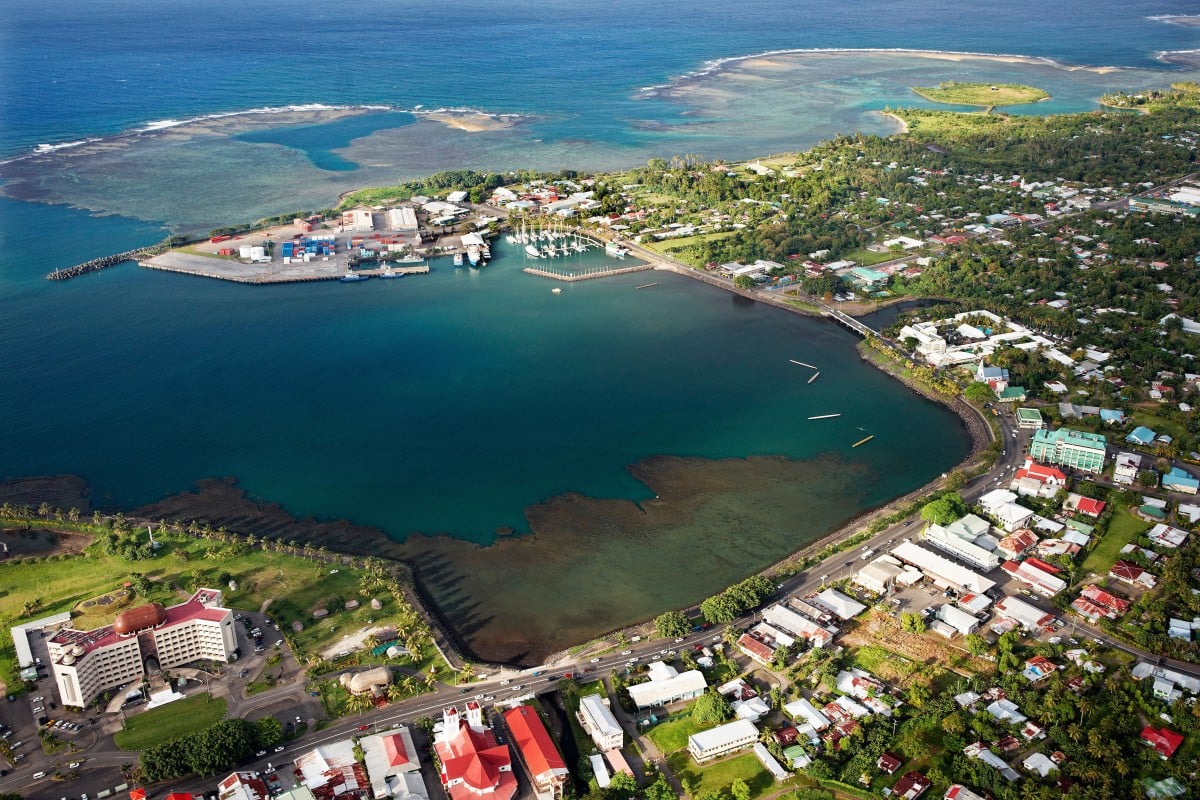
Samoan capital Apia will host the third China-Pacific Island Countries Economic Development Cooperation Forum, which begins on Sunday. Photo: Alamy
China will seek to expand its economic and diplomatic influence in the South Pacific at a forum this weekend, amid growing concern from the US and its allies over Beijing’s push in the strategically important region.
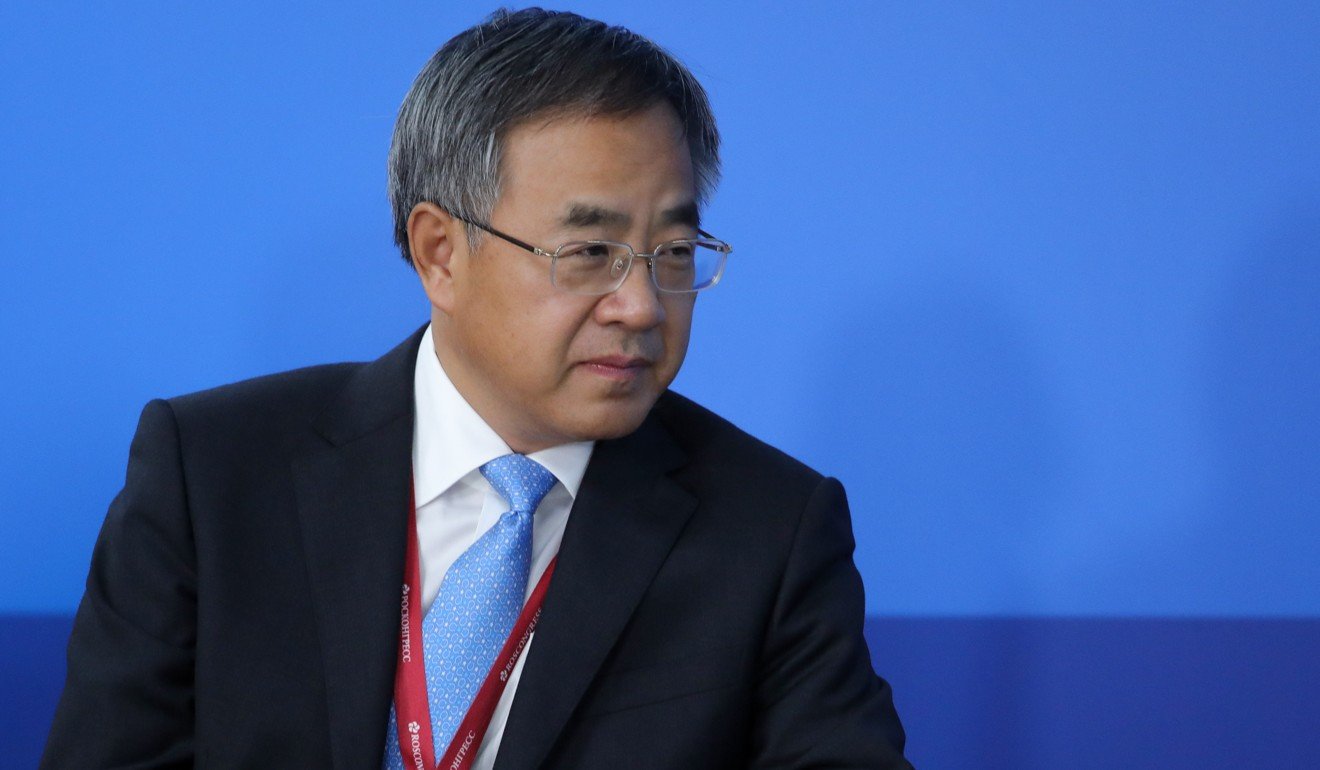
Vice-Premier Hu Chunhua will lead the Chinese delegation at the third China-Pacific Island Countries Economic Development Cooperation Forum in the Samoan capital Apia, which begins on Sunday. It is expected to be attended by 400 officials and more than 200 businesspeople.
Hu, the former Communist Party chief of China’s manufacturing powerhouse Guangdong who now overseas commercial and agricultural affairs, is expected to deliver a keynote speech at the opening ceremony.
Beijing sees the two-day forum as “timely” and “a good opportunity to deepen mutually beneficial cooperation between China and the Pacific”, a commerce ministry spokesperson told the official Economic Daily newspaper.
Trade, agriculture and fisheries, as well as tourism, infrastructure and climate change were at the top of the agenda for the forum, the spokesperson said.
Leaders of all the Pacific nations – except the four that do not have formal diplomatic ties with Beijing – are expected to attend the forum. Australia, which has “observer status” at the summit, will send Ewen McDonald, deputy secretary of the Department of Foreign Affairs and Trade and the head of its Pacific office.
Vice-Premier Hu Chunhua will lead the Chinese delegation at the forum. Photo: EPA-EFE
The forum comes after China hailed a “new breakthrough” in the region following the decision last month by the Solomon Islands and then Kiribati – despite warnings from the US – to cut diplomatic ties with Taipei and switch to Beijing.
They are the latest of Taipei’s allies to be poached by Beijing as it ramps up pressure on the self-ruled island that it sees as a renegade province to be reunited with the mainland, by force if necessary.
Observers said this weekend’s forum was Beijing’s latest effort to regain momentum in the Pacific.
“Having one of China’s top 25 officials visit the region so soon after [Chinese President] Xi Jinping spent close to three days in Papua New Guinea last November is certainly significant,” said Jonathan Pryke, director of the Pacific Islands programme at the Lowy Institute in Sydney, referring to Hu’s position in the 25-member Politburo.
“It shows clearly China’s attempt to recapture momentum after the West, and in particular Australia, have redoubled their efforts in maintaining and building relationships in the Pacific,” he said.
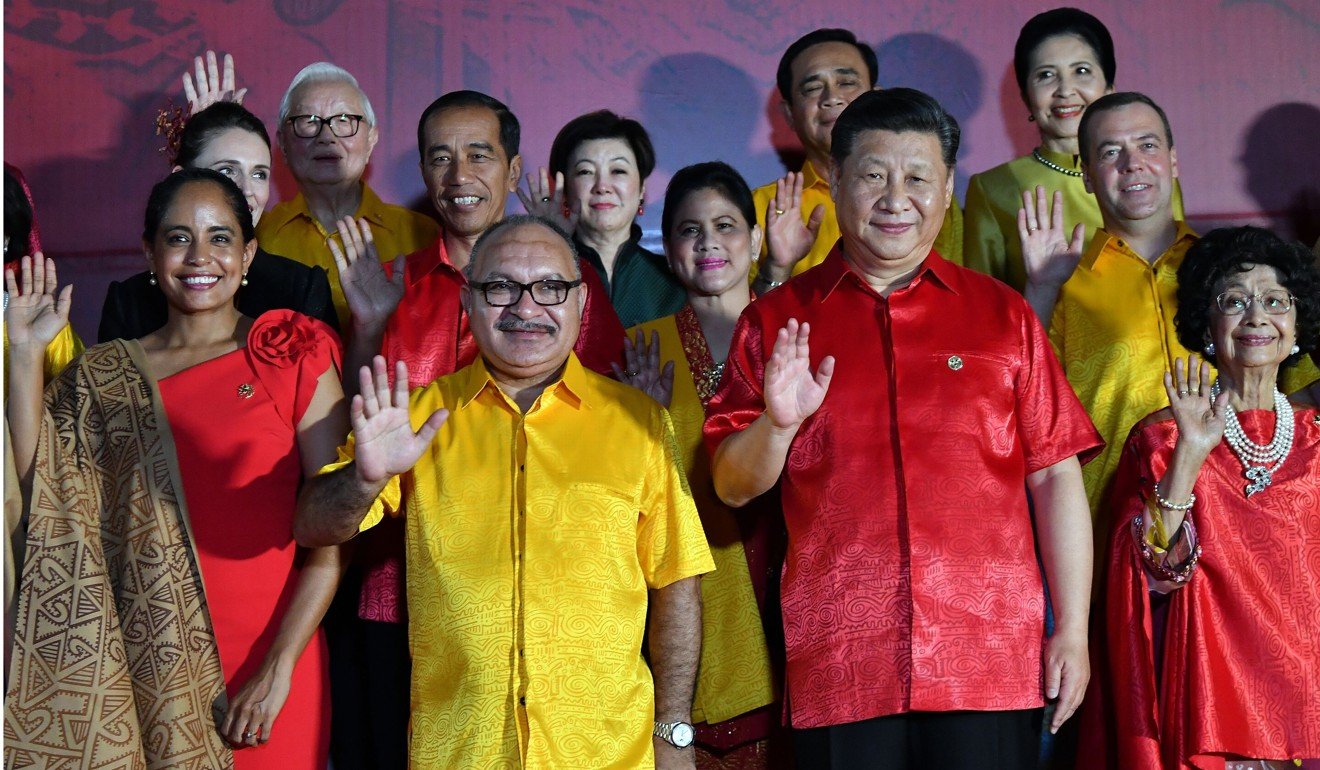
Papua New Guinea’s Prime Minister Peter O’Neill (second from left) and Chinese President Xi Jinping (second from right) pose for a photo during Xi’s visit in November. Photo: AFP
First held in Fiji in 2006, the forum is part of China’s efforts to expand its reach in the resource-rich region.
Back then, premier Wen Jiabao announced 3 billion yuan of concessional loans to Pacific nations and promised to facilitate more trade, medical aid and tourism with the countries. Chinese capital has been pouring into the region – particularly from the mining and fisheries sectors – ever since.
Of note was a 440 million yuan investment, supported by loans from the Export-Import Bank of China, to build a central business centre at Nuku’alofa, the capital of Tonga.
US and allies sideline China in PNG’s Bougainville by helping fund independence vote
As China’s influence grows, the South Pacific – a region traditionally under US hegemony, and on Australia’s doorstep – has “increasingly become a major power that cannot be neglected” and “an important part of China’s greater strategic landscape”, according to Shi Chunlin, an associate professor at Dalian Maritime University.
Trade has increased between China and the eight Pacific nations that have diplomatic ties with Beijing, rising to a combined US$4.32 billion last year – up 25 per cent from 2017.
China has also become the largest trading partner of new ally the Solomons, the second-largest to Papua New Guinea and Fiji, and the third-largest to Samoa.
China’s direct investment in the region has also jumped, reaching US$4.53 billion last year, a more than fourfold increase from the US$900 million of 2013.
Pryke said Beijing was expected to offer new support and loans to the Pacific nations.
“But the Pacific are much more picky about how they want to engage with all partners than they were a decade ago,” he added.
Returning from a trip to China earlier this month, Solomon Islands Prime Minister Manasseh Sogavare confirmed Beijing would provide a US$74 million grant to build a new stadium for the 2023 Pacific Games in the capital Honiara – something its former ally Taipei had committed to fund.
China Sam Group also reportedly signed an agreement on September 22 to lease the island of Tulagi in the Solomons, the site of a former Japanese naval base. The agreement mentioned the development of a refinery on the island, but critics said it could also potentially be used as a military base.
China is now the second-largest donor in the region, only after Australia, which has viewed Beijing’s financial largesse with suspicion.
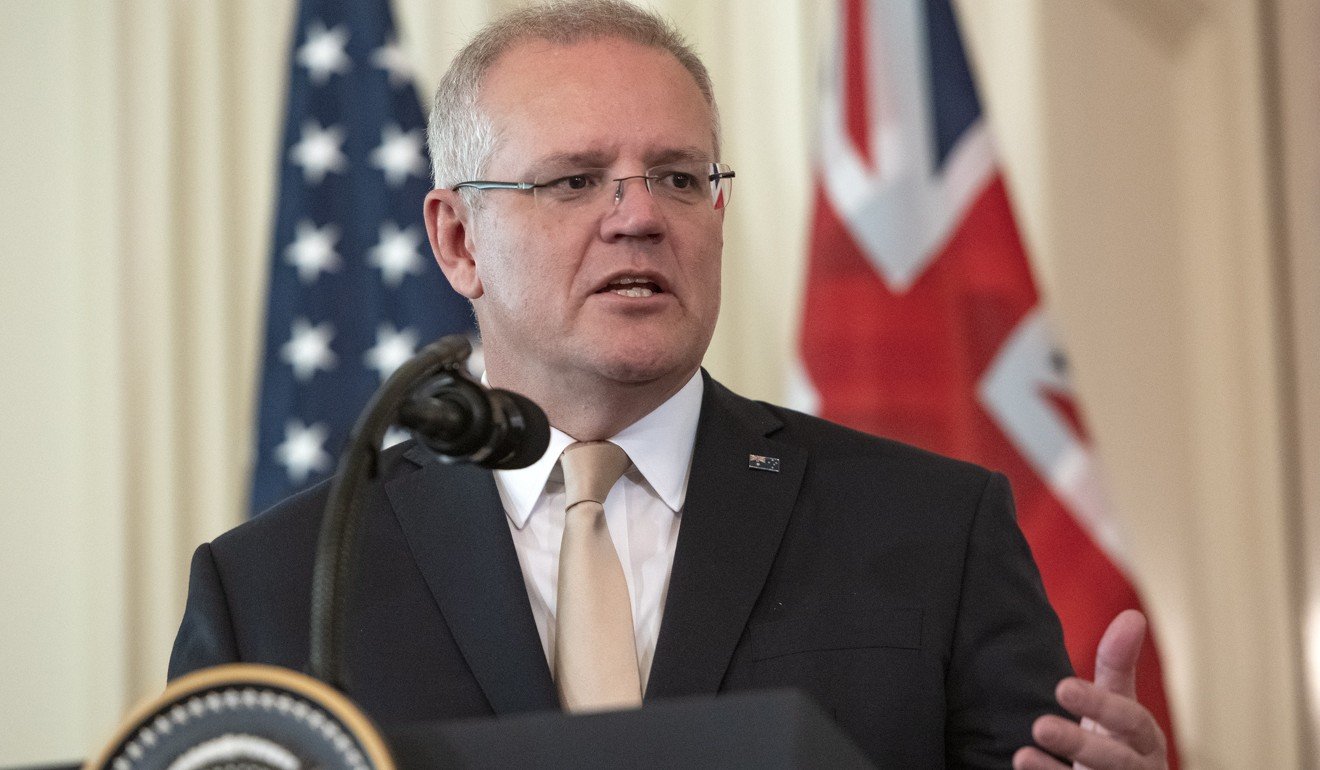
Last year, in an apparent effort to counter China’s rising influence in the region, Australian Prime Minister Scott Morrison announced that Pacific countries would be offered up to US$2.18 billion in grants and cheap loans to build infrastructure.
Australian Prime Minister Scott Morrison last year announced up to US$2.18 billion in grants and cheap loans for infrastructure in Pacific nations. Photo: EPA-EFE
The US, meanwhile, has also been wary of China’s push in the Pacific, amid an escalating geopolitical competition between the world’s two largest economies across many fronts – from trade to tech supremacy and security. The US has long maintained exclusive defence access in the region through its Guam military base and security pacts with the Federated States of Micronesia, the Marshall Islands and Palau.
Derek Grossman, a senior defence analyst with the US-based Rand Corporation, said this year’s forum in Samoa was likely to be higher profile than previous years after Beijing lured away two more diplomatic allies from Taipei.
He said it would be “closely watched in the US for how Beijing continues to leverage sweet economic deals via its Belt and Road Initiative to potentially entice others to switch”.
“The US, along with close friends Australia, Japan and New Zealand, are becoming increasingly concerned over the prospects for China to one day curry enough influence in these small island states to gain port access that could be used for new naval bases,” he said.
The most important issue at the forum, he said, would be “whether the West assesses that China is making further inroads with these states”.
“The likely answer will be that it is, suggesting that the US and its partners will have to compete with China in this region to ensure that it remains ‘free and open’, per the US Indo-Pacific strategy,” he said.
WASHINGTON (Reuters) – U.S. President Donald Trump on Friday said he thinks a trade deal between the United States and China will be signed by the time the Asia-Pacific Economic Cooperation meetings take place in Chile on Nov. 16 and 17.
RELATED COVERAGE
China says will work with the U.S. to address each other’s core concerns
Chinese Vice Premier Liu He will provide Beijing’s perspective on the progress of the talks in a speech on Saturday, according to a tweet from editor-in-chief of the Global Times, a tabloid published by the People’s Daily of China’s ruling Communist Party.
“I think it will get signed quite easily, hopefully by the summit in Chile, where President Xi and I will both be,” Trump told reporters at the White House, without providing details.
“We’re working with China very well,” Trump also said.
The White House has announced that China agreed to buy up to $50 billion of U.S. farm products annually, as part of the first phase of a trade deal, although China seems slow to follow through.
The so-called phase 1 deal was unveiled at the White House last week during a visit by vice premier He as part of a bid to end a tit-for-tat trade war between Beijing and Washington that has roiled markets and hammered global growth. U.S. officials said a second phase of negotiations could address thornier issues like forced technology transfer and non-financial services issues.
NEW DELHI/MUMBAI (Reuters) – India’s ruling Bharatiya Janata Party (BJP) is set to sweep two state polls next week, the first since Prime Minister Narendra Modi’s landslide win in a parliamentary election in May, a leading pollster said.
The BJP is set to comfortably win elections in the western state of Maharashtra and the northern state of Haryana, leaving the main opposition Congress party trailing, according to a survey by polling agency CVoter released on Friday.
CVoter estimates that a BJP-led alliance in Maharashtra will pick up 194 of the 288 seats on offer. In Haryana, the party is predicted to win 83 of the state’s 90 seats, leaving just three for Congress.
Voting in the elections will be held on Monday with the results expected to be announced on Thursday.
Several Congress party officials conceded they had all but given up hope of posing a serious challenge to Modi and the BJP.
In particular, the resignation of Congress chief Rahul Gandhi in July, after weeks of drama following the loss to the BJP in the general election, has sown internal confusion, triggering infighting and exits, two party officials in New Delhi said.
“It’s going to be a rout, and it will deflate morale even further,” one of the officials said, referring to the state elections. “It’s like a slow-moving disaster.”
They requested anonymity because they are not authorised to speak to the media.
Pranav Jha, the secretary in charge of Congress’s communication department, said the party was undergoing a period of “cleansing and churning” and remained committed to taking on the BJP.
“The people of India…can see through the diversionary drama of the ruling party, and realise that jobs, economy and issues of farmers can only be put on track by the Congress party,” Jha told Reuters.
Modi, analysts say, has moved decisively, including withdrawing special rights for Muslim-majority Jammu and Kashmir state, and consolidating the BJP’s hold over India’s Hindu-majority electorate.
INFIGHTING, INDIFFERENCE
In Maharashtra, one of India’s most industrialised states which includes Mumbai, two Congress officials said the top leadership’s relative indifference and infighting had hurt their already weak campaign.
Congress’s state wing had asked for Gandhi, his mother and current party chief Sonia Gandhi, and his charismatic sister Priyanka Gandhi Vadra to join the campaign, one of the two officials said.
But only Rahul Gandhi came and spoke at a handful of rallies.
“Senior leaders from BJP have covered every district. They have been visiting Maharashtra for the last two months to build momentum,” said one Congress official, who is contesting the upcoming poll.
“There wasn’t any concrete effort from Congress leaders in New Delhi to give energy to our cadre,” he said.
The list of recent resignations from the party include Ashok Tanwar, Congress’s former chief in Haryana who quit earlier this month and is now campaigning against his old party.
“The state of affairs in the Congress party is so dire that the decision makers can’t win an election themselves, while the soldiers on ground who stay in touch with the masses are neglected,” Tanwar wrote in his resignation letter.
The situation has even riled Congress allies. Two leaders from the Nationalist Congress Party, which is in alliance with the Congress in Maharashtra, said their partner was slack.
“It looks like Congress is not very serious about the state elections,” one of the leaders said. “Congress is not in the picture. Congress leaders are not attacking the ruling party the way we expected.”
In New Delhi, Congress officials said there was a sense of inertia at the party headquarters, without any understanding of who will become president after Sonia Gandhi, who is only holding charge temporarily.
“Without a clear leadership, nothing is going to change,” one of the officials said, “If it continues like this, the party will fade away.”
BEIJING, Oct. 17 (Xinhua) — China and Mauritius signed a free trade agreement (FTA) here Thursday, the first FTA between China and an African country, according to the Ministry of Commerce (MOC).
The China-Mauritius FTA is the 17th FTA signed by China.
The agreement covers trade in goods and services and investment and economic cooperation.
The FTA will not only provide a more powerful institutional guarantee to deepen bilateral economic and trade relations, but also boost China-Africa economic and trade cooperation, according to the MOC.
Negotiations on the China-Mauritius FTA were officially launched in December 2017. The two sides formally concluded the negotiations on Sept. 2, 2018, after four rounds of intensive negotiations.
In the area of trade in goods, China and Mauritius will eventually achieve zero tariffs on 96.3 percent and 94.2 percent of product tariff items, respectively, involving 92.8 percent of import volume for both countries from each other.
For the remaining tariff items of Mauritius, the tariffs will also be greatly cut, and the maximum tariffs for most of the involved products will not exceed 15 percent.
China’s main exports to Mauritius, such as iron and steel products, textiles and other light industrial products, will benefit from it.
Special sugar produced in Mauritius will also enter the Chinese market gradually.
The two sides also agreed on rules of origin, trade remedies, technical barriers to trade and sanitary and phytosanitary issues.
In the area of trade in services, China and Mauritius both promised to open up more than 100 sub-sectors.
Mauritius will open up more than 130 sub-sectors in important service fields such as communications, education, finance, tourism, culture, transportation and traditional Chinese medicine to China.
This is the highest level of opening up in the field of services in Mauritius so far.
In the field of investment, the agreement has been greatly upgraded from the 1996 China-Mauritius bilateral investment protection agreement in terms of protection scope, protection level and dispute settlement mechanism.
This is the first time that China has upgraded the previous investment protection agreement with an African country, which will not only provide stronger protection for Chinese enterprises to go to Mauritius, but also help them further boost investment cooperation in Africa through the platform of Mauritius, according to the MOC.
Meanwhile, the two sides also agreed to further deepen economic and technical cooperation in agriculture, finance, medical care, tourism and other fields.
The two sides will undergo respective domestic procedures for the agreement to take effect.
J-20 stealth fighters make a flight demonstration during an activity celebrating the 70th founding anniversary of the Chinese People’s Liberation Army (PLA) air force in Changchun, capital of northeast China’s Jilin Province, Oct. 17, 2019. It’s the first time that J-20 stealth fighters and Y-20 transport aircrafts make a flight demonstration at the northeastern China during the activity. (Xinhua/Lin Hong)
CHANGCHUN, Oct. 17 (Xinhua) — China’s J-20 stealth fighters Thursday joined an air show held to celebrate the 70th founding anniversary of the Chinese People’s Liberation Army (PLA) air force.
The airshow in Changchun, capital of northeast China’s Jilin Province, was kicked off by three parachutists carrying the national flag, the flag of the PLA and the flag of the PLA air force, respectively.
The J-20 stealth fighters, Y-20 large transport aircraft, J-16 fighters and the new training plane JL-10 treated the audience to a performance of demonstration flights.
Two J-11BS, China’s third-generation fighters, carried out a simulated air battle, and China’s airborne troops showcased anti-terrorist operations to display the air force’s achievements in real combat training.
Three aerobatic teams of the PLA air force also performed aerobatic flights, and the air force selected 71 pieces of equipment for static display in the five-day air show.





 CHINDIA ALERT: You'll be living in their world, very soon