Chindia Alert: You’ll be Living in their World Very Soon
aims to alert you to the threats and opportunities that China and India present. China and India require serious attention; case of ‘hidden dragon and crouching tiger’.
Without this attention, governments, businesses and, indeed, individuals may find themselves at a great disadvantage sooner rather than later.
The POSTs (front webpages) are mainly 'cuttings' from reliable sources, updated continuously.
The PAGEs (see Tabs, above) attempt to make the information more meaningful by putting some structure to the information we have researched and assembled since 2006.
BEIJING, July 4 (Xinhua) — Chinese President Xi Jinping has appointed six new ambassadors in accordance with a decision by the Standing Committee of the National People’s Congress, according to a statement from the national legislature Thursday.
Chen Hai was appointed ambassador to Myanmar, replacing Hong Liang.
Chang Hua was appointed ambassador to Iran, replacing Pang Sen.
Liao Liqiang was appointed ambassador to Egypt, replacing Song Aiguo.
Xu Erwen was appointed ambassador to Croatia, replacing Hu Zhaoming.
Yi Xianliang was appointed ambassador to Norway, replacing Wang Min.
Chen Xu was appointed China’s permanent representative and ambassador to the United Nations Office at Geneva and other international organizations in Switzerland, replacing Yu Jianhua.
Chinese Premier Li Keqiang (R) meets with Tijjani Muhammad-Bande, president-elect of the 74th session of the United Nations General Assembly, at the Great Hall of the People in Beijing, capital of China, July 4, 2019. (Xinhua/Pang Xinglei)
BEIJING, July 4 (Xinhua) — Chinese Premier Li Keqiang on Thursday met with Tijjani Muhammad-Bande, the president-elect of the 74th session of the United Nations (UN) General Assembly, pledging to continue firmly safeguarding the international system with the UN as the core.
The UN has played an irreplaceable role in maintaining world peace and stability, advancing global development and promoting international cooperation since it was founded over 70 years ago, Li said.
Next year marks the 75th anniversary of the founding of the United Nations.
“China supports the UN General Assembly in preparing relevant commemorative activities, as this is of special significance to safeguard the principles of multilateralism, equality of sovereignty, and solving problems through peaceful means that are represented by the UN,” Li said.
As a founding member of the UN, a permanent member of the UN Security Council, and the biggest developing country in the world, China will continue to firmly safeguard the international system with the UN as the core, uphold the purposes and principles of the UN Charter, and work with other countries to deepen international cooperation, safeguard international fairness and justice, and jointly cope with challenges so as to build a community with a shared future for humanity, Li said.
He also congratulated Muhammad-Bande for being elected as the president of the 74th session of the UN General Assembly.
Muhammad-Bande expressed gratitude to China’s strong support to the UN and pledged to firmly support multilateralism, safeguard the purposes and principles of the UN Charter, and support UN member states to solve problems through consultation.
He also vowed to maintain an objective and unbiased attitude in carrying out his work and strengthen communication and coordination with China.
Yang Jiechi, a member of the Political Bureau of the Central Committee of the Communist Party of China (CPC) and director of the Office of the Foreign Affairs Commission of the CPC Central Committee, and Chinese State Councilor and Foreign Minister Wang Yi also met with Muhammad-Bande on Thursday.
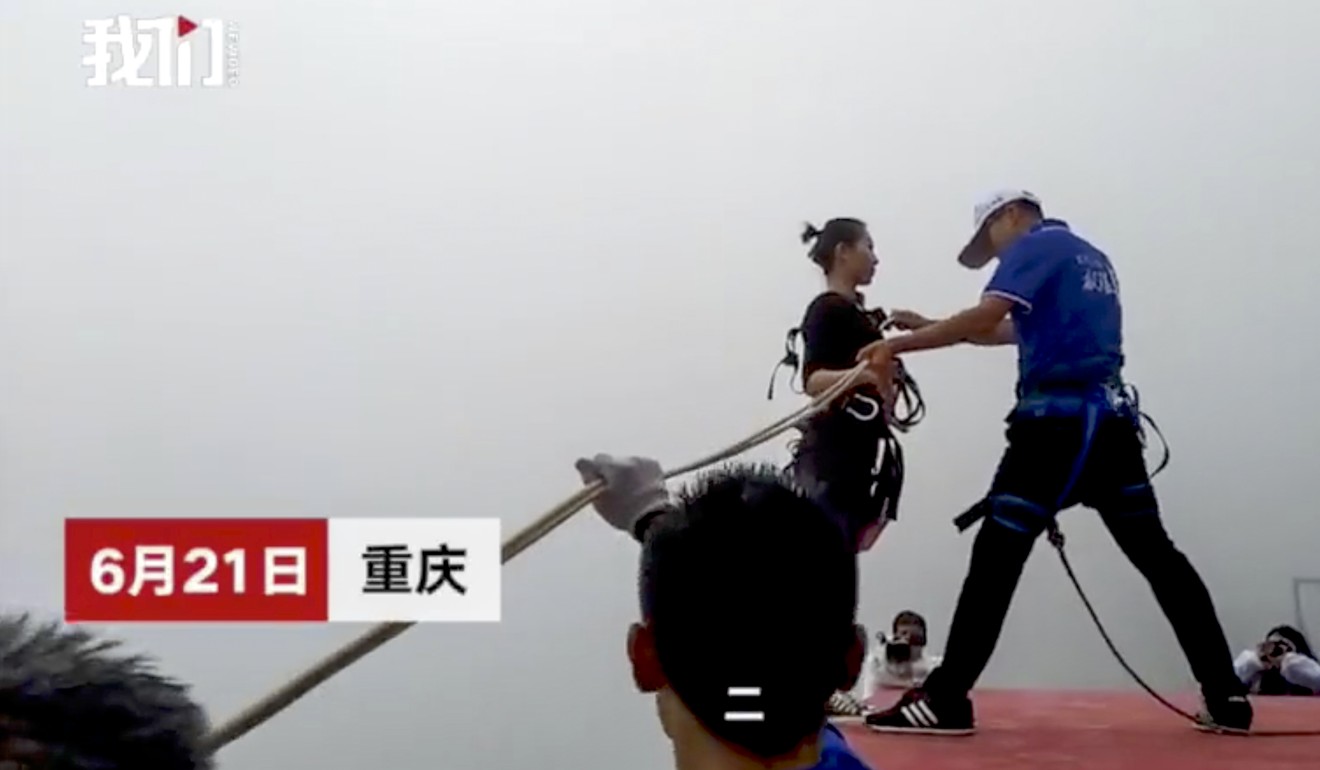
Mountain park worker Wan Tiandi started making the near-1,000ft bungee jump every day as the most efficient way of delivering a hot meal to her colleagues
She says it would take more than half an hour to drive down the mountain, but this way means she can get the food there within minutes
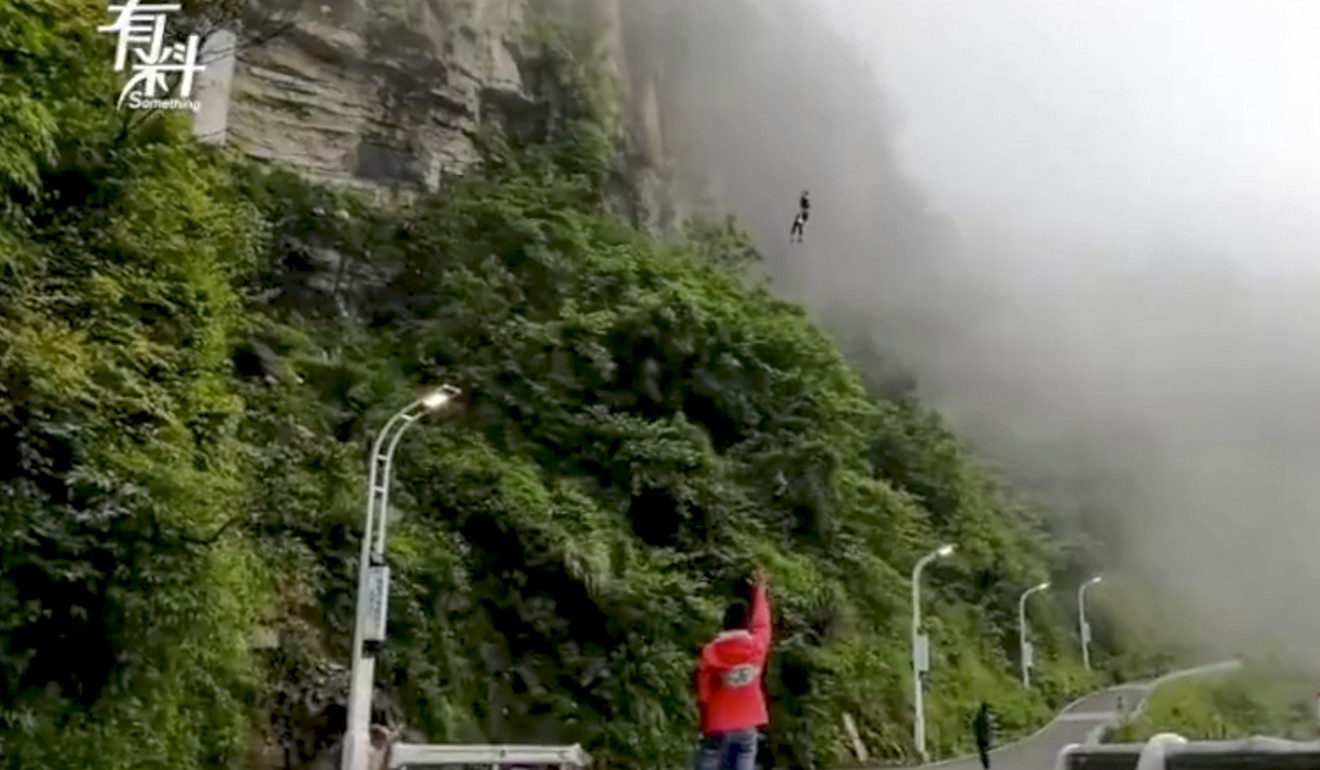
Wan Tiandi makes the 300-metre leap every lunchtime. Photo: Weibo
A woman working at a mountainous beauty spot in southwest China has started delivering hot meals to her colleagues by bungee jumping 300 metres (985ft) every lunchtime.
Wan Tiandi works at Dream Ordovician Park in Chongqing, where her duties include delivering lunches to more than 200 employees who are not allowed to leave their posts during their lunch hour, The Beijing News reported.
Because of the park’s geography it would take over half an hour to drive down the mountain to their work station.
To save time, she has now started bungee-jumping down the cliff to deliver the lunchboxes to her colleagues.
“Our park is huge. It will take me more than half an hour’s drive to send lunches to them, while this bungee jump takes only two minutes,” Wan was quoted as saying.
Wan Tiandi prepares to make the jump. Photo: Weibo
She said that in the past when her colleagues received the lunches, they were already cold.
She said she and her colleagues had discussed the problem and developed their unorthodox food delivery method.
“My colleagues need us to send them food but transport on the mountain is not easy. Some of them work at places where there are no roads except narrow mountainous paths,” Wan said.
Wan Tiandi bungee jumps off the cliff every lunchtime. Photo: Weibo
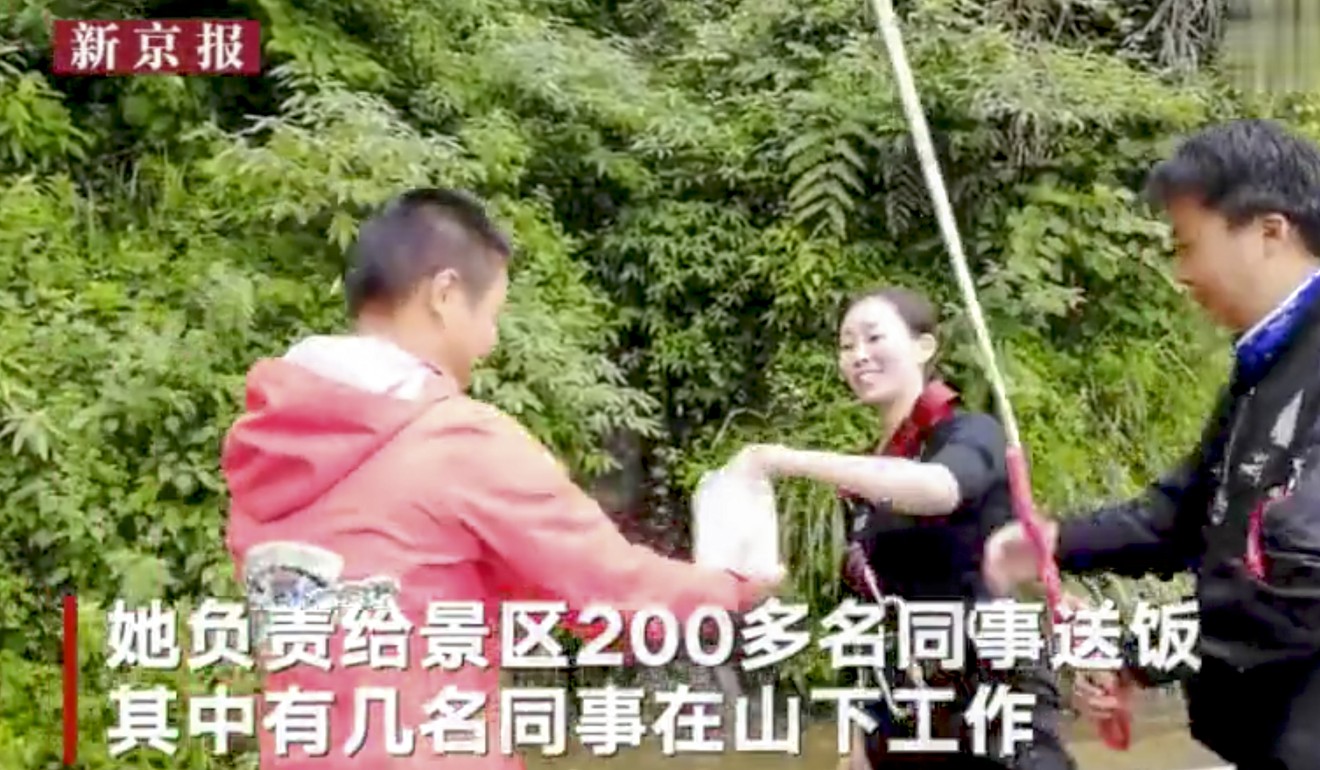
After she jumps from the cliff, Wan’s colleagues collect their lunchboxes that she carries in bags strapped to her waist.
Wan added that she enjoyed the thrill of bungee jumping and the sports enthusiast then jogged back to her office at the top of the mountain.
Her colleagues praised her for working hard to deliver hot food. “It is not easy. Her delivery is fast, steady and always on time,” one of her colleagues was quoted as saying.
Wan hands over the hot meals at the bottom of the cliff. Photo: Weibo
Sichuan attraction was due to reopen for the summer but managers decided there was no point after it was stripped bare of its most celebrated feature
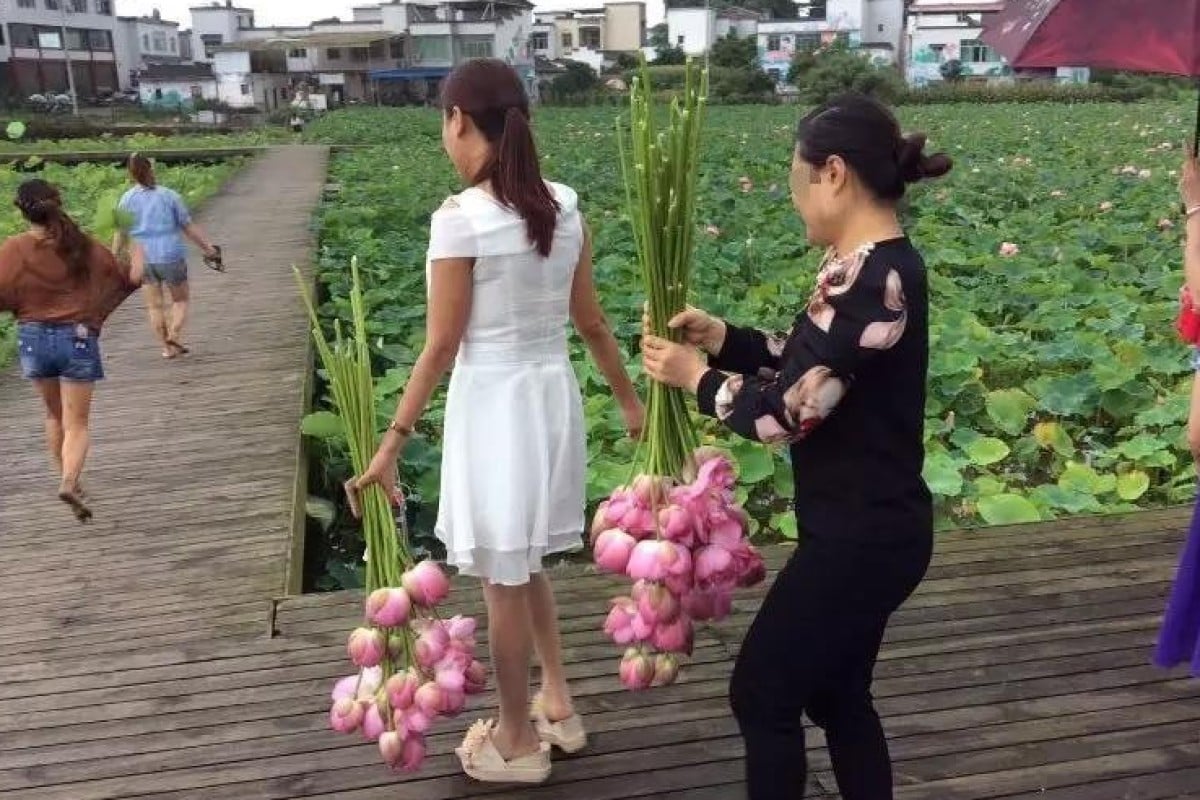
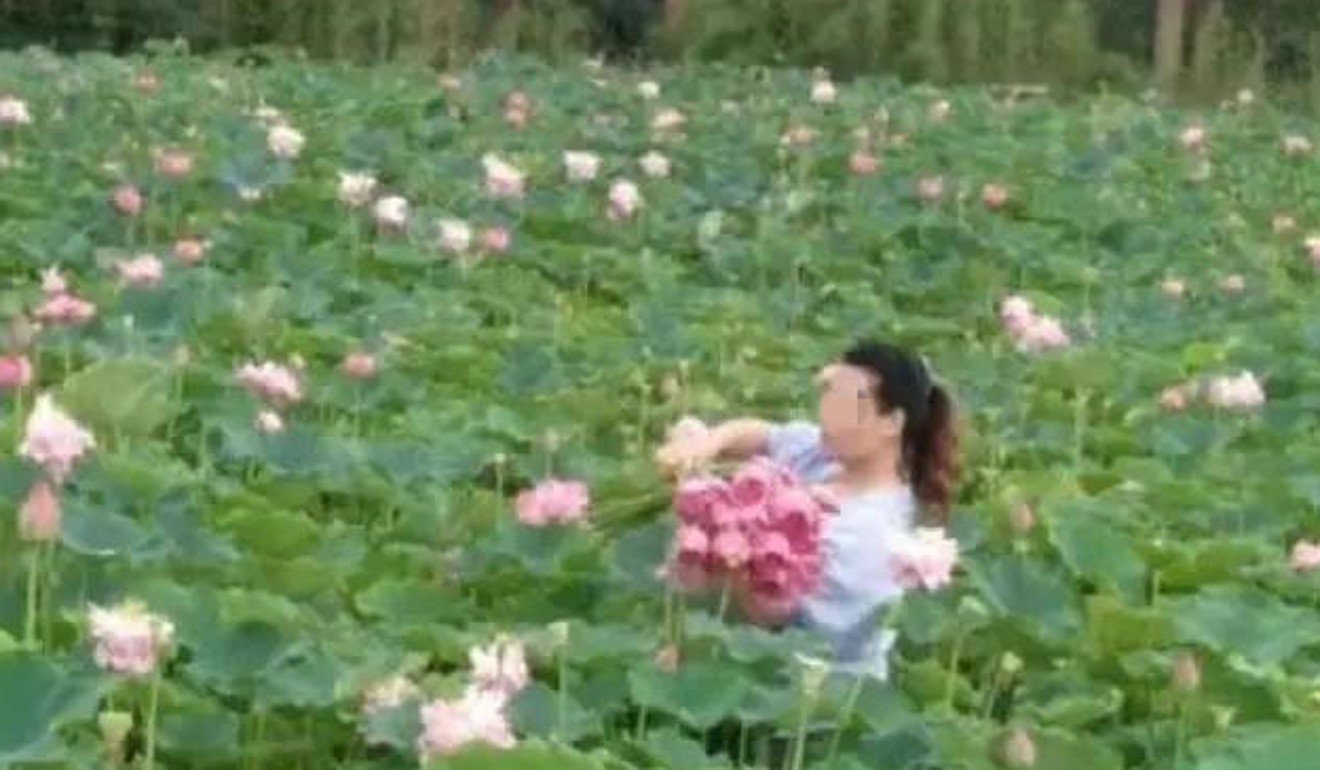
Visitors have been filmed breaking into the park in Sichuan to pick its lotus flowers. Photo: Red Star News
An ecological park in southwest China has been forced to close for the rest of the year because hundreds of tourists have stripped it of its celebrated lotus flowers.
Longqiao Cultural and Ecological Park in Sichuan province’s Lu county has been closed since late March for watercourse construction and was due to reopen soon.
Chinese university creates cherry blossom filter to save trees from tourists
The park is well known for its sprawling fields of lotus flowers that cover around 250,000 square metres (62 acres) – an area larger than New York’s Grand Central Terminal.
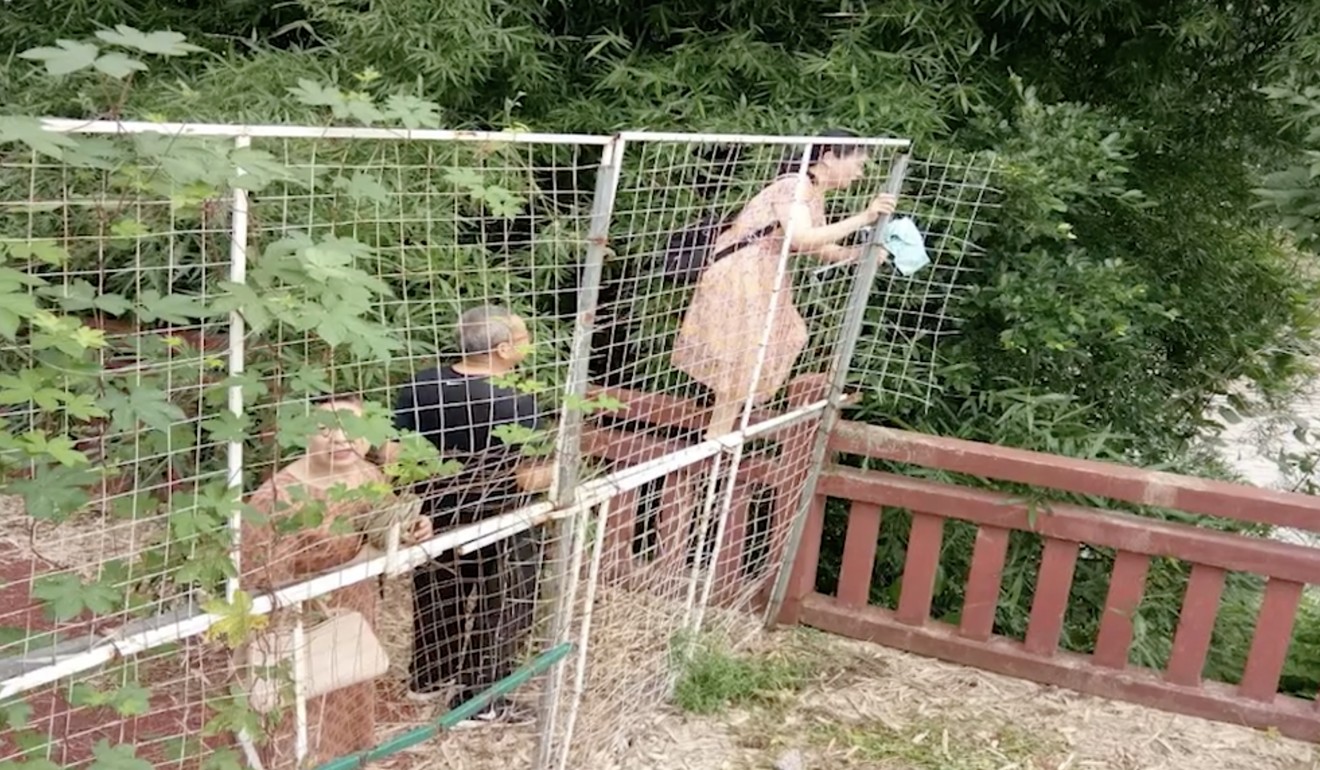
But since the start of the summer blossom season last month, hundreds of people have been breaking into the park to pick the flowers, forcing managers to keep it closed for the rest of the year.
The flower-pickers have prompted widespread condemnation. Photo: Red Star News
“We cannot control the tourists. We can just guarantee we’ve done our job well. We’ve put notes on the park gate and near the flower field and we have security personnel on patrol as well,” a member of staff surnamed Zhou said.
Zhou added that the construction work in the park was almost finished but that there was no point in reopening because there were virtually no flowers left.
Badly behaved Chinese tourists are back in Boracay
Around 200 to 300 people a day are still believed to be breaking into the park, and have forced management to increase the number of security patrols.
Videos and photos of people picking lotus flowers have been circulated widely online and drawn criticism.
Visitors pictured climbing the fence to break into the park. Photo: Thepaper.cn
“Even the highest fence cannot stop those without manners. It’s like you can never wake up a person that pretends to sleep,” one Weibo user commented.
“Only penalties can stop these greedy people,” said another.
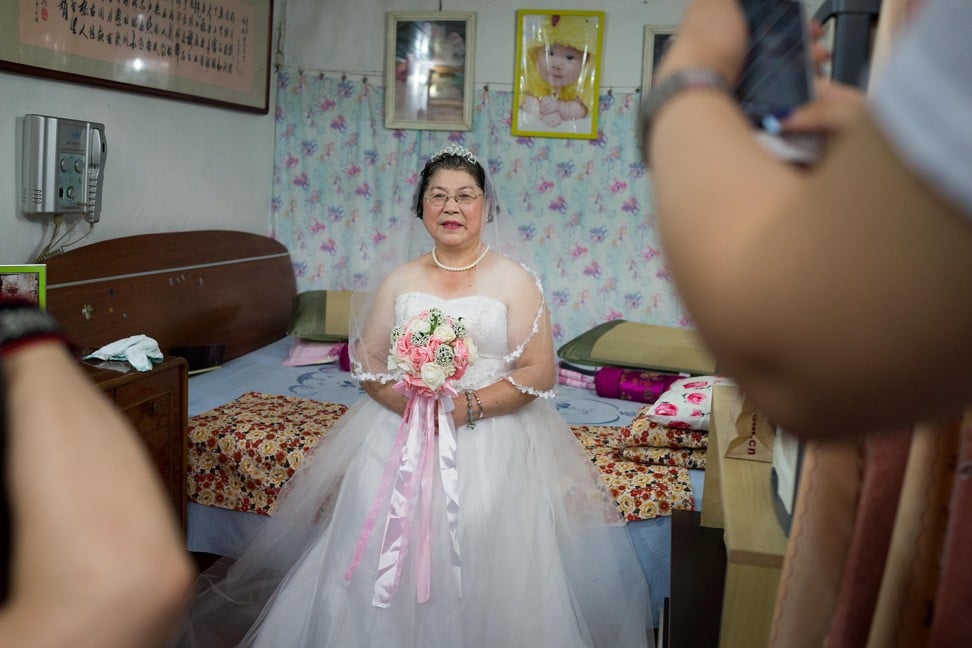
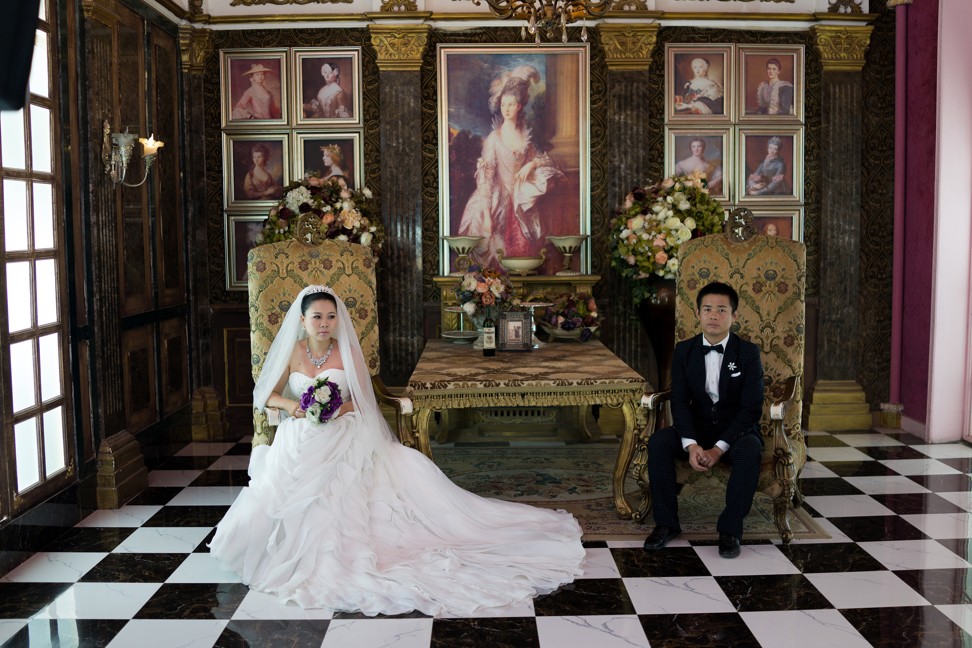
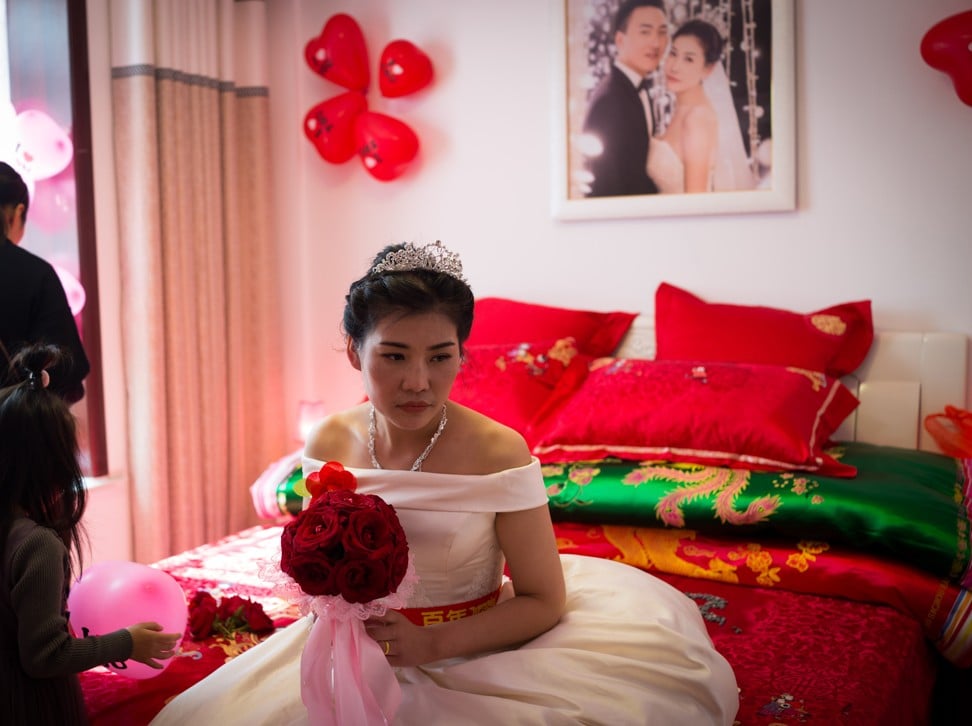
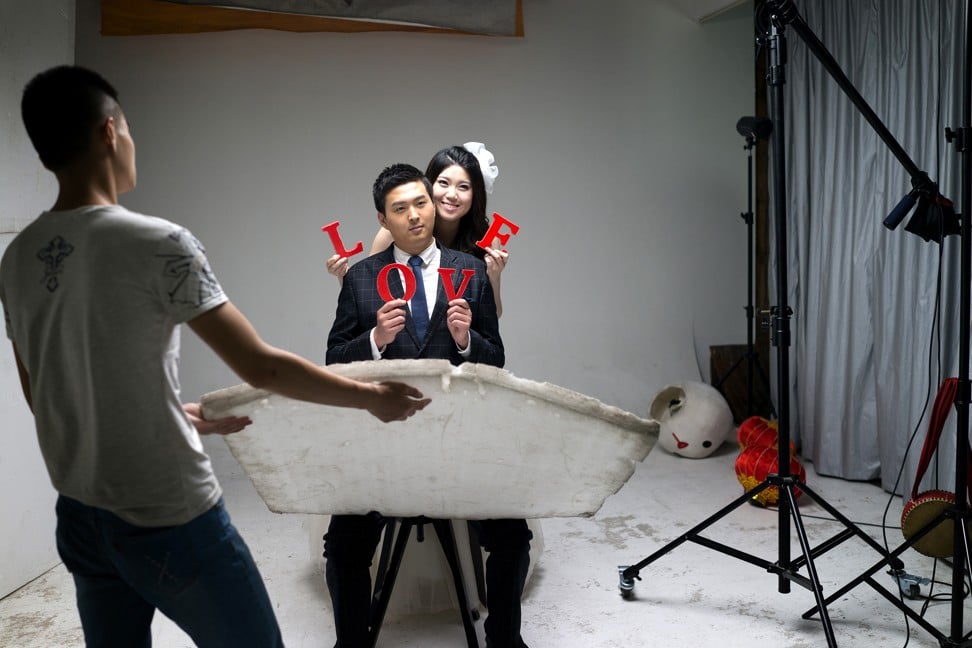
Documentary looks at the fantasy photo shoots of couples, including some who married decades ago when only drab clothing was allowed
It looks beyond the colourful clothes to consider issues of freedom, status, money and the new ‘China dream’
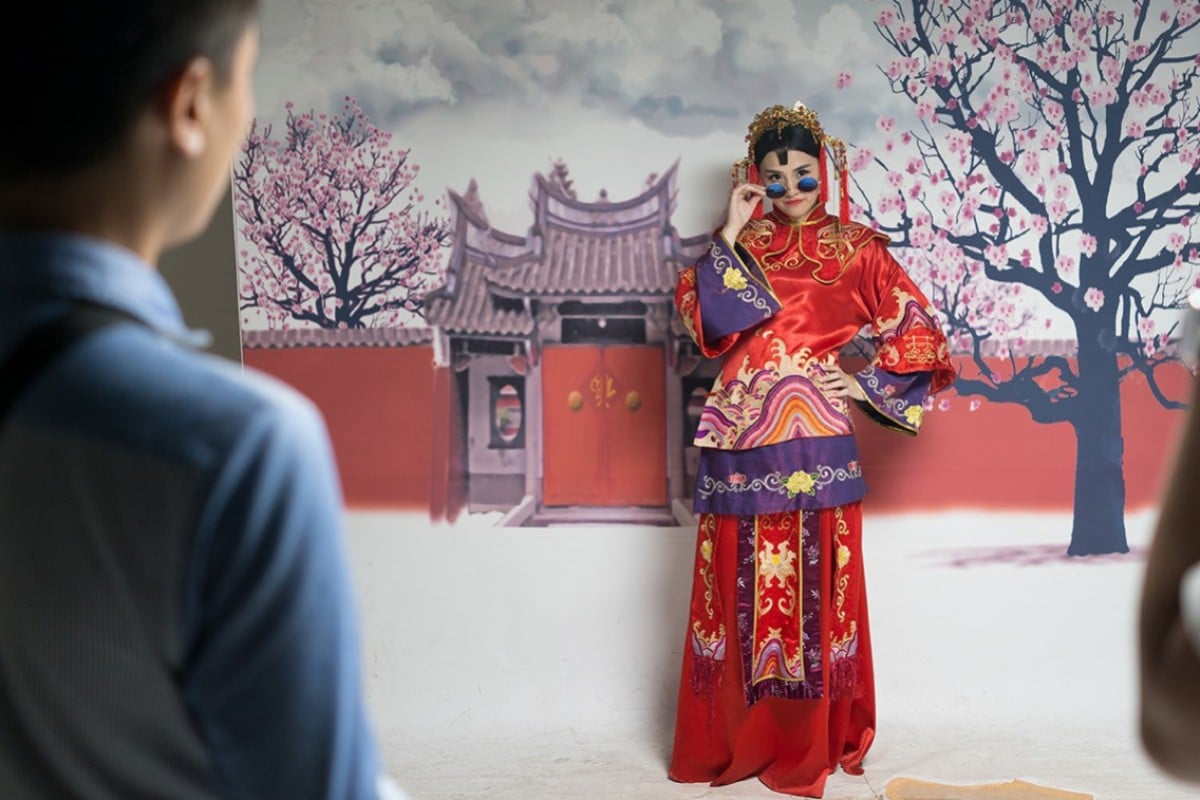
A still from China Love, a documentary by Olivia Martin-McGuire.
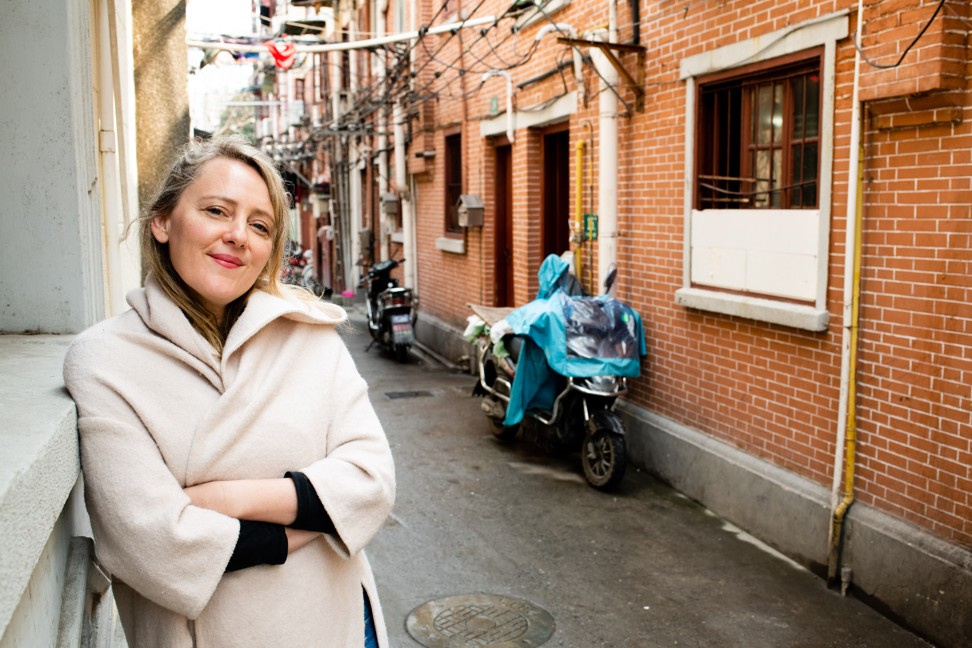
Pei-Pei and Xuezhong live in Shanghai’s French Concession. They married in 1968 and, as was typical for the time, have just one small black-and-white wedding photo.
“Pre-wedding photography could never have happened in 1968 because of the Cultural Revolution,” says Xuezhong, referring to the upheaval that took place under Mao Zedong, from 1966 to 1976. “Colourful clothing was not allowed. We had no choice.”
They did choose, however, to create new memories by having the wedding photos of their dreams taken decades later in a modern setting.
Their story is one of five featured in the documentary
, which explores relationships in contemporary China through the lens of the booming pre-wedding photo industry. It follows couples as they navigate love and family in the lead-up to the most important ritual in Chinese society: marriage.
The documentary debuts in Hong Kong this week, with a special screening on Thursday at the Asia Society, in Admiralty. Attending the screening will be the film’s Australian director, Olivia Martin-McGuire, who spent four years in Shanghai, where a series of photographs taken on the city’s streets developed into a fascination with matters of the heart.
“It started when I saw all these couples in amazingly colourful costumes – some hitching up their dresses to reveal trainers – having [pre-wedding] photos taken near The Bund,” she says.
But Martin-McGuire says the film is more than a commentary on the pre-wedding photography business. It delves into issues of freedom, status, money and the new “China dream”.
“Just over 40 years ago, marriage in China was arranged by the state. Romantic love was seen as a capitalist concept,” she says.
China Love director Olivia Martin-McGuire. Photo: Gráinne Quinlan
Fast forward a generation and the picture couldn’t be more different, with China’s wedding industry today worth a staggering US$80 billion, according to Martin-McGuire.
A big part of that goes on the pre-wedding photos, with some couples spending up to US$500,000 for shoots in exotic locations.
Shoots usually involve several costume and backdrop changes, and can see couples transform into characters from a fantasy. Take Jenny Cheng, born in Urumqi, capital of the Xinjiang Uygur autonomous region, and Australian-born David Shaw. The couple, who are featured in the film and will attend the screening in Hong Kong, had their wedding photos taken under water.
“I wanted the film to feel youthful, fun, and represent the sense of possibility that is infectious in China,” says Martin-McGuire.
China Love will be screened on Thursday, at 6.30pm, at the Asia Society, 9 Justice Drive, Admiralty, followed by a panel discussion. Visit
Civil affairs ministry reaffirms plan to eradicate names that ‘violate the core values of socialism, damage national confidence’
One man says it reminds him of the dark days of the Cultural Revolution
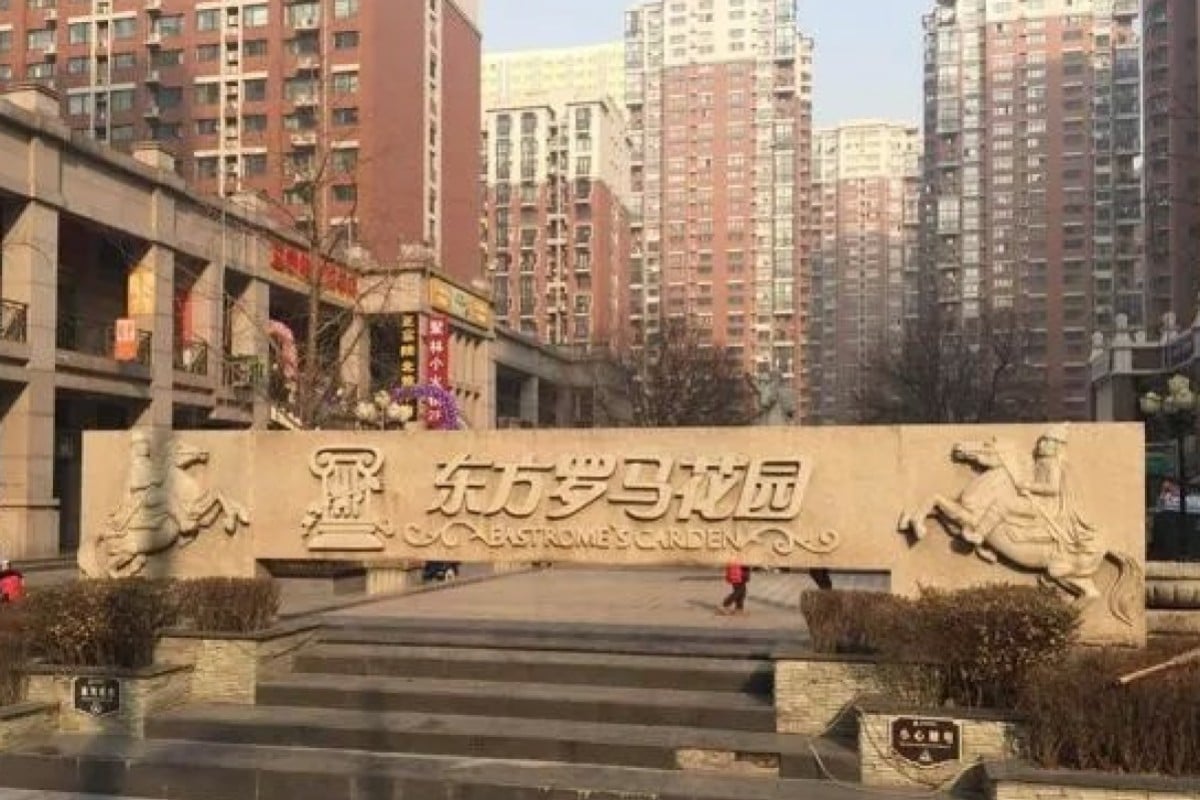
Beijing wants to eradicate place and property names, like “East Rome’s Garden”, that are influenced by foreign or “weird” words. Photo: Weibo
Beijing has reiterated its commitment to rid Chinese cities of “big, foreign and weird” property and place names, sparking a backlash from the public.
The campaign began last year when six government departments introduced a joint policy requiring provincial and county authorities to identify all such properties within their jurisdictions and rename them by the end of March.
On Friday, the Ministry of Civil Affairs reaffirmed its support for the plan, but reminded local governments to implement it “prudently and appropriately”.
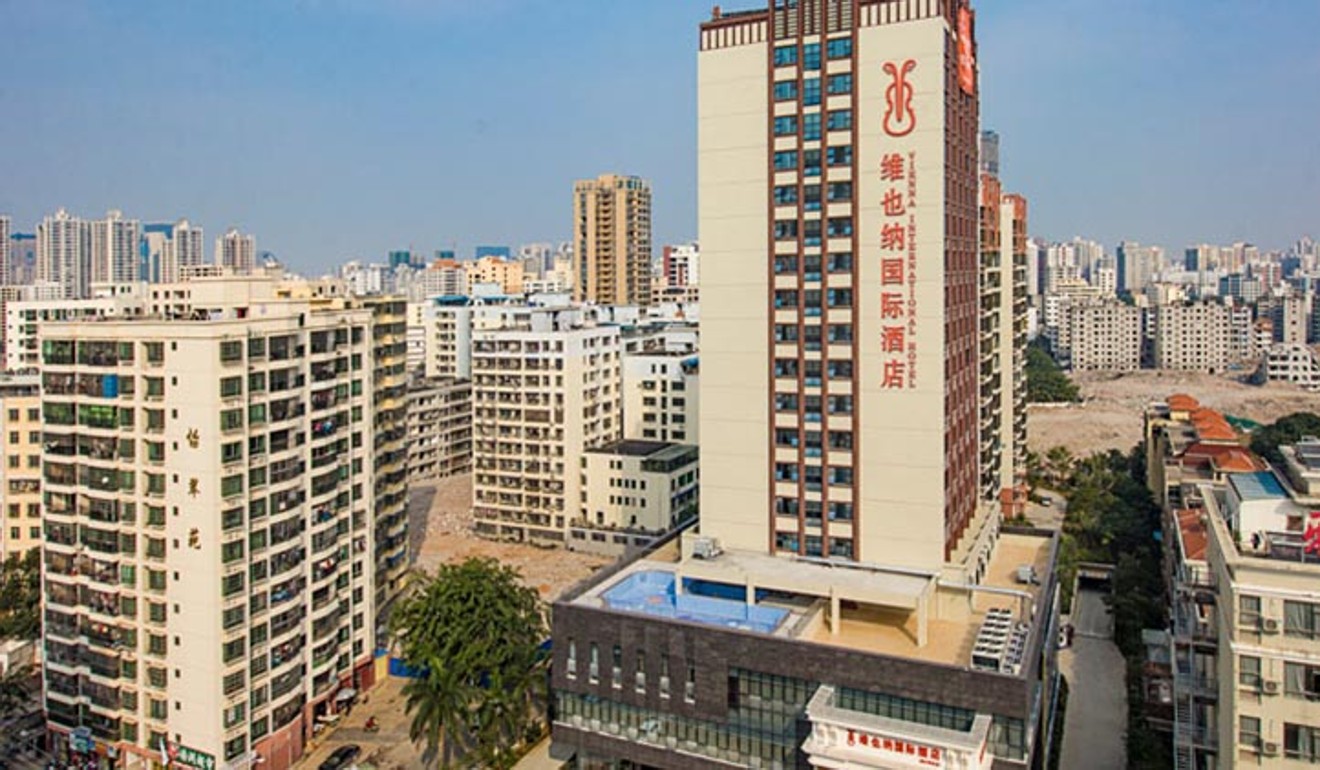
Many Chinese properties, especially hotels and apartment buildings, incorporate famous foreign places, like Manhattan, California or Paris, into their names, but under the new rule they all have to go. According to a report by local newspaper Sanqin Metropolis Daily, in one city in Xian, the capital of Shaanxi province, at least 98 apartment projects, hotels, townships, communities and office towers need to be rebranded.
Many Chinese properties, like the Vienna International Hotel, incorporate famous foreign places into their names. Photo: Weibo
But for some people, the plan is nothing more than a waste of time and money.
“If projects are forced to change their names, what about the name on the property certificate, the enterprise licence and tax registration? Do they have to be changed too?” asked Zhu Yun, a woman who lives in Guangzhou, the capital of south China’s Guangdong province.
Hospital’s plan for ‘lucky’ Harvard babies gets poor marks
“And what’s the standard for the new names, and who’s going to do the renaming? It’s just a waste of people’s energy and money, and will do nothing for the national culture or confidence.”
Zhu Min, an octogenarian who also lives in Guangdong, said the scheme had echoes of a darker time in China’s history.
“It reminds me of the bad times of the Cultural Revolution,” he said. “At that time, a great number of streets, roads and stores were forced to rename, because they contained elements of old customs and old culture.”
The debate has also been raging online, with tens of thousands of people airing their views on social media.
“Cultural and national confidence is about respect for multiculturalism,” one person wrote on Weibo, China’s Twitter-like platform.
Tsinghua University sues kindergartens for using its name
Despite the outcry, the civil affairs ministry said the implementation of the scheme was “an important measure … to carry forward the national and local culture”, Xinhua reported.
“The relevant regulations and guidelines of the campaign should be strictly observed to prevent the campaign from being expanded in an arbitrary manner,” it said.
The plan announced last year stated that “big, foreign, weird” place names and those based on homonyms “violate the core values of socialism, damage national confidence, and affect the production and lives of the people, and must be rectified and cleaned up”.
The city’s ambitious waste and recycling rules took effect on Monday, aiming to emulate successes of comparable policies in Japan, Taiwan and California
President Xi Jinping has urged China – the world’s second-biggest waste producer after the United States – to sort rubbish better
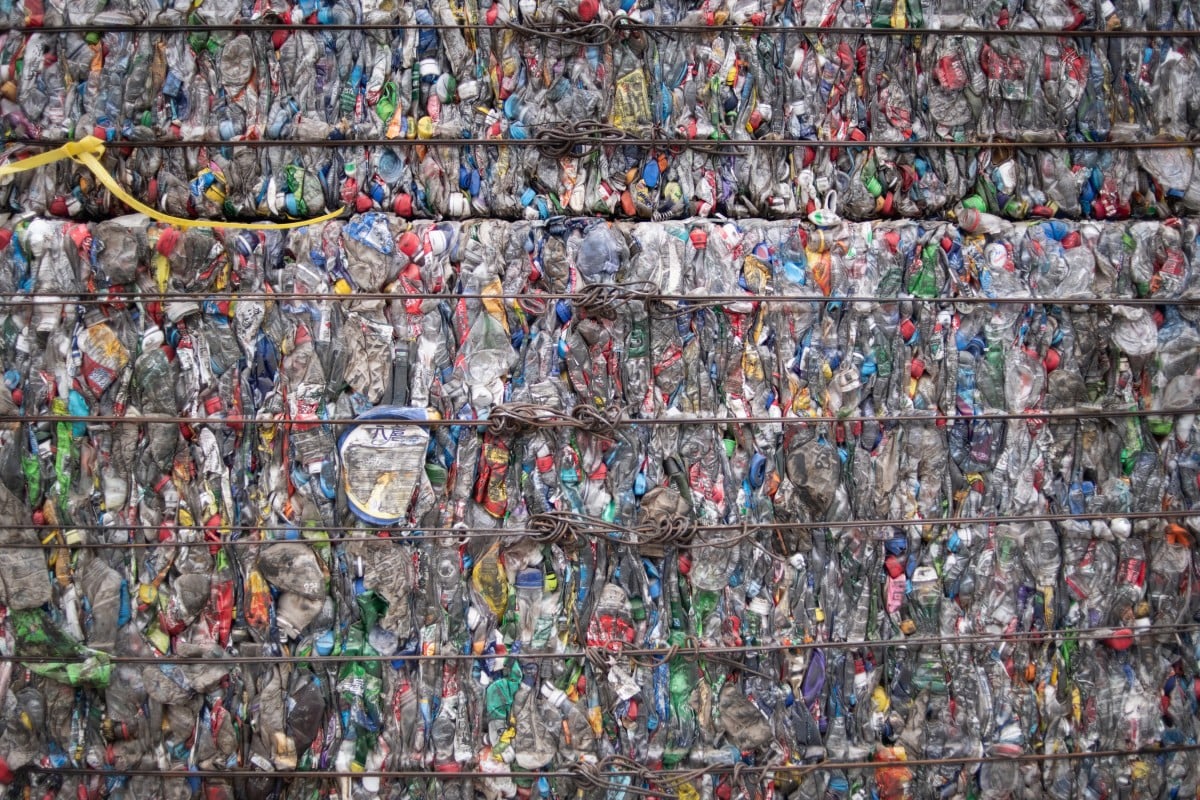
Recyclables such as plastic must be separated from wet garbage, dry garbage and hazardous waste under the new rules in Shanghai. Photo: AFP
At 9pm, Li Zhigang was sitting in front of his fruit shop on a bustling street in central Shanghai’s Xujiahui area, peeling the thin layers of plastic from rotten pears and mangoes.
“This is so much trouble!” he mumbled to himself while throwing the plastic into one trash can and the fruit into another.
In the past, Li simply threw away what could not be sold with the packaging on, but from July 1 he could be fined up to 200 yuan (about US$30) for doing so.
Like Li, many of the tens of millions of residents in the eastern Chinese city have been complaining in recent weeks that the introduction of compulsory
is making life difficult, but at the same time have been having to learn to do it.
Calls for garbage sorting have brought little progress in China in the past decade, but Shanghai is leading a fresh start for the world’s second-largest waste producer with its new municipal solid waste (MSW) regime, observers have said.
China generated 210 million tonnes of MSW in 2017, 48 million tonnes less than the United States, according to the World Bank’s What a Waste database.
“If we say China is now classifying its waste, then it’s Shanghai that is really doing it,” said Chen Liwen, a veteran environmentalist who has worked for non-governmental organisations devoted to waste classification for the past decade.
“It’s starting late, comparing with the US, Japan or Taiwan, but if it’s successful in such a megacity with such a huge population, it will mean a lot for the world,” she said.
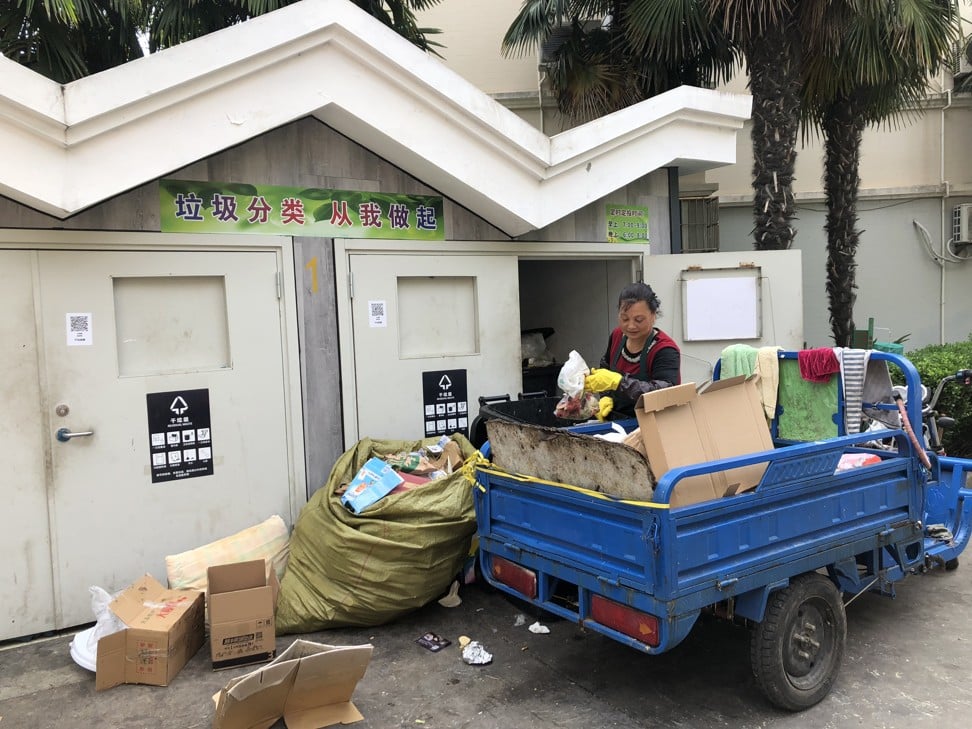
A cleaner re-sorts household waste left at a residential facility in Shanghai. Photo: Alice Yan
Household waste in the city is now required to be sorted into four categories: wet garbage (household food), dry garbage (residual waste), recyclable waste and hazardous waste.
General rubbish bins that had previously taken all types of household waste were removed from buildings. Instead, residents were told to visit designated trash collection stations to dispose of different types of waste during designated periods of the day.
Companies and organisations flouting the new rules could be fined 50,000-500,000 yuan (US$7,000-70,000), while individual offenders risked a fine of 50-200 yuan.
The city’s urban management officers will be mainly responsible for identifying those who breach the rules.
Huang Rong, the municipal government’s deputy secretary general, said on Friday that nearly 14,000 inspections had been carried out around the city and more than 13,000 people had been warned on the issue since the regulations were announced at the start of the year.
As July 1’s enforcement of the rules approached, it became a much-discussed topic among Shanghainese people. A hashtag meaning “Shanghai residents almost driven crazy by garbage classification” was one of the most popular on China’s Twitter-like Weibo platform.
“My daughter took a box of expired medicine from her workplace to the trash collection station near our home yesterday because she couldn’t find the local bin for hazardous waste,” Li said.
While the measures force a change of habits for most people, they bring opportunities for some.
Du Huanzheng, director of the Recycling Economy Institute at Tongji University, said waste sorting was crucial for China’s recycling industry.
“Without proper classification, a lot of garbage that can be recycled is burned, and that’s a pity,” he said. “After being classified, items suitable to be stored and transported can now be recycled.”
G20 set to agree on ways to reduce plastics in oceans
Shanghai’s refuse treatment plants deal with 19,300 tonnes of residual waste and 5,050 tonnes of kitchen waste every day, according to the municipal government. By contrast, only 3,300 tonnes of recyclables per day are collected at present.
Nationwide, the parcel delivery industry used more than 13 billion polypropylene woven bags, plastic bags and paper boxes as well as 330 million rolls of tape in 2016, but less than 20 per cent of this was recycled, according to a report by the State Post Bureau.
Prices of small sortable rubbish bins for home use have surged on e-commerce platforms, while bin makers are also developing smart models in response to new needs.
Some communities are deploying bins that people are required to sign in with their house number to use, and are equipped with a “big data analysis system”. The system records households have “actively participated” and which have not, so that neighbourhood management can publicise their addresses and make house visits, according to a report by Thepaper.cn.
In a residential community in Songjiang district, grocery store owner Nie Chuanguo has found something new to sell: a rubbish throwing service.
He has offered to visit homes, collect waste and throw it into the right bin at a designated time. He charges 30 yuan a month for those living on the ground and first floors, 40 yuan for those on the second and third, and 50 yuan for the fourth and fifth.
“This service will start from July 1. Many people have come to inquire about it,” he said.
According to Du, waste classification is not only about environmental impact or business opportunities. “Garbage sorting is an important part of a country’s soft power,” he said.
For China, it was an opportunity to improve its international reputation, he said. “In the past, Chinese people were rich and travelled abroad, but they threw rubbish wilfully, making foreigners not admit we are a respected powerhouse.”
He added: “It’s also related to 1.3 billion people’s health, since the current waste treatment methods – burying and burning – are not friendly to the environment.”
Shanghai’s part in tackling waste comes amid President Xi Jinping’s repeated calls for the country to sort waste better.
“For local officials, it is a political task,” said Chen, who heads a waste management programme in rural China called Zero Waste Villages.
Huang said the president had asked Shanghai in particular to set a good example in waste classification.
In March 2017, the central government set out plans for a standardised system and regulations for
, with a target for 46 major cities, including Shanghai, to recycle 35 per cent of their waste by then.
In early June, Xi issued a long statement calling for more action from local governments.
However, it was a long process that required input from individuals, government and enterprises, Du said.
“Japan took one generation to move to doing its waste sorting effectively, so we shouldn’t have the expectation that our initiative will succeed in several years,” Du said.
How China’s ban on plastic waste imports caused turmoil
“The lessons we can learn from Japan include carrying out campaigns again and again, and paying close attention to educating young pupils about rubbish classification.”
Chen echoed that Shanghai’s waste sorting frenzy now was only a beginning.
“What we can see now is that people are being pushed to sort waste by regulators, but what’s next? How shall we keep up the enthusiasm?” she asked.
She suggested that how well officials worked on garbage sorting should be included in their job appraisal, and that ultimately people should pay for waste disposal.
“The key to waste classification, going by international experience, is making polluters pay,” Chen said.
Most of Hong Kong and Taiwan’s dumped plastic bottles come from mainland
There is plenty of experience for Shanghai to learn from in California, where unrecyclable waste is charged for at twice the price of recyclables, and Taiwan, where people are charged only for disposal of residual waste, according to Chen.
Taiwan has one of the world’s most impressive recycling rates, with nearly 60 per cent of its waste between January and October last year having been recycled, according to the Taipei government.
The daily amount of garbage produced per person during that period was about 0.41kg – down substantially from 1.14kg in 1997 – the government said.
Hong Kong has tried to copy the Taipei model over the years but failed, with a recycling rate of MSW slightly above 30 per cent in recent years, according to official data.
until late 2020 at the earliest. Under its plan, 80 per cent of household waste will have to go into designated bags and will be priced at an average of 11 HK cents (1 US cent) per litre.
On Friday, Shanghai officials admitted that there were plenty of challenges involved in
sorting and transport.
Zhang Lixin, deputy chief of the municipal housing administration, said: “Many property management companies fear the difficulties brought by garbage sorting or are reluctant to implement the new rules.”
The administration trained the heads of more than 200 companies across the city in April, he said.
“We do find that some cleaners and rubbish trucks mix the waste, despite residents being asked to throw different types in different bins,” said Deng Jianping, head of the city’s landscaping and city appearance administration – the government department spearheading the initiative.
In the interests of curbing such practices, they could face fines of up to 50,000 yuan or even have their licences revoked, he said.
Riot police deployed after week of unrest over proposed plant next to residential areas – echoing recent years’ protests against incinerators elsewhere in the country
District government urges people to ignore rumours and says plant’s location has yet to be finalised
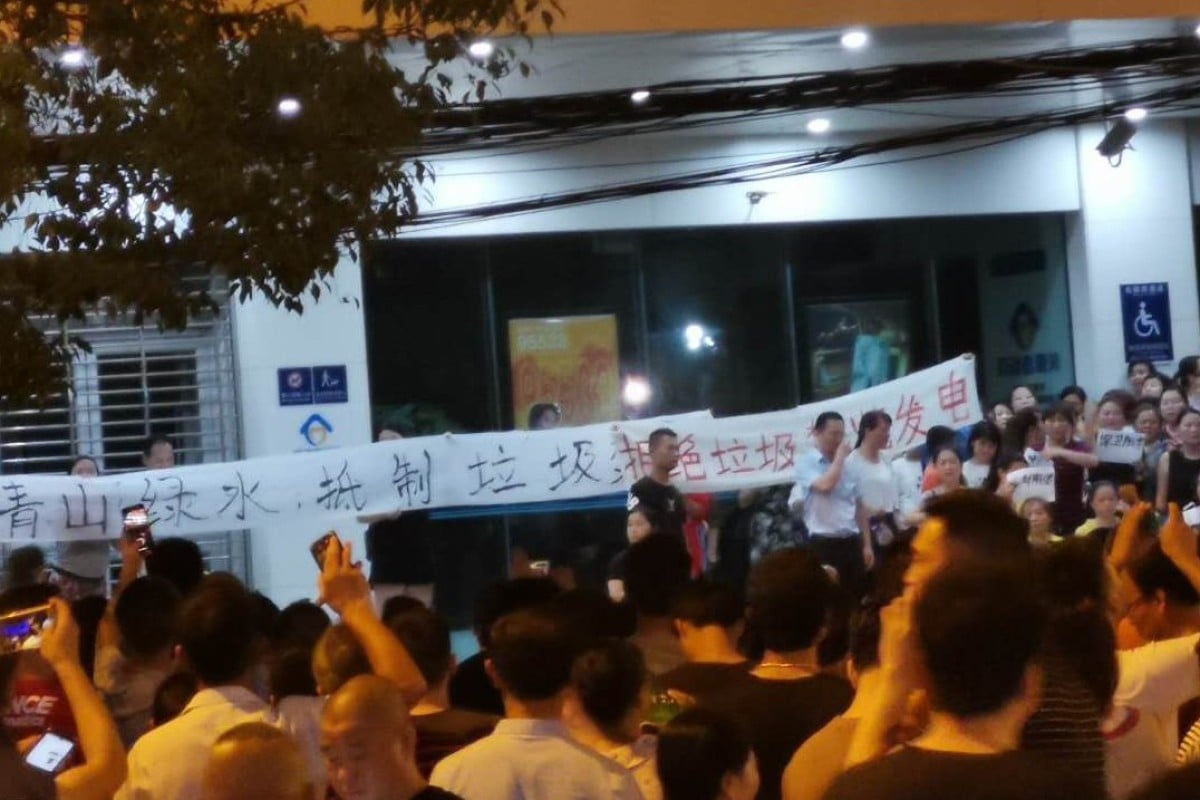
People in Yangluo protest against the proposed incineration plant on Thursday night. Photo: Handout
Thousands of people took to the streets in central China on Thursday night in a seventh day of protests against the construction of a waste incineration plant.
Protesters carried banners and chanted as they marched against a waste-to-energy plant that could be built next to residential areas in Yangluo, near Wuhan, the capital of Hubei province.
Residents were angered by plans to build the plant on a garbage landfill site that had been expected to be turned into a public park.
They shouted slogans such as “Return us the green mountain and clear waters” and “Garbage burning plant get lost from Yangluo”.
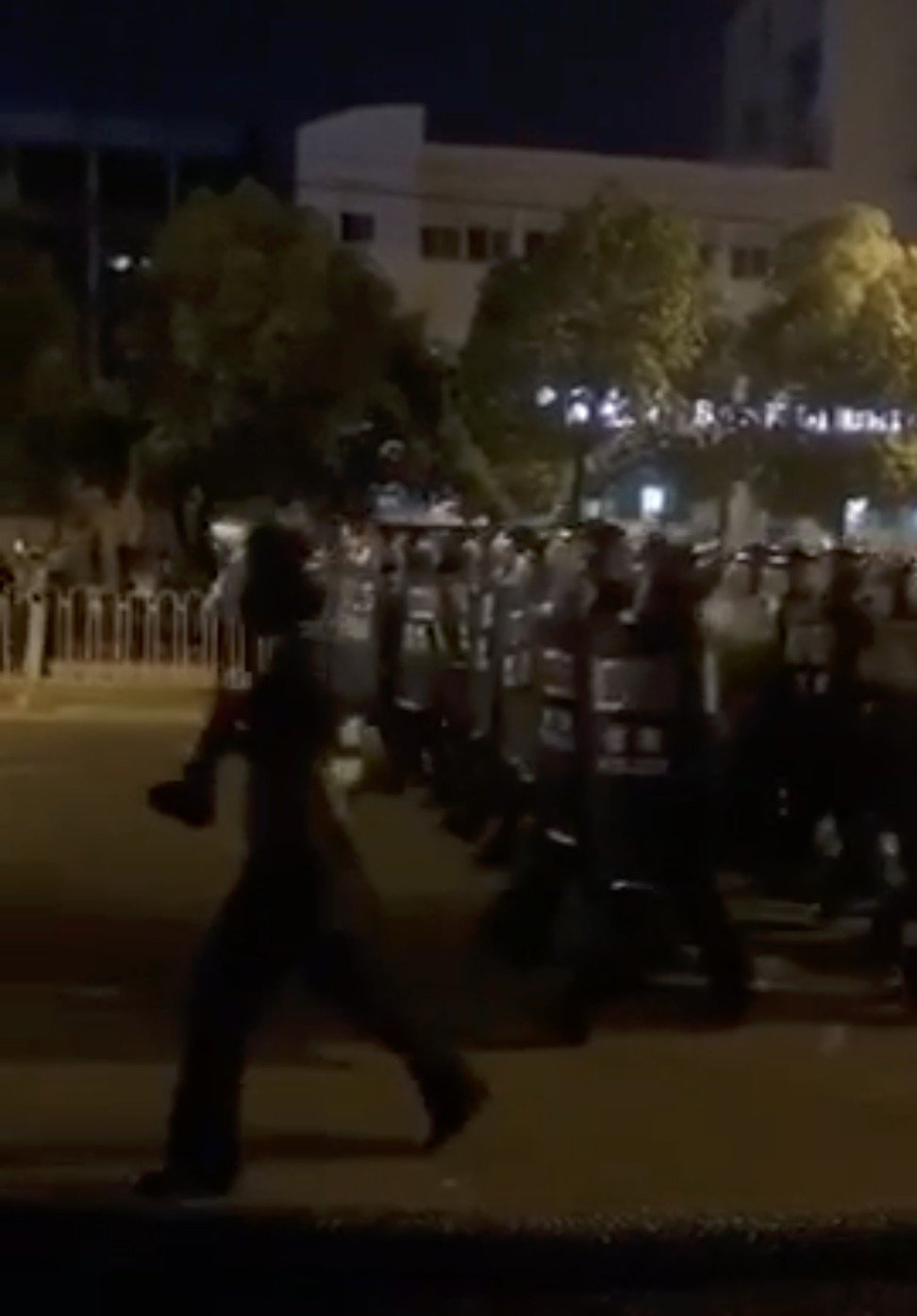
Riot police move in as protests continue in Yangluo on Thursday. Photo: Handout
A letter to the public by the Xinzhou district government on Wednesday had urged people “not to listen to or spread rumours”, and said that a location had yet to be finalised for the plant.
“What is rumoured online to be the garbage burning project that has already started is in fact demolition work for a railway construction project,” the letter said.
Converting waste to energy by burning it has been adopted in China as an alternative to burying rubbish in landfill sites – which causes pollution and requires a lot of land – but it has been widely resisted because of fears that it is a health hazard. Large protests against incinerators have been held in recent years in Zhejiang, Jiangsu, Hubei, Beijing and Guangdong.
“We understand the need to dispose of garbage in an environmentally friendly way, but does it have to be that close to our homes? Two universities and more than 10 residential areas are within a 3km (1.86 miles) radius,” said the man, referring to the Wuhan University of Bioengineering and Wuhan Engineering Institute.
Yangluo, designated as an economic and technology development area, is 30km northeast of downtown Wuhan and has a population of 300,000. The incineration plant would handle 2,000 tonnes of waste per day, the Wuhan urban management committee said last month.
Residents asked about the progress of the project in early June and were told that the authorities were still choosing a site.
Protests broke out last Friday after rumours spread that the project had already started – forcing the district government to say on Saturday that it would “not start without approval from the public”.
Nonetheless, thousands of protesters – about 10,000, according to one source – marched on Saturday and Sunday, leading to some arrests, although those detained at the weekend had since been released, protesters said.
After minor protests on Monday and Tuesday, residents gathered in greater numbers in Yangluo on Wednesday and Thursday nights, met by a heavy police presence.
Videos seen by the South China Morning Post show hundreds of riot police marching through the streets, equipped with helmets, shields and batons
The crowd dispersed at about 10pm as police began to round up some protesters. They were taken aboard a coach and two men were handled roughly, the videos showed.
Chinese town residents clash with riot police over incinerator
An official from the Xinzhou district government’s publicity department stressed to the Post that the project would not begin without public approval and its location had not yet been chosen.
China is deliberately separating Muslim children from their families, faith and language in its far western region of Xinjiang, according to new research.
At the same time as hundreds of thousands of adults are being detained in giant camps, a rapid, large-scale campaign to build boarding schools is under way.
Based on publicly available documents, and backed up by dozens of interviews with family members overseas, the BBC has gathered some of the most comprehensive evidence to date about what is happening to children in the region.
Records show that in one township alone more than 400 children have lost not just one but both parents to some form of internment, either in the camps or in prison.
Formal assessments are carried out to determine whether the children are in need of “centralised care”.
Alongside the efforts to transform the identity of Xinjiang’s adults, the evidence points to a parallel campaign to systematically remove children from their roots.
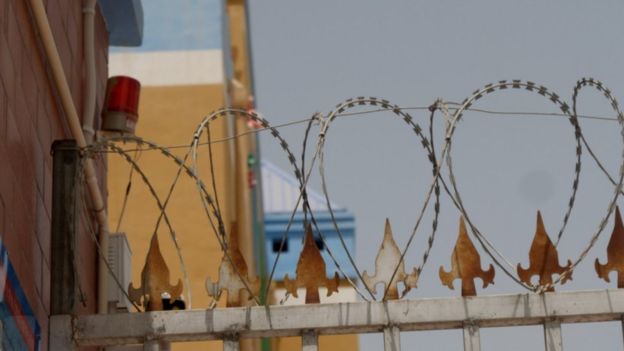
Image caption The Hotan Kindness Kindergarten, like many others, is a high security facility
China’s tight surveillance and control in Xinjiang, where foreign journalists are followed 24 hours a day, make it impossible to gather testimony there. But it can be found in Turkey.
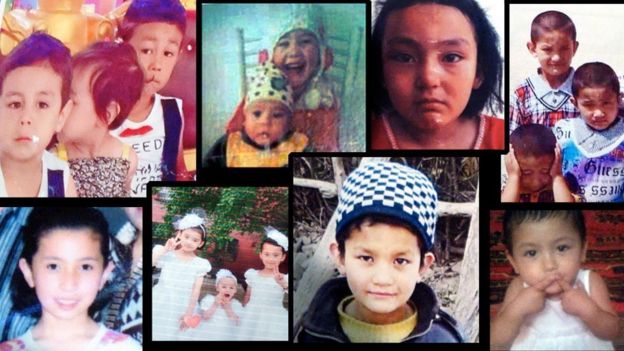
In a large hall in Istanbul, dozens of people queue to tell their stories, many of them clutching photographs of children, all now missing back home in Xinjiang.
“I don’t know who is looking after them,” one mother says, pointing to a picture of her three young daughters, “there is no contact at all.”
Another mother, holding a photo of three sons and a daughter, wipes away her tears. “I heard that they’ve been taken to an orphanage,” she says.
In 60 separate interviews, in wave after wave of anxious, grief-ridden testimony, parents and other relatives give details of the disappearance in Xinjiang of more than 100 children.
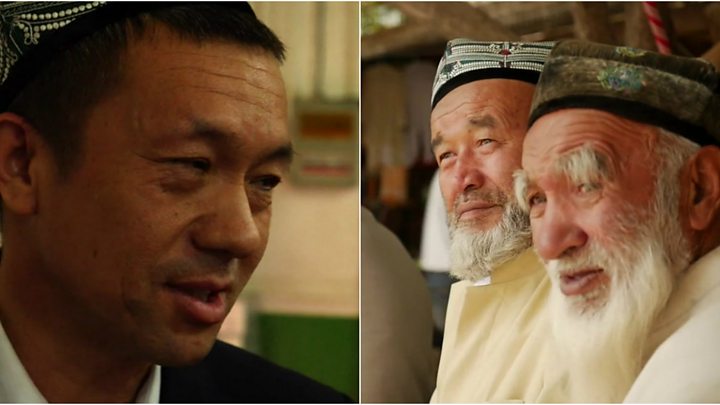
They are all Uighurs – members of Xinjiang’s largest, predominantly Muslim ethnic group that has long had ties of language and faith to Turkey. Thousands have come to study or to do business, to visit family, or to escape China’s birth control limits and the increasing religious repression.
But over the past three years, they have found themselves trapped after China began detaining hundreds of thousands of Uighurs and other minorities in giant camps.
The Chinese authorities say the Uighurs are being educated in “vocational training centres” in order to combat violent religious extremism. But evidence shows that many are being detained for simply expressing their faith – praying or wearing a veil – or for having overseas connections to places like Turkey.
For these Uighurs, going back means almost certain detention. Phone contact has been severed – even speaking to relatives overseas is now too dangerous for those in Xinjiang.
With his wife detained back home, one father tells me he fears some of his eight children may now be in the care of the Chinese state.
“I think they’ve been taken to child education camps,” he says.
New research commissioned by the BBC sheds light on what is really happening to these children and many thousands of others.
Dr Adrian Zenz is a German researcher widely credited with exposing the full extent of China’s mass detentions of adult Muslims in Xinjiang. Based on publicly available official documents, his report paints a picture of an unprecedented school expansion drive in Xinjiang.
Campuses have been enlarged, new dormitories built and capacity increased on a massive scale. Significantly, the state has been growing its ability to care full-time for large numbers of children at precisely the same time as it has been building the detention camps.
And it appears to be targeted at precisely the same ethnic groups.
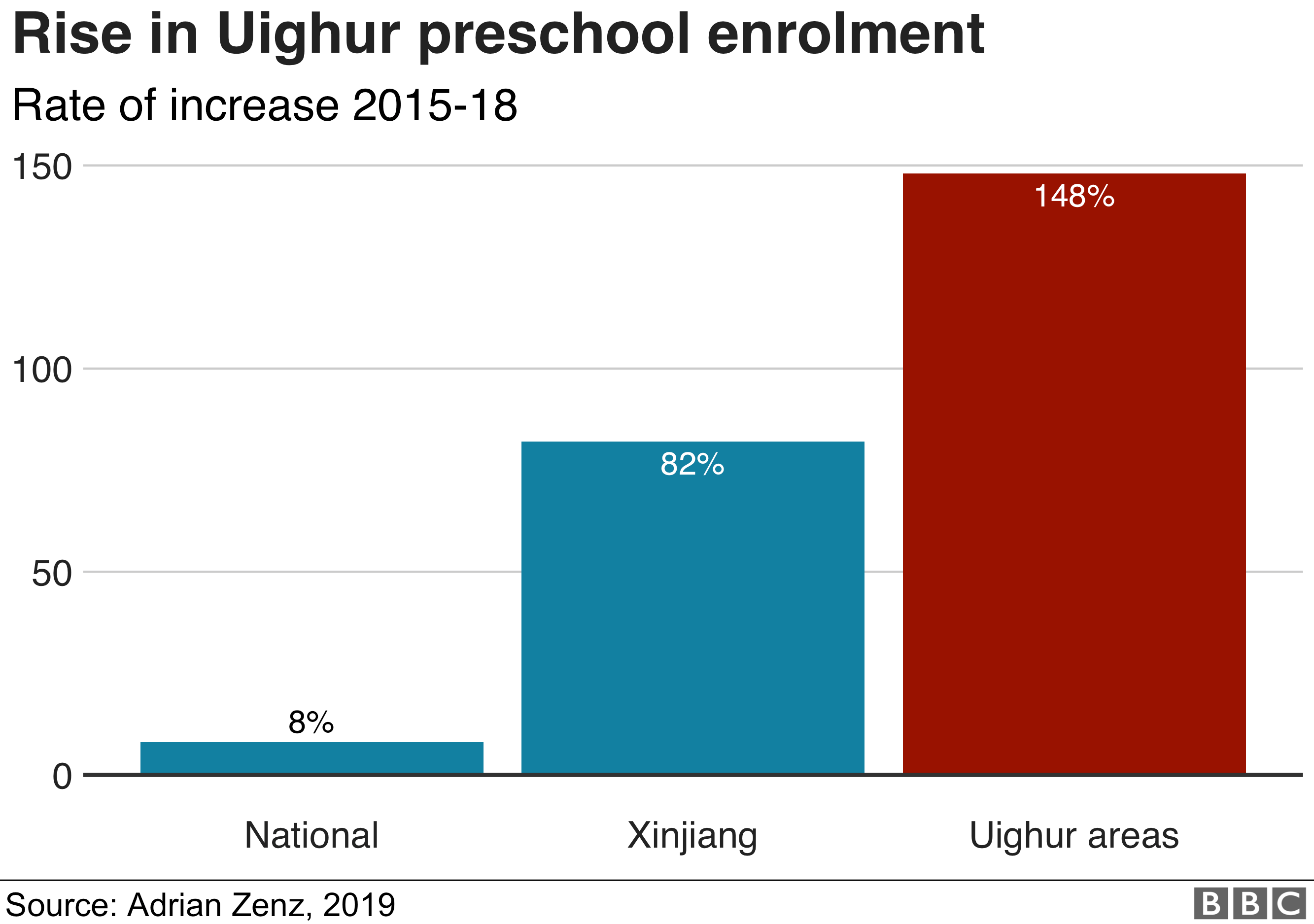
In just one year, 2017, the total number of children enrolled in kindergartens in Xinjiang increased by more than half a million. And Uighur and other Muslim minority children, government figures show, made up more than 90% of that increase.
As a result, Xinjiang’s pre-school enrolment level has gone from below the national average to the highest in China by far.
In the south of Xinjiang alone, an area with the highest concentration of Uighur populations, the authorities have spent an eye watering $1.2bn on the building and upgrading of kindergartens.
Mr Zenz’s analysis suggests that this construction boom has included the addition of large amounts of dormitory space.
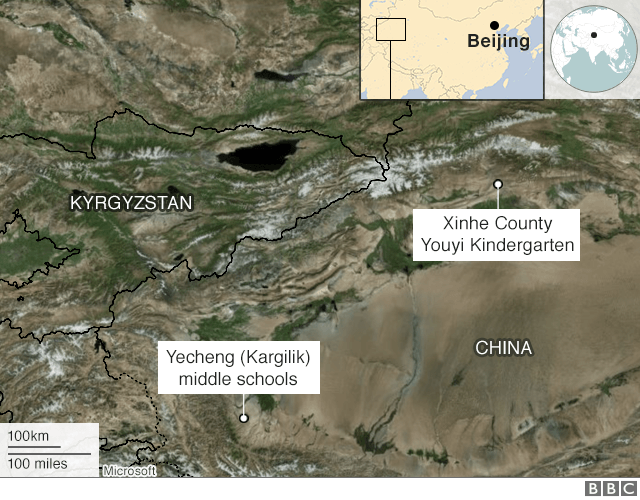
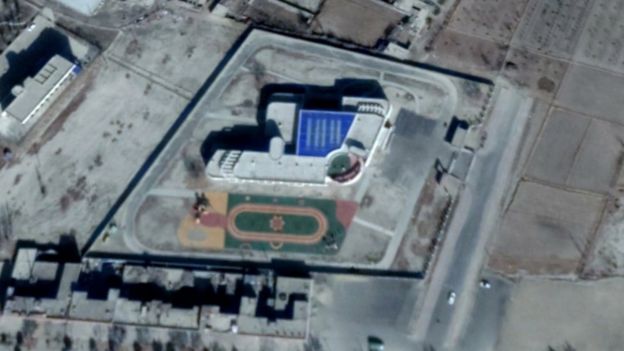
Image caption Xinhe County Youyi Kindergarten has space for 700 children, 80% of whom are from Xinjiang’s minority groups
Xinjiang’s education expansion is driven, it appears, by the same ethos as underlies the mass incarceration of adults. And it is clearly affecting almost all Uighur and other minority children, whether their parents are in the camps or not.
In April last year, the county authorities relocated 2,000 children from the surrounding villages into yet another giant boarding middle school, Yecheng County Number 4.
INTERACTIVE Use the slider button to see how the school has developed
May 2019
April 2018
Yecheng County Middle Schools 10 and 11
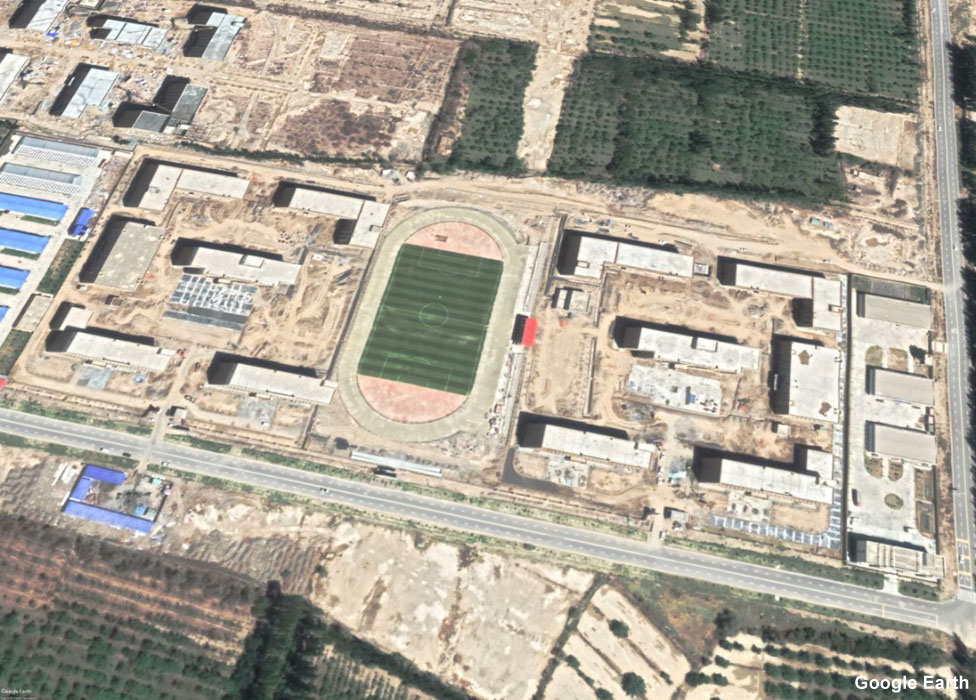
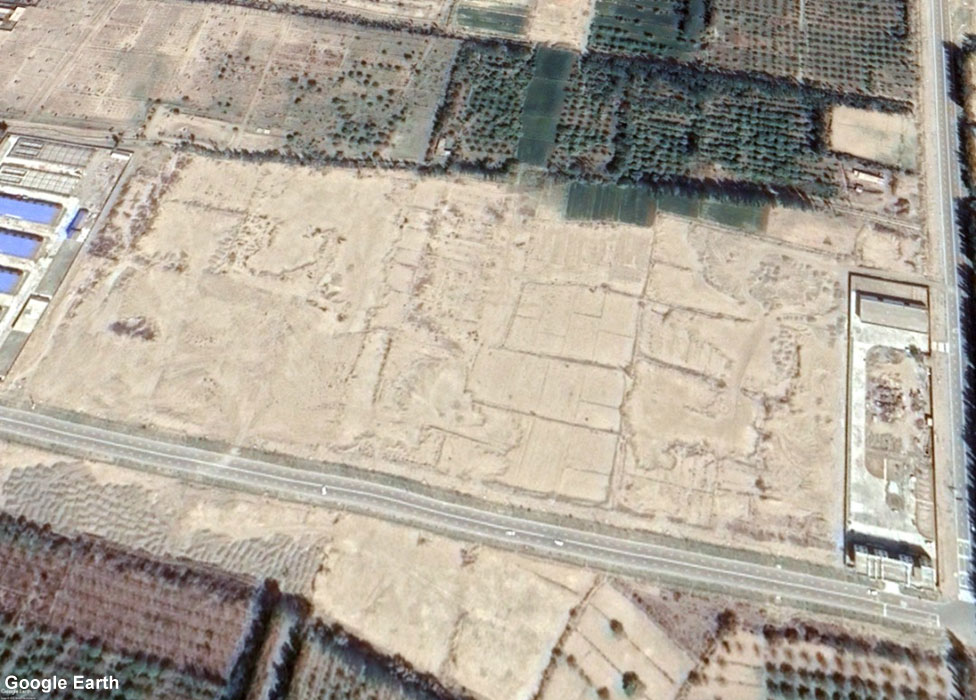
The image above shows a site being prepared for two new boarding schools in Xinjiang’s southern city of Yecheng (or Kargilik in Uighur).
Dragging the slider reveals the pace of construction – the two middle schools, separated by a shared sports field, are each three times larger than the national average and were built in little more than a year.
Government propaganda extols the virtues of boarding schools as helping to “maintain social stability and peace” with the “school taking the place of the parents.” And Mr Zenz suggests there is a deeper purpose.
“Boarding schools provide the ideal context for a sustained cultural re-engineering of minority societies,” he argues.
Just as with the camps, his research shows that there is now a concerted drive to all but eliminate the use of Uighur and other local languages from school premises. Individual school regulations outline strict, points-based punishments for both students and teachers if they speak anything other than Chinese while in school.
And this aligns with other official statements claiming that Xinjiang has already achieved full Chinese language teaching in all of its schools.
Media caption The BBC visits the camps where China’s Muslims have their “thoughts transformed”
Speaking to the BBC, Xu Guixiang, a senior official with Xinjiang’s Propaganda Department, denies that the state is having to care for large numbers of children left parentless as a result.
“If all family members have been sent to vocational training then that family must have a severe problem,” he says, laughing. “I’ve never seen such a case.”
But perhaps the most significant part of Mr Zenz’s work is his evidence that shows that the children of detainees are indeed being channelled into the boarding school system in large numbers.
There are the detailed forms used by local authorities to log the situations of children with parents in vocational training or in prison, and to determine whether they need centralised care.
Mr Zenz found one government document that details various subsidies available to “needy groups”, including those families where “both a husband and a wife are in vocational training”. And a directive issued to education bureaus by the city of Kashgar that mandates them to look after the needs of students with parents in the camps as a matter of urgency.
Schools should “strengthen psychological counselling”, the directive says, and “strengthen students’ thought education” – a phrase that finds echoes in the camps holding their parents.
It is clear that the effect of the mass internments on children is now viewed as a significant societal issue, and that some effort is going into dealing with it, although it is not something the authorities are keen to publicise.
Media caption The BBC has found new evidence of the increasing control and suppression of Islam in China
Some of the relevant government documents appear to have been deliberately hidden from search engines by using obscure symbols in place of the term “vocational training”. That said, in some instances the adult detention camps have kindergartens built close by, and, when visiting, Chinese state media reporters have extolled their virtues.
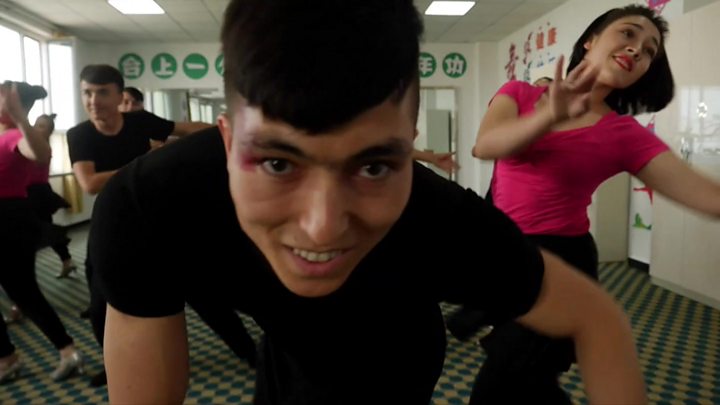
These boarding schools, they say, allow minority children to learn “better life habits” and better personal hygiene than they would at home. Some children have begun referring to their teachers as “mummy”.
We telephoned a number of local Education Bureaus in Xinjiang to try to find out about the official policy in such cases. Most refused to speak to us, but some gave brief insights into the system.
We asked one official what happens to the children of those parents who have been taken to the camps.
“They’re in boarding schools,” she replied. “We provide accommodation, food and clothes… and we’ve been told by the senior level that we must look after them well.”
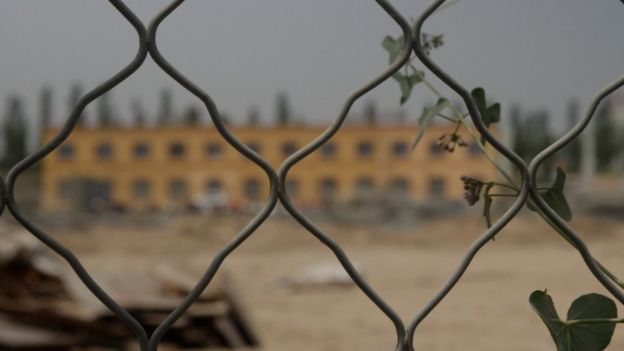
Image caption Hotan Sunshine Kindergarten, seen through a wire fence
In the hall in Istanbul, as the stories of broken families come tumbling out, there is raw despair and deep resentment too.
“Thousands of innocent children are being separated from their parents and we are giving our testimonies constantly,” one mother tells me. “Why does the world keep silent when knowing these facts?”
Back in Xinjiang, the research shows that all children now find themselves in schools that are secured with “hard isolation closed management measures.” Many of the schools bristle with full-coverage surveillance systems, perimeter alarms and 10,000 Volt electric fences, with some school security spending surpassing that of the camps.
The policy was issued in early 2017, at a time when the detentions began to be dramatically stepped up. Was the state, Mr Zenz wonders, seeking to pre-empt any possibility on the part of Uighur parents to forcibly recover their children?
“I think the evidence for systematically keeping parents and children apart is a clear indication that Xinjiang’s government is attempting to raise a new generation cut off from original roots, religious beliefs and their own language,” he tells me.
“I believe the evidence points to what we must call cultural genocide.”
Image copyright GETTY IMAGESImage caption This journey is documented in undated Hindu sacred texts known as the Puranas written a few thousand years ago
One of India’s biggest religious festivals, the Jagannath Puri Rath Yatra, gets under way on Thursday. The festival is unique in that three Hindu gods are taken out of their temples in a colourful procession to meet their devotees. The BBC’s Priyanka Pathak explains the legend behind the festival and its significance.
The biggest of these processions takes place in Puri in the eastern state of Orissa, while the other takes place in the western state of Gujarat.
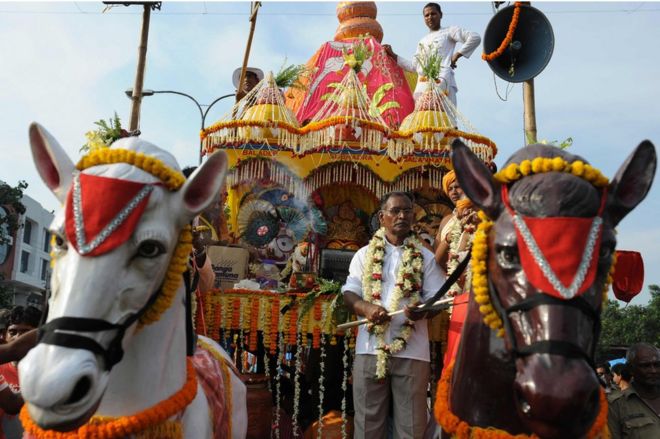
Believed to be the oldest Rath Yatra or chariot procession in the world, this festival marks the annual ceremonial procession of Lord Jagannath, his elder brother Balabhadra and younger sister Subhadra, from their home temple to another temple, located in what is believed to be their aunt’s home.
This journey is documented in undated Hindu sacred texts known as the Puranas which are believed to have been written a few thousand years ago.
What makes it so interesting?
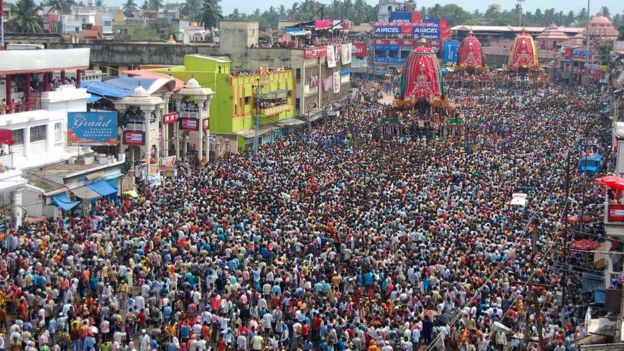
This is the only festival in the world where deities are taken out of temples to travel to devotees, and it is also the largest chariot procession in the world.
Millions of people come to watch as a “king” sweeps the road with a golden mop and three massive 18-wheeled chariots bearing the sibling deities make their way through massive crowds. Their chariots, which are mini architectural marvels, are constructed over 42 days from over 4,000 pieces of wood by the only family that has the hereditary rights to make them.
Image copyright AFP
Legend says it always rains on the day of the procession. For a whole week before, the temple doors are shut and no one is allowed inside, because it is believed that the sibling deities have a fever after bathing in the sun with 108 pitchers of water. The breaking of their fever calls for a change of scene, which is why they go to their aunt’s home for a few days.
The size, pomp and splendour of this procession has even contributed a word to the English dictionary: Juggernaut.
What is the legend of the sibling deities?
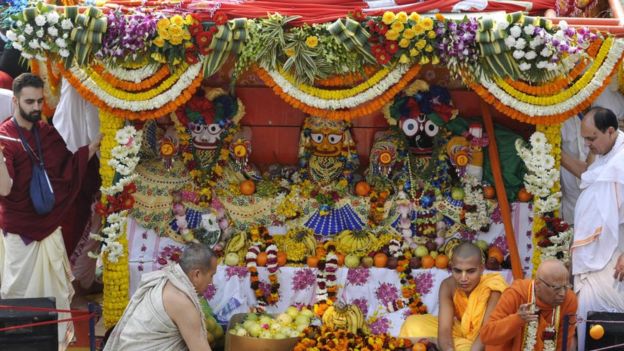
Unlike the ornate, carefully crafted metal idols everywhere else, these three deities are fashioned from wood, cloth and resin. They are malformed with large heads and no arms: reminders of the legend of an impatient King.
The legend begins in different ways.
One speaks of an arrogant Indrayumna, King of Puri in the east, who tried to steal the Hindu god Krishna’s heart. It had been immersed in the legendary Dwarka sea after his cremation and had reappeared to the tribes people of the place as an idol. When Indrayumna tried to claim its possession, the idol disappeared. The repentant king sought absolution from Krishna by sanctifying him in another form.
Image copyright GETTY IMAGESImage caption Unlike the ornate, carefully crafted metal idols everywhere else, these three deities are fashioned from wood, cloth and resin
Another speaks of how Krishna’s grief-stuck siblings – his elder brother Balabhadra and younger sister Subhadra- rushed into the Dwarka sea carrying his half-cremated body. At the same moment, King Indrayumna dreamed that Krishna’s body had floated back up on his shores as a log.
The two legends merge here: Indrayumna decided to build a temple to house the log. His next task was to find someone to craft the idols from it. Legends say that Vishwakarma, God’s own architect, arrived as an old carpenter. He agreed to carve the idols, but on the condition that he was not to be disturbed. However, when he did not emerge from his workshop for weeks, going without food, water or rest, a worried and impatient King threw the door open.
At the time the images were only half-finished, but the carpenter disappeared. Still, believing the idols to be made from the very body of God, the King sanctified them and and placed them in the temple.
When the deities disintegrate, they are remade in the same half-done image with new wood every 12 years. They were last remade in 2015.
Why are there two rath yatras and how are they connected?
Dwarka in Gujarat – where Krishna’s half-cremated body is believed to have been immersed into the ocean – is located on the west coast of India and Puri in Orissa- where it is said to have re-emerged as a log – is located in the east.
About 500 hundred years ago, a travelling Hindu saint and temple priest of a Hanuman temple in Gujarat, Shree Sarangdasji, arrived in Puri to offer prayers at the historic Jagannathan temple.
Image copyright GETTY IMAGES
While sleeping at the temple guest house, it is believed that he received visionary instruction from Lord Jagannathan to go back to Ahmedabad in Gujarat and install three idols of Jagannathan, Balbhadra and Subhadra there. Carrying out the instructions received in his dream, he founded the Ahmedabad Jagannathan Temple.
By doing so, he sanctified the two locations – one where Krishna’s mortal remains began their journey from the west, to their transformation as Puri’s Lord Jagannathan in the east.
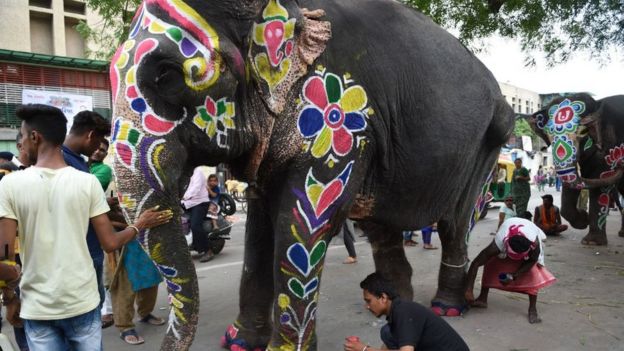
About 142 years ago, one of the founder’s disciples, Shree Narsinhdasji Maharaj, began the Ahmedabad Rath Yatra. The deities on chariots, pulled by elephants and humans, replicate their own journey in Puri, completing a set of rituals that sanctify the two places where Krishna’s mortal remains are believed to have come to rest.
What happens to the chariots and elephants after the journey?
At the end of the festival, the chariots are dismantled and their wood is used as fuel in the temple kitchens – believed to be the largest in the world that cook 56 things every day and feed anywhere between 2,000 to nearly 200,000 people.
The elephants are returned to the lands managed by the temple trusts to roam free – until the procession the following year.
This year’s festival was, however, marred by controversy over the elephants.
Following the death of some of the temple elephants in Gujarat, there was massive outcry over plans to replace them with elephants from the north-eastern state of Assam.
The four elephants would have had to make a perilous train journey of more than 3,100km (1,926 miles) in heatwave conditions to participate in the festival.




 CHINDIA ALERT: You'll be living in their world, very soon