07/07/2019

In drought-hit Delhi, the haves get limitless water, the poor fight for every drop

NEW DELHI (Reuters) – In this teeming capital city of more than 20 million people, a worsening drought is amplifying the vast inequality between India’s rich and poor.

The politicians, civil servants and corporate lobbyists who live in substantial houses and apartments in central Delhi pay very little to get limitless supplies of piped water – whether for their bathrooms, kitchens or to wash the car, dog, or spray a manicured lawn. They can do all that for as little as $10-$15 a month.

But step into one of the slum areas in the inner city, or a giant disorganized housing estate on the outskirts and there is a daily struggle to get and pay for very limited supplies of water, which is delivered by tanker rather than pipe. And the price is soaring as supplies are fast depleting.

India’s water crisis is far from even-handed – the elite in Delhi and most other parts of the country remain unaffected while the poor scramble for supplies every day. Prime Minister Narendra Modi’s official residence and those of his cabinet are in central Delhi, as are those of most lawmakers.

That may help to explain why it took until this week for Modi to call for a massive water conservation program, the first big initiative by the government despite years of warnings about dry reservoirs and depleted water tables, policy makers and water industry experts said.

Telecom sales representative Amar Nath Shukla, who lives in a giant unauthorized housing sprawl on the south side of Delhi, says he is now paying 700 rupees ($10) for a small tanker to bring him, his wife and three school-age children 2,000 liters of water, their weekly quota.

A year ago, Shukla would buy two of the rusty, oval-shaped tankers a week for 500 rupees each but he cut back to one as the price climbed 40 percent.

“Why should a densely populated settlement get so little of water and why should the sparsely-populated central district of New Delhi receive so much of extra supply?” asked Shukla.
More than 30 other residents Reuters spoke to in his Sangam Vihar district also complained about the quality of water.
“Until last year I was drinking the water sold by a few local suppliers but then I fell ill and the doctor asked me to buy water bottles made by only big, reputed companies,” said Dilip Kumar Kamath, 46, waving a prescription which listed abdominal pain and stomach infection as his ailments.

WATER GANGS

Delhi’s main government district and the army cantonment areas get about 375 liters of water per person per day but residents of Sangam Vihar on average receive only 40 liters for each resident per day. The water comes from boreholes and tankers under the jurisdiction of the Delhi water board, run by the city government.

But residents say some of the boreholes have been taken over by private operators associated with criminal gangs and local politicians. These gangs also have a major role in providing private tankers, which are all illegal, making people liable to price gouging.

And all this when temperatures, and demand, are soaring. Delhi was the second driest it has been in 26 years in June, and recorded its highest ever temperature for the month at 48 degrees Celsius on June 10.

Monsoon rains reached the capital on Thursday, more than a week later than usual, with only a light drizzle.

Most private tanker operators in Delhi either illegally pump out fast depleting ground water or steal the water from government supplies, various government studies show.

In Delhi, nearly half of the supply from the Delhi water board either gets stolen with the connivance of lowly officials or simply seeps out via leaky pipes, several studies show.

The board’s 1,033 tanker fleet is well short of the city’s requirements. Hundreds of private water tankers are operating this summer, though there are no official numbers.

WATER WARS

The water scarcity is even more acute in the Bhalswa Dairy locality of northwestern Delhi, more than 30 km (20 miles) from Sangam Vihar. The water from a couple of community taps and hand pumps are too toxic to use, forcing people to queue up for a government tanker that comes just once a day.

As a result, fights frequently break out when people, mostly can-carrying women and children, sprint towards the arriving tanker. Last year, at least three people were killed in scuffles that broke out over water in Delhi.

“Fights over water supplies have gone up since May and these fights now constitute almost 50% of our daily complaints,” said a police official at the Bhalswa Dairy Police station, who declined to be named.

Some tanker operators have also started selling bottled water, underlining concerns over the quality of water in their tanks and how costs for ordinary people can mount, said the police official.

Nearly 200,000 people living in the Bhalswa area are vulnerable to liver-related disease such as jaundice and hepatitis, said Kamlesh Bharti, president of non-governmental organization Kamakhya Lok Sewa Samiti, which works in the areas of health and education.

The Bhalswa area is next to a big waste landfill, which has contaminated both surface and groundwater in the area.

According to UK-based charity WaterAid, about 163 million people in India, roughly 12 percent of the population, do not have access to clean water close to their homes, the most of any country.

Almost all middle-class residents in the city have either water purifiers at home or they buy big cans of water from Bisleri, India’s top bottled water brand, Coca-Cola Co (KO.N) or PepsiCo Inc (PEP.O).

Bottled water suppliers reported a nearly three-fold jump in sales in India between 2012 and 2017, according to market research company Euromonitor.

India’s dependence on groundwater and the country’s failure to replenish aquifers have exacerbated the crisis, said V.K. Madhavan chief executive of WaterAid.

Both individual households and myriad industries mostly use fresh water and the reuse and recycling of water “is almost an alien concept” in the country, Madhavan said.

Still, Delhi authorities said the plan to build three dams in the upper reaches of the Yamuna river, which passes through the city, would help Delhi overcome the shortage.

It will take 3-4 years to construct them, said S. K. Haldar, a top official of the Central Water Commission.

But issues such as land acquisition, resettlement and environmental clearances could make such an aggressive timetable untenable, Madhavan said.

Source: Reuters

06/07/2019

Shanghai aims to have full 5G coverage by 2020

SHANGHAI, July 6 (Xinhua) — Shanghai will realize full 5G coverage by 2020, said a guideline for promoting 5G network coverage and application over the next three years released by the municipal government on Friday.

According to the guideline, 10,000 5G base stations will be built to cover the whole of downtown and main suburban areas in Shanghai by the end of 2019.

By 2020, the city will have full 5G coverage throughout the city with 20,000 5G base stations. A total of 20 billion yuan (about 2.9 billion U.S. dollars) will be invested in the area.

By 2021, Shanghai will have 5G related industries worth 100 billion yuan and 100 innovative companies in 5G application industries. The city will add 10,000 more base stations and 10 billion yuan investment based on 2020 numbers.

Shanghai will roll out a three-year action plan to promote 5G in key industries such as manufacturing, transport, medical care, education, leisure and entertainment and the city’s administration.

The city will also push forward innovative application of “5G+4K/8K+AI” in important venues such as China International Import Expo and AI World Conference & Expo, as well as key transport hubs.

Demonstrative regions will be established to promote the in-depth integration of 5G with intellectual manufacturing, industrial internet, big data, artificial intelligence, ultra-high-definition video and industrial control security, according to the guideline.

China is currently testing 5G across all major cities, provinces and regions, including Shanghai. It is forecasted that 28 percent of China’s mobile connections will be running on 5G networks by 2025, accounting for about one-third of all 5G connections globally, according to a report by telecoms lobby group GSMA, which represents the interests of 750 mobile operators.

Source: Xinhua
06/07/2019

China-Africa trade increases in Jan-May

BEIJING, July 6 (Xinhua) — China’s trade with Africa saw a mild increase in the first five months this year, official data showed.

China-Africa trade volume stood at 84.76 billion U.S. dollars during the period, up 3 percent year on year, as compared with a drop of 1.6 percent in China’s overall foreign trade in U.S. dollar terms during the period, according to the General Administration of Customs (GAC).

In breakdown, China’s exports rose 6.3 percent year on year to hit 43.57 billion U.S. dollars from January to May, while imports from Africa declined 0.3 percent to 41.19 billion U.S. dollars, leading to a surplus of 2.38 billion U.S. dollars.

In May, China-Africa trade expanded 1.7 percent to 18.67 billion U.S. dollars, with China seeing a surplus of 1.89 billion U.S. dollars, said the GAC.

China’s exports in the month stood at 10.28 billion U.S. dollars, up 8.7 percent year on year while the imports totaled 8.39 billion U.S. dollars, down 6 percent than a year earlier.

In 2018, China-Africa trade reached 204.2 billion U.S. dollars, up 20 percent year on year, and China has been Africa’s largest trading partner for 10 straight years.

Source: Xinhua

06/07/2019

China Focus: Tea seedling donation seeds new prospect for poverty alleviation

BEIJING, July 6 (Xinhua) — Valuable tea plants are flourishing on around 67 hectares of tea farms in Qingchuan County of southwest China’s Sichuan Province, bringing new hope to impoverished locals.

“Tea plants are growing so well that I believe our lives will be better and better in the future,” said Jiao Yuan’en, a 66-year-old local villager, in the upbeat mood.

Jiao’s tea plants are grown from seedlings donated by tea farmers, thousands of miles away in Anji of eastern Zhejiang Province, as a gift to help alleviate poverty.

In April 2018, 20 tea farmers from Huangdu village of Anji, a well-known tea planting area, wrote a letter to Xi Jinping, general secretary of the Communist Party of China Central Committee, proposing to donate 15 million tea seedlings to poor areas.

Responding to their letter, Xi praised their move and called on Party members to share the Party’s burdens and encourage those who get rich first to help latecomers in the battle against poverty.

With Xi paying close attention to this project, the State Council Leading Group Office of Poverty Alleviation and Development chose 34 impoverished villages in provinces of Guizhou, Hunan and Sichuan to receive the seedlings.

By the end of March this year, a total of 16.65 million seedlings from Huangdu village were planted in around 358 hectares of land, involving 1,862 needy households, and more than 95 percent of the seedlings have survived.

In Guizhou, the donated tea seedlings helped inspire other locals to engage in tea planting, and in Hunan, tea farms were incorporated into local tourism.

The kind-hearted action from Anji farmers is expected to help 5,839 villagers improve their livelihood and lift them out of poverty when the tea plants are ripe for harvest in the spring of 2020.

China aims to lift all rural residents living below the current poverty line out of poverty by the year 2020.

Source: Xinhua

06/07/2019

China Focus: Peacebuilders in China-Japan friendship

TIANJIN/BEIJING, July 6 (Xinhua) — Even at the age of 100, Yang Enze, one of the founders of China’s optical communication, does not stop his research and teaching as a professor at Tianjin University.

Besides his pioneering achievements as the chief engineer of China’s first optical communication project for practical use in the 1970s, Yang is also known as a survivor and a witness of the war of Japanese aggression against China.

“I was admitted to Wuhan University in 1937, the year when Japanese troops attacked the Lugou Bridge, also known as Marco Polo Bridge, on the outskirts of Beijing, on July 7,” said the senior recalling the start of his academic study.

The incident marked the beginning of Japan’s full-scale war against China during World War II and triggered China’s full-scale resistance against the invasion.

Ahead of the 82nd anniversary of the incident that falls on Sunday, Yang said because of the war, his university in central China’s Hubei Province was relocated to southwestern province of Sichuan to avoid the enemy forces. “Even in Sichuan, there were a lot of Japanese bombings, but none of the students missed any of the classes as long as there was no air-raid siren,” he recalled.

It was at that time he and many of his peers cemented the belief that the country needed advanced science and technology for reconstruction and revival.

“I have always kept in mind late chairman Mao Zedong’s words that it was Japanese militarists’ crime that was to blame for the war, not Japanese civilians, ” Yang said, noting that he still gets in touch with many Japanese scholars.

He established the first optical communication laboratory in Tianjin in 1985, when he was invited to teach at Tianjin University. In Yang’s career, he has made friends with several leading experts from Japan at international conferences and even kept friendship with some of them.

Also in Tianjin, Morita Naomi, a Japanese language teacher in Nankai University, works as a consultant to the school’s research institute of Zhou Enlai-Daisaku Ikeda.

“By involving in the research of the friendship between the late Chinese premier and the Japanese philosopher, I want to search for the core factors that help consolidate the friendship between the two peoples,” said Naomi.

She came to Nankai to pursue a master-degree study in Modern Chinese and Chinese Literature in 2010 and has stayed ever since.

When she first arrived, she had troubles even in learning Chinese phonics. Now she can read and speak Chinese fluently, write beautiful Chinese characters, and study ancient Chinese literature independently.

As a teacher, she feels frustrated that most of her Chinese students are more likely to be attracted by Japanese animation and games rather than Japanese literature.

According to the school’s statistics, nearly half of the undergraduates in the 2019 class of Japanese major chose to work in Japanese-funded enterprises or Japanese-related enterprises after graduation.

Naomi said Japanese visitors to China are more likely to choose destinations like Beijing, Shanghai and Guangzhou. Peking University in Beijing impresses young Japanese most.

According to a report released by the China Tourism Academy, China received 2.69 million Japanese visitors in 2018, making Japan China’s fourth largest source of foreign tourists. In the same year, Chinese made 9.06 million outbound visits to Japan as a direct destination.

The academy released the report at the 2019 China-Japan Tourism Forum Dalian held on May 26, which focused on promoting win-win cooperation on cultural exchanges and tourism between the two countries.

China and Japan agreed to push forward bilateral relations along the right track of peace, friendship and cooperation, at the summit of the Group of 20 (G20) major economies held in Osaka, Japan, in June.

This year marks the 70th anniversary of the founding of the People’s Republic of China, and Japan has also entered the Era of Reiwa. It is also the China-Japan Youth Exchange Promotion Year, for promoting friendship and cooperation in a wide range of areas between the two peoples.

“We keep the wartime memory not because we bear the hatred, but because we want the younger generations to cherish what they own today and move towards a better future,” said 70-year-old Zhen Dong, who on Friday visited an exhibition on Beijing’s past, held in Beijing Municipal Archives.

Zhao Hongwei, a professor with Tokyo-based Hosei University, said when it comes to the bilateral relations between China and Japan, it is very important to promote the free trade agreement and expand the markets of both sides.

Source: Xinhua

06/07/2019

China claims 55 of UNESCO world heritages with elected new sit

AZERBAIJAN-BAKU-CHINA-LIANGZHU-WORLD HERITAGE

The Chinese delegation celebrate during the 43rd session of the UNESCO World Heritage Committee in Baku, Azerbaijan, July 6, 2019. The United Nations Educational, Scientific and Cultural Organization (UNESCO) World Heritage Committee inscribed China’s Archaeological Ruins of Liangzhu City on the World Heritage List as a cultural site here on Saturday, bringing the total number of World Heritage Sites in China to 55, the highest in the world. (Xinhua/Tofik Babayev)

BAKU, July 6 (Xinhua) — China’s Archaeological Ruins of Liangzhu City was on Saturday inscribed to the UNESCO World Heritage List as a cultural site, bringing the total number of the Asian country’s sites on the list to 55.

The decision to add the Chinese cultural site, located in the eastern Chinese city of Hangzhou, to the United Nations Educational, Scientific and Cultural Organization’s (UNESCO) World Heritage List was approved by the World Heritage Committee at its ongoing 43rd session in the Azerbaijani capital of Baku.

“It is considered to be a supreme achievement of prehistoric rice-cultivating civilization of China and East Asia over 5,000 years ago and an outstanding example of early urban civilization,” said a report by the International Council on Monuments and Sites (ICOMOS), the committee’s official advisory body.

Sitting on a plain crossed by river networks in the Yangtze River Basin, the nominated property of Archaeological Ruins of Liangzhu City includes the archaeological remains of Liangzhu City (3300 BC-2300 BC), which was once the center of power and belief of an early regional state in the lower reaches of the Yangtze River during the Late Neolithic China period.

The property testifies to the existence of a regional state with a unified belief system and supported by a rice-cultivating agriculture in late Neolithic China. It also represents an early urban civilization with complex functions and structures.

“Archaeological Ruins of Liangzhu City is a major archaeological discovery of China in the 20th century and an important cultural site that witnessed the 5,000-year civilization of the country,” said Liu Yuzhu, head of China’s National Cultural Heritage Administration, at the committee session.

“We are proud that after 25 years of preparation, our efforts have finally led to the successful inscription of this exceptionally important property, which is the most concrete testimony of 5,000 years of Chinese civilization,” said Shen Yang, ambassador and permanent delegate of China to the UNESCO, following the announcement of the decision.

“We are keenly aware that the inscription also entails an enormous responsibility for conserving this heritage of humanity,” he added.

Zhou Jiangyong, Hangzhou’s municipal committee secretary of the Communist Party of China, said the Chinese city will spare no effort to “protect and make proper use of the enormous cultural heritage before passing it on to the the future generations.”

The Chinese side also pledged continued efforts and strengthened international cooperation in the protection and management of the world heritages in China.

The 43rd convention of the World Heritage Committee, held from June 30 to July 10, started on Friday to examine world heritage nominations. According to its agenda, it will also review the state of conservation of 166 sites on the World Heritage List, 54 of which are also on the List of World Heritage in Danger.

On Friday, China’s Migratory Bird Sanctuaries along the Coast of the Yellow Sea-Bohai Gulf (Phase I) was inscribed to the World Heritage List as a natural site.

At present, China has 55 world heritage sites, including 37 cultural sites, 14 natural sites, and 4 cultural and natural heritages.

Source: Xinhua

06/07/2019

Chinese state councilor to visit Poland, Slovakia, and Hungary

BEIJING, July 6 (Xinhua) — Chinese State Councilor and Foreign Minister Wang Yi will visit Poland, Slovakia and Hungary from July 7 to 13, at the invitation of Polish Foreign Minister Jacek Czaputowicz, Slovak Foreign Minister Miroslav Lajcak, and Hungarian Foreign Minister Peter Szijjarto respectively.

He will also co-host the second plenary session of China-Poland Intergovernmental Cooperation Committee with Czaputowicz and the second China-Hungary “Belt and Road” working group meeting with Szijjarto during the visit, foreign ministry spokesperson Geng Shuang said Saturday in Beijing.

Source: Xinhua

06/07/2019

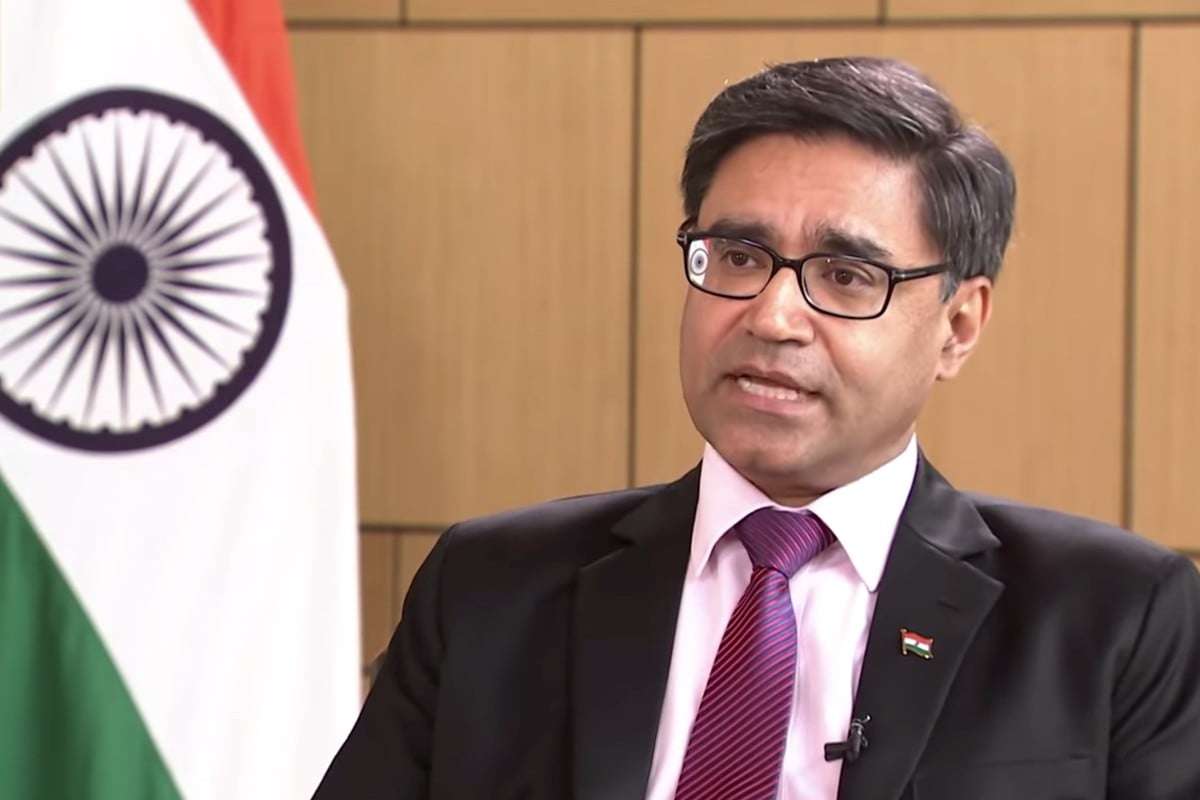
New Delhi and Beijing cannot let differences turn into disputes: India’s ambassador to China

  • Ambassador Vikram Misri has called on China to balance its US$60 billion trade deficit with India ‘before the issue becomes politically sensitive’
  • He also says India will not take sides over its use of US-blacklisted Huawei, as ‘any decision taken over this will only be taken in our national interest’
Indian ambassador to China Vikram Misri says that while the countries’ differences will not derail ties, there are still thorny issues to grapple with. Photo: CGTN
India and China must actively manage their differences

so they do not get in the way of the Asian superpowers working together for global stability, India’s top diplomat in China said on Friday.

To emphasise his point, Ambassador Vikram Misri listed eight long-standing and new bilateral issues that required attention, including 
India

’s almost US$60 billion trade deficit with China, cooperation on counterterrorism and a

peaceful resolution to their border dispute

.

“This trade imbalance is not economically sustainable in the long run,” said Misri at an Asia Society event in Hong Kong. “It is in our mutual interest to find workable solutions before the markets react in unpredictable ways and the issue becomes politically sensitive.”
Frosty ties between two of the world’s largest economies have thawed in the past year following a 73-day 
military stand-off in the Himalayas

in 2017, with Beijing seeking to forge closer ties with New Delhi amid its ongoing trade and tech war with the United States.

Ivanka Trump, the unlikely messenger of India-US relations
In May, Beijing dropped its long-held objections towards United Nations sanctions on

Masood Azhar

, the founder and leader of terrorist group Jaish-e-Mohammed, which was behind the suicide bombing of Indian soldiers that brought India and Pakistan to the brink of war earlier this year.

Analysts said this would pave the way for a better relationship between India and China.
Misri said both countries enjoyed a “full-spectrum relationship” of economic, commercial and people-to-people ties, and this was reinforced by the “strong personal bond” Indian Prime Minister

Narendra Modi

and Chinese President

Xi Jinping

had, despite the “elements of competition”.

The leaders of the two nations met four times last year and twice in 2019, with Xi set to visit India later this year. Both men share an understanding that “our rise can be mutually reinforcing” and a mutual interest in “preventing differences from turning into disputes”, the ambassador added.

But while Misri, a career diplomat posted to Beijing at the start of this year, stressed that differences would not derail ties, he made no bones about the thorny issues both sides are grappling with.

Will Modi’s snub of Xi’s belt and road derail China-India ties?
Both nations are still engaged in the second of a three-stage process to settle their border dispute – the world’s largest in terms of area, he said.
The first stage was an agreement on the political parameters for a boundary settlement in 2005. The current stage involves agreeing on a framework for a boundary settlement, which Misri said would be translated “into a delineated and demarcated boundary” in the final stage.
Communication over water and shared rivers has also been a key area of cooperation for the two nations.
Indian ambassador to China Vikram Misri speaking at the Asia Society in Hong Kong. Photo: Asia Society

They have established channels for information sharing on cross-frontier rivers, which last year enabled the Chinese side to warn the relevant Indian authorities of a landslide which would send a large amount of water to India. While in this instance the two sides were able to avert a loss of life, they can do more to broaden cooperation, Misri said.

He alluded to how China and India are vying for influence in the Indian Ocean, saying it was an area where both had “contiguous zones of maritime interest”.

The two sides need to work together to preserve peace and stability in the Indo-Pacific region – which stretches from the Indian Ocean to the central Pacific Ocean – and ensure transparent economic and commercial cooperation, infrastructure and connectivity, he said.

As China, India and Russia draw close, has Trump overplayed his hand?

Misri, who served as the private secretary to Modi as well as former prime ministers Manmohan Singh and I.K. Gujral, said there were three areas of mutual interest for India and China.

Besides a “peaceful periphery”, they should cooperate to ensure there are open international systems regarding trade and technology, and that global governance is reformed so the voices of nations such as theirs can be heard.

The Russia-India-China trilateral meeting on the sidelines of last month’s 

G20

summit in Osaka, where leaders discussed issues ranging from energy security to climate change, was an opportunity to discuss alternative viewpoints on changing international issues.

This was crucial amid the economic instability caused by 
US-China trade tensions

, that were causing “generalised damage” to the global economy, Misri said.

In the question and answer session with the event’s 112 attendees, Misri was asked if India was feeling the pressure to choose in the face of US efforts to get its allies to reconsider using or ban Chinese tech firm 
Huawei

from their superfast 5G networks.

Washington says Huawei equipment could be used by Beijing for spying and the US Commerce Department has placed the company on its entity list, effectively banning US companies from selling equipment and components to it.
When US President 
Donald Trump

and Xi met at the G20 summit, Trump announced American companies could resume sales to Huawei as long as the products involved did not threaten national security.

Misri referred to this, and said: “Let’s see how it shapes up.”
He added the issue was far from decided for India as it had only achieved 4G connectivity recently and was not yet ready to build out its 
5G

infrastructure.

Still, he said, “there’s no question on taking sides over this”. “Our leadership is very clear that any decision taken over this will only be taken in our national interest.”
Source: SCMP
06/07/2019

Can China win the soccer World Cup with a handful of naturalised players? Probably not

  • President Xi Jinping has made no secret of his desire for China to one day host and maybe even win football’s greatest prize
  • But a few passport-switching foreigners are unlikely to be enough to make his dreams come true
China’s soccer team has high hopes, but it still has a long way to go before it can even dream of competing on the world stage. Photo: Reuters
As China targets a place at the 2022 World Cup, England-born 
Nico Yennaris

recently became the first foreign player to join the men’s national soccer team as a naturalised citizen.

On his identity card he is listed as ethnic Han.
Several foreign soccer players and other sportspeople have become Chinese citizens in recent years, many of them drawn by the huge financial rewards on offer.
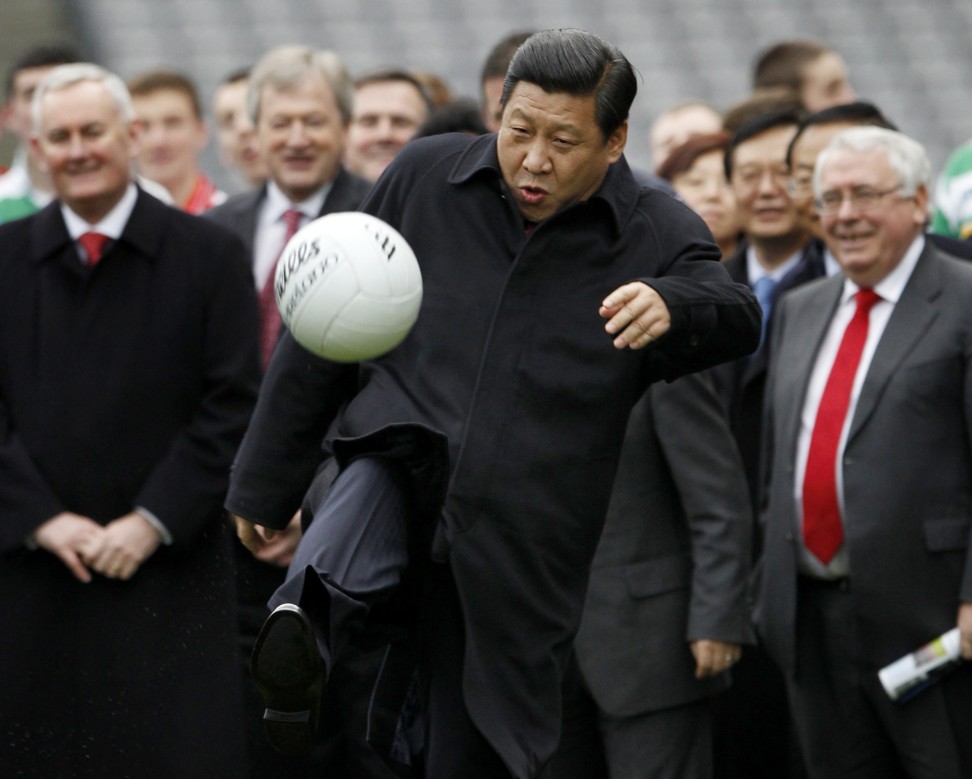
Naturalisation has a long history in many countries, but it is a new concept in China, whose football association only publicly announced it would use it to boost its talent pool late last year. President Xi Jinping’s passion for the game and ambitions for China to host and maybe one day win the World Cup has been public knowledge since before he became leader.
Chinese President Xi Jinping, pictured on a 2012 visit to Croke Park in Dublin while still vice-president, has big dreams for China’s soccer team. Photo: Reuters

John Hou Saeter, who was born to a Norwegian father and Chinese mother, in February became the first professional footballer to switch to Chinese citizenship. The 21-year-old, now known as Hou Yongyong, plays for Beijing Sinobo Guoan, one of the top teams in the Chinese Super League.

Another English player, Tyias Browning, recently joined Guangzhou Evergrande Taobao and is set to complete the process of applying for Chinese citizenship soon, Reuters reported last month.

Yennaris’ naturalisation may help bring China into 21st century
At a work conference in December, Du Zhaocai, the Communist Party secretary of the

Chinese Football Association

(CFA), promised to introduce new policies on naturalisation to help clubs attract players from overseas to join the Super League.

Professor Chen Xiyao from Shanghai University of Sport said such a move would have been unthinkable in the past.

“This is something new in China,” he said. “In the past we only saw our own athletes becoming naturalised citizens of other countries, but not foreign players coming to play for us.”

While the trend was undoubtedly prompted by Xi’s ambitions, Chen said it was also linked to the country’s growing economic prowess and wealth.

“China’s economic growth means it has become better known internationally. Everybody thinks China has money and sports clubs are spending huge sums to attract top players,” he said.

Former Everton player Tyias Browning now plays for Guangzhou Evergrande Taobao. Photo: Reuters

Mark Dreyer, founder of the China Sports Insider website, said naturalised players were motivated not only by money, but also the chance to increase their exposure and possibly play in a major tournament, which they would otherwise not get the chance to do.

“The rewards for the players are fairly clear: more money, more exposure and a shot at playing in the biggest tournaments in the world with China, which they wouldn’t have got if they’d stayed with their original countries,” he said.

“For athletes of Chinese descent, there will also be varying degrees of patriotism built into this as well.”

It is not just soccer players who are making the move top China. It is also happening in other sports, like ice hockey and figure skating.

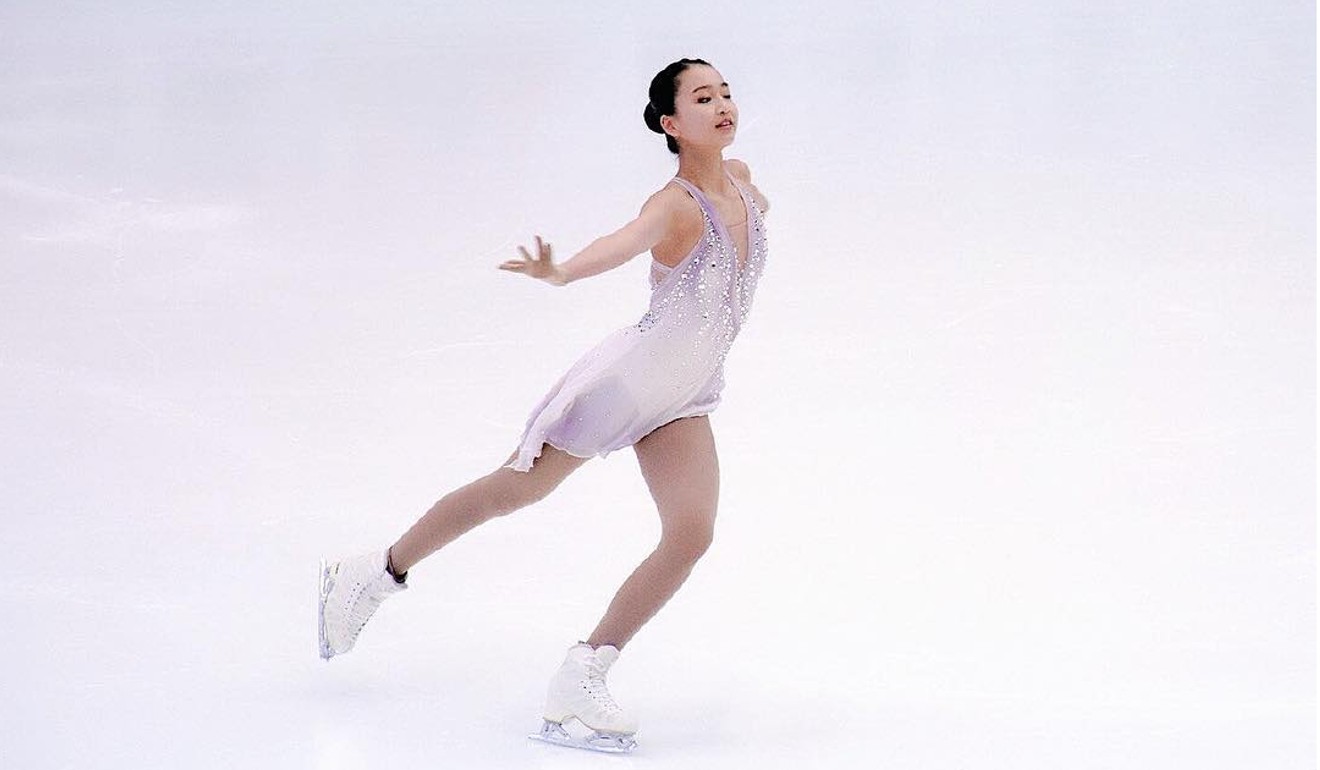
US-born Beverly Zhu, who won the 2018 US Figure Skating Championships, triggered a heated discussion in China after she joined the Chinese team last year, which means she can compete for the host nation at the Beijing 2022 Winter Olympics.

In ice hockey, a number of overseas players have also been naturalised, including Zach Yuen from Canada, who may also represent China in Beijing in 2022.

Beverly Zhu, who won the 2018 US Figure Skating Championships, joined the Chinese team last year. Photo: Instagram

Roy Chu, a lawyer with Links Law Offices in Shanghai who specialises in the sports industry, said that as China does not recognise dual nationality, foreigners have to give up their citizenship if they want to get a Chinese passport and apply for naturalisation.

“Therefore, the players to be naturalised have to be willing to represent China on the one hand, and on the other have a Chinese family background so as to simplify the legal procedures,” Chu said.

Browning’ grandfather and Yennaris’s mother are Chinese.

Dreyer said: “The players who choose to swap clearly think that the rewards outweigh the negatives of trading in their passport for a Chinese one.”

Under Chinese law, only foreigners with Chinese ancestry or those who have lived in China for at least five years can apply for Chinese citizenship. All but one of the sportsmen and women who have so far made the switch have Chinese ancestry.

The exception is Pedro Delgado, who was born and raised in Portugal but now plays for Shandong Luneng. He gained his Chinese citizenship last month and, according to the club, is the first foreign player without Chinese ancestry to become naturalised.

John Hou Saeter, who was born to a Norwegian father and Chinese mother, in February became the first professional footballer to switch to Chinese citizenship. Photo: Instagram

The naturalisation process is the same for sportspeople as it is for anyone else.

“The list of paperwork required by the Ministry of Public Security is quite short, but it doesn’t specify how long it takes to finish each step. So in that sense there is quite a lot of uncertainty,” Chu said.

“Those with Chinese ancestry will become the top targets for naturalisation in the short term so clubs can improve their talent pool, while those without may need more policy support,” he said.

London-born Nico Yennaris recently became the first foreign player to join China’s national soccer team as a naturalised citizen. Photo: AFP

Naturalised players also faced many challenges in China, especially if they did not speak the language or knew little about the culture, he said.

“Aside from settling into a completely different environment, they may also face resentment from their teammates, especially if those players lose their places in the team to the new arrivals,” Dreyer said.

“If the national team has several naturalised players, cliques could develop. We saw this in the US football team, when several German-born Americans were drafted in to play for the national team, causing internal rifts.”

And if the “foreign” players did not perform to the highest standards, the fans might also turn on them, he said.

Xi Jinping has made no secret of his desire to improve China’s and supports events at the school level. Photo: EPA
Under a

CFA directive

issued in March, footballers who become Chinese citizens must be also be educated to be patriotic and learn about the Communist Party. Clubs must also issue monthly reports on how the new players are settling in.

Grass-roots organisations within the Communist Party of China would be “in charge of educating such footballers on the history and basic theory of the party”, it said.
Dreyer said that while the naturalisation process might help China’s ice hockey team to perform slightly better at the 2022 Olympics than it had in the past, it was unlikely to have much of an impact on China’s international soccer ranking. China’s national team has only once qualified for the World Cup, in 2002.
“There is a reason they [naturalised players] didn’t play internationally for their original countries – they weren’t considered good enough,” he said.
“So they are not suddenly going to turn into world-beaters simply by pulling on a Chinese jersey.”
Chen agreed.
“I think it is just a short-term measure that will not truly change China’s overall performance in football or other sports,” he said. “After all, it’s an 11-person team game.”
Source: SCMP
05/07/2019

Joint law enforcement on environment in Beijing-Tianjin-Hebei region

SHIJIAZHUANG, July 4 (Xinhua) — Authorities in Beijing, Tianjin and Hebei will conduct joint law enforcement in environment-related areas from 2019 to 2020.

That was learned from a working meeting, held Wednesday in Langfang of Hebei Province, on joint law enforcement involving ecology and environment in Beijing, Tianjin and Hebei.

The campaign is aimed at handling cases of cross-region environmental pollution and related violations.

The authorities will inspect industries, with priority going to polluters such as printing, furniture-making, medicine and pesticide, and rubber products. They will also inspect water resources in regional border areas.

China pledged to coordinate its efforts on environmental protection and economic development in 2019. It promised to push for better air quality with better regional coordination and heavy-polluter revamps, according to the Ministry of Ecology and Environment.

Source: Xinhua

Law of Unintended Consequences

continuously updated blog about China & India

ChiaHou's Book Reviews

continuously updated blog about China & India

What's wrong with the world; and its economy

continuously updated blog about China & India