Chindia Alert: You’ll be Living in their World Very Soon
aims to alert you to the threats and opportunities that China and India present. China and India require serious attention; case of ‘hidden dragon and crouching tiger’.
Without this attention, governments, businesses and, indeed, individuals may find themselves at a great disadvantage sooner rather than later.
The POSTs (front webpages) are mainly 'cuttings' from reliable sources, updated continuously.
The PAGEs (see Tabs, above) attempt to make the information more meaningful by putting some structure to the information we have researched and assembled since 2006.
BEIJING, June 23 (Xinhua) — Air quality improved in Chinese cities in the first five months of 2019, according to the Ministry of Ecology and Environment (MEE).
Some 337 Chinese cities enjoyed good air quality on 80.3 percent of days from January to May this year, up 0.6 percentage points from the same period last year. Nearly 120 cities met the air quality standards, including 20 cities joining this year, data of MEE showed.
The average PM2.5 density, a key indicator of air pollution remained unchanged at 44 micrograms per cubic meter over the period and the average density of PM10 and sulfur dioxide fell 2.6 percent and 13.3 percent respectively year on year.
Haikou, Lhasa and Shenzhen ranked top three on the list of 168 cities’ air quality in the first five months while cities in the provinces of Hebei, Henan and Shanxi lagged behind.
Several regions saw a decrease in PM2.5 in May 2019, with that in Beijing-Tianjin-Hebei region and Yangtze River Delta down 16.7 percent and 8.6 percent year on year respectively.
China pledged to coordinate its efforts on environmental protection and economic development in 2019.
The country vowed to reduce imports of solid waste and push for better air quality with better regional coordination and heavy-polluter revamps, according to the ministry.
BEIJING, June 22 (Xinhua) — Chinese President Xi Jinping on Saturday exchanged greetings with his Irish counterpart Michael D. Higgins on the 40th anniversary of the establishment of bilateral relations.
Since the forging of the diplomatic ties 40 years ago, the two countries have been adhering to the spirit of mutual respect, treating each other on an equal footing, mutual benefit and win-win to push forward healthy and stable development of the bilateral relations and scored fruitful achievements in exchanges and cooperation in various fields, Xi said in a congratulatory message.
President Higgins paid a state visit to China in 2014 and the two heads of state conducted in-depth and friendly exchanges and mapped out a blueprint of China-Ireland relations, Xi recalled.
The Chinese president said he attaches high attention to advancing the ties between China and Ireland and stands ready to make joint efforts with President Higgins to lift the mutually beneficial strategic partnership to a new stage to benefit the two countries and peoples while taking the 40th anniversary as a new starting point.
For his part, Higgins said in a message that, over the last four decades, the bilateral ties have become even stronger as time goes by and pragmatic cooperation in various fields have been increasingly deepening.
The Irish side highly values developing ties with China and is willing to further explore potentials for pragmatic cooperation, boost coordination on safeguarding multilateralism and other global affairs and promote the Ireland-China ties toward further development, he added.
Also on Saturday, Chinese Premier Li Keqiang and Irish Prime Minister Leo Varadkar exchanged congratulatory messages.
Li said China, with the opportunity of the 40th anniversary of the establishment of diplomatic ties, is ready to work with Ireland to push the two countries’ mutually beneficial strategic partnership and friendly cooperation to continuously move forward.
Varadkar said that China’s reform and opening up and achievements in development carry global significance, noting that the Irish side will continue to fully develop Ireland-China partnership based on the spirit of mutual respect.
Photo taken on June 20, 2019 shows scenery at Caohai National Nature Reserve in Weining County, southwest China’s Guizhou Province. Caohai Lake, a major wetland in southwest China and an important wintering place for black-necked cranes, has recovered its original size. The lake once shrank sharply due to pollution and farming practices. (Xinhua/Tao Liang)
Stalled denuclearisation talks also expected to be on the agenda when Chinese president meets Kim Jong-un this week
Analysts say Korean peninsula has become intense diplomatic battleground between Beijing and Washington
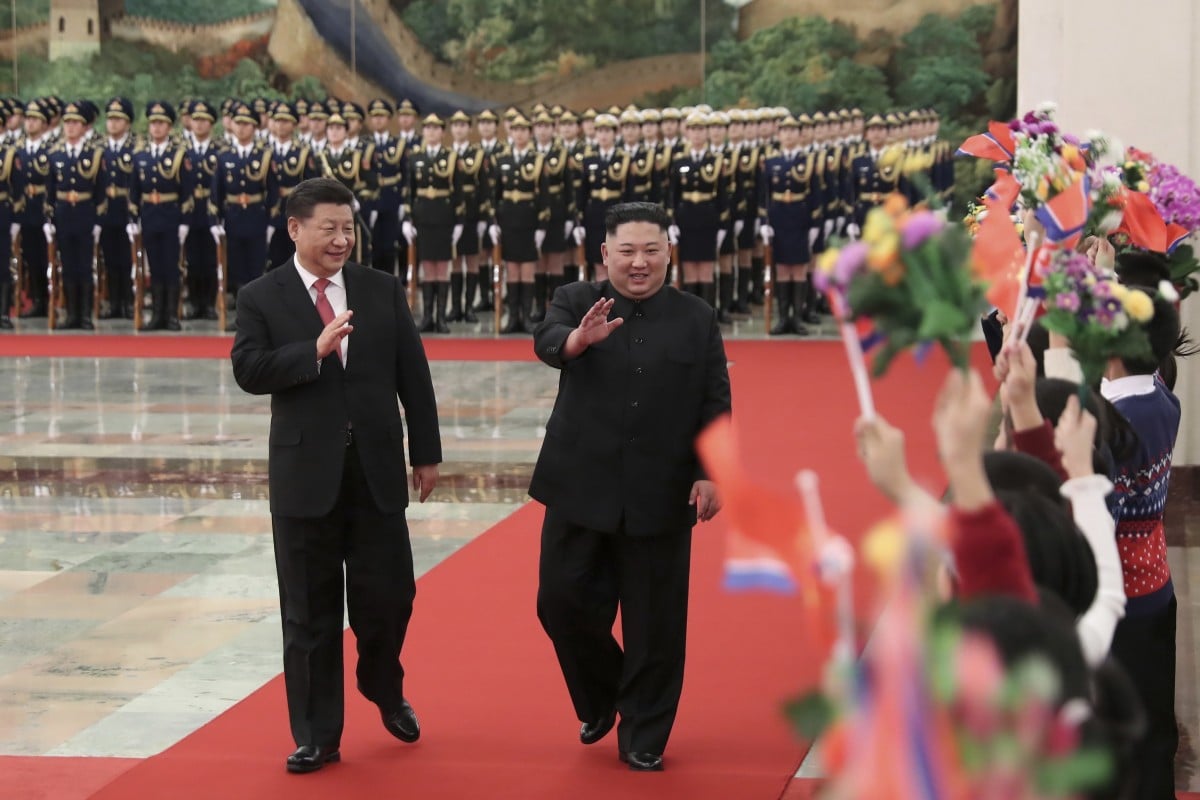
North Korean leader Kim Jong-un (right) attends a welcome ceremony in Beijing with Chinese President Xi Jinping in January. Xi will begin a visit to Pyongyang on Thursday. Photo: AP
will be a state visit – a higher status than the last trip to the hermit kingdom by a Chinese president, highlighting the close bilateral ties between Beijing and Pyongyang.
, is the first by a Chinese president to North Korea in 14 years and comes just a week before he is due to meet US President Donald Trump for talks on the sidelines of the Group of 20 summit in Japan.
“Leaders of the two countries will review the development of the bilateral relationship and carry out an in-depth exchange of opinions on the development of Sino-North Korean relations in the new era, and chart the future course of development,” state news agency Xinhua reported on Tuesday.
Xi’s predecessor, Hu Jintao, went to North Korea in October 2005 on a three-day trip described as an “official goodwill” visit.
Speaking at a regular press briefing in Beijing on Tuesday, foreign ministry spokesman Lu Kang said Xi’s visit aimed to “inject new impetus” into relations in the year the two countries marked the 70th anniversary of establishing diplomatic ties, and to give stalled denuclearisation talks a much needed push.
“Regarding the progress on denuclearisation, as I said, the result of the Hanoi leaders’ meeting in February was indeed a little unexpected. But after that, everyone actually looks forward to the resumption of dialogue in a good direction,” Lu said, referring to the failed talks between Trump and North Korean leader Kim Jong-un in the Vietnamese capital four months ago.
Trump hinted at the possibility of another meeting with Kim after receiving what he called “a beautiful letter” from the North Korean leader last week. On Tuesday, South Korea’s chief nuclear negotiator, Lee Do-hoon, said the US had been in contact with the North.
Life in North Korea the ‘admiration and envy’ of others, state media says
Washington will also send US Special Representative for North Korea Stephen Biegun to South Korea next week, days after Xi’s visit to Pyongyang, to fully align its position on North Korea with its ally.
Meanwhile, Trump confirmed he would meet Xi for talks in Osaka next week, saying in a tweet on Tuesday they had “a very good telephone conversation” and would hold “an extended meeting” at the G20 summit, where they are
Had a very good telephone conversation with President Xi of China. We will be having an extended meeting next week at the G-20 in Japan. Our respective teams will begin talks prior to our meeting.
Analysts said the Korean peninsula had become an intense diplomatic battleground between Beijing and Washington.
Cha Du-hyeogn, a visiting research fellow at the Asan Institute for Policy Studies in Seoul, said China and the US were competing for influence over the peninsula.
“The US and China are seeking a greater sphere of influence in the region. After the Singapore summit between Trump and Kim last year, the US and North Korea are the only key players on peninsula matters. China may want to restore its influence and become a major player,” Cha said.
“But China is less likely to have a so-called strategic competition with the US – that is to say, it won’t challenge the US-led sanctions regime and its goal in achieving North Korea’s denuclearisation. In fact, it is likely to persuade Kim to come to the negotiating table for complete denuclearisation.”
Chinese tourists flood North Korea as Beijing remains Pyongyang’s key ally
Pyongyang has demanded the lifting of sanctions imposed on the regime following its nuclear and missile tests, while Beijing has said the livelihoods of North Koreans should not be affected. But Washington insists full sanctions should remain in place.
The US has also voiced scepticism about Chinese compliance with the sanctions. At a security summit in Singapore earlier this month, US acting Pentagon chief Patrick Shanahan – who on Wednesday stepped down from his role
– presented his Chinese counterpart Wei Fenghe with photographs and satellite images of North Korean ships transferring oil near China’s coast.
Analysts said Xi would seek to use the visit to boost China’s diplomatic leverage on the North Korean nuclear front, strengthening its hand in dealing with the US.
Exports from North Korea to China, which account for the bulk of its trade, plunged 87 per cent last year from 2017, and the country has faced other economic problems at a time when Kim has vowed to deliver on the economy.
A diplomatic source said China was expected to offer a large amount of humanitarian assistance, such as food and fertiliser, to North Korea, which could weaken the impact of sanctions.
China’s goal of denuclearisation on the Korean peninsula is unwavering and will not changeLu Chao, North Korean affairs expert at Liaoning Academy of Social Sciences
Communist Party mouthpiece People’s Daily on Tuesday said via its social media account that Xi would discuss economic and trade cooperation with Kim during the visit.
Quoting Zheng Jiyong, director of the Centre for Korean Studies at Fudan University in Shanghai, the newspaper said Pyongyang had taken steps to reform its economy and introduced China’s industrial manufacturing blueprint.
In September, Beijing proposed building a rail link from the city of Dandong, in China’s northeastern Liaoning province, to Pyongyang and then on to Seoul and Busan in the South, as well as a new road between Dandong and Pyongyang through Sinuiju.
Lu Chao, a North Korean affairs expert at the Liaoning Academy of Social Sciences, said large-scale economic cooperation between China and North Korea was unlikely because of the sanctions, but smaller moves were possible.
Chinese tourists flood North Korea as Beijing remains Pyongyang’s key ally
“For example, China may export daily necessities to North Korea. And if it’s needed, China is very likely to provide [food] assistance to North Korea,” Lu said. “I believe the UN sanctions on North Korea should change, because it has shown a more substantive approach to [achieving] denuclearisation.”
But analysts said Beijing remained firm on the need for Pyongyang to honour its pledges so that denuclearisation could be achieved.
“China’s goal of denuclearisation on the Korean peninsula is unwavering and will not change … China supports [North Korea] and the US continuing to hold talks,” Lu said.
Beijing also had an important part to play in the peace process, according to Boo Seung-chan, an adjunct professor at the Yonsei Institute for North Korean Studies in Seoul.
“China can have a positive role as a mediator to facilitate the peace process on the Korean peninsula,” Boo said.
Leader will arrive on Thursday, ahead of G20 summit in Osaka, foreign ministry says
He is expected to hold talks with Donald Trump on sidelines of meeting
China has confirmed that President Xi Jinping will travel to japan this week. Photo: AFP
China on Sunday confirmed that President Xi Jinping will attend the G20 summit in Osaka this week.
Xi will spend three days in Japan – his first visit to the country since coming to power in 2013 – the foreign ministry said.
He will travel to Japan on Thursday and is expected to meet his US counterpart Donald Trump on the sidelines of the meeting of leading and emerging economies, which runs from Friday to Saturday, it said.
It is possible the pair will hold formal negotiations over dinner, as they did in Argentina in December at the last G20 summit.
Presidents Xi and Trump are expected to hold talks over dinner, as they did in Argentina in December. Photo: Kyodo
On Saturday, People’s Daily, the mouthpiece of China’s Communist Party said in a commentary that the trade war between China and the US could be resolved only through “equal conversation”.
“For the talks to resume … the key is to address the primary concern of the other side. The tariffs already in place must be revoked,” it said.
Trade deal ‘within reach if Xi and Trump show courage’
Meanwhile, state broadcaster CCTV on Friday criticised Washington’s decision to add five Chinese companies to its list of entities considered a threat to national security.
“The US made this move to put more pressure China ahead of the trade talks,” it said, adding that it might produce a result opposite to the one desired by Washington.
The report came after the US commerce department said it had added five Chinese firms that manufacture supercomputers and their components to the entity list, restricting their ability to do business with the US.
The blacklist effectively bars American firms from selling technology to the Chinese organisations without government approval. Last month, the commerce ministry added telecoms giant
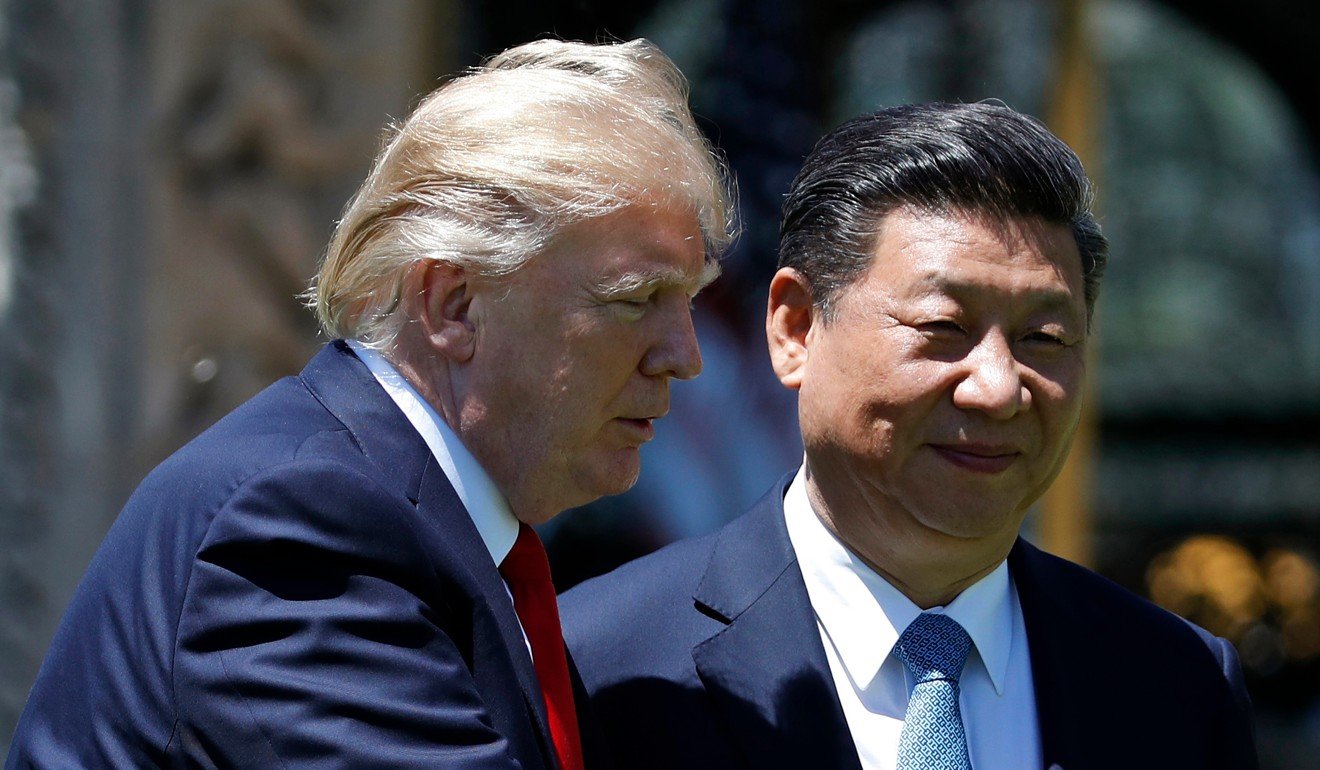
Xi told Trump on Tuesday he was willing to meet in Japan. Photo: AP
In a telephone conversation on Tuesday, Xi told Trump he was willing to meet in Japan and said he “agreed that the two countries’ trade delegations should keep communications going to solve their differences”, CCTV reported.
Kong Xuanyou, China’s new envoy to Japan, said on Friday that he hoped Xi would make an official visit to the country soon, ideally during the cherry blossom season next spring. The foreign ministry statement made no mention of such a visit.
BANGKOK (Reuters) – Southeast Asian leaders agreed on Sunday to work together on regional economy and security to strengthen their positions amid growing U.S.-China tensions, as they wrapped up this year’s first summit in Bangkok.
The 10-member Association of Southeast Asian Nations (ASEAN) will need its collective economic strength for bargaining power globally, especially amid the trade tensions between the world’s top two economies, Thai Prime MinisterPrayuth Chan-ocha told a news conference, as chairman of the 34th ASEAN Summit.
Prayuth urged ASEAN nations to complete negotiations this year for the China-initiated Regional Comprehensive Economic Partnership (RCEP) pact that includes 16 countries.
“This will help ASEAN handle the changes and uncertainty that will happen in the region going forward, particularly the impacts of trade tension between ASEAN’s important trade partners.”
Negotiations began in 2012 on RCEP, which envisions the creation of a free trade zone encompassing 45% of the world’s population and more than a third of its GDP, but does not involve the United States.
First proposed by China, RCEP’s 16 signatories include the 10 ASEAN member states and six Asia-Pacific countries, including major economies China, India, Japan and South Korea. ASEAN has existing free-trade agreements with all six countries.
“If we can do this, we will have the bargaining power and base for negotiation. Because when combined, we are 650 million people, the largest regional bloc in the world,” the Thai prime minister said.
Four ASEAN countries – Thailand, Indonesia, Singapore and Vietnam – will discuss the trade war in next week’s G20 summit, which assembles 20 major economies, in Tokyo, Prayuth said.
ASEAN countries also agreed on a common approach on a U.S.-led Indo-Pacific initiative, at a time when U.S.-China tensions were rising and forcing ASEAN countries to take sides.
Prayuth hailed the bloc’s agreement on the ASEAN Outlook on the Indo-Pacific as a “significant step” for the region.
The endorsed outlook document, seen by Reuters, acknowledges “maritime issues such as unresolved maritime disputes that have the potential for open conflict” as existing and emerging geopolitical challenges.
It outlines maritime cooperation “for peaceful settlement of disputes”. It also aims for connectivity in the Indo-Pacific region.
Guo Shengkun (R), a member of the Political Bureau of the Communist Party of China (CPC) Central Committee and head of the Commission for Political and Legal Affairs of the CPC Central Committee, meets with acting Portuguese Prime Minister and Minister of Foreign Affairs Augusto Santos Silva in Lisbon, Portugal, on June 21, 2019. (Xinhua)
LISBON, June 21 (Xinhua) — Senior Chinese official Guo Shengkun on Friday stressed the importance of raising the level of cooperation on law enforcement and security with Portugal.
Guo is a member of the Political Bureau of the Communist Party of China (CPC) Central Committee and head of the Commission for Political and Legal Affairs of the CPC Central Committee.
In meeting with acting Portuguese Prime Minister and Minister of Foreign Affairs Augusto Santos Silva, Guo said that the exchange of visits by leaders of the two countries within half a year reflects the high level of China-Portugal relations and injects new impetus into the development of bilateral ties.
This year marks the 40th anniversary of the diplomatic relations between the two countries. China is willing to take the opportunity to work together with Portugal to implement the important consensus reached by the leaders of the two countries, Guo said.
China, Guo said, is also ready to deepen cooperation in economy and trade, education, science and technology as well as the joint building of the Belt and Road Initiative.
Guo said the two sides should strengthen communication and coordination under the framework of China-European Union (EU) cooperation and multilateral institutions to promote the long-term healthy and stable development of China-EU relations, and jointly safeguard multilateralism and free trade.
Guo also said that the cooperation on law enforcement and security is an important part of the relationship between the two countries, stressing the need to establish a normalized cooperation mechanism to continuously promote the level of cooperation on the law enforcement, security and anti-terrorism to meet the demand of increasing trade and personnel exchanges, so as to make contributions to the development of China-Portugal comprehensive strategic partnership.
As acting prime minister, Silva welcomed Guo’s visit and highly praised the fruitful results of the exchanges and cooperation between Portugal and China in various fields.
Silva said Portugal is willing to work together with China to continue to tap the potential for pragmatic cooperation in the fields of economy and trade, law enforcement and security, strengthen coordination in international affairs, and promote the continuous development of Europe-China and Portugal-China relations
Silva also said that his country supports and is willing to actively participate in the joint building of the Belt and Road Initiative.
During the visit, Guo also held talks with head of the Portuguese law enforcement and security departments.
LONDON, June 21 (Xinhua) — Chinese Ambassador to the United Kingdom Liu Xiaoming on Friday said he trusted that Britain will make its decision independently, in the UK’s national interest and in the interest of Sino-UK cooperation.
Liu said in an exclusive interview with Sky News that even though there have always been differences between China and Britain, these differences have not prevented the countries from working for the common good.
Liu said Huawei is a good company and it has made its contribution to the telecom industry in the country.
The Ambassador said Huawei is the leader in 5G technology. “I do hope that the UK will keep Huawei for the benefit,” he said.
Beijing-based hi-tech firm says its technology keeps real-time tabs on firearms and is already in use in the military
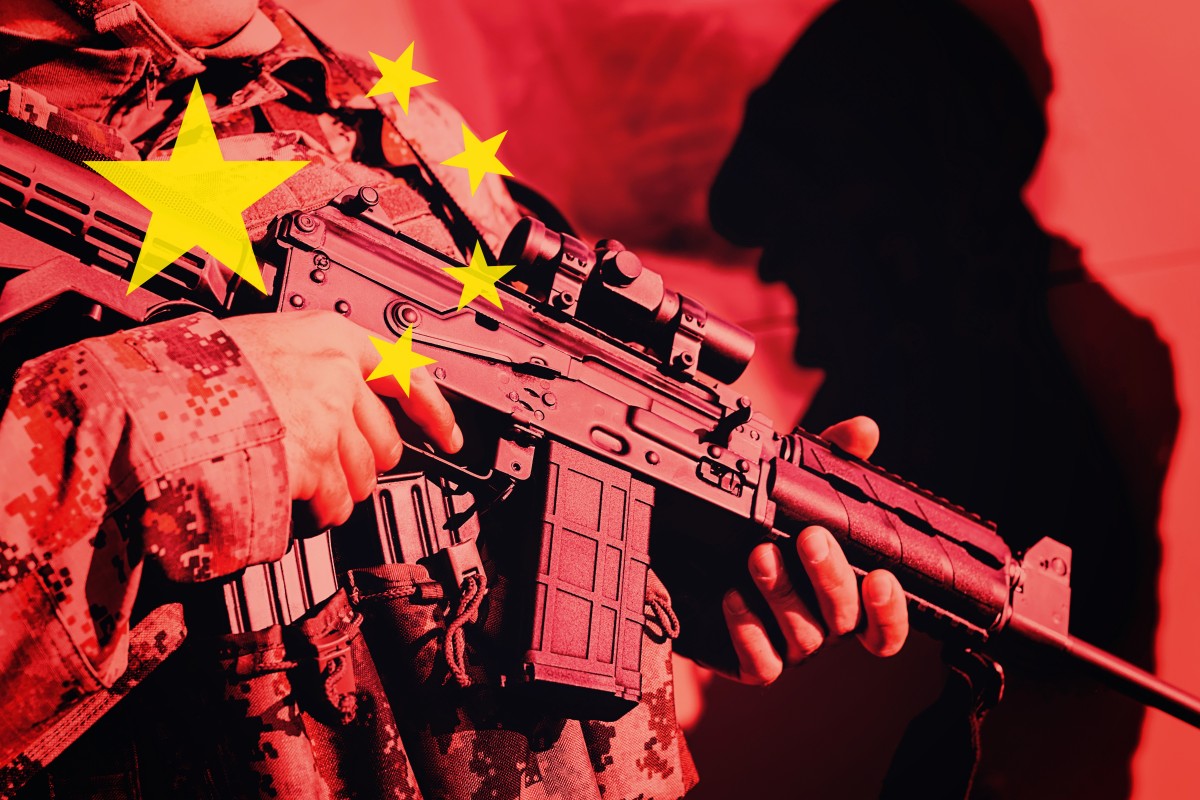
A Chinese company has developed a chip to track the location of firearms. Photo: Shutterstock
China has developed a satellite positioning chip to pinpoint the location of firearms and trigger an alert when guns are taken out of designated areas, according to a Chinese hi-tech firm.
Beijing Bailineng Technology, the developer of the technology, said in Beijing that the chips used China’s BeiDou Navigation Satellite System to send real-time location data back to a control centre.
Authorised handlers of the weapons would also be issued with BeiDou watches to send alerts if they are separated from their firearm, with the aim of stopping the weapons falling into the hands of criminals.
“At the moment the accuracy of positioning is about 3 metres,” Ge Chunsheng, a company spokesman, said at a defence equipment fair which ended on Thursday.
“The chips are built in inside, can’t be seen from the outside and very difficult to remove … without damaging the gun.”
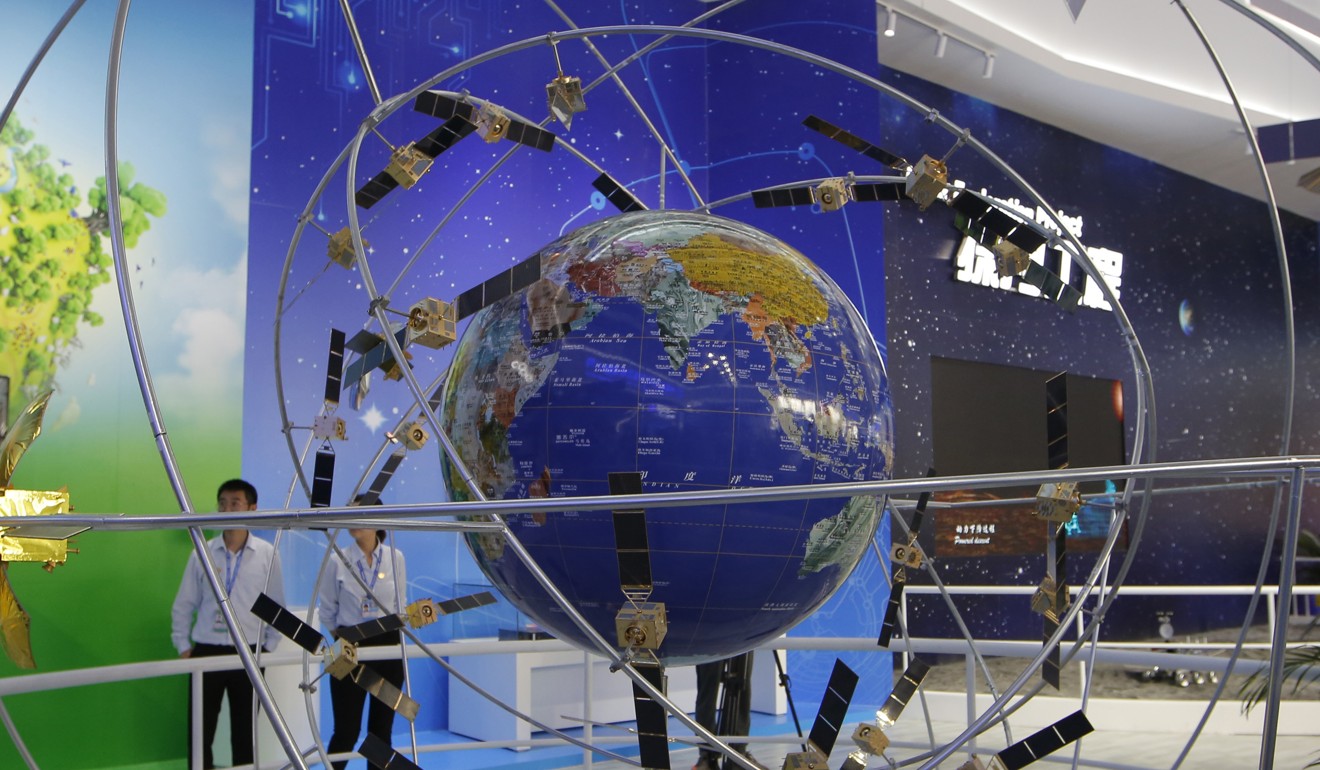
The chips use the BeiDou Navigation Satellite System to relay real-time data to a control centre. Photo: AP
China has strict gun control regulations banning civilians from owning firearms. Only the military, police and some specific personnel such as armed transport crews can legally possess firearms.
Previous gun-tracking systems relied on the US-owned and operated Global Positioning System (GPS). But China hopes the BeiDou system, set to be completed in 2020, will be able to replace GPS in China and compete with it globally.
China adds new satellite to its Beidou network that aims to rival US global positioning system
BeiDou was developed for military use but also has civilian applications. It began to cover parts of China in 2000, and launched a basic global service in December 2018.
The Chinese government has ordered all of its buses, heavy trucks and fishing boats to install BeiDou technology for real-time monitoring and tracking. As of 2017, 22 million vehicles and 50,000 vessels had been equipped with BeiDou terminals.
Image copyright AFPImage caption Decorated elephants lead the procession at the Jagannath temple’s annual festival in Ahmedabad
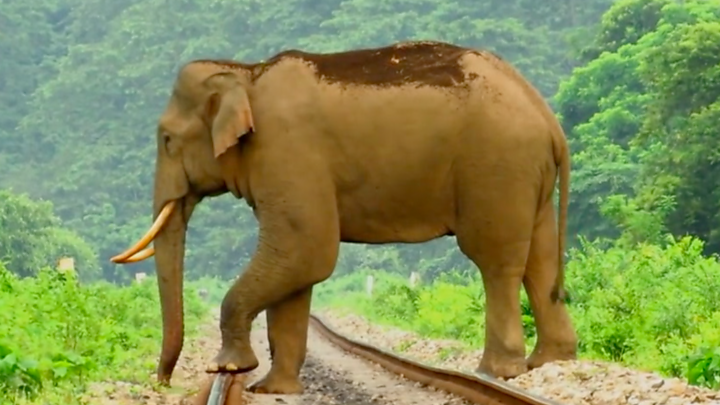
Animal rights activists in India have criticised a plan by the Assam state government to send four elephants on a perilous train journey of more than 3,100km (1,926 miles) to participate in a temple ritual. They say the long journey could be dangerous for the animals and may even kill them, writes the BBC’s Geeta Pandey in Delhi.
The elephants are to be moved from Tinsukia town in the north-eastern state of Assam to the extreme west of the country – Ahmedabad city in Gujarat state.
Reports say the railway authorities in Assam, who have been asked to make travel arrangements for the elephants, are looking for a coach to transport them.
No date is set for their departure yet, but they are expected to reach Ahmedabad before 4 July to participate in the annual Rath Yatra (chariot procession) at the Jagannath temple. The train journey is expected to take three to four days.
In previous years, Prime Minister Narendra Modi, who hails from Gujarat, has participated in the festival and the elephant procession, although temple officials say he’s not expected to attend this year.
Temple trustee Mahendra Jha told BBC Gujarati that they decided to “borrow” the animals from Assam “for two months” because three of their own elephants died from old age last year.
But activists and conservationists say the plan to move the elephants is “cruel and completely inhuman”, especially since temperatures are more than 40C (104F) in many places along the northern Indian route these elephants are expected to take.
Media caption Human-elephant conflict destroying lives in India
“Most of north-western India is reeling under a heatwave. There have been reports of people dying from heat during train journeys,” Kaushik Barua, a wildlife conservationist based in the Assam state capital, Guwahati, told the BBC.
“The wagon in which the elephants will be transported is not climate-controlled. It will be hitched to a passenger train which will be travelling at a speed of 100km/h (62mph), so can you imagine the plight of the animals?”
Mr Barua warns the journey may prove “dangerous” for the animals.
“They can suffer from heatstroke, from shock, and even die.”
Under the law, he says, there’s no problem moving these elephants since all the paperwork is in order, “but where’s the animal welfare?”
Also weighing in on the debate is the opposition Congress party MP from Assam, Gaurav Gogoi, who’s petitioned India’s Environment Minister Prakash Javadekar to intervene.
“Roughly half of the country is struggling through its worst drought in six decades…. These are extreme conditions for the elephants to travel… The elephants may suffer from acute skin infection and dehydration,” Mr Gogoi wrote in his letter on Thursday.
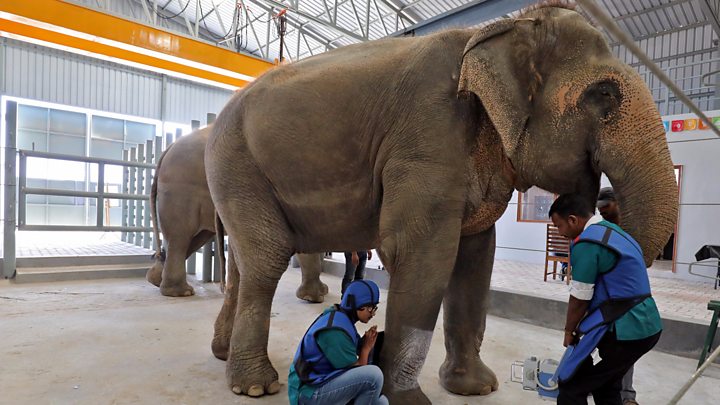
Media caption India’s first elephant hospital is run by the charity Wildlife SOS
“Therefore, I request the central government to intervene and instruct the state government to withdraw the decision as soon as possible.”
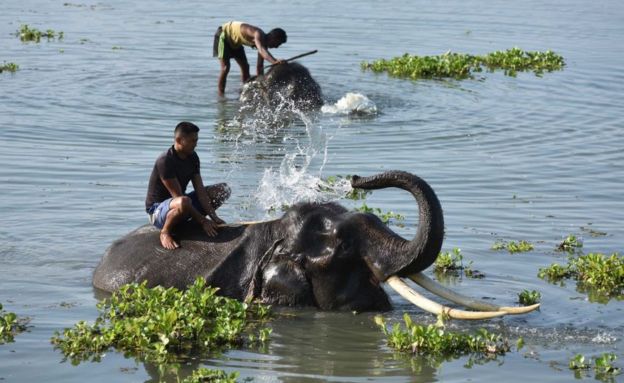
Elephants – both wild and captive – are a protected species in India and there are strict guidelines for their transportation, wildlife biologist Dr Bibhuti Prasad Lahkar told the BBC.
According to the rules, no elephant can be made to walk for more than 30km (18 miles) at a stretch or transported for more than six hours in one go.
The state’s wildlife officials, who’ve issued transit permits for the elephants, have so far refused to comment on the controversy. But after protests from activists and conservationists, “they have gone into a huddle, discussing a plan B,” according to a wildlife expert.
Image copyright GETTY IMAGESImage caption Elephants are a protected species in India
“There’s some suggestion that the pachyderms may be moved in trucks to allow them the flexibility to stop if needed and that they could be accompanied by a forest department veterinarian to look after them,” he said.
Mr Barua, however, is blunt.
“Gujarat doesn’t need these elephants,” he says. “Wildlife laws prevent [the] display and exhibition of elephants. Laws ban performances by elephants in circuses, zoos are not allowed to exhibit them, so why should temples be allowed to use them in rituals or processions? Don’t elephants have rights?
“We worship Ganesha, the Elephant God. Why are the Gods then being put through such cruelty by a temple?”