22/06/2019

India asks scooter, bike makers to draw up plan for EVs – sources

NEW DELHI (Reuters) – India’s federal think-tank has asked scooter and motorbike manufacturers to draw up a plan to switch to electric vehicles, days after they publicly opposed the government’s proposals saying they would disrupt the sector, two sources told Reuters.

Niti Aayog officials met with executives from companies including Bajaj Auto, Hero MotoCorp and TVS late on Friday, giving them two weeks to come up with the plan, according to one of the executives.

The think-tank, which is chaired by Prime Minister Narendra Modi and plays a key role in policymaking, had recommended that only electric models of scooters and motorbikes with engine capacity of more than 150cc must be sold from 2025, sources have told Reuters.

Automakers opposed the proposal and warned that a sudden transition, at a time when auto sales have slumped to a two-decade low, would cause market disruption and job losses.

India is one of the world’s largest two wheeler markets with sales of more than 20 million scooters and motorbikes last year.

During Friday’s meeting government officials argued that switching to EVs is of national importance so India does not miss out on the global drive towards environmentally cleaner vehicles, one of sources said.

But industry executives responded that a premature switch with no established supply chain, charging infrastructure or skilled labour in India, could result in India losing its leadership position in scooters and motorbikes, the second source said.

“There were clearly drawn out positions,” said the source, adding there were “strong opinions” at the meeting.

Bajaj, Hero and Niti Aayog did not respond to a request for comment, while TVS declined to comment.

ELECTRIFICATION

Niti Aayog is working with several other ministries on the recommendations, which are part of an electrification effort to help India reduce its fuel import bill and curb pollution.

The proposal also includes incentives for local production of batteries, an increase ownership cost of gasoline cars and forming a policy to scrap old vehicles, according to records of government meetings seen by Reuters.

The panel has also suggested measures such as directing taxi aggregators like Uber and Ola to convert 40% of their fleets to electric by April 2026, Reuters has reported.

Executives from EV start-up Ather Energy, ride-sharing firm Ola and officials from the Society of Indian Automobile Manufacturers (SIAM), an industry trade body, also attended the meeting, the sources said.

The proposals are India’s second attempt for a switch to EVs. In 2017 it proposed an ambitious plan mainly for electric cars but rowed back after facing resistance from car makers.

The current push could disrupt the market order for two-wheelers and open up avenues for local start-ups, analysts say.

Scooter and bike start-ups like Ather, 22Motors and Okinawa are already making in-roads in India.

“It is extremely critical that we make the transition to electric quickly lest we get wiped out by another global wave,” Tarun Mehta, CEO and co-founder at Ather said.
Source: Reuters
22/06/2019

What China must do to clean up its act on waste water

  • Inadequate infrastructure and industry standards are holding the country back in the battle to save the environment, new study finds
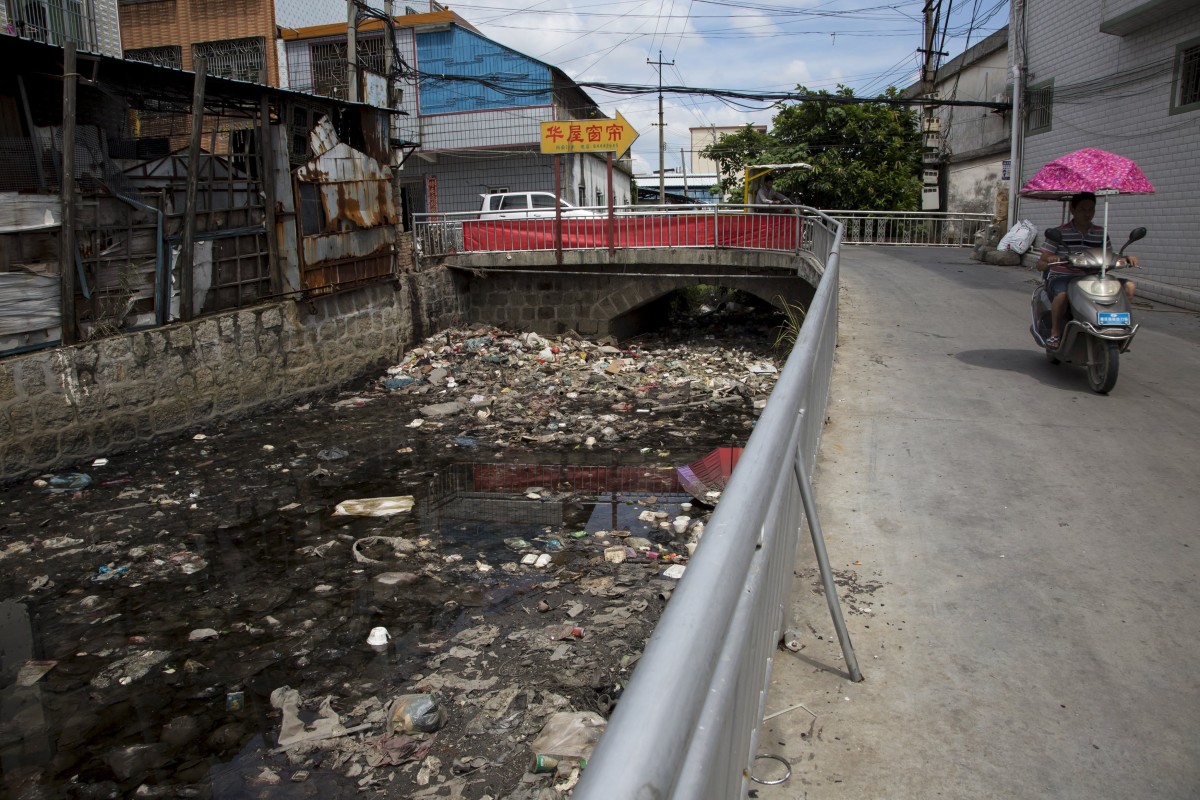
In some extreme cases, incomplete pipework meant factories in industrial parks discharged directly into waterways. Photo: Reuters
A shortage of waste water pipelines, lax local government oversight and a lack of industry standards are holding back efforts to cut industrial water pollution in China, according to a new joint study.
The research by Greenpeace and Nanjing University also found that many of the country’s waste water treatment plants were among its biggest polluters singled out by authorities.
Researchers made the assessment by examining data and reports released by the Ministry of Ecology and Environment last year. According to the reports, 243 – or 56 per cent – of the 436 major polluters fined in 2018 for excessive discharges were waste water treatment plants.
That is despite Beijing claiming to be one of the biggest processors of industrial and household waste water by volume in the world.
Fighting water pollution is part of Beijing’s pledge to fix the country’s depleted environment by 2020, one of the priorities President Xi Jinping identified at the start of his second five-year term in late 2017.
Dong Zhanfeng, deputy director of the Environmental Policy Department at the Chinese Academy for Environmental Planning, said waste water treatment was an important part of the fight against pollution.
“It’s called a ‘critical battle’ because the work is really tough,” Dong said.
China says progress made on water pollution, but battle remains

To try to curb contamination from industry, the central government has urged provincial authorities to concentrate factories in industrial parks, where infrastructure must be built to treat waste water.

The Greenpeace-Nanjing University researchers found that by the end of the third quarter last year, 97 per cent of 2,411 industrial waste water treatment plants needed for industrial parks around the country had been constructed. But not all of the completed plants were in full use because of insufficient pipes connecting factories and the treatment plants.

In extreme examples cited by the report, incomplete pipework meant two treatment plants in Hubei laid dormant for two years, forcing factories in the industrial parks to discharge directly into waterways.

In other cases, factories not linked to industrial waste water treatment plants discharged into the general sewage system, with the effluent ending up at household waste water treatment plants that could only filter part of the industrial waste.

This was the case in the southwest province of Guizhou, where a lack of pipework meant 89 of the 128 industrial parks relied on city sewage systems to treat polluted water.

Deng Tingting, a Beijing-based campaigner with Greenpeace East Asia, said conditions were a mess.

“Brand new waste water treatment plants sit unused while waste pumps into streams and rivers.

The current state of affairs is a mess, and it keeps companies from entering the growing market for waste water treatment. The decision not to shepherd this growing industry is a risky one,” Deng said.

China admits patchy progress tackling soil, water pollution, with some rivers worsening

The Ministry of Ecology and Environment estimated last year that in all China needed 400,000km (248,550 miles) of waste water pipework, costing around 1 trillion yuan (US$145 billion). The ministry did not say how much remained to be built.

Another major problem identified by the study was the lack of treatment standards for industrial waste water plants, with many plants relying on quality standards for household waste water treatment.

In addition, the researchers highlighted the problem of local governments and industrial park administrators shirking their responsibility to enforce standards.

The study called for clear demarcation of regulatory and oversight responsibilities among local environmental watchdogs, industry, industrial parks and water treatment plants.

Source: SCMP

22/06/2019

Can China sort its household waste recycling problem by 2020?

  • After two decades of inaction, Chinese President Xi Jinping has set a deadline for the nation
  • Small, local successes show education is the key
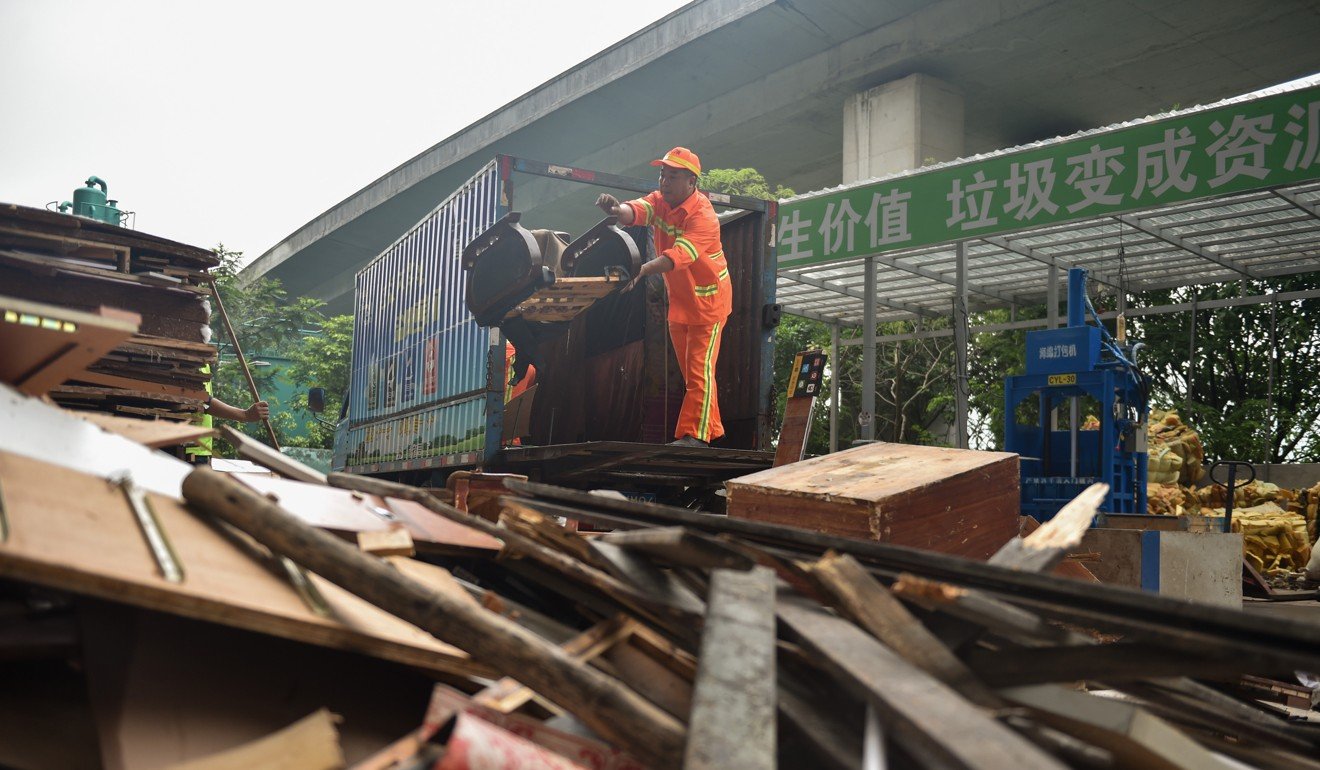
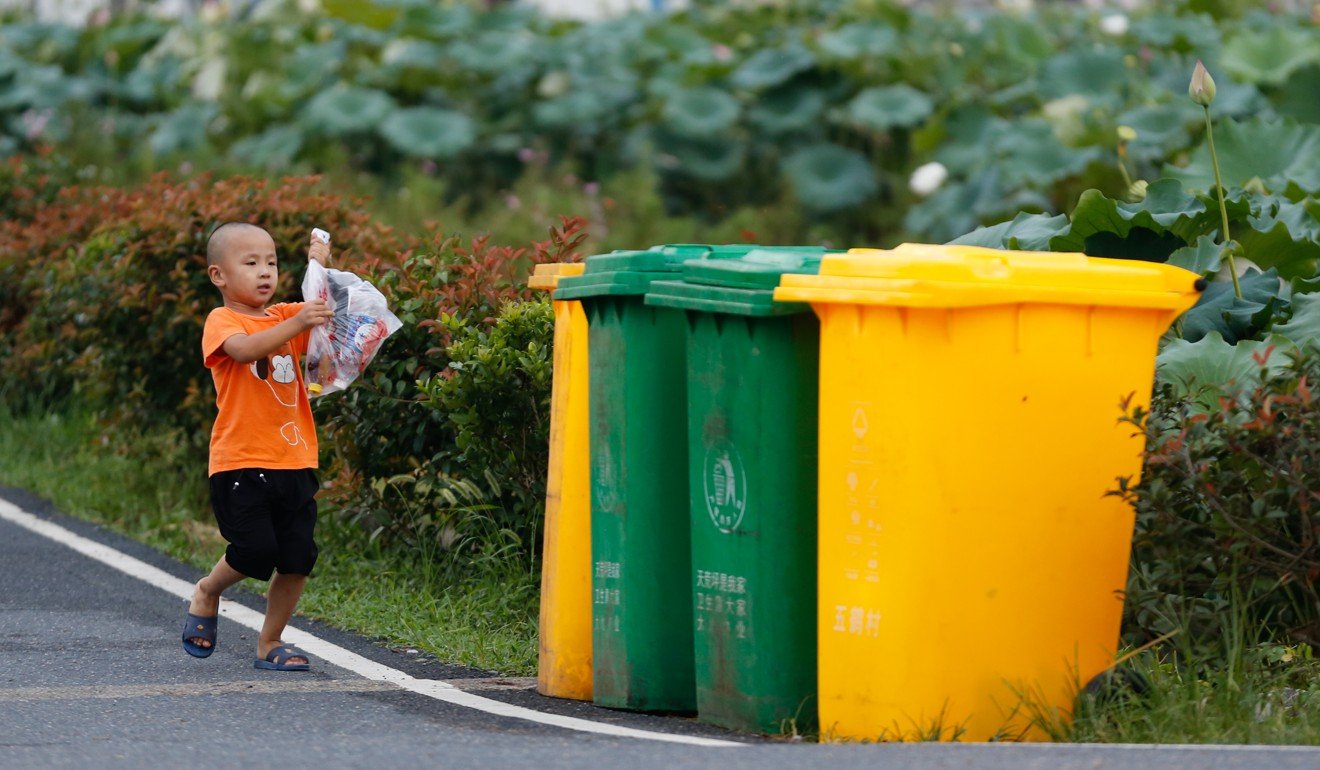
The sorting of household waste is more of a novelty than the norm in China. Photo: Xinhua
As 60-year-old Xu Mingan hurried to the rubbish bins on her Beijing estate, she saw an abandoned aluminium clothes rack.
Standing in front of several bins labelled “recyclables”, “kitchen waste” and “other waste”, she tore apart the rack, packed the aluminium parts together for selling to the recycling men who drop by occasionally, and threw the remaining plastics randomly into the bins.
“People don’t sort their waste here. We can’t even tell the difference between these bins,” she said.
But unlike other residents of the estate, Xu likes to rummage through the bins, picking up recyclables and selling them, as well as sharing discarded clothes, shoes, quilts and blankets that are still in good condition to the janitors.
The concept of sorting waste is still new in China. Photo: Xinhua

Xu, who has lived in Beijing for 10 years, admitted her family never sorted its household waste, despite two decades of encouragement from the government to do so. Her attitude may be about to change.

As part of the three major tasks Chinese President Xi Jinping has set the nation to achieve by 2020, China has adopted a new plan which aims to build a standard waste sorting system.

China must heed Xi’s call on tackling waste

In 2000, the government chose eight cities, including Beijing, Shanghai and Guangzhou, as pilots for the waste sorting plan, but the slogans fell on deaf ears and there have been few signs of progress.

But Xi appears to have given the grass-roots environmental policy his attention once more, delivering a long statement on June 3 about how the country needs to do better on sorting its waste.

“[We should have] extensive education and guidance, to let people realise the importance and necessity of waste sorting; through effective supervision and guidance, [we should] let more people take action and form a good habit on waste sorting,” he said.

In 2000 the Chinese government chose eight cities to pilot a waste sorting plan but it made little progress. Photo: Xinhua

In March 2017, the government set out a plan to formalise a standard system and regulations for rubbish sorting by 2020, with a target for 46 major cities – including Beijing – to recycle 35 per cent of their waste by that year. Three months later, the housing ministry published a notice requiring the cities to classify their waste and build a basic sorting system.

The recent attention from the top leaders has seen a spike in activity among local officials. Shanghai’s Communist Party chief Li Qiang was among the first to release local plans to implement household waste sorting in February, going in front of television cameras to demonstrate how to recycle plastic bottles.

“Waste sorting is a now a political task for local officials, and they might lose their jobs if they can’t do the job well,” said Zhang Yi, an expert with the ministry, which has primary responsibility for waste management.

G20 set to agree on ways to reduce problem of plastics in oceans

But the political will still needs time to translate into actual sorting and recycling, with environmental activists pointing out that little has been done in the two years since the plan was published.

“The vast majority of cities are still at the same level they were two years ago. They just change one bin into two or three bins in the community, but in the end, they are emptied into a single garbage truck,” said Chen Liwen, co-founder of Zero-Waste Villages, a non-government environmental organisation.

Waste classification should be done systematically, she said, with residents, government and sorting companies working together, “but we don’t have that at all”.

“The government should do a vast amount of work on education in the early stages, as well as change the sorting system in the later stage,” she said.

The recent attention from the top leaders has seen a spike in activity among local officials. Photo: Handout

Build the system

There are four main processes in the sorting of waste: dumping, collection, transport and treatment, Chen said. But currently, “not even one city has got the first step, trash sorting, sorted out”.

On May 31, China’s environment ministry published a report into its citizens’ thoughts on green issues and found a large gap between people’s recognition of the problem and their actions.

According to the study, 92 per cent of respondents believe rubbish sorting is important for environmental protection, but only 30 per cent said they were doing it “very well” or “fairly well”.

More than half gave their reasons for not sorting waste as “no classification bins in the community” and “no classification for the garbage truck, so no need to sort in the dumping process”. More than 30 per cent said they did not know how to classify their rubbish.

A government report found a large gap between people’s recognition of environmental problems and their actions. Photo: Handout

Wang Xi, a 29-year-old Beijing resident, said she did not know the standards for “recyclables” and “non-recyclables” so had never sorted her household waste. She only began to understand when she spent some time in Japan.

The difference there, she said, was that there was a guide in every home that showed how to sort waste into the different types – kitchen waste, plastic, paper – and designated collection days for each kind.

“If you mix the garbage, like put plastic in with the kitchen waste, the garbage company will send it back to you,” she said.

“But in China, all the bins are emptied into one garbage truck, so I don’t know what the point is for us to sort it in the first place.”

I don’t know what the point is for us to sort it in the first place – Beijing resident Wang Xi

Chen said the government needed to take the lead in waste sorting as a matter of public interest instead of only paying lip service to the issue.

Zhang said waste classification was a social issue but local officials had so far not paid enough attention to it. Most of the targeted 46 cities now had a plan on paper and had established offices with specific targets but, at the moment, waste sorting remained on paper too, he said.

How China’s ban on plastic waste imports threw recycling efforts into turmoil

Pilot projects in rural areas

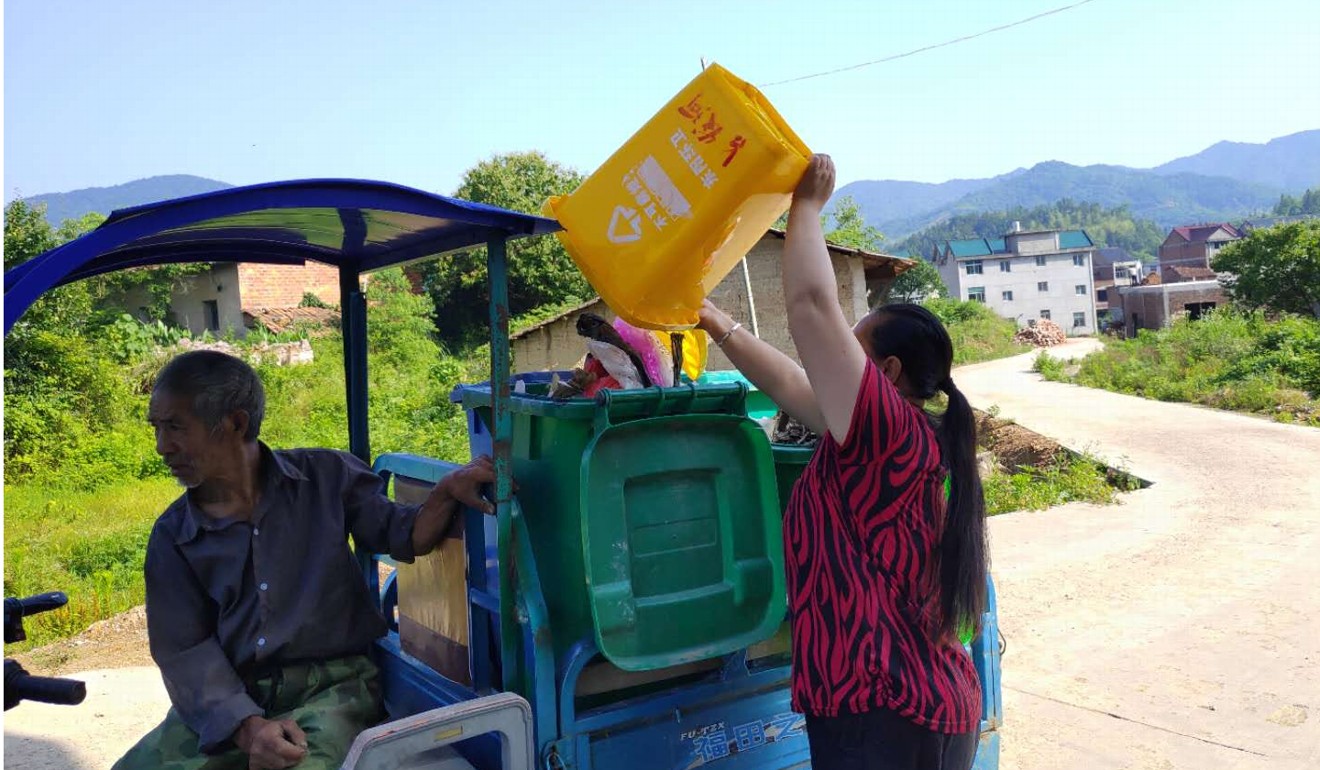
Despite the challenges ahead, some projects have shown promising results. Chen has been classifying waste in rural areas since 2017 and today her pilot projects have been replicated across more than 20 villages.

The greatest success has been in Jiangxi province, where 12 villages have been sorting their rubbish since December.

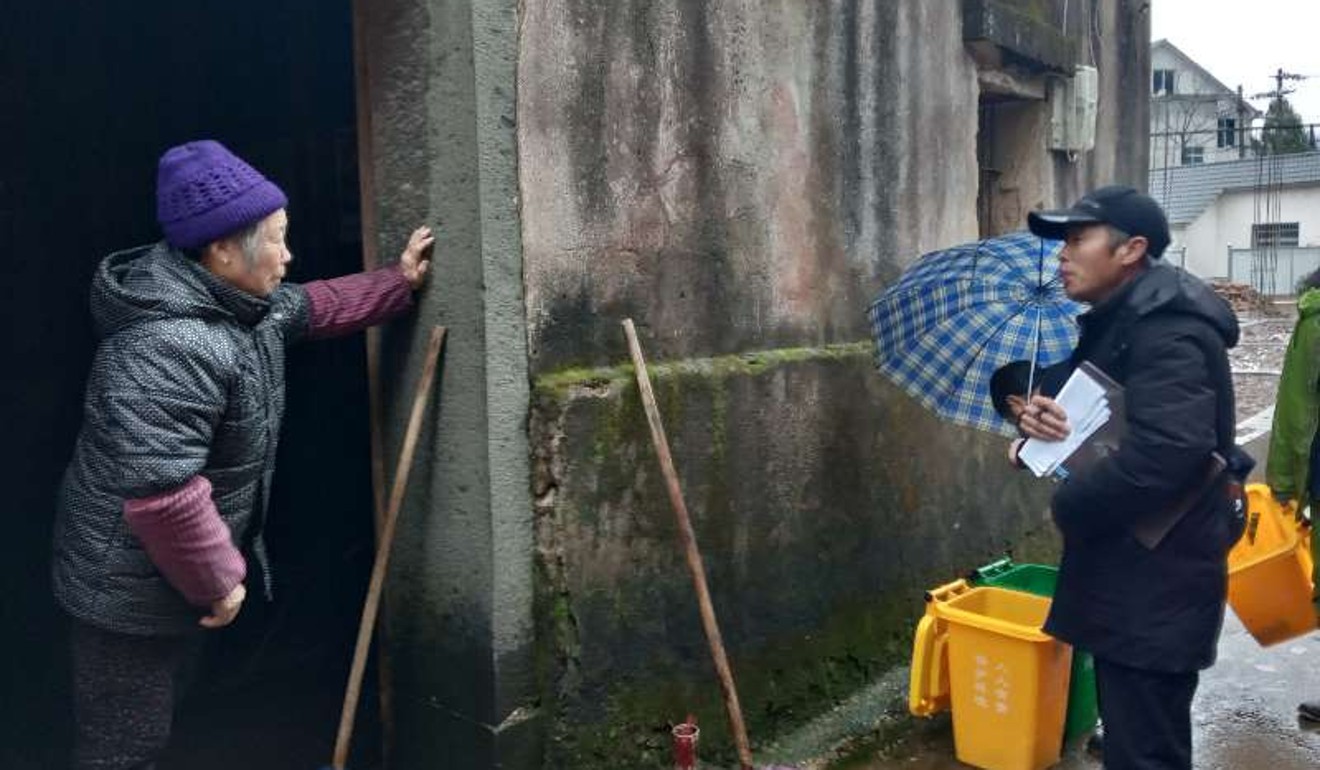
A government official in Dongyang county checks if a woman has correctly sorted her rubbish. Photo: Handout

Wang Qinghai, party chief of Dongyang county in the northeastern part of the province, said preparation work began last June.

“We investigated the scale of household residents in our county, and the number of hotels, restaurants and schools, to estimate the garbage production per capita and how much we could reduce after sorting,” he said.

The hardest part was educating the public, he said. “We organised training and meetings and sent materials, we also guided people when they dumped their garbage.”

Wang said the effect had been very good and people’s understanding of environmental protection and their cooperation with the government had been beyond his expectations.

Beijing struggling to contain its growing garbage problem

According to his estimates, after the introduction of classification system the amount of waste had decreased by 50 per cent. Now, the amount of waste being classified correctly in Dongyang county was over 99 per cent.

A successful waste programme needed the government’s lead and the cooperation of the relevant departments, Wang said. In Dongyang, the agricultural, water resources and urban-rural development departments had all taken part.

As for investment, Zhang estimated China needed to double its financing to introduce sorting facilities and build treatment systems but, speaking from his experience, Wang said waste sorting had not required any extra money.

Zhang remains optimistic that the 46 cities named in the latest waste management plan can achieve their goal by 2020.

“Waste sorting was a big problem in China that hadn’t been solved for nearly two decades, but as our ‘big boss’ pays attention to this, it will be solved,” he said.

Source: SCMP

22/06/2019

Southeast Asian leaders open summit in Bangkok

BANGKOK (Reuters) – Southeast Asian leaders opened a two-day summit in Bangkok on Saturday, though it was unclear what progress their 10-country group could make on disputes in the South China Sea and the plight of ethnic Rohingya fleeing Myanmar.

Formed more than half a century ago, the Association of Southeast Asian Nations (ASEAN) has historically struggled with challenges facing the region because it works only by consensus and is reluctant to become involved in any matter regarded as internal to a member state.

Thai Prime Minister Prayuth Chan-ocha was making his debut as a civilian leader representing current chair Thailand, after a general election in March that opposition parties say was designed to ensure his victory five years after the former army chief seized power in a 2014 coup.

Officials are expected to discuss a Code of Conduct (COC) for negotiations over the South China Sea, one of the world’s busiest waterways and a potential flashpoint, as it is claimed by several ASEAN members as well as China.

However, it was unlikely much progress would be made, though member nations might discuss the June 9 collision of a Philippine boat and a Chinese fishing vessel.

“It is encouraging to see that the ASEAN-China talks on the COC have continued,” said Marty Natalegawa, former foreign minister of Indonesia.

“However, there is real risk that developments on the ground – or more precisely at sea – are far outpacing the COC’s progress thereby possibly rendering it irrelevant.”

Philippine President Rodrigo Duterte has accepted China’s proposal to jointly investigate allegations that a Chinese fishing vessel abandoned 22 Filipinos after it sank their boat in the South China Sea, his spokesman said on Saturday.

Rights groups have also called on ASEAN leaders to rethink support for plans to repatriate Rohingya Muslims who have fled member state Myanmar, where activists say returnees could face discrimination and persecution.

More than 700,000 Rohingya crossed into Bangladesh in 2017, according to U.N. agencies, after a crackdown by Myanmar’s military sparked by Rohingya insurgent attacks on the security forces.

However, it is unlikely that there will be any criticism of Myanmar at the summit over the Rohingya, said Prapat Thepchatree, a political science professor at Thailand’s Thammasat University said.

“This issue has been a very sensitive one for ASEAN,” he said.

Host country Thailand deployed about 10,000 security forces around Bangkok for the summit, mindful of a decade ago when Thailand last hosted an ASEAN summit and dozens of protesters loyal to military-ousted former premier Thaksin Shinawatra forced their way into the meeting venue.

But on Saturday morning, only a small group of people had planned to stage a protest to call Prayuth’s election the product of a rigged system.

The group, called Citizens Wanting Elections, was stopped by police before it could reach a meeting point near the summit venue. The group later released a statement welcoming visiting leaders but criticising Prayuth.

“The individual who serves as President of ASEAN, who welcomes everyone today, did not come from a clean and fair election,” the letter said.

Source: Reuters

21/06/2019

Yoga Day: Thousands of Indians celebrate the day

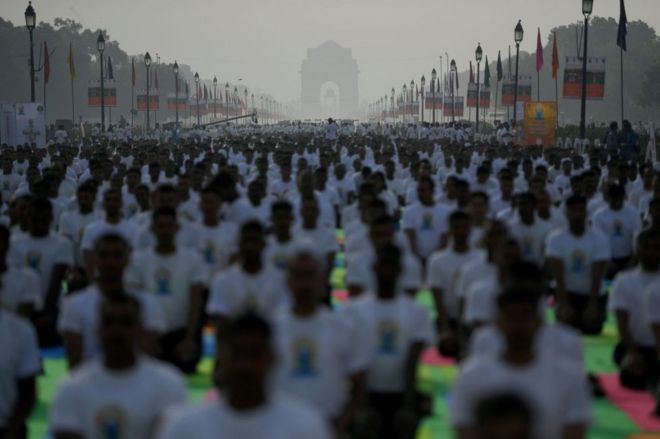
Indian yoga practitioners participate in a mass yoga session on International Yoga Day in New Delhi on June 21, 2019.Image copyright GETTY IMAGES

Indians across the country celebrated the fifth international yoga day on Friday.

Temperatures are soaring in many cities, including the capital Delhi, but that didn’t stop people from gathering outdoors and stretching and bending their way through at least an hour of yoga.

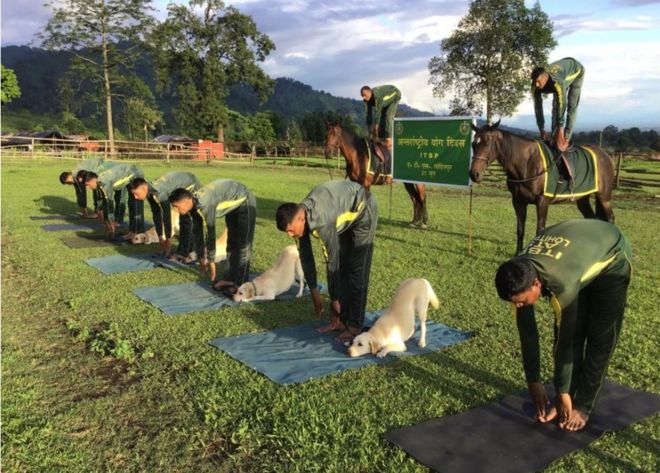
And everyone joined in – even the dog unit of the Indian army!

Dogs doing yoga with Indian armyImage copyright @SPOKESPERSONMOD/TWITTER

The Indo-Tibetan border police – and their dogs and horses – were not about to be outdone. They practised what they called yoga, doga and hoga.

And they were luckier than many of their counterparts – they got to practise their yoga in cooler climes, along India’s scenic Himalayan border.

Dogs and horses doing yoga alongside Indo-Tibetan border policeImage copyrightI TBPOFFICIAL

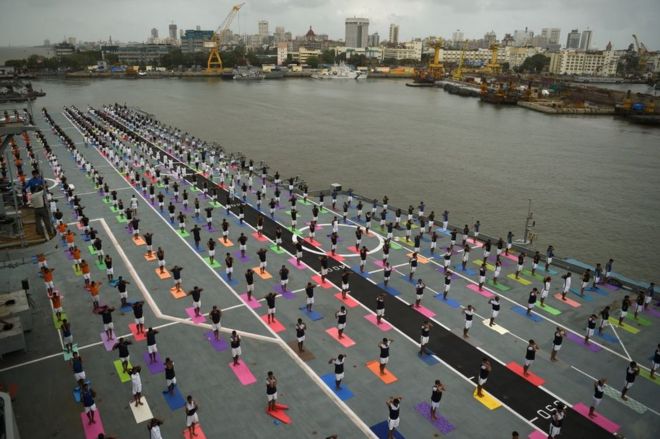
Among those who did yoga in more hostile climates were the armed forces on board the naval aircraft carrier INS Viraat which is docked off the coastline of sweltering Mumbai city.

Indian Armed Forces personnel take part in a yoga sesssion to mark International Yoga Day on the Indian Navy aircraft carrier INS Viraat anchored at the Mumbai harbour on June 21, 2017Image copyright GETTY IMAGES

In Gujarat, the soldiers got a little more creative with their yoga.

Source: The BBC

21/06/2019

Xi says China supports political settlement of Korean Peninsula issue

DPRK-PYONGYANG-CHINA-XI JINPING-KIM JONG UN-TALKS

Xi Jinping, general secretary of the Central Committee of the Communist Party of China (CPC) and Chinese president, holds talks with Kim Jong Un, chairman of the Workers’ Party of Korea (WPK) and chairman of the State Affairs Commission of the Democratic People’s Republic of Korea (DPRK), in Pyongyang, DPRK, June 20, 2019. (Xinhua/Ju Peng)

PYONGYANG, June 20 (Xinhua) — Visiting Chinese top leader Xi Jinping on Thursday reaffirmed China’s support for efforts to push forward the political settlement process on the Korean Peninsula issue and build up conditions for its resolution.

Xi, general secretary of the Central Committee of the Communist Party of China and Chinese president, made the remarks in talks with Kim Jong Un, chairman of the Workers’ Party of Korea and chairman of the State Affairs Commission of the Democratic People’s Republic of Korea (DPRK).

Xi spoke highly of the DPRK’s efforts to safeguard peace and stability on the Korean Peninsula and promote the denuclearization of the peninsula.

The situation of the Korean Peninsula concerns regional peace and stability, Xi pointed out, noting that a bright prospect of resolving the issue through dialogue has appeared over the past year, which has gained recognition and raised expectations of the international community.

The international community hopes that talks between the DPRK and the United States will move forward and bear fruit, Xi added.

Stressing that the Korean Peninsula issue is highly sensitive and complex, Xi said a strategic and long-term perspective is needed to accurately guide the evolution of the situation and effectively maintain peace and stability on the peninsula.

China, Xi said, is willing to provide assistance within its capacity for the DPRK to address its legitimate security and development concerns, strengthen coordination and cooperation with the DPRK as well as other relevant parties, and play a positive and constructive role in achieving denuclearization of the Korean Peninsula and long-term stability in the region.

For his part, Kim said that over the past year, the DPRK has taken many active measures to avoid tensions and control the situation on the Korean Peninsula, but has not received positive responses from the party concerned, which the DPRK does not want to see.

The DPRK is willing to stay patient, and hopes that the relevant party will work with the DPRK to seek solutions that accommodate each other’s legitimate concerns and push for results from the dialogue process, Kim said.

The DPRK highly appreciates the important role played by China in solving the Korean Peninsula issue, he said, adding that his country is ready to continue to strengthen communication and coordination with China to strive for new progress in the political settlement of the issue and safeguard peace and stability on the peninsula.

Xi arrived in Pyongyang earlier Thursday for a state visit to the DPRK. The visit, Xi’s first as CPC chief and Chinese head of state and also the first of its kind in 14 years, came as the two neighboring countries are celebrating the 70th anniversary of their diplomatic ties.

Source: Xinhua

20/06/2019

Spy satellites reveal extent of Himalayan glacier loss

Himachal PradeshImage copyright NRO/USGS
Image caption The Hexagon images were declassified in 2011 and digitised for scientific study

Images from Cold War spy satellites have revealed the dramatic extent of ice loss in the Himalayan glaciers.

Scientists compared photographs taken by a US reconnaissance programme with recent spacecraft observations and found that melting in the region has doubled over the last 40 years.

The study shows that since 2000, glaciers heights have been shrinking by an average of 0.5m per year.

The researchers say that climate change is the main cause.

“From this study, we really see the clearest picture yet of how Himalayan glaciers have changed,” Joshua Maurer, from Columbia University’s Lamont-Doherty Earth Observatory in New York, told BBC News.

The research is published in the journal Science Advances.

HexagonImage copyright NRO
Image caption The Hexagon satellites were a top secret American reconnaissance programme

During the 1970s and 1980s, a US spy programme – codenamed Hexagon – launched 20 satellites into orbit to secretly photograph the Earth.

The covert images were taken on rolls of film that were then dropped by the satellites into the atmosphere to be collected mid-air by passing military planes.

The material was declassified in 2011, and has been digitised by the US Geological Survey for scientists to use.

Among the spy photos are the Himalayas – an area for which historical data is scarce.

By comparing these pictures with more recent satellite data from Nasa and the Japanese space agency (Jaxa), the researchers have been able to see how the region has changed.

The Columbia University team looked at 650 glaciers in the Himalayas spanning 2,000km.

The group found that between 1975 and 2000, an average of 4bn tonnes of ice was being lost each year.

But between 2000 and 2016, the glaciers melted approximately twice as fast – losing about 8bn tonnes of ice each year on average.

BhutanImage copyright NASA
Image caption We now have a satellite record approaching nearly 50 years in length

Mr Maurer said: “For a sense of scale, 8bn tonnes of ice is enough to fill 3.2 million Olympic-sized swimming pools per year.”

And the ice loss was not uniform, he added.

“Glaciers lose most of their ice in the lower elevation portions of the glacier, and it’s there where most of the thinning is concentrated.

“Some of those zones have been thinning by as much as 5m per year.”

Among the scientific community, there has been some debate over the cause. Changes in rainfall in the region and soot deposited from industrial pollutants are thought to have hastened the melt.

However the Columbia team said that while these factors were contributing, rising temperatures in the Himalayas were the main cause.

“The fact we see such a similar spatial pattern of ice loss across so many glaciers across such a large and climatically complex region suggests there needs to be some kind of overall forcing affecting all of the glaciers similarly.”

Re-entry film canister capsulesImage copyright NRO
Image caption The Hexagon photographs would come down in a capsule from the satellites

Scientists say continued losses will have a huge impact.

In the short-term, the huge increase in meltwater could cause flooding.

In the longer term, millions of people in the region who depend on glacier meltwater during drought years could experience very real difficulties.

Commenting on the research, Dr Hamish Pritchard from the British Antarctic Survey, said: “What’s new here is being able to see how the melting of glaciers across the whole Himalayan range has increased due to climate change.

“Over one generation, the melt has doubled and these glaciers are now shrinking fast.

“Why does this matter? Because when the ice runs out, some of Asia’s most important rivers will lose a water supply that keeps them flowing through drought summers, just when water is at its most valuable.

“Without mountain glaciers, droughts will be worse for millions of water-stressed people living downstream.”

Himalayas from the ISSImage copyright NASA
Image caption The view of the Himalayas for the International Space station

Source: The BBC

20/06/2019

FM Wang Yi holds talks with Dutch counterpart

BEIJING, June 19 (Xinhua) — Chinese State Councilor and Foreign Minister Wang Yi held talks with visiting Dutch counterpart Stef Blok in Beijing Wednesdays.

Noting that the Netherlands has long been at the forefront of European countries in developing relations with China, Wang said the Chinese side stands ready to facilitate high-level exchanges and push for joint efforts to pursue high-quality construction of the Belt and Road.

Wang called on the two sides to strengthen communication and coordination within such multilateral mechanisms as the Group of 20 (G20), and seek greater development of the comprehensive partnership of cooperation between the two countries.

Blok expressed his country’s willingness to safeguard the free trade regime with China in a bid to achieve mutually beneficial outcomes.

He also said the Netherlands will provide a level playing field to enterprises of all countries including China.

Blok is paying a visit to China from June 19 to 22 at the invitation of Wang.

Source: Xinhua

20/06/2019

Top political advisor calls for efforts to promote China-Africa cooperation

CHINA-BEIJING-WANG YANG-CPPCC-AFRICA-FRIENDSHIP GROUP(CN)

Wang Yang (front C), a member of the Standing Committee of the Political Bureau of the Communist Party of China (CPC) Central Committee and chairman of the Chinese People’s Political Consultative Conference (CPPCC) National Committee, meets with members of the China-Africa Friendship Group of the CPPCC in Beijing, capital of China, June 19, 2019. (Xinhua/Gao Jie)

BEIJING, June 19 (Xinhua) — China’s top political advisor Wang Yang on Wednesday called on the newly established China-Africa Friendship Group of the national political advisory body to contribute to building a closer China-Africa community with a shared future.

Wang, a member of the Standing Committee of the Political Bureau of the Communist Party of China (CPC) Central Committee and chairman of the Chinese People’s Political Consultative Conference (CPPCC) National Committee, made the remarks while meeting here with members of the friendship group.

The members are in Beijing to attend the inauguration ceremony of the group and its first plenary session.

Wang said the group was the first friendship group between China and other countries under the CPPCC approved by the CPC Central Committee, and that its establishment was a groundbreaking event in the history of CPPCC’s foreign exchanges.

He urged the friendship group to implement the CPC Central Committee’s policy on China’s relations with Africa and to help deliver the outcomes of the 2018 Beijing Summit of the Forum on China-Africa Cooperation.

He also called on the group to make efforts to promote the CPPCC’s foreign exchanges.

Source: Xinhua

20/06/2019

Taliban delegation holds talks in China as part of peace push

BEIJING (Reuters) – China recently played host to a Taliban delegation as part of efforts to promote peace and reconciliation in Afghanistan, China’s foreign ministry said on Thursday.

Representatives of the Taliban, who have been fighting for years to expel foreign forces and defeat the U.S.-backed government in Kabul, have been holding talks with U.S. diplomats for months.

The focus has been the Taliban demand for the withdrawal of U.S. and other foreign forces, in exchange for guarantees that Afghanistan will not be used as a base for militant attacks.

Taliban negotiators have also met senior Afghan politicians and civil society representatives, including in Moscow recently, as part of so-called intra-Afghan dialogue to discuss their country’s future.

Chinese foreign ministry spokesman Lu Kang told a daily news briefing that Abdul Ghani Baradar, the Taliban representative in Qatar, and some of his colleagues had recently visited China, though he did not say exactly when.

Chinese officials met them to discuss the Afghan peace process and counter-terror issues, Lu told the briefing, without saying who met the delegation.

“China pays great attention to the evolving situation in Afghanistan in recent years. We have always played a positive role in the Afghan peace and reconciliation process,” Lu said.
China supports Afghans resolving their problems themselves through talks, and this visit was an important part of China promoting such peace talks, he said.
“Both sides believe that this exchange was beneficial and agreed to keep in touch about and cooperate on continuing to seek a political resolution for Afghanistan and fighting terrorism.”
China’s far western Chinese region of Xinjiang shares a short border with Afghanistan.
China has long worried about links between militant groups and what it says are Islamist extremists operating in Xinjiang, home to the mostly Muslim Uighur people, who speak a Turkic language.
China, a close ally of Pakistan, has been deepening its economic and political ties with Kabul and is also using its influence to try to bring the two uneasy neighbours closer.
The Chinese government’s top diplomat, State Councillor Wang Yi, visited Kabul last December.
Source: Reuters
Law of Unintended Consequences

continuously updated blog about China & India

ChiaHou's Book Reviews

continuously updated blog about China & India

What's wrong with the world; and its economy

continuously updated blog about China & India