Chindia Alert: You’ll be Living in their World Very Soon
aims to alert you to the threats and opportunities that China and India present. China and India require serious attention; case of ‘hidden dragon and crouching tiger’.
Without this attention, governments, businesses and, indeed, individuals may find themselves at a great disadvantage sooner rather than later.
The POSTs (front webpages) are mainly 'cuttings' from reliable sources, updated continuously.
The PAGEs (see Tabs, above) attempt to make the information more meaningful by putting some structure to the information we have researched and assembled since 2006.
TASHKENT (Reuters) – The trade war between the United States and China could be a risk to the world economic outlook if it is not resolved, International Monetary Fund Managing Director Christine Lagarde told Reuters on Friday during a visit to Uzbekistan.
“Obviously, the downside risk that we have is continued trade tensions between the United States and China,” Lagarde said, referring to the IMF’s world economic outlook.
“And if these tensions are not resolved, that clearly is a risk going forward.”
The IMF last month cut its growth forecast for 2019 to 3.3%, down from the 3.5% it had previously predicted.
It warned at the time that growth could slow further due to trade tensions and a potentially disorderly British exit from the European Union.
“But we expect that at the end of 2019 and in 2020 it will bounce back,” Lagarde said of the world economic outlook on Friday.
The United States infuriated China this week when it announced it was putting Huawei Technologies Co Ltd, the world’s biggest telecoms equipment maker, on a blacklist that could make it hard to do business with U.S. companies.
On Friday Beijing suggested a resumption of talks between the world’s two largest economies would be meaningless unless Washington changes course.
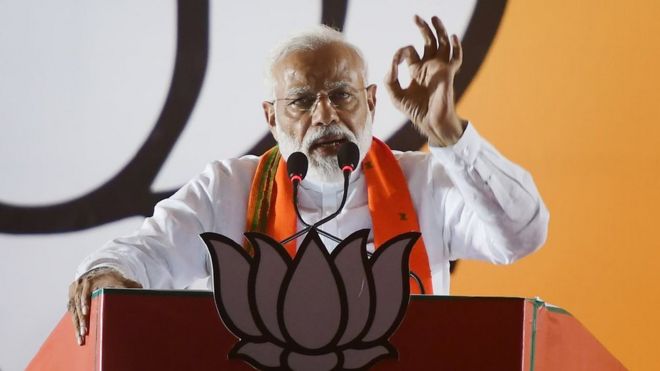
Image copyright GETTY IMAGESImage caption Mr Modi said he will not forgive Pragya Thakur
India is in full election mode: voting began on 11 April, and the final ballot will be cast on 19 May with results out on 23 May. Every day, the BBC will be bringing you all the latest updates on the twists and turns of the world’s largest democracy.
What happened?
Indian Prime Minister Narendra Modi has attended first ever press conference at the Bharatiya Janata Party (BJP) head office in Delhi – days before Indians take part in the final stage of voting.
But journalists were left disappointed as he did not take any questions, and instead largely talked about his government’s achievements.
“I have come to thank the country for blessing me. I have seen a lot of ups and downs but the country stayed with me,” he said.
Mr Modi also spoke of his pride in India’s democratic process and said he needs to show the world “how diverse our democracy is”.
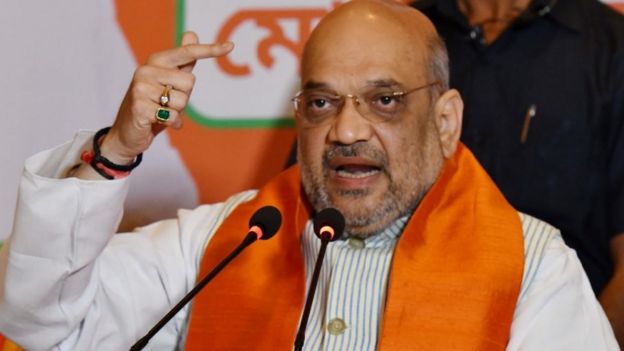
Mr Modi was seated next to party president Amit Shah. He said he would not take questions because the press conference was Mr Shah’s.
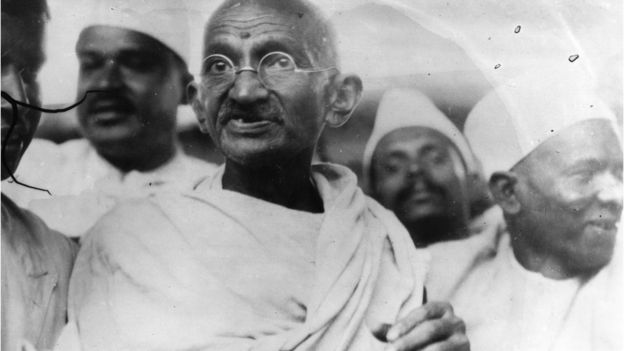
Earlier, the prime minister said he would “never be able to forgive” those who have “insulted” Mahatma Gandhi.
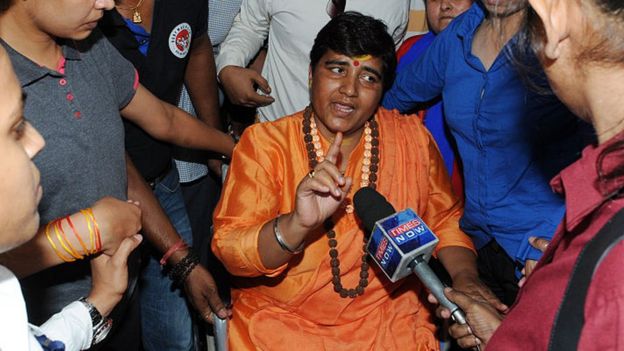
Mr Modi’s statement comes after controversial Bharatiya Janata Party (BJP) politician Pragya Thakur called Nathuram Godse – the man who assassinated Mahatma Gandhi – a “patriot”.
Ms Thakur apologised after several leaders, including those from the BJP, criticised her.
“Such statements should be condemned. There is no place in society for such comments. She [Ms Thakur] may have apologised, but I will never be able to forgive her,” he said in an interview to News24 TV channel.
Why does this matter?
This is the first time Mr Modi has attended a press conference as prime minister while in India. Most of his press conferences have been on state visits to other countries and often involved little more than reading out an official statement.
He has given some one-on-one interviews to Indian media, though critics say that these have largely been tightly controlled and given to journalists seen as sympathetic to him. However in recent weeks he has given a flurry of interviews to several leading publications and television channels, including those that have been critical of him.
But if people were expecting a complete about-turn in his media policy this time, they would have been disappointed.
This caused some frustration among journalists on Twitter.
Also on Friday, a BJP candidate apologised for calling Gandhi’s killer a patriot
Image copyright GETTY IMAGES
What is happening?
Bharatiya Janata Party (BJP) politician Pragya Thakur has apologised after calling Nathuram Godse – the man who assassinated Mahatma Gandhi – a “patriot”.
Several political parties had criticised her comment and her own party demanded that she should publicly apologise.
“It was my personal opinion. My intention was not to hurt anyone’s sentiments. If I’ve hurt anyone, I do apologise. What Gandhi Ji has done for the country cannot be forgotten. My statement has been twisted by the media,” Ms Thakur said on Thursday evening.
She made the comment after actor-turned politician Kamal Haasan said Godse was India’s first Hindu “extremist” earlier this week.
Why does this matter?
The BJP as well as opposition parties immediately reacted to her comment, which also caused a storm on social media.
BJP spokesperson GVL Narasimha Rao said that the party does not agree with her statement, and asked her to publicly apologise.
The main opposition Congress party demanded an apology from Prime Minister Narendra Modi and said that the BJP should take “punitive action” against Ms Thakur.
Congress spokesperson Randeep Surjewala said that “insulting martyrs is in the BJP DNA” and that the “soul of the nation” has been hurt by her remarks.
Congress party leader Priyanka Gandhi also lashed out at the BJP.
Political analysts also say that her comments have put the BJP in a tough spot, since Mr Modi and BJP president Amit Shah defended their decision to field her as a candidate despite terror charges against her.
Her candidature caused outrage as she is an accused of involvement in a blast that killed seven people and injured 100 others. Ms Thakur denies all charges against her.
However, Ms Thakur’s comments do reflect the views of some right-wing Hindus who support the BJP and have long seen Gandhi as too moderate.
Godse, who shot Gandhi in the chest three times at point-blank range on 30 January 1948, was also an activist with nationalist right-wing groups, including those closely associated with the BJP.
Hindu hardliners in India accuse Gandhi of having betrayed Hindus by being too pro-Muslim, and even for the division of India and the bloodshed that marked Partition, which saw India and Pakistan created after independence from Britain in 1947.
On Thursday, a ruling party candidate called Gandhi’s killer a patriot
What happened?
Controversial Bharatiya Janata Party (BJP) politician Pragya Thakur made headlines again. This time it was for calling Nathuram Godse – the man who assassinated Mahatma Gandhi – a “patriot”.
Her comment was made in response to a statement by southern actor-turned politician Kamal Haasan who had said India’s first “extremist” was a Hindu”, referring to Godse.
His statement, made on Monday, was heavily criticised by the BJP, which accused him of indulging in “divisive politics” and filed a complaint against him with the Election Commission of India.
Why does this matter?
The BJP responded by criticising Ms Thakur and asking her to publicly apologise.
“BJP does not agree with this statement, we condemn it. Party will ask her for clarification, she should apologise publicly for this statement,” party spokesperson GVL Narasimha Rao told reporters.
Image copyright GETTY IMAGES
Ms Thakur has seen her fair share of controversy. Her candidature caused outrage as she is an accused of involvement in a blast that killed seven people and injured 100 others. On 18 April, she said that police officer Hemant Karkare had died in the November 2008 Mumbai terror attacks because she had “cursed” him. She was then banned from campaigning for 72 hours as a result.
A team led by Mr Karkare had arrested her for questioning in connection with the Malegaon blast.
During her campaign, she also said she was “proud” of her part in the demolition of the 16th Century Babri mosque. In 1992, right-wing Hindu mobs razed the mosque to the ground, claiming it was built on the site of a temple destroyed by Muslim rulers. The site, which is in the city of Ayodhya, has been a religious flashpoint for Hindus and Muslims for decades.
Campaigning ended in West Bengal a day before deadline
What happened?
The Election Commission (EC) told political parties to end their campaigning in West Bengal state, a day before the deadline in the wake of poll-related violence.
The campaign will end on Thursday at 10pm local time, and voting will be held on Sunday.
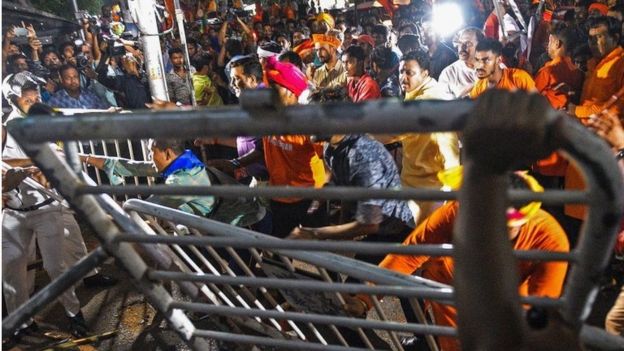
The decision comes after clashes broke out between the Bharatiya Janata Party (BJP) workers and protesters believed to be from the ruling Trinamool Congress (TMC) in Kolkata (formerly Calcutta) on Tuesday.
It happened during a roadshow of BJP chief Amit Shah. Several people were injured and vehicles were set on fire. A statue of renowned Bengali reformer Iswarchandra Vidyasagar was also vandalised in the clashes.
Both parties have accused each other of starting the violence.
Why does this matter?
Image copyright GETTY IMAGESImage caption Violence took place during BJP chief Amit Shah’s rally in Kolkata on Tuesday
The BJP welcomed the decision, saying it validated their argument that the state had “descended into anarchy” under the leadership of chief minister Mamata Banerjee.
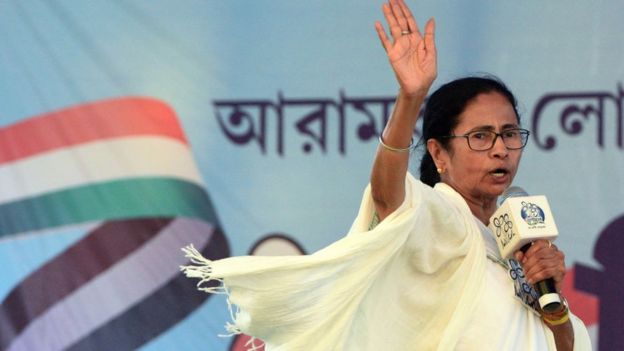
Ms Banerjee said that the move was “undemocratic” and “it had insulted the people of Bengal”.
“Tomorrow, [Prime Minister Narendra] Modi has two meetings in Bengal. When he finishes, the campaigning also ends… Instead of punishing Amit Shah, the Election Commission has given a gift to the BJP,” she said.
Image copyright AFPImage caption Several people were injured and vehicles were set on fire during the violence
Both parties are locked into a fierce election battle to win most out West Bengal’s 42 seats. Ms Banerjee has ambitions of becoming the prime minister in case a nationwide coalition of regional parties wins enough seats.
The state has also become crucial for the BJP as it’s trying to expand its reach in the eastern state. It won only two seats in the 2014 election.
The BJP performed well in northern states like Uttar Pradesh and Rajasthan in 2014, but this time it’s expected to suffer loses against a coalition of regional parties and the main opposition Congress.
So the party is trying to make up for the losses in West Bengal.
On Wednesday, the TMC and the BJP accused each other of poll violence
Image copyright GETTY IMAGES
What happened?
The war of words between West Bengal state chief minister Mamata Banerjee and the governing Bharatiya Janata Party (BJP) intensified ahead of voting on Sunday.
The latest verbal duel comes after violence was reported during BJP chief Amit Shah’s roadshow in Kolkata (formerly Calcutta) on Tuesday.
Clashes broke out between BJP supporters and protesters who were holding “Amit Shah go back” posters.
Some people suffered minor injuries and a few vehicles were set on fire.
The BJP said the protest was “orchestrated” and called it an “attempt to strangulate democracy”.
Why does this matter?
The eastern state has become politically crucial for the BJP as it has intensified campaigning in the past few days.
And that has sparked a feverish electoral battle between the BJP and Ms Banerjee’s Trinamool Congress (TMC).
“What does Amit Shah think of himself? Is he above everything? Is he god that no one can protest against him?” Ms Banerjee said.
In reply, Mr Shah accused the TMC of not following democratic norms during elections.
“Have faith in the people of Bengal that they’d face the TMC goons,” he said.
Prime Minister Narendra Modi is scheduled to hold more rallies in the coming days, so one can expect more verbal fireworks from the two leaders.
On Tuesday, the saga of the morphed Mamata meme continued
What happened?
India’s top court stepped in to release an activist belonging to India’s governing Bharatiya Janata Party (BJP) who was sent to prison for sharing a doctored image of West Bengal Chief Minister Mamata Banerjee.
Priyanka Sharma was sentenced to two weeks in prison on 10 May after she shared a picture of Bollywood star Priyanka Chopra and her husband Nick Jonas at the Met Gala – but with Ms Banerjee’s head superimposed on to Chopra’s body.
Earlier the court had said Ms Sharma could be released only if she apologised to Ms Banerjee, but later waived this condition.
Why does this matter?
The battle for West Bengal in this general election has been absolutely bruising.
The BJP, led by Prime Minister Narendra Modi himself, has been campaigning hard for votes in the state. This has brought them toe-to-toe with the state’s feisty chief minister. The fact that voting for West Bengal’s 42 seats has been split across all nine phases of voting has meant that the battle has been long and drawn-out.
And with just one phase to go before voting finally ends, the gloves are well and truly off. The two parties have traded insults on the campaign stage, their workers have attacked each other, and the violence on the ground has intensified. And now the battle has spread to cyberspace as well.
The country’s finance minister Arun Jaitley jumped at news of Ms Sharma’s release to call Ms Banerjee a dictator.
Analysts say that this political row is so bitter because the BJP has clearly identified West Bengal as one of the states where they may be able to make gains this election. This becomes more important for the party in the context of their fight in the politically crucial state of Uttar Pradesh, which sends the most number of MPs (80) to parliament.
They are up against a powerful coalition of regional parties there, and many expect them to lose seats as a result.
And PM Modi said Rahul Gandhi should be ashamed of 1984 riots
What happened?
Prime Minister Narendra Modi said that main opposition Congress party chief Rahul Gandhi should be “ashamed of himself” over his colleague’s remark on the 1984 anti-Sikh riots.
Mr Modi was replying to a controversial statement made by Sam Pitroda, who is a strategist of the Congress party.
In his reply to a question about the Congress’ role in the riots, Mr Pitroda had said “so what?”.
“I don’t think so, this is also another lie, and what about 1984? You speak about what you [Mr Modi] have done in five years. It [the riots] happened in 1984, so what?” he said.
Mr Gandhi said he was “ashamed” of Mr Pitroda’s statement, and asked him to apologise.
Mr Pitroda later said his statement was “twisted” and he did not mean to hurt sentiments.
But Mr Modi said the Congress chief “must apologise”.
“I was watching that naamdar [the dynast] told his guru that he should be ashamed of what he said. I want to ask naamdar, you pretended to scold your mentor for what? Because he exposed what was always in the Congress’s heart, and in the discussions of the naamdar family? Because he made public a family secret? Naamdar, it is you who should be ashamed,” Mr Modi said.
Why does this matter?
The controversy matters because it comes days ahead of voting for the 13 seats in the northern state of Punjab.
The BJP, which has formed a coalition with regional Shiromani Akali Dal, is locked in a bitter electoral battle with the ruling Congress in the state.
Sikhs are a majority in the state and the 1984 riots is still an emotional issue for many of them.
More than 3,000 Sikhs were killed in 1984 after the assassination of former prime minister Indira Gandhi by her Sikh bodyguards.
They were angry at her decision to send the army into the Golden Temple – Sikhism’s holiest shrine – to flush out militants earlier in the year.
The killing of Mrs Gandhi, who belonged to the Congress, saw mobs attack and murder members of the Sikh community across the country.
And both parties appear to be trying to come across as pro-Sikh ahead of the vote on 19 May.
On Sunday, Delhi voted but not enthusiastically
Image copyright GETTY IMAGESImage caption Delhi’s voter turnout was lower than in 2014
What happened?
Sunday saw India’s capital Delhi vote along with several other states in the polls – the penultimate phase of the country’s mammoth general election.
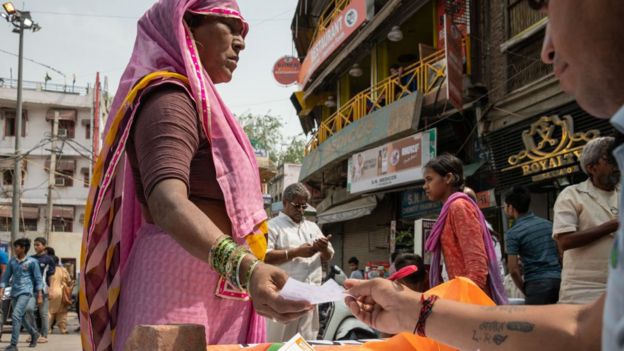
Voters turned out to vote, but in fewer numbers than they did in 2014. The election commission said that around 60% of the capital’s registered voters had actually cast ballots, which was about a five percent drop from 2014.
Delhi Chief Electoral Officer Ranbir Singh expressed disappointment, saying that the turnout did not match expectations.
Why does this matter?
The election commission is right to be disappointed – it had run a series of campaigns in the city, encouraging more people to vote.
But it was not as though polling in Delhi was an entirely smooth process. Some voters complained that their names were missing from electoral lists even though they had all the necessary documents. There were also reports that around 1,200 Electronic Voting Machines (EVMs) had malfunctioned across the city, delaying the polling process.
The fact that Delhi became a three-cornered contest after the main opposition Congress and the Aam Aadmi Party (AAP), which controls the Delhi state assembly, failed to stitch up an alliance may also have put voters off. Many analysts believe that this failure will only split voters who were against prime minister Narendra Modi’s Bharatiya Janata Party (BJP) and effectively hand them victory.
So they may have decided to just stay home, and not bother queuing up in the blistering heat – it touched 40C on Sunday.
NEW DELHI (Reuters) – The Bharatiya Janata Party (BJP) has one unwanted lead in this month’s general election race – according to data from an electoral watchdog it is fielding the most candidates among the major parties who are facing criminal charges. Its main rival, Congress, is just a step behind.
Election laws allow such candidates to run so long as they have not been convicted, on grounds both of fairness and because India’s criminal justice system moves so slowly that trials can take years, or even decades, to be resolved.
Still, the number of such candidates accused of offences ranging from murder to rioting has been rising with each election.
Analysts say political parties turn to them because they often have the deepest pockets in steadily costlier elections, and that some local strongmen are seen as having the best chance of winning.
Nearly one-in-five candidates running for parliament in the current election has an outstanding criminal case against them, inching up from 17% in the previous election and 15% in 2009, according to the Association for Democratic Reforms (ADR), a non-profit organisation that analysed candidates’ declarations.
The data shows that 40% candidates from Prime Minister Narendra Modi’s BJP face criminal charges, including crimes against women and murder, followed by the Congress party at 39%.
Among the smaller parties, the Communist Party of India (Marxist) has an even higher proportion, with 58 percent of its candidates embroiled in criminal cases.
Polls have suggested that the BJP and its allies lead the race to win the mammoth, staggered election that began last month and ends on Sunday. Votes will be counted on Thursday.
“Parties only think about winnability and they know that money power and muscle power of such candidates ensures that win,” said Anil Verma, head of the ADR.
With 240 cases against him, K Surendran of the BJP tops the list of candidates with the most outstanding criminal complaints that include rioting, criminal trespass and attempted murder.
He said most of the cases stem from his involvement in the BJP campaign to oppose the entry of women and girls of menstruating age into the Sabarimala temple in his home state of Kerala.
“I understand that an outsider might feel that I am a grave offender but, in reality, I am completely innocent of these charges,” he said. “It was all politically motivated.”
Dean Kuriakose from the Congress party has 204 criminal cases against him, the second highest, the data showed. Most of the cases were related to a political agitation against the ruling Communist Party in Kerala, which turned violent.
He was not available for comment. But a party spokesman said Kuriakose was innocent. “He was falsely charged by the police under influence from Kerala government,” the spokesman said.
Political analysts say that often people vote for candidates who face criminal charges because they are seen as best placed to deliver results. In some parts of India local strongmen mediate in disputes and dispense justice.
“Powerful people, even if criminals, offer a kind of parallel system of redressal,” said K.C. Suri, a professor of political science at the University of Hyderabad.
A separate ADR survey of more than 250,000 voters last year found 98% felt candidates with criminal backgrounds should not be in parliament, though 35% said they were willing to vote for such a candidate on caste grounds or if the candidate had done “good work” in the past.
Police in Shenzhen look for clues to accident in driver’s medical records
Motorist complains of ‘sudden attack’ at time of accident
Police in Shenzhen, Guangdong province, are investigating a driver’s medical history after a fatal accident on Thursday. Photo: Weibo
Police in southern China have detained a motorist after three people were killed and seven injured in a car accident on Thursday night.
Officers said a car went out of control and struck pedestrians on a road in Nanshan district in Shenzhen, Guangdong province, at about 7.20pm. The 23-year-old driver, surnamed Liu, was taken into custody.
In a statement online, the Shenzhen public security bureau said blood and urine tests showed the driver was sober and drug-free. They said medicine for epilepsy was found in the vehicle.
Two dead, six injured in Japan after bus drives through pedestrians in Kobe
During questioning, Liu told officers he lost control of car because he had had “a sudden attack”, but did not elaborate.
Police said they were examining Liu’s medical records.
In China, people with epilepsy are not allowed to apply for a driving licence, according to regulations from the Ministry of Public Security.
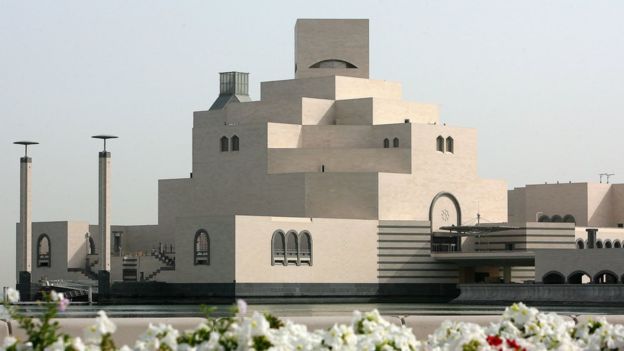
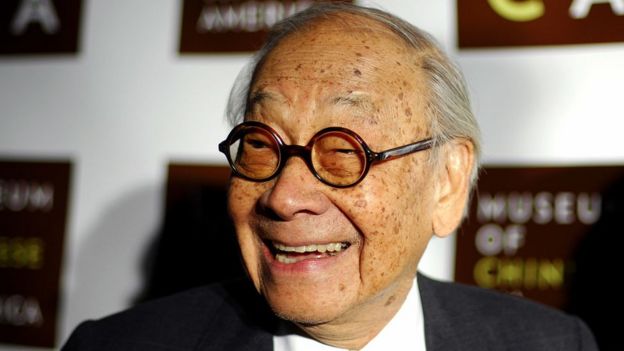
One of the 20th Century’s most prolific architects, he has designed municipal buildings, hotels, schools and other structures across North America, Asia and Europe.
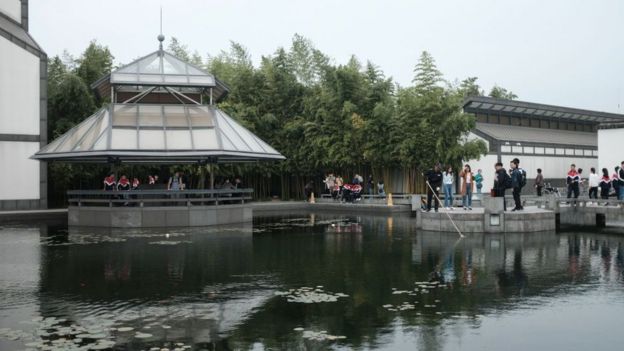
Image copyright GETTY IMAGESImage caption Qatar’s Islamic Museum of Art is one of Pei’s most famous designsImage copyright AFP/GETTYImage caption The architect also designed the Suzhou Museum in China, which was completed in 2006
His style was described as modernist with cubist themes, and was influenced by his love of Islamic architecture. His favoured building materials were glass and steel, with a combination of concrete.
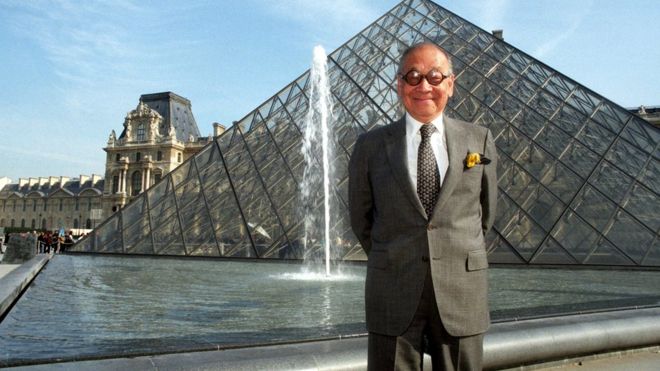
Pei sparked controversy for his pyramid at the Louvre Museum. The glass structure, completed in 1989, is now one of Paris’ most famous landmarks.
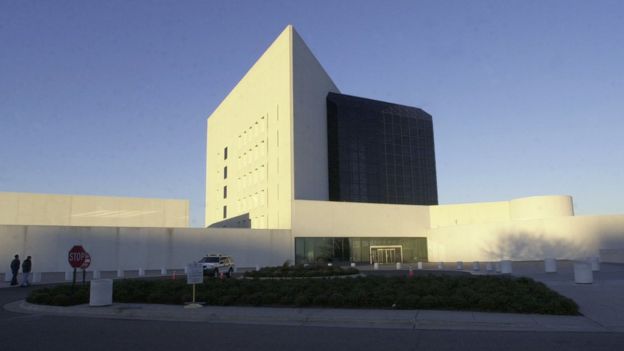
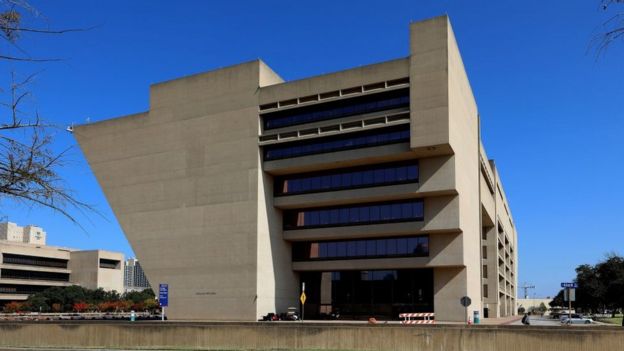
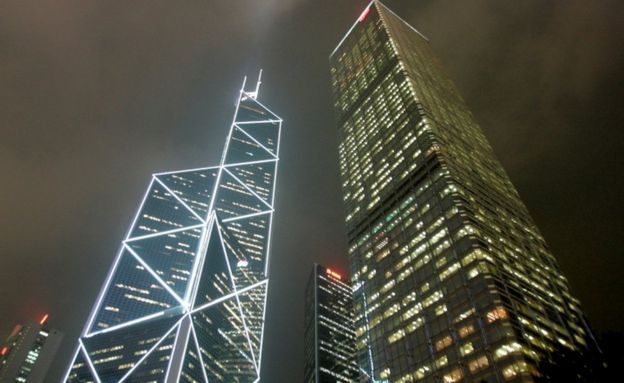
Image copyright GETTY IMAGESImage caption Pei designed Boston’s John F Kennedy Library and MuseumImage copyright GETTY IMAGESImage caption I M Pei designed Dallas City Hall with fellow architect Theodore J MushoImage copyright REUTERSImage caption I M Pei’s Bank of China tower (L) in Hong Kong
His other work includes Dallas City Hall and Japan’s Miho Museum.
“I believe that architecture is a pragmatic art. To become art it must be built on a foundation of necessity,” he once said.
He was won a variety awards and prizes for his buildings, including the AIA Gold Medal, the Praemium Imperiale for Architecture.
In 1983 Pei was given the prestigious Pritzker Prize. The jury said he had he “has given this century some of its most beautiful interior spaces and exterior forms”.
He used his $100,000 prize money to start a scholarship fund for Chinese students to study architecture in America.
Image copyright REUTERSImage caption Economists say India’s growth is powered by the ‘top 100 million’ people
As India lumbers towards the final phase of an exhausting general election and Prime Minister Narendra Modi’s BJP seeks a second term in power, there’s some worrying news. The world’s fastest growing major economy appears to be headed for a slowdown.
The signs are everywhere. Economic growth slowed to 6.6% in the three months to December, the slowest in six quarters. Sales of cars and SUVs have slumped to a seven-year-low. Tractors and two-wheelers sales are down. Net profits for 334 companies (excluding banks and financials) are down 18% year-on-year, according to the Financial Express newspaper.
Image copyright GETTY IMAGESImage caption Sales of cars and SUVs have slumped to a seven-year-low.
One newspaper wondered whether India was “losing the consumption plot”. Taken together, all this points to a fall in both urban and rural incomes, leading to demand contraction. A crop glut has seen farm incomes drop. And credit stagnation, partly triggered by the collapse of a major non-banking financial institution, or a shadow bank, has led to a fall in lending and worsened matters.
Kaushik Basu, former chief economist of the World Bank and professor of economics at Cornell University, believes the slowdown is “much more serious” than he initially believed. “The evidence is now mounting to the point where it can no longer be ignored,” he told me.
One reason, he believes, is the controversial currency ban in 2016 – also called demonetisation – which adversely hit farmers. More than 80% of the currency circulating in India’s sprawling cash-driven economy was taken out of circulation in what, in the words of one of Prime Minister Modi’s own advisers, was a “massive, draconian, monetary shock”.
Image copyright AFP
“This was evident to all by early 2017. What many observers did not realise then – I did not – is that the shock made the farmers take on debts which ended up causing sustained hardship to them that is continuing and slowing down the agriculture sector.”
SHANGHAI, May 16 (Xinhua) — Israel’s Ministry of Tourism of signed an agreement with China’s online travel operator Ctrip during an ongoing tourism exhibition (ITB China) to strengthen tourism in the Chinese market.
More cooperation will be carried out between the two sides, mainly in terms of itineraries, big data and marketing to attract Chinese travelers, particularly young people to Israel, according to the agreement.
Some 55,000 Chinese visited Israel during the first four months of 2019, marking a 70 percent increase year on year, according to the data released by the Ministry of Tourism of Israel.
In 2018, 105,000 Chinese visited Israel, which is over a 100 percent increase from 2015.
Israel has launched a series of measures to promote tourism in China, including developing travel products with diversified themes, increasing direct flights between the two countries and providing more convenient visa policies.
Israel has also upgraded Chinese cuisine in local restaurants and hotels, set up Chinese signs in its main sites and resorts, provided Chinese-language maps, and trained more Chinese-speaking guides.
ITB China, a professional exhibition focusing on travel and tourism industry, is annually held in Shanghai. This year, 800 exhibitors from 84 countries and regions attended the exhibition lasting from May 15 to 17.
XI’AN, May 16 (Xinhua) — The fourth Silk Road International Exposition concluded Wednesday in Xi’an, capital of northwest China’s Shaanxi Province.
During the five-day expo, 65 contracts in various fields including education, medical care, modern agriculture and intelligent manufacturing were signed with a total investment of 115.1 billion yuan (about 16.7 billion U.S. dollars).
Themed “New Era, New Pattern, and New Development,” the fourth Silk Road International Exposition attracted more than 2,000 Chinese enterprises and more than 200 overseas enterprises from 25 countries and regions, including Russia, the United States and Cambodia.
More than 30 activities and exhibitions were staged during the five-day event, including forums, conferences and investment and trade activities. An international forum on poverty relief was first held during the expo to contribute China’s experience and efforts to the global poverty reduction.
Known in ancient times as Chang’an, Xi’an was the starting point of the ancient Silk Road and plays a key role in the Belt and Road Initiative.
TIANJIN, May 16 (Xinhua) — President Xi Jinping sent a congratulatory letter to the Third World Intelligence Congress, which opened in northern China’s Tianjin municipality Thursday.
In the letter, Xi expressed his sincere welcome to renowned international entrepreneurs, industry leaders and Turing Award winners who attended the congress.
Noting that artificial intelligence (AI) is casting significant and far-reaching impacts on economic development, social progress and global governance, Xi said China attaches high importance to innovative development and takes new-generation AI as the driving force for scientific and technological development, industrial optimization and upgrading, as well as increasing productivity, striving to achieve high-quality development.
Xi expressed hope that participants of the congress could further exchanges, enhance consensus and step up cooperation to promote the healthy development of the new-generation AI.
Having read out Xi’s letter at the opening ceremony, Li Hongzhong, secretary of the Tianjin Municipal Committee of the Communist Party of China, said Tianjin would embrace a new era of intelligence, create a new intelligence-based economy, step up cooperation with other countries in the field of AI and speed up building “intelligent Tianjin.”
WASHINGTON/NEW YORK (Reuters) – The Trump administration on Wednesday took aim at China’s Huawei Technologies Co Ltd, banning the firm from buying vital U.S. technology without special approval and effectively barring its equipment from U.S. telecom networks on national security grounds.
Taken together, the two moves threaten Huawei’s ability to continue to sell many products because of its reliance on American suppliers, and represents a significant escalation in the U.S. government’s worldwide campaign against the company.
The steps also come at a delicate time in relations between China and the United States as the world’s two largest economies ratchet up tariffs in a battle over what U.S. officials call China’s unfair trade practices.
Washington believes the handsets and network equipment for telecommunications companies made by Huawei could be used by the Chinese state to spy on Americans.
Huawei, which has repeatedly denied the allegations, said in a statement that “restricting Huawei from doing business in the U.S. will not make the U.S. more secure or stronger; instead, this will only serve to limit the U.S. to inferior yet more expensive alternatives, leaving the U.S. lagging behind in 5G deployment.”
“In addition, unreasonable restrictions will infringe upon Huawei’s rights and raise other serious legal issues.”
The ban on U.S. suppliers, which appears similar to one on Huawei rival ZTE Corp. last year, could hit the shares of Huawei’s biggest U.S. suppliers, including chipmakers Qualcomm Inc and Broadcom Inc (AVGO.O).
In the first action taken on Wednesday, President Donald Trump signed a long-awaited executive order declaring a national emergency and barring U.S. companies from using telecommunications equipment made by firms posing a national security risk.
The order invoked the International Emergency Economic Powers Act, which gives the president the authority to regulate commerce in response to a national emergency that threatens the United States. It directs the Commerce Department, working with other government agencies, to draw up an enforcement plan by October.
Members of Congress said Trump’s order was squarely aimed at Chinese companies like Huawei, which generated $93 billion in revenue last year and is seen as a national champion in China.
“China’s main export is espionage, and the distinction between the Chinese Communist Party and Chinese ‘private-sector’ businesses like Huawei is imaginary,” Republican Senator Ben Sasse said.
ENTITY LIST
Soon after the White House announced the order had been signed, the Commerce Department said it had added Huawei and 70 affiliates to its so-called Entity List – a move that bans the telecom giant from buying parts and components from U.S. companies without U.S. government approval.
U.S. officials told Reuters the decision would make it difficult, if not impossible, for Huawei, the largest telecommunications equipment producer in the world, to sell some products because of its reliance on U.S. suppliers. It will take effect in the coming days.
Commerce Secretary Wilbur Ross said in a statement Trump backed the decision that will “prevent American technology from being used by foreign owned entities in ways that potentially undermine U.S. national security or foreign policy interests.”
With Huawei on the Entity List, U.S. suppliers will need to apply for licenses to provide the Chinese company with anything subject to U.S. export control regulations. Obtaining such licenses will be difficult because they will have to show the transfer of items will not harm U.S. national security, said John Larkin, a former export control officer in Beijing for the Commerce Department.
The United States in January unsealed a 13-count indictment against Huawei accusing the company and its chief financial officer of conspiring to defraud global financial institutions by misrepresenting Huawei’s relationship with a suspected front company that operated in Iran.
The indictment was unsealed a month after CFO Meng Wanzhou was arrested in Canada on a U.S. warrant for her role in the alleged fraud. Meng, who maintains her innocence, is fighting extradition.
5G NETWORKS
Reuters reported on Tuesday that Trump was expected to sign his long-awaited executive order this week. The order does not specifically name any country or company, but U.S. officials have previously labeled Huawei a “threat”.
The United States has been actively pushing other countries not to use the Chinese company’s equipment in next-generation 5G networks that it calls “untrustworthy.” In August, Trump signed a bill that barred the U.S. government from using equipment from Huawei and another Chinese provider, ZTE Corp.
ZTE was added to the Commerce Department’s Entity List in March 2016 over allegations it organised an elaborate scheme to hide its re-export of U.S. items to sanctioned countries in violation of U.S. law.
The restrictions prevented suppliers from providing ZTE with U.S. equipment, potentially freezing the company’s supply chain, but the restrictions were suspended in a series of temporary reprieves, allowing the company to maintain ties to U.S. suppliers until it agreed to a plea deal a year later.
The status of Huawei and ZTE has taken on new urgency as U.S. wireless carriers rollout 5G networks.
While the big wireless companies have already cut ties with Huawei, small rural carriers continue to rely on both Huawei and ZTE switches and other equipment because they tend to be cheaper. Trump’s order applies to future purchases and does not address existing hardware, officials said Wednesday.