14/12/2018

‘Not for court to scrutinise’: What the Supreme Court said in Rafale deal verdict

In a big victory for the Narendra Modi led NDA government, the Supreme Court on Friday gave a clean chit to the Centre on the procurement of 36 Rafale fighter jets from France.

A three-Judge bench headed by Chief Justice Ranjan Gogoi dismissed all the petitions, and said no Rafale probe was required.

The petitions seeking probe into the deal were filed by Prashant Bhushan, Arun Shourie, former Finance Minister Yashwant Sinha, advocates M.L.Sharma and Vineet Dhanda, and AAP lawmaker in Parliament Sanjay Singh.

Read | No Rafale probe, Supreme Court dismisses petitions

Taking up the petitions on Friday, the CJI said the court studied the materials carefully and interacted with defence officials, and was “satisfied” with the NDA government’s decision making process.

Here’s what the Supreme Court said in its order:

  • “The court does not find substantial matter to interfere with issue of procurement, pricing and offset partner in Rafale jet deal.”
  • “We studied the materials carefully, interacted with defence officials and we are satisfied with decision making process.”
  • “This is not court’s job to deal with pricing details of Rafale fighter jets.”
  • “We are satisfied that there is no occasion to doubt the procurement process. A country cannot afford to be under-prepared. Not correct for the court to sit as an appellant authority and scrutinise all aspects.”
  • “There is no reason for interference in the choice of offset partner and perception of individuals can’t be the basis for roving inquiry in sensitive issue of defence procurement.”
  • “We do not find any material to show that it is commercial favouritism.”
  • “We cannot compel the government to purchase 126 aircraft.”
  • “There has been necessity of fighter aircraft and country cannot remain without fighter jets.”


The bench had on November 14 reserved its verdict on a batch of pleas seeking a Rafale probe.

Reserving its verdict, the Supreme Court had said the pricing details of Rafale jets could only be discussed once it decided on whether to make it public.

The observation by the apex court had come after the government refused to publicly divulge pricing details of the deal, saying the Rafale deal pricing details are a matter of “national security” and cannot come under judicial review.

Read | Matter of ‘national security’, not for court to review Rafale deal: Centre to SC

The verdict comes as a major boost for the Narendra Modi government that had been cornered over the Rafale deal ahead of the five-state Assembly elections.

Manufactured by aerospace company Dassault Aviation, the Rafale fighter is a twin-engine Medium Multi Role Combat Aircraft.

India has signed an agreement with France to buy 36 Rafale fighter aircraft, costing approximately Rs 58,000-crore (about USD 8 billion), in a fly-away condition for Indian Air Force equipment upgrade.
The verdict comes as a major boost for the Narendra Modi government that had been cornered over the Rafale deal ahead of the five-state Assembly elections.

SNS Web | New Delhi | 

n a big victory for the Narendra Modi led NDA government, the Supreme Court on Friday gave a clean chit to the Centre on the procurement of 36 Rafale fighter jets from France.

A three-Judge bench headed by Chief Justice Ranjan Gogoi dismissed all the petitions, and said no Rafale probe was required.

The petitions seeking probe into the deal were filed by Prashant Bhushan, Arun Shourie, former Finance Minister Yashwant Sinha, advocates M.L.Sharma and Vineet Dhanda, and AAP lawmaker in Parliament Sanjay Singh.

Taking up the petitions on Friday, the CJI said the court studied the materials carefully and interacted with defence officials, and was “satisfied” with the NDA government’s decision making process.

Here’s what the Supreme Court said in its order:

  • “The court does not find substantial matter to interfere with issue of procurement, pricing and offset partner in Rafale jet deal.”
  • “We studied the materials carefully, interacted with defence officials and we are satisfied with decision making process.”
  • “This is not court’s job to deal with pricing details of Rafale fighter jets.”
  • “We are satisfied that there is no occasion to doubt the procurement process. A country cannot afford to be under-prepared. Not correct for the court to sit as an appellant authority and scrutinise all aspects.”
  • “There is no reason for interference in the choice of offset partner and perception of individuals can’t be the basis for roving inquiry in sensitive issue of defence procurement.”
  • “We do not find any material to show that it is commercial favouritism.”
  • “We cannot compel the government to purchase 126 aircraft.”
  • “There has been necessity of fighter aircraft and country cannot remain without fighter jets.”


The bench had on November 14 reserved its verdict on a batch of pleas seeking a Rafale probe.

Reserving its verdict, the Supreme Court had said the pricing details of Rafale jets could only be discussed once it decided on whether to make it public.

The observation by the apex court had come after the government refused to publicly divulge pricing details of the deal, saying the Rafale deal pricing details are a matter of “national security” and cannot come under judicial review.

Read | Matter of ‘national security’, not for court to review Rafale deal: Centre to SC

The verdict comes as a major boost for the Narendra Modi government that had been cornered over the Rafale deal ahead of the five-state Assembly elections.

Manufactured by aerospace company Dassault Aviation, the Rafale fighter is a twin-engine Medium Multi Role Combat Aircraft.

India has signed an agreement with France to buy 36 Rafale fighter aircraft, costing approximately Rs 58,000-crore (about USD 8 billion), in a fly-away condition for Indian Air Force equipment upgrade.
14/12/2018

World stocks tumble on weak economic data from China and Europe

LONDON (Reuters) – Stocks worldwide tumbled on Friday after weak economic data from China and Europe fanned concerns of a global economic slowdown and left investors fretting over the wider impact of a still-unresolved Sino-U.S. trade dispute.

The MSCI All-Country World Index .MIWD00000PUS, which tracks stocks across 47 countries, was down half a percent.

Euro zone business ended the year on a weak note, expanding at the slowest pace in over four years as new order growth all but dried up, hurt by trade tensions and violent protests in France, a survey showed.

Another survey showed French business activity plunged unexpectedly into contraction this month, retreating at the fastest pace in over four years in the face of violent anti-government protests.

Germany’s private sector expansion slowed to a four-year low, meanwhile, suggesting growth in Europe’s largest economy may be weak in the final quarter.

The data out of Europe added to weak readings from China, where November retail sales grew at the weakest pace since 2003 and industrial output rose the least in nearly three years, underlining risks to the economy as Beijing works to defuse a trade dispute with the United States.

Stock markets in Europe opened sharply lower, with Germany’s DAX index .GDAXIfalling 1-1/2 percent. The pan-European STOXX 600 index was down 1.3 percent. [.EU]

“The data this morning out of France really hasn’t helped the mood. You look at China data, you look at the flash PMIs out of France and Germany and they’ve really sort of reinforced concerns that the global economy is slowing down,” said Michael Hewson, chief markets analyst at CMC Markets in London.

“Ultimately, I think it rather questions the wisdom of the ECB ending its asset purchase programme at the end of this month. You’ve got Mario Draghi basically tightening into a downturn.”

MSCI’s broadest index of Asia-Pacific shares outside Japan .MIAPJ0000PUS fell 1.5 percent. Japan’s Nikkei .N225, also dragged down by the country’s weak tankan sentiment index, dropped 2.0 percent.

China’s benchmark Shanghai Composite .SSEC and the blue-chip CSI 300 .CSI300closed down 1.5 percent and 1.7 percent, respectively, and Hong Kong’s Hang Seng .HSI was off 1.5 percent.

A Chinese statistics bureau spokesman said the November data showed downward pressure on the economy is increasing.

The data “means that the worst is yet to come and policymakers will be very worried, particularly with consumption growth falling off a cliff,” said Sue Trinh, head of Asia FX strategy at RBC Capital Markets in Hong Kong.

“So I expect further support measures including rate cuts will come in coming weeks, although these data would indicate measures to date aren’t really working.”

The Chinese yuan weakened 0.4 percent to 6.9063 per dollar CNH=D4 in offshore trade following the data.

“Although hopes of progress in U.S.-China talks and cheap valuations are supporting the market for now, we have lots of potential pitfalls,” said Nobuhiko Kuramochi, chief strategist at Mizuho Securities.

“If U.S. shares fall below their triple bottoms hit recently, that would be a very weak technical sign.”

Overnight on Wall Street, the S&P 500 .SPX ticked down 0.02 percent to 2,650, not far from its 6-1/2-month closing low of 2,633 touched on Nov. 23, while the Nasdaq Composite .IXIC dropped 0.39 percent.

U.S. corporate earnings due next month could throw a spotlight on the impact from the U.S. tariffs on imports from China, while there is risk of a government shutdown and further political stalemate in a divided U.S. congress, Kuramochi added.

In the currency market, the euro was down 0.7 percent after the weak PMIs, last changing hands at $1.1293.[FRX/]

Sterling’s rally fizzled as signs that the British parliament was headed towards a deadlock over Brexit prompted traders to take profits from its gains made after Prime Minister Theresa May had survived a no-confidence vote.

The European Union has said the agreed Brexit deal is not open for renegotiation even though its leaders on Thursday gave May assurances that they would seek to agree a new pact with Britain by 2021 so that the contentious Irish “backstop” is never triggered.

The pound fell 0.6 percent to $1.2615 GBP=D3, on track to post its fifth consecutive week of losses. It was down 0.9 percent so far this week.

The dollar stood at 113.48 yen JPY=, down 0.1 percent on the day but above this week’s low of 112.245 set on Monday.

Oil prices gave up some of their Thursday’s gains following inventory declines in the United States and expectations that the global oil market could have a deficit sooner than they had previously thought.

U.S. crude futures CLc1 edged down 0.5 percent to $52.32 per barrel and Brent crude LCOc1 slipped 0.6 percent to $61.09, after both gained more than 2.5 percent on Thursday.

Cryptocurrency Bitcoin BTC=BTSP fell as low as $3,200, a fresh 15-month low.

A rash of bomb threats were emailed on Thursday to hundreds of businesses, public offices and schools across the United States and Canada demanding payment in cryptocurrency, but none of the threats appeared credible, law enforcement officials said.

14/12/2018

China buys US soybeans for first time since trade war

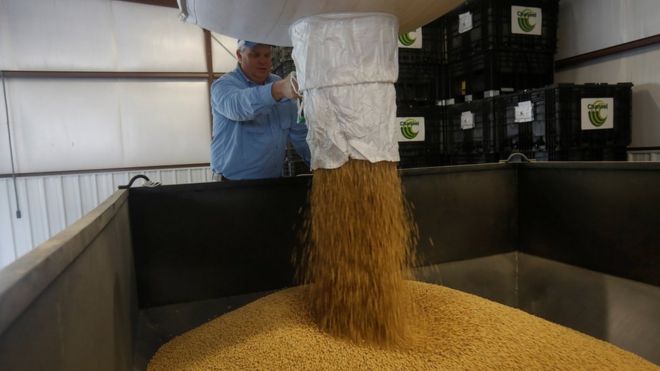
Soybeans coming thru siloImage copyrightREUTERS
Image captionChina’s purchase of 1.13 million tonnes of US soybeans has been hailed as a wonderful, great step by US officials.

China has bought US soybeans for the first time since the trade war between the two countries started in July – a move hailed as a “great step” by US officials.

One of the biggest casualties of the US-China trade war has been the US soybean sector.

China is by far the world’s biggest importer of soybeans.

And Beijing’s high tariffs placed on US soybeans this year has been severely hurting US farmers.

A trade truce between China and the US was reached earlier this month however, and there had been much anticipation that China would soon return to the US soybean market.

But while China’s purchase of 1.13 million tonnes of US soybeans on Thursday was met with much applause from some, others said the purchase was too small, and not a sign that the trade war was cooling.

“Having a million, million-and-a-half tonnes is great, it’s wonderful, it’s a great step,” said Steve Censky deputy secretary of the US Department of Agriculture.

“But there needs to be a lot more as well, especially if you consider it in a normal, typical year, we’ll be selling 30 to 35 million metric tonnes to China.”

The sale also failed to excite traders, who said the numbers fell short of estimates, which saw a sell-off in soybean futures.

“It’s a start, but it’s not nearly enough to fix our problems in regards to soybeans and a soybean oversupply in this country,” said Joe Vaclavik, president of Standard Grain, a Tennessee-based brokerage.

Why do soybeans matter?

In 2017, soybeans were the single biggest US agricultural export to China, which accounts for some 60% of the global trade in the commodity.

And soybeans are vitally important to China because they use the product to feed livestock.

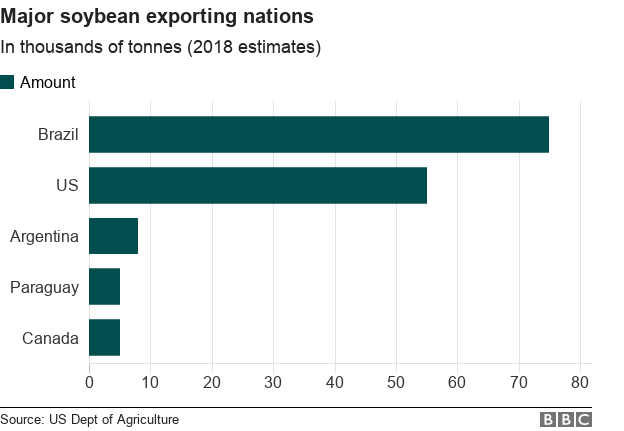
The key supplier globally is Brazil, but China has also relied heavily on the US for soybeans supplies – in part due to seasonality.

Bar chart for major soybean exporters

Chief economist Robert Carnell from ING Bank told the BBC that China’s purchase on Thursday was more about convenience than anything else.

“The simple fact is China needs a lot of soybeans and it’s been buying them from Brazil, not the US,” he said.

“But Brazil could never supply all the soybeans China needed, so ultimately [China has] been driven back to US soybeans. And I think it’s just convenient for them to do that right now.”

Mr Carnell said that the recent arrest of Meng Wanzhou, Huawei’s chief financial officer and deputy chair, was far more indicative of where the trade war between the US and China was really up to.

“[It’s] a battle for technology, a battle for 5G,” he said. “In particular, Huawei has become one of the world’s biggest suppliers of telecoms technology – and the US doesn’t really like that.

“[So that arrest] is giving you a much better, a much clearer message on where the trade war lines in the sand are really being drawn.”

14/12/2018

Lowest retail sales growth for 15 years dash China’s hopes that consumption will offset trade war

Beijing had high hopes that tax cuts for individuals would lift consumer spending and boost an economy which is showing the effects of the trade war, but overall retail sales in November proved disappointing.

Even record spend on Singles’ Day’ on November 11 could not prevent retail sales from posting their weakest growth rate in 15 years.

November’s retail sales, which covers both corporate and consumer spending, stood at 3.52 trillion yuan, down from 3.55 trillion yuan in October, according to data released by the National Bureau of Statistics on Friday.

The growth rate fell to 8.1 per cent compared to November 2017, below the 8.6 per cent rate in October. The figure was also below the 8.8 per cent growth forecast by a Bloomberg poll of economists. Adjusted for inflation, the growth was even lower, at 5.8 per cent.

As the US-China trade war continues to weigh on exports, Beijing is counting on households and companies to spend more to stabilise growth.

However, weak consumption underscores the difficulties the Chinese leadership is having in its efforts to keep the economy stable.

The government expected that its October move to raising the threshold for taxable personal income to 5,000 yuan per month would release unlock spending power equivalent to hundreds of billions of yuan.

It appears likely that some consumers saved their extra income for the November 11 shopping festival, when they can benefit from large discounts.

Shen Li, a physical therapist from Beijing, said his monthly after-tax income increased by 1,000 yuan due to the tax cut, which he used to purchase items such as household appliances on Singles’ Day.

Singles’ Day, China’s version of the US’ Black Friday, is often seen as a gauge of Chinese consumers’ spending power, but in the past it has not been able to drive up total retail sales figures.

This year’s Singles’ Day sales across Alibaba’s e-commerce platforms totalled US$30.8 billion, dwarfing the online sale numbers for Black Friday and Cyber Monday combined. But the growth rate of total transactions fell to 27 per cent, from last year’s 39 per cent.

The late October launch of Apple’s new iPhone XR, which is cheaper than the earlier iPhone XS series, did not boost telecom sales in China, which dropped 5.9 per cent in November year on year, to 48.5 billion yuan.

However, a plunge in car sales was the main culprit for weak consumption. Auto sales were down 10 per cent on a year earlier, to 345.9 billion yuan, according to the statistics bureau figures, as auto dealers struggled to clear their inventories.

This matched industry surveys from the China Passenger Car Association (CPCA), which reported this week that retail sales of sedans, multi-purpose vehicles and sport utility vehicles plunged 18 per cent to 2.05 million units last month, which makes a full-year decline very likely in the world’s largest auto markets.

Ding Shuang, chief China economist from Standard Chartered Bank, said weak auto sales were caused by the expiration of tax rebates for smaller cars, a slowdown in consumer loans partly due to the crackdown in online peer-to-peer lending platforms, and subdued property investment, since new homes are often sold together with garages.

Local commentators worried about ‘downgrading’ of consumption in 2018 as spending on premium goods slowed.

The growth of real estate investment from January to November remained stable at the 9.7 per cent rate seen in the January to October period.

“The decline of consumers’ abilities and willingness to spend is going to first cut down on big ticket items like cars,” said Jiang Chao, chief economist from Haitong Securities. “Auto accounts for two-thirds of China’s consumption of consumer durables.”

Rising household debt has given Chinese policymakers few options to boost spending other than cutting taxes. China’s household debt-to-GDP rose to 49.3 per cent in the first quarter, which was lower than in advanced economies but higher than the average 40 per cent among emerging economies, according to the Bank of International Settlements.

“Household debt will continue to rise and so debt service costs will remain a drag on consumption. But the debt service burden on households should not get much worse unless there is a big acceleration in credit growth (which we do not expect),” Ernan Cui, an analyst from research firm Gavekal Dragonomics, wrote in a report.

“Local commentators worried about ‘downgrading’ of consumption in 2018 as spending on premium goods slowed,” Cui said. “The biggest boom in products favoured by affluent households is probably over, but consumption upgrading will continue as long as income growth does.”

NBS spokesman Mao Shengyong said at a press conference on Friday that China still had the potential to maintain a stable and fast rate of consumption growth next year, given the rise in the number of middle class citizens.

Economists are eyeing new individual tax deductions that will go into effect next year and more tax relief for private companies to prevent the economy from slowing further.

A more complex tax deduction policy which takes in six types of expenses – from elderly care to medical costs- could inject an additional 80 billion yuan in consumers spend, according to Cui’s estimate.

Beijing has also indicated that it will tighten the collection of social insurance contributions that employers are required to pay, but analysts fear that this could negate the benefits of the tax deductions for employees.

14/12/2018

Chinese university student creates a buzz with cheap campus haircuts

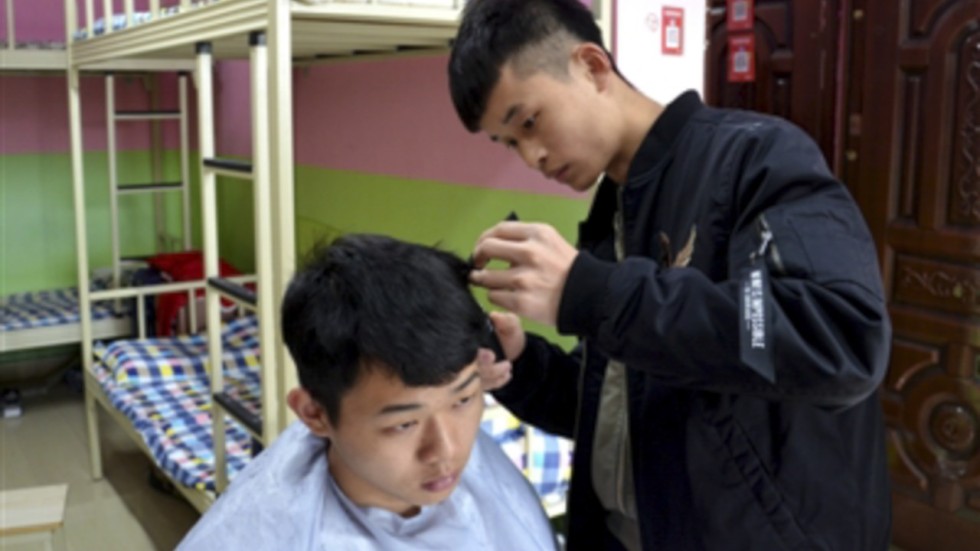
An enterprising student is creating a buzz at a university campus in southwest China, where his cheap and reliable haircuts are in demand.

Ding Weijie, 19, opened an “express hairdressing salon” in his dormitory at the Sichuan Hope Automotive Vocational College in early November, Chengdu Economic Dailyreported on Friday.

Although Ding is self-taught, his hairdressing skills have already turned heads on the campus in Ziyang. His 5 to 6 yuan (73 to 87 US cents) cuts for men have become so popular that appointments need to be booked a few days in advance.

The first-year student, whose major is new energy vehicles, said he had been looking for a way to make some extra cash.

“After I started university, I wanted to find a part-time job to earn some money for my living costs,” Ding, who is from Yibin in Sichuan province, told the newspaper.

ADVERTISEMENT

He initially took a job as a dishwasher in the university canteen, but it did not pay well and left him with little time for studying.

14/12/2018

Trips made by China-Europe freight trains surge in 2018

CHINA-EUROPE-FREIGHT TRAINS TRIPS-SURGING

Staff unload containers from the freight train X8044 after the train from Hamburg of Germany arrived at Wujiashan railway container center station in Wuhan, central China’s Hubei Province, Aug. 26, 2018. China-Europe freight trains made 5,611 trips in the first 11 months of 2018, surging 72 percent compared with the same period last year, according to a meeting held in southwest China’s Sichuan Province. In 2017, more than 3,000 trips were made via the China-Europe freight trains between cities on the two continents. The number is expected to reach 6,000 in 2018, according to the meeting held by the Transport

Photo taken on May 21, 2018 shows a cross-border e-commerce freight train from Hamburg of Germany arriving in Xi’an, northwest China’s Shaanxi Province. China-Europe freight trains made 5,611 trips in the first 11 months of 2018, surging 72 percent compared with the same period last year, according to a meeting held in southwest China’s Sichuan Province. In 2017, more than 3,000 trips were made via the China-Europe freight trains between cities on the two continents. The number is expected to reach 6,000 in 2018, according to the meeting held by the Transport Coordinating Committee of China Railway Corporation’s China-Europe project. As of November, the trains connect 56 Chinese cities with 49 European cities in 15 European countries. The number of trips from Europe to China has increased and accounted for 71 percent of the trips to Europe, according to the committee. In late August, the trains marked their 10,000th trip since beginning operations in March 2011. The China-Europe freight rail services have pushed forward China’s opening-up and boosted economic and trade cooperation with countries along the Belt and Road, the China Railway Corporation said in a statement. This year marks the fifth anniversary of the Belt and Road Initiative, a transnational network connecting Asia with Europe, Africa and beyond. Over the past five years, China’s trade in goods with countries along the Belt and Road exceeded 5.5 trillion U.S. dollars. Chinese direct investment in the non-financial sectors of these countries reached 80 billion dollars during the same period. (Xinhua/Li Yibo)

CHENGDU, Dec. 13 (Xinhua) — China-Europe freight trains made 5,611 trips in the first 11 months of 2018, surging 72 percent compared with the same period last year, according to a meeting held in southwest China’s Sichuan Province.

In 2017, more than 3,000 trips were made via the China-Europe freight trains between cities on the two continents. The number is expected to reach 6,000 in 2018, according to the meeting held by the Transport Coordinating Committee of China Railway Corporation’s China-Europe project.

As of November, the trains connect 56 Chinese cities with 49 European cities in 15 European countries. The number of trips from Europe to China has increased and accounted for 71 percent of the trips to Europe, according to the committee.

In late August, the trains marked their 10,000th trip since beginning operations in March 2011.

The China-Europe freight rail services have pushed forward China’s opening-up and boosted economic and trade cooperation with countries along the Belt and Road, the China Railway Corporation said in a statement.

This year marks the fifth anniversary of the Belt and Road Initiative, a transnational network connecting Asia with Europe, Africa and beyond.

Over the past five years, China’s trade in goods with countries along the Belt and Road exceeded 5.5 trillion U.S. dollars. Chinese direct investment in the non-financial sectors of these countries reached 80 billion dollars during the same period.

14/12/2018

Sino-US trade talks advance amid close contact: Ministry of Commerce

BEIJING, Dec. 13 (Xinhua) — China and the United States are advancing their trade talks with close communication on details, the Ministry of Commerce (MOC) said Thursday.

“The Chinese side welcomes the U.S. team to visit China for consultation and is open to visiting the U.S. for communication,” MOC spokesperson Gao Feng told a news conference.

Gao said the two countries had reached consensus on specific issues including agricultural products, energy and automobiles. “Soybean has always been an important kind of agricultural import from the U.S. given the huge demand in China.”

Gao said more details of the trade talks would be released.

Chinese Vice Premier Liu He, who currently heads the China-U.S. trade talks, spoke with U.S. officials on Tuesday, and the two sides exchanged views on implementing the consensus reached by the heads of state of the two countries and on the timetable and roadmap to push forward the trade talks.

13/12/2018

China to ‘cut US car tariff to 15%’

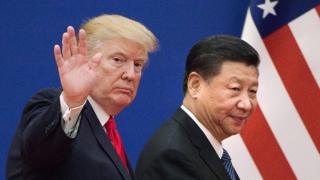
This file picture taken on November 9, 2017, shows US President Donald Trump (L) and China"s President Xi Jinping leaving a business leaders event at the Great Hall of the People in BeijingImage copyrightAFP/GETTY
Image captionUS President Donald Trump says he has a good relationship with President Xi Jinping

China has reportedly proposed cutting tariffs on US-made cars to 15%, the same tax levied on car imports from other countries.

Bloomberg reported that China’s cabinet will review the plans, which would undo the 40% import duty China imposed on US cars this summer.

The proposal, the timing of which remains uncertain, comes as the two countries restart trade talks.

President Donald Trump said earlier this month China would cut the tariffs.

However the claim has not yet been confirmed by Chinese officials, sowing confusion.

Tuesday’s reports in US media, which were based on anonymous sources including a car industry executive, said China outlined the plan on a recent telephone call between top trade negotiators from the two countries.

Bloomberg, which cited “people familiar with the matter”, said the step was not finalised and could still change.

The office of the US Trade Representative, which is leading the discussions, did not respond to a BBC request for comment.

In a tweet, Mr Trump said the two sides were having “very productive conversations”.

China’s commerce ministry confirmed that the two sides had spoken. In a statement it said the conversation concerned “pushing forward the timetable and road map for the next stage of economic and trade consultations work.”

Shares in car companies, including BMW, rose on the reports.

Image captionTesla, a US electric car-maker, has said its sales have been hurt by Chinese tariffs

Argentina meeting

The back-and-forth is the latest in a trade tow triggered by US claims that China engages in “unfair” trade practices, such as theft of intellectual property.

The dispute has prompted the US and China to impose new tariffs on billions of dollars worth of annual trade this year, measures that have contributed to economic worries in both countries.

The two sides, led by Mr Trump and President Xi Jinping, recently met in Argentina, where they agreed to a 90-day halt to any new tariffs.

Image captionMr Trump (front right) met Mr Xi (front left) after the G20 summit in Buenos Aires

US officials later said they wanted to see China move to reduce the car tariffs “immediately” as a sign that negotiations would proceed in good faith.

Analysts remain sceptical that the two sides will be able to reach a resolution of the underlying issues by 1 March.

Those doubts increased after the recent arrest of a high-ranking Huawei official in Canada at the request of the US, which worsened relations between the two countries.

Deja vu?

White House officials have maintained that the two matters are separate, but apparent agreements have faltered before.

In May, after talks in Washington, the US agreed to hold off on tariff threats, while China said it would reduce the import duty on foreign cars from 25% to 15%.

However that deal fell apart within weeks, after Mr Trump decided to move ahead with tariffs.

In retaliation, China raised the duty on US car imports to 40%, though it proceeded with the lower rate on imports from other countries.

13/12/2018

Canadian Michael Spavor detained in China as Huawei row continues

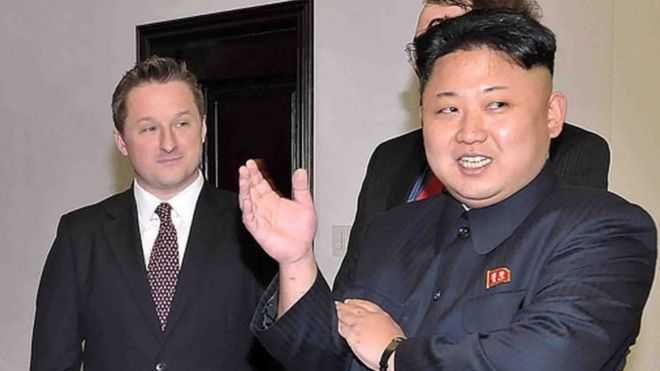
Michael Spavor with North Korean leader Kim Jong-un (2013)Image copyrightAFP
Image captionMr Spavor met North Korea’s Kim Jong-un during his 2013 visit to Pyongyang

A second Canadian has been detained in China on the same accusation of harming national security, as tension continues between the two countries.

It was confirmed on Thursday that Michael Spavor, a businessman, had been detained in addition to former diplomat Michael Kovrig.

Canada drew Chinese protests after it arrested an executive at telecoms giant Huawei at the request of the US.

Meng Wanzhou has been bailed but may face extradition for fraud.

She denies violating US sanctions on Iran through Huawei’s business dealings and China has threatened unspecified consequences if she is not released.

So high-profile is the case that US President Donald Trump has said he could intervene if it helps to avoid a further decline in US relations with China.

Who are the two Canadians?

Michael Spavor is a businessman based in Dandong, near the Chinese border with North Korea. He has deep ties to the North Korean government.

Ex-diplomat Michael Kovrig currently works for a think tank, the International Crisis Group (ICG), which has said it is concerned for his health and safety.

Presentational grey line

Timeline of events

1 December: Meng Wanzhou arrested in Canadian city of Vancouver at the request of the US as part of an inquiry into alleged sanctions-busting by her company Huawei

10 December: Canadian former diplomat Michael Kovrig arrested in Beijing “on suspicion of engaging in activities that harm China’s state security”

11 December: Meng Wanzhou released on bail but still faces the prospect of extradition to the US

12 December: China confirms the detention of businessman Michael Spavor for “activities that endanger China’s national security”, saying the investigation began on 10 December

Presentational grey line

He is being held officially “on suspicion of engaging in activities that harm China’s state security”.

Michael KovrigImage copyrightAFP
Image captionMichael Kovrig was working for a think tank that focuses on conflict reduction research

However, a Chinese foreign ministry spokesman, Lu Kang, suggested another reason, saying the ICG had not been registered as a non-governmental organisation in China and therefore it was unlawful for its staff to work there.

Canadian Foreign Minister Chrystia Freeland has said Mr Kovrig’s case was raised directly with Chinese officials.

Foreign ministry spokesman Guillaume Bérubé confirmed that Mr Spavor had contacted them earlier in the week because “he was being asked questions by Chinese authorities”.

Canada is working hard to determine Mr Spavor’s whereabouts, Mr Bérubé said.

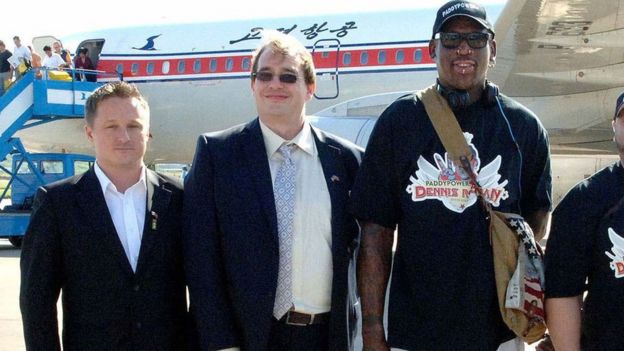
Michael Spavor (L) in North Korea with former NBA star Dennis Rodman (right) (3 Sept 2013)Image copyrightAFP
Image captionMichael Spavor (left) helped arrange ex-NBA star Dennis Rodman’s trip to North Korea in 2013

China state media confirmed on Thursday that, as with the previous arrest, Mr Spavor was under investigation on suspicion of “engaging in activities that endanger China’s national security”.

Mr Spavor runs an organisation called Paektu Cultural Exchange, which organises business, culture and tourism trips to North Korea.

He is a regular visitor to North Korea and regularly comments in the media on Korean issues. He is particularly well known for helping to arrange the visit by former NBA star Dennis Rodman to North Korea in 2013.

Rodman is a personal friend of North Korean leader Kim Jong-un.

One of Mr Spavor’s last tweets, on Sunday, said he was about to travel to Seoul in South Korea, but he did not arrive on Monday as planned.

Why was Meng arrested?

The former Canadian resident was detained in Vancouver where she has family and property connections.

She was granted bail of C$10m (£6m; $7.4m) on Tuesday but could still be extradited to the US.

Court sketch of Meng Wanzhou during her bail hearing in Vancouver, British Columbia, Canada 7 December 2018Image copyrightREUTERS

The US has been investigating Huawei, one of the world’s largest smartphone makers, since 2016, believing that it used a subsidiary to bring US manufacturing equipment and millions of dollars in transactions to Iran illegally.

The Supreme Court of British Columbia was told Ms Meng had used a Huawei subsidiary called Skycom to evade sanctions on Iran between 2009 and 2014.

She had allegedly misrepresented Skycom as being a separate company.

Ms Meng faces up to 30 years in prison in the US if found guilty of the charges, the Canadian court heard.

Are the arrests in China an act of retaliation?

After the detention of Mr Kovrig, Canada said there was no “explicit indication” of any link to the Meng case but China experts doubted that it was just a coincidence.

Guy Saint-Jacques, Canada’s former ambassador to China, told Canadian broadcaster CBC: “In China there are no coincidences… If they want to send you a message, they will send you a message.”

Speaking on condition of anonymity, a Western diplomat in China told Reuters news agency: “This is a political kidnapping.”

Asked if the detention of the two Canadians was in response to Ms Meng’s arrest, China’s foreign ministry spokesman described it as an “operation taken by China’s relevant national security authorities in accordance with the laws”.

Lu Kang said Ms Meng’s arrest was “wrong practice”, adding: “I can point out that, since the Canadian government took the wrong action at the request of the US and took Meng Wanzhou into custody, many Chinese are wondering if their trips to Canada are safe.”

Related Topics

More on this story

  • Huawei: The life of Chinese tech heiress Meng Wanzhou
    11 December 2018
  • Canada is seeking consular access to ex-diplomat detained in China
    12 December 2018
  • Huawei arrest puts ‘bullseye’ on Apple
    11 December 2018

China

13/12/2018

3 Chinese teachers detained for ‘stabbing kindergartners with toothpicks’

  • Parents say their children were warned that if they reported the abuse they would be punished even more
  • School’s legal representative dismisses claims of wrongdoing by teachers
PUBLISHED : Thursday, 13 December, 2018, 6:17pm
UPDATED : Thursday, 13 December, 2018, 6:24pm

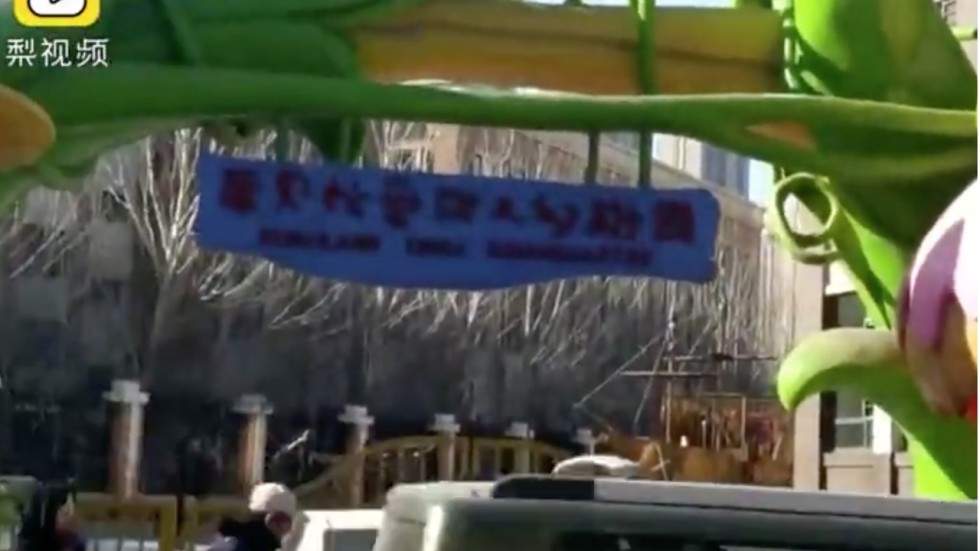
Three kindergarten teachers in northeast China have been detained on suspicion of physically abusing pupils in their care, including stabbing them with toothpicks, according to local media reports.

Police in Shenyang, Liaoning province, launched an investigation into the Kubeiland Emile International Kindergarten after receiving complaints from parents that at least 15 of its pupils had been abused by staff.

“They [pupils] would be pricked if they couldn’t finish their meal, or moved during nap time or didn’t dance well,” one parent was quoted as saying by China Business Journal.

The youngsters were even warned that if they spoke out about the punishments they received there would be worse to come, another parent said.

Several parents had medical records and photographs showing multiple prick marks on their children’s hands, legs, bottoms and abdomens, the report said.

Another parent said the school even tried to cover up the abuse by sending children who bled after being pricked to the school clinic to have their wounds cleaned up and sterilised.

In a report by video news website Pear Video, a mother was quoted as saying that she became suspicious after catching her son stabbing other children with a toothpick. When she challenged him about it, the boy said he was copying his teacher.

A father of another of the pupils echoed the claim that the children were warned not to report the abuse.

“He [the man’s son] said a teacher told them she could see and hear them talking to their parents, so they must not tell.”

The police officer in charge of the case said that three people had been detained pending a full investigation into the allegations.

However, Su Ning, the kindergarten’s legal representative, dismissed claims children had been abused and said the school had provided footage from its surveillance cameras that would invalidate the charges.

Accusations of child abuse in schools are not uncommon in China. Last month, eight teachers from a nursery in Shanghai were sentenced to prison terms of up to 18 months for roughly handling young children and force feeding them mustard.

Law of Unintended Consequences

continuously updated blog about China & India

ChiaHou's Book Reviews

continuously updated blog about China & India

What's wrong with the world; and its economy

continuously updated blog about China & India