25/11/2016

China battles foreign influence in education | The Economist

CHINA has long oscillated between the urge to equip its elite with foreign knowledge and skills, and an opposing instinct to turn inward and rebuff such influences.

In the 1870s the Qing imperial court ended centuries of educational isolation by sending young men to America, only for the Communist regime to shut out the world again a few decades later. Today record numbers of Chinese study abroad: over half a million people left in 2015 alone, many for America (see chart).

The Communist Party officially endorses international exchanges in education while at the same time preaching the dangers of Western ideas on Chinese campuses. A new front in this battlefield is emerging, as the government cracks down on international schools catering to Chinese citizens.

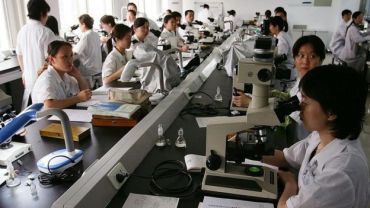
Only holders of foreign passports used to be allowed to go to international schools in China: children of expat workers or the foreign-born offspring of Chinese returnees. Chinese citizens are still forbidden from attending such outfits, but more recently a new type of school has proliferated on the mainland, offering an international curriculum to Chinese nationals planning to study at foreign universities. Their number has more than doubled since 2011, to over 500. Many are clustered on the wealthy eastern seaboard, but even poor interior provinces such as Gansu, Guizhou and Yunnan have them.

Some international schools are privately run, including offshoots of famous foreign institutions such as Dulwich College in Britain or Haileybury in Australia. Even wholly Chinese ventures often adopt foreign-sounding names to increase their appeal: witness “Etonkids”, a Beijing-based chain which has no link with the illustrious British boarding school. Since 2003 some 90 state schools have opened international programmes too, many of them at the top high schools in China, including those affiliated with Peking University and Renmin University in Beijing.

New laws are making it harder for such schools to operate. In 2014 Beijing’s education authorities stopped approving new international programmes at public high schools. Several other cities, including Guangzhou, Shanghai, Shenzhen and Wuhan, have also tightened their policies on such institutions. Some have capped fees for international programmes. The Ministry of Education says it is pondering a law that would require public high schools to run their international programmes as private entities (fearing this event, a few schools have already begun doing so).

Earlier this month a new law banned for-profit private schools from teaching the first nine years of compulsory education. That came only days after Shanghai started to enforce an existing ban on international schools using “foreign curriculums”. Some such institutions already offer a mixture: Wycombe Abbey International, which is based in Changzhou in eastern China and affiliated to a British girls’ boarding school, teaches “political education”, a form of government propaganda, and follows a Chinese curriculum for maths. But the new regulations threaten to nullify the very point of such institutions for most parents, which is to offer an alternative to the mainstream Chinese system, in which students spend years cramming for extremely competitive university-entrance exams that prize rote learning over critical or lateral thinking.

Lawmakers say the rules are prompted by concerns about the quality of international schools. The expansion of international programmes within regular Chinese schools also spurred a popular backlash against the use of public facilities and funds to teach pupils who plan to leave China. Since the number of people attending public schools is fixed, the elite high schools are accused of squeezing out regular students to feed their lucrative international stream. Local governments often provide capital for private schools, too.

The move to control international schools is “the next logical iteration” of a wider campaign against Western influences, reckons Carl Minzner of Fordham University in America. In 2015 China’s education minister called for a ban on “textbooks promoting Western values” in higher education.

This mission extends far beyond the educational realm: the government has called for artists and architects to serve socialism, clamped down on video-streaming sites that carry lots of foreign content and even proposed renaming housing developments that carry “over-the-top, West-worshipping” names. Chinese organisations that receive foreign funding, particularly non-governmental ones, face increasing scrutiny.

The Communist Party is instead seeking to inculcate young Chinese with its own ideological values: the new directive on for-profit schools calls on them to “strengthen Party-building”. After pro-democracy protests in Tiananmen Square in 1989, nationalistic “patriotic education” classes were stepped up in schools, a move that Xi Jinping, the president, has taken to new levels since 2012, seeking to infuse every possible field with “patriotic spirit”. “Morals, language, history, geography, sport and arts” are all part of the campaign now. Unusually, he also seeks to include students abroad in this “patriotic energy”.

But lashing out against international schools could prove risky. Any attack aimed at them essentially targets China’s growing middle class, a group that the ruling Communist Party is keen to keep onside. Chinese have long seen education as a passport to success, and it is not just the super-rich who have the aspiration or means to send their offspring abroad to attend university. Some 57% of Chinese parents would like to do so if they could afford it, according to the Shanghai Academy of Social Sciences. Even Mr Xi sent his daughter to Harvard, where she studied under a pseudonym.

Since school is optional after 15, and parents must pay for it, even at public institutions, the state will find it tricky to prevent high schools from teaching what they want. Moreover, constraints on international schooling in China are likely to swell the growing flow of Chinese students leaving to study abroad at ever younger ages. This trend is the theme of a 30-episode television series, “A love for separation”, about three families who send their children to private school in America.

Restricting for-profit schooling also risks hitting another growing educational market: urban private schools that cater to migrant children who cannot get places in regular state schools because they do not have the required residence permits. A law that undermines educational opportunities for the privileged and the underprivileged at once could prove far more incendiary than a little foreign influence.

Source: China battles foreign influence in education | The Economist

25/11/2016

China breaks patent application record – BBC News

China-based innovators applied for a record-setting number of invention patents last year.

The country accounted for more than a million submissions, according to an annual report by the World Intellectual Property Organization (Wipo). It said the figure was “extraordinary”.

Many of the filings were for new ideas in telecoms, computing, semiconductors and medical tech.

Beijing had urged companies to boost the number of such applications.

But some experts have questioned whether it signifies that the country is truly more inventive than others, since most of China’s filings were done locally.

What is a patent?

A patent is the monopoly property right granted by a government to the owner of an invention.

This allows the creator and subsequent owners to prevent others from making, using, offering for sale or importing their invention into the country for a limited time.

In return they must agree for the patent filing to be publicly disclosed.

To qualify as an “invention” patent, the filing must contain a new, useful idea that includes a step – a new process, improvement or concept – which would not be obvious to a skilled person in that field.

Some countries – including China – also issue other types of patents:

Utility model patents. The ideas must still be novel, but it is less important that there is a “non-obvious step”

Design patents. These require the shape, pattern and/or colour of a manufactured object’s design to be new, but do not require there to be a novel technical aspect

Skewed figures

A total of 2.9 million invention patent applications were filed worldwide in 2015, according to Wipo, marking a 7.8% rise on the previous year.

China can lay claim to driving most of that growth. Its domestic patent office – the Property Office of the People’s Republic of China (Sipo) – received a record 1,101,864 filings. These included both filings from residents of China and those from overseas innovators who had sought local protection for their ideas.

The tally was more than that of Sipo’s Japanese, South Korean and US equivalents combined.

Applicants based in China filed a total of 1,010,406 invention patents – the first time applicants from a single origin had filed more than one million in a single year.

But they appeared to be reticent about seeking patent rights abroad.

According to Wipo, China-based inventors filed just 42,154 invention patent applications outside their borders – Huawei and ZTE, two smartphone and telecoms equipment-makers, led the way.

There was a rise in the number of medical tech patent filings from China

By comparison US-based inventors sought more than five times that figure. And Japan, Germany and France also outnumbered the Asian giant.

One patent expert – who asked not to be named – suggested the disparity between Chinese inventors’ local and international filings reflected the fact that not all the claims would stand up to scrutiny elsewhere.

“The detail of what they are applying for means they would be unlikely to have the necessary degree of novelty to be granted a patent worldwide,” he said.

But Wipo’s chief economist said things were not so clear cut.

“There is clearly a discussion out there as to what is the quality of Chinese patents,” said Carsten Fink.

“But questions have also been asked about US and other [countries’] patents.”

And one should keep in mind that China is a huge economy.

“If you look at its patent filings per head of population, there are still fewer patents being filed there than in the United States.”

Patent boom

Part of the reason so many applications were made locally was that China set itself a target to boost all types of patent filings five years ago.

Sipo declared at the time that it wanted to receive two million filings in 2015.

The government supported the initiative with various subsidies and other incentives.

Adding together China’s invention, utility and design patents, its tally for 2015 was about 2.7 million filings, meaning it surpassed its goal by a wide margin.

One London-based patent lawyer noted that Chinese firms were not just filing patents of their own but also buying rights from overseas companies.

“This all goes to show the growth of the telecoms and high-tech industries in China, and that these companies are playing a more significant role globally than hitherto,” said Jonathan Radcliffe from Reed Smith.

“The fact we are now seeing them suing and being sued for patent infringement in Europe and in the US on subject matter such as mobile phones and telecoms standards – and indeed seeing Chinese companies suing each other over here in Europe for patent infringement – shows that they have truly arrived.”

Source: China breaks patent application record – BBC News

21/11/2016

A victory for China? | The Economist

THE relationship between China and America, as diplomats often intone, is more important than any other between two countries. But that did not help China understand the election of Donald Trump any better than anyone else. The government’s initial reaction was one of confusion, verging on denial. Many ordinary citizens expressed horror, but even more voiced admiration. Mr Trump, it seems, has a remarkable following in a country he blames for America’s malaise.

When news broke of Mr Trump’s victory, official media buried it. That evening, the flagship news programme on state television informed viewers of events in America in the final four minutes of a half-hour broadcast. While the rest of the world was glued to Mr Trump’s victory speech, Chinese viewers had to make do with Xi Jinping, China’s president, talking to Chinese astronauts orbiting the planet.

Chinese officials pay obsessive attention to ensuring the Communist Party’s line is reflected accurately by the country’s main media. But Mr Trump’s victory caught them in a muddle. Several outlets said Mr Xi had telephoned his compliments to Mr Trump. But Mr Trump said he had spoken to or heard from most foreign leaders—except Mr Xi. The phone call did not take place until six days after the vote. In most countries such a mistake would be insignificant, the result of sloppy reporting or ambiguous phrasing (in Mandarin, the phrase “sent a congratulatory note” can also mean “congratulate by phone”). In China it suggested that media overlords were not sure what line to take.

They had hoped the message from the election would be clear: that American democracy is in disarray and that “socialism with Chinese characteristics” is the best choice for China. For the first time, an American election was given extensive coverage (the third presidential debate was broadcast in its entirety). The authorities may have made the right call, as they would see it. “Thank God we don’t use this voting system,” said one blogger.

Unlikely hero

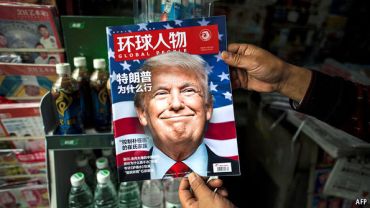
But if some netizens disliked what they saw of the process, many more were captivated by the electoral drama and, especially, by one of the candidates. Ordinary citizens followed the campaign with unprecedented interest. Online, 20 times more posts referred to Mr Trump in the past year than to Barack Obama in the past eight years. One blogger compared Telangpu, as Mr Trump’s name is commonly rendered in Chinese, to the late Deng Xiaoping. Both, apparently, are visionary dealmakers. In China’s online world, wrote another netizen, “Trump has this almost untouchable presence.”

Having digested the news of the victory, Chinese officials have begun to see possible benefits in a Trump presidency (see Banyan). But Ma Tianjie, who runs a website called Chublic Opinion, argues that support for the president-elect is based on culture and values, not calculation. This suggests it has three significant things to say about Chinese society.

First, younger Chinese are not so dissimilar to Mr Trump’s American supporters. As one user wrote on Zhihu, a question and answer site: “Most Chinese born after the 1980s are from a working-class background, who can still sympathise with the uneducated ignorance demonstrated by the less refined.” Anti-elitism retains a broad appeal. “Trump won because he truly spoke in the people’s voice,” wrote one microblogger.

Next, decades of unbridled economic growth have created a Trump-like worship of money and winners. As Lao Lingmin argued on the Financial Times’s Chinese-language website, support for Mr Trump reflected China’s “law of the jungle”. Chinese society, he wrote, “does not exist for the protection of vulnerable groups”.

Thirdly, says Mr Ma, pro-Trump sentiments in China show how far views can be swayed by zealotry, fanned by social media. On Zhihu, a supporter of Mr Trump repeated the president-elect’s falsehood that “there are towns in Britain that are completely under the control of Muslim extremists, who are openly using white girls as sex slaves.” The post got 18,000 likes.Yet online reactions also showed that Chinese opinions are sharply divided. A well-known blogger on Weibo called Chinese Trump supporters “spiritual rednecks”. Another pointed out that China may suffer: “Don’t they know his policies will give China a really hard time?” Intellectuals were aghast.

A news website in Shanghai, however, published an article by an academic who said Mr Trump’s win revealed America’s “ever greater decline”. Official opinion is closer to this view than to Mr Trump’s Chinese cheerleaders.

Source: A victory for China? | The Economist

21/11/2016

How Dangerous Are India’s Railways? – The Numbers – Briefly – WSJ

The derailment of a train in northern India that killed more than 130 people highlights the dangers and challenges along the country’s rail network.

Accidents on the rail system resulted in more than 25,000 deaths in 2014, according to the latest statistics available.

While the cause of Sunday’s incident isn’t yet known, it again draws the spotlight onto the country’s rickety rail system.

So how dangerous is traveling on the country’s trains? Here are the numbers.

28,360     The number of railway accidents in India in 2014. Though that was a decrease of 9.2% from a year earlier, 25,006 people died. That figure is much higher than the 768 deaths recorded on America’s railways the same year.

17,480     The number of railway accidents that were reported to be due to someone falling from a train or a “collision with people at track.” In India, passenger trains are often full to bursting, with people hanging out of windows and doors.  Pedestrians also often cross tracks by foot. The government has sought to raise awareness about the proper use of level crossings and the dangers of strolling near railway lines.

5,024     The number of people who died in railway accidents in Maharashtra in 2014. The western state is home to Mumbai, the country’s financial capital, which has some of the most crowded and dangerous suburban trains.

442     The number of rail-construction projects active in India as of March 2014. Indian Prime Minister Narendra Modi has made modernizing the ageing network a priority,  and has made building a high-speed corridor a pet project.

$16 billion     The amount a government audit found that delays and poor planning had caused costs on the 442 rail projects to balloon.

40%     The proportion of the more than 31,000 railway crossing that are unmanned. Those level crossing contribute to about 40% of train accidents, according to a government news release.

Source: How Dangerous Are India’s Railways? – The Numbers – Briefly – WSJ

21/11/2016

A China-America romance? | The Economist

AFTER the wildest political upsets this year, here’s a prediction for next: China will deem its relations with America to be entering something of a golden period.

The prediction is no more outlandish than others that have recently come true. But is it madness? On the campaign trail, Donald Trump singled out China as the prime culprit ripping jobs and business out of the United States “like candy from a baby”. Mr Trump threatened a trade war. He promised that, on day one as president, he would label China a currency manipulator. He said he would slap a punitive tariff of 45% on Chinese imports. For good measure, he also promised to tear up the climate agreement that President Barack Obama signed with his counterpart, Xi Jinping, in September—a rare bright point in the bilateral relationship.Throw in, too, amid all the disarray inside Mr Trump’s transition team, the names being bandied about for those who will be in charge of dealings with China. They hardly reassure leaders in Beijing. Possibles for secretary of state, for instance, are Rudy Giuliani, New York’s former mayor, who has little experience of China, and John Bolton, a hawk who is actively hostile to it.

And yet China is starting to look on the bright side. Driving the growing optimism in Beijing is a calculation that, if Mr Trump is serious about jobs and growth at home, he will end up in favour of engagement and trade. Put simply, protectionism is inconsistent with “Make America Great Again”. From that it flows, or so Chinese officials hope, that Mr Trump’s campaign threats are mainly bluster. Yes, he is likely formally to label China a currency manipulator. But that will trigger investigations that will not be published until a year later. Even after that, there may be few immediate practical consequences.

What is more, China’s leaders may divine in Mr Trump someone in their mould—not delicate about democratic niceties and concerned above all about development and growth. Reporting on the first phone conversation earlier this week between Mr Xi and Mr Trump, the normally rabid Global Times, a newspaper in Beijing, was gushing. After Mr Xi urged co-operation, Mr Trump’s contribution to the phone call was “diplomatically impeccable”; it bolstered “optimism”, the paper said, in the two powers’ relationship over the next four years. Indeed, thanks to his “business and grass-roots angles”, and because he has not been “kidnapped by Washington’s political elites”, Mr Trump “is probably the very American leader who will make strides in reshaping major-power relations in a pragmatic manner.”

No doubt optimism among more hawkish Chinese is based upon calculations that Mr Trump’s administration will prove chaotic and incompetent, harming America first and playing to China’s advantage in the long game of America’s decline and China’s rise. “We may as well…see what chaos he can create,” the same newspaper was saying only a week ago. And Chinese leaders are delighted to see the back of Barack Obama. They hate his “pivot” to Asia. They are bitter that Mr Obama’s “zero-sum mindset” never allowed him to accept Mr Xi’s brilliant proposal in 2013 for a “new type of great-power relations” involving “win-win” co-operation. How could Mr Obama possibly think that the doctrine boils down to ceding hegemony in East Asia to China?

And so, it is not hard to imagine what gets discussed in the first meeting between the two leaders, after Mr Trump’s inauguration. In his victory speech, the builder-in-chief promised a lot of concrete-pouring: “highways, bridges, tunnels, airports, schools, hospitals”. Mr Xi will point out that he has a fair amount of expertise in construction, too. It comes from running a vast country with more than 12,000 miles (18,400km) of bullet-train track where America has none, and a dam at the Yangzi river’s Three Gorges which is nearly as tall as the Hoover Dam and six times its length. Mr Xi will offer money and expertise for the president-elect’s building efforts, emphasising that China’s help will generate American jobs. In return, it would be an easy goodwill gesture for Mr Trump to reverse Mr Obama’s opposition to American membership of the Chinese-led Asian Infrastructure Investment Bank, and to lend more support to Mr Xi’s “Belt and Road” plans for building infrastructure across Asia and Europe. Advisers to Mr Trump suggest that is already on the cards.

The other leadership transition

A honeymoon, then, that few predicted. China certainly wills it. A calm external environment is critical for Mr Xi right now. He is preparing to carry out a sweeping reshuffle of the party’s leadership in the coming year or so. His aim is to consolidate his own power and ensure that he will have control over the choice of his eventual successors. That will demand much of his attention.

But don’t expect the honeymoon to last. For one, China may well have underestimated the strength of Mr Trump’s mercantilist instincts. It may also have second thoughts should a sustained dollar rally complicate management of its own currency. And even though America’s panicked friends have been this week, as the New York Times put it, “blindly dialling in to Trump Tower to try to reach the soon-to-be-leader of the free world”, Trumpian assurances of support have been growing for the alliances that China resents but that have reinforced American power in East Asia since the second world war. (As The Economist went to press, Japan’s prime minister, Shinzo Abe, was about to become the first national leader to meet the president-elect; he will reassure Mr Trump that Japan is taking on a bigger role in defending itself.)

And then who knows what might roil the world’s most important relationship? No crisis has recently challenged the two countries’ leaders like the mid-air collision in 2001 of a Chinese fighter jet and an American spy plane. Yet some similar incident is all too thinkable in the crowded, and contested, South and East China Seas. Remember, it is not just Mr Trump who is wholly untested in a foreign-policy crisis of that scale. Mr Xi is, too.

Source: A China-America romance? | The Economist

21/11/2016

U.S. panel urges ban on China state firms buying U.S. companies | Reuters

U.S. lawmakers should take action to ban China’s state-owned firms from acquiring U.S. companies, a congressional panel charged with monitoring security and trade links between Washington and Beijing said on Wednesday.

In its annual report to Congress, the U.S.-China Economic and Security Review Commission said the Chinese Communist Party has used state-backed enterprises as the primary economic tool to advance and achieve its national security objectives.

The report recommended Congress prohibit U.S. acquisitions by such entities by changing the mandate of CFIUS, the U.S. government body that conducts security reviews of proposed acquisitions by foreign firms.

“The Commission recommends Congress amend the statute authorizing the Committee on Foreign Investment in the United States (CFIUS) to bar Chinese state-owned enterprises from acquiring or otherwise gaining effective control of U.S. companies,” the report said.CFIUS, led by the U.S. Treasury and with representatives from eight other agencies, including the departments of Defense, State and Homeland Security, now has veto power over acquisitions from foreign private and state-controlled firms if it finds that a deal would threaten U.S. national security or critical infrastructure.

If enacted, the panel’s recommendation would essentially create a blanket ban on U.S. purchases by Chinese state-owned enterprises.

The report “has again revealed the commission’s stereotypes and prejudices,” Chinese Foreign Ministry spokesman Geng Shuang said in Beijing.

“We ask that Chinese companies investing abroad abide by local laws and regulations, and we hope that relevant countries will create a level playing field,” he told a daily news briefing.

EXTRA WEIGHT

The panel’s report is purely advisory, but could carry extra weight this year because they come as President-elect Donald Trump’s transition team is formulating its trade and foreign policy agenda and vetting candidates for key economic and security positions.

Congress also could be more receptive, after U.S. voter sentiment against job losses to China and Mexico helped Republicans retain control of both the House and the Senate in last week’s election.

Trump strongly criticized China throughout the U.S. election campaign, grabbing headlines with his pledges to slap 45 percent tariffs on imported Chinese goods and to label the country a currency manipulator on his first day in office.

“Chinese state owned enterprises are arms of the Chinese state,” Dennis Shea, chairman of the U.S.-China Economic and Security Review Commission, told a news conference.

“We don’t want the U.S. government purchasing companies in the United States, why would we want the Chinese Communist government purchasing companies in the United States?”

The recommendation to change laws governing CFIUS was one of 20 proposals the panel made to Congress. On the military side, it called for a government investigation into how far outsourcing to China has weakened the U.S. defense industry.

The 16-year-old panel also said Congress should pass legislation that would require its pre-approval of any move by the U.S. Commerce Department to declare China a “market economy” and limit anti-dumping tariffs against the country.

The United States and U.S. businesses attracted a record $64.5 billion worth of deals involving buyers from mainland China this year, more than any other country targeted by Chinese buyers, according to Thomson Reuters data.

The push into the United States is part of a global overseas buying spree by Chinese companies that this year has seen a record $200 billion worth of deals, nearly double last year’s tally.

CFIUS has shown a higher degree of activism against Chinese buyers this year, catching some by surprise. Prominent deals that fell victim to CFIUS include Tsinghua Holdings’ $3.8 billion investment in Western Digital (WDC.O).

Overall, data do not demonstrate CFIUS has been a significant obstacle for Chinese investment in the United States. In 2014, the latest year for which data is available, China topped the list of foreign countries in CFIUS review with 24 deals reviewed out of more than 100 scrutinized by CFIUS.

Although the number of Chinese transactions reviewed rose in absolute terms, it fell as a share of overall Chinese acquisitions, the report noted, and the vast majority of deals reviewed by CFIUS were cleared.

Source: U.S. panel urges ban on China state firms buying U.S. companies | Reuters

21/11/2016

U.S.-China Investment Flows Bigger Than Thought – China Real Time Report – WSJ

Would politicians in the U.S. and China be stronger proponents of foreign investment from each other’s nations if the amounts were bigger?

A new study estimates foreign direct investment between the U.S. and China is already two to four times the amount shown by official statistics, and its authors hope the findings will encourage politicians to forge even deeper bilateral links. “We simply did not have a good joint basis for discussion,” said Thilo Hanemann, research director at New York-based Rhodium Group.

With funding by big U.S. businesses and trade groups, Rhodium counted $228 billion in 6,677 U.S. investments into China since 1990, plus 1,200 Chinese investments into the U.S. worth $64 billion. The figures are significantly higher than official numbers produced in each country.

Publication of Rhodium’s “Two-Way Street” comes as investment and trade flows face increasingly skeptical governments in both the U.S. and China. Proponents of open flows express anxiety that, as U.S. president, Donald Trump could favor more protectionism. New policies could mean less business for investment bankers and lawyers who do cross-border deals, plus slower trade and fewer jobs in local communities.

Cool winds were already blowing before Mr. Trump’s surprise election.

Rising trade barriers are blamed for anemic global commerce this year, while cross-border investment is under such threat that Group of 20 leaders in September endorsed guidelines designed to inspire confidence in it. This week, the U.S. Congress was advised by a longtime critic of Beijing, the U.S.-China Economic and Security Review Commission, of an “inherently high risk” in allowing state-run Chinese companies to make acquisitions in the U.S.

A Chinese Foreign Ministry spokesman declined to comment on the commission’s report in a regular briefing Thursday and said the U.S.-China economic relationship is mutually beneficial.

Rhodium argues that the benefits of FDI aren’t widely enough appreciated because the amounts have been underestimated. Its researchers aimed to track every business investment of $1 million or more between the world’s two largest economies over the past quarter century.The researchers found deep impacts throughout China and the U.S., including 1.6 million jobs in China directly resulting from U.S. FDI and U.S. 100,000 due to Chinese money.

The paths into each other’s nations differ, the study determined. Some 71% of U.S. investments into China were greenfield, or new, projects. U.S. companies, including Gap Inc. and International Paper, according to their executives who participated in a launch of the report, initially went to China because it was cheaper. Today they increasingly look at its consumer market. Meanwhile, U.S. business as a whole could do more if permitted into key sectors such as entertainment and energy.

Chinese companies have mostly bought businesses in the U.S. with activity that has been almost all in the past five years, the researchers found. Dealmaking has risen so quickly that China’s flows to the U.S. topped its intake from the U.S. in 2015, with activity increasingly driven by private companies, including financial investors such as Shanghai-based Fosun Group, which also took part in the launch event.

The business community’s near-term anxiety is the election of Mr. Trump, who campaigned on allegations the Sino-U.S. economic relationship has been anything but a two-way street.

Stephen Orlins, president of the National Committee on U.S. China Relations, which sponsored the Rhodium work, predicted the 45th president will adopt open investment policies, saying: “As a business person, he will understand that foreign investment creates jobs in the United States. Trade may be different.”

Source: U.S.-China Investment Flows Bigger Than Thought – China Real Time Report – WSJ

16/11/2016

China’s top coal province says 29 percent of water unsuitable for humans | Reuters

Nearly a third of the surface water in Shanxi, China‘s biggest coal producing province, is so polluted that it cannot be used by humans, the local environmental watchdog said in a notice on Wednesday.

The Shanxi Environmental Protection Bureau said in a report that 29 out of the 100 surface water sites tested in the first three quarters of 2016 were found to be “below grade five“, which means that pollution levels are so high that the water has “lost functionality”.

China’s water is graded into five categories. Grade three and above is deemed safe for direct human contact, while grades four and five can only be used in industry and agriculture.

While there have been slight improvements compared to the first half of the year, Shanxi is still falling behind its targets, the bureau said.It said 11 sites had shown improvements compared to last year, but eight had deteriorated, including five spots in the major coal-producing city of Datong, which were found to have fallen “below grade five” over the period.

According to the Ministry of Environmental Protection‘s latest analysis of water quality on major rivers published this week, 22 percent of samples from 146 sites nationwide was found to be grade four or worse.

Shanxi produced 944 million tonnes of coal last year, more than a quarter of the national total, and decades of overmining in the province have damaged underground water tables and contaminated ground water supplies.

Source: China’s top coal province says 29 percent of water unsuitable for humans | Reuters

15/11/2016

The Economist explains: Why India scrapped its two biggest bank notes | The Economist

In a surprise televised address on the evening of November 8th, Narendra Modi, the prime minister of India, delivered a bombshell: most of the money in Indians’ wallets would cease to be accepted in shops at midnight. The two most valuable notes, of 500 and 1000 rupees ($7.50 and $15), were to be “demonetised”, economist slang for taken out of circulation. Indians have until the end of the year to visit banks to either exchange their cash against newly printed notes or deposit it in their accounts. After that, their notes will become mere pieces of printed paper with no value at all.

Citizens and businesses face weeks or months of disruption as the new currency stock is deployed. So why bother?

The government justified the move in part due to concerns over a proliferation of counterfeit notes (not unusually, it pointed the finger at neighbouring Pakistan), which it claims is fuelling the drug trade and funding terrorism. But its main impact will be on “black money”, cash from undeclared sources which sits outside the financial system. Perhaps 20% of India’s economy is informal. Some of that is poor farmers, who are largely exempt from tax anyway. But the rich are perceived to be sitting on a vast illicit loot. Though a large part of that sits in bank accounts in predictable foreign jurisdictions, a chunk of it is held in high-value Indian notes. Purchases of gold or high-end real estate have long been made at least in part with bundles (or suitcases) of illicit cash. The impact of the move is that everyone will have to disclose all their cash or face losing it. Those with mere bundles of 500 rupee notes clearly aren’t the target: the government has said tax authorities won’t be told about deposits of less than 250,000. But those who have stashed large piles of notes are in a bind. A recent amnesty programme for “black money” has just passed meaning the tax man is unlikely to look upon undeclared cash piles with sympathy.

The question is not whether the scheme will work but whether the cost of implementing it is worth it. The notes being nixed represent 86% of all cash in circulation: everyone is impacted. Queues have snaked around banks for days as Indians have tried to convert their notes into new money. And the “black money” hoarders have ways to liquidate their loot, for example hiring lots of people to deposit their notes into their own accounts and then send it back, all for a fee. The benefits are hard to gauge for now. The government is keen to be seen to be cracking down on tax-dodgers on behalf of the “common man”. But if the poor fellow then has to spend his days (like your correspondent) scouring the streets for an ATM that works, he may end up wondering if he is a beneficiary of the scheme or its victim.

Source: The Economist explains: Why India scrapped its two biggest bank notes | The Economist

10/11/2016

Theresa May promises ‘golden era’ in UK-Chinese relations – BBC News

Theresa May has promised to work for a “golden era” in the UK’s relations with China, as the country’s vice-premier visits London for talks.

Ma Kai‘s trip follows Mrs May’s decision after coming to power to delay approval of the part-Chinese-financed Hinkley Point C nuclear power plant.

The project was given the go-ahead, after China warned that “mutual trust” was needed between the countries.

Mr Ma is meeting Chancellor Philip Hammond to discuss investing in the UK.

Speaking before the eighth UK-China Economic and Financial Dialogue got under way, Mrs May said: “I’m determined that as we leave the European Union, we build a truly global Britain that is open for business.”

As we take the next step in this golden era of relations between the UK and China, I am excited about the opportunities for expanding trade and investment between our two countries.”

‘Mutual benefits’

There will be an announcement that the Chinese contractor CITIC Construction is to invest £200m in the first phase of the £1.7bn London Royal Albert Docks project, headed by the Chinese developer ABP.

Philip Hammond promises ‘constructive’ US talks

And the UK will in turn invest up to £40m in the Asian Infrastructure Investment Bank based in Beijing, for a fund to help developing countries to prepare infrastructure programmes.

Mr Hammond, who is hosting the Chinese delegation at London’s Lancaster House, said: “The mutual benefits are clear. China is the world’s second-largest economy. UK exports to China have grown rapidly and Britain is home to more Chinese investment than any other European country.”

US President-elect Donald Trump has said he wants to apply 45% tariff barriers to Chinese imports in an effort to protect free trade.

Mr Hammond told the BBC: “Britain’s always believed that the best way long-term to protect and promote prosperity is free markets and free trade.”

President Trump has just been elected by the American people. He will want to consult with his advisers, talk to officials and I’m sure we will have a very constructive dialogue, as we do with the Chinese, with the new American administration.”

He added: “It’s about getting the right balance in the global trading system, so that we can have the benefits of open markets, while being properly and appropriately protected.”

One of Mrs May’s first acts on becoming prime minister during the summer was to order a review of the project to build Hinkley Point C, in Somerset, part-financed by China.

Writing in the Financial Times in August, Liu Xiaoming, China’s ambassador to the UK, said: “If Britain’s openness is a condition for bilateral co-operation, then mutual trust is the very foundation on which this is built.”

Right now, the China-UK relationship is at a crucial historical juncture. Mutual trust should be treasured even more.”

The UK government approved Hinkley Point C in September, saying it had imposed “significant new safeguards” to protect national security.

Source: Theresa May promises ‘golden era’ in UK-Chinese relations – BBC News

Law of Unintended Consequences

continuously updated blog about China & India

ChiaHou's Book Reviews

continuously updated blog about China & India

What's wrong with the world; and its economy

continuously updated blog about China & India