05/09/2016

Britain, India to look at ways to retain strong trade ties after Brexit | Reuters

British Prime Minister Theresa May and Indian Prime Minister Narendra Modi agreed on Monday to look at ways to retain strong trading links after Britain leaves the European Union, a British official said.

“The Indians said they wanted to look at how we could continue to have a strong trading relationship and there was agreement that as we prepare to leave the EU, we should be exploring what that looks like,” the official said.

Prime Minister Modi said that we had always been an important partner for India and nothing about leaving the European Union would change that.”

The two leaders were meeting on the sidelines of the G20 summit in the Chinese city of Hangzhou.

Source: Britain, India to look at ways to retain strong trade ties after Brexit | Reuters

04/09/2016

China says should constructively handle disputes with India | Reuters

Chinese President Xi Jinping told Indian Prime Minister Narendra Modi on Sunday that the two countries should respect each other’s concerns and constructively handle their differences.

The two nuclear-armed neighbours have been moving to gradually ease long-existing tensions between them.

Leaders of Asia’s two giants pledged last year to cool a festering border dispute, which dates back to a brief border war in 1962, though the disagreement remains unresolved.

Meeting on the sidelines of the G20 summit in the eastern Chinese city of Hangzhou, Xi said relations had maintained a steady, healthy momentum, and should continue to increase mutual understanding and trust.

“We ought to respect and give consideration to each other’s concerns, and use constructive methods to appropriately handle questions on which there are disputes,” Xi said, in comments carried by China’s Foreign Ministry.

“China is willing to work hard with India the maintain the hard-won good position of Sino-India relations,” Xi added.

China’s Defence Ministry said last month that it hoped India could put more efforts into regional peace and stability rather than the opposite, in response to Indian plans to put advanced cruise missiles along the disputed border with China.

Indian military officials say the plan is to equip regiments deployed on the China border with the BrahMos missile, made by an Indo-Russian joint venture, as part of ongoing efforts to build up military and civilian infrastructure capabilities there.

China lays claim to more than 90,000 sq km (35,000 sq miles) ruled by New Delhi in the eastern sector of the Himalayas. India says China occupies 38,000 sq km (14,600 sq miles) of its territory on the Aksai Chin plateau in the west.

India is also suspicious of China’s support for its arch-rival, Pakistan.Modi arrived in China from Vietnam, which is involved in its own dispute with China over the South China Sea, where he offered Vietnam a credit line of half a billion dollars for defence cooperation.Modi’s government has ordered BrahMos Aerospace, which produces the BrahMos missiles, to accelerate sales to a list of five countries topped by Vietnam, according to a government note viewed by Reuters and previously unreported.

Source: China says should constructively handle disputes with India | Reuters

04/09/2016

UK’s May to review security risks of Chinese-funded nuclear deal | Reuters

Prime Minister Theresa May said on Sunday she wanted her security advisers to review a delayed nuclear power investment from China – a source of diplomatic tension – as she arrived in the country to attend a G20 summit.

May upset Chinese officials in July by delaying a $24 billion project that would see French firm EDF (EDF.PA) build Britain’s first new nuclear power plant in decades with the help of $8 billion from China.

Speaking during her first visit to China, May was asked whether she would ask the National Security Council, a team of ministers supported by intelligence officers, to look at the potential security implications of the Hinkley deal.

“I will be doing exactly as you’ve said,” May replied, saying it would be part of her decision-making process. The comment marked the first official acknowledgement that national security was a factor in her decision.

The initial delay caught investors by surprise and has cast doubt over whether May, who took office in July following Britain’s vote to leave the European Union, will continue to court China as a major source of infrastructure investment.

“This is the way I operate,” May earlier told reporters en route to the summit, which will include a one-to-one with Chinese President Xi Jinping.

“I look at the evidence, …take the advice and consider that and come to my decision.

“A final decision is expected later this month.

May, a former interior minister, is wary of the risks of allowing China to invest in nuclear projects, according to a former cabinet colleague. The EDF deal is viewed as a precursor to Chinese involvement in another two nuclear plants.

Asked whether she trusted China, May said: “Of course we have a relationship with them… What I want to do is build on that relationship.

“She also stressed a need to broaden the group of nations that Britain can trade with and tap for cash to help reinvigorate its power, transport and technology infrastructure.”This is the G20, this is about talking to a number of world leaders. I’m going to give the message that Britain is very much open for business… I want to be talking about the opportunities for free trade around the world.”

Source: UK’s May to review security risks of Chinese-funded nuclear deal | Reuters

03/09/2016

China tourism: Crossing the new glass bridges – BBC News

Tourism sites in the central Henan and Hunan provinces have been constructing vertigo-inducing skywalks in a bid to attract visitors.
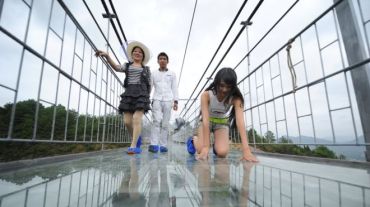
And it seems to have worked, attracting thrill-seeking tourists and locals, all wanting a chance to experience a bird’s eye view of the Chinese countryside.

One of them is student Li Shu Zhen, 19, from Hangzhou city.

She shared with the BBC her experience of climbing the Brave Man’s Bridge in Pingjiang county, Hunan province.

“You look down and feel a sense of fear, but you quickly recover from that and enjoy the scenery,” she said.

“It was beautiful, almost as if one was walking on air.”

Yoga has been one of the stranger activities performed on the Brave Man’s Bridge

An eating challenge was held on this bridge in Yueyang country – although you might lose your appetite if you look downT

he fully transparent bridge, which measures 300m long (984ft) and 180m high, first opened to the public in September.

It is one of the more popular bridges, with events – like mass yoga displays – often being staged on it.

Local officials say that glass panels were designed to withstand high winds and earthquakes, as well as the “weight of 800 visitors”.

Glass bridge fever has also spread to neighbouring Taiwan, where a 179m-high bridge opened in Nantou county.

Construction has already begun on a second glass bridge above Zhangjiajie valley in Hunan province

‘Even if the glass breaks’

Construction on the latest bridge, touted as the world’s longest glass-bottomed walkway, is also nearing completion.

Standing at 300m high and stretching 375m, the bridge will hang above the Zhangjiajie grand canyon, also in Hunan province.

Gearing up for the bridge’s 2016 opening, officials have even enlisted the public’s help in naming it.

One of its engineers, Yang Guohong, from state-owned China Railway Major Bridge Reconnaissance and Design Institute, said contractors had taken extra safety precautions.

“No matter how the tourists jump on the bridge, it will still be fine,” he told the People’s Daily newspaper.

“The steel structures beneath it are incredibly dense, so even if the glass breaks, visitors won’t fall through.”
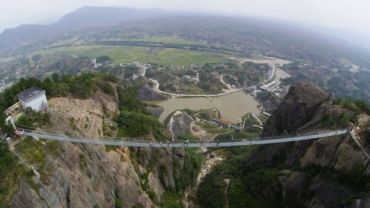
Would you dare to walk across?

But architects who spoke to the BBC said that such glass bridges were often “primarily a novelty, built as visitor attractions rather than commuter bridges”.

Architect Keith Brownlie, who was involved in a glass bridge for The London Science Museum, said that the appeal was “thrill”.

“It is the relationship between emotionally driven fear and the logical understanding of safety,” he said. “These structures tread the boundary between those two contrasting senses and people like to challenge their rational mind in relation to their irrational fear.

“Others felt that the bridges symbolised extravagance, especially in China.

“In architecture, glass has always been associated with luxury and often as a display of wealth,” said bridge designer Ezra Groskin.

“Glass floor panels, used in the creation of invisible architecture, are not a new phenomenon. However its use is often restricted due to cost and practicality.”

A terrifying incident last October sent visitors fleeing in fear after a section of a glass bridge in Yuntai mountain, Henan province, cracked

Shattered nerves

But how safe are China’s glass bridges?

An incident in October sent terrified visitors fleeing in fear after part of a glass skywalk in Henan province’s Yuntai Mountain Geological Park cracked, despite only being open for two weeks.

Park officials closed the walkway immediately, later saying there was “no reason for worry” and that the cracks had “no impact on safety”.

But experts questioned the use of glass in an exposed mountain environment.

“While a glass structure designed by a competent engineer and manufactured by a specialist contractor has no greater risk in terms of structural integrity than any other building material, glass can be prone to localised shocks,” noted architect Adam Holicska.

“The use of it in a mountain environment where there is a potential risk of rock impact can make it a questionable choice.

“Architect Keith Brownlie added that the cleaning of glass panels and lack of slip resistance should also be considered in such an environment.”One issue with glass decks is the problem of grip,” he said. “Glass is slippery and so anti-slip properties must be provided,”

The glass-bottomed Brave Man’s Bridge in Hunan province connects two mountains

“Please, no more such bridges,” commented a user on China’s popular micro-blogging site Weibo. “Judging from this incident, it is only a matter of time before more serious accidents and deaths occur.

“But glass bridge enthusiasts remain undeterred.

“I still would not hesitate to visit other glass bridges soon,” Ms Li admitted.

Other netizens on the site also expressed similar opinions.

“I am confident that officials will step up additional measures after that happened,” said one Weibo user.

“Thankfully deaths were avoided but one bad incident should not put one off from conquering such a spectacular bridge.”

Another compared it to other bridges of the world: “If Sydney’s Harbour Bridge experienced a crack, I doubt government officials would close it down. So we should not let such an episode affect our opinions about our unique Chinese structures.”

Source: China tourism: Crossing the new glass bridges – BBC News

02/09/2016

Jobs elusive as India clings to fastest-growing economy tag | Reuters

It’s been two years since India emerged as the world’s fastest-growing major economy, but the rapid expansion has done little to improve the lot of Ashok Kumar.

Parked up and sitting on the kerb, the 25-year-old truck driver is going nowhere fast. He is the sole breadwinner for the 13 people in his extended family and his monthly salary is stuck at $150.

With new, better-paid jobs hard to come by, Kumar lacks options. He fears becoming unemployed like his elder brother, who recently returned to their village in Uttar Pradesh after months of searching in vain for work.

Data out on Wednesday showed India’s economic growth slowed to 7.1 percent in the quarter to June, a 15-month low. That is faster than other major economies, but not fast enough to create enough new jobs to absorb all the one million people who join the workforce every month.

A government survey found that job creation fell by more than two-thirds in 2015. Analysts at HDFC Bank estimate that for every percentage point the economy grows, employment now adds just 0.15 of a percentage point – down from 0.39 in 2000.

It’s a major challenge for Prime Minister Narendra Modi, who has promised to create 250 million jobs over the next decade.

“For one job, there are at least 20 candidates,” said Kumar. “If you want the job, you can’t afford to bargain.”

Nearly two-thirds of India’s 1.3 billion people are under 35 years old. This rising demographic “bulge” will create the largest working-age population in the world. At the same time China, which has long curbed family size, will age as a society.

Whether this so-called demographic dividend will translate into the kind of economic gains seen in Japan and Korea, or lead to upheavals, depends on India’s ability to generate jobs.

Yet, despite average annual growth of 6.5 percent between 1991 and 2013, India added less than half the jobs needed to absorb new job seekers.

MORE WORKERS, FEWER JOBS

Under Modi, India has opened up further to foreign investment, hoping to generate more manufacturing jobs. A loan scheme for small businesses has been set up and there are plans for a $1.5 billion fund for startups.

Modi has also launched a programme to train over 4 million people in different skills in six years.Pronab Sen, country director for the International Growth Centre, a British-backed think tank, said such measures were “laudable”, but they aimed at boosting supply when more demand was needed.

“India has become a demand-starved economy,” Sen said. “If there is no demand, there will be no incentive to produce more which, in turn, will mean no new jobs.”

The level of desperation for work is staggering. In August, nearly half a million people, including post-graduates, applied for 1,778 jobs as sweepers in the city of Kanpur.

This was not a one-off. Last year, in Uttar Pradesh, 2.3 million people sought 368 low-level government jobs that required a primary education and ability to ride a bicycle.

Competition for such jobs has become fiercer as the public sector’s share in formal employment is declining.

Two years of drought has caused distress in farming, while the construction business has suffered a prolonged downturn – making work scarcer in the two sectors that employ the bulk of India’s unskilled workforce.

Satellite cities around the capital, like Greater Noida were, until recently, bustling with construction activity.

Now, Greater Noida’s skyline is dotted with half-built, abandoned, high-rises. Cranes and diggers stand idle.

In Delhi and the surrounding National Capital Region, housing starts fell 41 percent year-on-year in the first half of the year, according to consultancy Knight Frank. Across India, starts were down 9 percent from a year earlier.

Bhuwan Mahato, a contractor who supplies workers to construction projects around Noida, says demand for labour is down by at least 25 percent.

“I wish I hadn’t joined this business,” said Mahato, a 30-year-old migrant from the state of Bihar. “But, truthfully, there are no other opportunities, either.”

Source: Jobs elusive as India clings to fastest-growing economy tag | Reuters

02/09/2016

Crime Capital: Why Delhi Is by Far India’s Most Dangerous City – India Real Time – WSJ

Delhi is India’s biggest megacity, home of the country’s central government and, according to new police data, way ahead of the competition in the quest to claim the title as the country’s capital of crime.

The National Crime Records Bureau released its statistics for 2015 on Tuesday and Delhi left everyone else in the dust.Around 25% of the nearly 670,000 crimes recorded in India’s 53 largest cities were committed in Delhi last year, even though the megacity only accounts for around 10% of their combined populations.

The financial capital Mumbai was a distant second, recording only about 6% of the crimes. Tech hub Bangalore claimed about 5% of the crimes and Chennai looked to be the safest of the top five major metros, accounting for only 2% of the crimes.

This is not because Delhi–home of more than 16 million souls–has the largest population. Even on a per capita basis, the capital shined when it came to crime.

Last year it brought home the gold in theft and insulting the modesty of women, beating all the other cities with populations of more than 1 million,  according to the bureau’s data. In rape, only Jodhpur was worse. In the murder category, it was the bloodiest of the five major metros and well above average.

Delhi police attribute the high rate of crime in the city to their hard work. More and more cases are being registered every year as the force cracks down, said Taj Hassan, spokesman for the Delhi police.

“Delhi, being the national capital, witnesses a lot of law and order problems because people from all states live here,” he said. “The law and order situation is under control.”

More than previous years and in other cities, people are now being “encouraged to come forward and report” every incident of crime. “Not even a single complaint goes unnoticed,” he said.

There was, however, one area of hope.Surprisingly Delhi-ites were relatively law-abiding last year when it came to injuries caused by rash driving and road rage. Maybe the city’s notorious traffic is keeping cars from going fast enough to cause injury.

Maybe the city’s police force is too busy tracking down violent criminals to deal with bad drivers.

Source: Crime Capital: Why Delhi Is by Far India’s Most Dangerous City – India Real Time – WSJ

01/09/2016

India’s richest man unveils telecoms venture with free calls, cut-price data | Reuters

India’s Reliance Industries unveiled its new telecom network on Thursday, touting free calls and rock-bottom data prices that sent shares of established telecom players into a nosedive on fears of an all-out price war.

Reliance’s Chairman Mukesh Ambani, India’s richest man, told shareholders at the energy giant’s annual shareholder meet that services on the new network, dubbed Jio, would be available for free until Dec. 31 as it continues network tests. He did not say when the services would be launched commercially.

Reliance, one of India’s biggest business houses which gets most of its revenue from its sprawling oil and gas business, has in the recent years expanded into more consumer-facing markets such as retail and telecom as growth in its core business slows.

The company, which secured telecom airwaves in 2010, has so far invested more than $20 billion on building a nationwide network, and has pledged to offer affordable services to price-conscious Indian customers.

Ambani, who was interrupted by repeated rounds of applause as he took shareholders through Jio’s ambitious rollout plans, free countrywide roaming offering and more, vowed to “transform India from a high-priced data market to one with the lowest data rates anywhere in the world.

“Jio could make Reliance a big provider of telecoms and internet services across India – a nation of one billion mobile phone subscribers – and is a key plank of Ambani’s future strategy even though the business is unlikely to add significantly to consolidated profit any time soon.

Jio will effectively price one gigabyte of data at about 50 rupees for some users, about one-fifth of what rivals charge, Ambani said. Data charges will fall even further for heavier users, he said.

Ambani set a target of 100 million customers for Reliance Jio “in the shortest possible time”, without specifying.

Shares in India’s No. 1 wireless carrier Bharti Airtel Ltd dropped 6.3 percent on Thursday, while smaller rival Idea Cellular fell 10.5 percent, on fears that Jio’s aggressive rates will trigger a price war in the sector.

The incumbents have already started lowering data prices ahead of Jio’s entry.

Still, a telecom analyst, who declined to be named, said Jio would face challenges in luring low-spending phone users to its network.

Jio’s cheapest plan starts at 149 rupees and offers just 0.3 gigabytes of data and the company’s next plan up costs 499 rupees, while a majority of India’s phone users who still have basic phones spend less than 200 rupees a month on telecommunications services.

“It is definitely aggressive and will hurt the incumbents,” he said. “But it’s not like it’s going to push everyone else out of the market.”

($1 = 66.9475 Indian rupees)

Source: India’s richest man unveils telecoms venture with free calls, cut-price data | Reuters

01/09/2016

Indian manufacturing growth at 13-month high in August | Reuters

Indian factory activity expanded at its fastest pace since mid-2015 in August, helped by surging new orders, while only modest price increases should give the central bank scope to ease policy further, a survey showed.

The data will cheer policymakers after an official report on Wednesday showed Indian annual economic growth slowed in the April-June quarter to 7.1 percent, short of expectations for 7.6 percent in a Reuters poll.

The Nikkei/Markit Manufacturing Purchasing Managers Index rose to 52.6 in August from July’s 51.8, marking its eighth month above the 50 level that separates growth from contraction.

“Manufacturing PMI data show that the positive momentum seen at the beginning of the second semester has been carried over into August, with expansion rates for new work, buying levels and production accelerating further,” said Pollyanna De Lima, economist at survey compiler Markit.

The new orders sub-index, which takes into account both domestic and external demand, was 54.8 in August – its highest since December 2014 and indicating robust demand for Indian manufactured goods.

That pushed factories to increase production and the output sub-index climbed to a 12-month peak in August.But price growth lost momentum last month, with raw material costs increasing at their weakest rate in six months and output prices barely rising at all, suggesting consumer inflation could cool in coming months.

“In light of these numbers, the Reserve Bank of India has scope to loosen monetary policy in the upcoming meeting to further support economic growth in India,” De Lima said.On Oct. 4, the RBI is due to announce its first policy decision under newly-appointed governor Urjit Patel, who economists expect to broadly follow in outgoing chief Raghuram Rajan‘s footsteps.

Economists in a Reuters poll last month predicted the RBI would cut the repo rate by 25 basis points to 6.25 percent in the final three months of the year.

They see little steam left in the RBI’s current easing cycle, in which the policy repo rate has come down by 150 basis points since January 2015, to its lowest in more than five years.Consumer inflation in India was 6.07 percent in July, well above the RBI’s March 2017 medium-term target of 5 percent.

Source: Indian manufacturing growth at 13-month high in August | Reuters

31/08/2016

86-year-old transforms her village by selling eggs online[1]| Society

Liao Xiuying, a woman who survived the Japanese invasion more than half a century ago, is now helping to lift her village out of poverty with the help of e-commerce.

Liao’s parents died in the Chinese People’s War Against Japanese Aggression (1937-1945).

Liao started making and peddling salted duck eggs as a teenager, but she had never thought selling the eggs could turn into big business.

Last year, a cooperative was set up in Fenggang village of Ruijin to help the local residents sell farm produce including salted duck eggs through an online platform.

The new business model has paid off. Since its founding, more than two million salted duck eggs have been sold, and residents in poverty have seen their revenues and income increase significantly.

Source: 86-year-old transforms her village by selling eggs online[1]| Society

26/08/2016

The Economist explains: Why Kashmir is erupting again | The Economist

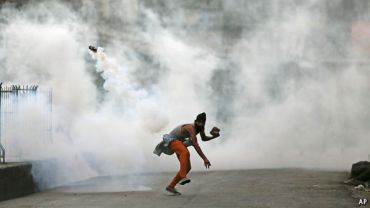
TODAY marks the 48th consecutive day of protests in Jammu & Kashmir, India’s only Muslim-majority state. Young Kashmiri men have been on the streets calling for independence from India and throwing stones at security forces. Indian security forces have responded with tear gas and shotguns that fire small-bore pellets instead of buckshot.

A strict curfew has also been imposed across the Kashmir valley, which includes Srinagar, the region’s largest city. So far, 66 civilians and two police officers have been killed in the violence. Why are Kashmiris protesting?

The region has been disputed since the partition of India and Pakistan in 1947. Both sides claim the territory and have fought three wars over it. Kashmir has been living under India’s Armed Forces (Special Powers) Act, which gives special powers to the army, since the eruption in 1990 of an armed insurgency that was covertly supported by Pakistan. Some 40,000 people have been killed since. Even in the relatively peaceful past decade, unrest has flared up, most notably in the summers of 2008 and 2010. The current protests started on July 9th after Indian security forces killed Burhan Wani, a young and charismatic Islamist militant. Resentment had been building for months. Kashmiris worried when Narendra Modi’s Hindu-nationalist Bharatiya Janata Party (BJP) came to power in 2014 that his national government would make life difficult for Muslims. At state elections later that year, the local Peoples Democratic Party formed a coalition with the BJP, leaving them feeling betrayed. Wani’s killing has mobilised a generation that had grown up under what it sees as an illegitimate Indian occupation.

The result has been a seven-week cycle of violent protests and retaliatory action by the police and paramilitary forces. Their supposedly non-lethal pellets have blinded dozens and injured hundreds. Shops and businesses have remained closed since the protests started, either under curfew orders or because of calls for strikes from separatist leaders. Many Kashmiris have not left their homes for weeks. Few expect the situation to improve any time soon, despite soothing words this week from Mr Modi and a visit to the region by India’s home minister.An obstacle to any lasting solution is India’s insistence on seeing Kashmir through the prism of its rivalry with Pakistan. The Indian government’s immediate reaction to this summer’s unrest was to accuse its neighbour of meddling. In fact, Wani was a home-grown insurgent; the young men on the streets are locals. Unemployment is widespread and economic opportunities are few. The state was also promised special status, guaranteeing autonomy, in India’s constitution. And many Kashmiris now want more: a survey in 2010 by Chatham House, a think-tank, found overwhelming support for independence. Kashmiris are at best ambivalent about their attachment to India. Until the government recognises their demands, the anger is unlikely to dissipate.

Source: The Economist explains: Why Kashmir is erupting again | The Economist

Law of Unintended Consequences

continuously updated blog about China & India

ChiaHou's Book Reviews

continuously updated blog about China & India

What's wrong with the world; and its economy

continuously updated blog about China & India