04/12/2015

Selective Equality? China Retirement Age Plan Sparks Backlash Among Women – China Real Time Report – WSJ

China’s policy makers have long accepted the need for workers to delay retirement to ease social and fiscal pressures from a rapidly aging population. Few, however, could agree on how to do it.

This week, state-backed researchers fueled fresh debate on the issue with a new proposal on how to coax more productive years out of China’s silver-haired generation. They called for gradually extending the country’s statutory retirement thresholds over the next three decades, culminating in a flat retirement age of 65 years. But their plan is proving unpopular. It is particularly striking a nerve among some women, who in China can retire between five and ten years earlier than men. The statutory retirement age for men is set at 60 years.

On social media, many female users mocked what they perceived as selective pursuit of gender equality. “In 2045, would there be equal pay between men and women? Would men be able to give birth?” a user, who identified as female, wrote on the popular Weibo microblogging service. “Chinese society, in reality, is rife with gender inequality; why bring about gender equality in retirement age?” another user wrote.

In an online survey, the state-run China National Radio found nearly 80% of respondents objected to setting a flat retirement age for men and women. “Delaying retirement is understandable, but setting the same retirement age for men and women isn’t compatible with our country’s conditions,” CNR quoted a Weibo user as saying. “Men would only have to work five more years, while women would have to work ten years longer. And women still have to face family pressures, so it’s clearly unsuitable.”

The proposal from the Chinese Academy of Social Sciences comes amid a longstanding debate in government and academic circles on how to implement a much-needed but deeply unpopular policy. Beijing has said it will gradually raise retirement thresholds starting in 2022, though the policy would only be finalized in 2017. Under rules unchanged since the 1950s, China allows most female workers to retire when they turn 50, while women in public-sector jobs can do so at 55 years of age. To change this, the CASS researchers proposed that the government could in 2017 set a flat retirement age for women at 55 years, eliminating the distinction between private and public-sector workers. Authorities could begin extending retirement thresholds—for men and women—at a fixed pace, starting in 2018.

CASS researchers suggest adding a year to the female retirement age every three years, while doing so for men every six years. Beijing could also allow flexibility for workers to bring forward or delay their retirement by up to five years, on the condition that their pension payouts would be adjusted accordingly, CASS said.

Source: Selective Equality? China Retirement Age Plan Sparks Backlash Among Women – China Real Time Report – WSJ

02/12/2015

Hacking of U.S. government was criminal, not state-sponsored: China | Reuters

China’s official Xinhua news agency said on Wednesday that an investigation into a massive U.S. computer breach last year that affected more than 22 million federal workers found the hacking attack was criminal, not state-sponsored.

An illustration picture shows a projection of binary code on a man holding a laptop computer, in an office in Warsaw June 24, 2013. REUTERS/Kacper Pempel

In an article about a meeting between top U.S. and Chinese officials on cyber security issues held in Washington, Xinhua said the breach at the United States Office of Personnel Management (OPM) was among the cases discussed.

The report did not give details of who conducted the investigation, or whether U.S. and Chinese officials both agreed with the conclusion.

The U.S. Embassy in Beijing referred Reuters to the Department of Justice and Department of Homeland Security in Washington for comment on the talks.

The Cyberspace Administration of China, the country’s Internet regulator, did not immediately reply to a Reuters request for comment.

OPM has been under scrutiny from lawmakers and the public ever since it disclosed earlier this year that it had fallen victim to two cyber attacks, which officials have privately linked to Chinese hackers.

The intrusions exposed sensitive personal information, including names, Social Security numbers and addresses of more than 22 million current and former federal employees and contractors, in addition to 5.6 million fingerprints.

Top U.S. and Chinese officials convened this week in Washington for the first round of cyber security talks following the signing of a bilateral anti-hacking accord in September.

The talks on Tuesday and Wednesday are seen as potentially significant in establishing acceptable norms for cyber espionage.

China and the U.S. reached a broad agreement on the joint fight against cyber crimes, and will set up a hotline for these issues, according to Xinhua and CCTV, China’s state-operated national broadcaster.

CCTV said a spokesperson for the Department of Homeland Security declined to comment on any agreement. The next meeting is scheduled for next June, Xinhua said.

Source: Hacking of U.S. government was criminal, not state-sponsored: China | Reuters

02/12/2015

China Road Rage Cases Top 17 Million So Far in 2015 – China Real Time Report – WSJ

Chinese police attributed 80,200 traffic accidents in 2013 to road rage, and the number rose by 2.4% in 2014. Men account for 97% of road rage incidents, official data show.

No Caption Available.

China is a notoriously dangerous place for driving in general. The World Health Organization has estimated that 261,000 people died on China’s roads in 2013. Chinese government data show that last year 1,895 people died in traffic accidents when crossing roads, and 4,180 people died between 2011 and 2014 on public buses that were speeding or overloaded.

Yet when it comes to the surge in road rage, experts point to a range of possible explanations. One is that the rapid development of China’s car market has led the country’s roads to become increasingly crowded, creating frustration and anger on the streets. Sociologists also link road rage to general anxiety and fickleness, one of the side products of China’s rapid economic growth — and its accompanying social pressure — over the past three decades.

In China, the total number of vehicles has increased by more than 18 million cars for each of the past five years. As of the end of October, China had 169 million autos, according to Ministry of Public Security statistics, next only to the U.S.’s 240 million. The number of license-holders has risen even more quickly; since 2010, China has added more than 20 million new drivers each year. Now one in five Chinese has a license.

The country’s infrastructure has struggled to keep up. Data from the Ministry of Public Security show that 35 Chinese cities now have more than one million automobiles. Ten of those cities — including Beijing, Chengdu and Shenzhen – each have more than two million cars on the road. But while the number of China’s motor vehicles and drivers has each risen more than 20-fold since 1987, the country’s road capacity has increased only 3.4 times over the same period.

The rash of new drivers is also posing safety hazards. The official Xinhua News Agency cited a spokesman from the Ministry of Public Security as saying that drivers with less than one year of experience play a large role in traffic accidents. To be sure, China has some safety regulations in place. For example, drivers and front-seat passengers are required to wear seatbelts, and the use of mobile phones while driving is prohibited. But these laws are often ignored in practice. Distracted driving – operating a vehicle while texting, talking on the phone, watching videos, eating or reading – contributed to more than a third of fatal traffic accidents in 2014, causing 21,570 deaths, the Ministry of Public Security said.

Chinese authorities are working to counter the trend. In the past month, the Ministry of Public Security launched a public education campaign on road etiquette after several high-profile cases of road rage violence this year. It advocated against dangerous driving behaviors including street racing, drunk driving, aggressive driving and blocking emergency lanes.

Source: China Road Rage Cases Top 17 Million So Far in 2015 – China Real Time Report – WSJ

01/12/2015

Boost for China as it joins IMF elite – FT.com

The IMF on Monday gave a major vote of confidence to China and its reform efforts, giving the renminbi greater weighting than the yen or pound as it included the currency in its elite basket of reserve currencies.

Chinese one-hundred yuan banknotes are stacked for a photograph at the Korea Exchange Bank headquarters in Seoul, South Korea, on Thursday, Feb. 27, 2014. Photographer: SeongJoon Cho/Bloomberg

The vote by the board to make the renminbi the fifth currency in the basket used to value the IMF’s own de facto currency followed months of deliberation at the fund and years of lobbying by a Beijing eager for the recognition.

“The Rmb’s elevation to the club of elite global reserve currencies is a big step for China and a significant one for the international monetary system,” said Eswar Prasad, professor of economics at Cornell University and a former IMF China mission chief.

The renminbi will become the third biggest currency in the “special drawing rights” basket when it takes effect on October 1. The move is largely symbolic but Christine Lagarde, IMF managing director, called it a “milestone” in China’s economic reform “journey” and its integration into the global financial system.

Following the move the currency slipped 0.19 per cent to Rmb6.4374 against the dollar in offshore trading in Hong Kong.

The People’s Bank of China set its daily “fix” — the onshore rate around which the currency can trade 2 per cent either side — at Rmb6.3973 per dollar, its fourth consecutive slightly weaker rate.

Investors generally expect China to allow its currency to weaken gradually but few see much likelihood of a repeat of its 3 per cent August devaluation, which sent shockwaves through global markets.

Source: Boost for China as it joins IMF elite – FT.com

30/11/2015

Smog chokes Chinese, Indian capitals as climate talks begin | Reuters

The capitals of the world’s two most populous nations, China and India, were blanketed in hazardous, choking smog on Monday as climate change talks began in Paris, where leaders of both countries are among the participants.

China’s capital Beijing maintained an “orange” pollution alert, the second-highest level, on Monday, closing highways, halting or suspending construction and prompting a warning to residents to stay indoors.

The choking pollution was caused by the “unfavourable” weather, the Ministry of Environmental Protection said on Sunday. Emissions in northern China soar over winter as urban heating systems are switched on and low wind speeds have meant that polluted air has not been dispersed.

In New Delhi, the U.S. embassy’s monitoring station recorded an air quality index of 372, which puts air pollution levels well into “hazardous” territory. A thick smog blanketed the city and visibility was down to about 200 yards (metres).

Air quality in the city of 16 million is usually bad in winter, when coal fires are lit by the poor to ward off the cold. Traffic fumes, too, are trapped over the city by a temperature inversion and the lack of wind.

However, the government has not raised any alarm over the current air quality and no advisories have been issued to the public. Thirty thousand runners took part in a half marathon at the weekend, when pollution levels were just as high.

In Beijing, a city of 22.5 million, the air quality index in some parts of the city soared to 500, its highest possible level. At levels higher than 300, residents are encouraged to remain indoors, according to government guidelines.

The hazardous air underscores the challenge facing the government as it battles pollution caused by the coal-burning power industry and will raise questions about its ability to clean up its economy at the talks in Paris.

Chinese President Xi Jinping and Indian Prime Minister Narendra Modi are both in Paris and both were scheduled to meet U.S. President Barack Obama on Monday to give momentum to the two-week negotiations.

Source: Smog chokes Chinese, Indian capitals as climate talks begin | Reuters

27/11/2015

He Starts Singing ‘You Raise Me Up.’ When She Joins In, Everyone Is Completely Speechless

You must watch this video.  Inspirational (at least to me).

http://shareably.net/little-boy-and-girl-sing-you-raise-me-up-on-chinese-show/

Tags:
24/11/2015

Modi woos investors in Singapore – The Hindu

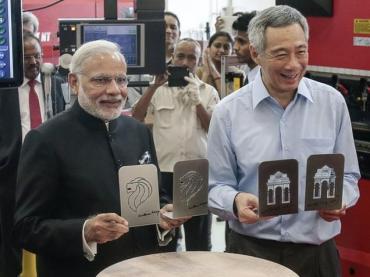
Promising more reforms to make India more attractive for foreign investments, Prime Minister Narendra Modi on Tuesday assured investors that he would “carefully hold” their hands and expressed hope that the GST would be rolled out in 2016.

Prime Minister Narendra Modi and Singapore Prime Minister Lee Hsien Loong at the Institute of Technical Education College in Singapore on Tuesday.

Speaking at the India Singapore Economic Convention, Mr. Modi said India is exploring a potential partnership with Singapore’s Changi Airport for developments of two Indian airports and invited companies to join in building smart cities.

“In the last 18 months, the runways for the take-off of the economy have been made. Reforms are happening in a big way. They are now reaching to the last mile. Reform is to transform the system so that they perform. They aim at helping people realise their dreams. It means more charm on the faces and less forms in the offices. Efforts to deepen financial markets have been made,” he said.

‘Most open economy

The Prime Minister said his government began to liberalise FDI laws soon after coming to power last year and the latest round of FDI reforms have made India the “most open economy” in the world.

“We are also conscious of last mile operational issues in such matters and we are fine tuning the norms. Recently, we further eased FDI norms, after which India is the most open economy in terms of FDI,” he added.

While talking about 40 per cent increase in FDI and improvement in rankings like ease of doing business and world competitiveness index, Mr. Modi said, “Perceptions are turning into positive outcomes”.

“We are hopeful to roll out GST regime in 2016. The company law tribunal is being set up. FDI inflows have gone up by 40 per cent compared with previous year’s comparative period. Perceptions are turning into positive outcomes. FDI commitments are translating into reality,” he noted.

Modi also outlined 14 decisive steps taken to address regulatory and taxation concerns and said that India offers tremendous opportunities for investments, ranging from affordable housing to smart cities, railways to renewable energy.

Source: Modi woos investors in Singapore – The Hindu

24/11/2015

Dream of the bed chamber | The Economist

“SEX, sex, sexual intercourse, penis, penis, vagina.”

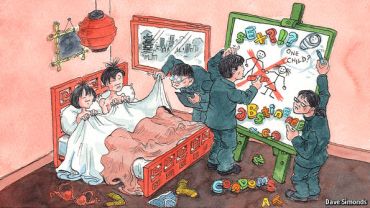
More than 150 undergraduates are sitting in a lecture hall at China Agricultural University in Beijing, shouting loudly. Many are sexually active, or soon will be. Yet for most it is the first sex education class they have attended.

Their instructor hopes that shouting such words will help youngsters talk more openly about sex. Lu Zhongbao, a 24-year-old forestry student, says he was told as a child that he “emerged from a rock”. When he started having sex with his university girlfriend he had little idea about contraception. This evening he arrived an hour early armed with another question: will masturbating damage his health?

It is not just China’s economy that has loosened up since 1979. The country is in the midst of a sexual revolution. A 2012 study found that more than 70% of Chinese people have sex before marriage. Other polls put that figure lower but consistently indicate that over the past 30 years, more young Chinese are doing it, with more partners, at a younger age. But a lack of sex education means that many are not protecting themselves, resulting in soaring abortion rates and a rise in sexually transmitted diseases.

The Communist Party has stuck its nose into people’s bedrooms for 30 years through its harsh family-planning policies. Yet taboos on sex before marriage prevailed, the result of paternalistic—not religious—values about female chastity, with a dose of Communist asceticism thrown in. Pre-marital sex fell foul of a range of laws, including the catch-all charge of “hooliganism”, only scrapped in 1997.

The social climate remains chilly. Most news items about sex involve scandals or crimes. Schools ban pupils from dating and many deploy “morality patrols” to root out flirting or frolicking couples. Sex outside wedlock is not illegal but children born to unmarried mothers face obstacles obtaining a hukou, or household residency, that entitles them to subsidised education and welfare. Yet with greater freedom from their parents, more money and increasing exposure to permissive influences from abroad, China’s youth are clearly separating sex from procreation.

Education on the subject is compulsory in Japan, South Korea and Taiwan—societies that have some cultural similarities with China. But most Chinese schools teach only basic anatomy.

This is not entirely for lack of trying. Pilot campaigns in Shanghai and Beijing schools in the 1980s were incorporated into a nationwide programme in 1988 but it was never implemented. In 2008 the Ministry of Education included sex education in the national health and hygiene curriculum. The barriers are not just prudery. Like football, fashion and other teenage pastimes, sex (and learning about it) is seen as a distraction from studies. “Sex is not an exam subject,” says Sheng Yingyi, a 21-year-old student.

Where classes happen, most students are merely given a textbook. “Happy Middle School Students”, written for 12- to 15-year-olds in 2006 and still widely used, refers to sperm meeting egg without describing the mechanics of intercourse. A more explicit volume for primary-school pupils published in 2011, which did explain how sperm were delivered, was criticised for being pornographic.

The dominant message is to abstain. A 2013 review by UNESCO and Beijing Forestry University noted the prevalence of “terror-based” sex education, with content largely focused on the horrors of pregnancy, abortion and HIV. Earlier this month a university in Xi’an in central China ran a course entitled “No Regrets Youth” where students received a “commitment card”, essentially a pledge to remain a virgin until marriage.

Source: Dream of the bed chamber | The Economist

24/11/2015

The elephants fight back | The Economist

FOR anybody who fears that China’s interest in elephants’ tusks could spell doom for the great beasts, there have been two pieces of good news.


On September 25th Xi Jinping, the Chinese president, joined Barack Obama in pledging “significant and timely steps” to halt commercial trade in ivory. Then on October 15th China announced a one-year ban on the import of ivory hunting trophies from Africa, closing a big loophole. Wildlife activists are delighted. These moves should have “a profound effect” on elephant numbers, says Peter Knights of WildAid, a charity.

The world’s elephant population has dived from 1.2m in 1980 to under 500,000 today. In 1989 the sale of ivory was banned worldwide. But in 1999 and again in 2008, the Convention on International Trade in Endangered Species (CITES), a conservation pact, allowed the sale of stockpiles of ivory from southern Africa to China. The countries vowed to use the proceeds for conservation; China claimed it had a robust registration system that would keep illegal ivory out. But conservationists rightly predicted the concession would fuel more smuggling and so more killing.

Permitted sales became a cover for illegal ones. In 2010-12 about 100,000 elephants were slain for their tusks. In the past five years, Mozambique and Tanzania have lost half their elephants to poaching.

This dire trend reflects China’s deeper engagement with Africa, combined with corruption and the presence of criminal gangs. But it seems that Chinese leaders have seen the trade’s effects on their reputation, says Dominic Dyer of the Born Free Foundation, a charity. They should now close the legal carving workshops and ban the domestic trade, too, he adds.

Despite strong demand for ivory among China’s rising middle class, attitudes may gradually be changing. As of 2012, nearly half of Chinese people saw elephant poaching as a problem, according to a survey by WildAid. The figure has been boosted by the support of celebrities. Yao Ming, a basketball player, and Jackie Chan, an actor, appear on posters everywhere with the message: “When the buying stops, the killing can too.” The government has donated $200m worth of media space every year since 2008.

Opinion on ivory has shifted fast, says Mr Knights, partly because of the success of another campaign, to protect sharks. In the markets of Guangzhou, the global centre for the trade, dried shark fins have fallen from 3,000 yuan ($470) per kilo five years ago to 1,000 yuan today, as Chinese people abjure shark-fin soup, a delicacy.

WildAid raised its voice over that issue, too, but more important was the Communist Party’s ban in 2013 of shark-fin soup at official banquets, part of a drive against corruption and excess. The Hong Kong government followed, as did airlines and hotels. A survey in 2013 found 85% of people said they had stopped eating shark-fin soup in the past three years.

One scourge is untouched by all this: the illegal trade in rhinoceros horn. More than 1,200 rhinos were killed for their horns in 2014 in South Africa alone, up from just 13 killed in 2007. This partly reflects a huge rise in demand in Vietnam, but China is also a consumer. Ground rhino horn is believed to cure fever and improve sexual performance. One kilo can cost up to $70,000.

Ominously, some African nations now want a one-off sale of rhino-horn stocks, as happened twice with ivory. To secure this, South Africa must win two-thirds of the member states at the next CITES conference, which it hosts next year. Mr Dyer hopes other countries, including China, will dissuade the Africans. “We are in exactly the same place we were with ivory nearly ten years ago,” he frets.

Source: The elephants fight back | The Economist

23/11/2015

China’s Sun Paper to build $1.36 billion facility in U.S. | Reuters

China’s Shan Dong Sun Paper Industry Joint Stock Co (002078.SZ) said on Monday it would spend about $1.36 billion to build a pulp mill in the United States in its first investment outside the country.

The facility is expected to break ground in 2016 and start operations in 2018, Sun Paper spokesman Song Weihua told Reuters.

The mill in the southeastern state of Arkansas is slated to make fluff pulp, a raw material for diapers and sanitary products.

On Friday Sun Paper Chairman Li Hongxin signed a memorandum of understanding for this at a ceremony in Jinan which was attended by U.S. Commerce Secretary Penny Pritzker and Arkansas Governor Asa Hutchinson.

The U.S. Food and Drug Administration has approved the company to manufacture paper at the mill, Sun Paper said in a statement to the Shanghai Stock Exchange on Monday.

The investment by the northern China-based company is the latest in a slew of deals by Chinese manufacturers looking to diversify their operations and take advantage of initiatives and rebates in western countries.

Shandong Tranlin Paper Co Ltd invested $2 billion in a paper and fertilizer plant in Virginia last year. (reut.rs/1PUY1r4)

Sun Paper declined to give details on its financing of the project, although sources said the company is likely to involve a combination of equity and debt.

Source: China’s Sun Paper to build $1.36 billion facility in U.S. | Reuters

Law of Unintended Consequences

continuously updated blog about China & India

ChiaHou's Book Reviews

continuously updated blog about China & India

What's wrong with the world; and its economy

continuously updated blog about China & India