01/02/2020

Coronavirus declared global health emergency by WHO

The new coronavirus has been declared a global emergency by the World Health Organization, as the outbreak continues to spread outside China.

“The main reason for this declaration is not what is happening in China but what is happening in other countries,” said WHO chief Tedros Adhanom Ghebreyesus.

The concern is that it could spread to countries with weaker health systems.

Meanwhile, the US has told its citizens not to travel to China.

The state department issued a level four warning – having previously urged Americans to “reconsider” travel to China – and said any citizens in China “should consider departing using commercial means”.

China has said it will send charter plans to bring back Hubei province residents who are overseas “as soon as possible”.

A foreign ministry spokesman said this was because of the “practical difficulties” Chinese citizens have faced abroad. Hubei is where the virus emerged.

At least 213 people in the China have died from the virus, mostly in Hubei, with almost 10,000 cases nationally.

The WHO said there had been 98 cases in 18 other countries, but no deaths.

Most international cases are in people who had been to Wuhan in Hubei.

However in eight cases – in Germany, Japan, Vietnam and the United States – patients were infected by people who had travelled to China.

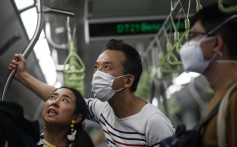
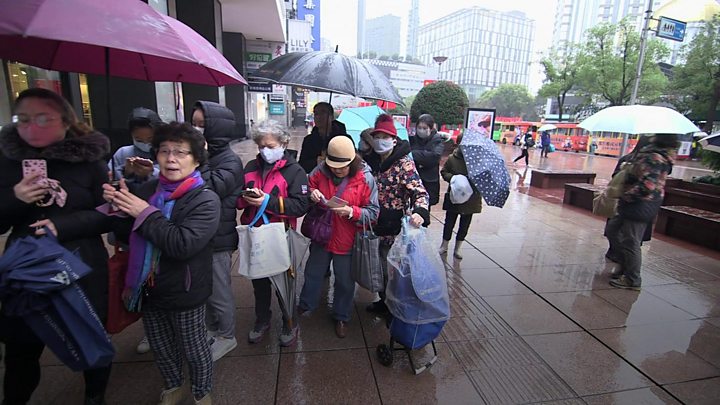
People wearing masks

Getty Coronavirus outbreak outside China
  • 18 The number of countries with cases
  • 14 Cases in Thailand and Japan
  • 13 Singapore
  • 11 South Korea
  • 8 Australia and Malaysia
  • 5 France and USA

Source: WHO and local authorities

Speaking at a news conference in Geneva, Dr Tedros described the virus as an “unprecedented outbreak” that has been met with an “unprecedented response”.

He praised the “extraordinary measures” Chinese authorities had taken, and said there was no reason to limit trade or travel to China.

“Let me be clear, this declaration is not a vote of no confidence in China,” he said.

But various countries have taken steps to close borders or cancel flights, and companies like Google, Ikea, Starbucks and Tesla have closed their shops or stopped operations.

The US Commerce Secretary, Wilbur Ross, has said the outbreak could “accelerate the return of jobs to North America”.

Presentational grey line

Preparing other countries

Analysis box by James Gallagher, health and science correspondent

What happens if this virus finds its way into a country that cannot cope?

Many low- and middle-income countries simply lack the tools to spot or contain it. The fear is it could spread uncontrollably and that it may go unnoticed for some time.

Remember this is a disease which emerged only last month – and yet there are already almost 10,000 confirmed cases in China.

The 2014 Ebola outbreak in West Africa – the largest in human history – showed how easily poorer countries can be overwhelmed by such outbreaks.

And if novel coronavirus gets a significant foothold in such places, then it would be incredibly difficult to contain.

We are not at that stage yet – 99% of cases are in China and the WHO is convinced the country can control the outbreak there.

But declaring a global emergency allows the WHO to support lower- and middle-income countries to strengthen their disease surveillance – and prepare them for cases.

Presentational grey line

How unusual is this declaration?

The WHO declares a Public Health Emergency of International Concern when there is “an extraordinary event which is determined… to constitute a public health risk to other states through the international spread of disease”.

It has previously declared five global public health emergencies:

  • Swine flu, 2009 – The H1N1 virus spread across the world in 2009, with death toll estimates ranging from 123,000 to 575,400
  • Polio, 2014 – Although closer than ever to eradication in 2012, polio numbers rose in 2013
  • Zika, 2016 – The WHO declared Zika a public health emergency in 2016 after the disease spread rapidly through the Americas
  • Ebola, 2014 and 2019 – The first emergency over the virus lasted from August 2014 to March 2016 as almost 30,000 people were infected and more than 11,000 died in West Africa. A second emergency was declared last year as an outbreak spread in DR Congo

Media caption Inside the US laboratory developing a coronavirus vaccine

How is China handling the outbreak?

A confirmed case in Tibet means the virus has reached every region in mainland China. According to the country’s National Health Commission, 9,692 cases have tested positive.

The central province of Hubei, where nearly all deaths have occurred, is in a state of lockdown. The province of 60 million people is home to Wuhan, the heart of the outbreak.

The city has effectively been sealed off and China has put numerous transport restrictions in place to curb the spread of the virus.
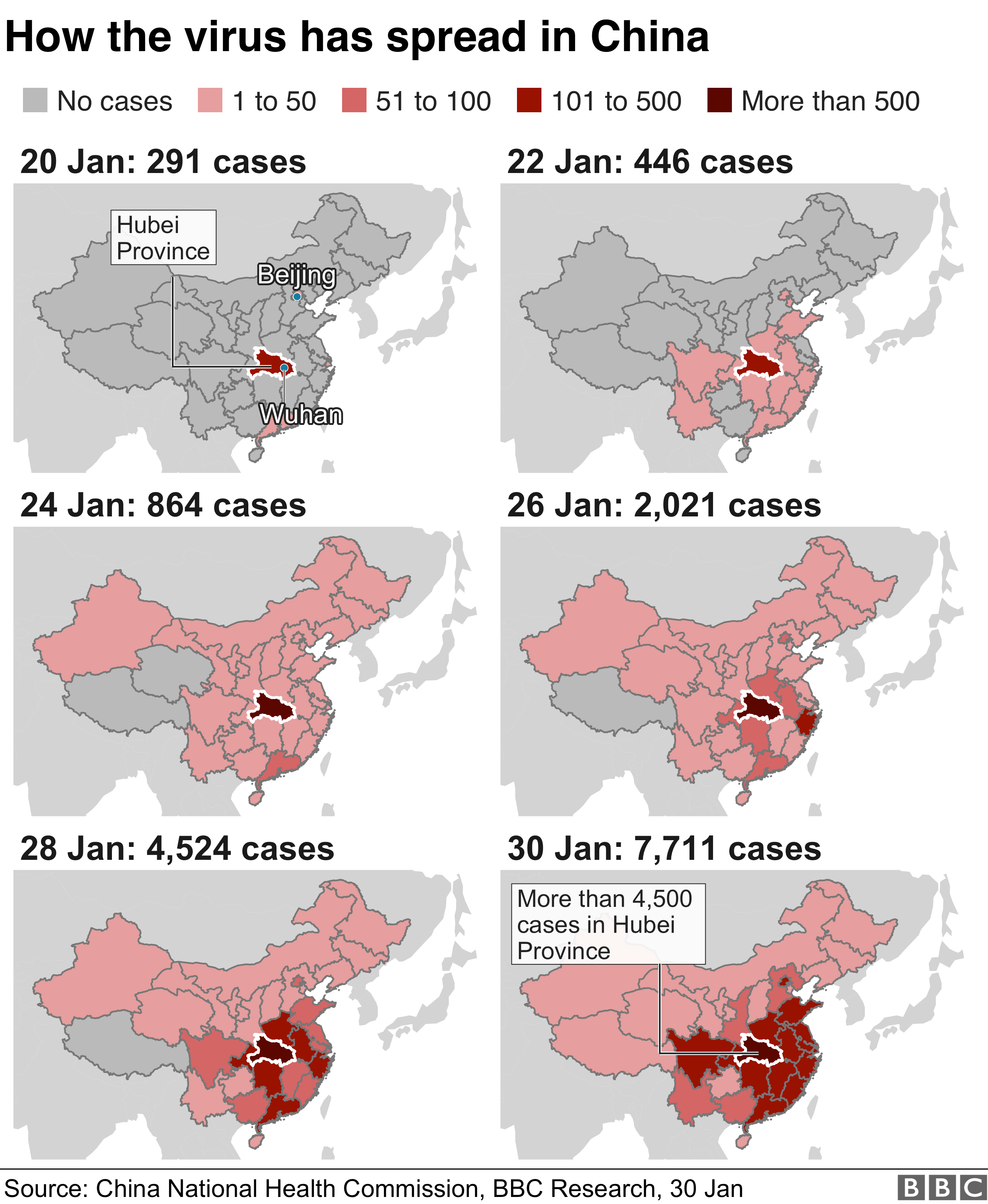
Coronavirus cases have spread to every province in China. There are now 7711 cases compared to 291 on 20 Jan. Hubei province has more than 4500 cases.
People who have been in Hubei are also being told to work from home until it is considered safe for them to return.

The virus is affecting China’s economy, the world’s second-largest, with a growing number of countries advising their citizens to avoid all non-essential travel to the country.

How is the world responding?

Voluntary evacuations of hundreds of foreign nationals from Wuhan are under way.

The UK, Australia, South Korea, Singapore and New Zealand are expected to quarantine all evacuees for two weeks to monitor them for symptoms and avoid contagion.

Australia plans to quarantine its evacuees on Christmas Island, 2,000km (1,200 miles) from the mainland in a detention centre that has been used to house asylum seekers.

In other recent developments:

  • Italy suspended flights to China after two Chinese tourists in Rome were diagnosed with the virus; earlier 6,000 people on board a cruise ship were temporarily barred from disembarking
  • In the US, Chicago health officials have reported the first US case of human-to-human transmission. Around 200 US citizens have been flown out of Wuhan and are being isolated at a Californian military base for at least 72 hours
  • Russia has decided to close its 4,300km (2,670-mile) far-eastern border with China
  • Two flights to Japan have already landed in Tokyo. Japan has now raised its infectious disease advisory level for China
  • Some 250 French nationals have been evacuated from Wuhan
  • India has confirmed its first case of the virus – a student in the southern state of Kerala who was studying in Wuhan
  • Israel has barred all flight connections with China
  • Papua New Guinea has banned all visitors from “Asian ports”
  • North Korea will suspend all flights and trains to and from China, said the British ambassador to North Korea

Source: The BBC
01/02/2020

Japan seeks to contain economic impact of virus, new measures come into effect

Tokyo (Reuters) – Japan on Saturday moved to contain the economic impact of a coronavirus outbreak originating in China as strict new measures aimed at limiting the spread of the virus, including targeting foreign visitors, came into effect.

Japan had 17 confirmed cases as of Friday, including some without symptoms. One of the most recent was a bus guide who worked on a bus tour for tourists from China – the same tour as a bus driver who also came down with the virus.

Prime Minister Shinzo Abe told a Saturday meeting of a government task force coordinating Japan’s response to the virus to come up with steps aimed at easing the impact of the outbreak on Japan’s economy.

Abe has made tourism a key part of his economic policy, with a large proportion of foreign visitors from China, and major Japanese companies have a number of factories in China.

“I ask ministers to compile measures to use reserves (in the state budget) and implement them as soon as possible,” Abe was quoted by Kyodo news agency as saying.

“The new coronavirus is having a major impact on tourism, the economy and our society as a whole. The government will do its utmost to address the impact.”

No further details were given, though Abe stressed ensuring that Japanese residents have access to medical checkups and masks, which have been selling out around the nation.

New measures to fight the disease took effect on Saturday, including banning the entry of Chinese holding passports issued by Hubei, where the disease is thought to have originated, as well as all foreigners who had visited the province within two weeks, whether they show symptoms or not.

The government also brought forward implementing measures including compulsory hospitalisation and the use of public funds for treatment by six days to Saturday.

Of the 2.6 million tourists who came to Japan in December 2019, nearly 600,000 were Chinese, outnumbered only by South Koreans, government data shows. Japan aims to have 40 million tourists visit the country in 2020, up from 31.8 million in 2019.

On Friday, the president of Japanese airline ANA Holdings (9202.T) said it was considering suspending flights to China after February reservations plunged, Jiji news agency reported.

JTB Corporation, Japan’s largest travel agency, said it was suspending tours to China throughout February, Kyodo news agency reported.

Source: Reuters

01/02/2020

India steps up farm support, offers tax cuts to revive faltering growth

NEW DELHI (Reuters) – India sought to boost growth in a federal budget on Saturday that raised spending on farms and expressways and offered cuts in personal taxes, but the measures fell short of market expectations and battered stocks.

Prime Minister Narendra Modi’s government is grappling with the country’s worst slowdown in a decade, with falling employment, consumption and investment ratcheting up the pressure to revive growth.

The government estimates growth this year to March 31 will slip to 5%, the weakest pace since the global financial crisis of 2008-09. It also warned an expected rebound the following year might entail a blow-out in fiscal deficit targets.

Finance Minister Nirmala Sitharaman, presenting the budget for the financial year beginning April 1, said 2.83 trillion rupees ($39.8 billion) will be allocated toward agriculture and allied activities, up 5.6 percent on the previous year.

The funds will be deployed to help farmers set up solar power generation units as well as establish a national cold storage system to transport perishables.

Sitharaman also vowed to spend $50.7 billion in coming years on a federal water scheme to address challenges facing one of the world’s most water-stressed nations.

Agriculture accounts for near 15% of India’s $2.8 trillion economy and is a source of livelihood for more than half of the country’s 1.3 billion population.

Sitharaman announced a new personal tax system including cuts for those ready to give up a myriad of tax breaks. She also abolished payment of dividend distribution tax by companies to spur investment.

“People have reposed faith in our economic policy,” Sitharaman said to the thumping of desks in parliament. “This is a budget to boost their income and enhance their purchasing power.”

Opposition parties slammed the budget, saying it had failed to address the slowdown in consumer demand and investment. “The government is in complete denial that the economy faces a grave macro economic challenge,” said former finance minister P. Chidambaram.

But higher government spending has put pressure on public finances, prompting caution from rating agencies. Sitharaman said the fiscal deficit for the current year would widen to 3.8% of GDP, up from 3.3% targeted for the current year.

Gene Fang, associate managing director, sovereign risk at Moody’s, said: “India’s 2020/21 budget highlights the challenges to fiscal consolidation from slower real and nominal growth, which may continue for longer than the government forecasts.”

GOVERNMENT SPENDING

For fiscal 2020/21 Sitharaman set the fiscal deficit at 3.5 percent. Moody’s said India’s government debt is already significantly higher than the average for Baa-rated sovereigns, a product of persistent fiscal deficits.

To help finance government spending, Sitharaman set a target for selling stakes in state firms at 2.1 trillion rupees for 2020/21, more than three times the amount expected this year.

She said the government will sell a part of its holding in state-run Life Insurance Corp, the country’s biggest insurance company.

But many experts said the measures did not go far enough to address the slowdown and structural flaws.

“In a normal scenario this budget would have been considered as good providing tax benefit to the common man, corporate and focus on farmers’ incomes, but the situation required more,” said Vinod Nair, head of research at Geojit Financial Services in Kochi.

Indian shares slid to a more than three-month low after a special trading session on Saturday, dented by what analysts said was a lack of sufficient stimulus measures. The NSE Nifty 50 index .NSEI closed 2.5% lower while the benchmark S&P BSE Sensex .BSESN fell 2.4%

“Markets had very high expectations from the budget … these expectations have not been met,” said Deepak Jasani of HDFC Securities.

The government also announced higher duties on a host of imports from walnuts to phone parts. Taxes on imports of pre-assembled printed circuit boards were raised to 20% from 10% and there were new taxes on mobile phones ringers and display panels in a bid to boost local manufacturing.

In its annual economic report released on Friday the government predicted growth would rebound to 6.0% to 6.5% in the fiscal year beginning April 1.

Some economists say global trade tensions and the outbreak of coronavirus in China pose a new risk to economic recovery by hitting cross-border commerce and supply chains.

Source: Reuters

31/01/2020

Singapore closes borders to all Chinese travellers to stem spread of coronavirus

  • The island nation is the first Southeast Asian country to bar all visitors from the mainland
  • The visa suspension will come into effect immediately, while the travel restriction will start at 11.59pm on Saturday
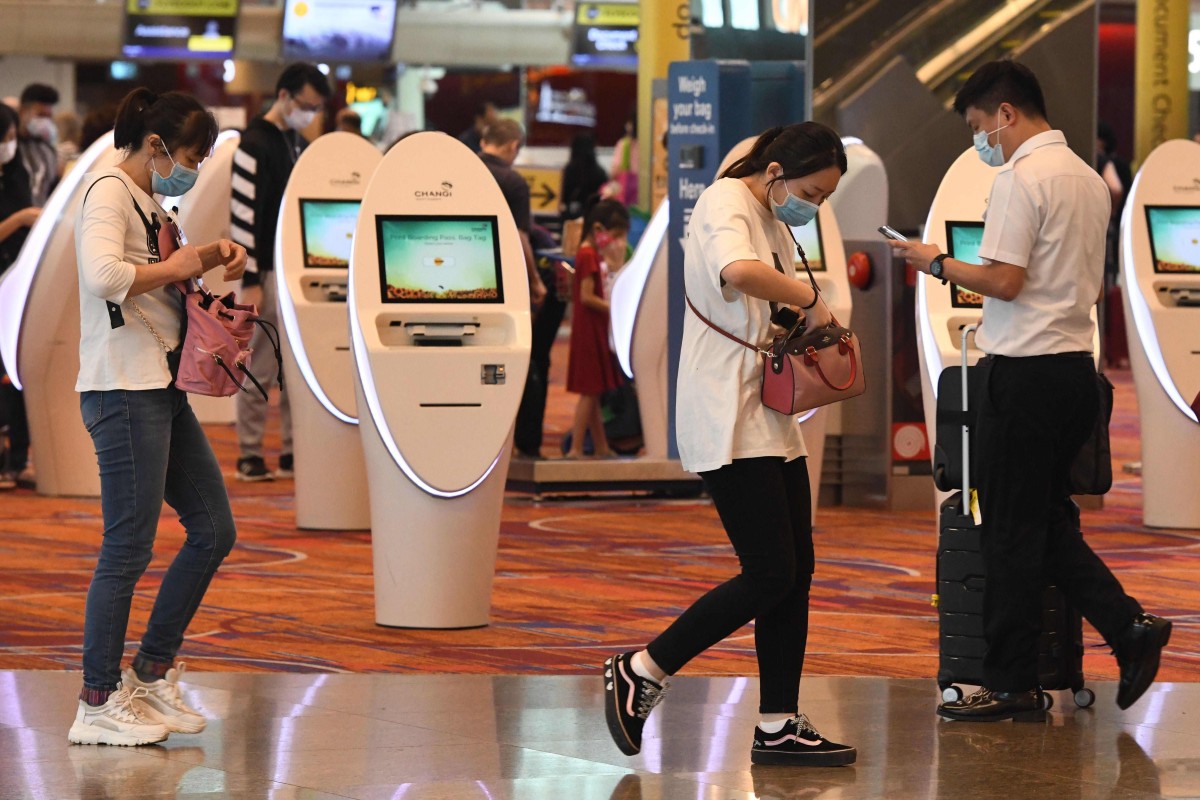
Travellers wearing face masks at Changi International Airport in Singapore. Photo: AFP
Singapore

will close its borders to all new visitors from mainland China, including foreigners who have been there within the past 14 days, becoming the first Southeast Asian country to do so in a bid to stem the spread of the deadly coronavirus
.

The island nation has China as one of its biggest trading partners and is a popular destination for Chinese tourists. Figures from the Singapore Tourism Board showed that 248,000 travellers from the mainland entered Singapore last November, while 3.42 million mainland Chinese tourists visited in 2018.

How Wuhan coronavirus spread anti-Chinese racism like a disease through Asia

30 Jan 2020

The visa suspension will come into effect immediately so travellers can be informed in advance, while the travel restriction will start at 11.59pm on Saturday.

As of Friday, Singapore has 13 confirmed cases of the novel coronavirus, all of whom are travellers from the Chinese city of Wuhan. Health authorities have stressed that there is no evidence of community spread within the city state as of now.

The coronavirus has infected almost 10,000 people around the world, killing 213. The World Health Organisation has declared the outbreak an international public health emergency.

The move is an escalation of Wednesday’s announcement that Singapore was stopping the entry of new travellers who had been to Hubei province, the epicentre of the outbreak. Wuhan is Hubei’s capital.

China coronavirus: Singapore’s seven habits for good hygiene

30 Jan 2020

Residents and citizens of Singapore who have been to China will be able to come into the city state, but will be subject to a 14-day leave of absence during which they are encouraged to stay at home.

The move to close its borders to Chinese visitors comes on the back of local authorities’ assessment that more people in other parts of China are and will be affected by the virus.

The Singapore government will on Saturday announce a fiscal package to help businesses and citizens during the crisis.

Coronavirus: global travel restrictions imposed on Chinese travellers

31 Jan 2020

National development minister Lawrence Wong, who co-chairs a multi-ministry task force to deal with the virus, said the outbreak had already impacted the economy and “will be going on for some time”.

Said Prime Minister Lee Hsien Loong: “It’s going to hurt us. China is a very big source of tourists for Singapore. [With the outbreak], that’s tailed off already considerably.”

Lee said tourism from other sources would also be affected as people took precautions, pinpointing the food and beverage, travel and hotel industries as those that were “bound to be significantly affected”.

“I expect the rest of the economy also to be affected because with China in semi-lockdown mode now, their economy is bound to slow down and our economy is quite tightly engaged with theirs, they are our biggest trading partner.”

Source: SCMP

31/01/2020

Travellers beat China virus lockdown via bridge over the Yangtze

JIUJIANG, China (Reuters) – People are leaving and entering China’s Hubei province by foot over a bridge spanning the Yangtze river, despite a virtual lockdown on vehicle traffic due to a coronavirus epidemic that has killed more than 200 people.The Yangtze divides Jiujiang in Jiangxi province and Huanggang in neighbouring Hubei, one of the cities hardest hit by the coronavirus outbreak and now sealed off from the rest of China to try to contain it.

But the foot traffic over the Yangtze shows gaps in the lockdown, adding to doubts over its effectiveness and providing a glimpse of life inside the epicentre of what the World Health Organization (WHO) has called a global emergency.

Wu Minzhou, a 40-year-old business owner who was fishing near the bridge on the Jiangxi side, said he was worried about exceptions being made for people leaving Hubei.

“Because there’s an … incubation period at play here, if they head out, for example, to cities in the north of China, then it’s highly possible they will infect those areas too,” he said.

While vehicles are not allowed over the bridge, it is open to some pedestrians. Police explained that people were still entering Hubei and they could still get out, but only in “special circumstances”.

Those included people who were in Hubei but booked train tickets to leave from Jiujiang before the Lunar New Year.

“Everyone’s panicking right now, but I think things are not that bad,” migrant worker Guan, 45, told Reuters after crossing from Hubei.

A 40-year-old woman, who only gave her surname as Li, said she was heading back to her home in Huizhou, Guangdong province, with her son.

She had to show their train tickets at the checkpoint and get their temperatures taken on the Hubei side of the bridge before being allowed to make the long trek into Jiangxi.

Another man told Reuters that he had driven to the bridge from Jiujiang with his friend, who was going the other way home to Hubei, a province of about 60 million people.

“But once you get back you cannot come out again,” said the man, who gave his surname as Tian. “You have to stay there, stay at home. You can’t come out.”

The epidemic, believed to have originated in a seafood market in the Hubei provincial capital of Wuhan, prompted the WHO to declare a global emergency on Thursday, only the sixth time it has done so.

Trains and other public transportation have been suspended, roads have been sealed off and checkpoints established at tollgates around Wuhan. The special measures have been extended to other cities in Hubei province.

Though Jiujiang itself has not officially been locked down, its streets were mostly deserted and its tourist sites closed on what was officially the last day of China’s Lunar New Year celebrations on Thursday.

“This year … we are all just following what the government has asked us to do. That is, we’re at home almost all the time,” said local taxi driver Guo Dongbo, 59. “We don’t go out and nobody else is out on the streets either.”

In one of the residential areas of Jiujiang, a city of nearly five million people, a man carried a loudspeaker playing a recorded message ordering anyone who has been to Hubei recently to go and register with the local residents’ committee.

By Friday, the city had 42 confirmed cases of infection.

Elsewhere, shops were mostly shuttered, and the few restaurants that remained open were nearly empty.

“Normally at this time of year a lot of people come here. Now there’s nobody,” said a vegetarian restaurant owner near the Donglin Buddhist temple in Jiujiang.

Source: Reuters

31/01/2020

Police kill man holding 20 women and children hostage in north India

LUCKNOW, India (Reuters) – Police shot dead a man holding around 20 women and children hostage at his house in northern India after a 10-hour standoff, state officials said on Friday.

The hostages who were held at gunpoint were safe, principal secretary home Awanish Kumar Awasthi said after the raid at the house in a village in Farrukhabad in Uttar Pradesh state.

The hostage taker was serving a life sentence for murder and was out on parole, he added.

Two policemen and a villager were injured in the rescue operation.

After the siege, a group of incensed villagers stormed the house where the children had been kept and attacked the hostage-taker’s wife, Awasthi said. The woman died from her injuries early on Friday, he said.

The abduction took place after the man had invited some children and women from the village to his house, saying he was throwing a birthday party for his daughter.

Police said his motive for holding the children was not clear.

Source: Reuters

31/01/2020

Plane leaves China virus epicentre with 110 Britons and foreigners aboard

BEIJING (Reuters) – A plane carrying 83 British and 27 foreign nationals flew out on Friday from China’s central city of Wuhan, the centre of a virus epidemic that has killed more than 200 people and infected more than 9,000, the British government said.

The civilian aircraft chartered by the Foreign Office left Wuhan at 9.45 a.m. (0145 GMT), the government said in a notice on its website.

It is due to arrive at 1 p.m. (1300 GMT) in Britain later on Friday, before continuing on to Spain, where the home countries of European Union citizens will take responsibility for the remaining passengers.

“We know how distressing the situation has been for those waiting to leave,” Britain’s Foreign Secretary Dominic Raab said, according to the notice. “We have been working round the clock to clear the way for a safe departure.”

The flight had been expected to depart Wuhan on Thursday morning with around 150 British citizens and 50 non-British nationals, but its departure was blocked by Chinese officials.

The reasons for the delay by Chinese officials and the lower-than-expected number of passengers were not immediately clear.

The UK embassy in Beijing and the UK Foreign Office did not immediately respond to requests for comment.

Some British citizens have spoken of being told they could not take family members with Chinese passports out of the city.

Those returning to Britain will be quarantined for 14 days at a National Health Service facility.

A British government spokesman said any citizens who were eligible for the flight would be given a seat but nationals already infected would not be allowed to leave Wuhan.

The U.S. government warned Americans not to travel to China as the death toll from the new coronavirus reached 213 on Friday and the World Health Organisation declared a global health emergency.

Source:Reuters

30/01/2020

Coronavirus: turbulent times ahead for air travellers as carriers cancel China flights

  • Lufthansa, British Airways, Air Canada among several big name airlines to halt flights, while others reduce services
  • Travel agents expecting slump in sales amid rising uncertainty over how epidemic will play out
Many airlines have cancelled flights into mainland China because of the coronavirus outbreak. Photo: AP
International air travellers and ticketing agents are in for a turbulent time in the weeks ahead as airlines around the world react to the coronavirus epidemic by cancelling or limiting flights to and from the Chinese mainland.
Lufthansa, British Airways, Air Canada and Indonesia’s Lion Air have 
cancelled all of their flights

, while United Airlines, American Airlines, IndiGo, Finnair, Delta Air Lines and Jetstar Asia have significantly reduced their services.

“It’s going to be pretty bad for travel agencies. We’ve had a lot of cancellations. Everyone is afraid of coming to China,” said Annabelle Auger from Travel Stone in Beijing.
“Many of our European clients are very worried because of the media coverage they’ve seen. Still, people are willing to wait and see for a few weeks to see how things go,” she said.
For foreigners looking to leave China, Auger said they should contact their embassy to find out about repatriation flights.

“The situation is very unclear, so it’s difficult to give any general recommendations,” she said.

Already this week, the embassies of the United States, Japan, South Korea and Britain have cleared flights to evacuate their nationals from Hubei, the central China province at the heart of the outbreak.

Auger said she and her colleagues had been busy rearranging flights for China-based foreigners who had gone away for the holidays.

“The schools are closed, so families with children abroad are thinking, ‘OK, let’s extend our stay for another week’,” she said.

Politics may have stalled information in coronavirus crisis, scientist says

30 Jan 2020
The Beijing government said on Monday it would extend the Lunar New Year
holiday until Sunday to help stop the spread of the disease, while school breaks have also been extended.

Another travel agent in Beijing, who asked not to be named, said the virus outbreak had yet to have a significant impact on business but concerns were growing.

“We are a bit worried that things may get difficult in the coming months,” she said. “But we trust that the government is doing all it can and will take the appropriate measures to solve the problems.”

Zhu Tao, director of the flight standards department at the Civil Aviation Administration of China (CAAC), said at a press conference in Beijing on Thursday that the relevant authorities were working closely with airlines to help Chinese nationals trapped overseas to get home.

The government had already chartered flights from Japan, Myanmar and South Korea to bring Chinese nationals back to Hubei, he said.

While all flights out of Hubei have been suspended since last week, Zhu said air transport was playing its part in fighting the disease.

As of Wednesday, the CAAC had sent 86 flights carrying 5,129 medical workers and 115,000 items of equipment and other supplies into Wuhan, he said.

Wu Zunyou, the chief epidemiologist at the China Centre for Disease Control and Prevention, said that efforts to prevent the coronavirus spreading outside the country had been successful, as only about 1 per cent of the confirmed infections were outside China.

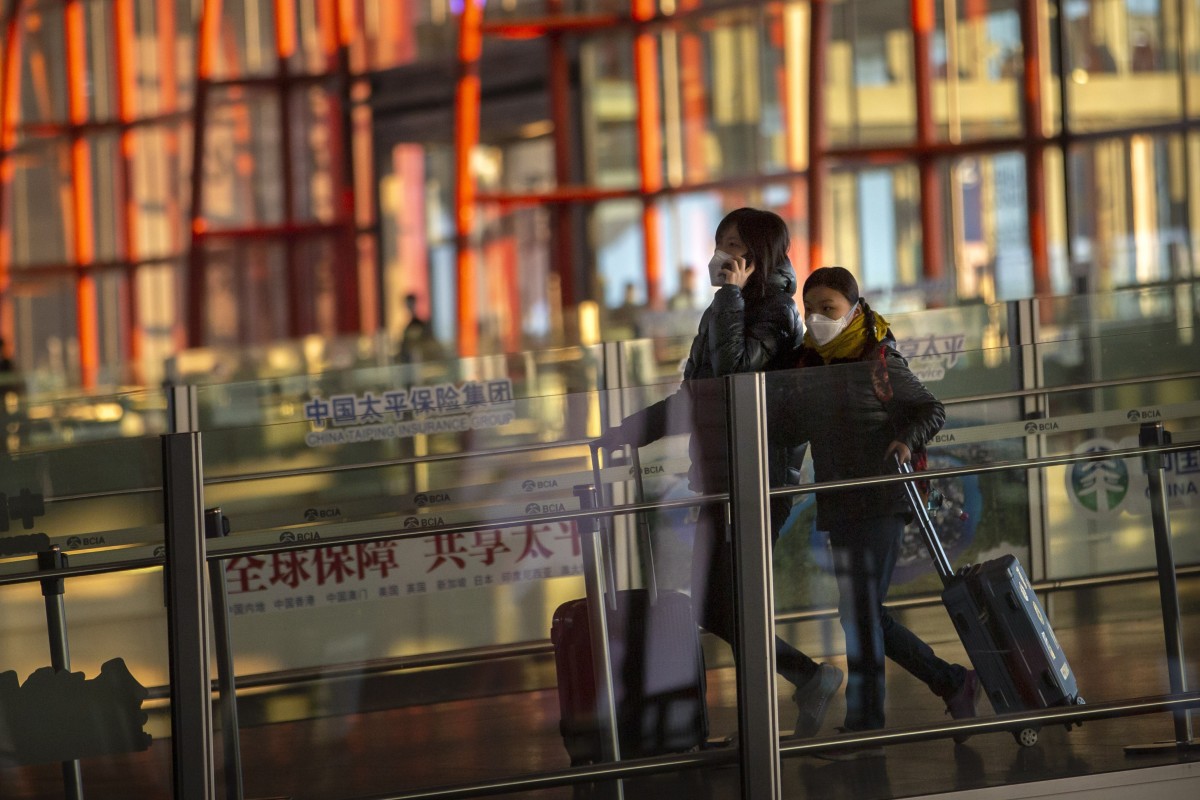
Despite the flight cancellations, Beijing’s Capital International Airport was operating as normal on Thursday.

Andre Muchanga, a student from Abu Dhabi at the Beijing Institute of Technology, said he made a late decision to fly home.

“I decided to buy my ticket last night,” he said. “At school, our dormitory is almost completely empty. I knocked on a friend’s door last night and found there was no one there, so I decided I better just go home and spend some time with my family.”

He said he decided not to buy a return flight as it he did not know when his classes would resume.

Signs at check-in counters reminded passengers who had travelled to Hubei or had a Hubei address to put themselves in isolation for 14 days.

While flights out of Hubei have been stopped, there was still plenty of inbound traffic.

“The number of domestic inbound travellers seems pretty normal for this time of year,” a man working on an information desk at Capital airport said.

“It’s the sixth day of the Lunar New Year. Lots of people have to return to work.”

An Air China employee, surnamed Hu, said that the airport had stepped up its disinfecting and general cleaning work. Body temperature checks had been installed at all access points and employees had been told to wear masks, he said.

“I don’t mind working during the Lunar New Year holiday,” he said. “I’m not afraid of the virus, I’m here to serve the people.”

SOurce: SCMP

30/01/2020

Coronavirus Wuhan diary: Living alone in a city gone quiet

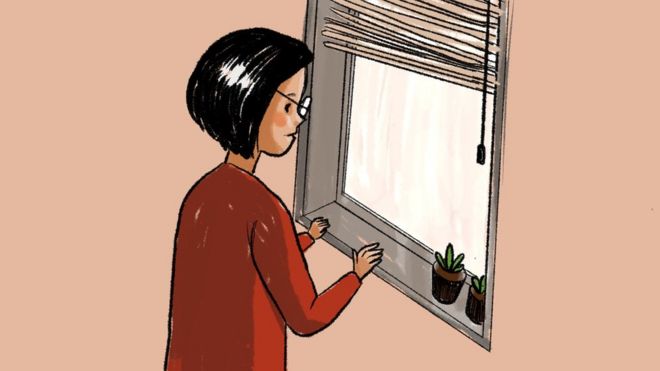
Illustration of a woman looking out of a window

Guo Jing lives in Wuhan, the Chinese city at the heart of the outbreak of a new virus which has got the world worried.

Wuhan has been under lockdown since 23 January, to try to contain the infection. Transport is shut down, most shops and businesses closed, and people are being advised to stay at home.

Jing is a 29-year-old social worker and rights activist who lives on her own. For the past week, she has kept a diary, which she shares here with the BBC.

Thursday 23 January – the day of the lockdown

I didn’t know what to do when I woke up and learned about the lockdown. I don’t know what it means, how long it will last and what kind of preparations I should make.

There are a lot of infuriating comments [on social media]: that many patients cannot be hospitalised after diagnosis [because of a lack of places], that patients with fever are not properly treated.

Many more people are wearing masks. Friends have told me to stock up on supplies. Rice and noodles have almost sold out.

Media caption Fears over coronavirus in China trigger face mask shortage

A man was buying lots of salt, and someone asked him why he was buying so much. He replied: “What if the lockdown lasted for a whole year?”

I went to a pharmacy and it was already limiting the number of shoppers. It had already sold out of masks and alcohol disinfectant.

After stocking up on food, I am still in shock. Cars and pedestrians are dwindling, and the city has come to a stop all out of a sudden.

When will the city live again?

Friday 24 January – a silent New Year’s Eve

The world is quiet, and the silence is horrifying. I live alone, so I can only tell there are other human beings around from the occasional noises in the corridor.

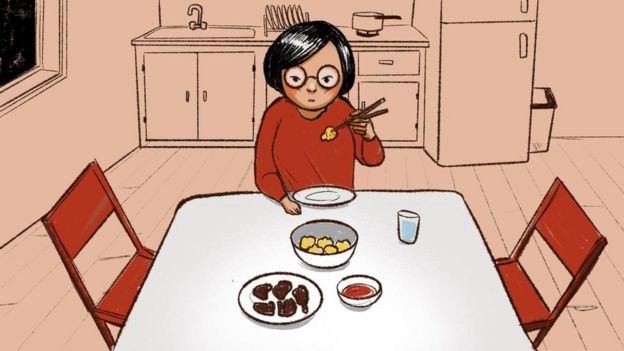
Illustration of a woman eating alone

I have a lot of time to think about how to survive. I don’t have any resources or connections.

One of my goals is not to fall sick, so I have to make myself exercise. Food is crucial to survival too, so I have to know whether there is enough supply.

The government hasn’t said how long the lockdown will last, nor how we can carry on functioning. People are saying it might last until May.

The pharmacy and the convenience store downstairs were closed today, but it was comforting to see that couriers are still out delivering food.

Noodles are all sold out in the supermarkets, but there is some rice. I also went to the market today. I bought celery, garlic shoots and eggs.

After going home, I washed all my clothes and took a shower. Personal hygiene is important – I think I am washing my hands 20 to 30 times a day.

Going out makes me feel that I am still connected to the world. It’s very difficult to imagine how elderly citizens living alone and people with disabilities will get through this.

I didn’t want to cook less than usual, because it was the last night of the year of the pig – it was supposed to be a meal of celebration.

Over dinner, I was on a video call with my friends. There was no escaping talk of the virus. Some people are in towns near Wuhan, some chose not to go home because of the disease, some still insist on gathering despite the outbreak.

A friend coughed during the call. Someone jokingly told her to hang up!

We chatted for three hours and I thought I could then fall asleep with happy thoughts. But when I closed my eyes, memories of the past few days came in flashbacks.

Tears fell. I felt helpless, angry and sad. I thought about death, too.

I don’t have many regrets, because my job is meaningful. But I don’t want my life to end.

Saturday 25 January – Chinese New Year alone

Today is Chinese New Year. I never have much interest in celebrating festivals, but now new year feels even more irrelevant.

In the morning, I saw some blood after I sneezed, and I was scared. My brain was filled with worries about sickness. I was wondering if I should go out or not. But I had no fever and a good appetite, so I went out.

I wore two masks even though people say it’s pointless and unnecessary. I am worried about [poor quality] fakes, so a double mask makes me feel safer.

It was still very quiet.

A flower shop was open, and the owner had placed some chrysanthemums [often used as funeral flowers] at the door. But I didn’t know if that meant anything.

In the supermarket, the vegetable shelves were empty and almost all dumplings and noodles were sold out. There were only a few people queuing.

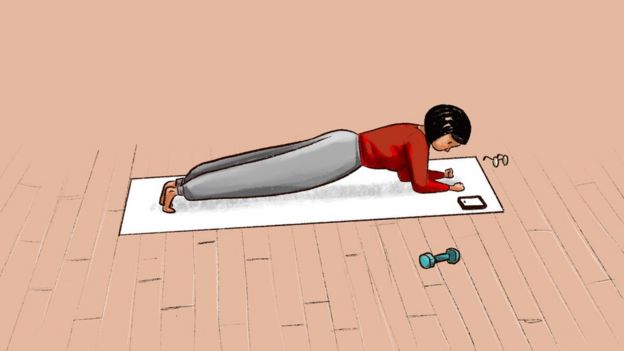
Illustration of a woman doing exercise

I keep having this urge to buy lots during each visit to the shop. I bought another 2.5 kg of rice, even though I have 7kg of rice at home. I also couldn’t help buying some sweet potatoes, dumplings, sausages, red beans, green beans, millet and salted eggs.

I don’t even like salted eggs! I will give them to friends, after the lockdown is lifted.

I have enough food for a month, and this compulsive buying seems crazy. But under such circumstances, how could I blame myself?

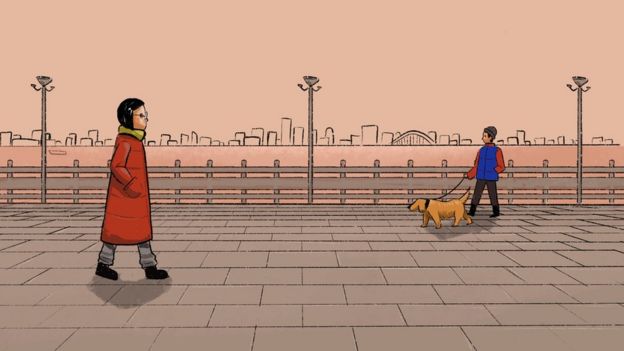
I went for a walk by the river. Two snack shops were open and some people were out walking their dogs. I saw some others were taking a stroll as well – I guess they also didn’t want to be trapped.

I’d never walked along that road before. It felt like my world had expanded just a little bit.

Sunday 26 January – making your voice heard

It not just the city that’s trapped. It’s also the voices of the people.

On the first day of the lockdown, I couldn’t write [anything about it] on social media [because of censorship]. I couldn’t even write on WeChat. Internet censorship has existed for a long time in China, but now it feels even more cruel.

When your life is turned upside down, it’s a challenge to build up your daily life again. I keep exercising in the mornings, using an app, but I can’t focus because my brain is occupied.

Media caption“Wuhan, add oil!”: Watch residents shouting to boost morale in quarantined city

I left home again today and tried to count how many people I met – I met eight during my walk to a noodle shop some 500m away from my home.

I didn’t want to go home. I wanted to explore more. It’s only two months since I moved to Wuhan. I don’t have many friends here, and I don’t know the city very well.

I guess I saw about 100 people today. I have to keep making myself heard and break the shackles. I hope everyone stays hopeful. Friends, I hope that we will meet and talk in the future.

Around 8pm I heard the shouts of “Go, Wuhan!” from people’s windows. The collective chanting is a form of self-empowerment.

Tuesday 28 January – finally sunlight

Panic has driven a wedge between people.

In many cities, people are required to wear a face mask in public. On the face of it, the measure is to control the pneumonia outbreak. But actually it could lead to abuse of power.

Illustration of a woman walking past someone walking a dog

Some citizens without a mask have been thrown off public transport. We don’t know why they didn’t wear a mask. Perhaps they couldn’t buy any, or they didn’t know about the notice. No matter what, their rights to go out should not be taken away.

In some videos circulating online, some people had sealed up the doors of people who’d self-quarantined themselves. People from Hubei province [where Wuhan is] were driven out of their homes and had nowhere to go.

But at the same time, some people are offering accommodation to Hubei people.

There are a lot of ways the government could encourage people to stay home. It has to ensure that every citizen has enough face masks, or even give cash rewards to citizens who stay home.

Today, there’s finally sunlight – just like my mood. I saw more people in my complex and there were a few community workers. They appeared to perform temperature checks on non-residents.

It is not easy to build trust and bonds under a lockdown. The city is worn down by heaviness.

In the midst of all this, I can’t help but becoming more on-guard.

My anxiety about survival has been slowly dissipating. Walking further in the city will be meaningless if I don’t make any connections with people here.

Social participation is an important need. Everyone has to find a role in society and makes one’s life meaningful.

In this lonely city, I have to find my role.

Source: The BBC

30/01/2020

A holiday camp for India’s captive elephants

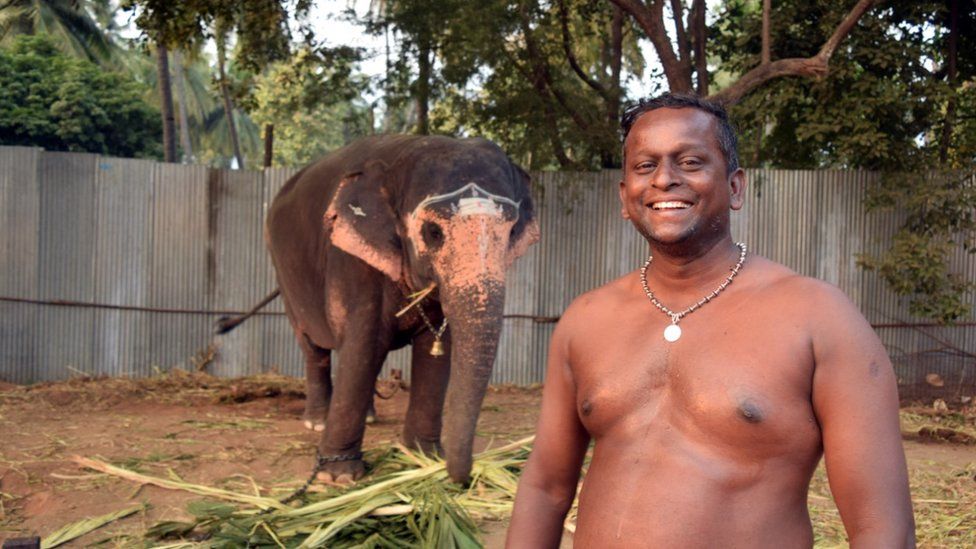
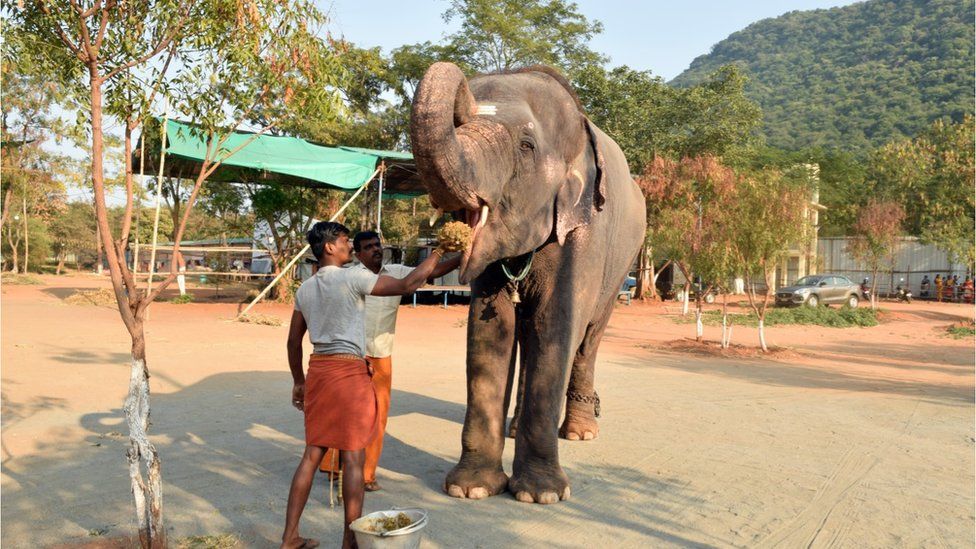
Arjun, the caretaker, and Akila, the elephant
Image caption Arjun, the caretaker, pictured above with temple elephant, Akila

Once a year, some of India’s captive elephants are whisked off to a “rejuvenation camp”, where they are pampered and cared for by their caretakers. Omkar Khandekar visited one such retreat in the southern state of Tamil Nadu.

After seven years of being a local celebrity, Akila the elephant knows how to pose for a selfie. She looks at the camera, raises her trunk and holds still when the flash goes off.

It can get tiring, especially when there are hundreds of requests every day.

Despite this, Akila, performs her daily duties diligently at the Jambukeswarar temple. These include blessing devotees, fetching water for rituals in which idols of the deity are bathed, and leading temple processions around the city, decked up in ceremonial finery.

And, of course, the selfies.

But every December, she gets to take a break.

“When the truck rolls in, I don’t even have to ask her to hop in,” Akila’s caretaker B Arjun said. “Soon, she will be with her friends.”

Elephant
Image caption Elephants sold to temples in Tamil Nadu are brought to this camp every year

India is home to some 27,000 wild elephants. A further 2,500 elephants are held in captivity across the states of Assam, Kerala, Rajasthan and Tamil Nadu.

The country is widely believed to be the “birthplace of taming elephants for use by humans”. Elephants here have been held in captive by Indians for millennia. But 17 years ago, after protests by animal rights activists over instances of handlers abusing and starving captive elephants, the government stepped in to give the animals a bit of respite.

As a result, Akila and numerous other elephants held in temples around India are now brought to a “rejuvenation camp” each year, their caretakers in tow. For several weeks, the animals unwind in a sprawling six-acre clearing in a forest at the foothills of Nilgiris, part of the country’s Western Ghats.

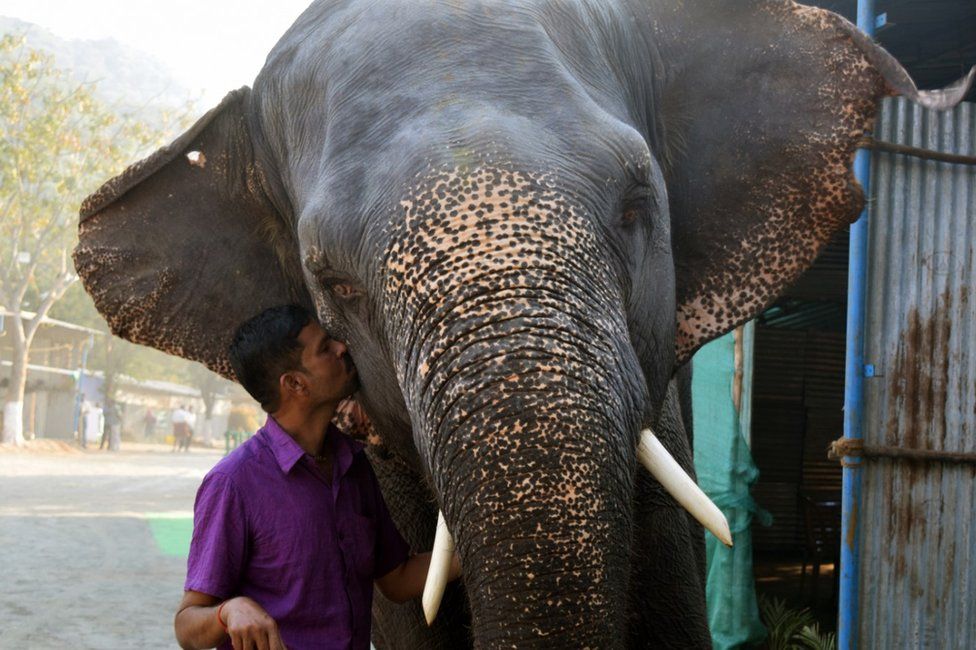
Elephant with caretaker
Image caption India has more than 2,000 captive elephants

The camps were described as an animal welfare initiative and have become a popular annual event for the state’s temple elephants.

The one Akila and 27 other elephants are attending currently opened on 15 December last year, and will go on until 31 January, costing about $200,000 (£153,960) to run.

Supporters argue it is money well spent. A break from the city for these elephants is therapeutic, explains S Selvaraj, a forest officer in the area.

“Wild elephants live in herds of up to 35 members but there’s only one elephant in a temple,” he says. “For 48 days here, they get to be around their own kind and have a normal life.”

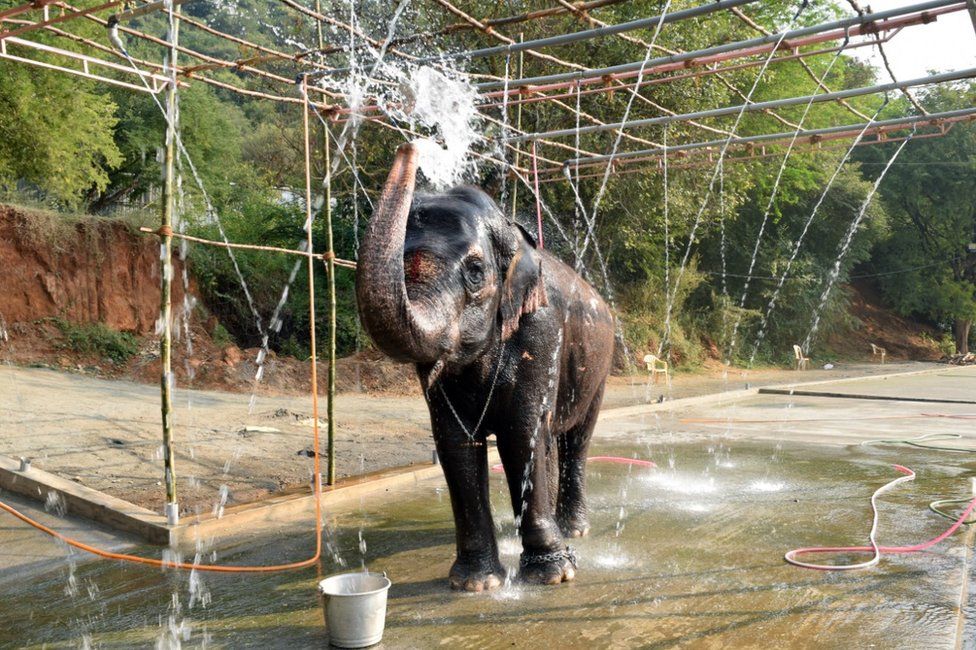
Elephant being fed
Image caption It costs about $200,000 to run the six-week annual camp

Akila, who is 16 years old, has been a regular at the camp since 2012, the year she was sold to the temple. Arjun, who has accompanied her every year, is a fourth-generation elephant caretaker.

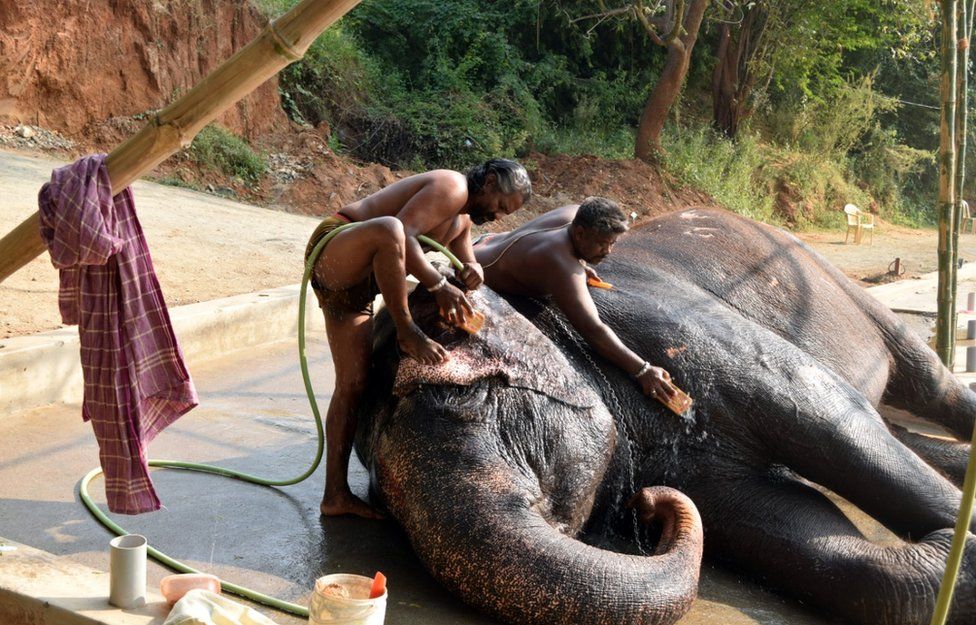
At the camp, he bathes Akila twice a day, feeds her a special mix of grains, fruits and vegetables mixed with vitamin supplements and takes her for a walk around the grounds. A team of vets are on hand to monitor the health of the camp’s large guests, while at the same time tutoring their handlers in subjects like elephant diet and exercise regimes.

Akila has even forged a friendship with Andal, an older elephant from another temple in the state, said Arjun.

But despite the shady trees and quiet, the getaway is a far cry from an elephant’s “normal life”.

Elephant at the camp
Image caption The government initiated such camps after protests over instances of handlers abusing captive elephants

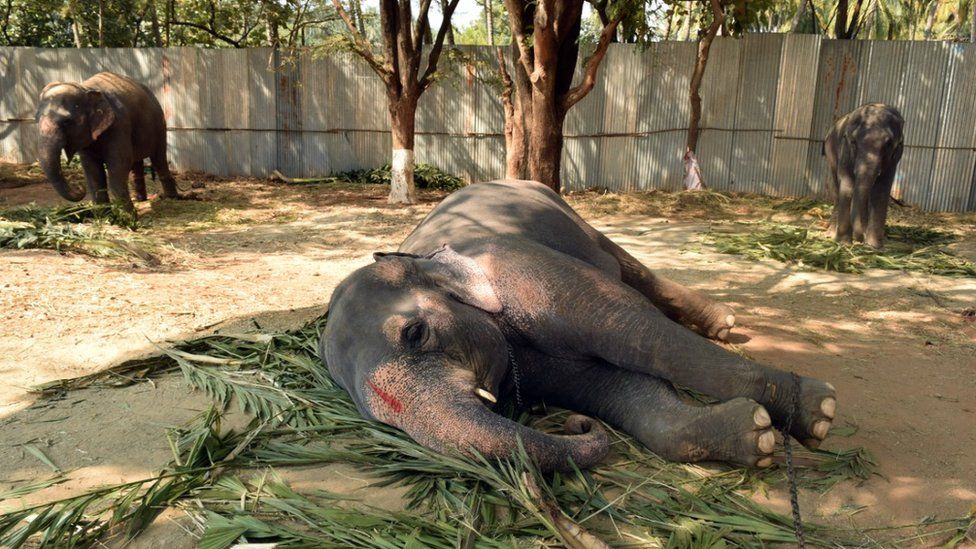
The walled campus has eight watchtowers and a 1.5km (0.93 miles) electric fence around its perimeter. While the elephants appear well cared for, they spend most of their time in chains and are kept under the close eye of their caretakers.

And one six-week rejuvenation camp a year does little to assuage the stress of temple elephants’ everyday lives, activists say.

“Elephants belong in jungles, not temples. A six-week ‘rejuvenation camp’ is like being let out on parole while being sentenced for life imprisonment,” argues Sunish Subramanian, of the Plant and Animals Welfare Society in the western city of Mumbai.

“Even at these camps, the animals are kept in chains and often in unhygienic conditions,” he adds. “If you must continue with the tradition, temple elephants should be kept in the camps for most of the year – in much better conditions – and taken to the temples only during festivals.”

Elephant taking a nap
Image caption The camps have been described as an animal welfare initiative

Even among the company of their own, the elephants – like Andal and Akila – aren’t allowed to get too close.

“I have to make sure the two keep their distance – otherwise, it’ll be difficult to separate them when we go back,” Arjun explains.

It is not just the animal rights activists who have concerns, however.

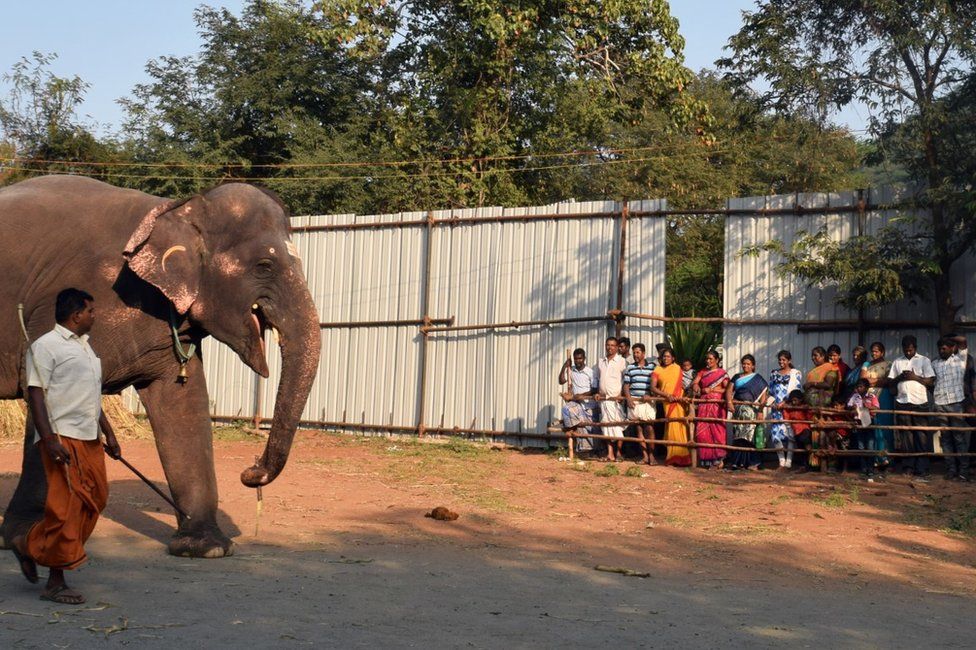
The camp has become a tourist spot in recent years, attracting a steady stream of visitors from neighbouring villages. Most watch, wide-eyed, from the barricades. But not everyone outside the camp is happy.

In 2018, a farmers’ union representing 23 villages nearby, petitioned a court to relocate the camp elsewhere. The petition claimed that the scent of the animals – all female, as is the norm among temple elephants – attracted male elephants from the wild.

This has caused them to go on the rampage, often destroying crops that farmers depend on for their livelihood. The union says 16 people have died in such incidents.

Elephant being bathed
Image caption The camp has also become a popular tourist spot in recent years

But the court rejected the petition. Instead, it asked why there were human settlements in what was identified as an elephant corridor. It also criticised the state government’s tokenism of rejuvenation camps.

“Some day,” it said, “this court is going to ban the practice of keeping elephants in temples.”

But Arjun can’t bear the thought of parting with Akila.

“I love her like my mother,” he says. “She feeds my family, just like my mother used to. Without her, I don’t know what to do.”

But he also understands that his elephant can get lonely. “And that’s why I work twice as hard to make sure she doesn’t.”

Source: The BBC

Law of Unintended Consequences

continuously updated blog about China & India

ChiaHou's Book Reviews

continuously updated blog about China & India

What's wrong with the world; and its economy

continuously updated blog about China & India