Chindia Alert: You’ll be Living in their World Very Soon
aims to alert you to the threats and opportunities that China and India present. China and India require serious attention; case of ‘hidden dragon and crouching tiger’.
Without this attention, governments, businesses and, indeed, individuals may find themselves at a great disadvantage sooner rather than later.
The POSTs (front webpages) are mainly 'cuttings' from reliable sources, updated continuously.
The PAGEs (see Tabs, above) attempt to make the information more meaningful by putting some structure to the information we have researched and assembled since 2006.
BEIJING, Oct. 27 (Xinhua) — Premier Li Keqiang has urged enhancing the vocational skills of people with disabilities and supporting their employment and business creation.
Li, also a member of the Standing Committee of the Political Bureau of the Communist Party of China Central Committee, made the remarks in a written instruction as the sixth China national vocational skill competition for persons with disabilities and the third national Abilympics that kicked off Sunday in Jiaxing, east China’s Zhejiang Province.
Different regions and relevant government departments at all levels should fully implement the supportive employment policies and strengthen vocational education and training for persons with disabilities, according to the instruction.
In advancing targeted poverty alleviation, greater efforts should be made to assist more poverty-ridden people with disabilities living in rural areas, helping more disabled people realize their dreams of finding jobs and starting businesses, said Premier Li.
About 900 disabled persons from across the country will compete in 26 different contests under five categories, which include fine arts, handicrafts and engineering.
Launched in 1989, the sixth China national vocational skill competition for persons with disabilities has been held every four years since 2003.
The third national Abilympics will showcase participants’ products and skills as well as the nation’s progress in employment and business creation of persons with disabilities.
China now has around 35 million registered persons with disabilities, with 18 million of working age.
The president is set to become the first Russian leader to make a state visit to the Philippines for more than 40 years, according to a former envoy
Moscow is aware of China’s entry into the Philippines, and could have its eye on some projects there, while the US is also watching developments
Russian President Vladimir Putin and Philippine President Rodrigo Duterte shake hands during a 2016 meeting in Peru. Photo: EPA
The timing of Moscow’s announcement over the weekend that President Vladimir Putin
has accepted an invitation to visit Manila has raised eyebrows, as it comes on the eve of crucial bilateral talks between the Philippines and China on joint oil exploration in the
In a statement immediately welcomed by the Philippine presidential palace, Igor Khovaev, Russia’s ambassador to the Philippines, on Saturday told reporters Putin had accepted Duterte’s invitation “with gratitude”.
No date has been set for the visit, with Khovaev only saying Moscow would “do our best to arrange this meeting as soon as possible”.
A steering committee with representatives from both Manila and Beijing is set to meet this week to discuss the joint oil exploration deal. China has proposed a 60 per cent-40 per cent split in favour of the Philippines, according to Hermogenes Esperon,
Courting Russia with South China Sea oil is a ‘dangerous gamble’ for Duterte
Neither side has clarified if the split refers to ownership or revenue, and no other details were disclosed.
After an August meeting with Duterte, Chinese President Xi Jinping said the countries could take a “bigger step” in jointly developing oil and gas resources if they could properly handle their sovereignty dispute in the South China Sea.
But defence and security analysts say the Philippine president took a “dangerous gamble” on a visit to Russia last month, when he invited the Russian state oil company Rosneft to explore for oil in Philippine waters – which include parts of the South China Sea claimed by China.
The timing of Moscow’s announcement has not gone unnoticed.
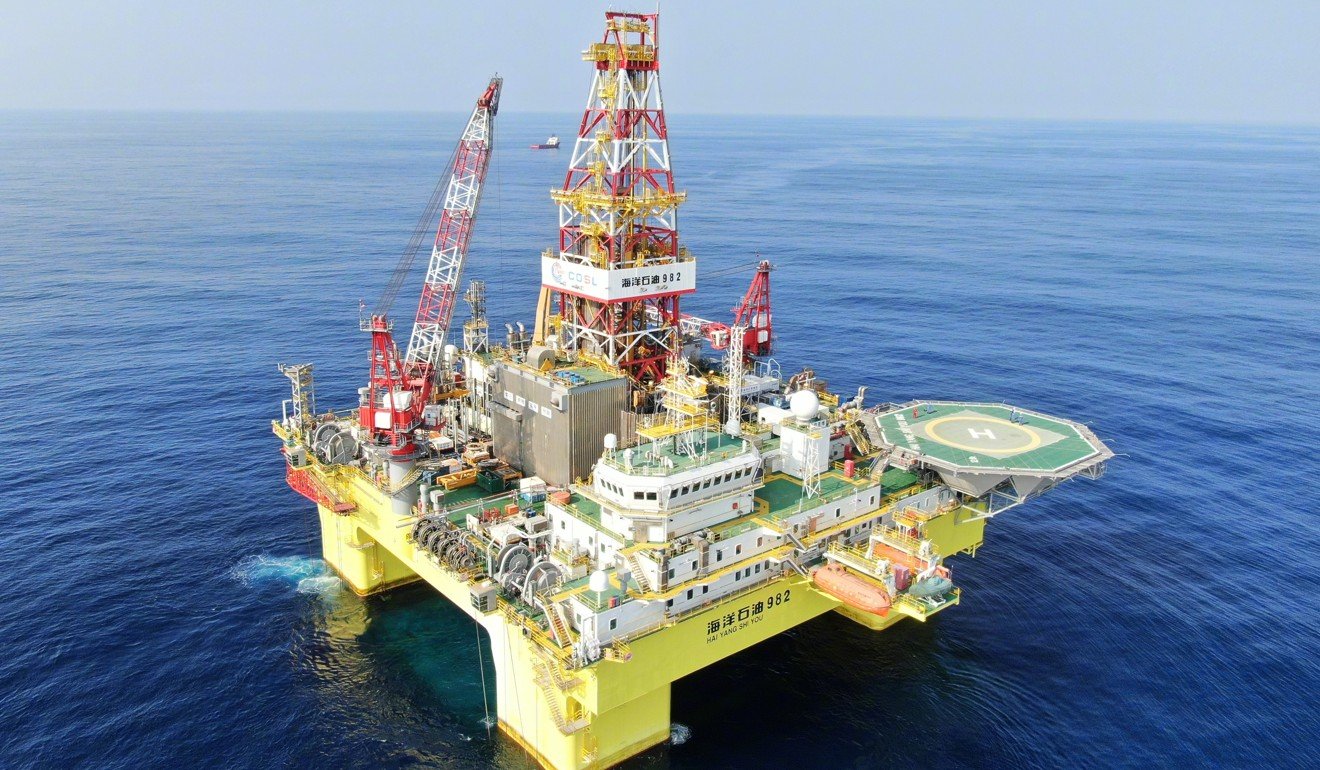
A Chinese deepwater oil rig in the South China Sea. Photo: Weibo
“It’s a welcome and historic development. Some wise guy in the Duterte government thought about timing [the invitation to Putin around the oil talks with Beijing],” said retired Philippine ambassador Lauro Baja, who once served as president of the United Nations Security Council.
Baja told the Post that no Russian president had visited the Philippines during his more than 40 years with the Department of Foreign Affairs.
“The Philippines then was almost a nonentity as far as Russia was concerned, [but] maybe now Russia recognises the strategic importance of the Philippines [in terms of] regional politics,” he said.
Baja said Moscow was aware of China’s entry into the Philippines, and could have its eye on some projects there.
“For all their so-called alliance, China and Russia are fierce competitors for influence and other benefits. And I think Russia has some objectives in mind like selling armaments and [forging] technological agreements,” he said, while cautioning that the situation remained “nebulous”.
New Philippines military chief sees no ‘shooting war’ in South China Sea despite disputes
“It’s a fascinating development but things are still early … For now, this is [just] an invitation extended by Duterte and accepted in principle by Putin.”
The United States will also be monitoring developments in the Philippines, according to Greg Poling, director of the Washington-based Centre for Strategic and International Studies’ Asia Maritime Transparency Initiative.
“Russia is eager to boost its influence in the region, and doubtless doing so with a long-standing US ally is seen as a bonus by Moscow,” he said. “There is nothing that prevents the Philippines from engaging in security cooperation with Russia, but the devil will be in the details.”
Poling added that the US would be concerned if Russia-Philippine cooperation involved acquiring military platforms that were incompatible with the shared platforms and doctrines used by Washington and Manila, as well as the latter’s other major security partners, namely Australia, Japan and South Korea.
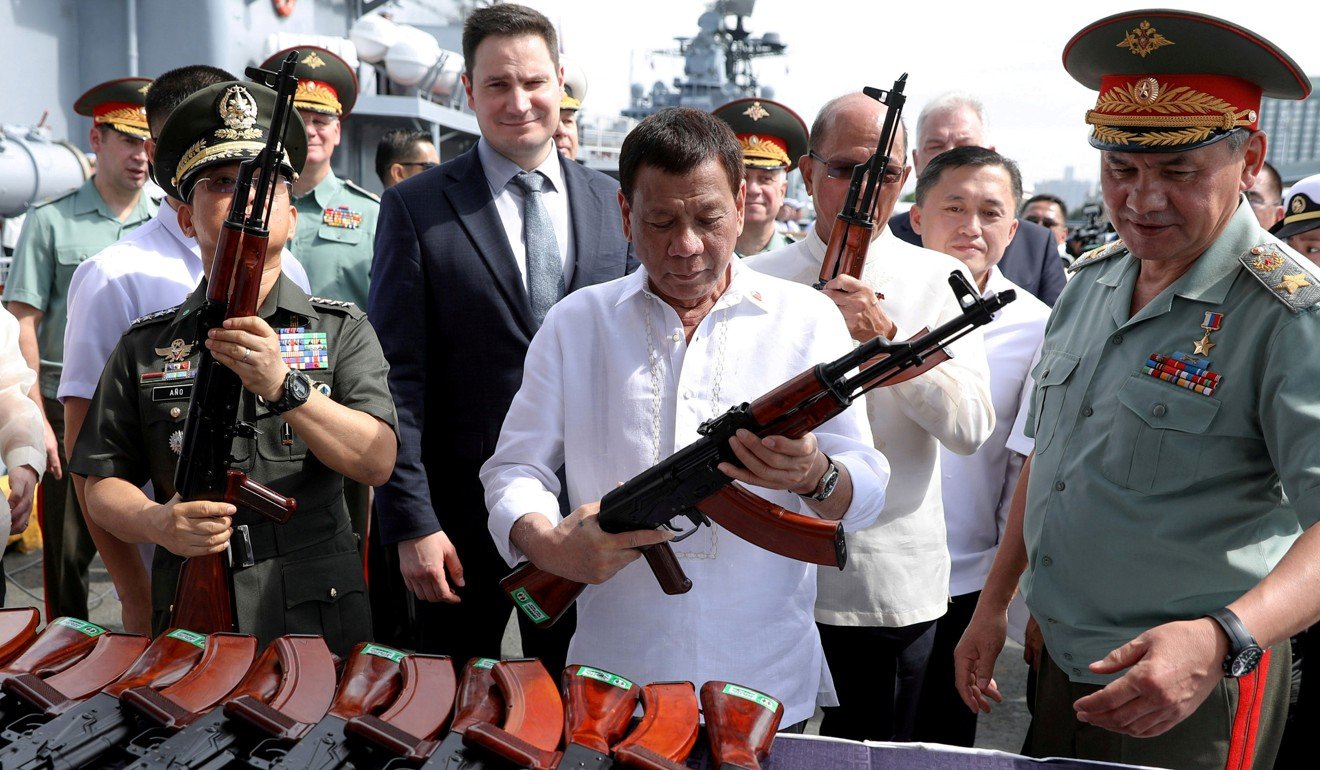
Philippine President Rodrigo Duterte inspects firearms donated by Russia in 2017. Photo: Reuters
“The US will also be concerned if any acquisitions or cooperation with Russia might threaten information security or intelligence cooperation between the US and the Philippines,” he said.
“And finally, any major platforms acquired from Russia would likely require the US to impose sanctions on the Philippines unless a waiver is granted, and the US government has been very stingy about awarding those waivers because they undermine the effectiveness of the sanctions regime.”
“Imagine a US stronghold and long-time ally and former colony becoming a manufacturing hub for Russian arms. And it makes it worse if [the Philippine armed forces] buys them too,” he said.
“Weakening the US alliances in Asia will benefit Russia [as it is] one of the US’ competitors in arms sales and geopolitics.”
Russia offers arms technology to the Philippines with ‘no conditions’ as US ties falter
The Philippines, Montero said, would benefit from such an arrangement since it is “a laggard in defence technology”. However, he pointed out that the country’s armed forces continue to buy weapons from the US and receive American arms as grants, potentially limiting the domestic market for Russian arms.
Navy cooperation has also been on the agenda, as Moscow and Manila discussed signing a new naval pact in March, while warships from each country have visited the other this year. Philippine naval vessels made their first-ever visit to Russia in October, while three Russian ships docked in the Philippines for a goodwill visit in January.
Russia is the top supplier of arms to Southeast Asia, and the No 2 global arms supplier, behind the US. Southeast Asia bought US$6.6 billion of Russian arms between 2010 and 2017, or more than 12 per cent of Russia’s sales, according to the Stockholm International Peace Research Institute, a Swedish think tank that publishes global arms tracking data.
LANZHOU, Oct. 26 (Xinhua) — Dunhuang Academy China and Peking University have signed an agreement to establish a research center for Dunhuang studies, aiming to nurture more high-level research talent in the area.
Rong Xinjiang, a professor with Peking University, and Zhao Shengliang, the head of the Dunhuang Academy, will be the directors of the new center.
With a focus on the documents of Dunhuang and grottoes art, Dunhuang studies is an emerging interdisciplinary subject that covers areas such as history, geography, archeology and art.
The Dunhuang Academy, located in northwest China’s Gansu Province, administers the Mogao Grottoes, a renowned UNESCO World Heritage site that showcases the cultural integration and mutual learning among different civilizations along the ancient Silk Road.
The Mogao Grottoes are home to a priceless collection of Buddhist artwork — more than 2,000 colored sculptures and 45,000 square meters of murals — in 735 caves carved along a cliff by ancient worshippers.
Peking University is a pioneer of Dunhuang studies in China, with scholars of its predecessor beginning research in the area in the early 20th century.
BEIJING (Reuters) – Beijing’s new $63 billion Daxing airport began its first scheduled international flights on Sunday as it ramped up operations to help relieve pressure on the city’s existing Capital airport.
Shaped like a phoenix – though to some observers it is more reminiscent of a starfish – the airport was designed by famed Iraqi-born architect Zaha Hadid, and formally opened in late September ahead of the Oct. 1 celebrations of the 70th anniversary of the People’s Republic of China.
It boasts four runways and is expected to handle up to 72 million passengers a year by 2025, eventually reaching 100 million.
China Southern Airlines (600029.SS) and China Eastern Airlines (600115.SS) will be the main domestic carriers at Daxing, though Air China (601111.SS) will provide a small number of flights too.
An Air China flight to Bangkok was the first international flight to leave on Sunday, while British Airways (ICAG.L) will operate the first transcontinental flight, to London.
About 50 foreign airlines, including Finnair (FIA1S.HE), plan to move all or part of their China operations to the airport in the coming quarters.
The relocation of all the airlines which will use Daxing is to due to be completed by the winter of 2021. Air China and its Star Alliance partners will remain mostly at Capital airport.
The airport, roughly the size of 100 football fields and expected to become one of the world’s busiest, has come in for some criticism due to its distance from central Beijing.
By public transport it takes over an hour to reach it from Beijing’s central business district, more than double the time needed to reach Capital airport, which strains at the seams and is often hit by delays.
Officials say Daxing airport is not only designed to serve Beijing, but also the surrounding province of Hebei and next-door city of Tianjin, to boost regional development.
Young Chinese girls in Hunan province used Nushu, a language that no men could read, to communicate with one another. Now a new film aims to tell us more about it
Gianna Jun and Binbing Li, in the film Snow Flower and the Secret Fan. Photograph: Fox Searchlight Pictures/Sportsphoto Ltd/Allstar
A decade ago Chinese-American author Lisa See was researching an article on footbinding when she found a reference to Nushu, the world’s only “women’s writing”. Though the origins were murky, the script revealed a culture of women’s relationships and sparked the idea for her novel, Snow Flower and the Secret Fan, the film of which, co-produced by Rupert Murdoch’s wife Wendi Deng, is released tomorrow.
After having their feet bound at around the age of seven, girls in Jiangyong County in Hunan province would live indoors – first in the “women’s chamber” of their own homes, and later in the homes of their husband’s family. To ease their isolation and offer support in their pain, girls from the same village were brought together as “sworn sisters” until their weddings. But a more serious relationship, almost akin to marriage and expected to last for life, could be arranged between two girls by a matchmaker, with a formal contract, if the pair shared enough of the same “characters” (being born on the same day, for example). In See’s book she writes: “A laotong relationship is made by choice for the purpose of emotional companionship and eternal fidelity. A marriage is not made by choice and has only one purpose — to have sons.”
Women used Nushu – a script unique to the area – to write to their laotongs after they “married out” into different villages. Yet until the 1960s few outside the province knew about it, and no men could read it, says See. “In the mid-60s an old woman fainted in a station,” she says. “The police went through her things to see who she was and found a piece of paper with what looked like a code, so she was arrested on suspicion of being a spy.” In the midst of the cultural revolution, the experts who finally identified the script were sent to labour camps, not emerging to study the writing until the 80s. Following the success of See’s book, the film aims to allow people to learn more.
India’s oldest exponent and teacher of yoga, V Nanammal, has died at her home near Coimbatore, in the southern state of Tamil Nadu.
She was 99 and still teaching a hundred students a day until a few months ago.
Born into an agricultural family, she was taught yoga by her father.
She went on to master more than 50 postures or asanas, and trained more than a million students – hundreds of them now yoga instructors themselves around the world.
Image copyright GETTY IMAGESImage caption V Nanammal (right) was known for her trademark pink sari
Known affectionately as “Yoga Grandma”, Nanammal received the Padma Shri – one of India’s highest civilian honours.
After nearly 10 years of planning, the country’s two shipbuilders will be reunited with a combined revenue of US$141.5 billion
China’s two shipbuilding giants have built hundreds of military vessels over the past few years as the country’s navy seeks to modernise rapidly. Photo: Xinhua
China on Friday announced the merger of the country’s two largest state-owned shipbuilding giants, a step Beijing has been preparing for nearly a decade to strengthen the competitiveness of its shipbuilding industry.
The intention to merge the Shanghai-based China State Shipbuilding Corp (CSSC) and the China Shipbuilding Industry Co (CSIC), based in Dalian, Northern Liaoning province, was announced in a statement on the website of the state-owned Assets Supervision and Administration Commission of the State Council, China’s cabinet.
The merger would enable China to establish a shipbuilding giant with a combined revenue up to 1 trillion yuan (US$141.5 billion), capable of building vessels ranging from warships, like aircraft carriers, to civilian ships such as container ships and oil tankers, said a source familiar with the merger plan.
“This merger has been in the making since Hu Wenming, a former party leader of the state-owned aviation industry, was assigned to CSSC as party secretary in 2010,” the source said, requesting anonymity because of the sensitivity of the issue.
“The merger plan was put on the drawing board at a time when the world shipping industry had entered a golden period in 2009, and the business of CSSC and CSIC was at its peak, but [China’s] analysis indicated a decline was on the horizon, as has actually happened in recent years.”
Chinese shipbuilder touts warships in push to expand arms sales in region
CSIC and CSSC were part of the same group until 1999 when they were split into two separate entities. Since then, China has overtaken South Korea and Japan to become the world’s largest builder of merchant ships, a rise spurred by the boom in world trade and the country’s accession to the World Trade Organisation in 2001.
CSSC manages shipbuilding business in the east and south of China, while CSIC oversees activities in the northern and western parts of the country. Both are also primary contractors for PLA naval ships.
Commercial shipbuilding was the major source of revenue for both enterprises, given they were generally less technologically challenging and of lower cost to build, the source said.
“Developing and building warships for the PLA needs more manpower and more advanced technologies because naval ships, which are built for sea battles, take longer to build and require cutting-edge technologies, hence the higher costs,” the source said.
China tests new warships in live-fire drills near Vietnam
CSSC and CSIC have built hundreds of military vessels over the past few years as the Chinese navy seeks to modernise rapidly. These have included aircraft carriers, Type 055 destroyers, Type 075 amphibious assault ships and Type 094A nuclear submarines.
But, the source said, the two giants’ naval warship building mission would be cut back next year, as Beijing expected greater financial pressure as a result of slower economic growth. The merger would allow the two companies to pool their resources and enhance their competitiveness, especially in the development of mega vessels.
But the source said the two giants’ naval warships building missions would be cut back beginning next year as Beijing foresees greater financial pressure as a result of slower economic growth. The merger will allow the two companies to pool their resources and enhance their competitiveness, especially in areas of mega vessels.
“The merger is also part of China’s long-term maritime energy development plan to meet President Xi Jinping’s sustainable and clean energy goal, because China needs more giant vessels to help ship oil and gas from other countries,” the source said.
NAIROBI, Oct.25 (Xinhua) — China is seeking to promote cooperation with Kenya in the development of the technology arena and digital economy.
Guo Ce, economic and commercial counselor of the Chinese embassy in Kenya, said on Thursday that China which is Kenya’s largest trading partner is also seeking cooperation with Kenya in terms of capacity building by outcome-sharing in the technological arena for mutual benefit.
“For instance, China has such wonderful information technology (IT) companies as TECNO and Huawei in Kenya, providing local users with easy access to the Internet and thus increasing the welfare of its people,” Guo said during the symposium on China-Kenya cooperation and development of digital economy on Thursday.
By the end of 2018, the number of Chinese netizens has reached 829 million, and the number of mobile Internet users has reached 871 million, with the e-commerce transaction volume amounting to 4.4 trillion US dollars.
In Kenya, the value of the ICT sector, driven by growth in the digital economy, expanded by 12.9% in 2018. And as of December 2018, the total number of active data/Internet subscriptions in Kenya stood at 45.7 million of which 47.9 percent were on broadband. The number of Internet users in Kenya accounts for 83.0% of its population.
Zhao Hui, secretary general of China Federation of Internet Societies (CFIS), said during the symposium that China has always attached great importance to the extensive and friendly cooperation in cyberspace with Kenya and other African countries.
Zhao said that Kenya, as the largest economy in east Africa, has achieved remarkable results in the development of the digital economy.
“It is undoubted that there will be great opportunities for China and Kenya to carry out in-depth cooperation in the digital economy,” she added.
CFIS expects to build up a communicating platform for companies from China and Kenya to promote the continuous improvement of China-Kenya digital industrialization through the symposium, Zhao said.
Peng Lihui, secretary general of China Electronics Chamber of Commerce (CECC), invited Kenyan organizations to join the Global Digital Economy Alliance (D50), which was initiated by CECC and 50 national industrial organizations and leading enterprises.
In the symposium, Jacqueline Sigu, manager of county programme and small and medium enterprises development at Kenya National Chamber of Commerce and Industry , said that the Kenyan government has already developed a blueprint for the digital economy, which will accelerate Kenya’s ambition to automate government and private sector business operations, while noting that the high cost of infrastructure remains a big challenge.
She said that China is an ideal partner for Kenya in the ICT sector because it is a world leader in digital innovations. “Kenya’s business community could borrow lessons from China that can adapt to meet local conditions,” she said.
She revealed that Kenya will leverage on close ties with China to solidify its status as eastern Africa’s regional ICT hub.
Liz Kisyanga, digital marketing manager of StarTimes Kenya, said that Chinese firms can play a big role in the provision of affordable internet and smart-phones in Kenya.
“More players in the digital economy space will result in more innovation and the ultimate beneficiary will be the Kenyan consumer,” Kisyanga said Kenya can partner with Chinese firms to rollout Internet services in the rural and remote areas that are typical underserved by technological service providers.
BEIJING, Oct. 25 (Xinhua) — Chinese Premier Li Keqiang will pay official visits to Uzbekistan and Thailand, at the invitation of Uzbek Prime Minister Abdulla Aripov and Thai Prime Minister Prayut Chan-o-cha, and attend a series of meetings in the two countries from Nov. 1 to 5, Foreign Ministry Spokesperson Hua Chunying announced Friday.
Li will attend the 18th meeting of the Council of Heads of Government (Prime Ministers) of the Shanghai Cooperation Organization (SCO) in the Uzbek capital Tashkent, and attend the 22nd China-ASEAN (10+1) leaders’ meeting, the 22nd ASEAN-China, Japan and Republic of Korea (10+3) leaders’ meeting and the 14th East Asia Summit (EAS) in the Thai capital Bangkok during the visits, the spokesperson added.
KUALA LUMPUR, Oct. 25 (Xinhua) — Trade between China and the Association of Southeast Asian Nations (ASEAN) will continue to expand, serving as an engine for global economic growth, Malaysian International Trade and Industry Deputy Minister Ong Kian Ming said on Friday.
Speaking at the 2019 China Macroeconomic Roundtable “Economic Forecast, High Quality Development, and Policy Implications” hosted in Xiamen University Malaysia, Ong said despite downward forecasts, strong economic activity between China and the ASEAN would help both weather the storm.
As the economic growth in China and Southeast Asia would continue to outstrip the economic growth of the United States as well as Europe, the greater cooperation between China and the ASEAN will have a bigger impact to the wider world, Ong said.
“We definitely can see Asia not only as an engine of services and manufacture and production but also later on as the engine of growth for the global economy. So there are many opportunities for China and Southeast Asia to work together in order to improve the economic outlook for our respective countries, as well as globally,” he said.
Jointly organized by the Center for Macroeconomics Research at Xiamen University and Xiamen University Malaysia, this year’s overseas forecast conference is the first time that the event was held in Malaysia.
At the conference, the team from the Center for Macroeconomics Research at Xiamen University released China’s main macroeconomic indicators for 2019-2020 and reported its policy implications based on simulation analysis.
Also released was the findings of this year’s “Economists Questionnaire Survey on China’s Macroeconomic Outlook,” which was co-organized by Xiamen University and Economic Information Daily newspaper.
Since 2006, Xiamen University has been holding China’s macroeconomic forecast conference twice a year.







 CHINDIA ALERT: You'll be living in their world, very soon