Posts tagged ‘3D printing’

25/11/2016

China breaks patent application record – BBC News

China-based innovators applied for a record-setting number of invention patents last year.

The country accounted for more than a million submissions, according to an annual report by the World Intellectual Property Organization (Wipo). It said the figure was “extraordinary”.

Many of the filings were for new ideas in telecoms, computing, semiconductors and medical tech.

Beijing had urged companies to boost the number of such applications.

But some experts have questioned whether it signifies that the country is truly more inventive than others, since most of China’s filings were done locally.

What is a patent?

A patent is the monopoly property right granted by a government to the owner of an invention.

This allows the creator and subsequent owners to prevent others from making, using, offering for sale or importing their invention into the country for a limited time.

In return they must agree for the patent filing to be publicly disclosed.

To qualify as an “invention” patent, the filing must contain a new, useful idea that includes a step – a new process, improvement or concept – which would not be obvious to a skilled person in that field.

Some countries – including China – also issue other types of patents:

Utility model patents. The ideas must still be novel, but it is less important that there is a “non-obvious step”

Design patents. These require the shape, pattern and/or colour of a manufactured object’s design to be new, but do not require there to be a novel technical aspect

Skewed figures

A total of 2.9 million invention patent applications were filed worldwide in 2015, according to Wipo, marking a 7.8% rise on the previous year.

China can lay claim to driving most of that growth. Its domestic patent office – the Property Office of the People’s Republic of China (Sipo) – received a record 1,101,864 filings. These included both filings from residents of China and those from overseas innovators who had sought local protection for their ideas.

The tally was more than that of Sipo’s Japanese, South Korean and US equivalents combined.

Applicants based in China filed a total of 1,010,406 invention patents – the first time applicants from a single origin had filed more than one million in a single year.

But they appeared to be reticent about seeking patent rights abroad.

According to Wipo, China-based inventors filed just 42,154 invention patent applications outside their borders – Huawei and ZTE, two smartphone and telecoms equipment-makers, led the way.
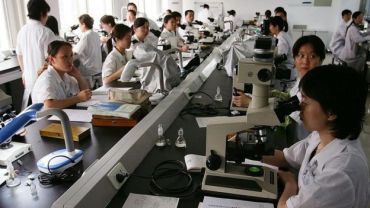
There was a rise in the number of medical tech patent filings from China

By comparison US-based inventors sought more than five times that figure. And Japan, Germany and France also outnumbered the Asian giant.

One patent expert – who asked not to be named – suggested the disparity between Chinese inventors’ local and international filings reflected the fact that not all the claims would stand up to scrutiny elsewhere.

“The detail of what they are applying for means they would be unlikely to have the necessary degree of novelty to be granted a patent worldwide,” he said.

But Wipo’s chief economist said things were not so clear cut.

“There is clearly a discussion out there as to what is the quality of Chinese patents,” said Carsten Fink.

“But questions have also been asked about US and other [countries’] patents.”

And one should keep in mind that China is a huge economy.

“If you look at its patent filings per head of population, there are still fewer patents being filed there than in the United States.”

Patent boom

Part of the reason so many applications were made locally was that China set itself a target to boost all types of patent filings five years ago.

Sipo declared at the time that it wanted to receive two million filings in 2015.

The government supported the initiative with various subsidies and other incentives.

Adding together China’s invention, utility and design patents, its tally for 2015 was about 2.7 million filings, meaning it surpassed its goal by a wide margin.

One London-based patent lawyer noted that Chinese firms were not just filing patents of their own but also buying rights from overseas companies.

“This all goes to show the growth of the telecoms and high-tech industries in China, and that these companies are playing a more significant role globally than hitherto,” said Jonathan Radcliffe from Reed Smith.

“The fact we are now seeing them suing and being sued for patent infringement in Europe and in the US on subject matter such as mobile phones and telecoms standards – and indeed seeing Chinese companies suing each other over here in Europe for patent infringement – shows that they have truly arrived.”

Source: China breaks patent application record – BBC News

10/08/2015

‘Silicon Valley’ China

The following was in answer to a series of questions by a journalist from International Finance Magazine.

The specific questions and answers are:

> Do you think China can be the next Silicon Valley? Indubitably

> What are your reasons? See this paper

> What according to you are the differentiating factors between China and Silicon Valley? Longevity, experience and culture including education system.

> Which are the areas where China scores points over Silicon Valley and which are the areas wherein it needs to improve?Whereas the US has a Silicon Valley and the area around Boston, China has several dozen ‘silicon valleys’ though most are in embryonic stage. Whereas the US Silicon Valley has a long history of success, which breeds success, the Chinese ones are all very new, although the oldest Zhongquancun in a Beijing suburb dates from the 80s; and in 2014 launched nearly 50 tech start-ups. See III.

> What steps does China need to take to have more of AliBabas in the country? See this paper which suggests that steps are already being taken.

> Some say that there is no dearth of money in China and hence there are many VCs and private equity firms. However, what is lacking is a disciplined approach. Your take on this. Agreed. However, the two magnets for investment in the past have been real estate and the so-called stock market, which is another name for legalized gambling.  Both have suffered reverses, property for a while and recently the stock market.  The Chinese investor is a quick learner.  Sooner rather than later they will turn to instruments and institutions that invest in innovation.

> How well are the young Chinese embracing entrepreneurship? The young in general are following the old path of secure jobs in government or established industry.  But with 1.3 billion people, there are enough youngsters interested in innovation and entrepreneurship for them to be a real force.

>Does the education system in China foster this? No it does not, See II – 3. last para.

 ==================

I believe that China is rapidly catching up with the US in innovation and entrepreneurship.  I say this for four reasons:

i. China has always been innovative and inventive.

ii. The Chinese government sees innovation and entrepreneurship as the solution to its rapidly dated ‘cheap’ mass manufacturing. It knows that China is experiencing its version of the industrial revolution in a fraction of the time it took the west and needs a new trick up its sleeve if China is not to be relegated to a third-world nation once again.

iii. China is already innovative and entrepreneurial in practice and speeding up the learning curve at the same speed it took up industrialization after Deng.

iv. Some respected ‘guru’s think so too.

I.   China has always been innovative and very inventive.

 We have all heard of gunpowder, movable press, paper making and the compass.  In 1948, Joseph Needham, Cambridge University set out to document Chinese innovation – https://en.wikipedia.org/wiki/Joseph_Needham Needham had heard a lot about this and was slightly skeptical, so he started professional research on it.  Today, his work – Science and Civilisation in China  – is still in progress although he passed away.  Seven volumes in 27 books have been published so far and the end is not in sight.  To help the lay reader, Prof Robert Temple has written a short book on it – The Genius of Chinahttp://www.curledup.com/geniusch.htm

II.  The Chinese government is focused on innovation and entrepreneurship.

It knows that its current USP, inexpensive and mass manufacturing will not last.  In fact, in some low tech areas it is discouraging any new factories.  It has also been steadily pushing up the minimum wage, thereby discoursing such manufacturing. In my view it has done four specific things to encourage innovation and entrepreneurship:

  1. Five-year plans, in particular:
  1. a. the 12th (2011 – 2015) – http://www.c2es.org/international/key-country-policies/china/energy-climate-goals-twelfth-five-year-plan – which included this section:

              Old pillar industries               The new strategic and emerging industries

1 National defense Energy saving and environmental protection
2 Telecom Next generation information technology
3 Electricity Biotechnology
4 Oil High-end manufacturing (e.g. aeronautics, high speed rail)
5 Coal New energy (nuclear, solar, wind, biomass)
6 Airlines New materials (special and high performance composites)
7 Marine shipping Clean energy vehicles (PHEVs and electric cars)

Sources: “Decision on speeding up the cultivation and development of emerging strategic industries,” http://www.gov.cn, September 8, 2010, http://www.gov.cn/ldhd/2010-09/08/content_1698604.htm; HSBCChina’s next 5-year plan: What it means for equity markets, October 2010.

1.b and the 13th (2016 – 2020) – http://www.chinabusinessreview.com/understanding-chinas-13th-five-year-plan/ – one of whose aims is likely to be “to support emerging industries”

  1. “Made in China 2025” policy – http://www.chinadaily.com.cn/bizchina/2015-05/19/content_20760528.htm -The 10 key sectors are new information technology, numerical control tools and robotics,aerospace equipment, ocean engineering equipment and high-tech ships, railway equipment,energy saving and new energy vehicles, power equipment, new materials, biological medicineand medical devices, and agricultural machinery.
  2. “Mass innovation and entrepreneurship” – http://www.chinadaily.com.cn/business/tech/2015-01/29/content_19436562.htm– “Chinawill foster a platform offering low-cost services in a variety of areasto micro businesses and individual start-ups that show

The government will also step up policy support, such as simplifying registration proceduresand giving subsidies, to innovative businesses. They will improve financing systems to givespecial support to start-up companies, according to the statement.

Although China’s broader economy is slowing, China’s young entrepreneurs are driving awave of startups that has become a bright spot for the economic landscape and an importantengine for future growth.

The number of newly founded companies in China surged almost 46 percent year on year to3.65 million in 2014, the latest data showed.”

China is very aware that the current education system does not foster innovation or entrepreneurship; so it is proposing major reform – http://www.chinadaily.com.cn/china/2015twosession/2015-03/11/content_19783458.htm – Current Chinese education has been criticized by many for being rigid and killing students’ imagination. In many exams, students are supposed to memorize the standard answer instead of putting forward their own ideas.

“Innovation requires the ability to seek different answers to the same question, through which they still reach the right destination,”

http://news.xinhuanet.com/english/china/2015-01/28/c_133954148.htm – “China’s State Council pledged to take various steps to create an amicable environment for innovation and entrepreneurship in order to power growth and generate jobs. … Although China’s broader economy is slowing, China’s young entrepreneurs are driving a wave of startups that has become a bright spot for the economic landscape and an important engine for future growth.

The number of newly founded companies in China surged almost 46 percent year on year to 3.65 million in 2014, the latest data showed.”

III. Innovation in practice

In practice, China now leads in world patent filing – https://chindia-alert.org/2015/05/21/patent-applications-lead-the-worldfocuschinadaily-com-cn/ – though in terms of patents filed in the US it is still behind Japan.

Chinese ‘silicon valleys’ – in addition to Zhongquancun, opened in the 80s – 80s –http://www.forbes.com/sites/ruima/2014/10/20/one-billion-chinese-entrepreneurs/andhttp://www.bloomberg.com/news/articles/2015-03-11/china-s-silicon-valley-sparking-49-technology-startups-a-daythere are dozens around the country.  It seems the ‘copycat’ syndrome applies to coy-catting innovation and entrepreneurship!- http://www.bloomberg.com/news/articles/2015-07-23/china-wants-silicon-valleys-everywhere

Chinese innovative products include, of course, AliBaba; but also, according to Forbes, in eight ‘industries –http://www.forbes.com/sites/anaswanson/2014/11/30/eight-innovative-industries-china-does-better-than-anywhere-else/:

  1. Micropayments
  2. E-commerce
  3. Delivery services
  4. Online investment products
  5. Cheap smart phones
  6. High speed rail
  7. Hydroelectricity
  8. DNA sequencing

IV.From ‘guru’s

You do not need to take my word for it, see comments by:

  1. Kai-Fu Lee, Google exec – http://blogs.wsj.com/chinarealtime/2015/07/30/behind-the-surge-in-chinese-tech-startups/?mod=chinablog&mod=chinablog
  2. McKinsey & Co – http://www.mckinsey.com/insights/asia-pacific/a_ceos_guide_to_innovation_in_china
30/08/2014

Houses in Shanghai are not built, they’re printed[1]- Chinadaily.com.cn

A Chinese company recently built 10 full-sized houses using a giant printer.

Houses in Shanghai are not built, they're printed

The detached, one-story houses now standing in the Shanghai Hi-Tech Industrial Park, in the city’s Qingpu district, look like ordinary buildings. But they were “printed out” in less than a day with “contour crafting“, commonly known as 3-D printing technology.

‘Mirror’ perfect fit for shoppers  Four huge printers measuring 32 meters long, 10 meters wide and 6.6 meters tall were used to make the houses, which were built layer by layer.

“It’s not only cost-effective but also environmentally friendly,” said Ma Yihe, inventor of the printers, who is also president of the Shanghai Winsun decoration and design company.

“Unlike traditional construction, the new technology doesn’t produce any waste,” said Ma, who has been working in the 3-D printing construction industry for 12 years.

The materials used to make the houses are a mixture of quick-drying cement and recycled industrial waste, which help lower construction costs by up to 50 percent. For the moment, the company is keeping the recipe for the cement a secret.

Meanwhile, the houses can withstand just about any safety test, Ma said.

via Houses in Shanghai are not built, they’re printed[1]- Chinadaily.com.cn.

27/06/2014

China’s Maker Movement Gets Government Support for DIY Workshops – Businessweek

On a Wednesday night in late May, about 60 people assembled in a warehouse in downtown Shanghai for a presentation on how to make mini sports cameras like the popular GoPro (GPRO). The meeting was organized by XinCheJian, one of China’s first hackerspaces, which offers workshops for participants interested in design and technology to create everything from robots to smartphone apps.

A 3D printer makes a miniature chair during the China International Technology Fair in Shanghai on May 8, 2013

The weekly gatherings attract 30 to 150 people and offer them a way to share ideas, skills, and inspiration. After attending a meeting in 2012, Rockets Xia, an environmental advocate with a Chinese nongovernmental organization, was so impressed by a 3D printing demonstration that he quit his job and went to work for DFRobot, a Shanghai-based company that makes robotics kits and other hardware for hobbyists.

The popularity of XinCheJian, which means “new factory,” is a sign of China’s joining the growing maker movement—what former Wired editor Chris Anderson in his 2012 book Makers described as the “third industrial revolution,” in which entrepreneurs use open-source design, 3D printing, and crowdfunding to manufacture goods on their own. In China, 30 independent hackerspaces, including XinCheJian, have opened across the country.

via China’s Maker Movement Gets Government Support for DIY Workshops – Businessweek.

15/04/2014

How a Chinese Company Built 10 Homes in 24 Hours – China Real Time Report – WSJ

Chinese companies have been known to build major real-estate projects very quickly. Now, one company is taking it to a new extreme.

Suzhou-based construction-materials firm Winsun New Materials says it has built 10 200-square-meter homes using a gigantic 3-D printer that it spent 20 million yuan ($3.2 million) and 12 years developing.

Such 3-D printers have been around for several years and are commonly used to make models, prototypes, plane parts and even such small items as jewelry. The printing involves an additive process, where successive layers of material are stacked on top of one another to create a finished product.

Winsun’s 3-D printer is 6.6 meters (22 feet) tall, 10 meters wide and 150 meters long, the firm said, and the “ink” it uses is created from a combination of cement and glass fibers. In a nod to China’s green agenda, Winsun said in the future it plans to use scrap material left over from construction and mining sites to make its 3-D buildings.

Winsun says it estimates the cost of printing these homes is about half that of building them the traditional way. And although the technology seems efficient, it’s unlikely to be widely used to build homes any time soon because of regulatory hurdles, Mr. Chen said.

The Chinese firm isn’t the first to experiment with printing homes. Architects in Amsterdam are building a house with 13 rooms, with plans to print even the furniture. The Dutch architect in charge of the project said on the project’s website it would probably take less than three years to complete.

via How a Chinese Company Built 10 Homes in 24 Hours – China Real Time Report – WSJ.

Enhanced by Zemanta
15/07/2013

Hello 3D printing, goodbye China

If the following article’s predictions do come true, then the world economy as we know it will be destroyed as the unintended consequence. No trucks, freight trains, container ships, no major manufacturing facilities, no major hub warehouses. No truck and freight train drivers, no container ship crews, no depot warehousemen. No truck, freight train, container ship manufacturers; less construction workers and companies. And there will be further knock-on effects. I wonder …

Sunday Times: “A SPECTRE is haunting the great container ship ports of China, with their highways jammed by lorries and the vast factory estates stretching from the coast of the South China Sea to the mountainous inland provinces.

Cheap Chinese labour could be made redundant by 3D printers (Chu Yang)

It is the spectre of a revolution led by a quiet, software-driven 3D printer, a machine that can laser up layers of liquid or granular resin — or even cell tissue — into a finished product.

Some 3D printers are huge devices that make complete components such as aircraft parts. Others are small units that could stand next to a desk and create a small plastic prototype.

Maplin, the British electronics retailer, said last week it would start selling one for just £700. The Velleman K8200 will allow those who are so inclined to make simple objects — mobile phone covers, perhaps, or toys.

“The only restriction is your imagination. You can make whatever you want,” said Pieter Nartus, export manager at Velleman.

To visionaries in the West, the digital 3D printer promises to disrupt conventional manufacturing and supply chains so radically that advocates compare its impact to the advent of the production line, or the internet.

In China, whose big factories are thinking of using giant 3D printers for manufacturing, the technology does not seem to pose an immediate threat.

“It is on their horizon but it is not a factor right now,” says a British buying agent who sources plastics in China.

However, as Chinese leaders ought to know from their compulsory classes in Karl Marx, control of the means of production is everything. And if 3D printing takes off, production will come back to a place near you.

The implications, economists say, are limitless. No huge factories. No fleets of trucks. No ships. No supply chain. No tariffs. Few middlemen. Orders tailored exactly to demand, so no need for stock and warehouses. Just a printer, raw materials, software and a design.

The advantages do not end there. Because the item is “sintered” — created from a powdered material — to precise settings using a laser, there is no waste such as metal shavings. To customise a product, the user simply changes the software. An operator presses a button and the printer spits out the item.

“The first implication is that more goods will be manufactured at or closer to their point of purchase or consumption,” said Richard D’Aveni, a professor at Dartmouth College in America.

Writing in the Harvard Business Review, D’Aveni predicted the elimination of the long supply chain linked to a huge factory staffed by cheap workers and sited on the other side of the world.

It may be the most significant, if underplayed, article in that distinguished publication in decades.

via Hello 3D printing, goodbye China | The Sunday Times.

24/02/2013

* China commercializes 3D printing in aviation

ZDNet: “China looks to lower the cost of 3D printing and make large titanium components to build the next-gen fighter jet and self-developed passenger plane.

63494380232763359210

By using laser additive manufactured titanium parts in its aviation industry, China is looking to become a global leader in commercializing 3D printing technology.

The laser additive manufacturing technology not only lowers the cost of titanium parts to only 5 percent of the original, it also reduces the weight of the components and enhances the strength of complicated parts.

As much as 40 percent of the weight can be reduced if the forged titanium parts on an American F-22 were made using the Chinese 3D printing technology, according to a a report on Chinese Web site, Guancha Zhe.

With funding from the government, especially from the military, the Chinese aviation laser technology team is making headways in making titanium parts for the country’s fifth generation of fighter jets, the J-20 and J-31, by lowering the cost and raising the jets’ thrust-weight ratio.

The Northwestern Polytechnical University of China is also making five meter-long titanium wing beams for the C919 passenger plane, which is scheduled to be put into commercial operation in 2016.

“As the aviation technology develops, the components are also getting lighter, more complicated, and also need to have better mechanical properties,” said Huang Weidong, director of the university’s laboratory, to a local newspaper. “It is very hard to use traditional technologies to make such parts, but 3D printing could just meet such demands.”

via China commercializes 3D printing in aviation | ZDNet.

Law of Unintended Consequences

continuously updated blog about China & India

ChiaHou's Book Reviews

continuously updated blog about China & India

What's wrong with the world; and its economy

continuously updated blog about China & India