Posts tagged ‘africa’

19/04/2014

In His First Year, China’s Xi Puts Unprecedented Focus on Africa – Businessweek

A little over a year ago, Xi Jinping embarked on his first foreign trip as China’s president, making stops in Russia and Africa. Over the past 13 months, his administration has focused unprecedented attention on strengthening economic and political ties in Africa, according to a new policy briefing by Brookings Institution scholar Yun Sun.

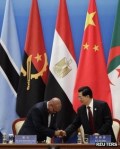
Chinese President Xi Jinping shakes hands with Namibian Prime Minister Hage Geingob on April 8 in Beijing

While China’s People’s Liberation Army has long maintained what Sun calls a “tacit operating principle of ‘no troops on foreign soil,’” last spring Beijing sent 170 combat troops from the PLA Special Force to accompany the United Nations peacekeeping mission in Mali. In the past, only Chinese engineers and medical personnel had ever been dispatched to foreign soils under a UN mandate.

“China’s choosing Africa to dispatch combat troops for the first time does suggest Beijing’s rising interests,” writes Sun, as well “enhanced commitment and [a] direct role in maintaining [the] peace and security of Africa.” China has also “dispatched a total of 16 fleets and escorted more than 5,300 ships and vessels” around the Gulf of Aden, in effect taking responsibility for maintaining the security of key shipping lanes.

via In His First Year, China’s Xi Puts Unprecedented Focus on Africa – Businessweek.

Enhanced by Zemanta
07/01/2014

China’s first ‘ivory crush’ signals it may join global push to protect African elephants – The Washington Post

China, the world’s biggest consumer of illegal ivory, crushed six tons of tusks and carved ornaments in public Monday, in an event that signaled it would do more to join global efforts to protect African elephants from rampant poaching.

About 25,000 of the estimated 500,000 elephants in Africa are illegally slaughtered each year for their tusks, conservationists say. It is a $10 billion industry that draws in global crime syndicates and African rebel groups, and threatens to wipe out elephants from parts of the continent within a decade.

Although Chinese authorities have stepped up anti-trafficking efforts in recent years, the trade in illegal ivory has continued, in part because many Chinese people do not know elephants have to die for the ivory to be taken.

On Monday, workers in overalls fed scores of weighty tusks and hundreds of small, intricately carved objects into a large, noisy green crushing machine in front of a crowd of officials, diplomats, conservationists and journalists in this small town just outside the southern city of Guangzhou.

“We also hope this event will raise the public awareness of conservation and intensify the responsibilities of enforcement agencies,” said Zhao Shucong, director of the State Forestry Administration. Zhao admitted that ivory smuggling was “still raging” and said that China was “in urgent need of sincere collaboration with different countries and international organizations” to support elephant conservation.

Past efforts to curb ivory poaching have at times disintegrated into finger-pointing between officials in Africa — where corruption and weak law enforcement have allowed poachers to prosper — and countries such as China, where most of the ivory ends up.

via China’s first ‘ivory crush’ signals it may join global push to protect African elephants – The Washington Post.

Enhanced by Zemanta
04/12/2013

Urgent deal reached in Africa to cut down illegal ivory trade | Fox News

Key states where the illegal ivory trade flourishes have pledged to take urgent measures to try to halt the illicit trade and secure elephant populations across Africa, the International Union for Conservation of Nature, or IUCN, said Wednesday.

elephant.jpg

The agreement was reached at the African Elephant Summit convened by the government of Botswana and the IUCN held in Gaborone over the past few days.

The measures were agreed upon by key African elephant range states including Gabon, Kenya, Niger and Zambia and ivory transit states Vietnam, Philippines and Malaysia, and ivory destination states, including China and Thailand, said the IUCN in a statement.

\”Our window of opportunity to tackle the growing illegal ivory trade is closing and if we do not stem the tide, future generations will condemn our unwillingness to act,\” Botswana President Ian Khama told the summit.

\”Now is the time for Africa and Asia to join forces to protect this universally valued and much needed species,\” he said.

via Urgent deal reached in Africa to cut down illegal ivory trade | Fox News.

11/04/2013

* China’s ‘Going Out Strategy’ and the implications for agricultural and forestry resources in Africa

CPI: “China is shifting the global political economy which has significant implications for natural resource management. The so-called Western powers, which have dominated global natural resource institutions for centuries, may be about to witness a new mode of resource governance. Although not always perceptible, even our relationship with nature has been modified and shaped in some way due to classifications and instruments of European order. The ‘Columbian Exchange’ (the widespread exchange of animals, plants, culture and human populations following the voyage of Christopher Columbus in 1492) signified a stage of voyages of discovery which helped create the British Empire and fostered the commodification and exchange of plants through global value chains of influence. The voyages of exploration were in part derived from a need to expand territory and acquire natural resources. In the late 1660s, books such as Silva and French Forest Ordinance signified a shift in thinking and attitudes towards the unforeseen consequences of economic development over conservation. Forestry was starting to be recognised as a science. At that time, the power of the nation rested largely on the ability of nations to continue ship building; resources such as timber therefore were vital to the continuation of that power.

The twenty- first century is witnessing a different mode of power. Empire has given way to new forms of cultural imperialism, or as Nye terms it: ‘soft power’, where culture itself is used as a tool to create influence. ‘Hard’ military power and colonisation are inefficient or ineffective at securing natural resources in an increasingly globalised world, therefore more peaceful methods need to be used. International development has for some time served the purpose of mutual exchange whereby relationships have been based predominantly on a Western notion of ‘conditionality.’ Development assistance is exchanged for a level of compliance with widely shared Western values.

As China leads a new geopolitical trend in ‘South-South’ cooperation, the implications for global governance are vast. China’s new demand for natural resources has, like developing nations before them, led to expanding their boundaries beyond their own nation and engaging in exploitation of other nations. The outward expansion of industry and natural resource management was officially launched in 2001 in a package of initiatives known as the ‘going out strategy’. Since its launch, China’s mode of development based on ‘no strings attached’ financial assistance and ‘non-interference’ in internal affairs as a development strategy (rather than a Western mode of ‘conditionality’) has attracted attention and criticism. After all, Western democratic neoliberal thought has always focused on shared values, even when the planet sits in its own capitalist ruins. That is not to condone human rights abuses, oppressive dictatorships or arms trade, but to recognise that the West has itself turned a blind eye to such issues, or else paid more attention to the plight of certain citizens when natural resources have been involved.

China’s success as the ‘world’s factory’ has led to a new demand in overseas natural resources – particularly oil, timber and minerals.  This has resulted in many new formed partnerships between China and Africa. One such example is the establishment of the Centre for China-Africa Agriculture and Forestry Research (CAFOR), in late 2012, in partnership with the International Network for Bamboo and Rattan (INBAR) and Zhejiang Agriculture and Forestry University (ZAFU). The project proposes to train high level professionals, improve global agriculture and forestry technology and secure China’s influence on African national policy making for international agriculture and forestry development strategies. Moreover, the centres will provide an opportunity for Sino-African agriculture and forestry culture exchange through the development of agricultural and forestry resources traditionally associated with China: tea and bamboo.

Although bamboo is largely associated with Asia, bamboo species are native to Africa. With the global population set to increase by 0.9% per year to 8.2 billion in 2030, according to FAO, there is a pressing need for substitute timber resources. Whilst the global bamboo economy is estimated at US $10 billion (which is set to double in the next five years) according to the World Bamboo Organisation, institutions to facilitate sustainable supply chains suited to the specific management characteristics of the plant are still lacking. Globally there has been a recent surge in interest in the plant in face of resource deficits, however China’s involvement in Africa would signify the first move to actively define and develop modern forestry institutions inclusive of bamboo. This not only has significant implications for Chinese focused trade and investment, but also institutionalised practices within the timber industry, which have been largely driven by Western interests.”

via China Policy Institute Blog » China’s ‘Going Out Strategy’ and the implications for agricultural and forestry resources in Africa.

25/03/2013

* China’s Xi tells Africa he seeks relationship of equals

Reuters: “China’s new president told Africans on Monday he wanted a relationship of equals that would help the continent develop, responding to concerns that Beijing is only interested in shipping out its raw materials.

TANZANIA-DAR ES SALAAM-CHINA-XI JINPING-ARRIVAL

On the first stop on an African tour that will include a BRICS summit of major emerging economies, Xi Jinping told Tanzanian President Jakaya Kikwete that China’s involvement in Africa would help the continent grow richer.

“China sincerely hopes to see faster development in African countries and a better life for African people,” Xi said in a speech laying out China’s policy on Africa, delivered at a conference center in Dar es Salaam built with Chinese money.

Renewing an offer of $20 billion of loans to Africa between 2013 and 2015, Xi pledged to “help African countries turn resource endowment into development strength and achieve independent and sustainable development”.

Africans broadly see China as a healthy counterbalance to Western influence but, as ties mature, there are growing calls from policymakers and economists for a more balanced trade deal.

“China will continue to offer, as always, necessary assistance to Africa with no political strings attached,” Xi said to applause. “We get on well and treat each others as equals.”

But gratitude for that aid is increasingly tinged with resentment about the way Chinese companies operate in Africa where industrial complexes staffed exclusively by Chinese workers have occasionally provoked riots by locals looking for work.

Countering concerns that Africa is not benefitting from developing skills or technology from Chinese investment, Xi said China would train 30,000 African professionals, offer 18,000 scholarships to African students and “increase technology transfer and experience”.”

via China’s Xi tells Africa he seeks relationship of equals | Reuters.

24/03/2013

* Africa’s trade ties with China in spotlight as President Xi visits

Reuters: “Chinese President Xi Jinping faces growing calls from policymakers and economists in Africa for a more balanced trade relationship between the continent and China as he arrives in Tanzania at the beginning of an African tour on Sunday.

Chinese President Xi Jinping adjusts his earphones during his visit to the Moscow State Institute of International Relations in Moscow March 23, 2013. REUTERS/Sergei Karpukhin

China’s ties with the continent dates back to the 1950s, when Beijing backed African liberation movements fighting to throw off Western colonial rule. It has built roads, railways, stadiums and pipelines to win access to Africa’s oil and minerals like copper and uranium to feed its booming economy.

Many across Africa see China as a valuable counterbalance to the West’s influence. But as the relationship matures there is mounting discomfort in Africa that the continent is exporting raw materials while spending heavily to import finished consumer goods from the Asian economic powerhouse.

“He will be looking to tone down the feeling that China is just here to exploit resources. I think that is going to be his main job,” James Shikwati, director of the Nairobi-based Inter Regional Economic Network think tank, told Reuters.

China’s new leader is due to land in Tanzania’s commercial capital, Dar es Salaam, on Sunday for a state banquet before delivering his first policy speech on Africa in a Chinese-funded conference hall on Monday.

Xi will go on from Tanzania to South Africa where leaders of the world’s major emerging economies, known as the BRICS, will meet on Tuesday and Wednesday and could endorse plans to create a joint foreign exchange reserves pool and an infrastructure bank at a summit.

The proposal underscores frustrations among emerging markets at having to rely on the World Bank and International Monetary Fund, which are seen as reflecting the interests of the United States and other industrialized nations.

Xi’s visit to Africa – which ends in the Republic of Congo – on his first trip abroad is seen as a demonstration of Africa’s strategic importance to China, driven by Beijing’s hunger for resources and African demand for cheap Chinese imports.”

via Africa’s trade ties with China in spotlight as President Xi visits | Reuters.

12/03/2013

* Africa told to view China as competitor

CNN: “Africa must shake off its romantic view of China and accept Beijing is a competitor as much as a partner and capable of the same exploitative practices as the old colonial powers, Nigeria’s central bank governor has warned.

As manufacturing in Africa slows, Nigeria's central bank governor cautions against exploitative forms of trade with China.

Reflecting the shifting views of a growing number of senior African officials who fear the continent’s anaemic industrial sector is being battered by cheap Chinese imports, Lamido Sanusi cautions that Africa is “opening itself up to a new form of imperialism”.

“China takes from us primary goods and sells us manufactured ones. This was also the essence of colonialism,” he writes in the Financial Times. His remarks are among the most trenchant yet by a serving African official about the continent’s ties with the world’s second largest economy.

Trade between China and Africa was worth more than $200bn in 2012, 20 times what it was in 2000 when Beijing committed to a policy of accelerated engagement. It has been a period of strong growth partly thanks to Asian demand for African resources . But a boom in commodities, services and consumer spending has coincided with the relative decline of African manufacturing from 12.8 per cent to 10.5 per cent of regional GDP, according to UN figures.”

via Africa told to view China as competitor – CNN.com.

18/09/2012

* In Africa’s warm heart, a cold welcome for Chinese

reuters: “Malawians bill their country as the “Warm Heart of Africa” and pride themselves on a reputation for friendliness. But Jaffa Shaibu, a burly 32-year-old merchant in a clothes market in Salima, a dusty town near the shores of Lake Malawi, feels less than welcoming to the Chinese traders who have moved in over the past four years.

Liberian children hold Chinese flags before the arrival of China's President Hu Jintao in Monrovia in this February 1, 2007 file photo. REUTERS-Christopher Herwig-Files

“The way it looks, one day there will be a big fight with them,” Shaibu said. “One day there will be blood.”

Echoing a grievance heard across Africa, Shaibu and his colleagues in this town of 40,000 complain of Chinese businessmen with better access to cheap imports of clothes, shoes and electronics, and deeper pockets that allow them to reduce their margins.

That sentiment is part of a grass-roots backlash against Beijing’s increasing diplomatic and commercial clout in Africa.

In many ways, the relationship between the two has never been stronger. Bilateral trade has almost doubled over the past three years, to $166 billion in 2011 from $91 billion in 2009. In July, Chinese President Hu Jintao offered Africa $20 billion in cheap loans over the next three years. China, he said, would forever be a “good friend, a good partner and a good brother” to Africa.

But a growing number of Africa’s billion people are less enthusiastic.”

via Insight: In Africa’s warm heart, a cold welcome for Chinese | Reuters.

25/08/2012

* 37 criminal suspects in Angola sent back to China

China Daily: “A total of 37 suspects involved in violent crimes targeting Chinese in Angola of west Africa were sent back to China under police escort Saturday.

They arrived in Beijing by air on Saturday morning.

The suspects, all of Chinese nationality, were allegedly involved in kidnapping, robbery, blackmail, human trafficking and forcing women into prostitution, said the statement from the Ministry of Public Security.

Chinese police sent a special team to Angola and, with the cooperation of local police, they cracked 12 criminal organizations and 48 criminal cases, rescuing 14 Chinese victims, the statement said.

The victims also returned to China on the same flight.

It was the first time Chinese police launched a large-scale action against crimes targeting Chinese in Africa, setting a new example of cooperation with African police, said Liu Ancheng, head of the criminal division under the ministry, at the airport.

Early this year, the ministry received a request from Chinese Embassy to Angola to help curb violent crimes targeting nationals in the African state since last year.

During the visit of Angolan Minister of Interior Sebastiao Jose Antonio Martins to China in April, Chinese Minister of Public Security Meng Jianzhu reached an agreement with him on sending police to help solve the problem.

According to investigations, a number of Chinese nationals were involved in serious crimes and handed out extreme brutality such as beating, burning victims after pouring gasoline on them and burying victims alive, to extract ransoms. Some were found taking young women to Angola and forcing them into prostitution.

In August, more than 400 Angolan police officers and Chinese police teams launched a joint raid against the gangs and arrested the suspects.

Also, local police arrested 24 accomplices in Fujian and Anhui provinces.

Police are confident and capable of improving law enforcement cooperation with foreign counterparts and protecting the safety of its citizens abroad, Liu said.”

via 37 criminal suspects in Angola sent back to China[1]|chinadaily.com.cn.

19/07/2012

* China pledges $20bn in credit for Africa at summit

BBC News: “China has pledged $20bn (£12.8bn) in credit for Africa over the next three years, in a push for closer ties and increased trade.

President Hu Jintao made the announcement at a summit in Beijing with leaders from 50 African nations. He said the loans would support infrastructure, agriculture and the development of small businesses.

The Chinese leader also called for better co-operation with African countries on international affairs.

As developing nations, China and countries in Africa should work better together in response to “the big bullying the small, the strong domineering over the weak and the rich oppressing the poor” in international affairs, said Mr Hu.

The loan is double the amount China pledged in a previous three-year period in 2009, since which time China has been Africa’s largest trading partner.

Trade between the two hit a record high of $166bn (£106bn) in 2011, Chinese Commerce Minister Chen Deming wrote in the China Daily newspaper, ahead of the two-day forum.

“We want to continue to enhance our traditional friendship… rule out external interference and enhance mutual understanding and trust,” said Mr Hu.”

via BBC News – China pledges $20bn in credit for Africa at summit.

Law of Unintended Consequences

continuously updated blog about China & India

ChiaHou's Book Reviews

continuously updated blog about China & India

What's wrong with the world; and its economy

continuously updated blog about China & India