Posts tagged ‘Barack Obama’

24/11/2015

Modi woos investors in Singapore – The Hindu

Promising more reforms to make India more attractive for foreign investments, Prime Minister Narendra Modi on Tuesday assured investors that he would “carefully hold” their hands and expressed hope that the GST would be rolled out in 2016.
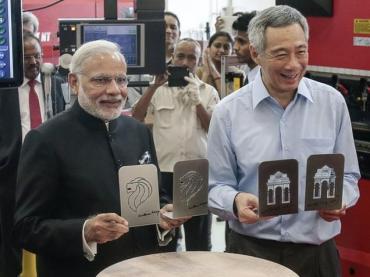
Prime Minister Narendra Modi and Singapore Prime Minister Lee Hsien Loong at the Institute of Technical Education College in Singapore on Tuesday.

Speaking at the India Singapore Economic Convention, Mr. Modi said India is exploring a potential partnership with Singapore’s Changi Airport for developments of two Indian airports and invited companies to join in building smart cities.

“In the last 18 months, the runways for the take-off of the economy have been made. Reforms are happening in a big way. They are now reaching to the last mile. Reform is to transform the system so that they perform. They aim at helping people realise their dreams. It means more charm on the faces and less forms in the offices. Efforts to deepen financial markets have been made,” he said.

‘Most open economy

The Prime Minister said his government began to liberalise FDI laws soon after coming to power last year and the latest round of FDI reforms have made India the “most open economy” in the world.

“We are also conscious of last mile operational issues in such matters and we are fine tuning the norms. Recently, we further eased FDI norms, after which India is the most open economy in terms of FDI,” he added.

While talking about 40 per cent increase in FDI and improvement in rankings like ease of doing business and world competitiveness index, Mr. Modi said, “Perceptions are turning into positive outcomes”.

“We are hopeful to roll out GST regime in 2016. The company law tribunal is being set up. FDI inflows have gone up by 40 per cent compared with previous year’s comparative period. Perceptions are turning into positive outcomes. FDI commitments are translating into reality,” he noted.

Modi also outlined 14 decisive steps taken to address regulatory and taxation concerns and said that India offers tremendous opportunities for investments, ranging from affordable housing to smart cities, railways to renewable energy.

Source: Modi woos investors in Singapore – The Hindu

24/11/2015

The elephants fight back | The Economist

FOR anybody who fears that China’s interest in elephants’ tusks could spell doom for the great beasts, there have been two pieces of good news.


On September 25th Xi Jinping, the Chinese president, joined Barack Obama in pledging “significant and timely steps” to halt commercial trade in ivory. Then on October 15th China announced a one-year ban on the import of ivory hunting trophies from Africa, closing a big loophole. Wildlife activists are delighted. These moves should have “a profound effect” on elephant numbers, says Peter Knights of WildAid, a charity.

The world’s elephant population has dived from 1.2m in 1980 to under 500,000 today. In 1989 the sale of ivory was banned worldwide. But in 1999 and again in 2008, the Convention on International Trade in Endangered Species (CITES), a conservation pact, allowed the sale of stockpiles of ivory from southern Africa to China. The countries vowed to use the proceeds for conservation; China claimed it had a robust registration system that would keep illegal ivory out. But conservationists rightly predicted the concession would fuel more smuggling and so more killing.

Permitted sales became a cover for illegal ones. In 2010-12 about 100,000 elephants were slain for their tusks. In the past five years, Mozambique and Tanzania have lost half their elephants to poaching.

This dire trend reflects China’s deeper engagement with Africa, combined with corruption and the presence of criminal gangs. But it seems that Chinese leaders have seen the trade’s effects on their reputation, says Dominic Dyer of the Born Free Foundation, a charity. They should now close the legal carving workshops and ban the domestic trade, too, he adds.

Despite strong demand for ivory among China’s rising middle class, attitudes may gradually be changing. As of 2012, nearly half of Chinese people saw elephant poaching as a problem, according to a survey by WildAid. The figure has been boosted by the support of celebrities. Yao Ming, a basketball player, and Jackie Chan, an actor, appear on posters everywhere with the message: “When the buying stops, the killing can too.” The government has donated $200m worth of media space every year since 2008.

Opinion on ivory has shifted fast, says Mr Knights, partly because of the success of another campaign, to protect sharks. In the markets of Guangzhou, the global centre for the trade, dried shark fins have fallen from 3,000 yuan ($470) per kilo five years ago to 1,000 yuan today, as Chinese people abjure shark-fin soup, a delicacy.

WildAid raised its voice over that issue, too, but more important was the Communist Party’s ban in 2013 of shark-fin soup at official banquets, part of a drive against corruption and excess. The Hong Kong government followed, as did airlines and hotels. A survey in 2013 found 85% of people said they had stopped eating shark-fin soup in the past three years.

One scourge is untouched by all this: the illegal trade in rhinoceros horn. More than 1,200 rhinos were killed for their horns in 2014 in South Africa alone, up from just 13 killed in 2007. This partly reflects a huge rise in demand in Vietnam, but China is also a consumer. Ground rhino horn is believed to cure fever and improve sexual performance. One kilo can cost up to $70,000.

Ominously, some African nations now want a one-off sale of rhino-horn stocks, as happened twice with ivory. To secure this, South Africa must win two-thirds of the member states at the next CITES conference, which it hosts next year. Mr Dyer hopes other countries, including China, will dissuade the Africans. “We are in exactly the same place we were with ivory nearly ten years ago,” he frets.

Source: The elephants fight back | The Economist

17/11/2015

The north star | The Economist

ASKED what they think of Lu Hao, their governor, residents of Harbin, capital of the north-eastern province of Heilongjiang, often reply with the word xiaozi. This roughly translates as “young whippersnapper”.

Mr Lu’s youthfulness is indeed striking. Born in 1967, he is the youngest of China’s current provincial governors. He was also the youngest to hold most of his previous positions. Those include factory boss at a large state-owned enterprise, deputy mayor of Beijing and leader of the Communist Youth League, an important training ground for many a national leader.

China’s system of political succession produces occasional surprises, such as the purge three years ago of another provincial leader, Bo Xilai, on the eve of what appeared to be his likely elevation to the pinnacle of power, the Politburo Standing Committee, alongside Xi Jinping, who is now president. But at least since the Communist Party began institutionalising succession arrangements in the 1990s, high-flyers have often been easy to spot. Mr Lu is one of them.

His stint at the youth league was of greatest portent. The organisation is something like an American fraternity club (without the misbehaviour)—its members form close ties which are often maintained in their later careers. Its leaders have a tendency to move into high national office. Hu Yaobang, a party chief in the 1980s, grew to prominence in the league, as did Hu Jintao, Mr Xi’s predecessor. Li Keqiang, the current prime minister, is also an ex-head of the league. Mr Lu’s stint in that role from 2008-13 made him an obvious rising star. His subsequent promotion to a provincial governorship confirmed this impression.

Youth is on his side. The next rung on the ladder to the top may be induction into the 25-member Politburo, possibly as early as 2017. But it will not be until around the time of the party’s 20th congress in 2022—a year after its 100th birthday—that Mr Xi will retire and Mr Lu will have a chance to shine, likely as one of the (now seven) members of the Standing Committee. He will then be 55, a year older than Mr Xi was when he joined the body in 2007. That would give Mr Lu a good few years at the top: Standing Committee members are expected to retire around 70. He would be a member of what party officials already call the “sixth generation” of Communist leaders (the first having been led by Mao Zedong, Mr Xi representing the fifth).

There are several other likely members of the upcoming generation. They include Hu Chunhua, Mr Lu’s predecessor as head of the youth league who is now the party boss of the southern province of Guangdong; and Sun Zhengcai, the party chief of Chongqing, a south-western region. One rising star has already fallen, however. Su Shulin was thought to have bright prospects until he was removed as governor of coastal Fujian province after being snared in a corruption investigation in October.

China’s media often drop hints of who to watch. Mr Lu’s appointment as Heilongjiang’s governor (a few months after he became the youngest full member of the party’s 370-strong Central Committee) was accompanied by a flurry of celebratory articles in the party’s main mouthpiece, the People’s Daily, and other newspapers. They emphasised Mr Lu’s youth, impeccable work ethic and solid record of excellent performance in his previous jobs.

Source: The north star | The Economist

04/11/2015

Prepare for Takeoff: China Rolls Out First Large Passenger Jet – China Real Time Report – WSJ

China’s first large passenger jet rolled off the assembly line on Monday after years of delays, bringing Beijing’s dream of developing a rival to Boeing Co. and Airbus Group SE closer to reality.

As WSJ’s Chun Han Wong reports: Still, the single-aisle C919 airliner won’t be delivered to airlines for at least another three years, highlighting the difficulties

China has faced in becoming a global player in aviation. Developed by the state-run Commercial Aircraft Corp. of China Ltd. (Comac), the twin-engine jet was initially set for its first flight in 2014, ahead of commercial deliveries starting in 2016. Production setbacks forced Comac to extend its deadlines repeatedly. Company executives say flight testing should start next year, with deliveries expected in 2018 or 2019 at the earliest.

Thousands of guests, including government officials and aerospace executives, witnessed the C919’s rollout at an assembly plant near Shanghai’s Pudong International Airport, according to Chinese state media.

Source: Prepare for Takeoff: China Rolls Out First Large Passenger Jet – China Real Time Report – WSJ

21/10/2015

Powering Down: Chinese Electricity Demand Stalls Amid Slowing Growth – China Real Time Report – WSJ

A slowing economy means keeping the lights on in China is getting a whole lot easier.

The China Electricity Council, a state-backed industry group, is trimming its estimate of just how much power the country needs, after weak third-quarter economic data on Monday reinforced fears about a slowdown of China’s economy. The official Xinhua News Agency on Tuesday quoted Ouyang Changyu, deputy secretary general of the China Electricity Council, as saying the group had revised down its full-year electricity-demand estimate to 1% growth this year, from 2% previously. As recently as 2011, electricity demand had grown by 12% annually.

The revised estimate reflects both a slowdown in China’s overall growth rate—which is struggling to hit the government’s target of about 7% this year—as well as important changes in the type of growth China is experiencing. The government wants to make the country less reliant on the energy-intensive sectors that propelled growth for four decades and instead shift toward cleaner and higher-paying industries and companies, ranging from financial services to web-based startups. In the first nine months of 2015, electricity demand has grown by .8%, down from 3.9% growth in the same period last year.

Electricity demand that is falling far faster than the government’s GDP data is among the reasons economists and investors are skeptical over the accuracy of official growth figures. The government said Monday GDP rose 6.9% in the first quarter. Chinese Premier Li Keqiang said in 2007 – back when he was a more junior official — that he relied on electricity data among other hard figures to get a truer picture of the country’s economic health.

Beyond electricity, other reasons for skepticism over the data include the decline of both imports and exports during the third quarter, weaker-than-expected industrial production and decelerating fixed-asset investment.

The ramifications of China’s slowing demand for electricity are global, and could contribute to weaker bottom lines at big companies such as coal and natural gas producers. Hong Kong-listed coal giant China Shenhua Energy Co. said its coal sales had plummeted by nearly one-fifth this year. The company is exporting far more coal this year than it’s importing — a sharp turnabout from 2014, when it imported four times as much coal as it exported.

The decline in electricity demand growth could also further weigh on natural gas—a cleaner alternative to coal in electricity production—which has suffered from stagnant demand this year.

Source: Powering Down: Chinese Electricity Demand Stalls Amid Slowing Growth – China Real Time Report – WSJ

23/09/2015

Command and lack of control | The Economist

IF THE People’s Liberation Army (PLA) were a company, it would be about to lose its position as the world’s largest corporate employer. When troop cuts recently announced by Xi Jinping, China’s president, are completed in 2017, the ranks of China’s armed forces will have shrunk by 300,000 to 2m, putting it just behind Walmart, a retailer (see chart). It would still be by far the world’s largest military outfit.

When the downsizing was announced, at a big military parade on September 3rd, the cuts seemed no more significant than a round of corporate redundancies. Mr Xi’s own explanation—that they would help the PLA to “carry out the noble mission of upholding world peace”—also seemed to come straight from the gobbledygook of corporate obfuscation.

But recent commentary in China’s state media suggests that the reductions may presage something more: a long-overdue reform of the command structure of the PLA and a shift in the balance of the main military services. If so, one of the most important subsidiaries of the Chinese state is in for a shake-up.

The army has long been the senior service. Almost three quarters of active-duty personnel are soldiers. The navy and air-force chiefs did not have seats on the main institution for exercising civilian control over the armed forces, the Central Military Commission, until 2004. It was only in 2012 that an officer outside the ranks of the army became its most senior military figure. The army’s dominance is a problem at a time when China is expanding its influence in the South China Sea and naval strategy is looming larger.

Moreover, there has long been a split within the PLA between combat forces (which kill the enemy) and other operations (logistics, transport and so on) which are regarded as secondary. But in modern, high-tech warfare, non front-line services such as those responsible for cyberwarfare and electronic surveillance often matter more than tanks and infantry.

Embodying these outdated traditions is a top-heavy, ill-co-ordinated structure with four headquarters and seven regional commands. Many Chinese analysts argue that, as now constituted, the PLA would not be able to conduct modern information-intensive military operations which integrate all the services properly.

China has long talked about military reform. In late 2013 Mr Xi told fellow leaders that the command system for joint operations was “not strong enough”. It was duly announced that China would “optimise the size and structure” of the armed forces. China Daily, an English-language newspaper, said that a “joint operational command system” would be introduced “in due course”.

It now appears that these changes are under way. Mr Xi was recently quoted in PLA Daily, a newspaper, saying that “we have a rare window … to deepen [military] reform”. It is possible that Mr Xi’s anti-corruption purge, which has taken aim at two men (one now dead) who were once the country’s most powerful military figures, as well as 50 other generals, may have weakened opposition enough for change to begin.

The South China Morning Post, a newspaper in Hong Kong, recently published what it described as a radical plan devised by military reformers. This would scrap three of the four headquarters, reduce the number of regional military commands to four and give a more prominent role to the navy. It remains to be seen whether Mr Xi will go that far. But there is no doubt that, in order to fulfil what he calls China’s “dream of a strong armed forces”, he wants a leaner, more efficient PLA. To China’s neighbours, that would make it even more frightening.

Source: Command and lack of control | The Economist

17/09/2015

Leaving Las Vegas: Chinese state railway companies to build US high-speed link from ‘Sin City’ to LA | South China Morning Post

Work on joint venture for 370km high-speed line linking Las Vegas to Los Angeles could start in 2016 and is part of mainland’s pursuit of overseas high-speed rail deals

A consortium of Chinese state rail companies has teamed up with an American company to build a high-speed rail line in the United States, with work possibly starting as early as September 2016.

It is the latest push by Beijing to export its high-speed rail technology and tap lucrative offshore markets.

China Railway International USA and the private rail venture, XpressWest, said in a joint statement on Thursday that they would form a joint venture to accelerate the launch of a high-speed rail linking the western cities of Las Vegas with Los Angeles.

The deal marks the latest attempt in China’s increasingly aggressive pursuit of overseas high-speed rail deals after the country built the world’s longest network in less than a decade.

Beijing recently clinched contracts in Russia, although it has faced hurdles in Mexico and Indonesia because of bureaucratic reversals of decisions in those countries.

XpressWest, a private venture of a Las Vegas-based hotel and casino developer, was given approval in 2011 to build and run the 370km high-speed line, according to its website.

The project has US$100 million in initial capital, the companies said in the statement, released at a government-organised forum before President Xi Jinping’s forthcoming visit to the US. China Railway International USA is owned by a consortium made up of subsidiaries from the mainland state companies China Railway Group, CRRC Corp, China State Construction Engineering Corp and China Railway Signal & Communication Corp.

Gary Wong, an analyst at Guotai Junan Securities, estimated that the XpressWest project was worth US$5 billion, which he said would likely offer the many Chinese companies involved little financial benefit.

However, it was significant as a deal because it would help open the undeveloped US high-speed rail market, Wong added.

“If this opens up the United States market for them, opportunities for future expansion will increase,” Wong said. “And if [their technology] is used in the United States, it will be easier for them to sell to other countries.”


13/07/2015

The Seven Signs of India’s Outsourcing Apocalypse – The Numbers – WSJ

After years of success, the outsourcing industry is under stress as the market shrinks and spending falls. Indian companies say their business models, built on cheap labor, are under threat from a shift to cloud computing, where clients ditch server rooms and bespoke software. Here’s how the outsourcing industry has shrunk in the past several years.

$120.4 billion

The value of outsourcing deals worldwide in 2014, down from $206.8 billion in 2010.

1,144

The number of outsourcing deals signed globally in 2014. The deals are down 61% from 1,805 deals in 2010, KPMG data shows.

$552 million

The average value of the world’s 100 largest outsourcing deals in 2012. Since then, the average size has fallen and was at $452 million in 2014, according to International Data Corp.

9

The number of outsourcing deals made in 2014 worth $1 billion or more, the lowest in more than a decade. Big outsourcing deals are rarer, and are being won by fewer companies – five of those deals were made by International Business Machines Corp., according to International Data Corp.

20%-30%

The amount Indian outsourcing contract values fall when they are renewed, according to Emkay Research. As the work gets scarcer, clients bargain harder on prices.

$21,307

The average annual salary of a software developer in India, according to job search website Naukrihub.com. That’s in contrast to the $93,350 average annual salary of a developer in the U.S., according to the Bureau of Labor Statistics. Outsourcing companies say that clients are demanding quicker results and fewer, more experienced staff, forcing Indian outsourcers to hire more in the U.S. and Europe. As a result, Nasscom estimates that only 200,000-220,000 outsourcing jobs will be added in India in 2015 compared with 273,000 new jobs in 2011.

More than 50%

Amount revenue growth at India’s outsourcing giants has fallen since 2008. Tata Consultancy Services said sales grew 15% for the financial year that ended in March, compared with the financial year ending March 2008 when sales grew 37%. Infosys said revenue rose 6% last financial year, down from 19% growth in 2008.

via The Seven Signs of India’s Outsourcing Apocalypse – The Numbers – WSJ.

21/05/2015

China’s nuclear power capacity to reach 30m kilowatts by year end|Society|chinadaily.com.cn

China will have 30 million kilowatts (KW) of nuclear power capacity by the end of 2015, said Xu Yuming, deputy director of the China Nuclear Energy Association on Thursday.


Embed from Getty Images

Currently there are 23 nuclear power units operating in China, with a combined capacity of 21.4 million kilowatts. Twenty-nine units are being built or planned, Xu said.

The government plans to increase China’s total nuclear power capacity to 58 million kilowatts by 2020, a rise of 170 percent over the current level.

Xu estimates that this will require 100 billion yuan ($16.34 billion) of investment every year.

It is expected that China’s electricity usage will double by 2030, Xu said, adding efforts should be made to promote clean energy including nuclear power.

Last month, China approved the construction of pilot nuclear power units using the Hualong One technology, a domestically-developed third generation reactor design drawing on the world’s leading design philosophy. The homegrown technology will help contribute to industrial upgrades and steady economic growth.

via China’s nuclear power capacity to reach 30m kilowatts by year end|Society|chinadaily.com.cn.

14/05/2015

India learns to ‘fail fast’ as tech start-up culture takes root | Reuters

After ping pong tables, motivational posters and casual dress codes, India’s tech start-ups are following Silicon Valley‘s lead and embracing the “fail fast” culture credited with fuelling creativity and success in the United States.

Taking failure as a norm is a major cultural shift in India, where high-achieving children are typically expected to take steady jobs at recognised firms. A failed venture hurts family status and even marriage prospects.

But that nascent acceptance, fuelled by returning engineers and billions of dollars in venture fund investment, is for many observers a sign that India’s $150 billion tech industry is coming of age, moving from a back office powerhouse to a creative force.

“There is obviously increased acceptance,” said Raghunandan G, co-founder of TaxiForSure, which was sold to rival Ola this year. He is now investing in others’ early stage ventures.

“My co-founder Aprameya (Radhakrishna) used to have lines of prospective brides to meet … the moment we started our own company, all those prospective alliances disappeared. No one wanted their daughters to marry a start-up guy.”

Srikanth Chunduri returned to India after studying at Duke University in the United States, and is now working on his second venture. “I think what’s encouraging is that acceptance of failure is increasing despite the very deep-rooted Asian culture where failure is a big no,” he said.

“IT’S OK TO FAIL”

via India learns to ‘fail fast’ as tech start-up culture takes root | Reuters.

Law of Unintended Consequences

continuously updated blog about China & India

ChiaHou's Book Reviews

continuously updated blog about China & India

What's wrong with the world; and its economy

continuously updated blog about China & India