Posts tagged ‘Beijing’

27/08/2012

* Car plate applicants exceed 1m in Beijing

China Daily: “A record 1-million-plus people in Beijing competed for fewer than 20,000 registration certificates qualifying them to buy cars through a lottery system on Sunday.

With a fixed number of car registrations issued each month and a lengthening waiting list, many potential car buyers are losing hope.

Some 1.05 million qualified applicants entered the registration lottery in August – 110,000 of them for the first time – and only 19,926 registrations will be issued, the city office in charge of the lottery system said on Saturday.

One in every 53 applicants will get the registrations, 80 percent fewer than in January last year, when Beijing introduced the lottery system to cap new car ownership at 240,000 a year.”

via Car plate applicants exceed 1m in Beijing |Society |chinadaily.com.cn.

25/08/2012

* 37 criminal suspects in Angola sent back to China

China Daily: “A total of 37 suspects involved in violent crimes targeting Chinese in Angola of west Africa were sent back to China under police escort Saturday.

They arrived in Beijing by air on Saturday morning.

The suspects, all of Chinese nationality, were allegedly involved in kidnapping, robbery, blackmail, human trafficking and forcing women into prostitution, said the statement from the Ministry of Public Security.

Chinese police sent a special team to Angola and, with the cooperation of local police, they cracked 12 criminal organizations and 48 criminal cases, rescuing 14 Chinese victims, the statement said.

The victims also returned to China on the same flight.

It was the first time Chinese police launched a large-scale action against crimes targeting Chinese in Africa, setting a new example of cooperation with African police, said Liu Ancheng, head of the criminal division under the ministry, at the airport.

Early this year, the ministry received a request from Chinese Embassy to Angola to help curb violent crimes targeting nationals in the African state since last year.

During the visit of Angolan Minister of Interior Sebastiao Jose Antonio Martins to China in April, Chinese Minister of Public Security Meng Jianzhu reached an agreement with him on sending police to help solve the problem.

According to investigations, a number of Chinese nationals were involved in serious crimes and handed out extreme brutality such as beating, burning victims after pouring gasoline on them and burying victims alive, to extract ransoms. Some were found taking young women to Angola and forcing them into prostitution.

In August, more than 400 Angolan police officers and Chinese police teams launched a joint raid against the gangs and arrested the suspects.

Also, local police arrested 24 accomplices in Fujian and Anhui provinces.

Police are confident and capable of improving law enforcement cooperation with foreign counterparts and protecting the safety of its citizens abroad, Liu said.”

via 37 criminal suspects in Angola sent back to China[1]|chinadaily.com.cn.

14/08/2012

* Surge in Tibetan self-immolations challenges Chinese rule-rights group

Reuters: “As many as five Tibetans set themselves ablaze in China in the past week to protest Chinese rule over Tibet, a U.S. broadcaster said, a surge highlighted by a rights group as a sustained campaign against Beijing’s grip on religious freedom.

Two self-immolations on Monday in the Aba prefecture, a mountainous and mainly ethnic Tibetan part of Sichuan province, were followed by at least one clash between police and ethnic Tibetans that left one protester dead, Radio Free Asia said.

Lungtok, a monk from the restive Kirti monastery in Aba, and Tashi, believed to be a layman, set themselves ablaze on Monday “to highlight their opposition to Chinese rule in Tibetan-populated areas”, Radio Free Asia reported, saying three other Tibetans have died in self-immolations in the past week in China.

Many Tibetans have called for Beijing to allow the return of the Dalai Lama, their self-exiled Buddhist leader. China has branded the self-immolators “terrorists” and criminals and has blamed the Dalai Lama, for inciting them.

Calls to the Aba prefecture office were not answered.

Phelim Kine, senior Asia researcher for New York-based Human Rights Watch, said the frequency of the Tibetan self-immolations is “a reflection of the ever-deepening frustration and despair” that many Tibetans feel about hopes for reform and protection for their culture, religion and language.

“We don’t see any inkling of such changes in the short to medium term, instead we see a hardening of position by the Chinese government,” he said. “This is an unfortunate trend that will continue till we head into the leadership transition.”

Chinese leaders typically clamp down on possible sources of unrest before a once in a decade congress, likely in October, to announce a new leadership team.”

via Surge in Tibetan self-immolations challenges Chinese rule-rights group | Reuters.

Tibet (and Xinjiang) continue to be sore point with China. Religious and ethnic self-determination doesn’t want to go away, despite the efforts by China to improve the social and economic conditions.

See also:

12/08/2012

* Beijing Reasserts Its Claims in South China Sea

NY Times: “China does not want to control all of the South China Sea, says Wu Shicun, the president of a government-sponsored research institute here devoted to that strategic waterway, whose seabed is believed to be rich in oil and natural gas. It wants only 80 percent.
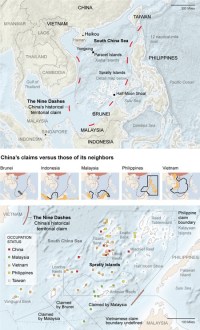
Mr. Wu is a silver-haired politician with a taste for European oil paintings and fine furniture. He is also an effective, aggressive advocate for Beijing’s longstanding claim over much of the South China Sea in an increasingly fractious dispute with several other countries in the region that is drawing the United States deeper into the conflict.

China recently established a larger army garrison and expanded the size of an ostensible legislature to govern a speck of land, known as Yongxing Island, more than 200 miles southeast of Hainan. The goal of that move, Mr. Wu said, is to allow Beijing to “exercise sovereignty over all land features inside the South China Sea,” including more than 40 islands “now occupied illegally” by Vietnam, the Philippines and Malaysia.

In the past several weeks, China has steadily increased its pressure, sending patrols with bigger ships and issuing persistent warnings in government-controlled newspapers for Washington to stop supporting its Asian friends against China.

The leadership in Beijing appears to have fastened on to the South China Sea as a way of showing its domestic audience that China is now a regional power, able to get its way in an area it has long considered rightfully its own. Some analysts view the stepped-up actions as a diversion from the coming once-a-decade leadership transition, letting the government show strength at a potentially vulnerable moment.

The Obama administration, alarmed at Beijing’s push, contends that the disputes should be settled by negotiation, and that as one of the most important trade corridors in the world, the South China Sea must enjoy freedom of navigation. The State Department, in an unusually strong statement issued this month intended to warn China that it should moderate its behavior, said that Washington believed the claims should be settled “without coercion, without intimidation, without threats and without the use of force.”

Washington was reacting to what it saw as a continuing campaign on the South China Sea after Beijing prevented the Association of Southeast Asian Nations, at its summit meeting in Cambodia in July, from releasing a communiqué outlining a common approach to the South China Sea.

The dispute keeps escalating. On July 31, the 85th anniversary of the founding of the People’s Liberation Army, the Chinese Defense Ministry heralded the occasion by announcing “a regular combat-readiness patrol system” for the waters in the sea under China’s jurisdiction.

The government then said it had launched its newest patrol vessel: a 5,400-ton ship. It was specifically designed to maintain “marine sovereignty,” said People’s Daily, the Communist Party’s leading newspaper.””

via Beijing Reasserts Its Claims in South China Sea – NYTimes.com.

09/08/2012

* China factory output growth at three-year low, spurs easing hopes

Reuters: “Annual growth in China’s factory output slowed to its weakest in more than three years in July, missing market forecasts and increasing expectations that Beijing will take further policy steps to support an economy that has been sliding for six straight quarters.

Official data released on Thursday also showed China’s annual consumer inflation fell to a 30-month low in July, suggesting that the central bank has ample scope to ease policy again after rate cuts in June and July to keep the economy on track to meet an official 2012 growth target of 7.5 percent.

China’s economy faces powerful headwinds as the euro zone debt crisis and a sluggish U.S. recovery keep global growth at a low ebb, the main factor that pushed China’s new export orders in July into their steepest fall in eight months.

“The government underestimated the pace of slowdown and there needs to be more aggressive stimulating policies,” said Alistair Thornton, an economist at IHS Global Insight in Beijing.

“The government has signaled that it’s taking a more aggressive line on stimulus measures … But it’s yet to feed into the real economy, which is why we are seeing such weak activities data for July.”

Hopes of further easing from China boosted riskier assets, with Asian shares rising to a three-month high and the commodity-sensitive Australian dollar testing a 4-1/2-month peak.

China’s industrial output growth slowed to 9.2 percent year-on-year in July, its weakest since May 2009, down from 9.5 percent in June and below the 9.8 percent forecast in a Reuters poll.

Annual growth in fixed-asset investment, in the likes of real estate, roads and bridges, came in at 20.4 in January-to-July, unchanged from the January-to-June period and just below the 20.5 percent forecast.

Growth of retail sales, the biggest driver of the economy’s expansion in the first quarter, eased to 13.1 percent, short of the forecast of 13.7 percent.”

via China factory output growth at three-year low, spurs easing hopes | Reuters.

09/08/2012

* China inflation rate dips to a 30-month low in July

BBC News: “China’s inflation dipped to a 30-month low in July, giving policymakers a bigger cushion to boost stimulus measures to spur economic growth.

Consumer prices rose by 1.8% in July, from a year earlier. That was down from a 2.2% growth rate in June and a 3% rise in May.

China has been looking to spur domestic consumption amid a slowing global demand for its exports.

China’s economy grew at its slowest pace in three years in second quarter.

The drop in prices of pork and meat and poultry products, which fell by 18.7% and 6.1% from a year earlier respectively, were the key drivers of the slowdown in the rate of inflation.

China’s economy grew at an annual rate of 7.6% in the April to June period, down from an 8.1% expansion in the previous three months.

There are fears that growth in the world’s second-largest economy may slow further in the coming months.

As a result, Beijing has taken various measures to spur growth.”

via BBC News – China inflation rate dips to a 30-month low in July.

07/08/2012

* In China’s Power Nexus, a Tale of Redemption

WSJ: “Liu Minghui’s battle to clear his name and save his business, a fight that pitted him against some of the most powerful forces in China, began the day of his company’s Christmas party in 2010.China Gas

Mr. Liu was set to leave his 18th-floor office in Shenzhen to cross the nearby border to Hong Kong for the party when plainclothes Public Security Bureau officers arrested him on suspicion of stealing money from the company he ran and co-founded, China Gas Holdings Ltd.

The former managing director spent nearly the next year in a Chinese jail, during which time he was forced to leave his executive and board roles at the company while remaining a substantial shareholder. He emerged from detention in time to see one of the country’s biggest companies launch a hostile offer for China Gas, the first by a state-owned business against a privately controlled company.

Now Mr. Liu’s comeback is nearly complete. He has been exonerated in the embezzlement case and is poised to win his fight with state-owned energy giant China Petroleum & Chemical Corp., or Sinopec, and its partner, ENN Energy Holdings Ltd. The bidding consortium on Monday extended the deadline for the US$2.15 billion offer until early September, saying the bid is still waiting regulatory approval. But with the stock trading at a 22% premium to the offer price of 3.50 Hong Kong dollars a share, the group seems unlikely to attract the shareholder support needed to take control.

The case highlights the harsh nature of business in China, where the legal system is opaque and the fate of companies can be decided in Beijing. It remains unclear why Mr. Liu was arrested and then cleared, why Sinopec bid for his company and why a surprising group of white knights came to Mr. Liu’s rescue.”

via In China’s Power Nexus, a Tale of Redemption; Sinpec, China Gas, Liu Menghui – WSJ.com.

In the same issue of WSJ.com, this article shows the positive (though still opaque) side of Chinese criminal justice and another the opposite: https://chindia-alert.org/2012/08/07/chinese-criminal-procedure-at-its-worst/

03/08/2012

* 20 Sentenced in Terrorism Case

NY Times: “China has sentenced 20 people to up to 15 years in prison for advocating violence and separatism in the western region of Xinjiang, where the central government has clamped down on dissent and restricted religious practices. The state-run newspaper Xinjiang Daily said Thursday that courts in the region had found that the 20 had organized and participated in terrorist groups. The courts said four of them made illegal explosives, the newspaper reported.

The report did not cite any violence linked to the defendants. It named only five people, all with Uighur names. Xinjiang is home to a large population of minority Uighurs but is ruled by members of China’s Han ethnic majority. Violence between the groups in recent years has left nearly 200 people dead. Dilxat Raxit, a spokesman for the exiled World Uyghur Congress, said that the accused used the Internet to obtain government-controlled information and to express political views. He said the terrorist charges and verdicts were politically motivated.”

via China – 20 Sentenced in Terrorism Case – NYTimes.com.

See also: 

29/07/2012

* China Court Dismisses Ni Yulan’s Fraud Conviction

NY Times: “A Chinese appeals court on Friday threw out a fraud conviction against a human rights activist who has fought on behalf of people evicted from their homes, but it upheld a separate conviction against her for causing a disturbance, her lawyers said.

A lower court had ruled that the activist, Ni Yulan, and her husband, Dong Jiqin, acted in an unruly way when they failed to pay for their stay at a hotel — where they had been detained by the police — and mistreated staff members. It also ruled that Ms. Ni had received money through deceit.

One of her lawyers, Cheng Hai, said the higher court, the Beijing First Intermediate Court, had rescinded the fraud conviction and reduced Ms. Ni’s prison sentence by two months to two years and six months after the person who gave Ms. Ni the money told the court it was a donation.

“We consider it a success,” said Dong Qianyong, another lawyer for Ms. Ni.

Public disturbance convictions against the couple remain, and Dong Jiqin’s two-year sentence handed down by the lower court stands, Mr. Cheng said.

Mr. Cheng said he planned to appeal again for Ms. Ni’s release.”

via China Court Dismisses Ni Yulan’s Fraud Conviction – NYTimes.com.

Yet another indication that China is softening its approach towards dissidents.

See also: https://chindia-alert.org/2012/05/20/china-dissident-chen-guangcheng-arrives-in-the-us/

24/07/2012

* Second child is a growing option

China Daily: “Increasing number of eligible parents want another baby.

Beijing mother Han Xue had a second child last year, 10 years after her first. But despite eligibility the process was far from easy and entailed a bureaucratic paper chase.

Han, 31, felt that two children would keep each other company and provide better support to her and her husband in old age.

“As soon as my first child turned 4, we filed an application for a permit to have a second child to the government office that oversees the street where I was born,” Han said.

Han and her husband were both single children and allowed, under the family planning policies introduced in the 1970s, to have a second child.

An increasing number of parents in this category are opting to do so.

Nanjing offers a prime example. Applications filed in the capital of Jiangsu province surged to 600 last year from 85 in 2007, family planning authorities said.

Meanwhile, the number of urban couples eligible to have two children has also increased as the single-child generation comes of marriageable age.

About 10,000 couples are eligible in Nanjing annually, and authorities estimate that by 2015 up to 17 percent of couples in the city will be entitled to have two children.

Already, about 15 percent of women in Nanjing who booked maternity beds for the second half of 2012 were expecting their second baby.

Since 1985, couples in the province are allowed a second child if both parents were single children.

In the province of Jiangxi, the story is much the same.”

via Second child is a growing option |Society |chinadaily.com.cn.

See also: Single-child policy has some negative effects

Law of Unintended Consequences

continuously updated blog about China & India

ChiaHou's Book Reviews

continuously updated blog about China & India

What's wrong with the world; and its economy

continuously updated blog about China & India