Posts tagged ‘Beijing’

19/07/2012

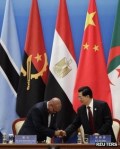
* China pledges $20bn in credit for Africa at summit

BBC News: “China has pledged $20bn (£12.8bn) in credit for Africa over the next three years, in a push for closer ties and increased trade.

President Hu Jintao made the announcement at a summit in Beijing with leaders from 50 African nations. He said the loans would support infrastructure, agriculture and the development of small businesses.

The Chinese leader also called for better co-operation with African countries on international affairs.

As developing nations, China and countries in Africa should work better together in response to “the big bullying the small, the strong domineering over the weak and the rich oppressing the poor” in international affairs, said Mr Hu.

The loan is double the amount China pledged in a previous three-year period in 2009, since which time China has been Africa’s largest trading partner.

Trade between the two hit a record high of $166bn (£106bn) in 2011, Chinese Commerce Minister Chen Deming wrote in the China Daily newspaper, ahead of the two-day forum.

“We want to continue to enhance our traditional friendship… rule out external interference and enhance mutual understanding and trust,” said Mr Hu.”

via BBC News – China pledges $20bn in credit for Africa at summit.

18/07/2012

* As China Talks of Change, Fear Rises on Risks

NY Times: “A heavyweight crowd gathered last October for a banquet in Beijing’s tallest skyscraper. The son of Mao Zedong’s immediate successor was there, as was the daughter of the country’s No. 2 military official for nearly three decades, along with the half sister of China’s president-in-waiting, and many more.

“All you had to do,” said one attendee, Zhang Lifan, “was look at the number of luxury cars and the low numbers on the plates.”

Most surprising, though, was the reason for the meeting. A small coterie of children of China’s founding elites who favor deeper political and economic change had come to debate the need for a new direction under the next generation of Communist Party leaders, who are set to take power in a once-a-decade changeover set to begin this year. Many had met the previous August, and would meet again in February.

The private gatherings are a telling indicator of how even some in the elite are worried about the course the Communist Party is charting for China’s future. And to advocates of political change, they offer hope that influential party members support the idea that tomorrow’s China should give citizens more power to choose their leaders and seek redress for grievances, two longtime complaints about the current system.

But the problem is that even as the tiny band of political reformers is attracting more influential adherents, it is splintered into factions that cannot agree on what “reform” would be, much less how to achieve it. The fundamental shifts that are crucial to their demands — a legal system beyond Communist Party control as well as elections with real rules and real choices among candidates — are seen even among the most radical as distant dreams, at best part of a second phase of reform.

In addition, the political winds are not blowing in their favor. The spectacular fall this spring of Bo Xilai, the Politburo member who openly espoused a populist philosophy at odds with elite leaders, offered an object lesson in the dangers of challenging the status quo. And official silence surrounding his case underscores high-level fears that any public cracks in the leadership’s facade of unity could lead its power to crumble.

As a result, few people here expect the party to willingly refashion itself anytime soon. And even those within the elite prepared to discuss deeper changes, including the second-generation “princelings,” as they are known, have a stake in protecting their own privileges.

“Compare now to 1989; in ’89, the reformers had the upper hand,” said Mr. Zhang, a historian formerly associated with the government’s Chinese Academy of Social Sciences, referring to the pro-democracy student protests that enjoyed the support of a number of important party leaders but were crushed in Tiananmen Square. “Twenty years later, the reformers have grown weaker. Now there are so many vested interests that they’ll be taken out if they touch anyone else’s interests.”

To Mr. Zhang and others, this is the conundrum of China’s rise: the autocracy that back-flipped on Marxist ideology to forge the world’s second-largest economy seems incapable of embracing political changes that actually could prolong its own survival.

Much as many Americans bemoan a gridlocked government split by a yawning partisan gap, Chinese advocates for change lament an all-powerful Communist Party they say is gridlocked by intersecting self-interests. None of the dominant players — a wealthy and commanding elite; rich and influential state industries; a vast, entrenched bureaucracy — stand to gain by ceding power to the broader public.

Many who identify with the reform camp see change as inevitable anyway, but only, they say, because social upheaval will force it. In that view, discontent with growing inequality, corruption, pollution and other societal ills will inevitably lead to a more democratic society — or a sharp turn toward totalitarianism.

An overriding worry is that unless change is carefully planned and executed, China risks another Cultural Revolution-style upheaval that could set it back decades.”

via As China Talks of Change, Fear Rises on Risks – NYTimes.com.

See also: https://chindia-alert.org/prognosis/chinese-challenges/

17/07/2012

* Chinese Businesses Get Advice on U.S. Investment

WSJ: “Looking to ease the way for Chinese investment in the U.S., the U.S. Chamber of Commerce is advising Chinese businesses not to count on “personal relationships” with government officials as a key to success.

The advice came in a report prepared by the U.S. Chamber for an investment forum Tuesday in Beijing. The event, co-hosted by the China Center for International Economic Exchanges, a Chinese government think tank, was expected to draw about 400 business executives and government officials, current and past.

A subsidiary of Aviation Industry Group of China last year bought Cirrus Industries, a Minnesota maker of propeller aircraft.

The U.S. Chamber said it was acting on its own initiative, though the U.S. government, seeking to lift economic growth, also has been trying to encourage Chinese investment. Chinese business leaders regularly say they are interested in investing in the U.S. but fear political opposition.

“We’re trying to showcase Chinese investment in the U.S.,” said Myron Brilliant, a senior vice president at the U.S. Chamber. “In a lot of areas there aren’t a lot of hurdles to investment.”

The 38-page report is based on interviews with Chinese business officials who have invested in the U.S. Some of its suggestions are obvious: “win-win cooperation can create great opportunities,” said advice attributed to Cirrus Industries Inc., a Duluth, Minn., propeller-aircraft maker purchased last year by a subsidiary of Aviation Industry Group of China.

But other advice reflects important differences between how business is done in the U.S. and in China. “Unlike in China, personal relations with officials play a very small part in the enforcement of laws and regulation,” said the report’s introduction.

Another tidbit for would-be Chinese investors: “The U.S. media [are] completely independent of the government, so even if some local officials welcome your investment, others might voice opposition in the media. Do not be discouraged by this.”

Chinese direct investment in the U.S. last year totaled $4.5 billion, according to New York market research firm Rhodium Group, a tiny portion of the foreign-direct investment in the U.S. The Commerce Department, which uses a different methodology from Rhodium, said FDI in the U.S. reached $227 billion in 2011.

via Chinese Businesses Get Advice on U.S. Investment – WSJ.com.

13/07/2012

* SE Asia meeting in disarray over sea dispute with China

Reuters: “Southeast Asian nations have failed to reach agreement on a maritime dispute involving China, ending a foreign ministers’ summit in disarray after Beijing appeared to split the 10 countries over the contentious issue.

The Philippines said in a statement on Friday that it “deplores” the failure of the Association of Southeast Asian Nations (ASEAN) summit to address the worsening row, and criticized Cambodia in unusually strong language for its handling of the issue.

China has been accused of using its heavy influence over summit chair Cambodia and several other ASEAN members to block regional-level discussions on the issue and attempts to agree a binding maritime Code of Conduct.

The Philippines said it took “strong exception” to Cambodia’s statement that the non-issuance of a communiqué was due to “bilateral conflict between some ASEAN member states and a neighboring country”.

It said it had only requested that the communiqué mention the recent standoff between Chinese and Philippine ships at the Scarborough Shoal, a horseshoe-shaped reef in waters that both countries claim.

“The Chair has consistently opposed any mention of the Scarborough Shoal at all in the Joint Communiqué and today announced that a Joint Communiqué ‘cannot be issued’,” the Philippine statement said.

The failure to issue a joint statement marks a sharp deterioration in efforts to cool tensions following recent incidents of naval brinkmanship over the oil-rich waters.

China, whose trade and investment ties with Cambodia have surged in recent years, has warned that “external forces” should not get involved in the dispute. Vietnam, Malaysia, Brunei and Taiwan also lay claim to parts of the South China Sea.”

via SE Asia meeting in disarray over sea dispute with China | Reuters.

Despite good intentions, territorial imperatives overcame desire for resolution.

See also: China’s external tensions

11/07/2012

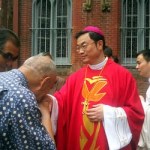
* Ordination of Bishops Increases Tensions Between China and Vatican

NY Times: “In a sign of rising tensions between the Vatican and China, authorities in recent days have ordained one Catholic bishop without Rome’s consent and detained another after he made a dramatic break with the country’s Communist-run religious hierarchy.

On Friday, government officials organized the consecration of the Rev. Joseph Yue Fusheng as bishop in the northern city of Harbin. Bishop Yue’s nomination had not been approved by the Vatican, and reports said bishops loyal to the Vatican were forced to participate — a common practice meant to give Beijing-appointed bishops legitimacy in the eyes of local believers. The Vatican immediately excommunicated him.

Then, on Saturday in Shanghai, the most important city for China’s Catholics, the Rev. Thaddeus Ma Daqin, a man widely seen as acceptable to both Beijing and Rome, was consecrated as auxiliary bishop, which would put him in line to succeed Bishop Aloysius Jin Luxian, 95, who had been approved by both Beijing and Rome.

But Bishop Ma stunned hundreds of worshipers in the city’s Cathedral of St. Ignatius by announcing that he would no longer work for the Chinese Patriotic Catholic Association, the government-run body that oversees Catholics in China.

“In the light of the teaching of our mother church, as I now serve as a bishop, I should focus on pastoral work and evangelization,” Bishop Ma told the crowded church. “Therefore, from this day of consecration, it will no longer be convenient for me to be a member of the patriotic association.”

The announcement, captured on video and posted on foreign and Chinese Web sites, was met with sustained applause from the congregation.

Bishop Ma’s fate is unclear. Catholic Church members in Shanghai said he did not lead Mass on Sunday as scheduled. They say he was taken away after the service and is being held at the Sheshan Catholic seminary, on the outskirts of Shanghai.”

via Ordination of Bishops Increases Tensions Between China and Vatican – NYTimes.com.

In terms of reform and liberalisation and so forth, China often takes two steps forward and one step back. This series of confrontations with the Vatican can be seen by many to be one of its backward steps.

See also: Chinese Christians

10/07/2012

* Chinese Firm Pursues Hawker

WSJ: “A Chinese bidder is in advanced talks to buy the bulk of aerospace company Hawker Beechcraft Inc.’s businesses for $1.79 billion, an approach that could raise political concerns given U.S. sensitivities about previous Chinese attempts to buy American assets.

Superior Aviation Beijing Co. will have an exclusive right for 45 days to negotiate to buy Hawker’s corporate jet and propeller plane operations, the U.S. company said. If a deal is reached, Superior would serve as the opening bidder in a bankruptcy auction in which other suitors could try to top its offer.

Hawker Beechcraft filed for bankruptcy protection in May. Above, an employee shown last year working on a jet at its Wichita, Kan., plant.

Superior, which has ownership ties to Beijing’s municipal government, won’t be bidding on Hawker’s defense unit because of potential U.S. national-security concerns about foreign purchases of such assets.

Hawker’s defense business houses military technology and sells military training and light attack aircraft to U.S. and foreign governments. The business, called Hawker Beechcraft Defense Co., will continue to operate and could later be sold separately. If sold, Hawker said, the company would refund as much as $400 million of Superior’s $1.79 billion purchase price.

A winning bid by Superior would further the ambitions of China’s aerospace industry to move deeper into jet production, as well as give Superior itself a bigger role in the industry. Makers of small aircraft have been looking to China recently as a key source of demand as the market for business jets shrinks.”

via Chinese Firm Pursues Hawker – WSJ.com.

This is in line with our analysis of Chinese acquisitions: https://chindia-alert.org/2012/02/13/pattern-of-chinese-overseas-investments/

18/06/2012

* China publishes books on officials’ morality

Xinhua: “A book series expounding the moral issues of officials, the first-ever publication on the topic in China, was released for sale Monday in Beijing as part of government-backed efforts to promote integrity among civil servants.

The four-book series embodies the results of research conducted by experts with the Beijing Academy of Social Sciences at the request of Beijing authorities two years ago, according to a report published by the Beijing Daily.

The books record the development of theories about officials’ morality through Chinese history and provide case studies, as well as highlight the importance of raising officials’ moral standards in modern society, an official with the Beijing Commission for Discipline Inspection of the Communist Party of China (CPC) was quoted as saying in the report.

The major difference between good and bad officials simply lies in whether they perform duties with a conscience, says the prologue of the series.

Nowadays, the CPC, as the ruling party, must value virtues of officials and it is a general trend for officials to abide by professional ethics, according to a passage in one of the books.

The book also points out a moral official in modern China should always serve the people as well as be loyal, pragmatic, fair-minded and incorruptible, while always improving oneself.

The series will serve as anti-graft reading material for all Communist Party cadres in Beijing, according to the report.”

via China publishes books on officials’ morality – Xinhua | English.news.cn.

Let’s hope the cadres take this book as seriously as their forebears took Mao’s Red Book.
15/06/2012

* Arrested spy compromised China’s U.S. espionage network

Reuters: “A Chinese state-security official arrested this year on allegations of spying for Washington is suspected to have compromised some of China’s U.S. agents in a major setback that angered President Hu Jintao, sources said.

Hu personally intervened this year, ordering an investigation into the case after the Ministry of State Security arrested one of its own officials for passing information to the Americans, two sources with direct knowledge of the matter said.

The official, an aide to a vice minister, was taken into custody sometime between January and March after the ministry became alarmed last year over repeated incidents of Chinese agents being compromised in the United States, they said.

Seal of the C.I.A. - Central Intelligence Agen...

Seal of the C.I.A. of the United States Gov’t (Photo credit: Wikipedia)

The ministry’s own investigations found the aide had been working for the Central Intelligence Agency (CIA) for years, divulging information about China’s overseas spy network in the nation’s worst espionage scandal for two decades, they added.

The sources’ comments represent the first confirmation that overseas Chinese espionage was deemed to have been damaged by the security breach, which has been kept quiet by both Beijing and Washington. Reuters first reported it on June 1.”

via Exclusive: Arrested spy compromised China’s U.S. espionage network: sources | Reuters.

10/06/2012

* Chinese Economy Shows a Second Month of Anemic Growth

NY Times: “The Chinese economy, widely seen until the last few weeks as the strongest remaining locomotive that could drag the global economy back from the brink of recession, showed a second month of anemic growth in May and performed even worse than the already lowered expectations of most economists.

Growth in industrial production, retail sales and investment in fixed assets like factories and office buildings was little changed from April, according to data released on Saturday afternoon in Beijing by China’s National Bureau of Statistics. Some economists had considered the April figures to be a fluke and had predicted a rebound in May, when the Chinese government began measures to rekindle growth.

April had been the weakest month in China since 2001 for growth in fixed-asset investment, and May was slightly weaker still. Before adjustment for inflation, retail sales grew even more slowly in May than in April. But retail sales were a little stronger in May after they were adjusted for inflation, which has slowed steadily this spring. Industrial production grew at a slightly faster pace in May from a year earlier, 9.6 percent, than it had in April, when growth was 9.3 percent.

And in an unexpected piece of good news released Sunday morning, China’s exports and imports both grew twice as fast last month as economists had expected. Exports rose 15.3 percent, triple the pace in April, and imports grew 12.7 percent after stalling the month before. Some economists said that if demand for China’s exports held up long enough for the Chinese government to start the many infrastructure projects approved in recent weeks, the country’s economy could avoid a more serious downturn.”

via Chinese Economy Shows a Second Month of Anemic Growth – NYTimes.com.

This overall view of the economy contrasts with the huge increase in passenger car sales.  See: https://chindia-alert.org/2012/06/10/china-passenger-car-sales-pick-up/

30/05/2012

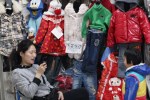
* Tainted children’s clothes scandal in China

A finding of cancer-causing chemicals on children’s clothes sparked public fear yesterday, after a report aired on national state broadcaster China Central Television(CCTV).

The station’s Weekly Quality Report investigative programme carried the report, claiming that a recent Beijing Consumer Association test of 63 samples of children’s clothes sold on the mainland revealed that nearly a third failed to meet quality and safety standards.

The association said that problems included excessive levels of formaldehyde and other carcinogenic chemicals.

The investigation began after consumers started complaining that their children had developed skin rashes after wearing the clothes.

From China Daily Mail blogTainted children’s clothes scandal in China.

Law of Unintended Consequences

continuously updated blog about China & India

ChiaHou's Book Reviews

continuously updated blog about China & India

What's wrong with the world; and its economy

continuously updated blog about China & India