Posts tagged ‘Bernie Sanders’

10/11/2016

Chinese Flag-Maker Flooded With Orders in Wake of Trump Win – China Real Time Report – WSJ

While China’s leaders weigh what to make of Donald Trump’s impending presidency, one manufacturer in the scenic city of Shaoxing has been enthusiastically carrying Mr. Trump’s banner.

Or, more accurately, he’s been printing, folding and shipping it.Yao Dandan is the owner of Shaoxing Jiahao Banner and Handicrafts Co. Ltd. Since election results suggesting a Trump victory began pouring in Wednesday morning, he says, he’s fielded a barrage of orders for Trump-themed flags.

The total number ordered as of Thursday morning: more than 40,000.

“I knew there would be demand for Trump flags after the election, so I made extra. But it’s not enough, so now I have to make more,” Mr. Yao said.The 30-year-old said that he’s been in the flag-making business for a decade and that Shaoxing’s factories specialize in making election banners. His factory has taken orders for close to half a million Trump banners in the past two months, he said.

Mr. Trump has taken heat for vowing tough restrictions on Chinese imports while over the years turning to China to source goods ranging from ties to steel, but there’s no evidence the next U.S. president purchased banners from Shaoxing. Mr. Yao said most of the orders he’s received came from Chinese clients living in the U.S.

Flags bound for the U.S. have to be higher quality than most, he said. He charges 2.5 yuan ($0.37) a piece for the smallest Trump banners, which his clients typically sell in the U.S. for between $1 or $2 (they sell for 5 yuan on e-commerce site Alibaba). The factory has produced every U.S. state flag, and earlier this year got multiple orders for Confederate flags.

What about orders for Hillary Clinton banners? Mr. Yao, who counts himself a Trump supporter, said he’s been asked but now refuses to make them because he believes Mrs. Clinton is unfair to China.

The news of Trump’s win was “a pleasant surprise,” he said. “It means I didn’t strive these past couple of months in vain.”

Asked about Mr. Trump’s vow to impose a 45% across-the-board tariff on Chinese goods, Mr. Yao confessed he wasn’t aware of that part of the property mogul’s platform but said he thought China’s government would make sure it wasn’t implemented.

The flag-maker said he’d never been to the U.S. but planned to remedy that soon.

“When things slow down, I’m going to go to the U.S. and have a look. At the very least I also contributed a little!” he said.

Source: Chinese Flag-Maker Flooded With Orders in Wake of Trump Win – China Real Time Report – WSJ

18/03/2016

How Modi’s Social Media Skills Earned Him a Spot on Time’s Internet Influencers List – India Real Time – WSJ

Since Narendra Modi took office nearly two years ago, his social media might has helped cultivate his international profile as an Indian prime minister who receives rockstar welcomes at concert venues and sports arenas overseas, shares smiling selfies with other heads of state and boasts among the biggest banks of Twitter followers of world political leaders.

This week, he burnished that image by winning a spot for a second consecutive year on Time magazine’s list of the 30 most influential people on the Internet.

The roundup of online luminaries describes Mr. Modi as an “Internet star,” noting that the prime minister, unlike other world leaders, uses social media to break news and conduct diplomacy. With 18.7 million followers, Mr. Modi ranks second only to President Barack Obama among political leaders.

The magazine’s picks of Internet A-listers also includes U.S. presidential hopeful Donald Trump, who has nearly 7 million Twitter followers, artist Kanye West and the author of the Harry Potter series, J.K. Rowling.

Mr. Modi used Twitter to announce Mr. Obama’s visit to India last year as the guest of honor at India’s Republic Day parade, and signaled a breakthrough in tense relations with neighboring Pakistan by tweeting that India’s foreign secretary would travel to that country. He tweets in several languages, shouting out to other world leaders on their birthdays and congratulating them on election victories.

The digital-savvy leader and his Bharatiya Janata Party’s social media team runs a full-time, data-driven operation. It coins hashtags and uses what one member called “online volunteers”–a digital army to retweet and comment on posts relating to the prime minister and his policies–to keep him trending.

They also use specialized software to study social media behavior and track the ebbs and flows of online sentiment to Mr. Modi’s speeches and actions, funneling their analysis to help craft his message–and to tweak it when traffic turns unfavorable.

Mr. Modi appears to have become a regular on Time’s rankings. Last year, he was on its “100 Most Influential People” list where Mr. Obama called him India’s “reformer-in-chief.”

Source: How Modi’s Social Media Skills Earned Him a Spot on Time’s Internet Influencers List – India Real Time – WSJ

21/12/2015

Panda power | The Economist

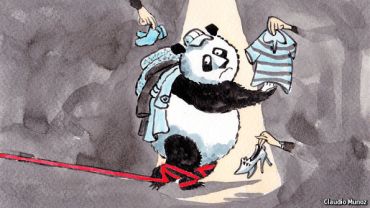
THE feeding frenzy for the pandas comes at nightfall. People furtively approach them, pouring bags of old clothes down their gullets.

By day, the trucks arrive to clean the bears out, leaving them empty for the next big meal. The pandas are plastic. They are large, bear-shaped receptacles, designed to entice people to donate their unwanted garments to those in need.

First deployed in 2012, there are now hundreds around Shanghai, often placed by entrances to apartment buildings. They swallowed about a million items of clothing last year. The procession of donors feeding trousers to pandas is impressive. But they usually do so under cover of darkness. Charitable giving is not yet a middle-class habit. Many people still feel awkward about it, despite their growing prosperity. China’s GDP per person is about one-seventh of America’s.

But in 2014 Chinese gave 104 billion yuan ($16 billion) to charity, about one-hundredth of what Americans donated per person (see chart). This is partly a legacy of attitudes formed during Mao’s rule, when the party liked to present itself as the source of all succour for the poor (to suggest otherwise was deemed counter-revolutionary). Even until more recent years the party was reluctant to encourage charities, worried that they might show up its failings.

The middle classes have worries too—that giving large amounts to charity may draw unwanted attention to their wealth. They do not want to fuel the envy of the have-nots or encourage tax collectors to pay them closer attention.

The top 100 philanthropists in China gave $3.2 billion last year, according to Hurun Report, a wealth-research firm based in Shanghai. That was less than the amount given by the top three in America.

In 2008 when a powerful earthquake hit the south-western province of Sichuan—the deadliest in China in more than 30 years—it seemed that one positive outcome would be a boom in charitable giving. Volunteers poured into the devastated region and donations filled the coffers of aid organisations. Problems soon arose, however. Embarrassed that private relief efforts were proving more effective than official ones, the government reined in citizen-led organisations.

Source: Panda power | The Economist

19/12/2014

China to construct 7 mln affordable homes in 2015 – Xinhua | English.news.cn

China will begin construction of seven million apartments under the affordable housing program in 2015, the Ministry of Housing and Urban-Rural Development (MOHURD) announced on Friday.

MOHURD minister Chen Zhenggao revealed the target at a national conference on housing and urban-rural development. He said 4.8 million such homes should be completed next year.

The affordable housing program is aimed at providing cheap homes for eligible low-income earners. China began the construction of over seven million homes and completed 4.8 million in 2014.

Chen said China will also continue to push forward the shanty town renovation program extensively as “it can not only improve people’s livelihood but also spur economic growth“.

via China to construct 7 mln affordable homes in 2015 – Xinhua | English.news.cn.

Law of Unintended Consequences

continuously updated blog about China & India

ChiaHou's Book Reviews

continuously updated blog about China & India

What's wrong with the world; and its economy

continuously updated blog about China & India