Posts tagged ‘Chiang Kai-shek’

01/01/2016

‘The Miraculous History of China’s Two Palace Museums’ – China Real Time Report – WSJ

In late 1948 and early 1949, toward the end of the Chinese civil war, Nationalist leader Chiang Kai-shek transported across the Taiwan Strait hundreds of thousands of valuable Chinese artifacts which are now stored in Taipei’s National Palace Museum. Along with its Palace Museum counterpart in Beijing – more famous as the Forbidden City – the museums serve as one of the most poignant reminders of the division of China.
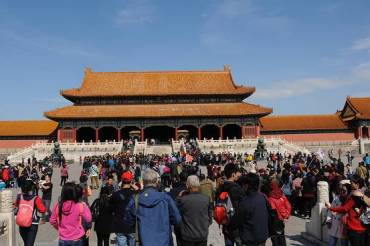
Beijing’s Palace Museum, which celebrated its 90th anniversary in October, was established shortly after the last Chinese emperor, Pu Yi, was forced from his palace, where he had been allowed to stay even after the Chinese republic was founded in 1911.

Intellectuals at the time wanted to set up a Chinese museum along the lines of the great museums in Europe.

Today, millions visit both museums each year, crowding around artifacts such as the Jadeite Cabbage and the Meat-Shaped Stone in Taipei.

Among the visitors are huge tour groups of mainland Chinese tourists, as the Taipei government continues to liberalize travel policies for its neighbor amid a broader detente.

This week, a branch of the National Palace Museum housing exhibits from around Asia was inaugurated in the southern Taiwanese city of Chiayi.

In his book “The Miraculous History of China’s Two Palace Museums,” Hong Kong-based writer Mark O’Neill details the treacherous history of how some of China’s most precious artifacts were rescued from the invading Japanese imperial army in the 1930s and later transported to Taiwan, and the powerful symbolism of the museums.

Source: Writing China: Mark O’Neill, ‘The Miraculous History of China’s Two Palace Museums’ – China Real Time Report – WSJ

07/04/2014

Housing Cools in China; Developers Face Loans They Can’t Repay – Businessweek

Amid a cluster of half-built brick townhouses surrounded by peach groves on the outskirts of Fenghua city, workers could be seen taking down metal scaffolding and hauling away steel plates last month. They had heard that Zhejiang Xingrun Real Estate, the company building the housing development called Peach Blossom Palace, was insolvent. “The developer owed us hundreds of thousands of yuan” for scaffolding and steel, said workers Xie and Wang, who would only give their surnames. “We are taking these materials back for now because there’s no work here.”

Unfinished houses at Zhejiang Xingrun’s development in Fenghua

The collapse of Zhejiang Xingrun may signal the start of a shakeout among the nation’s almost 90,000 real estate companies. After China began allowing private homeownership in 1998, homebuilders binged on easy credit from banks and other lenders. Now many developers are struggling with debt as thousands of apartment buildings across the country sit empty and the government makes it harder to borrow. CBRE Global Investors says there are about 30,000 developers after small construction companies and those formed for only one project are eliminated. “That is far too many, even for a country as large as China,” says Richard van den Berg, country manager for China at CBRE. “Consolidation needs to take place.”

Home prices in China have climbed 60 percent since 2008, when the government began a 4 trillion yuan ($645 billion) stimulus program to counter the effects of the global financial crisis. Former Premier Wen Jiabao began trying to cool the property market in 2010, imposing higher down-payment requirements, raising interest rates on loans for second-home purchases, and increasing construction of low-cost housing. Li Keqiang, who succeeded Wen in March 2013, further tightened credit in June, in part by cracking down on nonbank lenders.

About 67 percent of housing under construction in China last year was in less affluent cities such as Fenghua, according to Nomura Holdings (NMR). About 120 miles south of Shanghai, with a population of 500,000, Fenghua is best known as the birthplace of former Chinese nationalist leader Chiang Kai-shek. The city is filled with pawn shops, textile and garment factories, and empty residential buildings.

via Housing Cools in China; Developers Face Loans They Can’t Repay – Businessweek.

Enhanced by Zemanta
02/01/2014

Taiwan’s Ma says ending China standoff a must for the economy | Reuters

Ending Taiwan\’s political standoff with mainland China is necessary to boost Taiwan\’s sagging economy and to help it integrate more effectively with the region, the island\’s president, Ma Ying-jeou, said.

Taiwan's President Ma Ying-jeou speaks during a meeting with journalists in a hotel in Asuncion August 14, 2013. REUTERS/Jorge Adorno

China considers Taiwan a renegade province and has not ruled out the use of force to bring the island under its control. Economic ties, however, have grown considerably in recent years, especially since Ma took office in 2008.

In October, Chinese President Xi Jinping said a political solution to the standoff could not be postponed forever. But Ma later said he saw no urgency for political talks and wanted to focus on trade.

\”I fully understand that if the Taiwan economy is to expand further, we need to end the cross-strait standoff,\” Ma was quoted as saying in a statement posted on the Presidential Office\’s website.

The statement did not explain what concrete steps would be taken to end an impasse that has existed since Chiang Kai-shek and his ruling Nationalist Party fled from the mainland to Taiwan at the end of China\’s civil war in 1949.

Ma opened Taiwan to trade with China when he took office in 2008 and they have since signed economic agreements that have made mainland China Taiwan\’s largest trading partner.

But booming trade has not led to progress on political reconciliation or a lessening of military readiness on both sides.

via Taiwan’s Ma says ending China standoff a must for the economy | Reuters.

Law of Unintended Consequences

continuously updated blog about China & India

ChiaHou's Book Reviews

continuously updated blog about China & India

What's wrong with the world; and its economy

continuously updated blog about China & India