Posts tagged ‘China’

05/03/2016

The Limits of Growth: Economic Headwinds Inform China’s Latest Military Budget – China Real Time Report – WSJ

With an official defense budget increase of 7.6% to 954 billion yuan ($147 billion) announced today, Beijing’s quest to restore China’s historic “greatness” and to attain international status as a military power commensurate with its economic standing continues.

Yet with GDP growth slowing and social and demographic headwinds mounting, Chinese leaders face increasingly difficult tradeoffs concerning how to allocate government largesse.

With Beijing’s 2016 official defense budget, it is clear that even military spending is not immune to China’s economic and fiscal realities. Advance reports that this year’s official budget would entail an increase of as much as 20% proved significantly off-the-mark. So, what’s in a number? Nothing short of this: Beijing’s latest defense spending figure provides further evidence that it is determined to avoid succumbing to Soviet-style military overextension – yet it remains committed to enhancing capabilities to further its priorities, especially vis-à-vis contested island and maritime claims in the East and South China Seas.

Make no mistake: drawing on the world’s second-largest (and growing) economy, the People’s Liberation Army (PLA) is increasingly well-endowed and capable of asserting China’s regional interests. Even as GDP growth continues to slow, President Xi Jinping appears determined to order, and fund, ambitious military modernization and PLA reforms. The PLA is now far-and-away the world’s second best-resourced military and, unlike the globally-distributed and -deployed U.S. military, is focused overwhelmingly on its immediate neighborhood.

Source: The Limits of Growth: Economic Headwinds Inform China’s Latest Military Budget – China Real Time Report – WSJ


05/03/2016

China Sets Economic Growth Target of 6.5% to 7% for 2016 – China Real Time Report – WSJ

China has set an economic growth target of between 6.5% and 7% for 2016 and an average of at least 6.5% over the next five years, goals that acknowledge slowing momentum in the world’s second-largest economy but which still could be difficult to reach.

As WSJ’s Mark Magnier reports:

By adopting a range for the first time in two decades, China has given itself more flexibility in a system where hitting goals set far in advance, regardless of conditions on the ground, remains politically important.

The targets released here on Saturday at the opening of the National People’s Congress, China’s annual parliament, weren’t a surprise given that senior officials from President Xi Jinping on down had flagged them in recent months.

But they underscore that the government continues to prioritize stability, as output in the world’s second-largest economy downshifts faster than expected.

Last year, China’s economy grew 6.9%, its slowest pace in 25 years, compared with the 2015 target of about 7%. This year could bring a new quarter-century low, as traditional growth engines continue to lose traction.

Source: China Sets Economic Growth Target of 6.5% to 7% for 2016 – China Real Time Report – WSJ

02/03/2016

Today’s ‘Kings Without Crowns?’ — The Growing Powers of Xi’s Party Disciplinarians – China Real Time Report – WSJ

After hunting corrupt cadres over the past three years, the Communist Party’s much-feared graftbusters are switching gears to political policing.

In the process, they have emerged with an authority perhaps unparalleled since ancient China.

With President Xi Jinping’s blessing, the already-powerful Central Commission for Discipline Inspection is stationing inspectors in all central party and government departments, extending its reach into the top echelons of China’s bureaucracy.

In addition to targeting graft and waste, the CCDI has also become a kind of thought police for officials, academics and propagandists. Its inspectors are increasingly denouncing those deemed disloyalty to the party leadership.

The agency’s expanded scope reminded the Procuratorial Daily (in Chinese), a newspaper run by China’s top prosecutorial agency, of how Ming Dynasty rulers in the 14th century fortified a body of imperial censors who hunted errant officials in the name of the emperor.

Embedded in the Ming court’s six ministries, the censors could make direct representations to the emperor, despite their relatively junior rank, and assist the monarch in administrative tasks.

“But their most important power was to inspect the six ministries and impeach ministers,” the newspaper said. “It was this special status that made them ‘kings without crowns’ in the Ming Dynasty court.”

Recent developments, legal experts say, suggest that Mr. Xi is transforming the agency from a party watchdog into an arm of government.

“In effect, Xi Jinping is creating a parallel bureaucracy that can go around existing party and government institutions, to make things happen,” said Carl Minzner, a law professor at Fordham University who studies the Chinese legal system.

Disciplinary inspectors have also found a role in imposing party ideology beyond the traditional corridors of power.

Source: Today’s ‘Kings Without Crowns?’ — The Growing Powers of Xi’s Party Disciplinarians – China Real Time Report – WSJ

29/02/2016

China expects to lay off 1.8 million workers in coal, steel sectors | Reuters

China said on Monday it expects to lay off 1.8 million workers in the coal and steel industries, or about 15 percent of the workforce, as part of efforts to reduce industrial overcapacity, but no timeframe was given.

It was the first time China has given figures that underline the magnitude of its task in dealing with slowing growth and bloated state enterprises.

Yin Weimin, the minister for human resources and social security, told a news conference that 1.3 million workers in the coal sector could lose jobs, plus 500,000 from the steel sector. China’s coal and steel sectors employ about 12 million workers, according to data published by the National Bureau of Statistics.

“This involves the resettlement of a total of 1.8 million workers. This task will be very difficult, but we are still very confident,” Yin said.

For China’s stability-obsessed government, keeping a lid on unemployment and any possible unrest that may follow has been a top priority.

The central government will allocate 100 billion yuan ($15.27 billion) over two years to relocate workers laid off as a result of China’s efforts to curb overcapacity, officials said last week.

Source: China expects to lay off 1.8 million workers in coal, steel sectors | Reuters

24/02/2016

China cuts more red-tape – Xinhua | English.news.cn

I wish the UK government would follow this excellent lead.

“The State Council, China’s cabinet, has decided to abolish another 13 items of administrative approval to reduce intervention in the economy.

The items released on Tuesday involve finance and business qualification reviews.

The decision will help vitalize the economy and strengthen growth, the State Council said.

Facing a complicated global landscape and pressure from an economic slowdown at home, the central government has made transforming government functions a top priority.

State Council agencies have canceled or delegated administrative approval powers on 599 items since March 2013, meeting the target to cut the number of items requiring approval by one-third within the term of this government ahead of schedule.”

Source: China cuts more red-tape – Xinhua | English.news.cn

24/02/2016

China Inc.’s Nuclear-Power Push – China Real Time Report – WSJ

China wants to shift from customer to competitor in the global nuclear industry as it seeks to roll out its first advanced reactor for export, a move that adds new competition for already struggling global firms.

As WSJ’s Brian Spegele reports:

  • Two state-owned firms teamed up to design the advanced indigenous Hualong One reactor with plans to sell overseas. On Tuesday, one of them, China General Nuclear Power Group, hosted dozens of business executives from Kenya, Russia, Indonesia and elsewhere, as well as diplomats and journalists, at its Daya Bay nuclear-power station to promote the Hualong One for export.
  • Asked how much of the global market share for new nuclear reactors CGN wants Hualong One to win, Zheng Dongshan, CGN’s deputy general manager in charge of international business, said: “The more the better.”
  • The move marks a turnaround for China and the nuclear-power industry. For three decades, China served as a big market for nuclear giants including U.S.-based, Japanese-owned Westinghouse Electric Co. and France’s Areva SA. More than 30 reactors have been built across China since the 1990s with reliance on foreign design and technology.

Source: China Inc.’s Nuclear-Power Push – China Real Time Report – WSJ

23/02/2016

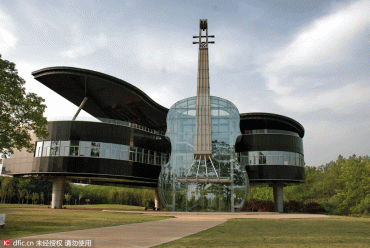
‘Weird’ new buildings banned in Chinese cities| Society

Cities will not be allowed to build more “oversized, xenocentric, weird” buildings devoid of cultural tradition in the future, according to a new directive from the central government.

The State Council, or the cabinet, and the Communist Party of China Central Committee issued the directive on Sunday. It says buildings should be “suitable, economic, green and pleasing to the eye.”

Cities have built some unusually shaped buildings to create memorable skylines in recent years, but many have drawn criticism. Here is one of sixteen very weird buildings in China!'Weird' new buildings banned in Chinese cities

See the other fifteen at:

Source: ‘Weird’ new buildings banned in Chinese cities[12]| Society

21/02/2016

Xi takes nuclear option in bid to rule for life | The Sunday Times

Very worrying, if true.

CHINA is moving towards one-man rule as the state media step up demands for personal loyalty to President Xi Jinping, a departure from the Communist party’s collective leadership of recent decades.

Xi Jinping appears to be building a personality cult around him as Mao did

Last week the party’s flagship newspaper issued a call for Xi to have the power to “remake the political landscape of China”. The article, supposedly written by one of a literary group, was put out on a social media account run by the People’s Daily. It said all communists must be loyal to Xi and “line up with the leadership”.

The campaign to enshrine Xi as the infallible “core” of authority is worrying many inside the political elite and coincides with China exerting its military muscle and possibly preparing to change its nuclear weapons strategy.

The People’s Liberation Army (PLA) has just stationed surface-to-air missiles on a disputed island in the South China Sea. The Chinese expansion comes as Barack Obama rallies Asian nations to support free navigation in the strategic waterway. The prospect of one man dominating the party, the state and the army in China could be the most challenging test in the next American president’s in-tray.

Xi’s grand plans include a total reorganisation of the Chinese military command structure that has included an internal debate about its nuclear weapons. Xi recently formed a dedicated PLA rocket force to control the nuclear ballistic missile arsenal. A report for the Union of Concerned Scientists, a US-based group, says China may be considering placing its nuclear forces on alert, which means that, like America and Britain, its weapons would be ready to fire on command.

That would be a shift of position for a nation that affirms it will not be the first to use nuclear weapons in any conflict. China has already started an ambitious programme to upgrade its older missiles with multiple warheads like those of other nuclear powers.

Rising military budgets show that despite the slower Chinese economy and big flows of capital out of the country, Xi is seizing any initiative to turn nationalism to his advantage. A source who grew up in the party’s privileged residential compounds in Beijing said the moves harked back to an earlier era: “There is a fear among the families, the long-time party members for generations, that this guy wants to make himself into another Chairman Mao and rule for life.”

It is clear that, like Mao, Xi, 62, is using articles and essays in the state media, often penned by pseudonymous authors or published in the provinces, to intimidate his enemies and promote himself.

Last week a social media platform controlled by the Beijing Daily, the voice of the capital’s municipal committee, launched a striking attack on a party faction opposed to Xi, the Communist Youth League. Officials connected to the league were “ambitious aristocrats whose self-serving attitude did no good to the party and led to scandals”, it sneered.

Targeting the league — whose members include the prime minister, Li Keqiang, and the former president, Hu Jintao — is a signal that Xi has broken with the consensus set after the unrest of 1989 that the party’s factions do not attack one another in public. In the past, a league connection meant a fast-track to promotion for young high-flyers. Now it seems to be a liability.

A study by the Central Commission for Discipline Inspection — the party watchdog unleashed by Xi against rivals accused of corruption — has criticised the “mentality” of league members. The commission’s propaganda publication, the China Discipline Inspection Paper, warned against “those who form their own circles inside the party” and referred to fallen officials as “gangs”.

This Mao-era language singled out the “petroleum gang” under the purged security chief, Zhou Yongkang, whose cronies dominated the Chinese oil industry, and the “secretary gang” around Ling Jihua, a close aide to Hu and a former league stalwart. Ling is already under arrest on corruption and bribery charges.

Defining people as members of “gangs” or “cliques” is a classic tactic of communist infighting and a prelude to destroying them.

Chilled by the signals from the top, half the provincial party chiefs in the country this month pledged allegiance to Xi as “the core”.

The term represents a significant change from the language used about Xi’s predecessors, Hu and Jiang Zemin, who were referred to as being only “at the core” of a collective leadership. The last strongman in China, Deng Xiaoping, exercised his power behind the scenes and scorned a cult of personality.”

Source: Xi takes nuclear option in bid to rule for life | The Sunday Times

18/02/2016

Apple Pay takes on China’s internet kings in mobile payments | Reuters

Apple Inc launched its mobile payment system in China on Thursday in a bid to convince the hundreds of millions of users of the country’s entrenched, dominant services to switch.

Photo

“We think China could be our largest Apple Pay market,” Jennifer Bailey, vice president of Apple Pay, told Reuters in an interview in Beijing.

In an early boost, China’s biggest lender, Industrial and Commercial Bank of China Ltd (ICBC), was among the banks that said earlier this week that customers would be able to use Apple Pay from Thursday.

However, Apple Pay has not had an easy ride so far in China, the fifth country to get the service. Even in its U.S. home market, Apple has faced skeptical retailers in its effort to develop a new revenue stream.

China is not likely to prove any easier to crack.

“People switch applications for significantly better experiences, it (Apple) has to deliver not just a little bit more secure, or a little bit easier to use,” said Mark Natkin, founder of Marbridge Consulting.

Greater China is Apple’s second-largest market by revenue, and the world’s biggest smartphone market. By the end of 2015, 358 million people, more than the U.S. population, had already taken to buying goods and services by mobile phone, according to the China Internet Network Information Center.

The vast majority are using payment services from China’s two biggest Internet companies that have existed for years.

Social networking and gaming firm Tencent Holdings Ltd operates WeChat Payment, and e-commerce company Alibaba Group Holding Ltd, through its Internet finance affiliate Ant Financial Services Group, runs Alipay.

“With 100 percent saturation of local payment systems, no one in China is clamoring for Apple Pay,” said one retailer who declined to be named for fear of harming business prospects. “Today, everyone has a local payment option on their phone, so Apple Pay is a solution in need of a problem.”

Source: Apple Pay takes on China’s internet kings in mobile payments | Reuters

16/02/2016

First train from China to Iran stimulates Silk Road revival – Xinhua | English.news.cn

First cargo train from China to Iran arrived in Tehran on Monday, indicating a milestone in reviving the “Silk Road,” which has opened a new chapter of win-win cooperation between China and Iran.

English: the Silk Road in Central Asia

English: the Silk Road in Central Asia (Photo credit: Wikipedia)

silk road

The train, also referred to as Silk Road train, has passed through Kazakhstan and Turkmenistan to Iran, travelling a distance of 10,399 kilometers. It had left Yiwu city in east China’s Zhejiang Province on January 28.

This train was carrying dozens of cargo containers, according to the deputy of Iran’s Road and Urbanism Minister, Mohsen Pour-Aqaei, who made a welcome speech after the arrival of the cargo train at Tehran Train Station on Monday.

As known to all, ancient Silk Road trade route had served as an important bridge for East-West trade and brought a close link between the Chinese and Persian civilizations.

The “Belt and Road” initiative was raised by Chinese President Xi Jinping in 2013, which refers to the New Silk Road Economic Belt, linking China with Europe through Central and Western Asia, and the 21st Century Maritime Silk Road, connecting China with Southeast Asian countries, Africa and Europe.

“To revive the Silk Road Economic Belt, the launch of the train is an important move, since about 700 kilometers of trip has been done per day,” said Pour-Aqaei, who was present at the welcome ceremony of the train in Tehran’s Railway Station.

“Compared to the sea voyage of the cargo ships from China’s Shanghai city to Iran’s Bandar Abbas port city, the travel time of the train was 30 days shorter,” he said.

Pour-Aqaei, also the Managing Director of Iran’s Railway Company, added that according to the plan, there would be one such a trip from China to Iran every month.

The travel of cargo train from China to Iran is part of a Chinese initiative to revive the ancient Silk Road used by the traders to commute between Europe and East Asia.

Tehran will not be the final destination of these kinds of trains from China, the Iranian deputy minister said, adding that in the future, the train will reach Europe.

This will benefit Iran as the transit course for the cargo trains from the east Asia to Europe, he said.

Chinese ambassador to Iran Pang Sen told Xinhua that as one of the cooperation projects after Chinese President Xi Jinping’s state visit to Iran, the cargo train is playing a important role to promote construction of the “Belt and Road” initiative.

Meanwhile, the railway line from Yiwu to Tehran provides the two countries an express and efficient cargo trade transportation method, Pang said, adding that the countries along the railway line will furthur upgrade rail technology with the aim to make its transportation ability faster and better.

Source: First train from China to Iran stimulates Silk Road revival – Xinhua | English.news.cn

Law of Unintended Consequences

continuously updated blog about China & India

ChiaHou's Book Reviews

continuously updated blog about China & India

What's wrong with the world; and its economy

continuously updated blog about China & India