Posts tagged ‘China’

08/03/2012

* China highlights human rights in criminal procedure law revision

Extracted from Xinhua: “China’s legislature has underlined the principle of “respecting and safeguarding human rights” by explicitly writing it into a draft amendment to the nation’s Criminal Procedure Law.

The draft was submitted Thursday to the ongoing 5th session of the 11th National People’s Congress (NPC) for third reading. …

Since China is in a transition period with prominent incidence of conflicts, the number of criminal cases remains large and severe violent crimes are on increase, Wang Zhaoguo, vice chairman of the Standing Committee of the National People’s Congress (NPC), said. …

China’s criminal justice system should be improved step by step based on the country’s reality, he said, summarizing, “Improvements should be made to keep up with the times without surpassing the present realities or blindly copying any foreign judicial and litigation systems.”

PREVENTING TORTURE OF SUSPECTS

… The draft amendment, for the first time, has made clear that confessions extorted through illegal means, such as torture, and witness testimony and depositions of victims obtained illegally, such as by violence or threats, should be excluded during the trials.

To institutionally prevent extortion of confession by torture, the draft has regulated that suspects be sent to a detention facility for custody after being detained or arrested and be interrogated there. The process of interrogation shall be audio or video-taped. …

“The revisions on ruling out illegal evidence and strictly regulating the procedure of collecting evidence will effectively curb torturing practices,” he went on.

REVIEWING DEATH PENALTY

The draft amendment also specifies the procedures for the Supreme People’s Court to review death penalty cases in order that such cases will be handled “with sufficient care” and “legal oversight” will be strengthened. According to the draft, the supreme court shall issue an order approving or disapproving a death sentence after reviewing it. If the supreme court overrules the death sentence, it may remand the case for retrial or revise the judgement thereof. …

“The proposed revisions will improve the procedure and guarantee the legal oversight necessary before taking somebody’s life,” he said.

LAWYERED UP

A proposed revision allowing the criminal suspect to engage a lawyer as his defense counsel when the police first interrogate him has been widely welcomed by lawyers. Under the current law, a suspect can only have a defense counsel when the case is handed over to prosecutors. Lawyers can only provide legal help for suspects under police investigation. …

DEFINING HOUSE SURVEILLANCE

The draft amendment defines the measure of house surveillance and stipulates the conditions for its application. …

NOTIFYING FAMILY

The draft amendment also strictly limits exceptions to the provisions of notifying family members of the suspect after a coercive measure is adopted.

The current law, while providing that a person’s family be notified within 24 hours of their detention or arrest, also gives two exceptions — one is under the circumstance where the notification may obstruct investigation, and the other is if his or her family can not be reached.

Under the proposed revision, for a person under arrest, the first exception is deleted since “obstruct investigation” is ambiguous.

In cases of detention, the draft amendment regulates that, only when he is involved in crimes of endangering national security and terrorism, the police may not inform his family for fear of hindering investigation.

It also stipulates that, for people under house surveillance in a designated place, their families should be informed within 24 hours after the coercive measure is taken, unless they can not be reached.”

http://news.xinhuanet.com/english/china/2012-03/08/c_131453966.htm

Although some Western human rights campaigners are bound to assert: “not far enough”, the very fact that this issue is being taken into account in the new criminal procedure law revision must be a step in the right direction. In many ways, the Communist Party is demonstrating that it is maturing and slowly but surely getting less fraught about subversion. It is realising that most of the protests are about tangible problems often caused by over zealous or, worse, corrupt local officials and not about challenging the power or authority of the Party.

06/03/2012

* China, India hold border talks, pledge to safeguard peace

Extracted from Xinhua: “China and India concluded a border meeting in Beijing on Tuesday with a joint pledge to safeguard peace and tranquility along their border, according to a Chinese Foreign Ministry statement released Tuesday.

This was the first meeting on the bilateral working mechanism for consultation and coordination over border affairs, which was launched in January this year. …

Both sides agreed to further enhance communication, trust and cooperation in accordance with the consensus reached by the two countries’ leaders, and to give full play to the role of the working mechanism, said the statement. They agreed to hold the next meeting for the working mechanism in India. …

China and India share a 2,000-km-long border that has never been formally delineated. The two countries began to discuss border issues in the 1980s. To maintain peace and stability in their border areas, the two sides signed two agreements in 1993 and 1996, respectively. In 2005, the two countries signed a political guideline on border demarcation during Chinese Premier Wen Jiabao‘s visit to India.”

via China, India hold border talks, pledge to safeguard peace – Xinhua | English.news.cn.

The Indo-Chinese border was unilaterally set under British Raj by Surveyor MacMohan. Although agreed by the Tibetan authorities, it was not ratified by the Manchu or later Chinese government. It was the intransigence of India when other neighbours like Pakistan, Burma, Nepal were willing to re-negotiate, that caused China to invade India in the autumn of 1962 with tanks rolling over the Himalayas. Since then the border has still not been formally agreed.

China’s borders with Russia and Vietnam were settled after some military incidents.

These latest talks hold hope that India is finally seeing that the way forward is to negotiate and not stand on unilateral definitions set by the British.

06/03/2012

* China’s debt-to-GDP ratio hits 43%

China Daily: “China‘s government debt amounts to about 17.5 trillion yuan ($2.78 trillion), about 43 percent of the country’s gross domestic product, Yang Kaisheng, president of the Industrial and Commercial Bank of China, said Tuesday.

The debt is composed of 10.7 trillion yuan ($1.7 trillion) of local government debt and 6.8 trillion yuan ($1.07 trillion) of central government debt, Yang said at a press conference on the sidelines of China’s annual parliamentary session.”.

via China’s debt-to-GDP ratio hits 43%|Economy|chinadaily.com.cn.

This is shocking news as a year ago (2010) the ratio was only 17.5%! Of course, earlier we blogged about the parlous state of local government debt rising astronomically. This is the result.  ;-(

See: http://www.economicshelp.org/blog/774/economics/list-of-national-debt-by-country/

Some of us are so riveted by China’s trade surplus of some $3 trillion, that we forget about its debt ratio. In other words, China is behaving only slightly more frugally than many Western nations. The only difference *and it is an important one) uis that the trade surplus does (just about) cover the debt.  😉

05/03/2012

* China lowers growth target to 7.5%

(Reuters) – Chinese Premier Wen Jiabao cut his nation’s 2012 growth target to an eight-year low of 7.5 percent and made boosting consumer demand the year’s first priority as Beijing looks to wean the economy off its reliance on external demand and foreign capital. …

“We aim to promote steady and robust economic development, keep prices stable, and guard against financial risks by keeping the total money and credit supply at an appropriate level, and taking a cautious and flexible approach,” Wen said in his annual work report to the National People’s Congress (NPC), China’s annual parliamentary session. …

His annual state-of-the-nation report to parliament dwelled on the institutional and income barriers the government must break to build a more balanced economy that relies less on exports and shares more wealth with hundreds of millions of poor farmers and migrant workers who are reluctant to spend. …

Shifting that balance is a key goal for Wen and Hu, both 69, as they near the end of a decade in power which has seen China become the world’s second-largest economy after the United States, contributing more to global growth than any other nation, while seeing a chasm widen between rich and poor. The number of Chinese billionaires nearly doubled in 2011 to 146 from 2010, Forbes said.

Stability, steady growth and spreading wealth are core justifications for more than 60 years of one-party rule by the Communist Party, which will install a new cohort of leaders by the end of 2012. …

The last year in power for Wen and Hu has shuddered with anxieties about inflation, a feverish property market, local government debt, stubborn inequality and social strains from protesting villages to ethnic tensions in western regions. …

Critics, including prominent policy-advisers, have said the Chinese government can foster healthy long-term growth only by taking on bolder reforms to rein in state-owned conglomerates and other entrenched interests — reforms that ultimately spill into sensitive issues of curbing the party’s own powers.

Wen has stood out among China’s leaders as the most persistent advocate of measured political relaxation, and has cast himself as a passionate advocate for farmers struggling with economic insecurity and land lost to developers.

“We should care more deeply for rural migrant workers and provide more services to them,” he said. “We will place farmland under strict protection.”

http://www.reuters.com/article/2012/03/05/us-china-economy-idUSTRE82400120120305?feedType=RSS&feedName=topNews&utm_source=feedburner&utm_medium=feed&utm_campaign=Feed%3A+reuters%2FtopNews+%28News+%2F+US+%2F+Top+News%29&utm_content=Google+Feedfetcher

05/03/2012

* China hints at new development approach to Tibet

The Hindu: News / International: “Ahead of the third anniversary of the March 14 riots in Tibet, a top official from the region said the government would pay more attention to preserving Tibetan culture to address rising concerns about imbalanced growth.

“If there is no culture, there will be no development,” Na Ceng, a Tibetan adviser to the Chinese People’s Political Consultative Conference (CPPCC), China’s top political advisory body, said in an interview with The Hindu.

“Culture is like the eye of a person. It plays a crucial role,” said Ceng, who in 1943 was recognised as a Tibetan “living Buddha.”

Ceng is among a group of delegates who has pushed forward a proposal for China’s first ever law on the preservation of intangible cultural heritage, during the ongoing annual session of the National People’s Congress (NPC), the country’s top legislative body.

The law, passed by the NPC this week, mandates that regional governments should do more to preserve minority cultures, including oral literature and cultural practices.

Ceng acknowledged that Tibet was facing a huge challenge “in transferring Tibetan Buddhism to the next generation.” “The cultural preservation law can play an important role.” …

Asked about recent protests over a move to expand the introduction of Mandarin Chinese as “a common language” in Tibetan universities, he said it would be ensured that “only Tibetan language” was spoken and taught in religious institutions. In October, hundreds of Tibetan students in the western Qinghai province and in Beijing protested the policy, which has subsequently been suspended.

Ceng, however, said “bilingual education” in schools and colleges, for Tibetan students to learn Mandarin, was a necessity, if Tibet was not to be left behind other regions.

via The Hindu : News / International : China hints at new development approach to Tibet.

China is keenly aware that it needs to resolve the Tibetan issue before it escalates with an increasing number of self-immolations, not only amongst monks but with lay citizens too.

05/03/2012

* Wukan village elects own committee – hint of Jasmin Spring?

Xinhua: “Thousands of people in south China’s village of Wukan went to polls Saturday to elect a new village committee, several months after staging massive protests over illegal land sales and other issues. The villagers cast their ballots at a voting center set up on a village school campus from 9 a.m. through 3 p.m. Saturday. The results are due late Saturday night. Twenty-two candidates delivered public speeches on Wednesday to woo votes. The village committee includes at most seven members, including a chief and two deputy chiefs. A 50-percent turnout is required to validate the election results, and winning candidates are required to take at least half of the votes. An additional election would be held Sunday if fewer than three people obtain the required number of votes. Saturday’s voting marked the last phase of a three-phase election that has resulted in the selection of an 11-member election committee and 109 village representatives thus far. Voters are required to show identification and obtain written authorization before they can cast their votes. The voter turnout was 81.4 percent Saturday, sustaining the high levels seen during the last two elections and indicating the villagers’ enthusiasm for more open and transparent direct elections. (Xinhua/Liang Xu)”

http://news.xinhuanet.com/english/photo/2012-03/03/c_131444377.htm

Last year, Wukan defied authorities and there was a major stand-off with security forces surrounding the village as it protested against illegal land grabs by the local authority and the mysterious death of a protester in custody. Surprisingly, instead of a violent end, the authorities backed off.

This year it held it elections as usual, but with one major difference. It could choose who to vote for and not only those pre-selected by the Party. This may seem like a small thing. But, perhaps it could also be the opening of Pandora’s box and local elections may never be the same again in China. And, who knows, maybe there will be free elections for district and county level in due course. And, one day, free elections at national level. BUT, if you are a pro-democracy person, I do not recommend you holding your breath for such a day soon.

04/03/2012

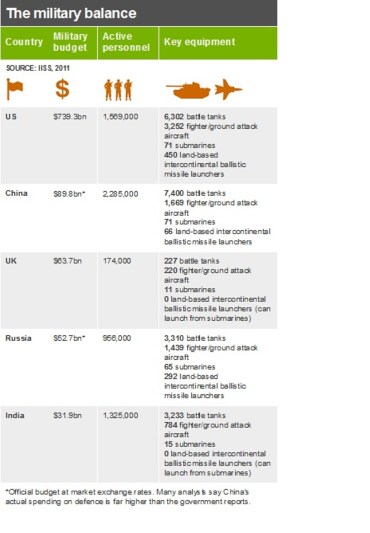
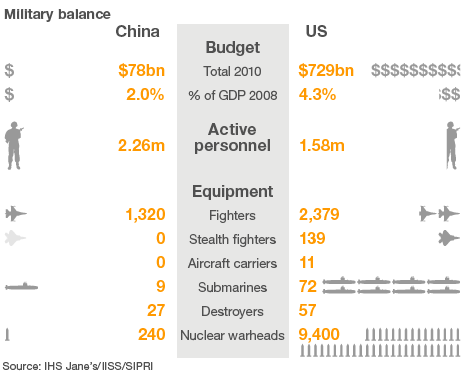
* Chinese defence budget exceeds $100bn (against US budget of over $700bn)


Extract from Xinhua: “China said Sunday it plans to raise its defense budget by 11.2 % to 670 billion yuan (106.4 billion U.S. dollars) in 2012. …

China’s military spending mainly comprises the living expenditures of service people, expenses for training and maintenance, and spending on equipment, he said. The costs for research, experiment, procurement, repair, transport and storage of all weapons and equipment, including new types of weapons, are included in the defense budget that is published every year, the spokesman said.

… Compared to other major countries, China’s military spending is low given its population of 1.3 billion, vast land area and long coastlines, Li said. While China’s military spending amounted to 1.28 % of its GDP in 2011, that of the United States, Britain and other countries all exceed 2 %, said Li. …

By June last year, China had sent a total of 2,044 peace-keeping personnel to 12 peace-keeping zones around the world, and the Chinese navy has sent escort vessels to the Gulf of Aden and waters off the coast of Somalia to protect thousands of commercial vessels from China and other countries, according to Li.”

http://news.xinhuanet.com/english/china/2012-03/04/c_131445012.htm

See also: https://chindia-alert.org/political-factors/geopolitics-chinese/

A significant rise. But still less than 1/7 of US spend, though the latter is expected to halve over the next few years. Also, salary and living expenses for up to 3 million service personnel does cost a pretty penny!


04/03/2012

* New Indian Army chief appointed

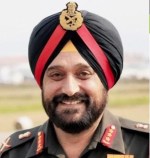
The Hindu: “Eastern Army Commander Lieutenant General Bikram Singh will be the next Chief of Staff of the 1.3 million-strong Indian Army. He will succeed General Vijay Kumar Singh, who retires on May 31.

The announcement by the Defence Ministry on Saturday came 90 days ahead of the scheduled day of assumption of charge — as against the 60-day norm the government has been following. The move removes uncertainty over the successor following a rash of speculative reports that Gen. Singh could put in his papers early which could alter the succession plan of the senior-most Army Commander taking over as the next Chief.

The appointment came a day after the incumbent Army Chief said he was not going to resign, effectively countering speculative reports by some television channels and dailies that Gen. Singh would resign after the Supreme Court disposed of his petition last month on the controversy over his year of birth.”

http://www.thehindu.com/news/national/article2957641.ece

Controversy over the true date of birth of the incumbent Army Chief ends with appointment of his successor. This news is purely coincidental to China’s announcement of it’s $100 billion military budget.

03/03/2012

* US military ties with India growing

Times of India: “Ties between the US and Indian militaries are growing, a senior defense official said on Friday, noting recent bilateral security talks between the two countries reaffirmed the partnership and the growing US interest in advancing it.

Acting under secretary of defense for policy James Miller joined Indian defense secretary Shashi Kant Sharma in co-chairing the 12th annual US-India defense policy group dialogue in New Delhi Feb 21 and 22.”

http://timesofindia.indiatimes.com/india/Military-ties-with-India-growing-US/articleshow/12121013.cms

Undoubtedly another attempt at ‘encircling’ China policy by US. Earlier this year US and Australia agreed closer military cooperation. This will, no doubt, cause some reaction from the Chinese military eventually.

02/03/2012

* Chinese manufacturing continues to expand

China Daily: “Manufacturing bounced back to a five-month peak in February, supported by stronger exports, easing concerns about a possible contraction.

The purchasing managers’ index, an indicator of manufacturing activity, hit 51 last month, 0.5 points higher than January, the National Bureau of Statistics and the China Federation of Logistics and Purchasing revealed on Thursday.

It has stayed above the 50-point level for three consecutive months after it dropped to a 32-month low of 49 in November. A reading higher than 50 means expansion, while below 50 shows contraction.

“The continually increasing PMI proves the nation is undergoing an economic rebound,propped up by industrial production,” Zhang Liqun, a research fellow with the DevelopmentResearch Center of the State Council, said.”

http://www.chinadaily.com.cn/china/2012-03/02/content_14735838.htm

Fears of a ‘hard landing’ for the Chinese economy recedes. Good news for global economies!

Law of Unintended Consequences

continuously updated blog about China & India

ChiaHou's Book Reviews

continuously updated blog about China & India

What's wrong with the world; and its economy

continuously updated blog about China & India