Posts tagged ‘China’

21/11/2016

U.S. panel urges ban on China state firms buying U.S. companies | Reuters

U.S. lawmakers should take action to ban China’s state-owned firms from acquiring U.S. companies, a congressional panel charged with monitoring security and trade links between Washington and Beijing said on Wednesday.

In its annual report to Congress, the U.S.-China Economic and Security Review Commission said the Chinese Communist Party has used state-backed enterprises as the primary economic tool to advance and achieve its national security objectives.

The report recommended Congress prohibit U.S. acquisitions by such entities by changing the mandate of CFIUS, the U.S. government body that conducts security reviews of proposed acquisitions by foreign firms.

“The Commission recommends Congress amend the statute authorizing the Committee on Foreign Investment in the United States (CFIUS) to bar Chinese state-owned enterprises from acquiring or otherwise gaining effective control of U.S. companies,” the report said.CFIUS, led by the U.S. Treasury and with representatives from eight other agencies, including the departments of Defense, State and Homeland Security, now has veto power over acquisitions from foreign private and state-controlled firms if it finds that a deal would threaten U.S. national security or critical infrastructure.

If enacted, the panel’s recommendation would essentially create a blanket ban on U.S. purchases by Chinese state-owned enterprises.

The report “has again revealed the commission’s stereotypes and prejudices,” Chinese Foreign Ministry spokesman Geng Shuang said in Beijing.

“We ask that Chinese companies investing abroad abide by local laws and regulations, and we hope that relevant countries will create a level playing field,” he told a daily news briefing.

EXTRA WEIGHT

The panel’s report is purely advisory, but could carry extra weight this year because they come as President-elect Donald Trump’s transition team is formulating its trade and foreign policy agenda and vetting candidates for key economic and security positions.

Congress also could be more receptive, after U.S. voter sentiment against job losses to China and Mexico helped Republicans retain control of both the House and the Senate in last week’s election.

Trump strongly criticized China throughout the U.S. election campaign, grabbing headlines with his pledges to slap 45 percent tariffs on imported Chinese goods and to label the country a currency manipulator on his first day in office.

“Chinese state owned enterprises are arms of the Chinese state,” Dennis Shea, chairman of the U.S.-China Economic and Security Review Commission, told a news conference.

“We don’t want the U.S. government purchasing companies in the United States, why would we want the Chinese Communist government purchasing companies in the United States?”

The recommendation to change laws governing CFIUS was one of 20 proposals the panel made to Congress. On the military side, it called for a government investigation into how far outsourcing to China has weakened the U.S. defense industry.

The 16-year-old panel also said Congress should pass legislation that would require its pre-approval of any move by the U.S. Commerce Department to declare China a “market economy” and limit anti-dumping tariffs against the country.

The United States and U.S. businesses attracted a record $64.5 billion worth of deals involving buyers from mainland China this year, more than any other country targeted by Chinese buyers, according to Thomson Reuters data.

The push into the United States is part of a global overseas buying spree by Chinese companies that this year has seen a record $200 billion worth of deals, nearly double last year’s tally.

CFIUS has shown a higher degree of activism against Chinese buyers this year, catching some by surprise. Prominent deals that fell victim to CFIUS include Tsinghua Holdings’ $3.8 billion investment in Western Digital (WDC.O).

Overall, data do not demonstrate CFIUS has been a significant obstacle for Chinese investment in the United States. In 2014, the latest year for which data is available, China topped the list of foreign countries in CFIUS review with 24 deals reviewed out of more than 100 scrutinized by CFIUS.

Although the number of Chinese transactions reviewed rose in absolute terms, it fell as a share of overall Chinese acquisitions, the report noted, and the vast majority of deals reviewed by CFIUS were cleared.

Source: U.S. panel urges ban on China state firms buying U.S. companies | Reuters
10/11/2016

China state media warns Trump against isolationism, calls for status quo | Reuters

Chinese state media has warned the U.S. president-elect against isolationism and interventionism, calling instead for the United States to actively work with China to maintain the international status quo.

President-elect Donald Trump threatened to tear up trade deals and pursue a more unilateral foreign policy under his “America First” principle during a tempestuous election campaign.

But China and other foreign governments are uncertain how much of Trump’s rhetoric will be translated into policy because he has at times made contradictory statements and provided few details of how he would deal with the world.

Trump often targeted China in the campaign, blaming Beijing for U.S. job losses and vowing to impose 45 percent tariffs on Chinese imports. The Republican also promised to call China a currency manipulator on his first day in office. U.S. isolationist policies had “accelerated the country’s economic crisis” during the Great Depression, warned a commentary by China’s official Xinhua News Agency, though it added that “election talk is just election talk”.

The commentary also cautioned against any tilt towards intervention.

POTENTIAL PRAGMATIST

The Chinese media in the past have criticized the United States and other Western powers for intervening in Afghanistan and Iraq and meddling in international hot spots such as Ukraine.

“History has proven that U.S. overseas military interventionism causes them to pay disastrous political and economic costs,” the commentary said. Hillary Clinton was widely seen in China as the more hawkish of the two candidates, while some Chinese commentators saw Trump as a potential pragmatist on foreign policy. But Beijing fears the unpredictability of a Trump presidency as it seeks to maintain an equilibrium in Sino-U.S. relations while dealing with the daunting tasks of a reform agenda to combat a slowing economy at home.

A second Xinhua commentary published on Thursday morning said the new U.S. president and China should “jointly build a new model of major power relations”. That echoes the position of Chinese President Xi Jinping that says global powers should work to accommodate, not contain, a rising China in the international system.

‘SHOCK OF HERESY’

Trump’s victory was watched closely on the Chinese internet with the tag “Trump has won” becoming the most-searched term on Weibo, a popular Chinese microblog service, on Wednesday afternoon in Asia, well before the race was conceded.

Some of the posts agreed that Trump might be just the change agent the United States needs now.

The U.S. has chosen indeterminacy in order to create change,” according to a post by Tsinghua University professor Sun Liping on Thursday that has been shared over a thousand times. “When the usual, determined method has already been unable to solve the problems, then you need the shock of heresy instead.”

Chinese state media had previously said the U.S. election process reflects a troubled political system, and showed an increasingly divided, disillusioned and indignant U.S. citizenry. “This election has also made clear that the U.S. political system is already caught in a predicament,” a third Xinhua commentary said. “As for when it will exit this predicament, the answer is still unknown.” The Global Times, a tabloid published by the ruling party’s People’s Daily newspaper, said Trump’s victory had “dealt a heavy blow to the heart of U.S. politics” but that he would be unable to make many changes in U.S. foreign policy.”

In an elite-controlled U.S., most of those holding power don’t support Trump. And U.S. allies across the world will pressure Washington to restrain Trump from isolationism,” it said.

Source: China state media warns Trump against isolationism, calls for status quo | Reuters

07/11/2016

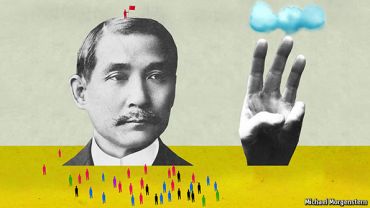
China and Taiwan struggle over Sun Yat-sen’s legacy | The Economist

FOR decades Taiwan’s rulers have paid their respects from afar to Sun Yat-sen, also known as Sun Zhongshan: “father of the nation”, founder of the Kuomintang (KMT) or Nationalist Party, and first president of the Republic of China.

In a ritual called yaoji, they face towards Sun’s mausoleum in Nanjing, 800km (500 miles) to the north-west in China, and offer fruit, burn incense and recite prayers.

Now that links across the Taiwan Strait are better, Sun-worshippers may make the pilgrimage in person. On October 31st it was the turn of the KMT’s chairwoman, Hung Hsiu-chu. But not only do some Taiwanese adore Sun. Museums in his honour also exist in Hong Kong, Macau, Singapore and Penang. He has a memorial park in Hawaii, where the great republican spent his teenage years, and a plaque in London, where he lived in exile from 1896-97. Most striking of all, he is admired by the Chinese Communists, who “liberated” China in 1949 from KMT rule.

In the Communist telling, Sun is the “forerunner of the democratic revolution”. As one visitor to his mausoleum put it this week: just as one sun and one moon hang in the sky, “there is only one father of the country.” There may be more Zhongshan Streets in China’s cities than Liberation Avenues. To mark this month’s anniversary of Sun’s birth 150 years ago, the state is minting a set of commemorative coins, including 300m five-yuan (75-cent) pieces that will go into circulation. It is a signal honour for a non-Communist. The party views Sun as a proto-revolutionary.

He makes an unlikely hero. Sun spent much of his life not in the thick of action but abroad. Half-a-dozen revolts that he helped organise against an ossified Qing dynasty were failures. As for the Wuchang uprising of October 1911, the catalyst for the end of three centuries of Manchu domination, he learnt of it from a Denver newspaper. He was back at the head of China’s first republican government early the following year, but merely as “provisional” president. Lacking the military strength to pull a fractured country together, he said he was the place-warmer for a strongman, Yuan Shikai. The nascent republic soon shattered and Yuan crowned himself emperor. Pressure from Western powers and Japan exacerbated China’s bleak situation. By 1916 Sun was back in exile again, in Japan.

For all that, Sun had brought down a rotten empire. For years he had raised the alarm over China’s direction, denouncing the Manchus and the rapaciousness of external powers. All his life, Sun had strived for a new republican order to turn a stricken China into a modern nation-state.

His ideas were hardly systematic, but he never deviated from the priorities of fostering national unity among Chinese, promoting democracy and improving people’s livelihoods—his “Three Principles of the People”. While railing against foreign depredations, he called for Chinese to embrace Western freedoms and rights (Sun’s messianic drive may have derived from his version of Christianity). His was an astonishingly more cosmopolitan world-view than that displayed by today’s Chinese leaders.Yet the longest-lasting impact of Sun on Chinese political life derives from something different. In the early 1920s he listened to advisers from the Soviet Union, which had won his admiration by renouncing territorial claims in China. He reorganised the KMT along Leninist lines, giving himself almost dictatorial powers (in Leninspeak: “democratic centralism”). The immediate effects were striking: an alliance between the KMT and the young Communist Party and a northward military advance in 1926 under Chiang Kai-shek, Sun’s heir, that toppled the warlords who were then wreaking havoc. Sun had died of liver failure the year before. He did not live to experience the brief national unity that Chiang imposed, nor the parties’ fatal split and descent into bloodshed, nor their struggle over Sun’s mantle.

Follow the Sun

And his legacy today? Consider that among his three principles, the two 20th-century dictators, Mao Zedong in mainland China and Chiang Kai-shek on Taiwan, gave a damn only about the first, national unity, on which, by their standards, they must be judged poorly. Sun’s Leninist party organisation—never one of his hallowed principles—had a far more profound impact on the two autocrats, and still does on China’s rulers today.

In Taiwan dictatorial KMT rule began crumbling a few years after Chiang’s death in 1975. Democratic development since then, including within the KMT, and the growth of a prosperous civil society, seem in line with Sun’s second and third principles relating to democracy and prosperity. But as for the first, a Chinese nationalism: forget it. Sun’s portrait still hangs in schools and government offices, and looks serenely down on the frequent fisticuffs in Taiwan’s parliament. But after resounding defeat in elections early this year, the KMT struggles for relevance on an island that is proud of its separateness from China. If there is any echo of Sun’s idealism, it is in the student “Sunflower Movement”, which wants to keep China at bay. For many Taiwanese, the Republic of China, Taiwan’s official name, is a figleaf for independence; Sun is an old ineffectual ghost. The current president, Tsai Ing-wen of the pro-independence Democratic Progressive Party, performed no yaoji this year.

And China? Democratic centralism still prevails—exemplified by the party’s monopoly on power, Xi Jinping’s autocratic rule and the suppression of dissent. Were Sun to speak from his tomb, he might remind Mr Xi how, under the Communist Party, national unity, real democracy and even broad-based prosperity remain elusive. He might point out, too, that when Sun adopted Leninism it was to advance rather than trump his beloved principles. In his final will, Sun wrote: “The work of the revolution is not done yet.” “Blimey,” he might now say: “Couldn’t you think of trying something different?”

Source: China and Taiwan struggle over Sun Yat-sen’s legacy | The Economist

04/11/2016

Xi Jinping gets a new title | The Economist

COMMUNIST leaders relish weird and wonderful titles. Kim Jong Il, the late father of North Korea’s current “Great Leader”, was, on special occasions, “Dear Leader who is a perfect incarnation of the appearance that a leader should have” (it doesn’t sound much better in Korean). China’s rulers like a more prosaic, mysterious epithet: hexin, meaning “the core”.

Xi Jinping—China’s president, commander-in-chief, Communist Party boss and so forth—is now also officially “the core”, having been called that in a report issued by the party’s Central Committee after a recent annual meeting.

The term was made up in 1989 by Deng Xiaoping, apparently to give his anointed successor, Jiang Zemin, greater credibility after the bloody suppression of the Tiananmen Square protests. Just as Mao had been the core of the first generation of party leaders and Deng himself of the second, so Mr Jiang was of the third. (Hu Jintao, Mr Xi’s predecessor, was supposedly offered the title of fourth-generation core but modestly turned it down.)

Being core confers no extra powers. Mr Xi has little need of those; he is chairman of everything anyway. Status, though, is what really matters in China (Deng ruled the country for a while with no other title than honorary chairman of the China Bridge Association). And Mr Xi seems to be finding that all his formal power does not convey enough. Early this year, in what looked like a testing of the waters, a succession of provincial party leaders kowtowed verbally to Xi-the-core. But the term soon disappeared from public discourse. Its revival makes it look as if Mr Xi has won a struggle to claim it.

That may augur well for him in his forthcoming battles over the appointment of a new generation of lesser officials (the peel?) at a party congress next year. Mr Xi wants to replace some of the 350-odd members of the central committee with his own people, while keeping as many of his allies as he can. In a sign that he might be able to do that, officials have started dismissing as “folklore” an unwritten rule that members of the Politburo have to retire at 68. The rule is commonly known as “seven up, eight down” (qi shang, ba xia), meaning 67 is fine, 68 is over the hill. Getting rid of it would seem to open the way to the non-retirement of several of Mr Xi’s close allies, notably 68-year-old Wang Qishan, who is in charge of fighting graft. It might even pave the way for Mr Xi’s own refusal to collect his pension when his second (and supposedly final) term as party chief is up in 2022, and he will be 69.

There is another parallel between political language now and in 1989. The recent meeting eschewed the party’s usual practice of tying current events to the triumphs of earlier Communist history and instead set the scene by referring mostly to the congress in 2012, when Mr Xi became leader. Another time when the party ignored history in this way was after the Tiananmen killings, when it wanted to draw a veil over what had just occurred and signal a fresh, dictatorial start. Mr Xi seems to be saying, implicitly, that a new era has begun with him, core among equals.

Source: Xi Jinping gets a new title | The Economist

02/11/2016

China’s Alibaba in ‘flying pig’ controversy – BBC News

A Chinese Muslim‘s call for e-commerce giant Alibaba to rename one of its services because it uses the word “pig” has sparked a backlash in China.

It all began when Alibaba changed the name of its popular travel booking app from Alitrip to one that means “Flying Pig” in Chinese. Its English name is Fliggy.

Over the weekend, Uighur businessman Adil Memettur criticised this decision on popular microblogging network Sina Weibo, where he has hundreds of thousands of followers.

He noted that the app is popular among minorities because it lets people whose names have unusual spellings make bookings.

“But now that Alitrip has changed its name to Flying Pig, I can only uninstall it, and maybe all my Muslim friends too, because the word “pig” is taboo to Muslims all over the world. Alibaba is an international corporation, could it take Muslim taboos into consideration?” he said.

Image copyrightSINA WEIBO / ADIL MEMETTUR. Mr Memettur is an Uighur Chinese who runs a cake business

His post quickly sparked condemnation and ridicule from other Chinese online, with some asking if this meant China had to expunge all references to pigs in popular culture and literature.

“We each have our own way of life; we do not force you to live according to our rules, but you cannot force us to change the law,” said Weibo user Fireflyinred.

Mr Memettur quickly took down the post and on Sunday night he posted an apology.

Alibaba told the BBC that they decided to rebrand the app to appeal to a younger demographic. “We embrace diversity and respect all creeds and religions. The name change is meant to reflect the demographic’s aspirations to pursue dreams, sit back and enjoy life,” said the spokesman.

The visceral pushback stems from the fact that the pig occupies an important place in Chinese culture.

Pork is not only a staple of Chinese cuisine – the government keeps a national reserve of pork in case of market shortages – but the pig is also celebrated in folklore and the Chinese zodiac.

Online, the reaction to Mr Memettur has been intense, often descending into derogatory comments and insulting jokes about Muslims and Uighur culture.

It has also highlighted how gaps in understanding between Muslim minorities and the Han Chinese majority can arise.

Image copyrightAFP/GETTY IMAGES – The Uighurs are one of China’s biggest Muslim minorities

Because of their relatively small numbers, concentrated mostly in the West, Muslims still do not figure largely in Chinese public discourse.

China’s 21 million Muslims, comprising minority ethnic groups such as the Huis and Uighurs, make up only 1.6% of the population, with the rest from the Han ethnic majority and they have mostly co-existed peacefully.

The western province of Xinjiang, home to many Chinese Uighurs, has seen unrest with residents saying they have been economically and culturally displaced by a growing influx of Han migrants. Violence there has been attributed by the authorities to Islamist militants and separatists – rights groups point to increasingly tight control by Beijing.

Image copyrightGETTY IMAGES- Xinjiang cities like Kashgar are home to Muslim minorities such as the Uighurs

In this instance some online, like blogger Han Dongyan, have called for respect and calm.”Don’t extend this to all Muslims… (Mr Memettur) has made a mistake and he can be criticised, but don’t respond to an extreme with another extreme and tar them all with the same brush, this is wrong too!” he wrote in one popular post.

Source: China’s Alibaba in ‘flying pig’ controversy – BBC News

01/11/2016

For China’s Leaders, Age Cap Is but a Moving Number – China Real Time Report – WSJ

The past three turnovers in the inner circle of China’s Communist Party leadership have come with an age guideline for retirement: Those 67 years old or younger could stay; those 68 or older had to go.

Now, comments from a senior party functionary are adding fuel to speculation that President Xi Jinping may break with the norm at a once-every-five-years party congress late next year.Speaking to reporters Monday, Deng Maosheng, a director at the party’s Central Policy Research Office, dismissed the qishang baxia (“seven up, eight down”) retirement convention as a “popular saying” that “isn’t trustworthy.”

“The strict boundaries of ‘seven up, eight down’ don’t exist,” said Mr. Deng, whose office is headed by one of Mr. Xi’s top policy advisers. Rather, he said, retirement rules are “flexible” and subject to revision as circumstances require.

His comments were the most public expression to date of what some party insiders have been saying privately for months. The age norm is a burden to Mr. Xi as he works to sideline rivals and hold on to allies in the next leadership lineup in the party’s Politburo and its standing committee, the inner sanctum of Chinese political power.

Political observers say one of those allies is 68-year-old Wang Qishan, who has directed the president’s withering crackdown on graft and, increasingly, political disloyalty. Under the qishang baxia norm, Mr. Wang is among five members of the Politburo Standing Committee, which currently numbers seven, due to retire at the next party congress.Party insiders have also speculated that the 63-year-old Mr. Xi may try to defy another recent convention, by not promoting a potential successor to the Standing Committee next year. That could set him up to remain in power after the expiration in 2022 of his second—and by recent custom, final—term. He would be 69 by then.Mr. Deng’s comments send “a clear signal that Xi will be a ‘rule modifier’ rather than a strict rule follower,” said Jude Blanchette, a Beijing-based researcher who is writing a book on Mao Zedong’s legacy. The rules are merely norms, and not well settled, he said.

As for the age norm, China politics experts say it was introduced by Jiang Zemin, then the outgoing party chief, to push a rival into retirement at the 2002 congress. According to Mr. Blanchette, that episode showed that Chinese leaders have “readjusted” malleable party norms “to fit political exigencies.”Or, as Mr. Deng put it in a news briefing in Beijing, the “strict organizational procedures and sufficient democratic processes” used in selecting top party leaders are “subject to adjustments in accordance with practical conditions.”

Mr. Xi’s growing clout may represent just such a practical condition. A top-level party conclave last week designated him as the party leadership’s “core,” an arcane title that political observers say signified his pre-eminent status. It was previously applied to Mao Zedong, Deng Xiaoping and Mr. Jiang but not Mr. Xi’s predecessor, Hu Jintao.

At Monday’s briefing, Mr. Deng of the party’s policy research office said the designation reflects Mr. Xi’s unanimous support within the party and broad public acclaim, but doesn’t threaten a return of a Mao-style “cult of personality”—which the party has explicitly banned—or contradict the party’s principles of collective leadership. Rather, the title was necessary to help the party and the country overcome new economic and political challenges, he said.

Mr. Hu, according to Mr. Deng, repeatedly declined to be designated as a “core” leader.“That time had its own circumstances,” he said. “The present has its own needs.”

Source: For China’s Leaders, Age Cap Is but a Moving Number – China Real Time Report – WSJ

31/10/2016

The Economist explains: Why some Indians want to boycott Chinese goods | The Economist

ON OCTOBER 30th India celebrates Diwali, the most important festival in the Hindu calendar. Over five days, millions of lamps and candles will be placed on doorsteps and rooftops; prayers will be offered to Lakshmi, the goddess of prosperity; and fireworks will go off in the skies over the streets of nearly every town and village. A festival that celebrates the victory of light over darkness, Diwali has in recent years brightened the mood of Chinese exporters as well: many Indian households favour cheaper, electric decorations made in China over the traditional earthen diyas (pictured).

But this year’s edition could take a dark turn. The country’s noisy social media are cluttered with posts calling for Indians to shun Chinese goods. A fake letter championing the boycott, ostensibly signed Narendra Modi, the prime minister, has gone viral. Politicians from India’s ruling Hindu-nationalist Bharatiya Janata Party (BJP) have endorsed the cause. What is going on?

The economic roots of the boycott are not new. China is India’s largest trading partner, with $71bn worth of goods exchanged between them in the past financial year. But China is also the nation with which India has its largest trade deficit, an imbalance that rose 9% to $53bn in 2015-2016. In contrast, China’s trade surplus with America reached $367bn in 2015. What the deficit is made of matters most. China’s light-industry goods compete directly and with overwhelming success against India’s small industries, the lifeline of its manufacturing sector and a reservoir of jobs. So India exports mostly raw materials to its neighbour. That has the government worried: of the 572 anti-dumping measures India took between 1995 and 2015, 146 were aimed at Chinese-made goods. The “Make in India” campaign, which has been championed by Mr Modi and sees foreign investment as crucial to boosting his country’s manufacturing power, has been careful not to advocate protectionism. Yet in a country where economic boycotts were first popularised as a non-violent strategy to combat British rule, such appeals carry emotional and historical heft. Geopolitics provided the spark for the current call. India has long been trying to get Masood Azhar, the boss of Jaish-e-Mohammad (JeM), a Pakistan-based jihadist group, listed as a terrorist by the United Nations. India suspects JeM of carrying out the January attack on an air-force base in Punjab, which killed eight Indians, including one civilian. JeM is also the alleged perpetrator of last month’s massacre at the Kashmiri garrison of Uri, in which 19 soldiers were killed (though another group claimed responsiblity). Yet twice this year, China used its Security Council veto to block Mr Azhar’s addition to the UN sanctions list. The move underscored Beijing’s all-weather support for the Pakistani establishment, elements of which India suspects of harbouring Mr Azhar. Some Indians don’t understand why they should have to trade with a nation working against their interests. This perception of China was compounded by its decision in June to oppose India’s accession to the Nuclear Suppliers Group, a 48-nation body that governs the global nuclear trade.

Yet calls for a boycott of Chinese-made goods are unlikely to have much effect. Both India and China are members of the World Trade Organisation, which forbids arbitrary bans on foreign goods. India’s commerce minister, Nirmala Sitharaman, recognised as much earlier this month when she said blocking imports was not a feasible option. A BJP leader deleted his tweets, blaming staff for the text; the opposition is silent on the issue. Nor is the wider business community likely to embrace the cause. Traders and industrialists, who have come to rely heavily on Chinese-made merchandise and machinery, form powerful lobbies. Yet with Mr Modi’s government promoting an increasingly assertive brand of nationalism, anger over China’s snubs will not easily go away. Expect further diplomatic fireworks.

Source: The Economist explains: Why some Indians want to boycott Chinese goods | The Economist

17/10/2016

China launches longest manned space mission | Reuters

China launched its longest manned space mission on Monday, sending two astronauts into orbit to spend a month aboard a space laboratory that is part of a broader plan to have a permanent manned space station in service around 2022.

The Shenzhou 11 blasted off on a Long March rocket at 7:30 am (2330 GMT) from the remote launch site in Jiuquan, in the Gobi desert, in images carried live on state television.

The astronauts will dock with the Tiangong 2 space laboratory, or “Heavenly Palace 2”, which was sent into space last month. It will be the longest stay in space by Chinese astronauts, state media reported.

Early on Monday, Fan Changlong, a vice chairman of China’s powerful Central Military Commission, met astronauts Jing Haipeng and Chen Dong and wished them well, state news agency Xinhua reported.

“You are going to travel in space to pursue the space dream of the Chinese nation,” Fan said.”With all the scientific and rigorous training, discreet preparation, and rich experience accumulated from previous missions, you will accomplish the glorious and tough task… We wish you success and look forward to your triumphant return.”

Shenzhou 11 is the third space voyage for Jing, who will command the mission and celebrate his 50th birthday in orbit.

In a manned space mission in 2013, three Chinese astronauts spent 15 days in orbit and docked with a space laboratory, the Tiangong 1.Advancing China’s space program is a priority for Beijing, with President Xi Jinping calling for the country to establish itself as a space power.

China insists its space program is for peaceful purposes.

Shenzhou 11, whose name translates as “Divine Vessel”, will also carry three experiments designed by Hong Kong middle school students and selected in a science competition, including one that will take silk worms into space.

The U.S. Defense Department has highlighted China’s increasing space capabilities, saying it was pursuing activities aimed at preventing other nations using space-based assets in a crisis.

China has been working to develop its space program for military, commercial and scientific purposes, but is still playing catch-up to established space powers the United States and Russia.

China’s Jade Rabbit moon rover landed on the moon in late 2013 to great national fanfare, but soon suffered severe technical difficulties.

The rover and the Chang’e 3 probe that carried it there were the first “soft landing” on the moon since 1976. Both the United States and the Soviet Union had accomplished the feat earlier.

China will launch a “core module” for its first space station some time around 2018, a senior official said in April, part of a plan for a permanent manned space station in service around 2022.

Source: China launches longest manned space mission | Reuters

13/10/2016

China tops US in numbers of billionaires – BBC News

Property magnate Wang Jianlin of Dalian Wanda tops the list of 594 billionaires in the country, ahead of 535 billionaires in the US.

Alibaba‘s Jack Ma was second, with his wealth having risen 41% from last year.

The annual list is compiled by Shanghai publishers Hurun and often compared to the Forbes list in the US.The Hurun Report’s rich list is one of the most closely-watched and accurate assessments of wealth in China. The annual report has been published for the past 18 years.

Earlier this year, the publisher released a separate, global list, showing that the number of billionaires in China outnumbered those in the US for the first time.

However, none of China’s super-rich make it into the global top 20.

Global reach

At the top of the China rich list is Wang Jianlin, who sits on a personal fortune of $32.1bn (£26.4bn).

His company Dalian Wanda has made headlines throughout the year with a number of high profile forays into the US movie markets. It has taken over Legendary Pictures, as well as stepping into US and UK cinema chains and striking an alliance with Sony Pictures.

Alibaba’s Jack Ma is a close second with $30.6bn, and Pony Ma of internet and online gaming giant Tencent comes third with $24.6bn.

Image copyright REUTERS

The biggest increase came from Yao Zhengua of investment and real estate firm Baoneng Group, whose wealth jumped by 820% to $17.2bn, putting him in fourth position.

Hurun chairman Rupert Hoogewerf said Mr Yao’s rise illustrated a shift in China’s maturing economy.

“Yao’s financial investment model represents the new wave of wealth creation in China,” he explained. “The first money made in China 20 years ago came from trading, followed by manufacturing, real estate, IT, and today it is about using the capital markets for financial investments.

“Robin Li and Melissa Ma of search engine Baidu have a fortune of $14.7bn, ranked eighth while founder of smartphone makers Xiaomi, Lei Jun, dropped out of the top 10 to number 14 as competition in China’s smartphone market intensified.

Most of China’s billionaires live in Beijing, followed by Shenzhen, Shanghai and Hangzhou.

Globally, the Forbes rich list is topped by Microsoft founder Bill Gates with $75bn, followed by Amancio Ortega of Zara and legendary investor Warren Buffett.

Source: China tops US in numbers of billionaires – BBC News

11/10/2016

Building Collapse Illustrates Peril of Do-It-Yourself Construction – China Real Time Report – WSJ

A fatal building collapse in southern China has highlighted a practice that more than once has produced death traps: structures built with little oversight by villagers on former farmland.

Such slapped-together buildings have tended to grow even more precarious as they age and as extra floors are added.

Four six-story buildings in a suburban area of Wenzhou, a city on China’s southern coast, collapsed Monday morning, claiming at least 22 lives, according to the state-run Xinhua News Agency, which cited local authorities. Six survivors were pulled from the building before the rescue was called off, Xinhua said.

The buildings were close to industrial parks of Wenzhou, a hub for light manufacturing including shoemaking, and most residents were migrant workers.The buildings were several decades old and erected by villagers, according to an article by the Wenzhou Daily that the local government reposted on its official website Tuesday. It said investigations were under way but an initial analysis showed that the collapse was likely caused by the buildings’ low quality and shaky foundation, a problem made worse by continuous rainfall in the past few days.

It used to be common practice in the 1980s and 1990s for residents outside China’s urban area to build houses with their own hands, often on what had been farmland. Over the years, floors were added without approval, leaving tottering buildings crumbling under the extra weight.

As cities have grown to incorporate such areas, local governments have tried to get rid of these “towns within cities,” tearing down the aging and shoddily built structures. The Wenzhou government had targeted much of the complex of the recent collapse for demolition, some of which had already started.

It wasn’t the first collapse of villager-built housing. Two years ago, a building under construction by local farmers in Xian in western China collapsed, killing five people.

Some online commenters pointed out that photos of the buildings involved show that more floors had been added to the original construction. The state-run newspaper Beijing News quoted a Wenzhou resident as saying that it was common for self-built buildings in the area to have additional floors.

The practice of adding floors has sometimes been a way for the owners of buildings targeted for demolition to extract more compensation from the government, which bases amounts to pay out to residents on the size of the living areas.

Another building collapse in Xian in 2011, which claimed seven lives, was caused by illegal additions the building’s owner had made to get more compensation, according to the local government. The owner was detained by the local police.

That tragedy came months after the Xian government rolled out new regulations to forbid compensation for illegal additions to a building. The local government said at the time that more than 50 cases of “self-built” building collapses had caused 69 deaths since 2007.

It was unclear whether the owners of the collapsed buildings in Wenzhou, who weren’t identified by the local government, will be held legally responsible for the casualties.

The Wenzhou collapse prompted calls for more regulation. “If relevant departments are still indifferent in face of self-built houses in such a disastrous state,” read one commentary by Beijing News on Tuesday, “then similar tragedies will be repeated.”

Source: Building Collapse Illustrates Peril of Do-It-Yourself Construction – China Real Time Report – WSJ

Law of Unintended Consequences

continuously updated blog about China & India

ChiaHou's Book Reviews

continuously updated blog about China & India

What's wrong with the world; and its economy

continuously updated blog about China & India