Posts tagged ‘China’

29/09/2016

Chinese Tourists Encouraged to Behave Ahead of Mass Vacation – China Real Time Report – WSJ

Urinating on the streets of Hong Kong? Hurling hot water at flight attendants? Stealing wood from Lovers’ Beach in Thailand?

These are the kind of mainland-Chinese tourist antics that the motherland is looking to stub out ahead of the week-long national holiday known as Golden Week, when throngs of citizens travel both domestically and abroad.

To help them do so, the China National Tourism Administration and one of China’s dominant online travel firms, Ctrip.com International, are teaming up to find model tourists to promote travel behavior worthy of emulation—and national recognition.

“Civility of Chinese tourists is an important indicator of a country’s soft power and one of the major ways to export a country’s influence,” the tourism administration’s Vice Chairman Wang Xiaofeng said at an event announcing the campaign.

The two organizations, along with state-run newspaper China Daily, are asking the Chinese public to provide examples of what they think is model traveler decorum. Ctrip will give gifts to exemplary participants, such as free travel products and company souvenirs, said Ctrip senior director of investment relations Zhou Shiwei.

“The campaign is about changing the perception of Chinese travelers,” he said. “We definitely want Chinese travelers to be well-received abroad.

”Examples include pictures of Chinese soccer fans who picked up trash in Seoul, even after the Chinese men’s team lost to South Korea earlier this month, or photos of Chinese tourists patiently waiting in line.Ctrip says the campaign is aiming to publish a compilation of guidelines and pictures suggested by Chinese netizens during Golden Week. Chinese tourists can upload pictures via Chinese social-media network Weibo, and to the China Daily website. It is unclear how the photos will be verified.More than 600 million Chinese are expected to travel abroad in the next five years, as China’s middle class grows and visa restrictions ease in some countries welcoming Chinese spending. Last year, about 120 million Chinese traveled overseas—10% more than in 2014, according to the national tourism administration.

Domestically, tourism generated about $620 billion last year, with more than four billion trips taken.

The campaign, entitled “Good Chinese Tourists,” is an addition to other recent efforts the government has put forth to curb travel misbehavior. Last year, it unveiled new measures that allow authorities to track the bad habits of wayward tourists for up to two years.

The tourism administration also recently published a guidebook on civilized tourism, in which it urges tourists to refrain from spitting and littering—common practices back home—and to take photographs only where permitted. “Do not chase, beat or feed animals,” it adds. “Do not be greedy with complimentary items.

”For traveling abroad, the guide includes recommendations that cutting in line is “shameful wherever you are” and suggests that tourists “not leave footprints on toilet seats.”

Source: Chinese Tourists Encouraged to Behave Ahead of Mass Vacation – China Real Time Report – WSJ
27/09/2016

What India’s Decision to Ratify Paris Climate-Change Pact Means – India Real Time – WSJ

India’s announcement that it would ratify the 2015 global agreement on climate change increases the chances that the pact will go into effect this year.

Source: What India’s Decision to Ratify Paris Climate-Change Pact Means – India Real Time – WSJ

23/09/2016

A glowing future | The Economist

UPON learning (via a terse government statement) that their bustling port city in eastern China had been tipped as the likely site of a plant to recycle used nuclear fuel, residents of Lianyungang took to the streets last month in their thousands. Police, whose warnings against demonstrations were ignored, deployed with riot gear in large numbers but only scuffled with the protesters, who rallied, chanted and waved banners in the city centre for several days. “No one consulted us about this,” says one woman who participated in the protests. “We love our city. We have very little pollution and we don’t want a nuclear-fuel plant anywhere near us. The government says it is totally safe, but how can they be sure? How can we believe them?” she asks.

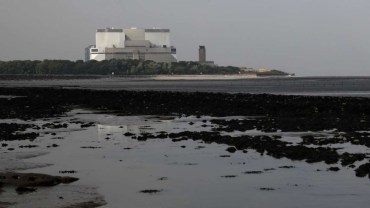
Such scepticism is shared by many in Lianyungang, which already hosts a nuclear-power plant (pictured), and elsewhere in China, where the government plans to expand nuclear power massively. China started its first nuclear plant in 1994. There are now 36 reactors in operation, and another 20 under construction (see map). A further four have been approved, and many more are in the planning stages. Only one new plant has been built in America, in contrast, since 1994; four more are under construction. By 2030 China is projected to get 9% of its power from nuclear, up from 2% in 2012. In absolute terms, its nuclear generation capacity will have increased eightfold over the same period, to 750 billion kilowatt-hours a year, roughly America’s current level.

After disaster struck Japan’s Fukushima nuclear power station in 2011, the Chinese authorities briefly halted this pell-mell rush toward the nuclear future, announcing a moratorium on the construction of new plants, urgent safety checks on existing ones and a prolonged policy review to decide whether nuclear power would remain a part of China’s energy strategy. The following year, however, the government resolved to carry on with its nuclear-energy programme.

The need is clear. Despite slowing economic growth, energy consumption per person is projected to rise dramatically, with no plateau in sight before 2030. Pollution from coal-fired power plants, China’s main source of electricity, causes widespread respiratory disease and many premature deaths each year, a source of persistent public anger. China has also made ambitious promises to reduce greenhouse-gas emissions. If it hopes to meet such targets, it will need to embrace nuclear, “because the only other truly reliable 24/7 source of electric power is coal,” says Zha Daojiong of Peking University.China’s utilities are also keen. The state-owned firms that run all the country’s nuclear plants are thought to earn a good return on their investment (their accounts are too murky to be certain), in part because their official backing allows them to finance new reactors very cheaply, and in part because regulators have fixed power tariffs in a favourable manner. One estimate put the return on nuclear assets between 2002 and 2012 at 7% a year, compared with 3% for coal- and gas-fired plants.

China even harbours ambitions to export its growing expertise in nuclear power. After relying first on Russian designs, and more recently importing American and French ones, China has also developed indigenous nuclear reactors. A recently approved deal with Britain, valued at $23 billion, will see China help finance a French-designed nuclear-power station and possibly build one of its own design later.

But China’s nuclear push has its critics. These include those who live near proposed nuclear facilities. Many, like the protesters in Lianyungang, are happy to have the power they need to run their air-conditioners but want to keep the unpleasant parts of the operation far from their doorsteps. Chinese now has a word for NIMBY: linbi, a fusion of the words for “adjacent” and “shun”. The government has repeatedly backed down in the face of public demonstrations, twice agreeing to relocate a uranium-enrichment plant, for example. It has also put the decision about the reprocessing plant in Lianyungang on hold.

Yet attitudes to nuclear power may be less hostile than in many Western countries. A study published in 2013 found an even split between supporters and opponents of expanding China’s nuclear-power industry. Compared with their counterparts in the rich world, Chinese citizens showed much greater “trust and confidence in the government” as the manager of nuclear policy and operations, the emergency responder in case of accidents and the provider of reliable information about the industry. The lead researcher for that study, He Guizhen of the Chinese Academy of Sciences, says that even protesters like those in Lianyungang are not implacably opposed. “Their message is not really that you can’t build these things no matter what, but that we are concerned about safety, especially after Fukushima, and we demand that you take safety seriously,” she says.

It appears this message is getting through. Early this year the government acknowledged in a white paper that its system for responding to a nuclear accident had “certain inadequacies”. In April officials revealed plans to draft a national nuclear-safety law. In May officials announced 600m yuan ($91m) in funding for six new nuclear-emergency squads, which would be ready for action by 2018. In August—on the same day that protesters marched in Lianyungang—China conducted its first “comprehensive nuclear-security emergency drill”. This week the government said officials must consult locals before settling the location of new nuclear facilities.

Deborah Seligsohn of the University of California, San Diego, says that because China’s nuclear-power industry is centrally run and limited to a handful of companies, authorities are able to keep tight control over safety standards, and that they have not hesitated to slow projects down when seeing signs of strain. Supervision, however, falls to several different agencies and levels of the bureaucracy. The burden of inspecting and managing the growing number of plants, she says, could be better handled by a more independent regulator in charge of its own budget.

In July China Energy News, a newspaper, reported that “quality problems” with domestically manufactured pump-valves were forcing some plants to shut down unexpectedly. (Most plants have since switched to imported valves.) More alarmingly, regulators this month revealed that a radiation-monitoring system at the Daya Bay nuclear-power station, which is within 50km of the huge cities of Shenzhen and Hong Kong, had been turned off inadvertently for three months before anyone noticed. Since no radiation leaked, the government deemed the oversight an event of “no safety significance”—one of several such lapses this year. The residents of Shenzhen and Hong Kong, presumably, would not see it in quite the same way.

Source: A glowing future | The Economist

17/09/2016

The plateau, unpacified | The Economist

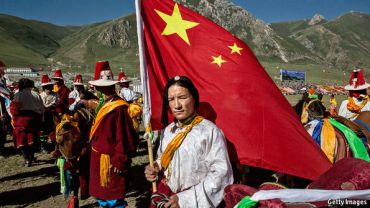
AN ELDERLY woman with long, grey plaits, wearing a traditional Tibetan apron of wool in colourful stripes, has spent her day weaving thread outside her home near the southern end of Qinghai Lake, high on the Tibetan plateau. She is among hundreds of thousands of Tibetan nomads who have been forced by the government in recent years to settle in newly built villages. She now lives in one of them with her extended family and two goats. Every few months one of her sons, a red-robed monk, visits from his monastery, a place so cut off from the world that he has never heard of Donald Trump. Her grandson, a 23-year-old with slick hair and a turquoise rain jacket, is more clued in. He is training to be a motorcycle mechanic in a nearby town. Theirs is a disorienting world of social transformation, sometimes resented, sometimes welcome.Chinese and foreigners alike have long been fascinated by Tibet, romanticising its impoverished vastness as a haven of spirituality and tranquillity. Its brand of Buddhism is alluring to many Chinese—even, it is rumoured, to Peng Liyuan, the wife of China’s president, Xi Jinping. Many Tibetans, however, see their world differently. It has been shattered by China’s campaign to crush separatism and eradicate support for the Dalai Lama, their spiritual leader who fled to India after an uprising in 1959. The economic transformation of the rest of China and its cities’ brash modernity are seductive, but frustratingly elusive.

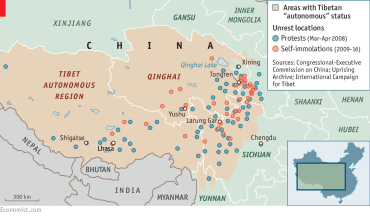
The story of political repression in Tibet is a familiar one. The Dalai Lama accuses China’s government of “cultural genocide”, a fear echoed by a tour guide in Qinghai, one of five provinces across which most of the country’s 6m Tibetans are scattered (the others are Gansu, Sichuan, Yunnan and the Tibet Autonomous Region, or TAR—see map). “We know what happened to the Jews,” he says. “We are fighting for our existence.” Less commonly told is the despair felt by many young Tibetans who feel shut out of China’s boom. They are victims of Tibet’s remote and forbidding topography as well as of racial prejudice and the party’s anti-separatist zeal. They often cannot migrate to coastal factories, and few factories will come to them. Even fluent Mandarin speakers rarely find jobs outside their region.

Yet Tibetans are not cut off from the rapidly evolving culture of the rest of China, where more than 90% of the population is ethnic Han. Mayong Gasong Qiuding, a 26-year-old hotel worker in Yushu in southern Qinghai, listens to Mandarin, Tibetan and Western pop music in tandem. He can rattle off official slogans but can recite only short Tibetan prayers. His greatest wish, he says, is to go to the Maldives to see the sea. Tibetan women in Qinghai use skin-whitening products, following a widespread fashion among their Han counterparts; a teenager roller-skates anticlockwise around a Buddhist stupa, ignoring a cultural taboo. Young nomads frustrate their elders by forsaking locally-made black, yak-hair tents for cheaper, lighter canvas ones produced in far-off factories.

Han migration, encouraged by a splurge of spending on infrastructure, is hastening such change. Although Tibetans still make up 90% of the permanent population of the TAR, its capital Lhasa is now 22% Han, compared with 17% in 2000. Many Tibetans resent the influx. Yet they are far more likely to marry Han Chinese than are members of some of China’s other ethnic groups. Around 10% of Tibetan households have at least one member who is non-Tibetan, according to a census in 2010. That compares with 1% of households among Uighurs, another ethnic minority whose members often chafe at rule by a Han-dominated government.

Core features of Tibetan culture are in flux. Monasteries, which long ago played a central role in Tibetan society, are losing whatever influence China has allowed them to retain. In recent years, some have been shut or ordered to reduce their populations (monks and nuns have often been at the forefront of separatist unrest). In July buildings at Larung Gar in Sichuan, a sprawling centre of Tibetan Buddhist learning, were destroyed and thousands of monks and nuns evicted. Three nuns have reportedly committed suicide since. Of the more than 140 Tibetans who have set fire to themselves since 2011 in protest against Chinese rule, many were spurred to do so by repressive measures at their own monastery or nunnery.

Cloistered life is threatened by social change, too. Families often used to send their second son to a monastery, a good source of schooling. Now all children receive nine years of free education. “The young think there are better things to do,” says a monk at Rongwo monastery in Tongren, a town in Qinghai, who spends his days “praying, teaching [and] cleaning”. New recruits often come from poorly educated rural families.

Mind your language

In the TAR (which is closed to foreign journalists most of the time), the Tibetan language is under particular threat. Even nursery schools often teach entirely in Mandarin. A generation is now graduating from universities there who barely speak Tibetan. Some people have been arrested for continuing to teach in the language. In April last year Gonpo Tenzin, a singer, was sentenced to three-and-a-half years in prison for his album, “No New Year for Tibet”, encouraging Tibetans to preserve their language and culture.

In some areas outside the TAR, however, the government is less hostile to Tibetan. Since the early 2000s, in much of Qinghai, the number of secondary schools that teach in Tibetan has risen, according to research there by Adrian Zenz of the European School of Culture and Theology at Korntal, Germany. The range of degrees taught in Tibetan has expanded too. Unlike elsewhere, someone who has studied mainly in Tibetan can still get a good job in Qinghai. A third of all government roles advertised there between 2011 and 2015 required the language. Despite this, many parents and students chose to be taught in Mandarin anyway, Mr Zenz found. They thought it would improve job prospects.

Karma chameleon

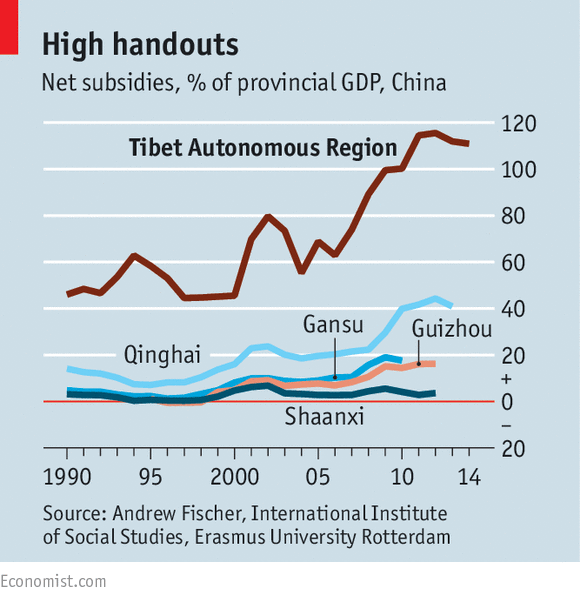
But work can be difficult to get, despite years of huge government aid that has helped to boost growth. Government subsidies for the TAR amounted to 111% of GDP in 2014 (see chart), according to Andrew Fischer of Erasmus University Rotterdam. Eleven airports serve Qinghai and the TAR—they will have three more by 2020. A 156-mile train line from Lhasa (population 560,000) to Shigatse (population 120,000), which was completed in 2014, cost 13.3 billion yuan ($2.16 billion). A second track to Lhasa is being laid from Sichuan, priced at 105 billion yuan.

Better infrastructure has fuelled a tourism boom—domestic visitors to the TAR increased fivefold between 2007 and 2015—but most income flows to travel agents elsewhere. Tourists stay in Han-run hotels and largely eat in non-Tibetan restaurants (KFC opened its first Lhasa branch in March). Tibetan resentment at exclusion from tourism- and construction-related jobs was a big cause of rioting in Lhasa in 2008 that sparked plateau-wide protests. Other big money-spinners—hydropower and the extraction of minerals and timber—are controlled by state-owned firms that employ relatively few Tibetans. The Chinese name for Tibet, Xizang, means “western treasure house”. But Tibetans have little share in its spoils. The rehousing of nomads has helped provide some with building jobs, but has also brought suffering: those relocated sometimes find it harder to make a living from herding.

In most other parts of China, villages have been rapidly emptying as people flock to work in cities. In the country as a whole, the agricultural population dropped from 65% to 48% as a share of the total between 2000 and 2010. On the plateau it fell only slightly, from 87% to 83%. It is hard for Tibetans to migrate to places where there are more opportunities. Police and employers treat them as potential troublemakers. In 2010 only about 1% of Tibetans had settled outside the plateau, says Ma Rong of Peking University. They cannot move abroad either. In 2012 Tibetans in the TAR had to surrender their passports (to prevent them joining the Dalai Lama); in parts of Qinghai officials went house-to-house confiscating them.

Karma chameleon

For university graduates, the prospects are somewhat better. There are few prospects for secure work in private firms on the plateau. But to help them, the government has been on a hiring spree since 2011. Almost all educated Tibetans now work for the state. A government job is a pretty good one: salaries have been rising fast. Few Tibetans see such work as traitorous to their cause or culture. But the government may not be able to keep providing enough jobs for graduates, especially if a slowdown in China’s economy, which is crimping demand for commodities, has a knock-on effect on the plateau.

Many of the problems faced by Tibetans are common in traditional pastoral cultures as they modernise. But those of Tibetans are compounded by repression. They are only likely to increase when the Dalai Lama, now 81, dies. The central government will try to rig the selection of his successor, and no doubt persecute Tibetans who publicly object.

In private, officials say they are playing a waiting game: they expect the “Tibetan problem” to be more easily solved when he is gone. They are deluding themselves. They ignore his impact as a voice of moderation: he does not demand outright independence and he condemns violence. Tibetan culture may be under duress, but adoration of the Dalai Lama shows no sign of diminishing. Poverty, alienation and the loss of a beloved figurehead may prove an incendiary cocktail.

Source: The plateau, unpacified | The Economist

15/09/2016

Britain approves China-backed Hinkley Point nuclear plant deal after review of scheme | South China Morning Post

The British government said on Thursday it was giving the green light to a controversial new nuclear project at Hinkley Point after Prime Minister Theresa May ordered a review.

“Having thoroughly reviewed the proposals for Hinkley Point C, we will introduce a series of measures to enhance security and will ensure Hinkley cannot change hands without the government’s agreement,” Business Secretary Greg Clark said in a statement.

Beijing calls for British nuclear project financially backed by China to proceed.

“Consequently, we have decided to proceed with the first new nuclear power station for a generation.”

The board of French state-owned power company EDF approved its participation in the project in southwest England on July 28, only for Britain’s new government under May to announce hours later that it wanted to review it.China has a one-third stake in Hinkley Point and analysts have warned that Britain would have risked its relations with the world’s second-largest economy if it cancelled the costly deal.

Source: Britain approves China-backed Hinkley Point nuclear plant deal after review of scheme | South China Morning Post

13/09/2016

China’s Industrial Output, Retail Sales Accelerate in August – China Real Time Report – WSJ

China’s economy strengthened in August, with a slew of data, from factory production to retail sales, beating estimates Tuesday. The improved performance is a fresh sign that stepped-up government spending and strong property sales are helping to stabilize growth in the world’s second-largest economy.

As for the numbers themselves, as reported by the government, industrial output rose 6.3% last month from a year earlier. Investment in buildings and other fixed assets outside rural households climbed a better-than-expected 8.1% year over year in the first eight months of 2016, while retail sales grew 10.6% in August from a year ago.

Economists generally cheered the numbers, but wondered how long the better times would last. Following are excerpts from economists’ views on the latest data, edited for length and style:Better-than-expected data out of China today raise hopes that policymakers’ efforts to reverse the slide in investment growth are seeing some success. Stronger industrial activity last month appears to have been partly driven by a recovery in investment spending, especially in the state sector. The delayed impact of earlier policy easing means that a stronger second half of this year is likely. The latest evidence of a pick-up suggests that recent concerns that policy easing had failed to provide any noticeable boost to the economy were likely somewhat premature.  Julian Evans-Pritchard, Capital EconomicsToday’s data suggest that the downside risk for third quarter GDP is significantly reduced. Investment in manufacturing industry increased only 3% in Jan-Aug, while investment in services picked up to 11.2%, showing economic rebalancing continues to take place. The uptick in industrial output is consistent with the rebound in the August official manufacturing PMI. However, the divergence of PMI performance between large corporates and small- and medium-size enterprises remains a concern.

Louis Lam and David Qu, ANZ ResearchWe expect investment to remain under pressure for the rest of the year because of slower real estate construction and spare capacity in key sectors. But with industrial profits recovering recently, and investment also up in August, the downward pressure should diminish. Meanwhile, export momentum should improve along with global trade, while we expect consumption to hold up. In all, while further stimulus is necessary to reach the government’s GDP growth target of at least 6.5% this year, the outlook has improved slightly after the August data.  Louis Kuijs, Oxford EconomicsChina needs to nurture an initial economic stabilization with continued fiscal support. Today’s data show economic growth seems to have stabilized a little last month, but it is not on a solid footing yet.  Measures such as tax cuts and increased government spending can not only help spur growth but also help restructure the economy by boosting consumption. Fiscal expenditures rose 10% in August from a year earlier, much faster than July’s 0.3% increase.  Liu Xuezhi, Bank of Communication

Source: Economists React: China’s Industrial Output, Retail Sales Accelerate in August – China Real Time Report – WSJ

08/09/2016

A 16-year-old British girl earns £48,000 helping Chinese people name their babies – BBC Newsbeat

Beau Jessup, a British A-level student from Gloucestershire, came up with the idea after a family visit to China.

They were out for a meal with friends when she was asked to give an English name to a newborn baby.

In China it is considered important to have an English name for future study or business with the UK.

‘Special Name’ requires the user to pick five of the 12 personality traits which they most hope their baby will grow into

In China they name their child based on the elements and Beau wanted a similarity between how they pick their Chinese name and how they pick their English name.

And she does this by assigning personality traits to each English name.

They also select the gender of the baby and pay the equivalent of 60p.

The three chosen names are then shared with family and friends on We-Chat, China’s WhatsApp equivalent, to help make the final decision.

Each suggestion is printed on a certificate with its meaning and an example of a famous person with that name.

Beau says that when she was first asked to name her father’s friend’s baby, she was surprised.

“I’m not really qualified or relevant enough in that baby’s life to be the person to give it a name.

“But after hearing of some of the “embarrassing” names, Beau decided she needed to act.

There was someone called Rolex

“There are quite a few examples where people have gotten the names wrong.”

Beau explains that the Chinese are fascinated by western culture but their access to it is restricted by the government in China.There isn’t open access to the internet so they can’t use standard baby naming websites that people may use in the UK.

“Being exposed to luxury items and things like Harry Potter, Disney films and Lord of the Rings means they use those for reference.

“I once heard of someone called Gandalf and another called Cinderella.”

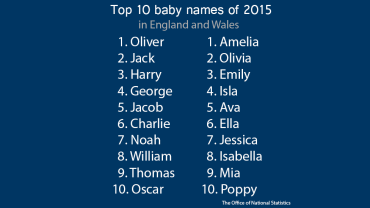
Amelia and Oliver were the most popular baby names in England and Wales in 2015

That’s according to the Office for National Statistics which released the complete set of data last week.

But Beau doesn’t know which names are the most popular on her website, and she’s “happy about that”.

“It is called ‘special name’ and it’s based on individual preference and what they personally want their child to be.”

Beau says it’s quite strange to know she’s named more than 200,000 babies

“It’s nice to be a part of such a happy experience and be a part of those young stages in a baby’s life.”The site’s success has been a pleasant surprise.

“I wanted to do it just to see if an idea could turn into more than just simply an idea.”

And I never expected it to become more than just a small project because I never really considered myself very academic.

“It is obviously a nice surprise, but it is definitely a surprise.”

Source: A 16-year-old British girl earns £48,000 helping Chinese people name their babies – BBC Newsbeat

04/09/2016

China says should constructively handle disputes with India | Reuters

Chinese President Xi Jinping told Indian Prime Minister Narendra Modi on Sunday that the two countries should respect each other’s concerns and constructively handle their differences.

The two nuclear-armed neighbours have been moving to gradually ease long-existing tensions between them.

Leaders of Asia’s two giants pledged last year to cool a festering border dispute, which dates back to a brief border war in 1962, though the disagreement remains unresolved.

Meeting on the sidelines of the G20 summit in the eastern Chinese city of Hangzhou, Xi said relations had maintained a steady, healthy momentum, and should continue to increase mutual understanding and trust.

“We ought to respect and give consideration to each other’s concerns, and use constructive methods to appropriately handle questions on which there are disputes,” Xi said, in comments carried by China’s Foreign Ministry.

“China is willing to work hard with India the maintain the hard-won good position of Sino-India relations,” Xi added.

China’s Defence Ministry said last month that it hoped India could put more efforts into regional peace and stability rather than the opposite, in response to Indian plans to put advanced cruise missiles along the disputed border with China.

Indian military officials say the plan is to equip regiments deployed on the China border with the BrahMos missile, made by an Indo-Russian joint venture, as part of ongoing efforts to build up military and civilian infrastructure capabilities there.

China lays claim to more than 90,000 sq km (35,000 sq miles) ruled by New Delhi in the eastern sector of the Himalayas. India says China occupies 38,000 sq km (14,600 sq miles) of its territory on the Aksai Chin plateau in the west.

India is also suspicious of China’s support for its arch-rival, Pakistan.Modi arrived in China from Vietnam, which is involved in its own dispute with China over the South China Sea, where he offered Vietnam a credit line of half a billion dollars for defence cooperation.Modi’s government has ordered BrahMos Aerospace, which produces the BrahMos missiles, to accelerate sales to a list of five countries topped by Vietnam, according to a government note viewed by Reuters and previously unreported.

Source: China says should constructively handle disputes with India | Reuters

04/09/2016

UK’s May to review security risks of Chinese-funded nuclear deal | Reuters

Prime Minister Theresa May said on Sunday she wanted her security advisers to review a delayed nuclear power investment from China – a source of diplomatic tension – as she arrived in the country to attend a G20 summit.

May upset Chinese officials in July by delaying a $24 billion project that would see French firm EDF (EDF.PA) build Britain’s first new nuclear power plant in decades with the help of $8 billion from China.

Speaking during her first visit to China, May was asked whether she would ask the National Security Council, a team of ministers supported by intelligence officers, to look at the potential security implications of the Hinkley deal.

“I will be doing exactly as you’ve said,” May replied, saying it would be part of her decision-making process. The comment marked the first official acknowledgement that national security was a factor in her decision.

The initial delay caught investors by surprise and has cast doubt over whether May, who took office in July following Britain’s vote to leave the European Union, will continue to court China as a major source of infrastructure investment.

“This is the way I operate,” May earlier told reporters en route to the summit, which will include a one-to-one with Chinese President Xi Jinping.

“I look at the evidence, …take the advice and consider that and come to my decision.

“A final decision is expected later this month.

May, a former interior minister, is wary of the risks of allowing China to invest in nuclear projects, according to a former cabinet colleague. The EDF deal is viewed as a precursor to Chinese involvement in another two nuclear plants.

Asked whether she trusted China, May said: “Of course we have a relationship with them… What I want to do is build on that relationship.

“She also stressed a need to broaden the group of nations that Britain can trade with and tap for cash to help reinvigorate its power, transport and technology infrastructure.”This is the G20, this is about talking to a number of world leaders. I’m going to give the message that Britain is very much open for business… I want to be talking about the opportunities for free trade around the world.”

Source: UK’s May to review security risks of Chinese-funded nuclear deal | Reuters

03/09/2016

China tourism: Crossing the new glass bridges – BBC News

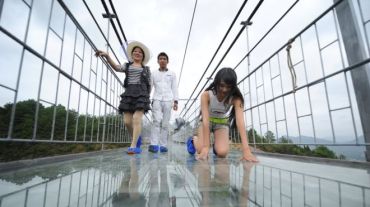
Tourism sites in the central Henan and Hunan provinces have been constructing vertigo-inducing skywalks in a bid to attract visitors.

And it seems to have worked, attracting thrill-seeking tourists and locals, all wanting a chance to experience a bird’s eye view of the Chinese countryside.

One of them is student Li Shu Zhen, 19, from Hangzhou city.

She shared with the BBC her experience of climbing the Brave Man’s Bridge in Pingjiang county, Hunan province.

“You look down and feel a sense of fear, but you quickly recover from that and enjoy the scenery,” she said.

“It was beautiful, almost as if one was walking on air.”

Yoga has been one of the stranger activities performed on the Brave Man’s Bridge

An eating challenge was held on this bridge in Yueyang country – although you might lose your appetite if you look downT

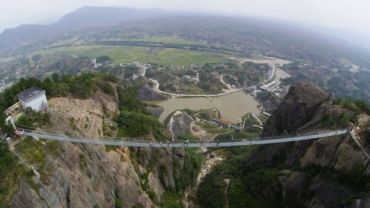
he fully transparent bridge, which measures 300m long (984ft) and 180m high, first opened to the public in September.

It is one of the more popular bridges, with events – like mass yoga displays – often being staged on it.

Local officials say that glass panels were designed to withstand high winds and earthquakes, as well as the “weight of 800 visitors”.

Glass bridge fever has also spread to neighbouring Taiwan, where a 179m-high bridge opened in Nantou county.

Construction has already begun on a second glass bridge above Zhangjiajie valley in Hunan province

‘Even if the glass breaks’

Construction on the latest bridge, touted as the world’s longest glass-bottomed walkway, is also nearing completion.

Standing at 300m high and stretching 375m, the bridge will hang above the Zhangjiajie grand canyon, also in Hunan province.

Gearing up for the bridge’s 2016 opening, officials have even enlisted the public’s help in naming it.

One of its engineers, Yang Guohong, from state-owned China Railway Major Bridge Reconnaissance and Design Institute, said contractors had taken extra safety precautions.

“No matter how the tourists jump on the bridge, it will still be fine,” he told the People’s Daily newspaper.

“The steel structures beneath it are incredibly dense, so even if the glass breaks, visitors won’t fall through.”

Would you dare to walk across?

But architects who spoke to the BBC said that such glass bridges were often “primarily a novelty, built as visitor attractions rather than commuter bridges”.

Architect Keith Brownlie, who was involved in a glass bridge for The London Science Museum, said that the appeal was “thrill”.

“It is the relationship between emotionally driven fear and the logical understanding of safety,” he said. “These structures tread the boundary between those two contrasting senses and people like to challenge their rational mind in relation to their irrational fear.

“Others felt that the bridges symbolised extravagance, especially in China.

“In architecture, glass has always been associated with luxury and often as a display of wealth,” said bridge designer Ezra Groskin.

“Glass floor panels, used in the creation of invisible architecture, are not a new phenomenon. However its use is often restricted due to cost and practicality.”

A terrifying incident last October sent visitors fleeing in fear after a section of a glass bridge in Yuntai mountain, Henan province, cracked

Shattered nerves

But how safe are China’s glass bridges?

An incident in October sent terrified visitors fleeing in fear after part of a glass skywalk in Henan province’s Yuntai Mountain Geological Park cracked, despite only being open for two weeks.

Park officials closed the walkway immediately, later saying there was “no reason for worry” and that the cracks had “no impact on safety”.

But experts questioned the use of glass in an exposed mountain environment.

“While a glass structure designed by a competent engineer and manufactured by a specialist contractor has no greater risk in terms of structural integrity than any other building material, glass can be prone to localised shocks,” noted architect Adam Holicska.

“The use of it in a mountain environment where there is a potential risk of rock impact can make it a questionable choice.

“Architect Keith Brownlie added that the cleaning of glass panels and lack of slip resistance should also be considered in such an environment.”One issue with glass decks is the problem of grip,” he said. “Glass is slippery and so anti-slip properties must be provided,”

The glass-bottomed Brave Man’s Bridge in Hunan province connects two mountains

“Please, no more such bridges,” commented a user on China’s popular micro-blogging site Weibo. “Judging from this incident, it is only a matter of time before more serious accidents and deaths occur.

“But glass bridge enthusiasts remain undeterred.

“I still would not hesitate to visit other glass bridges soon,” Ms Li admitted.

Other netizens on the site also expressed similar opinions.

“I am confident that officials will step up additional measures after that happened,” said one Weibo user.

“Thankfully deaths were avoided but one bad incident should not put one off from conquering such a spectacular bridge.”

Another compared it to other bridges of the world: “If Sydney’s Harbour Bridge experienced a crack, I doubt government officials would close it down. So we should not let such an episode affect our opinions about our unique Chinese structures.”

Source: China tourism: Crossing the new glass bridges – BBC News

Law of Unintended Consequences

continuously updated blog about China & India

ChiaHou's Book Reviews

continuously updated blog about China & India

What's wrong with the world; and its economy

continuously updated blog about China & India