Posts tagged ‘communist party of china’

27/07/2016

China’s Fosun to sign agreement for $1.4 billion Gland Pharma buy – paper | Reuters

Shanghai Fosun Pharmaceutical (Group) Co (2196.HK) will sign a definitive agreement on Wednesday to buy a controlling stake in India’s Gland Pharma in a $1.4 billion deal, the Economic Times newspaper reported, citing a source with direct knowledge.

In May, Shanghai Fosun had made a non-binding proposal to buy Gland Pharma, which is backed by KKR & Co (KKR.N), to boost its drug manufacturing and research and development capacity.

Fosun did not immediately comment, when contacted by Reuters. Gland Pharma made no immediate comment on the report.

The paper said KKR declined to comment.

Source: China’s Fosun to sign agreement for $1.4 billion Gland Pharma buy – paper | Reuters

25/07/2016

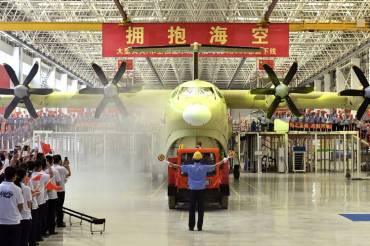
China Unveils ‘World’s Largest Amphibious Aircraft’ – China Real Time Report – WSJ

Chinese media said the AG600 giant aircraft, which rolled off a production line in Zhuhai in southern China on Saturday, will be used for marine rescue missions and forest fire fighting.

Source: Video: China Unveils ‘World’s Largest Amphibious Aircraft’ – China Real Time Report – WSJ

18/06/2016

Study Finds China’s Ecosystems Have Become Healthier – China Real Time Report – WSJ

China’s skies may be toxic, and its rivers fetid and prone to sudden infestations of pig carcasses. But according to a new study, the country’s environmental battle has also been making quiet, measurable progress.

The paper, a collaboration between U.S. and Chinese researchers published in this week’s issue of Science, found that China’s ecosystems have become healthier and more resilient against such disasters as sandstorms and flooding. The authors partly credit what they describe as the world’s largest government-backed effort to restore natural habitats such as forests and grasslands, totaling some $150 billion in spending since 2000.

“In a more and more turbulent world, with climate change unfolding, it’s really crucial to measure these kinds of things,” says Gretchen Daily, a Stanford biology professor and a senior author on the paper.

The study didn’t examine air, water or soil quality, all deeply entrenched problems for the country.

Beijing’s investments in promoting better ecosystem protection were triggered after a spate of disasters in the 1990s. In particular, authors note, two decades after China started to liberalize its economy, rampant deforestation and soil erosion triggered devastating floods along the Yangtze River in 1998, killing thousands and causing some $36 billion in property damage.

The government subsequently embarked on an effort to try to forestall such environmental catastrophes. According to the study, in the decade following, carbon sequestration went up 23%, soil retention went up 13% and flood mitigation by 13%, with sandstorm prevention up by 6%.

The paper also involved authors from the Chinese Academy of Sciences and the University of Minnesota, among other institutions. Data was collected by remote sensing and a team of some 3,000 scientists across China, said Ms. Daily, who praised the “big-data” approach to tracking the quality of China’s ecosystems.

“The whole world is waking up to the need to invest in natural capital as the basis for green growth,” she said.

Reforestation was one particular bright spot, she said. Under the country’s founding father, Mao Zedong, China razed acres of forests to fuel steel-smelting furnaces. To reverse the trend–and combat creeping desertification in the country’s north — the country embarked on a project in 1978 to build a “Great Green Wall” of trees. Today, authorities say that 22% of the country is covered by forest, up 1.3 percentage points compared with 2008.

The authors note that the study has limits. While China has reported improving levels of air quality in the past year, urban residents still choke under regular “airpocalypses.” The majority of Chinese cities endure levels of smog that exceed both Chinese and World Health Organization health standards.

“You can plant trees till the end of time,” says Ms. Daily. “But they’ll never be enough to clean up the air.”

Source: Study Finds China’s Ecosystems Have Become Healthier – China Real Time Report – WSJ

26/04/2016

As China’s Economy Slows, Unrest Among Veterans Rises – China Real Time Report – WSJ

Over lunch in a Beijing backstreet, four Chinese veterans raised glasses to toast their reunion with fiery “baijiu” liquor.

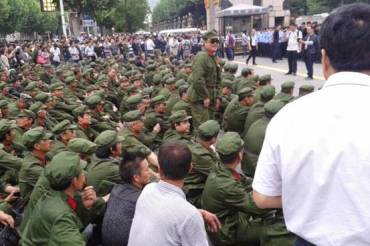
PLA veterans stage a sit-down protest outside government offices in Hubei province on May 4, 2015.

They’d not drunk together since they were in the same army unit, fighting skirmishes with Vietnamese forces in the aftermath of a 1979 border war.

Now in their 50s, they’d come here shortly before an annual parliament meeting in March to fight a different kind of battle – to demand the welfare support that they say was promised to them, and millions of other veterans, on leaving the armed forces years ago.

The four veterans, all from the southern province of Hunan, are an example of the problem facing President Xi Jinping as he prepares to lay off 300,000 out of 2.3 million troops in the biggest restructuring of the People’s Liberation Army, or PLA, since the 1950s.

China already has at least six million PLA veterans on state welfare, thousands of whom have staged well-organized protests in recent years over what they see as insufficient government support. Traditionally the government has offered subsidies to former soldiers and reserved slots for them at state-run companies, though many veterans say officials don’t follow through or that the perks aren’t enough to make ends meet.

Now, with an economic slowdown threatening to cause millions of state sector layoffs, prominent military figures have warned that veterans’ protests could escalate if the government can’t provide jobs or sufficient welfare support for the 300,000 being laid off.

One of the largest veterans’ protests was in June last year when several thousand, mostly veterans of China’s war with Vietnam, wearing uniforms and medals, protested outside offices of the Central Military Commission, which commands the armed forces and is headed by Mr. Xi.

A month earlier, there was another big veterans’ protest outside a Beijing courthouse. Smaller demonstrations occur frequently in other cities, according to experts who monitor them.

Many other veterans have tried to sue the government or lodge formal petitions, as the four in the restaurant did. Before lunch, they said, they’d submitted one at a nearby building that houses the petitions office of the Central Military Commission.

Officials there took the petition and scanned their identity cards, but gave them neither a receipt nor a reply, they said. “They just told us to go back where we came from,” said one of the four, a 54-year-old former worker in a coal-washing plant. “We got the feeling it was useless to go there.”

Source: As China’s Economy Slows, Unrest Among Veterans Rises – China Real Time Report – WSJ

18/03/2016

Deep in a pit | The Economist

COMMUNIST Party give us back our money”, “We want to live, we need to eat!” Such were the slogans daubed on banners that were displayed on March 12th during a protest by thousands of coal miners in the dingy streets of Shuangyashan, a city in Heilongjiang province near the border with Russia.

The demonstrators gathered outside the headquarters of Longmay, the largest mining company in the north-east and Heilongjiang’s biggest state-owned enterprise (SOE). They demanded wages which they said they had not received for at least two months. Some protesters blocked railway lines; others scuffled with police wearing riot gear. Internet censors deleted pictures of the unrest (such as the one shown) as they spread across social media.

The protest was one of the biggest by workers at an SOE for many years. It was an indication of the problems that China’s government will probably face as it seeks to cut excess capacity among SOEs like Longmay and reduce their enormous losses. In February the labour minister, Yin Weimin, said that 1.3m coal workers and 500,000 steel workers could lose their jobs over the next five years.

Other estimates say 3m-5m people may be thrown out of work in these industries as well as in aluminium production and glassmaking. That is far fewer than the tens of millions who lost their jobs during SOE restructuring in the late 1990s. But the economies of some cities, including Shuangyashan, are driven by a handful of large SOEs. In these, downsizing will be traumatic and possibly turbulent.

Labour unrest is rising everywhere as economic growth slows (see chart). Many firms, like Longmay, are reacting to financial distress by paying wages late or not at all. According to China Labour Bulletin, a Hong Kong-based NGO, there were 2,700 strikes last year, twice the number in 2014. In the two months leading up to China’s lunar new-year holiday in early February, there were over 1,000 strikes and protests, 90% of them related to the non-payment of wages. Three days after the protest in Shuangyashan, an almost equally large one began at Tonghua Steel in neighbouring Jilin province, also over wage arrears.

In Shuangyashan (its name, meaning Double Duck Mountains, refers to the shape of two nearby peaks), the authorities have tried to soothe the protesters by giving them overdue pay. Some mine workers say they have now begun receiving their salaries for January, and that they have been assured their pay packets for February will be coming soon. But the government remains nervous of further unrest. On March 15th police were still ubiquitous, on the streets of Shuangyashan as well as outside a nearby mine. In the city centre, a row of women who said the men in their families all worked in mines sat holding placards offering their services as cleaners or house painters. “We have no money to eat. What do they expect us to do?” said one woman angrily before being told by police to stop talking. A man who identified himself as a government official followed your correspondent everywhere.

The protests in Shuangyashan were particularly embarrassing for the party, occurring as they did during the 12-day annual session of China’s parliament, the National People’s Congress (NPC), which ended on March 16th. Every year during the NPC session, officials try even more strenuously than usual to prevent street unrest, lest it tarnish the image of political unity and national prosperity that they want the NPC to project (see article). Party bosses in Heilongjiang will get their knuckles rapped by leaders in Beijing for failing to anticipate this outbreak, which followed months of grumbling among Longmay’s workers about lay-offs and overdue pay. In September, the company said it would shed 100,000 of its 240,000 staff.

Source: Deep in a pit | The Economist

21/02/2016

Xi takes nuclear option in bid to rule for life | The Sunday Times

Very worrying, if true.

CHINA is moving towards one-man rule as the state media step up demands for personal loyalty to President Xi Jinping, a departure from the Communist party’s collective leadership of recent decades.

Xi Jinping appears to be building a personality cult around him as Mao did

Last week the party’s flagship newspaper issued a call for Xi to have the power to “remake the political landscape of China”. The article, supposedly written by one of a literary group, was put out on a social media account run by the People’s Daily. It said all communists must be loyal to Xi and “line up with the leadership”.

The campaign to enshrine Xi as the infallible “core” of authority is worrying many inside the political elite and coincides with China exerting its military muscle and possibly preparing to change its nuclear weapons strategy.

The People’s Liberation Army (PLA) has just stationed surface-to-air missiles on a disputed island in the South China Sea. The Chinese expansion comes as Barack Obama rallies Asian nations to support free navigation in the strategic waterway. The prospect of one man dominating the party, the state and the army in China could be the most challenging test in the next American president’s in-tray.

Xi’s grand plans include a total reorganisation of the Chinese military command structure that has included an internal debate about its nuclear weapons. Xi recently formed a dedicated PLA rocket force to control the nuclear ballistic missile arsenal. A report for the Union of Concerned Scientists, a US-based group, says China may be considering placing its nuclear forces on alert, which means that, like America and Britain, its weapons would be ready to fire on command.

That would be a shift of position for a nation that affirms it will not be the first to use nuclear weapons in any conflict. China has already started an ambitious programme to upgrade its older missiles with multiple warheads like those of other nuclear powers.

Rising military budgets show that despite the slower Chinese economy and big flows of capital out of the country, Xi is seizing any initiative to turn nationalism to his advantage. A source who grew up in the party’s privileged residential compounds in Beijing said the moves harked back to an earlier era: “There is a fear among the families, the long-time party members for generations, that this guy wants to make himself into another Chairman Mao and rule for life.”

It is clear that, like Mao, Xi, 62, is using articles and essays in the state media, often penned by pseudonymous authors or published in the provinces, to intimidate his enemies and promote himself.

Last week a social media platform controlled by the Beijing Daily, the voice of the capital’s municipal committee, launched a striking attack on a party faction opposed to Xi, the Communist Youth League. Officials connected to the league were “ambitious aristocrats whose self-serving attitude did no good to the party and led to scandals”, it sneered.

Targeting the league — whose members include the prime minister, Li Keqiang, and the former president, Hu Jintao — is a signal that Xi has broken with the consensus set after the unrest of 1989 that the party’s factions do not attack one another in public. In the past, a league connection meant a fast-track to promotion for young high-flyers. Now it seems to be a liability.

A study by the Central Commission for Discipline Inspection — the party watchdog unleashed by Xi against rivals accused of corruption — has criticised the “mentality” of league members. The commission’s propaganda publication, the China Discipline Inspection Paper, warned against “those who form their own circles inside the party” and referred to fallen officials as “gangs”.

This Mao-era language singled out the “petroleum gang” under the purged security chief, Zhou Yongkang, whose cronies dominated the Chinese oil industry, and the “secretary gang” around Ling Jihua, a close aide to Hu and a former league stalwart. Ling is already under arrest on corruption and bribery charges.

Defining people as members of “gangs” or “cliques” is a classic tactic of communist infighting and a prelude to destroying them.

Chilled by the signals from the top, half the provincial party chiefs in the country this month pledged allegiance to Xi as “the core”.

The term represents a significant change from the language used about Xi’s predecessors, Hu and Jiang Zemin, who were referred to as being only “at the core” of a collective leadership. The last strongman in China, Deng Xiaoping, exercised his power behind the scenes and scorned a cult of personality.”

Source: Xi takes nuclear option in bid to rule for life | The Sunday Times

14/01/2016

Xi’s new model army – The Economist

Xi Jinping reforms China’s armed forces—to his own advantage

CHINA’S biggest military shake-up in a generation began with a deliberate echo of Mao Zedong.

Late in 2014 President Xi Jinping went to Gutian, a small town in the south where, 85 years before, Mao had first laid down the doctrine that the People’s Liberation Army (PLA) is the armed force not of the government or the country but of the Communist Party. Mr Xi stressed the same law to the assembled brass: the PLA is still the party’s army; it must uphold its “revolutionary traditions” and maintain absolute loyalty to its political masters. His words were a prelude to sweeping reforms in the PLA that have unfolded in the past month, touching almost every military institution.

The aim of these changes is twofold—to strengthen Mr Xi’s grip on the 2.3m-strong armed forces, which are embarrassingly corrupt at the highest level, and to make the PLA a more effective fighting force, with a leadership structure capable of breaking down the barriers between rival commands that have long hampered its modernisation efforts. It has taken a long time since the meeting in Gutian for these reforms to unfold; but that reflects both their importance and their difficulty.

The PLA itself has long admitted that it is lagging behind. It may have plenty of new weapons—it has just started to build a second aircraft-carrier, for instance—but it is failing to make effective use of them because of outdated systems of command and control. Before any substantial change in this area, however, Mr Xi felt it necessary to strengthen the party’s control over the PLA, lest it resist his reforms and sink back into a morass of money-grubbing.

The reforms therefore begin with the main instrument of party control, the Central Military Commission (CMC), which is chaired by Mr Xi. On January 11th the CMC announced that the PLA’s four headquarters—the organisations responsible for recruiting troops, procuring weapons, providing logistics and ensuring political supervision—had been split up, slimmed down and absorbed into the commission. Once these were among the most powerful organisations in the PLA, operating almost as separate fiefs. Now they have become CMC departments.

Power to the party

The political headquarters was the body through which the party kept an eye on the ranks and ensured they were up to speed on Maoist texts and the party’s latest demands. The loss of its autonomous status may suggest that the party’s role is being downgraded. Far from it. Now the party’s CMC (there is also a state one, which exists only in name) will be better able to keep watch. The body’s 15 new departments will include not only departments for politics but also for logistics, personnel management and fighting corruption. Mr Xi has already turned his guns on graft, imprisoning dozens of generals.

The second reform has been to put the various services on a more equal footing. The land forces have hitherto reigned supreme. That may have been fine when the PLA’s main job was to defend the country against an invasion across its land borders (until the 1980s the Soviet Union was considered the biggest threat). But now China has military ambitions in the South China Sea and beyond, and wants the ability to challenge American naval and air power in the western Pacific. A recent editorial in the Liberation Army Daily, a PLA mouthpiece, berated the armed forces for their “army-centric mindset”.

In addition to those for the navy and air force, a separate command has now been created for the army, which had previously run everything. On December 31st the CMC also announced the formation of a command responsible for space and cyberwarfare, as well as one for ballistic and cruise missiles (previously known as the Second Artillery Force, part of the army). There is also a new joint command with overall control of the various services, a little like America’s joint chiefs of staff.

Big changes are also afoot in regional command structures. China used to be divided into seven military regions. These were powerful and relatively self-contained; sharing or swapping troops and equipment was rare. Now, according to reports in the South China Morning Post, a newspaper in Hong Kong, the number will be reduced to five. Troops will be recruited and trained by the various services before regional deployment. This will ensure greater central control over the regions.

China has been talking about military reform for decades, but change has been glacial. Opposition within the armed forces has been intense. “If [reform] is not done properly,” wrote Sun Kejia and Han Xiao of the PLA National Defence University last month, “it could affect the stability of the armed forces or even all of society.” (The article was promptly removed from the Liberation Army Daily website.) Demobbed soldiers could make trouble—Mr Xi wants the number of troops to be cut by 300,000. State firms have been ordered to reserve 5% of jobs for laid-off veterans.

The recent reforms are more extensive than most Western observers had expected after the Gutian conference. But even so, they are incomplete. The army still holds sway over some appointments (all five chiefs of the new regional commands are army generals, for instance). The PLA has traditionally given higher status to combat units than to those providing communications, logistics, transport and the like, a misplaced emphasis in an age when information and communications are crucial in warfare. The reforms do little to correct that bias. Moreover, many details about them remain unclear. No one knows, for example, where the troop cuts will come from or what units will go into the new space and cyberwarfare command.

The first result of the reforms is likely to be confusion in the ranks, until the new system settles down. Dennis Blasko, an American observer of the PLA, says no one can be sure of the results until they are tested in battle. Amid the murk, only one man clearly seems to have got his way: Mr Xi.

From: http://www.economist.com/news/china/21688424-xi-jinping-reforms-chinas-armed-forcesto-his-own-advantage-xis-new-model-army

30/12/2015

Top 10 policy changes in China in 2015

  1. Two children for all couples

China will allow all couples to have two children, abandoning its decades-long one-child policy, the Communist Party of China announced in late October. The change is intended to balance population development and address the challenge of an ageing population.

Under the new policy, couples who have two children can enjoy longer maternity leave and they could have more than two children if eligible. Current longer marriage and maternity leaves enjoyed by citizens who marry late and delay having children will be removed, and so will the rewards for couples who volunteer to have only one child.

The two-child policy will come into force on Jan 1.

2. Raising the retirement age

The 13th Five-Year Plan (2016-20) proposes progressively raising the retirement age to help address the country’s pension pressure and labor shortage.

On Nov 20, the Ministry of Human Resource and Social Security said raising the retirement age will be done progressively in small steps. The authority will raise the retirement age by several months every year, and the policy adjustment will be made public in advance. The Ministry of Human Resources and Social Security is drawing up the policy and will solicit public opinions on the completed draft.

In 2017, China should complete the integration of its two pension systems. From 2018, the retirement age for women should be raised one year every three years, and the retirement age for men should be raised one year every six years. This means in 2045, the retirement age for both men and women will be 65.

3. Household permits on the way for all

China will provide unregistered citizens with household registration permits, a crucial document entitling them to social welfare, according to a high–level reform meeting held in early December.

“It is a basic legal right for Chinese citizens to lawfully register for hukou. It’s also a premise for citizens to participate in social affairs, enjoy rights and fulfill duties,” said a statement released on Dec 9 after a meeting of the central leading group for comprehensively deepening reform.

The meeting was told that registration should take place regardless of family planning and other policy limits, and that those without hukou who face difficulties in applying should have their problems solved.

4. Unified pension system

The landmark pension reform plan, announced by the State Council on Jan 14, aims to eliminate the dual-track pension system in China.

New measures on old-age insurance were unveiled for the nearly 40 million workers in government agencies and public institutions, most of whom are civil servants, doctors, teachers and researchers. Insurance will now be paid by both workers and organizations, instead of just by organizations or central finance as in the past.

Before the measures were introduced, corporate employees had to pay for their own old-age insurance, while government staff enjoyed pensions without making any contribution at all. The reform helps to bring fairness and quench long-term public outcry.

5. Rural residents encouraged to buy properties in cities

China will roll out measures to reduce its property inventory and stabilize its ailing housing market, said a statement released on Dec 21 after a key policy meeting.

Rural residents relocating to urban areas should be allowed to register as city residents, which would enable them to buy or rent property, according to the conference.

In addition, a low-rent public housing program will cover those without household registration.

6. Harsher environmental protection law

China’s revised Environmental Protection Law came into effect on Jan 1, bringing with it heavier punishments.

According to the revised law, extra fines accumulating on a daily basis will be imposed on enterprises that fail to rectify violations.

Local officials may be demoted or sacked for misconduct, including the concealment of offenses, falsifying data, failing to publicize environmental data, and not giving closure orders to enterprises that illegally discharge pollutants.

7. Entrepreneurship encouraged among college students

The Ministry of Education announced in May that more than 30 measures would be introduced to support students starting their own businesses, and for innovation in scientific and academic research.

The measures are outlined in a series of guidelines released by the State Council, including developing and opening compulsory and selective courses for students, and awarding them credits for taking the courses.

Establishing innovation and entrepreneurship records, with transcripts for students, encouraging teachers to guide students in innovation and starting up businesses, and providing them with funds and supporting them to take part in entrepreneurship contests are also on the list.

8. New plan targets water pollution

China released the Action Plan for Water Pollution Prevention and Control on April 16 to tackle serious water pollution, aiming to intensify government efforts to reduce emissions of pollutants and to protect supplies.

The plan calls for 70 percent of the water in the country’s seven major river basins, including the Yangtze and Yellow rivers, to be in good condition by 2020, and for a continued improvement to 75 percent by 2030.

The amount of “black and smelly water” in urban areas will be reduced to 10 percent by 2020 and will largely disappear by 2030.

9. Toughest smoking ban in Beijing

A new regulation on tobacco use took effect in Beijing on June 1. The regulation extends existing smoking bans to include all indoor public areas and workplaces, plus a number of outdoor areas, including schools, seating areas in sports stadiums and hospitals where women or children are treated.

Violators will face fines of up to 200 yuan ($32), a twentyfold increase from the previous 10-yuan penalty stipulated by the previous regulation adopted in 1996. Owners of buildings classified as public places, such as restaurants, that fail to stop smokers lighting up face fines of up to 10,000 yuan.

Members of the public can report violations to the authorities by dialing a health hotline (12320) or via social media.

10. Price control on most medicines lifted

China has lifted price controls on most medicines since June 1 with the intention of creating a more market-driven pricing system that will help keep medical costs in check.

Only narcotics and some listed psychotropic drugs continue to be controlled by the government, with ceiling retail prices.

Public health departments must boost supervision on medical institutions and check improper medicine and medical equipment use, as well as excessive checkups and treatment, according to a notice issued in May.

From: http://usa.chinadaily.com.cn/china/2015-12/28/content_22835045.htm

17/11/2015

The north star | The Economist

ASKED what they think of Lu Hao, their governor, residents of Harbin, capital of the north-eastern province of Heilongjiang, often reply with the word xiaozi. This roughly translates as “young whippersnapper”.

Mr Lu’s youthfulness is indeed striking. Born in 1967, he is the youngest of China’s current provincial governors. He was also the youngest to hold most of his previous positions. Those include factory boss at a large state-owned enterprise, deputy mayor of Beijing and leader of the Communist Youth League, an important training ground for many a national leader.

China’s system of political succession produces occasional surprises, such as the purge three years ago of another provincial leader, Bo Xilai, on the eve of what appeared to be his likely elevation to the pinnacle of power, the Politburo Standing Committee, alongside Xi Jinping, who is now president. But at least since the Communist Party began institutionalising succession arrangements in the 1990s, high-flyers have often been easy to spot. Mr Lu is one of them.

His stint at the youth league was of greatest portent. The organisation is something like an American fraternity club (without the misbehaviour)—its members form close ties which are often maintained in their later careers. Its leaders have a tendency to move into high national office. Hu Yaobang, a party chief in the 1980s, grew to prominence in the league, as did Hu Jintao, Mr Xi’s predecessor. Li Keqiang, the current prime minister, is also an ex-head of the league. Mr Lu’s stint in that role from 2008-13 made him an obvious rising star. His subsequent promotion to a provincial governorship confirmed this impression.

Youth is on his side. The next rung on the ladder to the top may be induction into the 25-member Politburo, possibly as early as 2017. But it will not be until around the time of the party’s 20th congress in 2022—a year after its 100th birthday—that Mr Xi will retire and Mr Lu will have a chance to shine, likely as one of the (now seven) members of the Standing Committee. He will then be 55, a year older than Mr Xi was when he joined the body in 2007. That would give Mr Lu a good few years at the top: Standing Committee members are expected to retire around 70. He would be a member of what party officials already call the “sixth generation” of Communist leaders (the first having been led by Mao Zedong, Mr Xi representing the fifth).

There are several other likely members of the upcoming generation. They include Hu Chunhua, Mr Lu’s predecessor as head of the youth league who is now the party boss of the southern province of Guangdong; and Sun Zhengcai, the party chief of Chongqing, a south-western region. One rising star has already fallen, however. Su Shulin was thought to have bright prospects until he was removed as governor of coastal Fujian province after being snared in a corruption investigation in October.

China’s media often drop hints of who to watch. Mr Lu’s appointment as Heilongjiang’s governor (a few months after he became the youngest full member of the party’s 370-strong Central Committee) was accompanied by a flurry of celebratory articles in the party’s main mouthpiece, the People’s Daily, and other newspapers. They emphasised Mr Lu’s youth, impeccable work ethic and solid record of excellent performance in his previous jobs.

Source: The north star | The Economist

04/11/2015

Are Chinese ‘Too Rational’ for a Second Child? Interview With Mei Fong – China Real Time Report – WSJ

China’s announcement last week that it will let all couples have two children ended one of the most contentious birth restrictions in history–the one-child policy.

Implemented in 1980 to rein in explosive population growth during the Mao Zedong era, the one-child policy and its enforcement had myriad consequences, including forced abortions and sterilization. It placed the burden of elderly care on single children and fueled a gender imbalance. Some researchers also say a new generation of only children – or “little emperors” — are more pessimistic and less competitive than older generations with siblings. Now, the Chinese government is shifting course to offset the effects of a rapidly aging population and to avert labor shortages.

China Real Time spoke to Mei Fong, author of the book “One Child: The Past and Future of China’s Most Radical Experiment” and a former Wall Street Journal reporter, about the one-child policy and the unwinding of it. The book will be published in hardcover in January, but a digital edition was released Tuesday, Nov. 3. Below are edited excerpts of the interview: Mei Fong

Many couples say that despite changes in the policy, they will not have two children. What can the government do to promote births?

There was a recent Internet survey [on Chinese website Sina of 180,000 respondents who were asked if they wanted a second child] saying that 43% of people don’t want children. But there’s a difference of what people say and what they will do. A lot of people ideally want to have two so that they can have both a boy and a girl. The problem is that the one-child policy wasn’t the sole reason people weren’t and aren’t having children. For urban residents, the idea of having just one has been ingrained in them. It’s a social and economic decision and it would take a major mind shift to think of anything else.

People consider it almost it irresponsible to divert resources from any child.

One of the things that demographer Cai Yong said that has always stuck in my mind is that people are too rational for the business of having children.

Who are the likely candidates to have more children?

It’s the rich ones who will add a child. Wealthy people have been traveling to the U.S. for fertility services and U.S. passports , though it’s unclear how many. I know of one couple in Shanghai who had three children by going to the U.S. Houghton Mifflin Harcourt

But it’s hard to make generalities about China. It’s a big place and we all know someone who has had a second child or third child.

Will that mean that a two-child policy will create a bigger upper class? And what will be the consequence? One of the things that the one-child policy has created already is an inequality gap. The spectrum hit the middle class, because the people above the middle class can afford to pay for it, while the ones below were often exempt. The one-child policy is adding to the class-struggle issues. It’s the rich people who have and will have bigger families. They’re the ones that can afford fertility treatment, because fertility is a major problem. They could always afford to pay the penalties [for having more than one child].

Several years ago, there was a study that said China’s single children, its little emperors,  were less competitive and less empathetic than those with siblings. Do you see that changing? I have some doubts about that because there have been many different studies on this. But certainly, they do seem to give themselves more pessimistic labeling, like diao si [roughly translated as loser], than others.

Source: Are Chinese ‘Too Rational’ for a Second Child? Interview With Mei Fong – China Real Time Report – WSJ

Law of Unintended Consequences

continuously updated blog about China & India

ChiaHou's Book Reviews

continuously updated blog about China & India

What's wrong with the world; and its economy

continuously updated blog about China & India