Posts tagged ‘Education’

25/08/2016

TV Show Spotlights Middle Class Anxieties in China – China Real Time Report – WSJ

A hit Chinese TV drama that tells the story of three families who sent their young teens to study abroad has surfaced middle-class doubts about their future in the country.
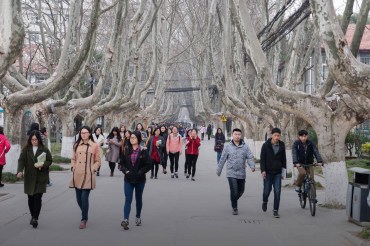
“A Love for Separation,” based on a novel by Lu Yingong, started screening last week and grabbed the public’s attention despite competing with the Olympic games for viewers. Users on the cultural website douban.com gave the show an average score of 8.2 out of 10.

Some critics say it reflects a widespread anxiety among China’s middle class: they constantly feel insecure and believe that the only way for their children to get a better life is to leave China and pursue their dreams elsewhere. The story line has triggered discussions about the country’s test-based education system and about “tiger” mothers, fathers and teachers. Many scenes of domestic conflict in the show center around the children’s test scores.

In one clip circulating on social media, Fang Duoduo, a ninth-grader, yells at her father, “You want respect from me? You only treat me like an exam machine!”

In this still from the TV show “A Love for Separation,” the character Fang Duoduo’s mother helps with her homework late at night.

PHOTO: SCREENSHOT

Stress about the highly-competitive gaokao, or college entrance exam, is one of the reasons why some parents would rather send their kids abroad to study.

In the show, Duoduo’s mother tells her, “If you can’t make sure you in the top 100 right now, you won’t enter a key senior high school. If you can’t enter a key senior high, you won’t enter a key university. If you can’t enter a key university, you whole life is done.”

In China, college admission hinges on the gaokao, which can only be taken once annually. Competition is so intense that parents would do anything to make sure their kids’ sail through the exam without interruptions. Last summer, a Sichuan family made headlines when it emerged that a mother hid from her daughter news of her father’s death for nearly two weeks until she’d finished taking the test, for fear it would influence her results.

The show reflects a “collective anxiety” among the middle class, the writer Huang Tongtong said in an article on her public WeChat account.

“Do you sometimes feel like everything you own is so fragile? Is it merely a fluke that you have the kind of life you live? Do you have the confidence that your children can live a good life? These are the questions that each one of us has to face,” Ms. Huang wrote.

Frustrated with a rigid education system and a growing list of grievances, more and more well-off Chinese parents send their children away when the children are increasingly young. More than 520,000 people left China to study abroad last year, up nearly 14% from 2014, according to China’s education ministry.

In a survey of 458 Chinese millionaires by China Citic Bank and Hurun Report, 30% of them said they plan to send their children to attend senior high schools overseas, while 14% of them said their children should leave at a younger age, for junior high school.

In the U.S. alone, Chinese students make up about half of the 60,815 foreign pupils in high schools and 6,074 in primary schools.

“The show makes me so sad. I used to argue with my parents all because of my scores. Study is the most important issue in my family. Only study study hard, there was never love and care,” said one user on the Twitter-like Weibo platform in China.

Source: TV Show Spotlights Middle Class Anxieties in China – China Real Time Report – WSJ

24/06/2014

A Neglected Problem in China’s Education System – China Real Time Report – WSJ

China’s top two leaders recently presided over a rare discussion on vocational education where they pushed for major changes to the country’s retrograde technical schools.

Political leaders everywhere are known to pay lip service to the need for improvements in education, but concern over China’s vocational schools is likely more than that just political bluster. That’s because the quality of the country’s lower-level technical schools could have a major impact on the country’s future economic growth.

As China looks to climb into the ranks of developed nations, one of its main goals is to evolve beyond serving as the world’s factory floor. One barrier to achieving that goal, analysts and education officials say, is the country’s lack of highly-skilled workers.

Premier Li Keqiang emphasized that point at Monday’s meeting, saying a “massive skilled labor force” was needed to upgrade the “made in China” label, “from ‘adequate’ to  ‘high-quality’ and ‘premium’” (in Chinese).

Mr. Li was talking at an unusual national-level work conference on vocational education – only the 3rd such conference to be held in China since 1978. China’s President Xi Jinping gave the opening remarks, according to the state-run Xinhua news agency, signifying the level of importance China’s leadership places on the topic.

The attention is warranted: China’s vocational programs — which teach practical skills ranging from carpentry to forestry and encompass more than 29 million students, according to Xinhua — have been badly neglected when compared with the country’s rapidly multiplying universities. Often criticized for being poorly equipped, they are also poorly managed and have trouble finding qualified teachers, experts say.

“In the vast majority of vocational education schools in China, kids are not learning anything, especially in rural areas,” said Scott Rozelle, director of Stanford University’s Rural Education Action Program, which studies China’s vocational schools. “In studies in central and northwest China, we found dropout rates of 50% in the first two years of these programs.”

Mr. Rozelle said that China’s vocational schools are the only segment of China’s educational system that lacks an evaluation system, so it is difficult to tell which schools are good and which subpar.

China is currently home to 13,600 vocation schools and colleges, which provide a large chunk of the country’s workers in labor-intensive industries. According to government estimates, they are expected to attract more than 38 million students by 2020.

The government is now pushing a number of changes to the vocational school system, including requiring local government to allocate a standard budget for vocational schools as they do for regular colleges, according to Xinhua. Private investors and non-governmental organizations are also encouraged to sponsor vocational schools, and private vocational schools will enjoy preferential loans from banks.

The state-run China Daily newspaper called the government’s recent attention to vocational schools “unprecedented”. But the devil is in the details. It won’t be clear until later how much money local governments will actually budget to upgrading the vocational school system and what kind of incentives there will be to improve.

via A Neglected Problem in China’s Education System – China Real Time Report – WSJ.

02/05/2014

Chinese College Grads Choose Jobs Over More Study – Businessweek

As China’s college students prepare for graduation, more are aiming to join the job market than ever before.

Job seekers in Hong Kong

More than 76 percent of those surveyed say they plan to begin working immediately after graduation, up from 73.6 percent last year and 68.5 percent in 2012. Meanwhile, about one-fifth say they will continue with higher education and 4 percent plan to start their own businesses.

That’s shown in an annual survey by Zhaopin.com, one of China’s largest job-seeking websites, which was released on April 15. Zhaopin canvassed more than 52,000 college students across China, 70 percent of which were in their final year as undergraduates, with the remainder being graduate students.

via Chinese College Grads Choose Jobs Over More Study – Businessweek.

Enhanced by Zemanta
30/03/2014

Accomplished women in India face higher risk of domestic violence: study | India Insight

Women in India who are more educated than their husbands, earn more or are the sole earners in their families face a higher risk of domestic violence than women who are more dependent on their partners, according to a new study.

Much of India is still deeply patriarchal and there are wide gaps in the status of men and women. And this form of violence could be a way for men to reassert their power or maintain social control over their wives to preserve the “status quo” in the relationship, said the study’s author Abigail Weitzman.

Weitzman, a graduate student at New York University, looked at data from the female-only module of India’s National Family Health Survey (NFHS) collected between 2005 and 2006, concentrating on married women.

The study found that compared to women less educated than their husbands, women with more education face 1.4 times the risk of violence from their partners, 1.54 times the risk of frequent violence, and 1.36 times the risk of severe violence.

The study appeared in the latest issue of the Population and Development Review, a peer-reviewed journal published by the Population Council, an international non-profit organization that conducts research on development issues.

“The result of such violent responses may in turn prevent some women from pursuing employment or greater earnings opportunities either because they have been injured or because the material benefits of such opportunities no longer outweigh the physical costs at home,” the study said.

via Accomplished women in India face higher risk of domestic violence: study | India Insight.

Enhanced by Zemanta
13/02/2014

* China spends billions on rural education – Xinhua | English.news.cn

The Chinese central government has invested 61.8 billion yuan (10.1 bln U.S. dollars) improving schoolhouses and educational facilities in rural areas over the past four years.

Since 2010, 39.9 billion yuan from the central budget has been used in schoolhouse renovation and 21.9 billion yuan in educational equipment, said Liu Limin, deputy minister of education, at a press conference on Thursday.

Money was also used to build cafeterias at schools in 699 “poor” counties, after media reports exposed that some students in remote villages have to cook for themselves during study time, according to Liu.

The deputy minister revealed that the ministries of education and finance and the National Development and Reform Commission jointly worked out a plan on improving the level of education in poor areas at the end of last year.

The plan aims at completing six major tasks in three to five years, including improving basic school facilities like teaching equipment, sports grounds and toilets, promoting digital teaching methods and improving the quality of teaching staff, according to Liu.

He also said that the ministry will try to ensure better compulsory education and care for 23 million rural left-behind children at school age, who stayed alone or with their relatives while their parents go to cities to make a living.

via China spends billions on rural education – Xinhua | English.news.cn.

Enhanced by Zemanta
29/12/2013

Centre mulls $3 billion fund for Muslims’ education – The Times of India

The Centre on Saturday said it will soon announce a special fund to the tune of $3 billion for uplift of the Muslim people by providing infrastructure, mainly for education.

\”We need infrastructure. Indian Muslims need education and for that we need infrastructure. Currently we lack in infrastructure,\” Union minister for minority affairs K Rahman Khan said here.

\”We are working on to create a fund of $2-3 billion, which will be around Rs 10,000-15,000 crore. Even if only one per cent of Indian Muslims donate, we will be able to generate this amount,\” Khan said while delivering the keynote address during a function of American Federation of Muslims of India origin.

He said Muslim people in India have the resources but only need the mechanism to generate and manage the fund.

When asked by when the government is likely to finalize the fund, Khan said \”We have been working on this for some time. Now we are going to announce it very soon.\”

He further said the government is taking all necessary steps to improve the conditions of the Muslims.

\”The only priority of Indian Muslims is education. If you are educated, the society can be changed … Do not think that you are a minority, think that you are the second largest population in India,\” Khan said.

via Centre mulls $3 billion fund for Muslims’ education – The Times of India.

06/12/2013

One Silver Lining of China’s Lopsided Labor Market: Shrinking Income Inequality – Businessweek

In the same week that international educators are debating the comparative merits of global school systems—and whether China’s PISA scores are overhyped—a new report from China Economic Quarterly sheds light on an unintended consequence of China’s recent push to expand higher education.

The annual supply of fresh college graduates far exceeds the number of white-collar positions available in China. Meanwhile a dwindling pool of young people willing to work in Chinese factories has driven up assembly-line wages. The result, conclude GK Dragonomics analysts Andrew Batson and Thomas Gatley, is an unexpected narrowing of China’s worryingly high level of income inequality.

Over the past decade, China has rapidly expanded access to higher education. University enrollment tripled from 2000 to 2010, from 2.2 million to 6.6 million students. Unfortunately, job creation didn’t keep pace. According to survey results from China’s labor ministry obtained by China Economic Quarterly, there were 100 job applicants in mid-2013 for every 80 white-collar jobs in China. For blue-collar positions, however, the scenario was reversed: There were 100 applicants for every 125 slots in China.

via One Silver Lining of China’s Lopsided Labor Market: Shrinking Income Inequality – Businessweek.

24/11/2013

Nearly 1 mln sit Chinese national civil servant exam – Xinhua | English.news.cn

As many as 990,000 candidates took the National Public Servant Exam on Sunday, a decrease of 130,000 from last year, according to the State Administration of Civil Service.

China\’s central authority, their affiliated public institutions and local branches will recruit over 19,000 civil servants in 2014, a slight drop from 2013, according to a statement from the administration.

One out of 51 exam takers will succeed in gaining a post this year, according to the statement.

The annual exam includes an aptitude test and a written policy essay, and those who pass the written exam will make it to the interview round.

The popularity of the exam has been attributed to mounting pressures in finding employment, fairness of the test, and the attractiveness of civil servant jobs, which are stable and respected.

Statistics from the administration showed that there were 7.089 million civil servants in China by the end of 2012.

via Nearly 1 mln sit national civil servant exam – Xinhua | English.news.cn.

16/09/2013

China’s wealthy increasingly attracted to Britain’s elite secondary schools

SCMP: “A decade after Bo Guagua, grandson to a revolutionary hero and son of fallen Communist Party leader Bo Xilai, became the first Chinese to attend Britain’s elite Harrow School, agencies promising access to Britain’s top independent schools are expanding rapidly to cope with rising demand from the growing pool of high-net-worth individuals from China.

handout_tonbridge_36295771.jpg

The London-based education consultancy Gabbitas opened its first office in Shanghai in 2009. Four years later, it also advises well-off parents in Guangzhou, Wenzhou and Dalian on how to get their children into secondary schools once reserved for British and continental European aristocracy.

Within five years the agency plans to open another 12 branch offices, said Sofie Liao, director of Gabbitas in China. Schools like Eton and Harrow “are getting more and more enquiries from Chinese families,” she said, anticipating annual growth rates of 10 to 15 per cent.

Liao’s biggest challenge is to lower parents’ expectations, she said. Parents “have to be realistic,” she said. They “tend to think, you register with Eton and then you need to pack your luggage and go there next year.”

These schools “have royalty, they don’t care how much money you have in your bank account or how many listed companies you have,” Liao said.

She said parents are signing up their children to join the UK’s exclusive schools at a younger age to increase their chances of being accepted. “The youngest students we have are pre-prep school age, two to three years old. They have to wait another 11 years before they can get in.”

“It’s a very long selling cycle,” said Jazreel Goh, director for education marketing at the British embassy in Beijing, adding that such agencies are unlikely to be challenged by the average Chinese rivals.

“The market is a very niche and specialised service. The bar for being a good boarding school agent is set quite high – you have to have the network of boarding schools and you have to know which might suit the applicant,” she said.

Goh estimated that there are about ten professional boarding school agencies in China. The trend she has seen is more upper-middle-class parents signing up with agencies to send their children to the UK.

Students from China, including Hong Kong, make up by far the largest group of foreign students studying at British independent schools, according to a census in January this year surveying more than a thousand schools by the British Independent School Council. Among the 25,912 foreign secondary school children in Britain, 9,623 or 37.1 per cent came from China.”

via China’s wealthy increasingly attracted to Britain’s elite secondary schools | South China Morning Post.

30/08/2013

Chinese Students Bolster U.S. College Budgets

NY Times: “Washington Monthly’s annual college issue usually has some fascinating material, and this year is no exception. One example is an article by Paul Stephens on the sharp rise in foreign students on American campuses (to more than 764,000, an increase of roughly 200,000 in less than six years, he says, citing data from the Institute of International Education and the State Department). Many are from wealthy overseas families paying full tuition — and helping to bolster college budgets.

Where are the students coming from? By this reckoning, the bulk of the net increase — more than 160,000 of the 200,000 — has come from China.

Washington Monthly

Mr. Stephens writes:

While administrators promote the diversity and global perspectives these new students bring to campus, it’s clear that such high-minded goals are not the only motivation for enrolling large numbers of foreign students. With state spending on higher education declining sharply over the last five years — it’s down an average of 28 percent nationwide — out-of-state and international students who pay full tuition (and sometimes even additional tuition) have kept these institutions in the black. As state assemblies have cut back, the people of China have picked up the tab.

State Department statistics on F-1 student visas issued to applicants from four selected nations.State Department statistics on F-1 student visas issued to applicants from four selected nations.

via Chinese Students Bolster U.S. College Budgets –

Courtesy:

Arijit Banik

Senior Manager, Economics, Pension Monitoring & Hedging at RBC Investor Services

Law of Unintended Consequences

continuously updated blog about China & India

ChiaHou's Book Reviews

continuously updated blog about China & India

What's wrong with the world; and its economy

continuously updated blog about China & India