Posts tagged ‘Foreign direct investment’

24/06/2016

Two stumbles forward, one back | The Economist

LAST November, two days after India’s ruling party suffered a drubbing at local polls in the state of Bihar, the government unexpectedly opened a dozen new industries to foreign direct investment (FDI). A gushing official called it “the biggest path-breaking and the most radical changes in the FDI regime ever undertaken”.

On June 20th, two days after Raghuram Rajan, the respected governor of India’s central bank, abruptly announced that he would soon step down, the government covered its embarrassment with another impromptu salute to FDI. The slim package of enticements, amounting to a slight lowering of barriers in some of the same industries, has made India “the most open economy in the world for FDI,” said the office of Narendra Modi, the prime minister.

Hyperbole is not unexpected from a government keen to burnish its liberalising credentials. But it has not lived up to its cheery slogans (“Startup India”, “We Unobstacle”, “Minimum Government, Maximum Governance”). Two years after clinching a sweeping electoral mandate, and with the opposition in disarray, Mr Modi’s reform agenda should be in full swing. Instead, as with previous governments, his ill-focused initiatives have run up against India’s statist bureaucracy.

To be fair, much of what has been done is useful. Corruption has been stemmed, at least at ministerial level. A vital bankruptcy law has been approved. Yet for all the evidence that Mr Modi’s team is doing a better job running the existing economic machinery, it has shown limited appetite for overhauling it.

Pessimists see Mr Rajan’s departure as evidence of a further wilting of ambition. After all, as a former chief economist of the IMF, he is an enthusiastic advocate of structural reform. Then again, at the central bank he has focused chiefly on bringing down inflation. Optimists hope he is being eased out because of his habit of speaking his mind, thereby occasionally contradicting the government line, rather than to pave the way for retrograde policies.

Thanks to a mix of lower oil prices and prudent fiscal policies (and perhaps also flawed statistics) the economy grew by 7.9% in the first quarter, compared with the same period the year before, the fastest pace among big economies. Ministers think further acceleration is possible.

That may prove difficult. India’s public-sector banks, which hold 70% of the industry’s assets, are stuffed with bad loans; the central bank reckons that some 17.7% are “stressed”. That Mr Rajan forced them to disclose this fact will not have endeared him to politically connected tycoons now being badgered to repay the banks. Bank shares rose after he said he was leaving, presumably in the hope that his successor will go easy on them. Rating agencies fret that they will still need recapitalising, blowing a hole in the government’s finances. In the meantime, credit to industry has all but ground to a halt.

India’s overweening bureaucracy is another drag on growth. Copious red-tape and poor infrastructure put India 130th out of 189 countries in the World Bank’s “Ease of doing business” rankings. Getting permits to build a warehouse in Mumbai involves 40 steps and costs more than 25% of its value, compared with less than 2% in rich countries. It takes 1,420 days, on average, to enforce a contract.

A slew of liberalising reforms in 1991, when India was in far worse shape than now, were left unfinished as the economy gradually recovered. Whereas product markets were freed from the “licence Raj”, which no longer dictates how much of what each factory can produce, inputs such as land, labour and capital are still heavily regulated. Having once sought to prise those open, the Modi government now encourages state governments to take the lead with their own reforms.

One result is that there is no proper market for land: businesses that want to set up shop are best off wooing state governments to provide some. Chief ministers with a presidential approach (a model Mr Modi espoused in his previous job running Gujarat) scurry around scouting for plots on behalf of the private sector in a manner that would have seemed familiar to the central planners of yore.

That India is pro-business but not necessarily pro-market is a frequent refrain. “The government wants to create jobs, not the environment in which job-creation flourishes,” says one investor. Special economic zones are set up as sops, sometimes to entice single companies. Even big foreign investors are essentially told what to do: Walmart can only open cash-and-carry stores closed to the general public, Amazon must sell mostly other merchants’ goods rather than its own, and so on.If businesses cannot get things done themselves, even the most energetic politician will struggle to set up enough factories to general public, Amazon must sell mostly other merchants’ goods rather than its own, and so on.

Source: Two stumbles forward, one back | The Economist

23/06/2016

Foreign Direct Investment Into India Jumps 26%, U.N. Says – India Real Time – WSJ

India’s fast-growing economy attracted $44 billion in foreign direct investment in 2015, making it the 10th largest destination globally for such investment last year, according to United Nations figures released this week.

That represents a 26% increase in foreign investment in India over the year before, according to the U.N. Conference on Trade and Development, which published the data in its latest World Investment Report. Prime Minister Narendra Modi has touted the growing stream of overseas money entering India as a signal accomplishment of his two years in office.

The latest U.N. figures suggest in particular that the Modi government’s efforts to encourage more global companies to “Make in India” are reaping some success. Foreign investments worth $28.7 billion in so-called “greenfield” manufacturing projects, or those that start from scratch, were announced in India last year—more than double the $11 billion in investments that were announced in 2014. Electronics manufacturing saw an especially big boost, with $13.5 billion invested in such projects in 2015, compared with $1.1 billion the year before.

The Modi administration has made changes to keep the money coming. Last year it began allowing foreigners to own larger stakes in Indian companies in insurance, construction, mining, manufacturing and others. This week the government announced increases in foreign-investment limits in defense, retail, civil aviation, pharmaceuticals and grocery businesses. The changes, the official press release declared, make India “the most open economy in the world” for foreign direct investment.

Some experts doubt the latest rule changes will cause more money to flood in right away, though, given the degree to which Indian regulations remain vague and regulatory decision-making remains opaque.

India has risen steadily as a host of overseas investment since 2000, when the entirety of foreigners’ stakes in the economy was valued at $16 billion. The same figure last year was $282 billion.

In terms of yearly inflows, the country still ranks far behind mainland China, which lured $136 billion in foreign direct investment in 2015; Hong Kong, which attracted $175 billion; and Singapore, $65 billion. The U.S. was 2015’s top host of investment from abroad: $380 billion of it flowed into the world’s largest economy last year.

Among executives surveyed by the UNCTAD, 19% picked India as the most promising host country for investment over the next few years. Nearly half picked the U.S.; 21% chose China. But world-wide, the U.N. body expects foreign investment flows to dip by 10% to 15% this year. Its surveys indicate that multinational companies are skittish about volatile exchange rates, geopolitical uncertainty and mounting debt in developing countries.

Source: Foreign Direct Investment Into India Jumps 26%, U.N. Says – India Real Time – WSJ

10/06/2016

China now rivals US and Europe as growth engine for Asian exports | South China Morning Post

China is now an equal or even bigger driver of export growth in neighbouring economies than the US and EU combined, marking a significant shift in the economic pecking order since the 2008 global financial crisis.

That’s according to research by Deutsche Bank AG economists who weighed up the influence of the US and China over the rest of Asia through the prism of export growth, as well as the currency and bond markets.China committed to free trade, market reforms, says senior official

In Taiwan and Indonesia, for example, the growth of China’s gross domestic product (GDP) dominates the US and European Union’s as a source of export demand. In other economies, the trading giants are equally important.

“This is noticeably different from the pre-crisis years when China was much less important –- bordering on irrelevance – as an engine of growth in the region,” Deutsche analysts led by Asia-Pacific chief economist Michael Spencer wrote in a note.

After a rocky start to the year, China has been aided in its growth prospects by a record surge in credit in the first quarter. Key indicators for May are expected to show that the economy is continuing to find its footing and growth is on track to hit the Communist Party’s goal of 6.5 per cent to 7 per cent for 2016.

The International Monetary Fund in April upgraded its China growth forecasts by 0.2 percentage point for this year and next, following signs of “resilient domestic demand” and growth in services that offset weakness in manufacturing.

China needs market-driven interest rate system to help yuan become global currency: economists

Beyond the pace of GDP growth, China’s currency gyrations are also increasingly important across the region. While the dollar still drives volatility in most Asian currencies, the yuan is as least as important for fluctuations in the Malaysian ringgit and South Korean won and is growing in significance for other exchange rates, except the Philippines peso.

“Asia is far from being a ‘yuan bloc’, but idiosyncratic shocks to the yuan cannot be ignored,” according to the Deutsche analysts.

The People’s Bank of China (PBOC) surprised traders this week by setting the reference rate at weaker-than-expected levels, helping send the currency to its biggest declines in four months versus a trade-weighted basket that includes the yen and the euro. The rate’s fixing had become more predictable since early February after the PBOC pledged greater transparency and the yuan increasingly tracked moves in the dollar against major currencies. That was after a sudden weakening of the yuan in January fuelled fears of a devaluation and triggered global market turmoil. During the subsequent three months, the central bank adopted a more market-based system to set the rate and said the basket would play a bigger role.

China cooling imports are sending a huge chill across the global economy

But the US still dominates in the bond markets, and moves in Treasury yields continue to steer Asian bond trading. And even if Asia central banks don’t match rate tightening by the US Federal Reserve, financial conditions in the region may tighten if US yields increase.

“We find only weak evidence that fluctuations in Chinese yields have any impact on other countries’ bond markets,” the analysts said.

Source: China now rivals US and Europe as growth engine for Asian exports | South China Morning Post

24/11/2015

Modi woos investors in Singapore – The Hindu

Promising more reforms to make India more attractive for foreign investments, Prime Minister Narendra Modi on Tuesday assured investors that he would “carefully hold” their hands and expressed hope that the GST would be rolled out in 2016.

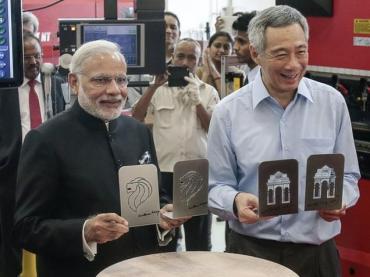
Prime Minister Narendra Modi and Singapore Prime Minister Lee Hsien Loong at the Institute of Technical Education College in Singapore on Tuesday.

Speaking at the India Singapore Economic Convention, Mr. Modi said India is exploring a potential partnership with Singapore’s Changi Airport for developments of two Indian airports and invited companies to join in building smart cities.

“In the last 18 months, the runways for the take-off of the economy have been made. Reforms are happening in a big way. They are now reaching to the last mile. Reform is to transform the system so that they perform. They aim at helping people realise their dreams. It means more charm on the faces and less forms in the offices. Efforts to deepen financial markets have been made,” he said.

‘Most open economy

The Prime Minister said his government began to liberalise FDI laws soon after coming to power last year and the latest round of FDI reforms have made India the “most open economy” in the world.

“We are also conscious of last mile operational issues in such matters and we are fine tuning the norms. Recently, we further eased FDI norms, after which India is the most open economy in terms of FDI,” he added.

While talking about 40 per cent increase in FDI and improvement in rankings like ease of doing business and world competitiveness index, Mr. Modi said, “Perceptions are turning into positive outcomes”.

“We are hopeful to roll out GST regime in 2016. The company law tribunal is being set up. FDI inflows have gone up by 40 per cent compared with previous year’s comparative period. Perceptions are turning into positive outcomes. FDI commitments are translating into reality,” he noted.

Modi also outlined 14 decisive steps taken to address regulatory and taxation concerns and said that India offers tremendous opportunities for investments, ranging from affordable housing to smart cities, railways to renewable energy.

Source: Modi woos investors in Singapore – The Hindu

21/07/2015

Indian Companies Invest Billions, Create Thousands of Jobs in the U.S. – The Numbers – WSJ

As India attempts to thaw its business environment and attract the interest of foreign companies, a hundred Indian firms have together made investments worth more than $15 billion in America, according to the findings of a new survey by the Confederation of Indian Industries and audit firm Grant Thornton International Ltd.

The findings, which were released in a report titled “Indian Roots, American Soil” on Tuesday, suggest that Indian companies in the U.S., most operating in the information-technology sector, have created thousands of jobs there and show a growing interest in hiring more American workers in the next few years.

Indian outsourcing companies in the U.S. have in recent months been criticized for depending too much on foreign staff — H1-B visa holders – instead of hiring locals.

The 100 Indian companies surveyed are spread across all 50 U.S. states, the report said. Here are the main numbers from the report.

91,000

The survey says Indian firms have created more than 91,000 jobs in the U.S., most of them concentrated in New Jersey, where they have hired over 9,000 people. In California, more than 8,000 people work for Indian companies.

$15.3 billion

The total value of tangible investments – for example in real estate or equipment — made in the U.S. by the surveyed companies. Texas has received the largest amount — almost $3.85 billion from 17 Indian companies, most in the information-technology and telecom sectors. The report didn’t give a timeframe for these investments.

40%

The percentage of surveyed companies that do information-technology business is 40%. The report also highlights the emergence of Indian companies in the pharmaceutical and manufacturing sectors, which each accounted for 14% of the firms surveyed.

84%

That’s the proportion of companies in the survey that plan to make more investments in the U.S. in the next five years. California, New Jersey, New York and Texas are the “most promising states for expected future investment,” the report said.

90%

The forecast for hiring local U.S. employees is also encouraging, the survey reveals. Almost 90% of the companies responded positively when asked if they foresaw hiring locally in the coming five years.

via Indian Companies Invest Billions, Create Thousands of Jobs in the U.S. – The Numbers – WSJ.

26/05/2015

The Top 10 Successes of Narendra Modi’s First Year – India Real Time – WSJ

Opinions differ on what Indian Prime Minister Narendra Modi has accomplished in his first year but most observers agree he has been busy since taking over last May.

Opinions differ on what Indian Prime Minister Narendra Modi has accomplished in his first year but most observers agree he has been busy since taking over last May.

He’s been relentless, offering constituents of world’s largest democracy a constant flow of policy speeches, international trips, colorful photo opportunities and ambitious new programs.

His charismatic style of governing has had mixed results.

While he has had some failures–including his party’s defeat in the Delhi elections and its inability to calm concerns within minority communities as outlined in this accompanying post about Mr. Modi’s misses—he has also had some impressive successes.

Here are 10 that stood out:

More Foreign Direct Investment: There was no big-bang busting India open to international competition and deregulation in Mr. Modi’s first year, but the prime minister has to get credit for allowing more FDI in the insurance, defense and other sectors.

Diesel Deregulation: This politically unpopular move was delayed for years but Mr. Modi just ripped the Band-Aid off and freed up diesel prices to move with the global market, potentially saving the government billions of dollars.

Global Diplomacy: Though he made little headway with India’s biggest rival–Pakistan–Mr. Modi’s globetrotting brought the country closer to most of its other neighbors and raised the nation’s profile around the world. Getting President Barack Obama to India for Republic Day was a brilliant public relations coup even if the U.S. President voiced concerns about how India treated its minorities while here.

GDP Growth: Some time during Mr. Modi’s reign, India overtook China as the fastest- growing large economy in the world. Although most of the jump in GDP came from a reworking of how the number is calculated, the revised figure produced a new point of pride for many.

Direct Subsidy Payments: Replacing leaky, expensive-to-administer and badly-targeted subsidies with direct payments to the poor is a more efficient way to help the country’s needy. Mr. Modi started direct payments for cooking gas in some places and is hoping to expand them to subsidize food and fertilizer purchases for the poorest.

Coal and Telecom Auctions: Coal mining rights and telecommunications bandwidth were at the center of the biggest scandals that helped to sink the Congress party in general elections in 2014. Mr. Modi’s Bharatiya Janata Party did not shy away from putting them back on the block to help raise money for the government and kick-start growth in these crucial sectors.

Media Management: Prime Minister Modi starved the media of access at the same time as flooding the airwaves. Speeches broadcast on every news channel, a regular radio show, carefully curated photo opportunities in weird outfits and wonderful places and an unprecedented barrage ofsocial media messages through Facebook, Twitter and even Weibo in China have all been used to let the world know what Mr. Modi is doing and thinking.

Scandal Free: Of course it’s early in the game, but so far in his premiership, there has been no huge scandal to suggest that the latest people in power are more corrupt than the last batch.

This Outfit: When the prime minister greeted President Obama, wearing this dapper suit in January, he wrecked the Internet. Mr. Modi’s vanity pinstripes had the worldwide web buzzing for weeks after Mr. Obama left and then sold at auction for close to $700,000. The money went to charities that work to educate girls.

Mr. Modi hugs Barack Obama while wearing a pinstrip suit with his name in the stitching.

AFP/Getty

He’s been relentless, offering constituents of world’s largest democracy a constant flow of policy speeches, international trips, colorful photo opportunities and ambitious new programs.

His charismatic style of governing has had mixed results.

While he has had some failures–including his party’s defeat in the Delhi elections and its inability to calm concerns within minority communities as outlined in this accompanying post about Mr. Modi’s misses—he has also had some impressive successes.

Here are 10 that stood out:

More Foreign Direct Investment: There was no big-bang busting India open to international competition and deregulation in Mr. Modi’s first year, but the prime minister has to get credit for allowing more FDI in the insurance, defense and other sectors.

Diesel Deregulation: This politically unpopular move was delayed for years but Mr. Modi just ripped the Band-Aid off and freed up diesel prices to move with the global market, potentially saving the government billions of dollars.

Global Diplomacy: Though he made little headway with India’s biggest rival–Pakistan–Mr. Modi’s globetrotting brought the country closer to most of its other neighbors and raised the nation’s profile around the world. Getting President Barack Obama to India for Republic Day was a brilliant public relations coup even if the U.S. President voiced concerns about how India treated its minorities while here.

GDP Growth: Some time during Mr. Modi’s reign, India overtook China as the fastest- growing large economy in the world. Although most of the jump in GDP came from a reworking of how the number is calculated, the revised figure produced a new point of pride for many.

Direct Subsidy Payments: Replacing leaky, expensive-to-administer and badly-targeted subsidies with direct payments to the poor is a more efficient way to help the country’s needy. Mr. Modi started direct payments for cooking gas in some places and is hoping to expand them to subsidize food and fertilizer purchases for the poorest.

Coal and Telecom Auctions: Coal mining rights and telecommunications bandwidth were at the center of the biggest scandals that helped to sink the Congress party in general elections in 2014. Mr. Modi’s Bharatiya Janata Party did not shy away from putting them back on the block to help raise money for the government and kick-start growth in these crucial sectors.

Media Management: Prime Minister Modi starved the media of access at the same time as flooding the airwaves. Speeches broadcast on every news channel, a regular radio show, carefully curated photo opportunities in weird outfits and wonderful places and an unprecedented barrage of social media messages through Facebook, Twitter and even Weibo in China have all been used to let the world know what Mr. Modi is doing and thinking.

Scandal Free: Of course it’s early in the game, but so far in his premiership, there has been no huge scandal to suggest that the latest people in power are more corrupt than the last batch.

This Outfit: When the prime minister greeted President Obama, wearing this dapper suit in January, he wrecked the Internet. Mr. Modi’s vanity pinstripes had the worldwide web buzzing for weeks after Mr. Obama left and then sold at auction for close to $700,000. The money went to charities that work to educate girls.

Mr. Modi hugs Barack Obama while wearing a pinstrip suit with his name in the stitching. AFP/Getty

This Solo: Mr. Modi needed only a few minutes watching a Taiko drum performance during his visit to Japan before he grabbed the sticks and proved he could bash it out with the best of them.

via The Top 10 Successes of Narendra Modi’s First Year – India Real Time – WSJ.

21/01/2015

China’s “new normal” of investment brings new opportunity for win-win – Xinhua | English.news.cn

For the first time in its history, China has become a net capital exporter with outbound direct investment outnumbering foreign direct investment in 2014, presenting new opportunities for win-win cooperation with the rest of the world.

China's "new normal" of investment brings new opportunity for win-win

At the Annual Meeting of the World Economic Forum (WEF) scheduled for Jan. 21-24 in Davos, Switzerland, Chinese Premier Li Keqiang will expound on the Chinese economy‘s “new normal.”

Chinese investors channeled capital into 6,128 overseas firms in 156 countries and regions in 2014, with outbound investment reaching 102.89 billion U.S. dollars, up 14.1 percent from a year earlier, according to a press conference by the Ministry of Commerce (MOC) on Wednesday.

Growth was much faster than the 1.7 percent gain recorded in foreign direct investment, which was 119.6 billion dollars. This is the first time the two-way nominal capital flows have been near a balance.

“If the Chinese firms’ investment through third parties were included, the total ODI volume would reach about 140 billion dollars, which means China is already a net outbound investor,” said Shen Danyang, spokesman with MOC.

Chinese investors are investing in real estate, businesses and other assets overseas while growth at home is slowing. The country registered the slowest expansion pace in 2014 in 24 years, according to the GDP data released Tuesday.

The slowdown comes at a vulnerable time for the world economy — the eurozone is still at risk of another recession, the Abenomics has failed to drag Japan out of the mire, and investors are pulling out of emerging market funds.

Policymakers and investors were not prepared for a reality that after more than three decades on steroids, the world’s second-largest economy has been transitioned to a “new normal” of slower growth.

The market, crazy about speed and figures, seems to have missed the reality that the Chinese economy is healthier under the “new normal” featuring positive trends of stable growth, an optimized structure, enhanced quality and improved social welfare.

China’s sound economic fundamentals have not changed and the government will maintain macro-policies appropriate, Premier Li said during a meeting with Klaus Schwab, founder and executive chairman of the WEF on Tuesday.

The improvement of the quality and efficiency of the Chinese economy and its upgrading will make important contributions to maintaining the stability and healthy development of the world economy and finance, Li said.

The Chinese economy, shifting focus to consumption and investment from polluting heavy industry and manufacturing via complex reforms, will continue to function as a vital ballast for the world economy.

Besides, Beijing aims to create an open capital market by pushing ahead with a broad range of financial reforms to allow more foreign investment and encourage Chinese players to invest abroad. The more transparent and efficient allocation of the Chinese capital will have a positive effect on the global market.

In the process, China has proposed or promoted a host of initiatives and plans, such as the initiatives on the Silk Road Economic Zone, the 21st Century Maritime Silk Road, the BRICS Development Bank and the Asian Infrastructure Investment Bank.

It is fair to say that China’s capital export is creating life blood for the global economy to avoid the risk of declining.

In light of financial difficulty faced by Asia in realizing inter-connectivity and mutual access, China has pledged to contribute 40 billion U.S. dollars to setting up a Silk Road Fund to provide financial support for infrastructure construction, resources exploration and industrial cooperation for countries along the “One Belt and One Road.”

It is estimated that in the next decade, China’s outbound investment will total 1,250 billion dollars, giving more impetus to the worlds’ economic growth.

via Spotlight: China’s “new normal” of investment brings new opportunity for win-win – Xinhua | English.news.cn.

08/07/2014

Indian Railway Budget – Reuters

In his maiden budget, Railway Minister Sadananda Gowda said the bulk of future railway projects will be financed through public-private partnerships and his ministry would seek cabinet approval for allowing foreign direct investment in the state-owned network, excluding passenger services.

India’s railway, the world’s fourth-largest, has suffered from years of low investment and populist policies to subsidise fares. This has turned a once-mighty system into a slow and congested network that crimps economic growth.

The Narendra Modi government pushed through a steep hike in rail passenger and freight fares last month, and expectations were high there would be bold proposals to improve the railways – a lifeline for 23 million Indians every day.

via India Insight.

09/06/2014

Highlights – President Pranab Mukherjee’s address to parliament – Reuters

The new government will pursue an economic reform agenda that foresees introducing the goods and services tax, encouraging foreign investment and speeding approvals for major business projects, President Pranab Mukherjee said in a parliamentary address on Monday.

Mukherjee also said the focus of the Modi government would be to:

– contain food inflation

– improve supply side of agro-based products

– prepare contingency plans for sub-normal monsoons

– increase public and private investments in agriculture

– address issues in farm pricing and procurement

– set up IITs and IIMs in every state

– have zero tolerance against violence against women and will strengthen criminal justice system

– tackle illegal immigration and infiltration in the north east region

– roll out broadband highways in every village in next five years

– vigorously follow up issue of black money with foreign governments

– focus on social media as a tool for participative governance

– provide predictable, fair and stable policy environment

– make every effort to introduce goods and services tax

– encourage investment through foreign direct investment

– promote labour-intensive manufacturing, tourism for job creation

– move towards a single-window system of clearances to promote manufacturing

– fast-track investment friendly public, private partnership

– liberalise foreign direct investments in defence

– encourage private investments in defence production

– implement reforms in defence procurement

– take up modernisation and revamp of railways on priority

– chalk out infrastructure development programmes for high-speed rails, roads and airports

– launch comprehensive national energy policy and focus on increasing electricity generation

– urgently pursue reforms in coal to attract private investments

– operationalise international civilian nuclear pacts

– ensure every family has good house by 2022

– ensure 24×7 electricity supply by 2022

– follow zero tolerance towards extremism, terrorism and communal violence

– formulate clear rules for allocation of coal, minerals and telecoms spectrum

– work towards putting economy on high growth path

– engage energetically with neighbours, including China

– bring renewed vigour in its engagement with the United States

via India Insight.

Enhanced by Zemanta
14/01/2014

Kejriwal’s Foreign Shop Ban is Bad for Delhi – India Real Time – WSJ

Delhi’s decision to block foreign supermarkets in the capital–one of the few markets that matter in India–is bad for the city and for the country, some analysts said Tuesday.

As India looks to attract more foreign investment, New Delhi’s flip flop on accepting foreign investment in multi-brand retail in the capital sends the wrong signal, the analysts said.

“Delhi is one of the key metro markets, keeping it out of reach of retailers may significantly reduce the attractiveness of an India investment for any major retailer,” said Deep Mukherjee, a director at ratings agency Fitch. “This uncertainty with respect to change of guard at the state level will always be a problem for any long-term investor in the retail space.”

The new Aam Aadmi Party-led government in New Delhi this week asked the Department of Industrial Policy and Promotion to remove Delhi’s name from the list of cities which allow multi-brand retail stores. Multi-brand retail is Indian bureaucratic speak for retail stores that carry more than one brand, such as supermarkets.

Big global brands used to only be able enter India through franchises, wholesale stores or single-brand stores, such as clothing shops. That kept out big supermarkets such as those run by Wal-Mart Stores Inc.

Last year India opened the retail sector to allow foreign retailers to own up to 51% in local supermarkets. It asked the state governments to make the final decisions on allowing multi-brand stores.

Since then, eleven of the country’s 22 states–including Delhi–decided to allow multi-brand retail outlets.

Last month, however, the Aam Aadmi, or common man, Party, took control of Delhi in state elections after promising it would block foreign investment in retail, concerned it would hurt the mom and pop stores that dominate the sector.

Keeping foreign funds and expertise out of the sector will hurt consumers and delay the modernization of India’s outdated supply chains, said some industry groups.

via Kejriwal’s Foreign Shop Ban is Bad for Delhi – India Real Time – WSJ.

Enhanced by Zemanta
Law of Unintended Consequences

continuously updated blog about China & India

ChiaHou's Book Reviews

continuously updated blog about China & India

What's wrong with the world; and its economy

continuously updated blog about China & India