Posts tagged ‘Hunan’

30/09/2016

Glass loos with a view open in China – BBC News

Whatever will the Chinese think of next?

China’s recent obsession with glass tourist attractions has gone round the U-bend with the opening of some see-through treetop public toilets.

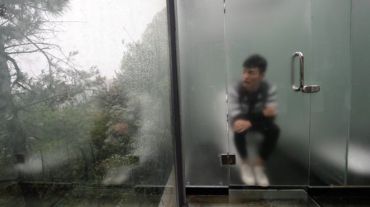
The loos, near Shiyan Lake in southern Hunan province, have fabulous views of both the forest below and other people using the facilities.

Cubicle walls, even those between the men’s and women’s sections, are only separated by lightly frosted glass.

But state media said few visitors dared use the loos on their opening day.

Image copyrightBARCROFT IMAGESImage caption

Shy users of the urinals may take comfort from the privacy barriers between them, though not in the fact they are made of glass

Despite a boom in the construction of glass bridges and walkways in scenic locations in China in recent years – in some cases so popular they had to be closed – these are thought to be the first entirely glass public bathrooms in the country.

However, it not the first time those busting to go have been exposed a little more than they might like by the enthusiasm for glass.

There were reports recently of some male toilets in a university dorm in Hunan which included one very public cubicle.

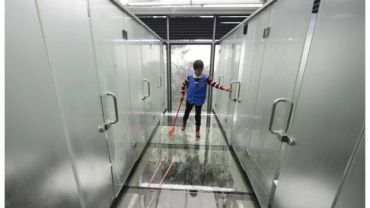
Image copyrightBARCROFTImage captionUnusually, a head for heights is a requirement for a job as a cleaner there

Image copyrightBARCROFTImage caption Awkward: cubicle walls are only lightly-frosted, even between the men’s and women’s sections

News of the wide-view WCs at Shiyan Lake sparked a range of reactions online.Responding to a Facebook post about it by state television channel CCTV, Ejike Nnadi summed up the feelings of many: “Hell no.”

Others were more taken by the idea. “You’ll be surprised by what you can tolerate when you really, really need to go,” said one post.

Another nodded towards another modern use for restrooms: “I’d be in there ’til my battery hit zero if there was signal in there!”

Image copyrightBARCROFTImage captionThe well-lit lavs are built on a steep hillside

Tina Chen took a dimmer view of all such projects though. “(It) is not about being shy, just again someone had extra money to waste.”

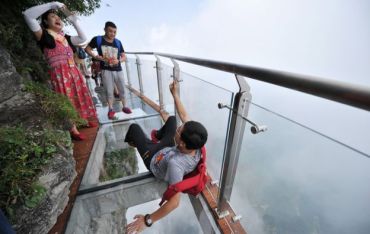
Image copyrightGETTY IMAGESImage caption Unusual glass structures have provided popular photo ops for tourists across China

Awkward or not, it is hoped that these bathrooms for the brave will encourage tourists to visit the countryside around Changsha city and admire the spectacular autumn colours of its forests.

Source: Glass loos with a view open in China – BBC News

03/09/2016

China tourism: Crossing the new glass bridges – BBC News

Tourism sites in the central Henan and Hunan provinces have been constructing vertigo-inducing skywalks in a bid to attract visitors.
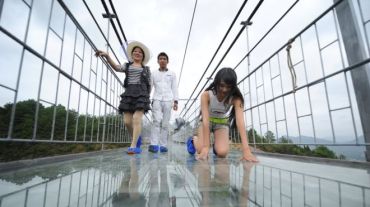
And it seems to have worked, attracting thrill-seeking tourists and locals, all wanting a chance to experience a bird’s eye view of the Chinese countryside.

One of them is student Li Shu Zhen, 19, from Hangzhou city.

She shared with the BBC her experience of climbing the Brave Man’s Bridge in Pingjiang county, Hunan province.

“You look down and feel a sense of fear, but you quickly recover from that and enjoy the scenery,” she said.

“It was beautiful, almost as if one was walking on air.”

Yoga has been one of the stranger activities performed on the Brave Man’s Bridge

An eating challenge was held on this bridge in Yueyang country – although you might lose your appetite if you look downT

he fully transparent bridge, which measures 300m long (984ft) and 180m high, first opened to the public in September.

It is one of the more popular bridges, with events – like mass yoga displays – often being staged on it.

Local officials say that glass panels were designed to withstand high winds and earthquakes, as well as the “weight of 800 visitors”.

Glass bridge fever has also spread to neighbouring Taiwan, where a 179m-high bridge opened in Nantou county.

Construction has already begun on a second glass bridge above Zhangjiajie valley in Hunan province

‘Even if the glass breaks’

Construction on the latest bridge, touted as the world’s longest glass-bottomed walkway, is also nearing completion.

Standing at 300m high and stretching 375m, the bridge will hang above the Zhangjiajie grand canyon, also in Hunan province.

Gearing up for the bridge’s 2016 opening, officials have even enlisted the public’s help in naming it.

One of its engineers, Yang Guohong, from state-owned China Railway Major Bridge Reconnaissance and Design Institute, said contractors had taken extra safety precautions.

“No matter how the tourists jump on the bridge, it will still be fine,” he told the People’s Daily newspaper.

“The steel structures beneath it are incredibly dense, so even if the glass breaks, visitors won’t fall through.”
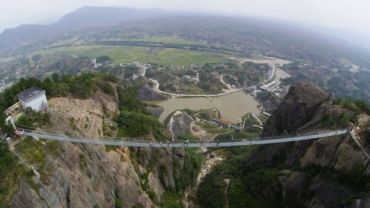
Would you dare to walk across?

But architects who spoke to the BBC said that such glass bridges were often “primarily a novelty, built as visitor attractions rather than commuter bridges”.

Architect Keith Brownlie, who was involved in a glass bridge for The London Science Museum, said that the appeal was “thrill”.

“It is the relationship between emotionally driven fear and the logical understanding of safety,” he said. “These structures tread the boundary between those two contrasting senses and people like to challenge their rational mind in relation to their irrational fear.

“Others felt that the bridges symbolised extravagance, especially in China.

“In architecture, glass has always been associated with luxury and often as a display of wealth,” said bridge designer Ezra Groskin.

“Glass floor panels, used in the creation of invisible architecture, are not a new phenomenon. However its use is often restricted due to cost and practicality.”
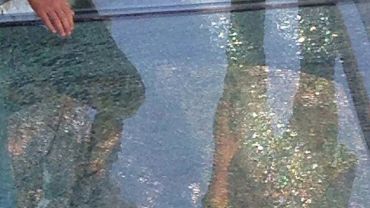
A terrifying incident last October sent visitors fleeing in fear after a section of a glass bridge in Yuntai mountain, Henan province, cracked

Shattered nerves

But how safe are China’s glass bridges?

An incident in October sent terrified visitors fleeing in fear after part of a glass skywalk in Henan province’s Yuntai Mountain Geological Park cracked, despite only being open for two weeks.

Park officials closed the walkway immediately, later saying there was “no reason for worry” and that the cracks had “no impact on safety”.

But experts questioned the use of glass in an exposed mountain environment.

“While a glass structure designed by a competent engineer and manufactured by a specialist contractor has no greater risk in terms of structural integrity than any other building material, glass can be prone to localised shocks,” noted architect Adam Holicska.

“The use of it in a mountain environment where there is a potential risk of rock impact can make it a questionable choice.

“Architect Keith Brownlie added that the cleaning of glass panels and lack of slip resistance should also be considered in such an environment.”One issue with glass decks is the problem of grip,” he said. “Glass is slippery and so anti-slip properties must be provided,”

The glass-bottomed Brave Man’s Bridge in Hunan province connects two mountains

“Please, no more such bridges,” commented a user on China’s popular micro-blogging site Weibo. “Judging from this incident, it is only a matter of time before more serious accidents and deaths occur.

“But glass bridge enthusiasts remain undeterred.

“I still would not hesitate to visit other glass bridges soon,” Ms Li admitted.

Other netizens on the site also expressed similar opinions.

“I am confident that officials will step up additional measures after that happened,” said one Weibo user.

“Thankfully deaths were avoided but one bad incident should not put one off from conquering such a spectacular bridge.”

Another compared it to other bridges of the world: “If Sydney’s Harbour Bridge experienced a crack, I doubt government officials would close it down. So we should not let such an episode affect our opinions about our unique Chinese structures.”

Source: China tourism: Crossing the new glass bridges – BBC News

20/01/2015

Tapping China’s ‘Silver Hair Industry’ – China Real Time Report – WSJ

Researchers at Abbott Laboratories in Shanghai are busy testing flavors of nutritional drinks for China’s senior citizens. Kimberly-Clark Corp. has launched television ads for its Depend adult diapers and expanded distribution online. Local e-commerce companies like Alibaba Group Holding Ltd. and JD.com Inc. are rolling out senior-focused marketing pushes.

The companies are after the growing ranks of people born during a Mao Zedong-inspired baby boom that took the country’s population to nearly one billion people in 1980 from 542,000 in 1949. China’s birthrate dropped sharply during the 1970s and 1980s as the government reversed course and implemented a one-child policy.

The boomers are now hitting old age: China’s over-65 population is projected to soar to 210 million in 2030 from 110 million, and by 2050 will account for a quarter of China’s total population, according to United Nations data. By then, the U.N. says, China’s elderly population may exceed the entire U.S. population.

“What has us interested…is that half a billion people over the age of 60 will be living in China over the next 35 years,” said Scott White, president of Abbott’s international nutrition division.

via Tapping China’s ‘Silver Hair Industry’ – China Real Time Report – WSJ.

11/07/2014

China’s Patriotic Red Tourism Makes a Comeback – Businessweek

Ear-splitting explosions go off and plumes of gray smoke drift over the arid Shaanxi countryside of northwestern China. Ragtag Communist soldiers in blue uniforms fire their rifles at an advancing Nationalist tank while villagers run for cover. Finally, justice prevails; the red flag of the Chinese Communist Party is held proudly aloft while peasants dance in celebration.

A reenactment of the “Defense of Yan’an”

It’s a scene repeated every day at 11 a.m. as 350 actors reenact the “Defense of Yan’an,” a famous battle against the Nationalist forces of Generalissimo Chiang Kai-shek that was crucial to the founding of the People’s Republic in 1949. “By coming here we can understand how the party sacrificed, created the new China, and built such a beautiful country for us,” says 13-year-old Deng Yi, visiting from Wenzhou, who along with his mother and father, each shelled out 150 yuan ($24) to watch the show.

That’s what China’s leaders want to hear as they expand “red tourism” in more than 100 sites across China. Their goal: to boost patriotism and support for the Chinese Communist Party. “We need to seize these two concepts—red bases and patriotic education on the one hand and developing red tourism on the other,” said President Xi Jinping in March.

Red tourism is not new to China. Millions flocked to red sites including Mao Zedong’s birthplace in Shaoshan, Hunan province, during the Cultural Revolution from 1966 to 1976. Visits to revolutionary locales spiked in 2011, as China prepared to celebrate the party’s 90th anniversary. If China’s leaders have their way, red tourism will have a massive renaissance. Already last year, 786 million tourists visited revolutionary sites, up 17.3 percent from the previous year, generating 198.6 billion yuan ($32 billion) in revenue, up 19.1 percent, according to the National Tourism Administration.

“We need to seize these two concepts—red bases and patriotic education on the one hand and developing red tourism on the other.”—President Xi

One of the most popular is Yan’an, the “cradle of the revolution” where Mao, General Zhu De, and other revolutionaries spent more than a decade living in caves starting in 1936. It’s also where President Xi, while a teenager, spent seven years among the peasants during the Cultural Revolution. Jinggangshan, in Jiangxi province, where the rebels hid out in the late 1920s and early 1930s, and Zunyi, in Guizhou province, a key stop on the Long March, are also top destinations.

To prepare for the onslaught of photo-snapping fellow travelers, China’s Ministry of Civil Affairs last year spent 2.8 billion yuan on constructing memorials, while the state bureau in charge of cultural relics earmarked 487 million yuan for renovating red sites. Another 1.5 billion yuan was spent on 66 “red tourism highways” across the country.

“We hope to teach the next generation about what happened before,” says Hong Jiasheng, chairman of Yan’an Shengdian Red Tourism Development, which is run jointly with the local government and draws 500,000 tourists annually. An entrepreneur from Zhejiang province, Hong launched on July 6 a similar show in Fushun, Liaoning province, reenacting an important 1948 battle.

The push to develop red tourism is part of a larger campaign launched in December to instill citizens with what Xi calls core socialist values aimed at realizing the “Chinese Dream.” Those include patriotism, dedication, civility, and harmony. The values campaign will expand patriotic education in primary and middle schools, with university students encouraged to go on organized weeklong summer visits to red sites. Since China’s opening to the world, “Chinese have embraced diversified thoughts, including the decayed, outdated ideals of mammonism and extreme individualism,” the People’s Daily said in a February editorial.

via China’s Patriotic Red Tourism Makes a Comeback – Businessweek.

14/06/2014

Fake UN officials arrested – Global Times

Two men pretending to be United Nations officials were arrested on Saturday in the city of Yueyang, Hunan Province.

English: Emblem of the United Nations. Color i...

English: Emblem of the United Nations. Color is #d69d36 from the image at http://www.un.org/depts/dhl/maplib/flag.htm (Photo credit: Wikipedia)

Wielding certificates that read “special pass of the United Nation‘s maintenance forces’ general headquarters” and “work permit for global maintenance and liaison of world peace,” the two men demanded the release of a prisoner on bail for medical treatment.

They presented their release permits approved by the nation’s top leaders to Yueyang prison officers, Yangtze Information Daily reported, threatening to call Beijing’s Zhongnanhai leadership compound.

The prison guard doubted their story and requested backup while pretending to cooperate with the UN officials.

When the relevant authorities arrived, one huxster reached for his phone and said he was calling a top official in Beijing, flashing photos of the leader and himself at bemused officers.

Police investigators said the conmen had been hired by the prisoner’s relative for their far-reaching connections and ability to solve problems.

via Fake UN officials arrested – Global Times.

13/06/2014

China’s Supreme Court overturns death sentences for two men who raped 11-year-old girl | South China Morning Post

The Supreme People’s Court has overturned the death sentences given to two men convicted of raping and forcing an 11-year-old girl to work in a brothel.

90711f3a78fe2afc4c012fe68c41ddfe.jpg

The court said the high-profile case, which has received national media attention, would be retried.

Tang Hui, the victim’s mother, has campaigned for years believing death sentences should be handed out to all people who were guilty in her daughter’s case.

She has also petitioned local governments to punish officials who she said had been bribed by prostitution gangs to protect their operations.

“The ruling has dealt a heavy blow to us,” Tang told the South China Morning Post yesterday.

“My family just tries to live a normal life. As the case reopens, we’ll experience all the nightmares again. I’m especially worried about my daughter.”

Tang’s daughter has contracted herpes, an incurable sexually transmitted disease, and psychological trauma after she was raped and forced to work as a prostitute at the age 11 for two months in a brothel in Yongzhou in Hunan province in 2006.

Her daughter’s two main kidnappers were sentenced to death in June 2012, four accomplices received life sentences and one was jailed for 15 years.

A representative from the Supreme People’s Court said in an interview with the People’s Daily that the death sentences had been overturned because the crimes were not serious enough to warrant capital punishment.

“The circumstances of the crime had not reached the degree of being extremely serious,” the spokesman said.

Forcing a large number of victims into prostitution, or performing torture on victims that resulted in death or permanent injury might have warranted the death sentence, the official added.

Lu Miaoqing , a lawyer in Guangzhou, said the Supreme People’s Court ruling was understandable as judges tended to avoid capital punishment unless a crime had caused deaths.

via China’s Supreme Court overturns death sentences for two men who raped 11-year-old girl | South China Morning Post.

31/12/2013

Tainted farmland to be restored |Society |chinadaily.com.cn

Farming of contaminated arable land almost the size of Belgium has been halted and the land will be rehabilitated to ensure food security, a senior official said on Monday.

Tainted farmland to be restored

A soil survey by the Ministry of Environmental Protection found that pollution affects about 3.33 million hectares, Wang Shiyuan, vice-minister of land and resources, said.

\”This finding is similar to the geographical environmental survey by the Ministry of Land and Resources,\” Wang added.

Arable land in China totaled 135.4 million hectares at the end of last year, 15 million hectares more than the bottom line set by the government to ensure food security, Wang said at a news conference, citing the results of the second national land survey released on Monday.

However, the amount of stable cultivated land will drop to 120 million hectares, as some farmland will be converted to forests, grasslands and wetlands, while pollution will leave some land unusable, Wang said.

The environment ministry earlier declined to disclose data related to soil pollution, saying further investigation is needed and that the figure is a State secret.

A nationwide survey on soil pollution was carried out between 2006 and 2010, led by the Ministry of Environmental Protection and the Ministry of Land and Resources, but the results were never made public.

Bai Chengshou, deputy head of the nature and ecology conservation department at the environmental protection ministry, said results will be published in future, with more data included.

\”The current work is to take more samples in key areas with severe soil pollution, so that the results can be more accurate and representative,\” he said.

Bai said a \”soil pollution action plan\”, similar to the Airborne Pollution Action Plan (2013-17) released by the central government in mid-September, is being prepared.

He said the plan, which will provide a detailed framework for national soil pollution control measures before 2017, is likely to be released around June after being approved by the State Council.

Wang said the swaths of polluted farmland are concentrated in developed eastern and central regions and in the northeastern industrial belt.

He singled out Hunan province which, with its booming heavy industries, had repeatedly reported much higher levels of cadmium found in rice than permitted by national standards.

Answering a China Daily question on whether the tainted land is still being farmed, Wang said no further planting will be allowed on it, as food safety is a top concern for governments at various levels.

Each year, the central government will earmark several billion yuan to rehabilitate farmland tainted by heavy metals and threatened by the over-draining of underground water, Wang said, without giving details.

\”Only rehabilitated farmland that has passed assessment will be used again,\” he said.

via Tainted farmland to be restored |Society |chinadaily.com.cn.

See also: https://chindia-alert.org/2013/12/30/china-says-more-than-3-million-hectares-of-land-too-polluted-to-farm-south-china-morning-post/

28/12/2013

BBC News – China: More than 500 resign over election fraud

More than 500 municipal lawmakers in one Chinese province have stood down following an electoral fraud scandal, according to state media.

A teller counts Chinese yuan notes

The 512 officials resigned after accepting bribes from 56 members of the provincial assembly to elect them to their posts, Xinhua news agency said.

The 56 disgraced lawmakers for central Hunan Province were also dismissed.

President Xi Jinping has vowed to fight corruption – warning it could topple the Communist Party.

\’Vile impact\’

Municipal officials have the power to appoint representatives to the local People\’s Congress, the provincial parliament that rubber-stamps decisions.

Local authorities dismissed 56 representatives of the 763-strong Hunan People\’s Congress for being \”elected by bribery\”, state television channel CCTV said on its Twitter account.

An initial investigation revealed that 110m yuan ($18.1m, £11m) was offered in bribes to lawmakers and staff in the province\’s second city of Hengyang, Xinhua reported, citing a Hunan government statement.

\”The fraud, involving such a huge number of lawmakers and a large amount of money, is serious in nature and has a vile impact,\” Xinhua quoted the statement as saying.

\”This is a challenge to China\’s system of people\’s congresses, socialist democracy, law and Party discipline,\” it said.

It named Tong Mingqian, the former Communist Party chief of Hengyang, as being \”directly responsible\” for the election scandal.

President Xi has launched an anti-corruption campaign, pledging to target both \”tigers and flies\” – high and low ranking officials in the government.

There have been bans on new government buildings and lavish banquets, as Mr Xi demands officials cut down on waste and extravagance.

via BBC News – China: More than 500 resign over election fraud.

09/12/2013

Mao Zedong: Merry Mao-mas! | The Economist

THE village of Shaoshan in the green hills of Hunan province in east-central China is gearing up for a big party on December 26th: the 120th birthday of its most famous son, Mao Zedong. Debate rages in China over Mao’s historical role. Some call him a tyrant for the violence he put at the heart of his rule, causing the deaths of tens of millions of people. Others worship him almost as a god. In Shaoshan he is a money-spinner, with the farmhouse where he was born attracting millions of Chinese tourists every year.

For President Xi Jinping evaluating Mao’s legacy is especially tricky. On the anniversary he must tread a careful line. Since he took over as Communist Party chief a year ago Mr Xi has shown a fondness for Maoist rhetoric. He calls, for instance, for a “mass line” campaign to restore the party’s traditional values and a “rectification” movement to purge it of corruption. Mr Xi’s willingness to show off his grip on power suggests a leadership style more evocative of the Mao era than of the grey consensus of recent years. Earlier this year he is reported to have told Vladimir Putin, the Russian president, that “you and I have very similar characters”.

Maoism

Yet in ideological terms, Mr Xi is no Maoist. This month’s anniversary is probably a headache he could do without. In November, at a landmark plenum, the party’s central committee adopted a resolution which, in economic terms, aims to shift China even further from Maoism than the late reformer, Deng Xiaoping, attempted. Market forces, it ruled, would henceforth play a “decisive role” in the economy.

Still, Mao continues to exert a powerful influence over the party and public opinion. Mr Xi dares not play down Mao’s “contributions” for fear that outright de-Maoification could fatally weaken the party’s grip. A recent article in the party’s mouthpiece, the People’s Daily, said that a big reason for the collapse of the Soviet Union—an unadulterated tragedy, it was naturally understood—was the “negation of Lenin and other [historical] leaders”. As Communist China’s founder as well as the leader most noted for brutal excess, Mao is Lenin and Stalin rolled into one.

At December’s birthday celebrations, some sense an opportunity. At one end of the political spectrum are liberals who want Mr Xi and China’s new generation of leaders to repudiate Mao as a prelude to far-reaching political reform. At the other end are diehard or born-again Maoists who revere the late chairman as an embodiment of anti-Western nationalism. They want Mao to be, in effect, sanctified, with December 26th declared a national holiday. In recent months, both ends of the spectrum have been trying to push their cases. They will be paying close attention to what Mr Xi has to say.

via Mao Zedong: Merry Mao-mas! | The Economist.

23/10/2013

China paper in detained journalist plea – BBC News

A Chinese newspaper has published a rare front-page plea for the release of one of its journalists held by police.

A screen shot of New Express front page

The New Express, based in Guangzhou, called for Chen Yongzhou, who was detained last week, to be freed.

The paper said Mr Chen\’s detention was linked to reports he wrote about a part state-owned construction equipment company based in Hunan.

Police in Hunan have confirmed the journalist has been detained for \”damage to business reputation\’\’.

Earlier this year, Mr Chen wrote several reports about Zoomlion, which is partly owned by the Hunan provincial government.

Zoomlion issued a statement after one New Express article, which alleged it had improperly accounted for sales, caused its share price to drop.

In a statement to the Hong Kong stock exchange in late May, the company called the claims \”false, groundless and misleading\”.

via BBC News – China paper in detained journalist plea.

Law of Unintended Consequences

continuously updated blog about China & India

ChiaHou's Book Reviews

continuously updated blog about China & India

What's wrong with the world; and its economy

continuously updated blog about China & India