Posts tagged ‘India’

24/06/2016

Two stumbles forward, one back | The Economist

LAST November, two days after India’s ruling party suffered a drubbing at local polls in the state of Bihar, the government unexpectedly opened a dozen new industries to foreign direct investment (FDI). A gushing official called it “the biggest path-breaking and the most radical changes in the FDI regime ever undertaken”.

On June 20th, two days after Raghuram Rajan, the respected governor of India’s central bank, abruptly announced that he would soon step down, the government covered its embarrassment with another impromptu salute to FDI. The slim package of enticements, amounting to a slight lowering of barriers in some of the same industries, has made India “the most open economy in the world for FDI,” said the office of Narendra Modi, the prime minister.

Hyperbole is not unexpected from a government keen to burnish its liberalising credentials. But it has not lived up to its cheery slogans (“Startup India”, “We Unobstacle”, “Minimum Government, Maximum Governance”). Two years after clinching a sweeping electoral mandate, and with the opposition in disarray, Mr Modi’s reform agenda should be in full swing. Instead, as with previous governments, his ill-focused initiatives have run up against India’s statist bureaucracy.

To be fair, much of what has been done is useful. Corruption has been stemmed, at least at ministerial level. A vital bankruptcy law has been approved. Yet for all the evidence that Mr Modi’s team is doing a better job running the existing economic machinery, it has shown limited appetite for overhauling it.

Pessimists see Mr Rajan’s departure as evidence of a further wilting of ambition. After all, as a former chief economist of the IMF, he is an enthusiastic advocate of structural reform. Then again, at the central bank he has focused chiefly on bringing down inflation. Optimists hope he is being eased out because of his habit of speaking his mind, thereby occasionally contradicting the government line, rather than to pave the way for retrograde policies.

Thanks to a mix of lower oil prices and prudent fiscal policies (and perhaps also flawed statistics) the economy grew by 7.9% in the first quarter, compared with the same period the year before, the fastest pace among big economies. Ministers think further acceleration is possible.

That may prove difficult. India’s public-sector banks, which hold 70% of the industry’s assets, are stuffed with bad loans; the central bank reckons that some 17.7% are “stressed”. That Mr Rajan forced them to disclose this fact will not have endeared him to politically connected tycoons now being badgered to repay the banks. Bank shares rose after he said he was leaving, presumably in the hope that his successor will go easy on them. Rating agencies fret that they will still need recapitalising, blowing a hole in the government’s finances. In the meantime, credit to industry has all but ground to a halt.

India’s overweening bureaucracy is another drag on growth. Copious red-tape and poor infrastructure put India 130th out of 189 countries in the World Bank’s “Ease of doing business” rankings. Getting permits to build a warehouse in Mumbai involves 40 steps and costs more than 25% of its value, compared with less than 2% in rich countries. It takes 1,420 days, on average, to enforce a contract.

A slew of liberalising reforms in 1991, when India was in far worse shape than now, were left unfinished as the economy gradually recovered. Whereas product markets were freed from the “licence Raj”, which no longer dictates how much of what each factory can produce, inputs such as land, labour and capital are still heavily regulated. Having once sought to prise those open, the Modi government now encourages state governments to take the lead with their own reforms.

One result is that there is no proper market for land: businesses that want to set up shop are best off wooing state governments to provide some. Chief ministers with a presidential approach (a model Mr Modi espoused in his previous job running Gujarat) scurry around scouting for plots on behalf of the private sector in a manner that would have seemed familiar to the central planners of yore.

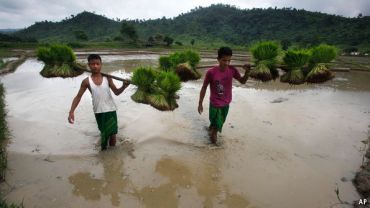
That India is pro-business but not necessarily pro-market is a frequent refrain. “The government wants to create jobs, not the environment in which job-creation flourishes,” says one investor. Special economic zones are set up as sops, sometimes to entice single companies. Even big foreign investors are essentially told what to do: Walmart can only open cash-and-carry stores closed to the general public, Amazon must sell mostly other merchants’ goods rather than its own, and so on.If businesses cannot get things done themselves, even the most energetic politician will struggle to set up enough factories to general public, Amazon must sell mostly other merchants’ goods rather than its own, and so on.
Source: Two stumbles forward, one back | The Economist

24/06/2016

China rejects bending rule for India to join nuclear club | Reuters

China maintains its opposition to India joining a group of nations seeking to prevent the proliferation of nuclear weapons by controlling access to sensitive technology, said the head of the arms control department in China’s Foreign Ministry.

The Nuclear Suppliers Group (NSG) met this week in Seoul, but China said it would not bend the rules and allow India membership as it had not signed the nuclear Non-Proliferation Treaty (NPT), the main global arms control pact.

“Applicant countries must be signatories of the Treaty on the Non-Proliferation of nuclear weapons (NPT),” Wang Qun, the head of arms control department in China’s Foreign Ministry, was quoted as saying in Seoul on Thursday night.

“This is a pillar, not something that China set. It is universally recognized by the international community,” Wang said according to a statement released by the Chinese foreign ministry on Friday.China is leading opposition to a push by the United States to bring India into the NSG which aims to prevent nuclear weapons proliferation by stopping the sale of items that can be used to make nuclear arms.

The issue of India’s membership was not formally discussed at the NSG meeting this week, Wang said on Friday.

The United States, which has a nuclear cooperation deal with India, considers it a nuclear power that plays by the rules and is not a proliferator, and wants to bring Asia’s third largest economy into the 48-member group.

India already enjoys most of the benefits of membership under a 2008 exemption to NSG rules granted to support its nuclear cooperation deal with Washington.

On Friday, on the sidelines of the plenary meeting of the NSG, Wang stressed China considered it important to handle new memberships under a consensus and that there was no move yet to allow a non-NPT state to join.

“International rules will have to be respected, big or small,” Wang told Reuters. “Big like NPT. Small like the rules and procedures of this group.”   “The important question of which we are concerned, is how to deal with the question of participation of countries within the group of non-NPT states. It’s a formidable task.”Indian Prime Minister Narendra Modi raised the issue on Thursday at a meeting with Chinese President Xi Jinping at a regional summit in Tashkent, Uzbekistan, but there was no breakthrough.

One diplomat at the NSG plenary in Seoul said the group’s outgoing chairman, Argentinian diplomat Rafael Grossi, would act as a “facilitator” to continue to search for an accession deal.

Opponents argue that granting India membership would further undermine efforts to prevent proliferation. It would also infuriate India’s rival Pakistan, an ally of China’s, which has responded to India’s membership bid with one of its own.Pakistan joining would be unacceptable to many, given its track record. The father of its nuclear weapons program ran an illicit network for years that sold nuclear secrets to countries including North Korea and Iran.

Source: China rejects bending rule for India to join nuclear club | Reuters

23/06/2016

Why India’s monsoon is difficult to forecast | The Economist

METEOROLOGISTS are forecasting a bumper monsoon for India this year. This is good news for the more than 600m people—about half of India’s population—who depend on the rains it brings. Knowing when and where the monsoon will arrive is especially important for farmers; even now, two-thirds of India’s fields lack irrigation. But forecasting the monsoon remains fantastically difficult, especially as four in every ten monsoons are classified as abnormal anyway. What makes India’s monsoon so unpredictable?

The word monsoon derives from mausam in Hindi (and originally from Arabic), meaning “weather”. Monsoon climates typically have two very distinct seasons: wet and dry. In India, the onslaught of the rains begins when moist air is carried northwards from the Indian ocean during the summer. The winds transporting the main or “south-west” monsoon come from an area south of the equator which is characterised by high atmospheric pressure. As the air gathers moisture during the journey, atmospheric convection forms huge storm clouds which arrive first in southern India around early June (as they did this year). The monsoon creeps north and west, showering Pakistan and north India about a month later. By September it is in retreat, and has normally withdrawn from the south of the country by December. Many factors seem to affect the duration and intensity of the monsoon. One is El Niño, a climatic phenomenon associated with warmer temperatures in the tropical Pacific ocean. Last year the monsoon proved disappointing while El Niño was in full swing: total rainfall between June and September was 14% below the 50-year average. How exactly the phenomenon interacts with the monsoon is not well understood, however, as even large Niños in the past have coincided with normal monsoons.

Anthropogenic emissions also seem to affect rain patterns. India is the world’s fourth-biggest emitter of greenhouse gases. The insulating effect of such emissions helped make last year the hottest on record; this year looks set to be even more scorching. A warmer atmosphere probably means even greater variability in the monsoon. Rainfall extremes are expected to increase, thanks in part to the fact that a warmer atmosphere can hold more moisture (about 7% more, for every degree Celsius of warming). Air pollution complicates matters further. It is a terrible problem in India, contributing to more than 600,000 early deaths a year. Cooking at home, and the smoke it releases, accounts for much of the trouble. Aerosols such as black carbon interact with sunlight. Some of these tiny particles—many less than a tenth the width of a human hair—scatter light, while others absorb it. In the former case, this prevents the light from warming the earth’s surface. In the latter, absorbing the light causes the particles to warm the air around them. Both alter the heating of the atmosphere, and therefore the heating of the land relative to the ocean—the process which drives the monsoon.

Scientists are using a variety of techniques to better forecast the monsoon, from monitoring changes in land use (because vegetation stores more moisture) to sending underwater robots into the Bay of Bengal (to learn more about the salinity and temperature of the ocean). Their research could improve climate models and farming practices—but improved water-storage facilities, better irrigation and more access to insurance schemes might have to make up for the gaps in knowledge that will persist.

Source: The Economist explains: Why India’s monsoon is difficult to forecast | The Economist

23/06/2016

Tata patriarch’s aviation ambitions a step closer as India opens up | Reuters

Officially at least, Ratan Tata, patriarch of one of India’s wealthiest business families, retired in late 2012. In reality, he has been a driving force behind Tata’s bet on airlines and a rare public campaign to open up the booming aviation sector.

The $100 billion Tata group conglomerate is a major beneficiary of the decision last week to open up aviation in India, making it easier for start-ups to fly overseas sooner.

The decision is no panacea for Tata, whose airlines – Vistara and AirAsia India – have had a slow start in a competitive market dominated by IndiGo, owned by InterGlobe Aviation (INGL.NS), and Etihad-backed Jet Airways (JET.NS), both of which opposed the rule change.

But it marks a victory for 78-year-old Ratan Tata, and ends more than two years of airlines lobbying, of Twitter rows and of frequent public statements from the usually circumspect steel-to-salt group.

“This was a David-and-Goliath kind of situation,” said a source close to Tata group. “There was huge lobbying from the other side.

“Ultimately, sources familiar with the talks said, it was Ratan Tata, a trained pilot, who was key to sealing the deal, capitalising on his clout.In a message earlier this year, he called for “a new open market economy” and said airlines lobbying against a rule change was “reminiscent of protectionist and monopolistic pressures by vested interests’ entities who seem to fear competition.

“A spokesman for Tata Sons, which promotes the group, denied Ratan Tata was directly involved, saying he had “nothing to do with operations or management of either of the airlines” after his retirement, and that views he expressed were personal.

Source: Tata patriarch’s aviation ambitions a step closer as India opens up | Reuters

23/06/2016

Foreign Direct Investment Into India Jumps 26%, U.N. Says – India Real Time – WSJ

India’s fast-growing economy attracted $44 billion in foreign direct investment in 2015, making it the 10th largest destination globally for such investment last year, according to United Nations figures released this week.

That represents a 26% increase in foreign investment in India over the year before, according to the U.N. Conference on Trade and Development, which published the data in its latest World Investment Report. Prime Minister Narendra Modi has touted the growing stream of overseas money entering India as a signal accomplishment of his two years in office.

The latest U.N. figures suggest in particular that the Modi government’s efforts to encourage more global companies to “Make in India” are reaping some success. Foreign investments worth $28.7 billion in so-called “greenfield” manufacturing projects, or those that start from scratch, were announced in India last year—more than double the $11 billion in investments that were announced in 2014. Electronics manufacturing saw an especially big boost, with $13.5 billion invested in such projects in 2015, compared with $1.1 billion the year before.

The Modi administration has made changes to keep the money coming. Last year it began allowing foreigners to own larger stakes in Indian companies in insurance, construction, mining, manufacturing and others. This week the government announced increases in foreign-investment limits in defense, retail, civil aviation, pharmaceuticals and grocery businesses. The changes, the official press release declared, make India “the most open economy in the world” for foreign direct investment.

Some experts doubt the latest rule changes will cause more money to flood in right away, though, given the degree to which Indian regulations remain vague and regulatory decision-making remains opaque.

India has risen steadily as a host of overseas investment since 2000, when the entirety of foreigners’ stakes in the economy was valued at $16 billion. The same figure last year was $282 billion.

In terms of yearly inflows, the country still ranks far behind mainland China, which lured $136 billion in foreign direct investment in 2015; Hong Kong, which attracted $175 billion; and Singapore, $65 billion. The U.S. was 2015’s top host of investment from abroad: $380 billion of it flowed into the world’s largest economy last year.

Among executives surveyed by the UNCTAD, 19% picked India as the most promising host country for investment over the next few years. Nearly half picked the U.S.; 21% chose China. But world-wide, the U.N. body expects foreign investment flows to dip by 10% to 15% this year. Its surveys indicate that multinational companies are skittish about volatile exchange rates, geopolitical uncertainty and mounting debt in developing countries.

Source: Foreign Direct Investment Into India Jumps 26%, U.N. Says – India Real Time – WSJ

22/06/2016

Cabinet approves auction of mobile phone airwaves – govt source | Reuters

The cabinet approved on Wednesday an auction of mobile phone airwaves, a government source told Reuters.

Earlier this year India’s telecoms ministry had proposed sale of airwaves in the 700 Mhz, 800 Mhz, 900 Mhz, 1800 Mhz, 2100 Mhz, 2300 Mhz and 2500 MHz bands.

India is the world’s second largest mobile phone market by users after China, and a rapid expansion of high-speed 4G services is expected to create demand for additional airwaves.The government is expected to announce details of the auction at a press conference later in the day, the official who did not want to be named, said.

Source: Cabinet approves auction of mobile phone airwaves – govt source | Reuters

22/06/2016

India’s Space Agency Sends 20 Satellites Into Orbit – India Real Time – WSJ

India on Wednesday put 20 satellites into the Earth’s orbit, including 17 from foreign countries, a record number for its space agency as it seeks to become a low-cost and reliable choice for launches.

The successful mission by the Indian Space Research Organisation puts it right after Russia and the U.S. for the number of satellites launched from a single rocket so far, said an ISRO official. In 2014, a single Russian space launch vehicle deployed 33 satellites. A National Aeronautics and Space Administration rocket carried 29 satellites in 2013.

ISRO’s rocket, the Polar Satellite Launch Vehicle, carried its own Cartosat-2 series satellite for earth observation along with 13 satellites from the U.S., two from Canada, one each from Germany and Indonesia and two from Indian academic institutions.

“ISRO continues to break new barriers,” Indian Prime Minister Narendra Modi said on his Twitter account. He said the country’s space program “has time and again shown the transformative potential of science and technology in people’s lives.”

The launch comes as global space agencies face competition from private companies who are aiming to bring down the cost and time for manufacturing and launching satellites by automating their production and using unmanned reusable rockets.

U.S. businessman Greg Wyler has joined hands with Airbus Group SE to build an automated manufacturing facility in Florida that can churn out hundreds of satellites each year. Traditional satellites are built using touch labor. SpaceX, an aerospace startup founded by Elon Musk, successfully landed a rocket on an ocean platform in early May after launching a communications satellite.

India has been fast achieving recognition as a budget option for launching satellites. In 2014, ISRO put a satellite into the orbit of Mars, becoming the first Asian country to reach the red planet, and at fraction of the cost of a similar launch in U.S. and Europe.

In May ISRO launched the test model of its planned reusable space shuttle.  In April, it launched the seventh satellite needed to create its own navigation system, joining a small group of nations with their own versions of GPS.

The global space industry was estimated to be worth $330 billion in 2014, the latest year for which data are available, according to the Space Foundation, a U.S.-based research group. Commercial space activities comprised as much as 76% of the industry, it said.

There were 92 rocket launches in 2014, and Russia continues to hold its leadership in this area with 32 rocket launches, followed by U.S. with 32 and 11 by Europe, the Space Foundation said. It didn’t provide figures for India.Ajay Lele, a senior fellow at New Delhi-based Institute for Defense Studies and Analyses estimates the U.S. has about a 40% share of the global satellite-launching market, while Europe has 25% and Russia 20%. Countries such as China and India have a much smaller share of the market of about 3% percent or less, Mr. Lele said.

ISRO officials said after the launch they want to accelerate the pace of sending satellites into space by extending partnerships with private Indian companies. The space organization has launched more than 57 satellites from about 20 countries on board the PSLV over about two decades.

Source: India’s Space Agency Sends 20 Satellites Into Orbit – India Real Time – WSJ

21/06/2016

India’s suicide farmers’ widows face living death | Reuters

At the age of 24, Joshna Wandile and her two children were thrown out of the house she shared with her in-laws after her farmer husband hanged himself. He left a pile of debts after years of drought laid waste to his land.Wandile is not alone. More than 300,000 farmers have killed themselves in India over the last two decades, leaving their widows battling with the state, moneylenders, in-laws and their communities.

While widows in rural India are often ostracised and abused, farmer widows have it particularly tough, activists said ahead of International Widows’ Day on Thursday.”I had nothing when my husband died – he sold everything in the house, even the cooking vessels, to pay the creditors,” said Wandile who lives in Vidarbha in Maharashtra, among the worst affected by farmers’ suicides.

“I couldn’t even feel sad. I could only think: where will we live? How will I earn enough money? How will I keep us safe?” said Wandile, who was married at 17.

Maharashtra, which is struggling with its worst drought in four decades, accounted for more than half the 5,650 farmer suicides in India in 2014, according to official data. Some estimate last year’s toll exceeded 3,000.

“Bankruptcy or indebtedness” was the most common reason cited. Most were small farmers, with holdings of under two hectares.

There is little information on the families left behind who struggle to claim their right to the land they till and the house they live in, while battling archaic stigmas that dog their every step.

Source: India’s suicide farmers’ widows face living death | Reuters

21/06/2016

Yoga Takes Over the World on Second International Day of Yoga – India Real Time – WSJ

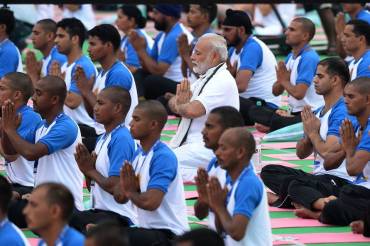
A year after the first International Day of Yoga was celebrated the world over, yoga enthusiasts were back again Tuesday morning lunging forward, raising and stretching their arms, and slowly inhaling and exhaling.

The day was introduced when Indian Prime Minister Narendra Modi successfully lobbied the United Nations to dedicate 24 hours to the ancient discipline in September 2013.This year, Mr. Modi joined thousands of people in the northern Indian city of Chandigarh as they pulled their mats out for a massive demonstration. World over, 173 countries will celebrate the discipline Tuesday.

“We are disconnected from ourselves in today’s times. Yoga helps us reconnect with ourselves,” Mr. Modi said, addressing participants at his event.

On Monday, Mr. Modi also released a set of commermorative postal stamps showing the various steps of the “surya namaskar,” or sun salutation.In India’s capital city, President Pranab Mukherjee conducted a Yoga class at the Rashtrapati Bhavan, his residence-cum-office located in the heart of Delhi.

Images of different Yoga postures were displayed at the headquarters of the United Nations in New York in the build up to Yoga Day.

“Practicing yoga can help raise awareness of our role as consumers of the planet’s resources and as individuals with a duty to respect and live in peace with our neighbours,” said Ban Ki-moon, the UN Secretary-General.

Source: In Pictures: Yoga Takes Over the World on Second International Day of Yoga – India Real Time – WSJ

18/06/2016

New App Promises to Tell Indian Farmers When to Sow Crops – India Real Time – WSJ

Monsoon season in India has just begun, but farmers in Andhra Pradesh, a southeastern coastal state of India, won’t need to look to the skies to know when to sow their crops.

A new mobile application launched earlier this month and developed by a local agriculture research institute, Microsoft India and the state government tells farmers in the state which week is perfect for sowing seeds, the health of their soil and other indicators.

The app uses rainfall data collected from farms in 13 districts in Andhra Pradesh over 45 years to give farmers a sense of when to start planting, Suhas P. Wani, director of Asia research at the International Crops Research Institute for Semi-Arid Tropics or ICRISAT, a research organization in Hyderabad said.Farmers are asked to register a mobile number with the state government, choose a language–currently limited to the regional Telugu and English–and enter details of the village, district or sub-district.

The advice received could vary from farmer to farmer and from village to village, Mr. Wani said. “The app has crop-specific information such as 10 years of groundnut sowing progress data” to guide farmers who grow specific crops, he added.

He said that constant data on crop yield was being collected on a monthly basis by field officers and sent for evaluation to provide regular forecasts to farmers.

A weather button shows the temperature and rainfall as well as fertilizer recommendations for the day and projection for the next seven days. Additionally, a farmer can get weather alerts for extreme conditions like hailstorms or unseasonal rains that impact crop yields.

Andhra Pradesh logged the highest number of farmer suicides in the country last year. At least 58 farmers took their own lives in the state, according to an agriculture ministry report.

But not every farmer can afford to invest in expensive smartphone technology.

So far, most of the farmers have requested to be sent the information via SMS message. Mr. Wani said once registered, farmers can get the predicted sowing date through SMS. “The main idea behind the application is to help farmers reduce losses by telling when to sow seeds or spray the plants,” he said.

The application will be rolled out in other Indian states next year, based on feedback from farmers in the state, he added.

Source: New App Promises to Tell Indian Farmers When to Sow Crops – India Real Time – WSJ

Law of Unintended Consequences

continuously updated blog about China & India

ChiaHou's Book Reviews

continuously updated blog about China & India

What's wrong with the world; and its economy

continuously updated blog about China & India