Posts tagged ‘Narendra Modi’

14/12/2014

After Swacch Bharat, Modi wants ‘drug-free India’ – The Hindu

Voicing concern over the “devastating” drug addiction menace, Prime Minister Narendra Modi on Sunday said society as well as the government will have to work together to fight this problem and that a helpline would be set up soon to assist those seeking solutions.

In his third Mann Ki Baat programme on radio, he said the menace is a “national pain” but instead of the youth mired in the problem, drugs should be shunned.

He said drug addiction is “a malaise filled 3D — darkness, destruction and devastation — as it leads to the dark alleys of destruction and devastation“.

The Prime Minister said a thinking process should begin to ensure that the country is rid of this problem and added that he will try to involve celebrities from the cine world, sports and other fields to campaign for a “drug-free India”.

via After Swacch Bharat, Modi wants ‘drug-free India’ – The Hindu.

12/12/2014

Modi Gets International Yoga Day – India Real Time – WSJ

It’s probably not a stretch to say that Indian Prime Minister Narendra Modi just scored a win at the United Nations.

The international body Thursday declared June 21 the International Day of Yoga, something Mr. Modi called for in September in his maiden address to the U.N. General Assembly in New York.

”By changing our lifestyle and creating consciousness, it can help us deal with climate change,” he told the group of nations at the time. ”Let us work towards adopting an International Yoga Day.”  On Thursday, 177 countries co-sponsored the resolution to establish an international day of yoga, Pakistan, India’s neighbor and long-time rival did not join in doing so. Malaysia is also not sponsoring the event. Islamic clerics sparked controversy in 2008 after issuing a fatwa against yoga, because of its association with Hinduism.

via Modi Gets International Yoga Day – India Real Time – WSJ.

11/12/2014

The Vladimir Putin and Narendra Modi Agreements in Full – India Real Time – WSJ

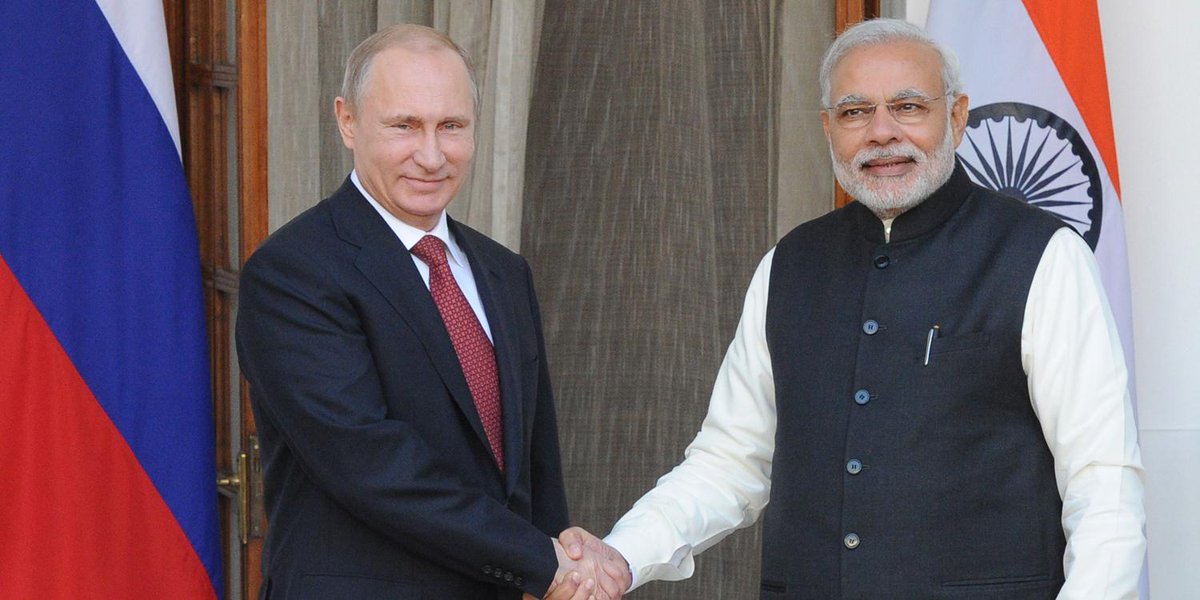
Indian Prime Minister Narendra Modi and Russian Prime Minister Vladimir Putin announced that their countries had signed 20 bi-lateral agreements including memorandums of understanding and commercial contracts on Thursday.

View image on Twitter

During Mr. Putin’s visit to India’s capital, the Russian leader said in a news conference that the documents placed an emphasis on trade and economic issues.

Eight of the agreements signed relate to nuclear power and energy production including a roadmap for bilateral cooperation in the civil nuclear energy sector over the next 20 years. Russia also agreed to supply “major equipment” to the Kudankulam nuclear power plant in Tamil Nadu.

India agreed to identify a second site apart from Kudankulam for Russian-designed nuclear power plants.

Mr. Modi said that they had “outlined an ambitious vision for nuclear energy” and would have “the highest standards of safety in the world.”

A list of the agreements signed is below as provided by India’s Ministry of External Affairs.

via The Vladimir Putin and Narendra Modi Agreements in Full – India Real Time – WSJ.

07/12/2014

India Raises $278 Million From Sale of Stake in Steel Authority – Businessweek

India said the sale of a stake in state-run Steel Authority of India Ltd. will fetch $278 million, the first step in a push for $9.5 billion from share sales to help narrow the nation’s budget deficit to a seven-year low.

The disposal of a 5 percent holding in Steel Authority of India is set to generate about 17.15 billion rupees ($278 million) and the offer was more than two times oversubscribed, the Finance Ministry said in a statement today.

“This will give a lot of confidence to the government to come out with disinvestment in other companies,” said R. K. Gupta, managing director at New Delhi-based Taurus Asset Management Co., which oversees $710 million.

via India Raises $278 Million From Sale of Stake in Steel Authority – Businessweek.

04/12/2014

India Ranked Less Corrupt Than China for the First Time in 18 Years – India Real Time – WSJ

Transparency International’s annual survey ranked India as less corrupt than China for the first time in 18 years as a nationwide outcry against corruption helped lift global perceptions of the South Asian nation.

In the yearly ranking of least-corrupt countries, India jumped 10 places from in its ranking last year to 85th out of the 175. China tumbled 20 places in the ranking to number 100. The last time India did better than China in the rankings was 1996.

The Berlin-based watchdog surveyed multilateral banks, big foundations and other international institutions about the level of corruption in different countries to come up with its annual Corruption Perceptions Index which was used for the rankings.

Perceptions about India were helped as street protests and national elections focused the world’s largest democracy’s attention on corruption, said the Berlin-based watchdog.

The call for a crackdown on corruption led to new laws and a new government. Prime Minister Narendra Modi, came to power in May on pledges to fight corruption.

Transparency International India executive director Ashutosh Kumar Mishra gives credit to the anti-corruption movement sparked by Gandhian Anna Hazare. His high-profile protests helped force the previous government to create a number of anti-corruption bills.

China slipped below India after it lost more ground than almost any other country in the rankings, suggesting that many observers are unconvinced by President Xi Jinping’s high-profile campaign to combat corruption.

While the two Asian giants have had the same rankings in 2006 and 2007, this is the first time China has been below India in the rankings since 1996, the first year Transparency International had rankings.

While it may have gained a little ground this year, India still has a long way to go before it can be ranked near the least-corrupt countries like Australia, Canada, Singapore and Denmark.

via India Ranked Less Corrupt Than China for the First Time in 18 Years – India Real Time – WSJ.

04/12/2014

Modi seeks to draw line under row over minister’s pro-Hindu comments | Reuters

Prime Minister Narendra Modi sought on Thursday to draw a line under a row sparked by a ministerial colleague’s derogatory comments about non-Hindus, urging angry parliament deputies to accept her apology and move on.

A supporter of Bharatiya Janata Party (BJP) holds a placard with a picture of India's Prime Minister Narendra Modi as he attends a rally addressed by the party president Amit Shah (not pictured) in Kolkata November 30, 2014. REUTERS/Rupak De Chowdhuri

The opposition, led by the Congress, has demanded the dismissal of Niranjan Jyoti, the junior minister for food processing industries, for telling voters this week that they must “decide whether you want a government of those born of (Hindu god) Ram, or those born illegitimately”.

The saffron-clad minister apologised a day later after her remarks drew outrage and calls that she be prosecuted for violating the secular spirit of India’s constitution.

Critics say that Modi’s nationalist Bharatiya Janata Party has a deep-seated bias against Muslims and that it is pursuing Hindu-dominant agenda.

Modi urged the upper house of parliament to accept Jyoti’s apology amid a third straight day of protests.

via Modi seeks to draw line under row over minister’s pro-Hindu comments | Reuters.

02/12/2014

South Asia’s hydro-politics: Water in them hills | The Economist

IT IS a thrill trekking beside the upper Marsyangdi river in northern Nepal. On view are spectacular waterfalls and cliffs, snowy Himalayan peaks, exotic birds and butterflies. But just where tourists and villagers delight in nature, hydropower engineers and economists have long been frustrated; in such torrents they see an opportunity that for too long has been allowed to drain away.

Himalayan rivers, fed by glacial meltwater and monsoon rain, offer an immense resource. They could spin turbines to light up swathes of energy-starved South Asia. Exports of electricity and power for Nepal’s own homes and factories could invigorate the dirt-poor economy. National income per person in Nepal was just $692 last year, below half the level for South Asia as a whole.

Walk uphill for a few hours with staff from GMR, an Indian firm that builds and runs hydropower stations, and the river’s potential becomes clear. An engineer points to grey gneiss and impossibly steep cliffs, describing plans for an 11.2km (7-mile) tunnel, 6 metres wide, to be blasted through the mountain. The river will flow through it, before tumbling 627 metres down a steel-lined pipe. The resulting jet—210 cubic metres of water each second—will run turbines that at their peak will generate 600MW of electricity.

The project would take five years and cost $1.2 billion. It could run for over a century—and produce nearly as much as all Nepal’s installed hydropower. Trek on and more hydro plants, micro to mighty, appear on the Marsyangdi. Downstream, China’s Sinohydro is building a 50MW plant; blasting its own 5km-long tunnel to channel water to drive it. Nearby is a new German-built one. Upstream, rival Indian firms plan more. They expect to share a transmission line to ill-lit cities in India.

GMR officials in Delhi are most excited by another river, the Upper Karnali in west Nepal, which is due to get a 900MW plant. In September the firm and Nepal’s government agreed to build it for $1.4 billion, the biggest private investment Nepal has seen.

Relations between India and Nepal are improving. Narendra Modi helped in August as the first Indian prime minister in 17 years to bother with a bilateral visit. Urged by him, the countries also agreed in September to regulate power-trade over the border, which is crucial if commercial and other lenders are to fund a hydropower boom. Mr Modi was back in Kathmandu for a summit of the South Asian Association for Regional Co-operation, on November 26th and 27th. Governments think the normally rudderless body could find a purpose in energy integration—though the talks were poisoned by poor relations between Pakistan and India. Another big Indian hydro firm agreed with Nepal’s government, on November 25th, to build a 900MW hydro scheme, in east Nepal, known as Arun 3. Research done for Britain’s Department for International Development suggests four big hydro projects could earn Nepal a total of $17 billion in the next 30 years—not bad considering its GDP last year was a mere $19 billion.

All Nepal’s rivers, if tapped, could feasibly produce about 40GW of clean energy—a sixth of India’s total installed capacity today. Add the rivers of Pakistan, Bhutan and north India (see map) and the total trebles.  Bhutan has made progress: 3GW of hydro plants are to be built to produce electricity exports. The three already generating produce 1GW out of a total of 1.5GW from hydro. These rely on Indian loans, expertise and labour.

Why a Himalayan cross-border hydropower rush now? In Nepal projects were once scuppered by local politics, a ten-year civil war, suspicion of India and a lack of regulation that put off creditors. Slowly, such problems are being tackled. The war ended in 2006. It helps, too, that the terms of the projects look generous to the host. For Upper Karnali, GMR will set aside 12% of electricity production, free, for Nepali consumers. It will also give Nepal a 27% stake in the venture. After 25 years of operation the plant will be handed to Nepal.

A second reason, says Raghuveer Sharma of the International Finance Corporation (part of the World Bank), was radical change that opened India’s domestic power market a decade ago. Big private firms now generate and trade electricity there and look abroad for projects. India’s government also presses for energy connections over borders, partly for the sake of diplomacy. There has even been talk of exporting 1GW to Lahore, in Pakistan—but fraught relations between the two countries make that a distant dream.

via South Asia’s hydro-politics: Water in them hills | The Economist.

28/11/2014

Narendra Modi woos Saarc nations, pledges slew of investments to counter China – The Times of India

India pledged a slew of regional investments at Saarc summit this week, seeking to counter China’s growing economic inroads into its backyard as it remains embroiled in bitter rivalry with Pakistan.

Prime Minister Narendra Modi said South Asia‘s largest economy would fund regional infrastructure, health facilities and even a communications satellite, and promised to free up its markets to exporters in smaller countries in the region.

Modi, who won a landslide election victory in May, has made clear that boosting India’s influence in its immediate neighbourhood is a key strategic priority for his government.

Critics say the previous Congress party government began to take relationships for granted, allowing economic giant China — which shares a border with four of India’s neighbours — to step into the breach.

But the failure of the South Asian Association for Regional Cooperation (Saarc) to make any significant progress during a two-day meeting underscored the scale of the challenge New Delhi faces.

Cross-border trade among the eight Saarc nations — Afghanistan, Bangladesh, Bhutan, India, Nepal, the Maldives, Pakistan and Sri Lanka — still accounts for less than five percent of total commerce in the region.

“Indians want to keep South Asia as their exclusive sphere of influence,” said Sreeram Chaulia, dean of the Jindal School of International Affairs in Delhi.

“To do that… we need to play the economic game and we need to play the connectivity game better. We have been protectionist, and that is not good,” he said, welcoming Modi’s pledge to help smaller nations reduce their trade deficits with India.

Leaders signed just one agreement, on energy cooperation, at a summit that was overshadowed by the rivalries between India and Pakistan, leading host country Nepal’s Prime Minister Sushil Koirala to say that Saarc had fallen short of expectations.

Nepal, long under the political influence of New Delhi, has benefited hugely from China’s bounty over the last decade, getting much-needed new roads and other infrastructure. Even the venue where the leaders met was built with Chinese money.

It is among several Saarc nations including Pakistan and Sri Lanka that reportedly support full membership for China, which currently enjoys observer status in the regional grouping.

India has resisted promoting its regional rival to full membership status, which comes with the power to veto agreements.

Frustrated by the slow pace of progress towards regional cooperation, it has also sought to woo its neighbours outside the Saarc framework.

via Narendra Modi woos Saarc nations, pledges slew of investments to counter China – The Times of India.

27/11/2014

South Asia Summit Nearing Failure as India, Pakistan Bicker – Businessweek

South Asian leaders overseeing a quarter of the world’s people struggled to agree on how to ease trade barriers in the region as India and Pakistan continued a decades-long row over a disputed border.

Pakistani Prime Minister Nawaz Sharif

Indian Prime Minister Narendra Modi was scheduled to meet every regional leader except Pakistani Prime Minister Nawaz Sharif for a one-on-one meeting during a gathering in Nepal starting today. Leaders of the South Asian Association for Regional Cooperation, or SAARC, last held a summit in 2011.

Failure to agree on cross-border travel and electricity supply would risk derailing Modi’s plan to turn the bloc into a regional force that can counter China’s growing influence. Chinese leaders have promised to invest part of a $40 billion Silk Road fund on infrastructure in South Asia.

via South Asia Summit Nearing Failure as India, Pakistan Bicker – Businessweek.

27/11/2014

China looms over South Asian summit in the Himalayas | Reuters

When eight South Asian leaders gather for a summit in Kathmandu on Wednesday, they will meet in a conference center donated by China to its cash-strapped Himalayan neighbor Nepal 27 years ago.

Prime Minister Narendra Modi watches a guard of honour upon his arrival for the 18th South Asian Association for Regional Cooperation (SAARC) summit in Kathmandu November 25, 2014. REUTERS/Navesh Chitrakar

In the decades since it built the modernist brick and glass hall, China has massively stepped up its presence in South Asia, supplying ports, power stations and weapons.

China’s advance has been aided by bickering between India and Pakistan that stymies almost all attempts at integration in a region that is home to a fifth of the world’s population but has barely any shared roads, fuel pipes or power lines.

India’s Prime Minister Narendra Modi has not welcomed Beijing’s renewed suggestion its status be raised from “observer” in the South Asian Association for Regional Cooperation (SAARC), in which India is presently the only major power.

SAARC summits bring together leaders from Afghanistan, Bangladesh, Bhutan, India, the Maldives, Nepal, Pakistan and Sri Lanka.

Modi’s hope of using the group as a counterweight to China is unlikely to gain traction at the two-day Kathmandu meeting, with officials saying Pakistan is blocking deals to increase transport and energy connections.

Pakistan mooted the idea of upgrading China’s and South Korea’s status in the organization at a meeting of SAARC foreign ministers on Tuesday. It was quickly rebuffed by India.

via China looms over South Asian summit in the Himalayas | Reuters.

Law of Unintended Consequences

continuously updated blog about China & India

ChiaHou's Book Reviews

continuously updated blog about China & India

What's wrong with the world; and its economy

continuously updated blog about China & India