Posts tagged ‘Narendra Modi’

06/11/2015

Xiaomi’s Big Bet on Indian Internet Revolution Starts to Pay Off – China Real Time Report – WSJ

The sales are a significant rise compared with the three million phones the company said it sold in its first year of business in India.

Xiaomi aims to sell 80 to 100 million smartphones this year and has been valued by investors at $46 billion. But increasing competition at home, from companies who mimic Xiaomi’s business model of selling high-end phones at low prices, will make it tough to meet its sales target. So the five-year-old startup is setting its hopes on growth in India. Xiaomi found success in China by combining razor-thin profit margins on hardware with glitzy product launches that helped build its fanbase.

The closely-held company needs to prove that it can export its business model to other countries to continue to justify its high valuation.

Xiaomi introduced its first model, the Mi 4i, outside China, at a launch in New Delhi in April. In August, it said it would begin assembling its entry-level Redmi 2 Prime in India.

Xiaomi’s recent success in India shows that its model can work there, said the company’s Vice President Hugo Barra. Since January, sales in the South Asian country increased 45% quarter-over-quarter, on average.

The firm’s Indian office is tweaking Xiaomi’s model of Internet flash sales, designed to boost demand and cut costs. During the company’s sale for the Hindu holiday Diwali, items were sold for as little as a rupee. “Some people bought a Mi TV for one rupee,” Mr. Barra said. One rupee is equal to $0.02. The heavily discounted deals meant that Xiaomi spent nothing on marketing. “This is an idea the India team came up with that you will see reused in other markets,” he said. The company still faces challenges in India.

While Xiaomi says it sold three million phones in its first year in India, market leader Micromax Informatics Ltd. says it sells three million phones a month. While the Chinese company relies mostly on online sales to cut costs, the majority of Micromax’s sales are in brick-and-mortar retail outlets, where most Indians still shop.

It remains unclear how much India can help bolster Xiaomi’s balance sheet. While smartphone sales are booming in India, the market is still tiny.

Xiaomi’s Mr. Barra says the company will slowly add to its catalogue of products in India, which currently includes phones and a handful of accessories like headphones and a fitness tracker. In China, Xiaomi sells everything from water purifiers to power strips.

Next up could be the company’s line of Internet routers, Mr. Barra said, which includes a model with six terabytes of storage.

“We are looking at bringing the router family to India,” he said. But don’t expect the smart bathroom scale to show up in India right away, or even the company’s newest gadget: a cut-price Segway-like device. “We carefully select things that will sell in India in good volumes. We have to be thoughtful and plan carefully.”

Source: Xiaomi’s Big Bet on Indian Internet Revolution Starts to Pay Off – China Real Time Report – WSJ

18/10/2015

Top African leaders to meet PM Modi in his trademark jacket

PM Narendra Modi has not only gained prominence across world for giving a personal touch in his diplomatic efforts but he is also famous for his impeccable dress sense. Prime Minister will take the diplomatic skills to new level when he will host a dinner for top African leaders later this month.

Top African leaders to meet PM Modi in his trademark jacket

According to a report in The Times of India, All of the 42 heads of state and government, who are attending the 3rd India-Africa Forum Summit, from Egyptian President Abdel Fattah el-Sisi to South African counterpart Jacob Zuma, will attend the dinner wearing Modi’s trademark jacket. They are specially designed by government agencies.

The bundi waistcoat that PM Modi made his own accessory will be at the heart of his latest bit of sartorial diplomacy. The sleeveless jackets will be available in several brilliant colours.

The African leaders will also be wearing unique ‘ikkat kurta’ (no pyjamas) being gifted to them by the government during their visit to India.

A senior African diplomat said to TOI that he was really impressed with the attention PM Modi was giving to the summit despite his hectic campaigning for Bihar elections.

Source: Top African leaders to meet PM Modi in his trademark jacket

18/10/2015

Sonia says Modi govt imposing its ideology on people – The Hindu

Congress president Sonia Gandhi on Saturday blamed the Modi government for the growing intolerance to intellectuals and communal tensions in the country. The government, she said, was anti-poor and corporate-friendly.

Congress president Sonia Gandhi at an election rally in Buxar, Bihar on Saturday. Photo: Ranjeet Kumar

“Ever since Narendra Modi came to power, the intellectuals are being harassed and an effort has been made to stoke communal tensions through rumours. The BJP is trying to enforce its own ideology on people. It is shameful,” she said at election meetings at Buxar and Chappra. Her comments refers to the recent lynching of a man at Dadri in Uttar Pradesh and writers returning their Sahitya Academy awards.

“Modiji, Hindu aur Musalmaan apas main ladte nahi, balki unko ladaya jata hai… kyunki communal jhagde band ho gaye toh kuch logo ki dukaandari band ho jayegi, aur yeh BJP se behtar kaun janta hai? [Mr. Modi, Hindus and Muslims don’t clash with each other but they are being pushed to do it … If communal clashes are being stopped, many people’s business will be closed, and who knows this better than the BJP?],” she said.

Ms. Gandhi said the Modi government worked only for big businesses and had no concern for the poor.

She said the Congress would not allow the Goods and Services Tax (GST) Bill to go through the Rajya Sabha as it was against the welfare of the people. “The UPA government wanted the GST law for the development of industry, but we are opposing it now for the welfare of the people,” she said.

“Mr. Modi speaks much but delivers little. Has he delivered on the tall claims made by him during the last Lok Sabha polls,” she asked. When the crowd yelled “no”, she said: “It is high time he understood the pain of the people.”

The government was silent when pulse prices were rising, farmers were committing suicide and unemployment among the youth was rising, she said.

Taking on Mr. Modi for alleging that the Congress had done little in the past 60 years of its regime, Ms. Gandhi said: “When we got freedom, we had nothing; but the Congress government did revolutionary works in education, health and employment in the past 60 years. We maintained the unity and integrity of the country and strengthened democracy.”

Source: Sonia says Modi govt imposing its ideology on people – The Hindu

29/09/2015

Google’s Sundar Pichai Welcomes India’s Modi to Silicon Valley – India Real Time – WSJ

Before Indian Prime Minister Narendra Modi touches down in Silicon Valley at the weekend, one of his country’s most-successful sons has welcomed him to the U.S. tech hub.

Sundar Pichai, the Indian-born Google CEO, says in a video message that “there is tremendous excitement” about Mr. Modi’s arrival in the valley “among all Googlers” a shorthand for people who work at the search engine giant.

Mr. Modi will meet with Mr. Pichai and other Indian-born CEOs, including Satya Nadella of Microsoft Corp., during his valley visit and tour Google’s headquarters where he will look at inventions in healthcare and smartgrid technology. His visit comes after Chinese President Xi Jinping held a roundtable in Seattle with U.S. and Chinese CEOs including Tim Cook of Apple Inc. and Jeff Bezos of Amazon.com on Wednesday.

“The bond between India and Silicon Valley is strong. India has long been an exporter of talent to tech companies,” Mr. Pichai says in the two minute clip.

Raised in the southern city of Chennai and attending the legendary Indian Institute of Technology, Mr. Pichai became CEO of Google in August having started out at the company in 2004 as a semiconductor engineer after gaining a graduate degree from Stanford University and an M.B.A. from the University of Pennsylvania’s Wharton School. More In Google Who Is Google’s Sundar Pichai? Why Indian Managers Are Succeeding in Tech’s C-Suite Sundar Pichai to Lead Google, Now a Subsidiary of Alphabet, After Restructuring Tech Giants Help Track Nepal Earthquake Survivors as Communications Are Hit Google Executive Dan Fredinburg Killed in Everest Avalanche After Nepal Earthquake

“The products built by Indian graduates from IIT and other institutions have helped to revolutionize the world,” the Google chief adds.

But it is India that is now undergoing its own revolution, he continues. Mr. Pichai touches on Mr. Modi’s plans to digitize India and get 600 million people in remote areas connected to the Internet.

“We at Google as well as many others around the world are passionate about playing our part, there is no more important role for tech companies today than helping to connect the next billion Internet users,” he adds.

The prime minister’s Digital India plan is stuttering however. Up to June only 1% of the villages in the program had been connected to broadband via fiber optic cables.

The slow pace of the rollout of the Internet in India is among the main subjects raised for Mr. Modi in his upcoming Q&A at Facebook Inc. on Sunday.

Meghna Agarwal has asked how Facebook can help India in reaching remote areas “so that each one of the Indians has a voice of their own thus promoting equality and bridging the gap between the rich and the poor?”

Sumit Dhawan asked what Mr. Modi is doing to bring high speed broadband Internet to India.

In Mr. Pichai’s video, the CEO predicts that in the next few years, 50 million women and 20 million small businesses will get online for the first time. He promises Google will help India with products that work on low bandwidth and even offline as well as with investments in core infrastructure to help the Indians among them.

Source: Google’s Sundar Pichai Welcomes India’s Modi to Silicon Valley – India Real Time – WSJ

23/09/2015

Prime Minister Popularity and Voter Optimism Have Soared in India Under Modi, U.S. Think-Tank Survey Shows – India Real Time – WSJ

In the sixteen months since Prime Minister Narendra Modi won a landslide victory in national elections, he has faced policy setbacks, parliamentary roadblocks and electoral failure. These appear to have had little impact on support for him.

A new report by the U.S.-based think tank Pew Research Center says Mr. Modi remains overwhelmingly popular among Indians. Among those surveyed, 87% said they have a favorable opinion of Mr. Modi. Unpacking that statistic gives Mr. Modi greater reason to celebrate. His popularity is the highest among two crucial demographic groups: 18 to 29 year olds and rural Indians. Nine out of 10 people in each category gave the leader of the world’s largest democracy a thumbs up.

Mr. Modi’s undented approval ratings come at a time when his appeal among investors and analysts has lost some of its sheen. India-watchers complain big policy pronouncements have been few and slow to come, limiting India’s growth potential. Far from sharing that pessimism, a majority of Indians are upbeat about their country’ economic prospects, the survey showed. More than half of the respondents said they were happy with the direction of their country, up from 29% in 2013, toward the end of the Congress party’s decade-long tenure when the economic was stuttering and corruption scandals dogged the government. More than 90% of those surveyed by Pew said they had faith in government, up from 70% two years ago. These findings raise key political questions.

Some strategists wonder why, given his once-in-a-generation mandate, Mr. Modi hasn’t pushed for tougher, more-disruptive measures to accelerate growth. His government recently backtracked on a policy that would have made it easier to acquire land for infrastructure and industry because of protests by opponents in Parliament and fear of a backlash from rural voters.

Others argue Mr. Modi is playing the long game, seeking to build on his popularity to consolidate more political power at state and local levels rather than risking it at an early stage on controversial policies. Leaders of his Bharatiya Janata Party say they are planning for at least two five-year terms under Mr. Modi’s premiership during which they hope their party, whose political authority has grown sporadically since its inception in 1980, will achieve the kind of dominance Congress enjoyed in the decades after India won independence from British colonial rule in 1947.

Such a strategy – and Pew’s data – explains why Mr. Modi is the BJP’s star campaigner. In the state of Bihar where elections are scheduled to begin next month, the BJP has not announced a candidate for chief minister, the person who would run the state if the party won. Instead, posters and hoardings are plastered with Mr. Modi’s face. To be sure, the Bihar polls won’t be easy. Caste allegiances play an important role in the vote and the incumbent regional leader, Nitish Kumar, is seen as an effective leader for development. A recent opinion poll by the Hindi-language ABP News channel and Nielsen showed the BJP and Janata Dal (United)-led alliances are neck and neck.

Source: Prime Minister Popularity and Voter Optimism Have Soared in India Under Modi, U.S. Think-Tank Survey Shows – India Real Time – WSJ

17/09/2015

How Modi’s Win Helped Boost India’s Ranks of Millionaires – India Real Time – WSJ

The ranks of the millionaires grew at a faster rate in India than anywhere else around the globe in 2014 thanks to the election of Prime Minister Narendra Modi and falling oil prices, according to a report on worldwide wealth.

After only marginal growth in 2013, India’s tally of high-net-worth individuals increased by 26.3% in 2014 compared with the previous year and with 17.5% in China and 8.2% in the U.S. over the same period, the data from consultants Capgemini and RBC Wealth Management, said.

High-net-worth individuals are defined as those with investible assets of more than $1 million.

The report says that the election of “a popular reform-minded prime minister” in May 2014 “had a positive effect on the economy and equity markets, boosting [high-net-worth-individual] gains.” More In Narendra-Modi

Mr. Modi’s win “helped to boost investor confidence and contributed to strong performance in the stock market,” the report’s authors said.

“Lower oil prices helped reduce the country’s budget deficit and retail inflation fell considerably,” they added. Still, in absolute numbers of very wealthy, India continues to lag behind. It had 1,975,000 people with $1 million to invest in 2014, compared with 4,682,000 in the U.S. and Canada and 8,901,000 in China.

The Asia Pacific region as a whole though, including India and China, had a higher number of millionaires than North America in 2014.

Source: How Modi’s Win Helped Boost India’s Ranks of Millionaires – India Real Time – WSJ

09/09/2015

Modi Tells Nervous Business Leaders the Global Shakeup Is India’s Time to Shine – India Real Time – WSJ

Prime Minister Narendra Modi called Indian business leaders to his official residence Tuesday to discuss how to bulwark the country as China’s slowdown continues to send shock waves through the global economy.

In the three-hour summit, executives and economists ran through a long-standing wish list that includes investing more in infrastructure, expediting government clearances and lowering capital costs. Some executives suggested an interest-rate cut was overdue from the central bank, and that domestic companies should be given more protection from inexpensive imports.

“We have to be cautious, while we take some bold steps on the economy to increase growth,” Rana Kapoor, chief executive of Yes Bank Ltd., told reporters after leaving the meeting. “At the same time, you have to make sure that India has a soft landing after the severe impact of the yuan devaluation.” There has been a jump in foreign direct investment in India this year. But the executives told Mr. Modi that local companies need to see long-delayed improvements in economic management before they can ramp up capital spending. “Domestic investment is at a standstill, and that’s largely because there is no demand,” said Jyotsna Suri, president of the Federation of Indian Chambers of Commerce and Industry.

Mr. Modi reiterated that the world-wide turbulence is an opportunity to highlight India’s resilient growth, vast domestic market and government policies geared toward promoting investment, Finance Minister Arun Jaitley said.

Source: Modi Tells Nervous Business Leaders the Global Shakeup Is India’s Time to Shine – India Real Time – WSJ

24/08/2015

What the Indian and Pakistani Media Said About Canceled NSA Talks – India Real Time – WSJ

With talks set for Monday between India and Pakistan called off, the blame game is in full swing. Newspapers in both countries spilled a lot of ink on the vitriolic back-and-forth between New Delhi and Islamabad and tried to predict what would happen next.

India’s Amar Ujala, a Hindi-language daily newspaper, said Pakistan’s stubbornness had derailed the planned meeting between the two countries’ national security advisors.

The paper pointed to a joint statement by Indian Prime Minister Narendra Modi and his Pakistani counterpart, Nawaz Sharif, when they agreed to the talks in July, saying the two sides would discuss terrorism. “If Pakistan had an objection, it should not have signed the joint statement,” the paper wrote.

“Pakistan took India’s sovereignty too casually,” said another editorial in Navbharat Times, one of the most-widely read Hindi dailies, referring to a Pakistani demand that its security advisor be allowed to meet separatists from the disputed region of Kashmir ahead of the talks. “Now it can’t expect India to show respect.”

Some in India’s English-language press took a milder tone.

The Times of India, India’s most widely circulated English-language daily described the cancelation of talks as a “temporary setback.” In an editorial, it described the days before the talks were finally called off as a “prolonged game of chicken to see who blinks first.”


“There’s a more than even chance Pakistan will seek to escalate tensions on the so-far quiet northern stretches of the Line of Control,” said the Indian Express in an editorial published Monday referring to the border which divides India-and Pakistan-held Kashmir. The paper advised both countries of the need for “maturity and self-reflection” which it said was “little in evidence this past week.”

On the other side of the border, some in the Pakistani media held India accountable for the failure of the talks.

In an editorial, Dawn, one of Pakistan’s biggest newspapers, said the Indian government’s anger against “a fairly innocuous and standard meeting” between Pakistan and Kashmiri separatists was a sign of Indian Prime Minister Narendra Modi’s “true intentions.”

“He does not really want dialogue with Pakistan, but does not want to be seen rejecting talks outright in front of the international community,” Dawn said.

In Pakistan’s the Nation, an editorial said Pakistan’s decision to pull out of the talks mean it was “finally taking a stand” against India. “Enough is enough,” it said.

India was “not ready to settle” and Pakistan was now quitting its “good cop routine,” something the paper said Monday was the “right move.”

“India will make sure to repackage the situation as Pakistan refusing to talk, rather than India reneging on its promises. As the bigger country, as the more globally popular country, India will get away with that,” the paper concluded.

The Nawa-i-Waqt, a prominent national Urdu-language daily, said in an editorial Sunday that “from day one, it has been India’s policy to indicate its willingness to talk to Pakistan on all issues including Kashmir to deceive the world, but whenever the time nears for talks at any level, it makes some excuse to sabotage them.”

via What the Indian and Pakistani Media Said About Canceled NSA Talks – India Real Time – WSJ.

21/08/2015

India-Pakistan Talks Hang in the Balance Over Kashmir – India Real Time – WSJ

When rival neighbors India and Pakistan plan to meet, it often comes down to the wire – and this week is no exception.

Two days before Pakistan’s National Security Advisor Sartaj Aziz is scheduled to land in New Delhi for meetings with his Indian counterpart Ajit Doval, statements from India’s foreign ministry Friday morning cast doubt over whether the talks would actually take place.

The reason: another planned meeting between Mr. Aziz and separatists from the Indian state of Jammu and Kashmir at a reception at the Pakistan High Commission on Sunday.

Through a series of tweets, a televised interview and a media statement, India hardened its stand against Pakistan’s decision to consult with Kashmiri separatists. The Kashmir region lies at the center of decades of enmity between India and Pakistan. Both countries administer parts of the territory but claim it in full.

Vikas Swarup, spokesman for India’s foreign ministry, said in a tweet posted on his verified Twitter TWTR -6.19% account on Friday: “India has advised Pakistan yesterday that it would not be appropriate for Mr. Sartaz Aziz to meet with Hurriyat representatives in India,” referring to a group of Kashmiri separatists.

Pakistan says these men must be consulted before India and Pakistan hold discussions concerning Kashmir. India resists the involvement of groups that have clashed with the Indian establishment for decades, boycotting elections and stoking tensions in the Kashmir Valley. Security officials in New Delhi accuse them of facilitating militancy in the region and colluding with Pakistan-based terrorist groups.

If India cancels the hard-won meetings over the issue of Kashmiri separatists, it won’t be the first time. In July last year, Prime Minister Narendra Modi called off planned talks between the countries’ foreign secretaries after separatist leaders met with Pakistan’s ambassador to India, in defiance of New Delhi’s warnings not to do so. By cancelling the meet, Mr. Modi sought to set new ground rules of engagement between India and Pakistan – one Islamabad appears not to have been willing to accept.

Mr. Swarup repeated India’s concerns publicly Friday, taking a stand that could threaten the upcoming talks unless Pakistan yields. He said a meeting between separatists and Mr. Aziz “would not be in keeping with the spirit and intent” of an understanding between Mr. Modi and Pakistani Prime Minister Nawaz Sharif at a meeting in July – when the NSA talks were firmed up — “to jointly work to combat terrorism.”

His statements are a second warning shot, after Indian authorities in Jammu and Kashmir temporarily detained separatist leaders on Thursday in an apparent signal of New Delhi’s objections. But Pakistan has so far given no indication it’s in the mood to compromise. Pakistani foreign ministry officials said the reception would go on as scheduled.


The meetings may also fall apart over another disagreement: What will the two sides talk about?

Pakistan has said the dispute over Kashmir will figure on the agenda when the countries’ top security officials get together. India says the meetings will focus only on terrorism.

India accuses Pakistan of harboring militants who launch attacks on India and wants to press Pakistan further to take stern action against such groups. Pakistan denies allegations it backs militants, saying it too is grappling with terror against its citizens.

In recent days, Pakistan has stepped up efforts to draw attention to the Kashmir dispute, raising hackles in New Delhi. It pulled out of organizing a conference of Commonwealth countries that was scheduled to begin next month saying it didn’t want to host lawmakers from the Indian state of Jammu and Kashmir. Pakistan’s foreign ministry said on Thursday that Islamabad would “raise all issues during the meetings in India, including Kashmir.”

In an attempt to clarify its position, Mr. Swarup said in another tweet Friday that India has “sought confirmation of our proposed agenda for the NSA level talks” – a typically behind-the-scenes detail whose public declaration by Mr. Swarup points to the lack of trust and widening gulf between the two sides.

via India-Pakistan Talks Hang in the Balance Over Kashmir – India Real Time – WSJ.

20/08/2015

What Stands in the Way of Modi’s Digital India – The Numbers – WSJ

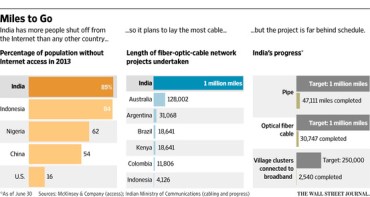
Indian Prime Minister Narendra Modi has grand plans to expand the reach of the Internet to his country’s most far-flung citizens.  But some big numbers stand in his way.

1.06 billion

The number of Indians who currently don’t have access to the Internet. India’s offline population is greater than that of China and Indonesia–home to the next two largest unconnected groups–combined.

1 million

The number of miles of fiber optic cable needed to connect 250,000 village clusters in India to the Internet, according to a committee set up to get the project into gear. The original plan estimated that 370,000 miles of cable would do the job.

1%

The proportion of clusters of villages that up to June 30 were fully connected to Internet services in community centers, hospitals and schools under the National Fiber Optic Network that was launched in 2011.

2013

The original deadline for completion of the network. The date has since been shunted back twice and now stands at 2019.

$11.2 billion

The revised budget for the fiber optic network. Almost four times what was originally planned.

via What Stands in the Way of Modi’s Digital India – The Numbers – WSJ.

Law of Unintended Consequences

continuously updated blog about China & India

ChiaHou's Book Reviews

continuously updated blog about China & India

What's wrong with the world; and its economy

continuously updated blog about China & India