Posts tagged ‘Norway’

27/01/2016

The Drivers of Growth in China’s New Normal – China Real Time Report – WSJ

As China’s economic growth slows and the manufacturing and industrial sectors face declines, many companies are trying to determine whether or where they can tap into more growth.
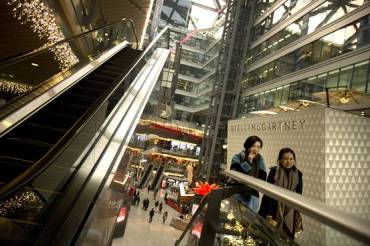
The old drivers of the economy, including the middle class and the export sector, are out. What’s in for China’s so-called “new normal” is the upper-middle class and the service sector.

Affluent shoppers under the age of 35 and Internet surfers will push China’s consumer market up to $6.5 trillion in sales by 2020, an increase of 54% from 2015, according to consultancy the Boston Consulting Group. Upper-middle class households, defined as those making between $24,001 and $46,000 in annual income, will double to 100 million in population by 2020 and account for 30% of all urban households in the country.

Consumption is not isolated from the slowdown, but China hasn’t stopped shopping, consultancy The Boston Consulting Group said in a recent report. Consumption growth this year is poised to outpace GDP growth, which economists expect to range between 6% and 6.6%, BCG said.

Source: The Drivers of Growth in China’s New Normal – China Real Time Report – WSJ

19/04/2015

U.S., China top dumping of electronic waste; little recycled | Reuters

The United States and China contributed most to record mountains of electronic waste such as cellphones, hair dryers and fridges in 2014 and less than a sixth ended up recycled worldwide, a U.N. study said on Sunday.

Overall, 41.8 million tonnes of “e-waste” — defined as any device with an electric cord or battery — were dumped around the globe in 2014 and only an estimated 6.5 million tonnes were taken for recycling, the United Nations University (UNU) said.

“Worldwide, e-waste constitutes a valuable ‘urban mine’, a large potential reservoir of recyclable materials,” said David Malone, the U.N. under-secretary-general and rector of UNU.

The report estimated that the discarded materials, including gold, silver, iron and copper, was worth some $52 billion.

The United States led e-waste dumping with 7.1 million tonnes in 2014, ahead of China on 6.0 million and followed by Japan, Germany and India, it said.

The United States, where individual states run e-waste laws, reported collection of 1 million tonnes for 2012 while China said it collected 1.3 million tonnes of equipment such as TVs, refrigerators and laptops in 2013.

via U.S., China top dumping of electronic waste; little recycled | Reuters.

21/07/2014

China and the Arctic: Polar bearings | The Economist

CHINA does not loan out its pandas to just anyone, so a deal in April for two of the bears to head to Copenhagen zoo raised some eyebrows in Scandinavia. Some commentators suggested that this was all about the Arctic and especially about Greenland, which Denmark partly administers, and its mineral resources.

Certainly China is interested in the Arctic. On July 11th its icebreaker, Xue Long (“Snow Dragon”), embarks on the country’s sixth Arctic expedition, with 65 scientists on board. A new 1.3 billion yuan ($210m) icebreaker will soon be launched, and last December a China-Nordic research centre was opened in Shanghai.

New freight opportunities interest China along the Northern Sea Route (NSR) as ice recedes. In 2010 four ships took the route. Last summer 71 vessels did so. Each ship that takes the route must, at certain points, be accompanied by an ice-breaker, so it is unclear how soon the NSR will be suitable for mass transit, if at all.

Some climate models predict the Arctic Ocean could be ice-free in summer by the middle of this century. The route cuts the distance between Rotterdam and Shanghai by 22% and Yang Huigen of the Polar Research Institute of China has predicted that 5-15% of China’s international trade will use the NSR by 2020. But Linda Jakobson, of the US Studies Centre at the University of Sydney, says that is a “rather optimistic assessment” and that talk of the NSR as a new Suez Canal is overblown. Weather conditions and environmental sensitivities will make the route a difficult one.

As for energy, China is one of the biggest investors in mining in Greenland. A deal with Rosneft, a state-controlled Russian company, will explore offshore Arctic fields for oil. But the undersea resources in the Arctic are largely within the Exclusive Economic Zones of the littoral states (notably Russia), so if China wants to look for energy it will have to do so jointly.

Meanwhile, other relationships have thawed. A rift with Norway over the awarding of the Nobel peace prize to Liu Xiaobo, a detained Chinese activist, is healing. But the new Chinese presence is not without concerns. Huang Nubo, a tycoon, recently bought 100 hectares (250 acres) of land in northern Norway and has bid for a plot on the island of Svalbard, where China has a research station. He aims to develop a resort for Chinese tourists. Mr Huang had similar plans in Iceland in 2011, but local protests quashed them. A Norwegian newspaper has called him a “suspected imperialist”. Perhaps Norway is in need of some pandas.

via China and the Arctic: Polar bearings | The Economist.

12/02/2014

Old palace columns coming home[1]- Chinadaily.com.cn

A Norwegian museum will return seven marble columns, taken about 150 years ago from western Beijing’s Imperial Yuanmingyuan Garden, or the Old Summer Palace.

Old palace columns coming home

The deal was reached under a trilateral agreement made by the museum, Chinese tycoon Huang Nubo and Peking University. The columns will return to China in September and be publicly exhibited at Peking University after maintenance and restoration work.

Huang, chairman of Beijing Zhongkun Investment Group, will donate 10 million Norwegian kroner ($1.63 million) to the museum.

Huang told China Daily that the museum donation is not a trade or “throwing away money”, but “a very meaningful action that shows patriotism, as well as a way of repaying back the mother country, which made me rich”.

Karin Hindsbo, director of the Kode Art Museum in Bergen, told China Daily that “the donation shall be used on academic research and the general care of our collections of Chinese art“.

“A donation like this makes a world of difference for Kode,” Hindsbo said.

Huang said he was invited to visit the art museum in Bergen, Norway’s second-largest city, by then-director Erlend G. Hoyersten when Huang was at a Sino-Scandinavian poets’ exchange event in Norway last year.

“The moment I saw the columns, my eyes teared up. After all, the lost relics from Yuanmingyuan represent an indelible history for all Chinese,” Huang said. “I told the museum staff the relics should not be on show, and they were sympathetic to my feelings.”

During the Qing Dynasty (1644-1911), British and French expeditionary forces invaded the garden in 1860, removing its precious imperial collections and burning the rest.

Norwegian cavalry officer Johan W.N. Munthe got some of them from unknown sources and donated 2,500 Chinese artifacts to the Kode museum in the early 20th century.

via Old palace columns coming home[1]- Chinadaily.com.cn.

Enhanced by Zemanta
Law of Unintended Consequences

continuously updated blog about China & India

ChiaHou's Book Reviews

continuously updated blog about China & India

What's wrong with the world; and its economy

continuously updated blog about China & India